Archives For November 30, 1999

Building them up

ib2newseditor —  December 28, 2017
Graffiti2

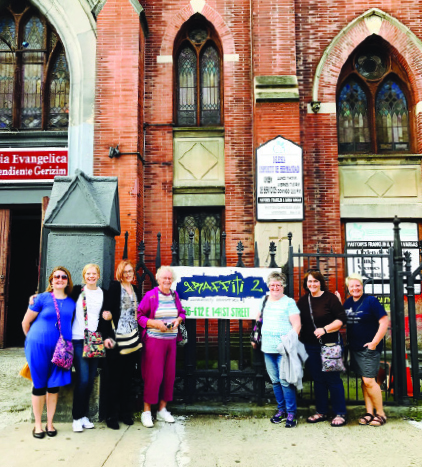
In September, a group of seven Illinois pastors’ wives navigated the New York subway every day to get to the Graffiti 2 headquarters in the Bronx, where they assisted with behind-the-scenes work needed to facilitate outreach programs for kids and adults. Photos by Andrea Hammond

Subway

Riding in the subway.

For Illinoisans who live outside the Chicago city limits—or don’t often visit—the hustle and bustle of New York City would likely bring on a good dose of culture shock.

For Terry Kenney, a pastor’s wife in Beardstown, her recent mission trip to the Big Apple brought back memories of her childhood in Chicago.

“New Yorkers do not think anything about walking” to get from place to place, said Kenney, whose husband, Brian, pastors First Southern Baptist Church in Beardstown. For the team of seven pastors’ wives from Illinois, navigating the city streets and the subway and taxis was a new, stretching experience. But a positive one.

“I never had a desire to go to New York,” Kenney said, “but now I’m going to take my husband back and let him see it.”

City reachers
The Illinois team was in the city to partner with Graffiti 2, a community ministry based in the South Bronx. Started a decade ago, Graffiti 2 is an offshoot of Graffiti Church, a Southern Baptist church planted in the early 1970s. The Graffiti ministries are grounded in a mission to meet the physical and spiritual needs of New Yorkers.

Toward that end, Graffiti 2 runs an after-school program for kids in the neighborhood, and also has started a jobs program that gives people the skills they need to learn and succeed in a career.

Standing in front of an intricate stained glass window in Graffiti’s new headquarters, the Illinois women watched one of Graffiti’s artisans at work at her sewing machine. The goods produced by Graffiti 2 artisans are sold through WorldCrafts, a fair-trade ministry of Woman’s Missionary Union.

Herself a seamstress, Kenney said it was nice to climb upstairs in the old church building and see where the artisans work, and hear about their needs. The Illinois team also helped Graffiti 2 with some administrative tasks resulting from their recent move to the building.

“We prayer-walked around their neighborhood in the South Bronx before meeting artisans and touring their new location,” said Andrea Hammond, a pastor’s wife from Grace Southern Baptist Church in Virden. “We experienced how they impact their community for Christ by finding out what their needs are, meeting them, then sharing Christ through those needs.”

Calling in common

stainglass

At the Graffiti 2 headquarters in the Bronx, artisans create fair-trade products and learn career skills.

Carmen Halsey came up with the idea for the New York mission trip as she was brainstorming ways to help pastors’ wives connect with one another. Inspired by the concept of “destination weddings,” Halsey, IBSA’s director of women’s missions and ministries, wanted to find a place that would let wives retreat to an attractive location, while also working together to fulfill a mission.

As they worked together on a large mailing project for Graffiti 2, Halsey said, the women had an opportunity to hear each other’s stories, and share their own. That was the special part, she said, watching the multi-generational group support each other and get to know one another.

“It’s a lonely job,” Terry Kenney said of being a pastors’ wife. There aren’t too many people you can confide in, she said, and the New York trip let the women open up to one another. That part of the trip was helpful for Ailee Taylor, who serves with her husband, Derrick, at NET Community Church, the congregation they planted in Staunton last year.

“I have not been a pastor’s wife for very long, and it is a group of women that I have not been around before,” she said. “In addition to learning and serving alongside the team at Graffiti 2, I was able to connect and grow alongside other women that share the role of pastors’ wives.”

The trip also had benefits that are transferable to her own ministry in Illinois.

“Even though New York is an urban environment, I learned things that apply to my rural environment,” Taylor said. “I also learned that we have a lot of things that we easily take for granted in Illinois.”

The mission trip was a renewing experience, she said, using decisive words for how she felt about returning to Illinois: “Filled, challenged, and fired up.”
For more information about upcoming missions opportunities for adults, students, and kids, go to IBSA.org/missions.

Annual conference aims to engage students in helping persecuted people around the world

Awsom

The lights in the room dimmed. Suddenly, there were loud, wailing sirens and the sounds of hovering aircraft and explosions. Shouts could be heard from each corner of the room as the girls yelled out, eagerly looking to find the rest of their lost family members.

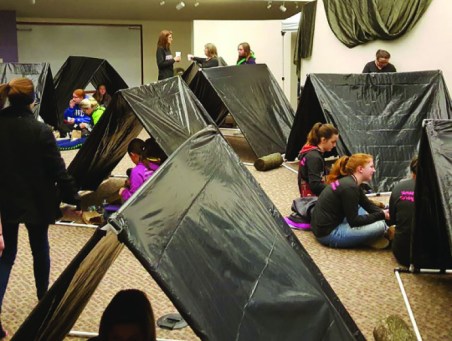
The IBSA Building was transformed into a refugee camp Nov. 5 for the annual AWSOM conference for young women (AWSOM stands for “Amazing Women Serving Our Maker”). Through an intensive, simulated overnight experience, this year’s AWSOM focused on helping the 222 students in attendance understand the plight of the refugee, and how they can help. Attenders also heard the stories of Christians who have lived with persecution (see boxes).

Alina Aisina – Central Asia

Aisina was born in a gospel-sensitive country in Central Asia to a Christian mother and an abusive, atheist father.
Aisina, her sister, and her mom eventually fled their city because their lives were threatened for what they believed. Aisina grew up with a lot of fear, she said, “Not knowing what tomorrow was going to bring and being afraid for my life.”
After receiving a shoebox from Operation Christmas Child, however, Aisina described the change in her life. While her physical life didn’t change, she said, her attitude did because she knew she wasn’t alone. She felt a loving Father looking after her by using strangers from another country to demonstrate Christ’s love for her through the shoebox.

After the simulated war broke out, the students, grouped in “families” of five, were instructed to find refuge in a neighboring country. They could only travel with limited items, however, and had to leave the rest of their belongings behind.

When the girls reached their temporary shelter, a setup of makeshift tents representing a refugee camp, they were given minimal supplies. Current and former missionaries dressed as border guards spoke only the language of the countries they served, to represent the foreign atmosphere to which refugees must adapt.

In the end, the family had to make the decision either to return home to their war-torn country, navigating elements such as land mines, or to apply for citizenship in the new country in hopes of building a new life.

The crisis is real
Prior to the simulation, International Mission Board missionary Christopher Mauger showed a brief aerial video clip documenting the plight of the Rohingya Muslims as they fled from Myanmar, formerly called Burma.

Mauger, who serves in Southeast Asia, described the situation as “desperate” and “unbelievable,” and as a crisis that “needs prayer.” “If they have to go down [to Bangladesh] for refuge, it’s really bad,” he said. “There’s nothing there.”

Mauger explained how “hundreds of thousands” of Rohingya Muslims have been exiting the country as a result of persecution from Myanmar’s government, which is Buddhist.

“For those who have a place to live, they are living in camps with plastic for roofing,” Mauger said. “They are crowded in small areas, food is scarce, and they don’t have any hygienic necessities.”

Mauger described how easy it is to get distracted with a situation like this by blaming the evil in this world. But by changing their perspective, he said, Christians can help. “We can tell these people about God,” he said, “by giving and supporting the Christian organizations that are helping in that area.”

Wendy – China

Wendy lives in China, where she partnered with Ronny and Beverly Carroll while they served as missionaries with the International Mission Board. The Carrollslive in Illinois, and Wendy visited Springfield to speak about the ministry she coordinates to help people long oppressed because of their beliefs.
During the Chinese Revolution in the 1960s, Wendy said, all forms of religion were repressed. While many Chinese Christians fled, others, including a man named Su, were imprisoned. After Su’s release 20 years later, Wendy’s ministry found him and helped him rediscover Christ. This was Su’s first encounter with a Christian in more than two decades.

Becki McNeely, a leader from Lakeland Baptist Church, said AWSOM “opened the students’ eyes to an increased awareness of the state of refugees.”

Several students echoed McNeely. One young woman described how it “must be hard to live in a persecuted country” after hearing the accounts of the speakers. Several more expressed their increased awareness of the refugee crises and were “saddened” at its reality.

Carmen Halsey, director of women’s ministry and missions, said IBSA is securing resources to inform churches about refugee issues. She added that she hoped the experience helped students to be able to “feel the psychological anguish caused by separation and flight” and to “see what forces people into refugee situations,” as well as adopting a more welcoming attitude towards refugees in their own country.

Go to vimeo.com/IBSA to view video from this year’s AWSOM conference.

-Andrew Woodrow

Global missions focus is December 3-10

LMCO Moscow.jpg

GROWING NEED – Moscow now has more Muslims than any other European city. Here, thousands gather for Friday prayers at the city’s Grand Mosque.

Every December since 1888, the Lottie Moon Christmas Offering has empowered Southern Baptists’ international missions work. This year’s Lottie Moon Offering and Week of Prayer feature people doing difficult work around the world—whether they’re reaching out to Muslims in Russia, starting a new church in Japan, or giving hope to refugees.

Reaching the unreached
When most people think of Russia, they may conjure up images of Romanov royalty, a parade of dictators like Stalin and Lenin or Brezhnev, or maybe cultural icons such as Mikhail Baryshnikov or Dostoyevsky. They don’t think of Muslims.

But Islam is part of the fabric of old Russia—it made it there 66 years before Christianity did. As a result, Muslim groups are indigenous to the North Caucasus region, an area between the Black and Caspian Seas situated on northern slopes of the mountain range that generally separates Europe from Asia. These people groups include 45 to 50 subsets of people and even more languages, making them very difficult to reach.

However many of them are moving into Moscow, Russia’s capital, which now has more Muslims than any other European city. Its newly reopened Grand Mosque can hold 10,000 worshippers.

“God says, ‘If you can’t go to them, I’ll bring them to you,’” said Elizabeth*, a Christian worker among Muslims in Moscow. “There’s no better time to be in the former Soviet Union. God is moving Muslims right under our noses.”

Seeing the impossible
International Mission Board missionaries Jared and Tara Jones knew that God could do a lot with something little. But they never imagined just how many doors he would open through their adopted infant son, Ezra.

In the East Asian country, 40,000 children live in orphanages, but parents rarely give up their rights so that a child can be adopted. But the Joneses knew God had placed a baby on their hearts, and they prayed. “We serve a God who makes doors where doors don’t exist,” Jared said. “And this little guy gives us multiple opportunities to talk about the Lord.”

Their son’s pediatrician was the key to another door—a church plant they had been praying about for years. One day, the doctor told Tara out of the blue that she wanted to start a church at her office and asked if Jared could lead it. Tara described it as a divine appointment. The first Sunday 70 people came. They’ve seen hearts changed and people keep coming.

Remembering the forgotten
Don Alan* says he remembers a refugee telling him once that he didn’t feel alive, but he wasn’t dead either—he was somewhere in between.

“Hopelessness is a universal feeling among refugees,” Don said. “They feel forgotten.” That’s why International Mission Board missionaries like Don, who serves in North Africa and the Middle East, and Seth Payton*, who works with refugees in Europe, spend their lives taking hope into those hopeless places.

“Refugees come to Europe looking for a better life, and many times they find nothing,” Seth said. Often, they’ve paid traffickers a high price for a long, miserable trip across the desert and then a dangerous boat ride across the Mediterranean Sea. If they make it alive, then they often can’t get jobs. They spend their days scrounging for food and their nights packed into an apartment with 15 other people.

“We pray that through this time God will open their hearts and draw them into his kingdom through the hope that he offers,” Seth said. “Hundreds of refugees from closed countries are becoming believers in Europe. So there are great things happening in the midst of a heartbreaking situation.”

Go to IMB.org/lottie-moon-christmas-offering for videos, stories, photos, and prayer requests for each day of the Week of Prayer for International Missions.

*Names changed.

– From IMB.org


Why Chicago?

ib2newseditor —  December 7, 2017

chicago-cloud-sculpture

We may not verbalize the “why” question with the persistence of a young child, but we still look for a reason or substantial meaning when called to some action.

Through more than a dozen years in church planting, I’ve heard the “why” question. When a family gave five acres for a new church property to a local association in eastern North Carolina, many in nearby churches asked why, even as their buildings were nowhere near filling their seating capacity.

When I planted a church in Buckeye, Ariz., the North Carolina churches I invited to partner with us often wondered why they should care about planting a church in a community 2,000 or more miles away.

For nearly four years now, I have had the privilege of living in Chicago. During that time, I have mentored, coached and challenged many church planters here. I’ve also invited churches in more than a dozen states to get engaged in supporting church plants here in Chicago with prayer, action and finances.

“Why Chicago?” some ask, jesting, “Why not Hawaii? That would be a great mission trip!”

Yet there are three key answers:

The first reason is biblical. In Luke’s account of the Great Commission in Acts 1:8, Jesus tells His disciples and us, “But you will receive power when the Holy Spirit has come on you, and you will be my witnesses in Jerusalem, in all Judea and Samaria, and to the end of the earth” (CSB).

No matter where you live, major metropolitan areas like Chicago are located between you and “the end of the earth.” And frankly, because of political views and sensationalized news, Chicago in particular is to many in southern Illinois and elsewhere what Samaria was to the Jews: a place and people we’ve been trained or conditioned to dislike or even hate. Yet, even if it is Samaria to Christians, it’s a place and people to which Jesus has sent us to bear witness of Him and His Good News.

The second reason is practical. Cities like Chicago have, from their earliest settlement, become a home for immigrant people groups — many that are identified as “unreached and unengaged” by the International Mission Board.

Because of technology and ease of global travel from America’s major cities, many immigrants maintain a reach to and influence in their homelands. So, effectively evangelizing and discipling people in a city like Chicago gives us a reach into many parts of the world, including most of the peoples in the 10/40 window, a region between the 10th and 40th parallels across Africa and Asia where most of the people who have never heard the Gospel live.

Reaching Chicago and other metropolitan areas with the Gospel could bring a significant advance toward the global evangelization that Jesus promised in Matthew 24:14.

The final answer to “Why Chicago?” is missiological. Chicago is sometimes called the “most segregated city in America.” And while that is changing in some of the neighborhoods of the city, people groups are usually heavily concentrated in certain areas. Poles are heavily concentrated in the northwest neighborhoods and nearby suburbs. Chinatown, as you might guess, is home to mostly Chinese people, many of them still speaking Mandarin or Cantonese. Pakistanis are clustered along Devon Avenue in the northern part of the city. Professional millennials make up two-thirds of the population in the West Loop. Wicker Park is the epicenter of the hipsters.

High concentrations of people groups in a specific place give us a missiological advantage in reaching them. Even if it is a cross-culturally gifted southern boy and his family living among south Asian immigrants, winning one or two to Jesus could result in dozens who live nearby coming to faith in Christ. Given their close proximity to each other, bringing them together to a form a new church can happen very naturally.

While it may not be unique, Chicago is rare in giving us three good reasons to seize the opportunities for the Gospel that lie within our reach.

Dennis Conner directs IBSA church planting efforts in northeast Illinois. Beginning Jan. 1, Conner will transition to planting a church in Chicago’s South Loop neighborhood. This article first appeared in the Illinois Baptist and has been republished by Baptist Press.

Cabin churn side

Step into 1818: Log cabin houses early Baptist history

The urgent need to get the gospel to more people was a driving theme of the 111th Annual Meeting of the Illinois Baptist State Association (IBSA). Churches were challenged to make four “Pioneering Spirit” commitments in the areas of church planting, evangelism, giving, and leadership development.

The Pioneering Spirit theme also coincides with 200th anniversary to be celebrated in 1818. In keeping with the state’s bicentennial, IBSA is asking 200 or more churches to make each of the four commitments.

Moving from our current “flatland” to new heights in those areas will require a steep uphill climb, IBSA leaders said, but it’s the only option.

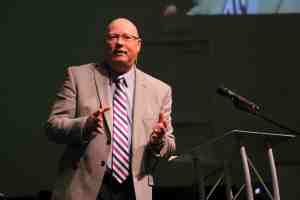
“We can’t be satisfied with the status quo, because the status quo is decline,” said Kevin Carrothers during his president’s message. Preaching from the book of Numbers, Carrothers, director of missions for Salem South Baptist Association, said no one remembers the names of the nay-saying Israelites who didn’t want to go into the Promised Land. Instead, the real legacy of pioneering spirit was left by Joshua and Caleb, the two spies who trusted God to provide.

Kevin Carrothers

Kevin Carrothers

“They recognized the will of God was more important to obey than the whims and the desires of men, even if the majority won,” Carrothers said.

In the meeting’s final session Thursday morning, Pastor Sammy Simmons offered an annual sermon full of encouragement for those weary from a difficult season of life and ministry. Rely on the Lord, said the pastor of Immanuel Baptist Church in Benton, Ill. And keep taking bold steps for the sake of the gospel.

“The conditions are too rough, the lostness is too great for us to continue to do business as normal,” Simmons preached. “The cause of the gospel causes us to make bold sacrifices for King Jesus.

“I’m all in for this pioneering spirit. Oh, how much our church needs it. Oh, how much I need it. Oh, how much our state needs it.”

New challenges
During his report, IBSA Executive Director Nate Adams gave messengers a progress report on IBSA’s four key goals:

  • Develop leaders: So far in 2017 more than 500 pastors and leaders have participated in IBSA-sponsored leadership development events, Adams said. About half that number are engaged in more in-depth leadership cohorts.
  • Inspire cooperation: Adams reported that giving through the Cooperative Program and the Mission Illinois Offering is up slightly from last year, and through October, IBSA staff has had direct connection or consultation with 70% of all IBSA churches.
  • Stimulating church health and growth: So far in 2017, IBSA staff has trained over 5,800 participants from 527 churches. Children’s camp offerings have grown from three weeks to seven, Adams said, and IBSA has made major capital investments in both IBSA camps. The 75th anniversary of Lake Sallateeska Baptist Camp was celebrated with a special video presentation during the Thursday morning session.
  • Catalyzing evangelistic church planting and missions: It’s been a busy year for Disaster Relief, Adams said, with volunteers responding to in-state disasters and hurricanes elsewhere in the country. IBSA anticipates long-term involvement in the Houston area hard hit by Hurricane Harvey.

Fourteen new churches were planted in the state in 2017, Adams reported, and IBSA welcomed 17 new churches for affiliation during the Annual Meeting.

Adams also pointed to other measurements, including membership, Sunday school attendance, baptisms, missions volunteerism, and missions giving, that have remained relatively flat over the past several years. He ended his report by encouraging churches to embrace one or more of the four “Pioneering Spirit” commitments designed to challenge IBSA to courageously depart from the status quo.

Throughout the meeting, the “Pioneering Spirit” commitments were detailed through interviews with Illinois Baptists who exemplify faithful service in four key areas:

  1. Go new places is a church planting challenge, asking at least 200 churches to commit to pray for new congregations, partner with a church planter to assist his work, or to lead in the planting of a new congregation.
  2. Engage new people is an evangelism challenge, which IBSA Associate Executive Director Pat Pajak described at the meeting. “We’re praying that 200 of our IBSA churches will baptize 12 people next year,” or more than the church’s previous three-year average. The hope is that churches will turn the decline in baptisms by setting evangelism goals and equipping members to share their faith, and by engaging lost people through evangelistic events and mission trips.
  3. Make new sacrifices. “We’re asking churches to make missions-giving a higher priority in your budget,” said Adams. “We’re asking would your church be willing to make CP a greater percentage of your budget—if the Lord would lead you to make new sacrifices to give through CP.” The Pioneering Spirit commitment is for 200 or more churches to increase CP giving (for example, 1% per year) with a goal of reaching at least 10% of undesignated offerings.
  4. Develop new leaders. Mark Emerson, associate executive director of IBSA’s Church Resources Team,urged pastors to commit to leadership development for current members and potential young leaders. The goal is for 200 or more churches to have intentional development processes in place.

Other business
– Messengers approved the 2018 IBSA budget of $8.7 million, with projected Cooperative Program giving of $6.3 million. IBSA forwards 43.5% of Cooperative Program gifts on to national SBC causes, the eleventh-highest among 42 state conventions.

– Messengers approved a motion brought by the IBSA Board of Directors that all property currently held by IBSA for Baptist Children’s Home and Family Services be conveyed by deed to BCHFS in its entirety. This includes 17 tracts of property (744.9 acres) that were acquired for use and are used by BCHFS, but are currently titled to IBSA.

– IBSA’s ministry partners gave video reports throughout the business meeting, including Illinois Woman’s Missionary Union (WMU) and President Jill McNicol. God has advanced the work of WMU and given them new opportunities to reach new people, McNicol said, noting three places—Southeast Asia, the Bronx, and Cairo, Ill.—where Illinois women have served on mission in the past year.

“To the women of WMU, missions is not just a thing. It’s people. It’s lost people needing a savior. And it’s teaching Christians how to live on mission for God, to reach those lost people.”

Officers

NEW OFFICERS – Each of IBSA’s four officers were elected by
acclamation: (Left to right) Sharon Carty, assistant recording
secretary; Adron Robinson, president; Adam Cruse, vice|
president; and Robin Mayberry, recording secretary.

– IBSA’s four officers for 2018 were elected by acclamation: Adron Robinson, president, pastor of Hillcrest Baptist Church in Country Club Hills; Adam Cruse, vice president, pastor of Living Faith Baptist Church in Sherman; Robin Mayberry, recording secretary, member of Bluford Baptist Church; and Sharon Carty, assistant recording secretary, member of Emmanuel Baptist Church in Carlinville.

The next IBSA Annual Meeting is Nov. 7-8, 2018, at First Baptist Church, Maryville. Tom Hufty, pastor of FBC Maryville, will bring the annual sermon, and Michael Nave, pastor of Cornerstone Church in Marion, will serve as the alternate speaker.

Illinois Baptist Team Report

IMG_4145 (1)

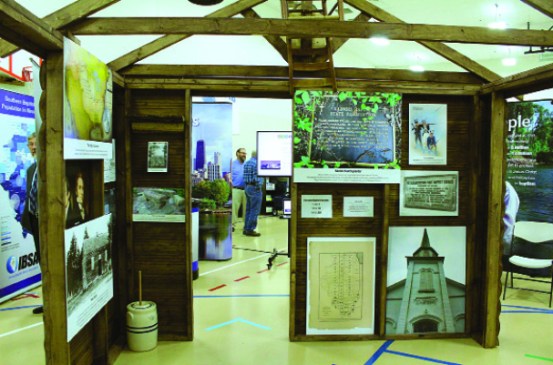
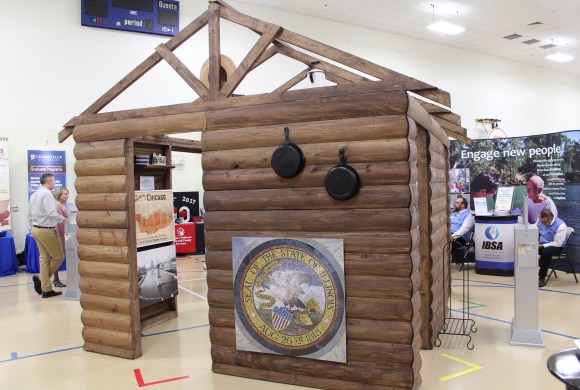
A log cabin stood in the exhibit hall at the 2017 IBSA Annual Meeting, surrounded by displays showing the current challenges of taking the gospel to people in Illinois.

Decatur, Ill. | Illinois Baptists were urged to remember their pioneering ancestors as they take the gospel to the more than 8 million people in the state who don’t know Christ.

One year before Illinois’ bicentennial celebration, the 2017 Annual Meeting of the Illinois Baptist State Association focused on “Pioneering Spirit” and asked churches to make four commitments: go new places, engage new people, make new sacrifices, and develop new leaders.

Kevin Carrothers web“We can’t be satisfied with the status quo, because the status quo is decline,” said IBSA President Kevin Carrothers (left) during his president’s message. The commitments are designed to help churches on the “uphill climb” to get the gospel to more people.

Preaching from the book of Numbers, Carrothers said no one remembers the names of the naysaying Israelites who didn’t want to go into the Promised Land. Instead, the real legacy of pioneering spirit was left by Joshua and Caleb, the two spies who trusted God to provide.

“They recognized the will of God was more important to obey than the whims and the desire of men, even if the majority won,” Carrothers said.

During a Wednesday evening worship service, church leaders put commitment cards on the altar—a symbol of their decision to take the gospel to new places, or to engage new people with the Good News, or to make new sacrifices of their resources, or to invest in new ways in the next generation of pastors, church planters, and missionaries.

The urgent need to get the gospel to more people was a driving theme of the meeting and Pastors’ Conference that preceded it, which started two days after a mass shooting at a Texas church. Southern Baptist Convention President Steve Gaines was slated to speak during both the Pastors’ Conference and Annual Meeting, but instead traveled to Sutherland Springs, Texas, to minister to the church that lost 26 people in the attack.

Tom Hufty webTom Hufty (right), pastor of First Baptist Church, Maryville, Ill., filled in for Gaines at the Annual Meeting, outlining the 8-year journey his church has been on since Pastor Fred Winters was shot and killed in his pulpit in March of 2009.
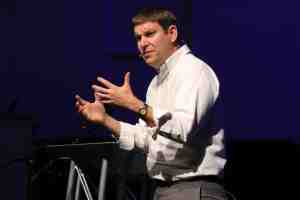
“These tragedies remind us there’s an urgency to share the gospel,” Hufty said. The pastor told meeting attenders he remembers exactly where he was and what he thought when he heard the news about Winters: What must it be like to have been in that building that day, and how difficult it would be to lead the church through the aftermath.

“Even in that shape,” Hufty said, speaking of churches that have endured tragedy, “the church is still the heartthrob of the bridegroom”–of Christ. Ministry isn’t rocket science, Hufty said. “It’s loving God. It’s loving people. It’s making disciples.”

Sammy Simmons webIn the meeting’s final session Thursday morning, Pastor Sammy Simmons (right) offered encouragement for those who are weary from a difficult season of life and ministry. Rely on the Lord, said the pastor of Immanuel Baptist Church in Benton. And keep taking bold steps for the sake of the gospel.

“The conditions are too rough, the lostness is too great, for us to continue to do business as normal,” Simmons preached. “The cause of the gospel causes us to make bold sacrifices for King Jesus.

“I’m all in for this pioneering spirit. Oh, how much our church needs it. Oh, how much I need it. Oh, how much our state needs it.”

Curtis Gilbert 2 webDecatur, Ill. | The IBSA Pastors’ Conference began Tuesday with an impassioned plea for leaders to heed the apostle Paul’s words in Titus 1:5-9:

“The reason I left you in Crete was to set right what was left undone and, as I directed you, to appoint elders in every town: one who is blameless, the husband of one wife, having faithful children not accused of wildness or rebellion. For an overseer, as God’s administrator, must be blameless, not arrogant, not hot-tempered, not addicted to wine, not a bully, not greedy for money, but hospitable, loving what is good, sensible, righteous, holy, self-controlled, holding to the faithful message as taught, so that he will be able both to encourage with sound teaching and to refute those who contradict it.

Curtis Gilbert (above) warned pastors not to miss four areas of needed assessment evident in Paul’s words. First, how’s your love for Jesus, asked Gilbert, pastor of The Journey in Belleville. Don’t get used to Jesus, he told pastors.

“If you’re bored, the reason is you’ve gotten your eyes off him, and onto yourself and onto your ministry,” he said. No matter how long you’ve walked with Jesus, Gilbert told conference attenders, you still have as much need for the gospel and for Jesus as when you first confessed him as Lord.

The Metro East pastor asked pastors to assess their lives and ministries in three more areas: how well they love the gospel, their families, and God’s people.

He reminded pastors that as shepherds, they have as much need of their people as their people do of them. “If they keep putting a cape on you, and you keep letting them, then you need to be rebuked,” Gilbert warned pastors. “Because you are nobody’s Superman.”

Joe Valenti webJoe Valenti (right) spoke after Gilbert and urged pastors to fall in love with the gospel. “Everything else comes out of that,” said the student and missions pastor from Cuyahoga Valley Church in Broadview Heights, Ohio.

There are more than 11,000 people groups in the world, Valenti said, and more than 7,000 are still unreached with the gospel. That’s not a problem for the International Mission Board or for missionaries or for the Cooperative Program, he said. Rather, “We need to see the completion of the Great Commission as a personal problem.”

Jacqueline ScottRecently I was blessed to join a group of individuals that had a heart to reach out to the inhabitants of Cairo, Illinois. This town on the southern tip of the state is a fraction of the size it once was, and is plagued by poverty, crime, and despair.
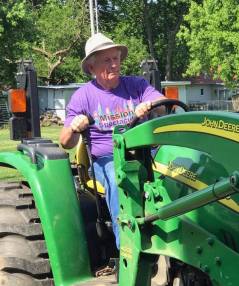
I was anxious to be part of the evangelism team. Speaking to others about Christ is my passion, especially in a street ministry setting. The analogy I use is that the army of God needs boots on the ground, and I enjoy the march.

As my friends and I drove through the overpass into Cairo, a darkness seemed to engulf us. I don’t think they noticed, or at least they didn’t mention it. It was the darkness of spiritual oppression, even in the light of day. We were all joyous about the possibility of new converts and changed lives, yet I clearly recognized the spiritual stronghold on this community.

We were sent out two-by-two, just as Jesus illustrated with the disciples. We were given a small tract called “Your Life (A New Beginning),” which could be used as a conversation starter. We were to inform the individual that this little booklet had valuable information on obtaining a good life, then ask them how their life was going.

In Cairo, I saw the effect of simply talking with people about Jesus.

On the first day I felt some trepidation about this task. I would vacillate between complete trust in the Spirit’s leadership, followed by strict attention to the tract. Although I knew the tract was simply a tool, I found myself concerned about whether I’d covered all the bases. I became more focused on my presentation than on the individual’s reaction or response.

A “cold call” is never an easy form of interaction, especially in witnessing. Having just a few minutes at the door, our purpose is to offer the A-B-C’s of salvation, and hope for follow-up and for growth to come later. Nevertheless, we sometimes fall into “Christianese” while conveying the message. This often results in more confusion than clarification. And on that first day in Cairo, I found myself far too focused on checking the talking points in the tract.

As a group we had prayed numerous times, but in this wavering between trust in him and desire to complete the presentation, I knew the Lord was beckoning me to a new place of reliance on him.

I can honestly say I love to talk and I love people. I’ve often said my spiritual gift is beneath my nose and my spiritual calling is to “love people into the kingdom.” So the question is: what do I love to talk about? Answer: people coming to a real relationship with Christ.

For me, having a “gospel conversation” is a natural process, as natural as any other conversation, if the subject matter is about something or someone you love. The word of God reminds us that we are equipped for every good work (2 Timothy 3:17), and we are always to be ready to give an answer to everyone for the hope that is within us (1 Peter 3:15).

If we have been mandated to “go and tell” as the Great Commission emphasizes, are we to conclude that God would purposely make fulfillment of that call difficult? I believe not. His word cites in Deuteronomy 30:14 and Romans 10:8 that the word is very near us; it’s in our mouths, which means all we have to do is open our mouth. Be sensitive to the Holy Spirit and allow him to speak his truth through us as yielded vessels.

There in Cairo I asked the Lord to allow me to be natural, sensitive, and intentional, using the gift that he had given me, the gift of sharing, whether it be a through a booklet, a testimony, or conversation about the commonalities in our lives.

The next two days were significantly better because I released the idea that I had some sense of responsibility for the outcome of a person’s decision. With each day, I felt more liberated to have natural conversations. At one house, an individual of the Black Hebrew Israelite religion informed my partner and me that we made a good team. This was strictly due to how we presented the message in a natural, non-threatening manner. The man was willing to listen because we didn’t so much “present” the gospel; we simply talked about the Savior.

Jacqueline Scott is a member of Dorrisville Baptist Church in Harrisburg. She also serves on the IBSA Board of Directors.

Missions mobilization


Missions Spectacular

Missions Spectacular mowing ministry project

Mission trips are excellent opportunities for evangelism. In fact, sharing Jesus is the primary reason 22,000 Illinois Baptists personally engage in missions each year.

Supported in part by the Mission Illinois Offering, IBSA’s Church Resource Team equips missions leaders in Illinois churches to lead mission trips and to engage their churches in Acts 1:8 mission strategy. From just next door to the other side of the world, IBSA churches share Christ with many people and people groups. Missions Spectacular, Children’s Ministry Day, ChicaGO Week for Students, and GO Weeks on international mission fields are just a few ways IBSA helps mobilize Christ-followers for missions.    

And with 1,600 trained volunteers, Illinois Baptist Disaster Relief brings aid after natural disasters, while chaplains witness to suffering people.

Pray for Dwayne Doyle and Carmen Halsey who lead missions mobilization, and the teams who equip and send thousands of Illinois Baptists each year.

Give to the Offering. If your church promotes and receives a Mission Illinois Offering, we encourage you to give that way. If not, you can also give here — www.IBSA.org/GiveToMIO.

Learn more about the Mission Illinois Offering.

Watch “Students on Mission at ChicaGo Week.”

White common daisy flower isolatedAs warm weather descended on San Francisco that year, so did the hippies, as many as 100,000 of them. The Haight-Ashbury District became ground zero for a festival that lasted for weeks: young people with flowers in their tresses singing and dancing and cavorting in public spaces, doing a little protesting of the Vietnam War, and smoking a lot of what their mothers wouldn’t approve.

They called it the ‘summer of love.’

Ironically, that summer in 1967 was also marked by fear and terror and rioting, as large sections of Detroit went up in flames just as Watts in Los Angeles had two years earlier. In Detroit, the violence that started after police raided an unlicensed bar ended with 2,000 buildings destroyed, more than 7,000 people arrested, over 1,000 injured, and 43 deaths. Free love on the West Coast, and unrestrained hate in the Midwest.

Here, 50 years later, we have witnessed another season of dichotomy, a tense summer of issues—and people—in conflict. The political tensions and threats of nuclear attack were topped by violent marches in Charlottesville that killed one young woman and revealed the breadth of a racial rift in America that few imagined existed.

As is 1967, the summer of 2017 was on some fronts a summer of hate. But from our vantage point, we can say, too, it was a summer of love.

There were stories in our pages that attested that: mission trips around the world where the love of Christ was shared. In downstate Cairo and Brazil and many other places, people received Christ as Savior. We saw children learn about Jesus at IBSA camps and Vacation Bible Schools everywhere.

And to cap it all, the eclipse. Carbondale was epicenter this time as millions from Oregon to South Carolina looked upward, many seeming to search for something beyond themselves. A famed Chicago weatherman wept on air for the beauty of nature. More important, Baptists in southern Illinois shared Christ, and lost people came to faith.

When they look back on the summer of 2017 to give it a name, no one will look at the protests and nuclear threats and political martial arts and call it ‘the summer of love.’ But seeing the totality of our Christian outreach this season, and the genuine outpouring from God’s heart, maybe we will.

-Eric Reed