Archives For November 30, 1999

Eclipse through glasses

As eclipse-watchers turned their eyes to the skies Monday, Aug. 21, much of the attention in Illinois was focused on the southern part of the state, where several communities laid in the eclipse’s “path of totality.” In Carbondale, just north of the point of longest duration for the total eclipse, churches worked together to share the gospel with thousands of people who traveled to the region for the event.

“As we see this amazing event today that God has made, let’s point people to see the Son who paid for our sin so that we can have eternal life!” Pastor Scott Foshie posted on Facebook. Foshie, pastor of Steeleville Baptist Church and an IBSA zone consultant in southern Illinois, helped facilitate an area-wide evangelistic effort to hand out 50,000 eclipse-themed gospel tracts.

The churches of Nine Mile Baptist Association, working in partnership with IBSA, had the tracts printed and mobilized volunteers to get them into the hands of eclipse-viewers in a multi-day outreach effort. The tract was designed to serve as a souvenir of the eclipse experience. “This is going to be the easiest thing you’ve ever passed out in your life,” Lakeland Baptist Church Pastor Phil Nelson said in a video promoting the outreach.

“They’re coming to see this eclipse, but God wants them to meet his son Jesus…I can’t think of an easier way to tell somebody about Jesus,” Foshie said. “All you’ve got to do is smile, walk up to them, and say, ‘Would you like to have this souvenir? God bless you.’ I mean, it’s that simple, and then we’ve planted a gospel seed.”

In addition to the tracts, pray-ers were stationed at four points in Carbondale—Lakeland, Murdale Baptist Church, FBC Elkville, and the Baptist Student Center at Southern Illinois University. The volunteers, standing next to six-foot crosses, prayed for cars as they entered the city. It was estimated around 90,000 people would be in Carbondale for the eclipse.

Many churches in the region partnered together for the outreach, Foshie said. “It was encouraging to see so many jump in and respond to our call to partner with us to share the gospel. This kind of partnership to reach the lost is what led Southern Baptists to join together in cooperation, and it is what keeps our ties strong.”

Foshie had heard of a young woman in Goreville who gave her life to Christ after receiving the tract, and reported volunteers had also handed them out to crowds that gathered in Carbondale, Pinckneyville, Chester, Ellis Grove, Steeleville, and other places in southern Illinois.

“It has been so encouraging to see so many churches and pastors pull together to plant gospel seeds in this way. I think God has used this ministry to bring us closer together. No doubt, he will continue to use this increased cooperation and closeness to reach the lost for Christ in more ways in the future.”

-Meredith Flynn

Sharing Jesus everywhere

ib2newseditor —  August 21, 2017

Pat Pajak praying

Pat Pajak will make you cry. Why? Because he cries.

Whenever there’s talk about how many people in Illinois don’t know Jesus, you can count on Pat to get choked up. And whenever Pat tells how he had the privilege of sharing the gospel with someone—and that someone accepted Jesus as Savior—tears will flow. His shoulders shake up and down. His voice cracks. And for a moment, the story stops. But he catches a breath, and continues.

And invariably, the person he’s witnessing to agrees that they need Jesus, and prays to receive him as Savior.

The biker. The nurse. The couple at the gas station on the way to North Carolina. “I believe in witnessing opportunities wherever you’re at,” Pajak said.

Pat Pajak has a gift. Some would say his gift is evangelism, but that’s only part of it. Pat makes lostness in Illinois—vast, unfathomable, and seemingly almost too big to tackle—become real, and personal, and up-close.

“Lostness” is people, and Pat knows them personally. Even if he doesn’t, he’ll sidle up to them and ask if they go to church anywhere. And that leads to real conversation about knowing—and believing in—Jesus Christ.

Whether it’s 8 million people in a state of 13 million, or the nurse at the Decatur hospital where he had heart surgery, lost people matter to Pat, because they matter to God.

After three decades as a pastor of growing evangelistic churches, and another leading church strengthening in Illinois, Pat today serves as associate executive director of evangelism for IBSA.

Winning Illinois, one by one
For some people, simply walking across the room to start a conversation feels like taking a risk. Taking the next step—turning a conversation toward the gospel—may feel even riskier. But that’s what we’re all called to do. Share the gospel.

And for many IBSA churches and their members, that’s where Pat Pajak comes in.
Pat will train more than 200 churches in soul-winning this year. And through IBSA’s Pastor’s Evangelism Network, Pat will help mentor more than 100 pastors. Encouraging pastors who encourage their churches in faith-sharing is Pat’s specialty.

“The easiest way, I think, to impact lostness in Illinois, is to build friendships with people where they begin to trust you,” he said.

For Pat and his wife, Joyce, that level of trust was established in a crisis more than 30 years ago, when a house fire claimed their infant son and a pastor soon led them to Jesus. Not every conversion comes after crisis, but Pat finds opportunity to share Christ in tough times, even his own.

“After Memorial Day last year, I had a heart attack…and quadruple bypass surgery,” he said. And since he believes in sharing Christ wherever you happen to be, that included the ICU and later the cardiac rehab unit. Eventually, he led eight nurses to faith in Jesus Christ in a three-month period.

“I said, ‘Will you allow me to pray with you?’” he recalled from an encounter with Gina. “So I shared the Romans Road with her and asked if that made sense to her. She said yes, and she prayed and asked Jesus Christ to come into her heart.”

Pat wells up when he tells the story. “I saw her today and she hugged me and said, ‘I love you.’”

From complete stranger to sister in Christ.

“What a difference it would make if our church (members) decided, ‘I have the responsibility of sharing Christ, not just my pastor,’” he said.

With support from the Mission Illinois Offering and Week of Prayer, IBSA is equipping pastors, church members, and church planters to share the gospel. “Now is the moment,” Pajak said, because people in Illinois need Jesus Christ. “We just need to capture that.”

In other words, now more than ever.

Learn more about the Mission Illinois Offering at MissionIllinois.org.

totaleclipsecolumbiasc.com

totaleclipsecolumbiasc.com

When the sun goes dark Aug. 21, southern Illinois will be one of the best places to catch the first total solar eclipse visible from the U.S. since 1979. Churches in the region, along with others across the country, are planning to use the event as an opportunity to share the gospel.

Everyone in the contiguous U.S. will be able to see at least a partial eclipse, but the 70-mile-wide “path of totality,” in which a total eclipse will be visible, will pass through 14 states, including Illinois. Makanda, Ill., located just south of Carbondale, has been cited as the “greatest point of duration,” or the place where the eclipse will be visible the longest—2 minutes and 38 seconds, according to a city website devoted to sharing eclipse information.

Lakeland Baptist Church in Carbondale hosted an area-wide prayer and worship rally Aug. 14 to spiritually prepare for the influx of people. And Nine Mile Baptist Association, through a partnership with IBSA, plans to distribute 50,000 gospel tracts during the weekend prior to the eclipse. Additionally, people will be stationed at each of Carbondale’s four entry points to pray over every car that enters the city. “We want to cover our city in prayer,” said Lakeland Pastor Phil Nelson.

Elsewhere in the eclipse’s path, churches are utilizing the unique ministry opportunity to meet spiritual needs in their community—whether it’s inviting eclipse viewers to use their parking lots, or using the event to launch future ministries.

In Casper, Wyo., Mountain View Baptist Church and College Heights Baptist Church have partnered with Child Evangelism Fellowship of Central Wyoming to purchase copies of a DVD titled “God of Wonders,” which explains how creation reveals God and how salvation is available through Jesus Christ. Church members will distribute the DVDs during the eclipse along with 3,000 evangelistic bookmarks.

“Additionally,” Mountain View pastor Buddy Hanson said, “if our parking lot is utilized for eclipse watchers, we will take that opportunity to try and share the gospel.”
In Lincoln, Neb., the launch of Hope City, a North American Mission Board church plant, is set to correspond with the eclipse. The congregation’s first service is slated for Aug. 20. That day and during the eclipse, the church will distribute 2,000 “college survival kits” at the University of Nebraska-Lincoln.

First Baptist Church in Hendersonville, Tenn., will host a gospel concert on Sunday, Aug. 20, and is inviting people to watch the eclipse from their parking lots the next day. “We have already handed out over 4,000 eclipse viewing glasses and have several hundred more for those needing them,” said Executive Pastor Bruce Raley.

Beginning just after 10 a.m. local time in Lincoln Beach, Ore., the total eclipse will take approximately an hour and a half to pass over Oregon, Idaho, Wyoming, Montana, Nebraska, Iowa, Kansas, Missouri, Illinois, Kentucky, Tennessee, Georgia, North Carolina, and South Carolina. Viewers are strongly encouraged to wear eclipse glasses or other protective eyewear.

– From Baptist Press, with additional reporting by the Illinois Baptist

New study shows factors that attract and keep new members

Attracting and keeping people considered unchurched is rated as the top predictor of growth through new professions of faith at small churches, according to a new study encompassing 12 Christian denominations including Southern Baptists.

“These churches are places of invitation, welcome, and involvement for the unchurched,” the study’s authors said. “So, the unchurched stick around in greater numbers. And they come to Christ and get committed to the church in greater numbers.”

The Billy Graham Center of Wheaton College conducted the newly released study in partnership with Lifeway Research of the Southern Baptist Convention and the Caskey Center for Church Excellence of New Orleans Baptist Theological Seminary. The telephone survey of 1,500 pastors and church leaders found and ranked 29 predictors of growth through Christian conversion at churches of 250 members or less. Study authors released the top 10 growth predictors June 26.

Second to attracting and keeping the unchurched, small churches that grow by Christian conversions tend to offer classes for new attendees, the study found. Such classes help even when they are not evangelistic.

Third, small churches that grow through new baptisms are led by pastors who routinely undergo personal evangelism training.

“If the pastor is a learner and stays inspired and growing in the area of evangelism,” study authors said, “that pastor’s church will reach more people who commit to Christ and who stick.”

Newcomers church growth chart

In response to declining baptisms in the U.S., Southern Baptist Convention President Steve Gaines appointed a 19-member evangelism task force at the 2017 SBC annual meeting. The group of SBC seminary presidents and professors, pastors, and a state convention leader are expected to report its findings at the 2018 SBC annual meeting in Dallas.

Nearly 90% of Southern Baptist churches had weekly attendance of 250 or less as recently as 2013, and qualified for the “small church category.”

In the Wheaton study, the other top growth predictors among small churches are:

  • The pastor more frequently “pops the question,” asking people to commit after he shares the gospel.
  • The church spends a higher percentage of its budget on evangelism and missions.
  • Church members often tell the pastor that they themselves are sharing the gospel with others, rather than relying on the pastor to carry the load alone. “The church does not need superstar pastors who share their faith while everybody in the church cheers them on from the sidelines,” study authors said.
  • Unchurched visitors often communicate favorable feedback to pastors after weekly worship services.
  • The church shares the gospel outside its walls and conducts community service.
  • Churches that grow through conversions concurrently tend to draw members from other congregations. “In other words,” study authors wrote, “transfer and conversion growth tend to go together for small churches.”
  • Cited as the 10th most predictive factor of growth through new conversions, according to the study, “the pastor more frequently blocks out time in the calendar for the purpose of sharing the gospel with non-Christians. If the pastor is to lead evangelism in the church, the pastor must first personally live out the evangelism call.”

Smaller churches in the survey, those with 150 or fewer members, tended to grow more easily than the larger small churches in the survey, the study found. Additionally, predominantly Hispanic and Native American churches tended to fare better in growth.

Joining Southern Baptists in responding to the survey are members of the Assemblies of God, the Associate Reformed Presbyterian Church, the Church of the Nazarene, the Conservative Congregational Christian Conference, Converge Worldwide, the Evangelical Covenant Church, the Evangelical Free Church in America, The Foursquare Church, the Missionary Church, Vineyard US, and The Wesleyan Church.

Study authors include Ed Stetzer, executive director of Wheaton’s Billy Graham Center for Evangelism and former LifeWay Research executive director.

LifeWay Research plans to release a full report of the study at lifewayresearch.com.

– Diana Chandler, Baptist Press

A sunset in the rearview mirror of car as a races down the road

I recall researching an article a few years back on the actions messengers took at certain conventions. Some years were marked by insightful and course-altering votes; others had no discernable effect. With the advantage of hindsight, we ask, What actions from the 2017 Southern Baptist Convention will have lasting impact on our denomination and the effectiveness of our work in the world?

The vote on alt-right racism will be remembered; and the appointment of a task force on evangelism has the potential to change our direction. But there was one motion that could produce even greater, meaningful change—if it makes it past the Executive Committee. And there’s a second that I want to suggest.

Modest proposal 1: Shall we merge the mission boards?

A couple of years ago, a messenger moved that a merger of the North American and International Mission Boards be studied. When his motion was ruled out of order for parliamentary reasons, the messenger pleaded that exploration of the issue not be delayed because of procedural rules. He cited the emerging financial crisis of the IMB and cuts in missionaries on the field that had just been announced as motivating factors. At the time, it was clear that NAMB had plenty of reserves, and a merger could fix the money crunch. But rules are rules, and the motion was dead.

Until this year.

A similar motion was made at the 2017 meeting in Phoenix. Here’s how Baptist Press reported it, in a list of motions that were referred to the Executive Committee:

“A motion by Harvey Brown of First Baptist Church in Charlotte, N.C., requesting the president appoint a study committee to consider the feasibility of merging IMB and NAMB.”

There was no discussion this time around, or emotional pleading for the sake of missionaries on the field. And frankly, it seems some of steam has escaped on this topic.

IMB reported it is on firm financial footing. IMB President David Platt has weathered a couple of storms, and with the honeymoon over, he appears to be settling in for a long ministry focused on global missions. Platt still partners with NAMB, speaking at conferences about church planting in North America. But his heart beats for the peoples of the world.

And NAMB President Kevin Ezell has stopped making the offer, publically at least, for IMB to relocate from Richmond to Alpharetta. During Platt’s first year, Ezell said there was plenty of room at NAMB’s Georgia headquarters since his administrative staff had been radically downsized. Ezell still cheers for Platt’s presidency, but the pair aren’t making as many joint appearances. Maybe both have found their footing.

The question arises every decade or two: Is the distinction between “home” missions and “foreign” missions outdated (just as those terms are)? Should missions today be focused more on people groups and languages than geography—including in the United States? As the “nations” (translating ethnos as “nations” or “peoples”) have come to North America, should missionaries here share the gospel with them in the same ways they would back in their home countries?

And this: Should state conventions (again) lead church planting in their states, as the missions personnel most familiar with the nearby mission field and with the partner churches who can facilitate evangelistic church planting ministry?

Will one mission board focused on people groups, and state conventions focused on their own neighborhoods better achieve the evangelization of the world and the U.S.?

I can’t say for certain, but it’s a good time to explore the issue.

Modest proposal 2: Virtual messengers? In the next issue.

– Eric Reed is editor of the Illinois Baptist newspaper.

Phoenix map 2

People everywhere need the Lord, says IBSA’s Dennis Conner

In its first two years of production, “The Beverly Hillbillies,” topped the TV ratings in the U.S. It was so popular in those early years that nearly 40% of households that were watching television were watching the Clampetts. That’s a larger percentage of viewers than Game 7 of the Cub’s World Series Championship victory.

The basis for all the humor on the show was the fact that the principal characters were out of place. The family from deep in the hills of the Ozark Mountains discovers oil on their land and moves into a posh mansion in Beverly Hills. Hilarous hijinks ensue.

While not quite that extreme, a move from a small town in northeastern North Carolina to the western suburbs of Phoenix 11 years ago was a similar learning experience for my wife and me. Here are just a few of the things we learned:

People are open to the gospel. True, church attendance has declined substantially in the little more than half century of my lifetime. Yet, while people may not be going to a church gathering to hear the gospel, they are willing to hear it, discuss it, consider it, embrace it, or reject it in a park, a coffee shop, a work place, a restaurant, a classroom, a condo building, and a myriad of other places.

When we were planting Crosspointe, the Church at Tartesso, Arizona, most of the gospel conversations I had with those who became believers (and those who didn’t) were in one of the parks in our community.

In the three years I’ve lived in Chicago, I’ve learned people are open to the gospel here as well. And while I haven’t lived in the other cities, towns, villages, or farm communities that make up the varied mission field of Illinois, I’m confident that every place in our state has people who are open to the gospel, even if they might reject an initial invitation to church.

The fruit of the Spirit is effective in opening doors of opportunity for evangelism. When our lives are characterized by love, joy, peace, patience, kindness, goodness, faithfulness, gentleness, and self-control, we will never lack opportunities to talk about what produces those qualities in us.

Unbelieving people recognize the difference in us. They are drawn to the fruit of the Spirit. They will ask questions. Often, their desire to learn will be expressed in invitations to family or social events that welcome us into their lives and networks of relationships.

Effective evangelism often starts with open ears, eyes, and minds. Taking time to get to know someone is an expression of the value we place on them. Asking questions about a person’s education, family, work, or interests demonstrates a desire to know them. If that desire is genuine, it will communicate our value of others as human beings. Simply demonstrating care and concern for others earns us relational credibility and opportunities for relational influence. As Jesus-followers, our influence will lead others to go with us as we follow after him.

New people bring new opportunities for the gospel. Moving to a new place will often open people up to new relationships and new experiences. While planting a church in a brand-new planned community in Arizona, we hosted numerous community events that were intended to serve the community and gather new neighbors together.

Bringing people together at the common ground of a park or a school gave them an opportunity to get to know each other. Being a part of those networks of relationships gave the people of Crosspointe an opportunity to share the gospel with new friends.

People who are new to Chicago will often be ready to meet new people. A monthly weekend brunch for newcomers could be an effective tool in a condo building. While small towns in rural Illinois may not see as many new people as Chicago, the new people who do arrive are often even more open to new relationships because the established social networks can be hard to penetrate.

In just a few weeks, Illinois Baptists will have an opportunity to spend several days in Phoenix for the Southern Baptist Convention. Take some time to step away from the familiar crowd from Illinois. Engage some locals in conversation. If you encounter someone who is not a Phoenix native, ask them about how different it is for them. Their answer may just make you more aware of the people in your own town who need to hear and respond to the gospel.

Dennis Conner is IBSA’s director of church planting in northeast Illinois.

The power of one

ib2newseditor —  February 13, 2017

red leaves church steeple

This is a time of year when we at IBSA do a lot of evaluating, not only of our staff’s efforts, but also of the overall health dynamics of churches. An outstanding 95% of IBSA churches completed annual church profile reports for 2016, and this gives us a wealth of information to study.

Like every year, some churches thrived last year and others struggled, so it’s possible to overgeneralize. But looking at the broad stroke data for 964 churches and missions (up seven from the previous year), it’s reasonable to say that some ministry areas such as leadership development and Sunday School participation were up, while others such as church planting and missions giving were down, at least compared to the previous year.

Of all the “down” areas, though, none concern me more than our churches’ overall baptism number, which dropped more than 11% in 2016, to 3,953. The number of churches reporting zero baptisms increased by over 10%, to 352, meaning that more than a third of IBSA churches did not baptize anyone last year.

Just one voice, one commitment, one resolution of faith can turn things around.

A few days ago, one pastor asked me how things were going, and the first burden I found spilling out of my heart was the decline in church baptisms. He nodded his head in empathy and agreement. “I know we were down in our church last year,” he acknowledged.

But what he said next truly encouraged me. “So we are really getting after that this year. We have set a baptism goal, and we have evangelism training planned. But we also have set goals as a church for the number of gospel presentations we will make, and the number of spiritual conversations we will seek to have, believing that those will then lead to gospel presentations.”

He went on to tell me how each leader and church member was being challenged to look for these opportunities, and that they were reporting them through Sunday school classes and other ways.

That same week, a young pastor wrote me an e-mail, thanking me for how two of our IBSA staff members had specifically helped and encouraged his small church. He admitted that in the past he had questioned how much his church’s Cooperative Program giving helped struggling churches, compared with church plants. Now, in his first senior pastorate, he had experienced firsthand the practical ministry support that state staff provide. Others in his association felt the same, he said, and were planning to join him in increasing their Cooperative Program giving this next year.

What struck me about both these conversations, and both these pastors, was the positive power of one voice, one commitment. One pastor looked at a lower baptism number and said, “We will not be satisfied with that. Here’s what we’re going to do.” Another pastor took a fresh look at the value of cooperative missions giving and said, “We can do more.”

So often it just takes just one voice, one commitment, one resolution of faith to turn things around. I think of Noah, and David, and Elijah, and Nehemiah, and other Old Testament heroes. I think of Peter’s boldness and Paul’s resilience in the New Testament. And of course I think of Jesus, not only on the cross, but also in eternity past, saying to the Father, “This shall not stand. I will do what it takes to make this right.”

Today, each of those pastors is using his own power of one to lead and inspire his church to a better place, regardless of the past, or what happened last year. In doing so, they reminded me how much can change when one person simply refuses to accept the status quo.

Nate Adams is executive director of the Illinois Baptist State Association. Respond at IllinoisBaptist@IBSA.org.

The Reformation at 500

ib2newseditor —  January 30, 2017
70116rose-parade-jan-2

Rose Parade Jan. 2, 2017

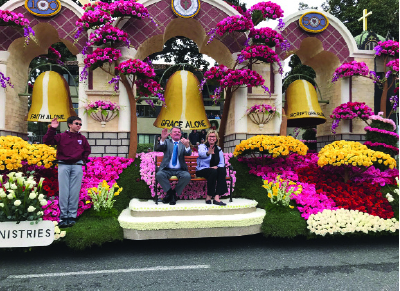
When the Protestant Reformation gets its own float in the Tournament of Roses Parade, something big must be happening. Not that we needed the Pasadena tableau to underscore the upcoming event, but we must admit it was surprising to hear NBC’s Al Roker announce the 500th anniversary of the Reformation as three flower-covered church bells tolling “A Mighty Fortress Is Our God” cruised by at 10 mph.

Would Martin Luther—ex-communicated, jailed, and persecuted for his pursuit of biblical faith—have been shocked to see his life’s work trussed in rose petals and paraded before cheering crowds?

I was.

There, following the surfing dogs, the Rose Queen, and the Salvation Army Band, was the Wittenberg Door, covered in black beans and poppy seeds, commemorating that All Hallow’s Eve in 1517 when the angry priest Luther nailed his complaints against the Catholic Church on the front door. Inscribed on the giant bells was “Faith Alone,” “Grace Alone,” and “Scripture Alone,” the three-sola distillation of Reformation theology.

Also at the front of the float was a man dressed as Jesus, waving to the crowd on one side of Colorado Boulevard and then the other. We can’t fault the sponsors, Lutheran Layman’s League, for their exuberance, for Luther himself redirected the attention of the faithful worldwide to the finished work of Christ as the only means of salvation. Not obeisance to saints or Mary, time served in purgatory, the purchase of “indulgences” for others or ourselves—only God’s grace through faith in Jesus Christ can save us. So commonplace today, this must have sounded radical to Luther’s first audiences. Yet, here we stand, benefactors of his brave actions, celebrating his Halloween escapade and all that resulted from it.

70116luther
But five centuries after the fact, this anniversary is an opportune time for Southern Baptists to ask a few serious questions:

How Reformed are we? What was started by Luther was picked up, refined, and defined by John Calvin and others. The line from Calvin (and other Reformers) to Southern Baptists isn’t as obvious as is the line from John Knox to the Presbyterians or Luther to the Lutherans, but the Reformers have certainly informed our Baptist theology.

Some Southern Baptists fully embrace Calvin’s doctrines of grace, the sovereignty of God, and election, considering themselves “five-point Calvinists.” Others, who defined their position as “traditional” Southern Baptist in the 2012 debate at the New Orleans convention, accept some of Calvin’s points, but rely more on the verses about God’s desire that all would be saved. Some would say they live in the tension between Calvinism and Arminianism, between the sovereignty of God in bringing people to salvation and the free will of man to accept or reject God’s offer.

This anniversary is a good opportunity for churches to study the principles of Reformed theology and ask, How Reformed are we?

What is the appeal of Reformed theology? For people who have grown up in an era of slushy theology and postmodern uncertainty, Reformed theology offers clear, clean delineation of belief. It’s faith with handles on it. That might explain the appeal to Christians who were described as “young, restless, and reformed” in Collin Hansen’s seminal work by that name in 2008. Hansen capsulized a phenomenon that had been in development for two decades by the time he wrote the book, and must be credited in large part, in SBC life, to Albert Mohler. From his position as president of Southern Seminary starting in 1993, Mohler has schooled a generation of young pastors, theologians, and now seminary presidents.

What is the long-term impact of rising Reformed theology on the SBC? Not everyone is enamored by the growth of Calvinism in Southern Baptist ranks. Some leaders have expressed concern about the possible impact on missions and evangelism.

Certainly our theological debate has been invigorated in recent decades. A denomination given to pragmatic, applicable theology through the Baby Boom years has more recently turned to serious consideration of the nature of the gospel. Can committed Calvinists, “traditional” Southern Baptists focused on evangelism, and the “somewhat Reformed” all coexist in the SBC tent, with a shared purpose that unites us, despite differences over finer points of theology? Or is another schism coming?

What will happen to evangelism? Our denomination’s baptism numbers continue to decline. Southwestern Seminary President Paige Patterson, a “traditionalist,” continues to express concern that rising Calvinism will naturally cool the fires of evangelism.

International Mission Board President David Platt might demonstrate a new kind of Reformed pastor, for whom evangelistic work by God’s people has high priority in God’s sovereignty. Will Platt’s zeal prove characteristic of the younger generation who are following his charge: “For the nations!” Or will the soul-winning Calvinist prove to be an anomaly?

Now, 500 years after Luther struck the first blows for Reformation, these are a few of the issues Southern Baptists must address—before the parade passes by.

– Eric Reed is editor of the Illinois Baptist.

watch pocketIn the church I grew up in, “missionary” was a sacred and scary title, bestowed only upon the spiritual elite, the Navy Seals of the Christian world. We considered them heroes, sat in awe through their slideshows, and gladly donated our money to their ministries.

It was years later that I first realized that every Christian was a missionary, that all Christians were called to leverage their lives and talents for the kingdom. God’s calling into mission is not a separate call we receive years after our salvation; it is inherent in the very call to salvation. Every believer is given a spiritual gift and a role to play in the spread of the Great Commission. “Follow me,” Jesus said, “And I will make you fishers of men.” That’s for everyone, not just those who feel a special tingly feeling they interpret as the call of God, or those who see some message from heaven spelled out in the clouds. Too many Christians sit around waiting on a “voice” to tell them what God has already spelled out in a verse.

Another way to put it: The question is no longer if we are called to leverage our lives for the Great Commission; it’s only where and how.

When “normal” Christians embrace this idea of calling, the gospel spreads like a prairie grassfire. Luke, the writer of Acts, goes out of his way to show us that the gospel travels faster around the world in the mouths of regular Christians than it does through full-time, vocational Christian workers. Luke notes, for example, that the first time the gospel left Jerusalem, it was not in the mouths of the apostles. Regular people “went everywhere preaching the word,” while the apostles stayed in Jerusalem (Acts 8:1–4). The first time the gospel actually went out into the world, not a single apostle was involved.

  • The first “international mission trip” was taken later in that same chapter by Philip, another layman. The Spirit carried him to a desert road where he met an Ethiopian government official, and Philip led him to Christ.
  • The church at Antioch, which served as the hub for missionary activity for the last half of the book of Acts, was not planted by an apostle, but simply “some brothers,” whose names Luke did not even bother to record—presumably because no one would have known whom he was talking about.
  • Apollos, a layman, first carried the gospel into Ephesus, and unnamed brothers first established the church at Rome. These Christians didn’t travel to Rome on a formal mission trip, but were carried there through the normal relocations that come with business and life. As they went, they made disciples in every place (Acts 8:5–8; 18:24–19:1; 28:15).
  • As the historian Steven Neill notes, “Nothing is more notable than the anonymity of these early missionaries.…Luke does not turn aside to mention the name of a single one of those pioneers who laid the foundation. Few, if any, of the great Churches were really founded by apostles. Peter and Paul may have organized the Church in Rome. They certainly did not found it.”

The next wave of missions will be carried forward, I believe, in much the same way—on the wings of business. Consider this: If you overlay a map of world poverty with a map of world evangelization, you will find that the areas most in need of business development are also the most unevangelized. Many of the most unreached places in the world, most closed to Christian missionaries, have arms wide open to any kind of businessmen.

Missiologists frequently refer to a “10/40 window” in which the most unreached peoples live (lying between the 10 and 40 degree latitude lines). For business leaders, the 10/40 window isn’t a window at all; it’s a wide open door.

God may not call you to leave the United States (though he might!). But if you’re a believer, he is calling you to follow him where he goes, as he seeks to make his name known. Whether you’re an investment banker or a full-time pastor, a stay-at-home mom or an overseas missionary, God has a mission for you. From Raleigh-Durham to Bahrain, the responsibility to think that way belongs to every believer. As we often say, “Whatever you are good at, do it well for the glory of God, and do it somewhere strategic for the mission of God.”

It’s time for the “ordinary believers” in our churches to recover the understanding that they are called to the mission and shaped by God for a specific role in that mission. The question is no longer if we are called to leverage our lives for the Great Commission; it’s only a matter of where and how.

J.D. Greear, Ph.D., is pastor of The Summit Church in Raleigh-Durham, N.C., and author of “Gaining by Losing: Why the Future Belongs to Churches that Send.”

The BriefingPhyllis Schlafly, ‘Founding mother’ of the modern conservative movement, dies at 92
Phyllis Schlafly, best known for her tireless work to defeat the Equal Rights Amendment, has died at the age of 92. “Phyllis Schlafly courageously and single-handedly took on the issue of the Equal Rights Amendment when no one else in the country was opposing it,” said James C. Dobson, founder of Focus on the Family. “In so doing, she essentially launched the pro-family, pro-life movement.”

SBC leaders grieve court’s expansion of parenthood
The decision by New York’s highest court to expand custody and visitation rights to “de facto parents” serves as evidence same-sex marriage advocates desire to overthrow humanity’s oldest institution and as part of “a major turning point in human history,” Southern Baptist leaders said.

Chicago homicides in 2016 reach 500
Chicago’s 500th homicide of the year happened over Labor Day weekend, according to the Chicago Tribune. That number carries a lot of weight for the city — not just in quantity, but in meaning: 2016 is now the deadliest year in two decades.

‘Sad’ Russian anti-evangelism law ends a ministry
Independent Baptist missionaries Donald and Ruth Ossewaarde always suspected their Gospel ministry in Oryol, Russia, wouldn’t last when they began in 2002. But they did not expect Donald to be among the first people arrested under Russia’s new law prohibiting organizations from evangelizing outside church walls and without a government permit.

Missouri sends first openly lesbian to Miss America Pageant
Miss Missouri, Erin O’ Flaherty, will compete for the Miss America crown this weekend as the first openly lesbian contestant. “Behind the scenes, we’ve been well-represented, but I’m the first openly gay title holder, so I’m very excited,” she told The Associated Press. “I knew going in that I had the opportunity to make history. Now I get to be more visible to the community and meet more people.”

Sources: Baptist Press, Religion News Service, CNN, Baptist Press, Time Magazine