Archives For November 30, 1999

Leaning into the challenge

ib2newseditor —  February 12, 2018

Amid decline, churches called to new commitments
Pioneering Spirit

Throughout 2018, Southern Baptist churches in Illinois are invited to accept challenges in four key areas: evangelism, church planting, missions giving, and leadership development.

The challenges, focused on the “pioneering spirit” needed to advance the gospel among more than 8 million lost people in Illinois, were laid out last November at the Annual Meeting of the Illinois Baptist State Association. Their urgency was reinforced by new data based on the 2017 Annual Church Profile reports completed by 95% of IBSA churches.

“The 2017 ACP data from IBSA churches tells us that, while some churches are thriving, many are struggling,” said IBSA Executive Director Nate Adams. “For example, about 40% of IBSA churches didn’t report a baptism in 2017. And the sum total of information from all churches shows flat or steadily declining dynamics in many key indicators, including baptisms, worship attendance, Bible study participation, and church planting.

“This doesn’t do justice to the many bright spots where effective ministry and growth is happening, but it does give an overall picture.”

In 2017, IBSA churches baptized 3,441 people, a 13% decrease from last year’s total of 3,953. Other measurements also were down, including professions of faith, church membership, and missions giving. Giving through the Southern Baptist Cooperative Program totaled $5,924,029 in 2017, compared to $6,032,407 the previous year.

A highlight of 2017 was growth in the area of missions participation, as 21,607 people engaged their Acts 1:8 mission fields through projects and partnerships.

“It was studying last year’s ACP numbers, and really the last several years’, that led us to the important theme for the 2017 IBSA Annual Meeting,” Adams said. “Advancing the gospel through Baptist churches in Illinois has, and always will, require a ‘Pioneering Spirit.’ That means continuously engaging new people, developing new leaders, making new sacrifices, and going new places with the gospel.

“Churches that are not intentionally and effectively reaching out into their communities with a pioneering, missionary spirit, face inevitable decline.”

The lower numbers in Illinois reflect national trends, according to the most recent data available. (National ACP data for the previous year is released in the summer, prior to the annual Southern Baptist Convention.) In 2016, baptisms in SBC churches decreased by 4.9% from the previous year, and worship attendance declined 6.8%.

“I would encourage any church that is struggling or simply desiring assistance to invite IBSA, its local association, or perhaps another like-minded church to come alongside and help,” Adams said. “Often another trusted leader’s perspective can make all the difference, along with the experience and resources that others can bring.

“For our part, IBSA is eager to bring training, consulting, and resources in any of these areas, and to any IBSA church. That’s why we’re here, and we really want to help.”

The power of ‘one’
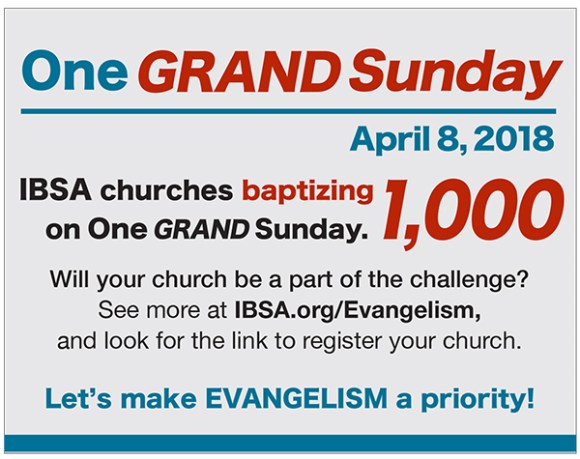
A decline in baptisms over the past decade is behind this spring’s “One GRAND Sunday” emphasis, which calls IBSA churches to participate in baptizing at least 1,000 people on April 8, the Sunday after Easter.

Last year, 352 IBSA churches reported zero baptisms. The churches that did report baptisms had an average of 6.4 baptisms per church.

The ‘GRAND’ goal is lofty, IBSA’s Evangelism Director Pat Pajak has acknowledged, particularly amid the current downward trend. But he’s urging church members to focus on the “one” part of the challenge, and to pray for one person to come to Christ and be baptized. That idea was recently echoed by prayer leader Phil Miglioratti.

“And as my ‘one’ is added to your ‘one’…as their church’s ‘one’ is matched by that church’s ‘one’…as a Sunday class prays for ‘one’ and is joined by a fellowship group asking for ‘one’…a youth group in a southern association, a seniors’ class in the center of the state, a planting team up north, a children’s ministry along the eastern border, and a WMU along the western border, each claiming, petitioning, pleading for ‘one’…one plus one equals two. But in God’s mathematics, ‘one’ plus ‘one’ times prayer could equal ‘One GRAND Sunday!’

“Even the smallest church among us can ask in faith for ‘one,’” Miglioratti said.

Sign up for the “Pioneering Spirit” challenge at pioneeringspirit.org. Register for One GRAND Sunday at IBSA.org/Evangelism.

Churches challenged to baptize 1,000 on one day

One Grand social

One thousand baptisms on a single Sunday. That’s the challenge behind One GRAND Sunday, an initiative designed to help IBSA churches train church members in evangelism, share the gospel, and follow-up with believer’s baptism.

One GRAND Sunday is scheduled for April 8, one week after Easter.

“Easter is normally a high attendance day, and the strategy of scheduling April 8 as One GRAND Sunday is to encourage people to return the following week to witness an historic event—their church being a part of 1,000 people being baptized on one day!” said Pat Pajak, IBSA’s associate executive director of evangelism.

The baptism-focused Sunday is part of a series of “Pioneering Spirit” challenges put before IBSA churches at the 2017 Annual Meeting. The evangelism challenge is for 200 or more IBSA churches to baptize 12 or more people each year, or to baptize more than the church’s previous three-year average. In other words, the commitment is for IBSA churches to become “frequently baptizing churches.” So far, 57 churches have accepted the challenge to engage new people with the gospel.

“Unfortunately, baptisms across our state have been declining over the past several years, and I would like to see One GRAND Sunday serve as a reminder that the church exists to evangelize and baptize those in the communities where God has planted them,” Pajak said.

The One GRAND Sunday emphasis coincides with a North American Mission Board-sponsored effort to promote gospel conversations, or opportunities to share the gospel. NAMB is urging Southern Baptists to have one million gospel conversations by next summer’s Southern Baptist Convention in Dallas. At gcchallenge.com, people can upload videos of themselves sharing about gospel conversations they’ve had, and get more information about gospel-sharing resources, like the “3 Circles” guide.

With just under three months left until April 8, Pajak suggested this timeline for churches preparing for One GRAND Sunday:

January: Collect your church’s baptism numbers for the past three years. Prayerfully set a new goal for this year.

February: Announce the baptism event and launch gospel conversations. Register your goal at IBSA.org/Evangelism. Conduct the training for church members. Consider teaching the “3 Circles” method.

March: Promote One GRAND Sunday. Personally follow-up with prospects and new believers. Teach about baptism, either personally or in a group setting.

April 8: Baptize!

April 9: Start over again.

One thousand is a large number, but Pajak put the goal in perspective. “What may look like a very lofty goal can easily be accomplished if every one of our 1,000 churches simply committed to baptizing one person.”

For more information about One GRAND Sunday and evangelism resources, or to register to participate in the April 8 emphasis, go to IBSA.org/Evangelism.

Blue abstract background with white spot light, abstract tropica

With less than one-sixth left of 2017, unless there’s a drastic turnaround, the year likely won’t be remembered as one of the country’s best. Devastating hurricanes. Political gridlock. The worst mass shooting in U.S. history. The headlines have only gotten bleaker as the year has worn on. And the year’s not over yet.

A new survey on what Americans fear the most paints a picture of how the year has taken a toll on lots of people. Almost 75% of Americans are afraid or very afraid of corrupt government officials, according to Chapman University’s annual survey. That topped the list last year too, but was the only fear expressed by more than half of respondents. This year, five fears were held by a majority, including the new healthcare plan, pollution, and not having enough money for the future.

Things are difficult, and people are scared. Scanning the headlines or, more likely, scrolling through a news feed, doesn’t help either. The current climate is such that as our team brainstormed how to write about Thanksgiving this year, we couldn’t come up with much of a fresh angle. Certainly, we have a lot to be thankful for; as Americans, we know that’s true. But with the din of the constant news cycle perpetually in our ears, it can be difficult to pinpoint the bright spots in an otherwise dreary year.

Perhaps that’s why a Friday conversation with an Illinois pastor’s wife was so refreshing. Jane Miller and her husband, Larry, have been part of Shiloh Baptist Church in Villa Ridge for nearly 33 years. Jane answered our call that Friday afternoon for information about the church’s recent 200th anniversary, but ended up sharing some unexpected hope too.

She talked about how she and Larry have developed deep friendships with the people in their church over the years. How he has mowed yards when some of their church members haven’t been able to do it themselves. That he keeps the church refrigerator stocked with eggs from the chickens he keeps. Every off-hand reference she made to their church and their ministry told the story of people who have put down roots in a community and are committed to each other.

That’s hopeful.

So, too, is a group of kids waiting—beach towels over their arms—to be baptized at Stonefort Missionary Baptist Church.

Perhaps it’s because the year has been so murky that these bright spots, which might have been overlooked in the past, shine even brighter. As we approach a season focused on giving thanks, may we be grateful for the little things that remind us of God’s goodness and provision, in this year and every other.

-MDF

Counting to 200

ib2newseditor —  November 6, 2017

illinois coat of arms

Illinois became a state on December 3, 1818. And so soon, those who pay attention to such things will begin the one-year countdown to our state’s bicentennial.

Because Illinois is our state mission field, the “Judea” in our churches’ Acts 1:8 missions responsibility, IBSA will be joining the bicentennial celebration with a countdown of our own. Launching at the 2017 IBSA Annual Meeting, and continuing through next year’s Annual Meeting, we are challenging IBSA churches to consider “counting to 200” in four very special ways.

First, we have identified 200 places or people groups in Illinois where a new church is desperately needed. We are inviting churches to adopt one or more of those 200 by praying, or partnering with resources or volunteers, or actually sponsoring the plant as the mother church.

Second, we are praying for at least 200 churches that will seek to become more frequently baptizing churches, by setting annual baptism goals and equipping their members to intentionally have gospel conversations and participate in evangelistic events and mission trips. We are praying for churches that will set their sights on baptizing at least once a month, or more than their previous three-year average.

Third, we are praying for at least 200 churches that will commit a percentage of their annual budgets to Cooperative Program missions, and then seek to increase that percentage annually toward 10% or more.

Potential for true mission advance is through churches that embrace pioneering spirit commitments.

And finally, we are praying for at least 200 churches that will commit to intentional leadership development processes—not only for the pastor and current leaders, but also for future pastors, planters, and missionaries.

Of course, some churches are fulfilling one or more of these challenges already. But for the overwhelming majority of IBSA churches, these challenges will be a major stretch. In fact, as our 2017 Annual Meeting theme suggests, moving beyond our status quo into these types of commitments will take a true “pioneering spirit.” It’s the kind of spirit that brought Baptist pioneers to Illinois more than 200 years ago.

That’s why we at IBSA are asking churches to register their “pioneering spirit” commitments, either now or in the coming months. Not only do we want to celebrate those commitments between the 2017 and 2018 IBSA Annual Meetings, but we also want to give those churches our focused, priority attention as an IBSA staff.

Certainly we will continue to be responsive to the requests and needs of all IBSA churches, and to provide services, resources, consultations, and events throughout the busy year. But we believe that the greatest potential for true mission advance in Illinois will be through churches that embrace these pioneering spirit commitments, and we want to come alongside them in special ways, and give them our priority assistance. We also want to network these churches together, so that they can benefit from one another’s experiences and ministry strategies.

The second verse of our Illinois state song begins, “Eighteen-eighteen saw your founding, Illinois, Illinois, and your progress is unbounding, Illinois, Illinois.” It goes on to remind us of the origin of that unbounding progress. “Pioneers once cleared the lands where great industries now stand. World renown you do command, Illinois, Illinois.”

When you see things like great industries and world renown, it’s usually because a few pioneers paved the way for them. And if we are to see great churches and world impact coming from Illinois Baptists, it will be because a few pioneers sacrificially pave the way. Will your church be one of those first 200 that brings a much-needed pioneering spirit to our state’s bicentennial, and to our mission of seeking and saving the lost here in Illinois?

Nate Adams is executive director of the Illinois Baptist State Association. Respond at IllinoisBaptist@IBSA.org. Read more at IBSA.org/pioneering.

New study shows factors that attract and keep new members

Attracting and keeping people considered unchurched is rated as the top predictor of growth through new professions of faith at small churches, according to a new study encompassing 12 Christian denominations including Southern Baptists.

“These churches are places of invitation, welcome, and involvement for the unchurched,” the study’s authors said. “So, the unchurched stick around in greater numbers. And they come to Christ and get committed to the church in greater numbers.”

The Billy Graham Center of Wheaton College conducted the newly released study in partnership with Lifeway Research of the Southern Baptist Convention and the Caskey Center for Church Excellence of New Orleans Baptist Theological Seminary. The telephone survey of 1,500 pastors and church leaders found and ranked 29 predictors of growth through Christian conversion at churches of 250 members or less. Study authors released the top 10 growth predictors June 26.

Second to attracting and keeping the unchurched, small churches that grow by Christian conversions tend to offer classes for new attendees, the study found. Such classes help even when they are not evangelistic.

Third, small churches that grow through new baptisms are led by pastors who routinely undergo personal evangelism training.

“If the pastor is a learner and stays inspired and growing in the area of evangelism,” study authors said, “that pastor’s church will reach more people who commit to Christ and who stick.”

Newcomers church growth chart

In response to declining baptisms in the U.S., Southern Baptist Convention President Steve Gaines appointed a 19-member evangelism task force at the 2017 SBC annual meeting. The group of SBC seminary presidents and professors, pastors, and a state convention leader are expected to report its findings at the 2018 SBC annual meeting in Dallas.

Nearly 90% of Southern Baptist churches had weekly attendance of 250 or less as recently as 2013, and qualified for the “small church category.”

In the Wheaton study, the other top growth predictors among small churches are:

  • The pastor more frequently “pops the question,” asking people to commit after he shares the gospel.
  • The church spends a higher percentage of its budget on evangelism and missions.
  • Church members often tell the pastor that they themselves are sharing the gospel with others, rather than relying on the pastor to carry the load alone. “The church does not need superstar pastors who share their faith while everybody in the church cheers them on from the sidelines,” study authors said.
  • Unchurched visitors often communicate favorable feedback to pastors after weekly worship services.
  • The church shares the gospel outside its walls and conducts community service.
  • Churches that grow through conversions concurrently tend to draw members from other congregations. “In other words,” study authors wrote, “transfer and conversion growth tend to go together for small churches.”
  • Cited as the 10th most predictive factor of growth through new conversions, according to the study, “the pastor more frequently blocks out time in the calendar for the purpose of sharing the gospel with non-Christians. If the pastor is to lead evangelism in the church, the pastor must first personally live out the evangelism call.”

Smaller churches in the survey, those with 150 or fewer members, tended to grow more easily than the larger small churches in the survey, the study found. Additionally, predominantly Hispanic and Native American churches tended to fare better in growth.

Joining Southern Baptists in responding to the survey are members of the Assemblies of God, the Associate Reformed Presbyterian Church, the Church of the Nazarene, the Conservative Congregational Christian Conference, Converge Worldwide, the Evangelical Covenant Church, the Evangelical Free Church in America, The Foursquare Church, the Missionary Church, Vineyard US, and The Wesleyan Church.

Study authors include Ed Stetzer, executive director of Wheaton’s Billy Graham Center for Evangelism and former LifeWay Research executive director.

LifeWay Research plans to release a full report of the study at lifewayresearch.com.

– Diana Chandler, Baptist Press

Rites of summer: VBS

ib2newseditor —  July 17, 2017
VBS-Rockford

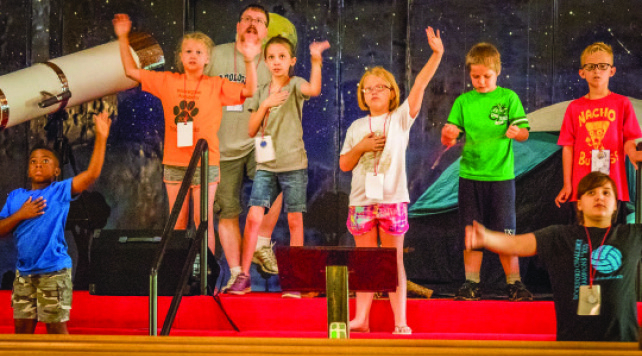
Living Stones Community Church, Rockford

A woman pulling dandelions along the sidewalk in front of her house seems willing, even eager to take a break.

“Well,” she says, “the church is over there about a block,” pointing westward along one of the community’s few streets. “But the marker you’re asking about is right over there, waving a hand holding weeds southward.

“That’s where it really started, so that’s where they put the marker.”

It’s clear that Hopedale, Illinois is still proud of its place in history as the one-horse, no stop-light town that birthed an international movement: Vacation Bible School.

In the late spring of 1894, Mattie Pritchard Miles, wife of Hopedale’s Methodist minister, had a bold idea: take advantage of the summer break to teach otherwise idle children about the Bible. She planned a day of Bible teaching and activities “for all children of whatever church—or no church at all.” From the beginning, VBS has been about outreach. Perhaps that’s why its first organizer took the school outside the walls of her church and denomination.

The meeting place was on the grounds outside the elementary school, where the historical marker stands today, with the park next door.

Some 37 children showed up.

What’s even more remarkable is that Mrs. Miles didn’t hold a one-week VBS, or even two-weeks as some older people may remember. Her Vacation Bible School lasted 26 days over five weeks.

The 1894 school quickly became a model for churches and denominations everywhere. The big stone marker includes a time capsule that is to be opened in 2094, on the 200th anniversary of VBS.

In the meantime, proponents of the summertime discipleship ministry, and Southern Baptists in particular, still see its value for evangelism as well as discipling children (and adults). LifeWay reports that 25% of all baptisms in SBC churches come through VBS.

Consider these other 2015 statistics from LifeWay, which produces VBS curriculum especially for SBC churches.

• Every one person trained in VBS in SBC churches results in 1.1 salvation decisions.
• 10% of people enrolled in SBC VBS are unchurched.
• 2.7 million people enroll in VBS each year.
• 72,925 people each year accept Christ as Lord and Savior.
• 2,666 people commit their lives to church-related vocations through VBS.
• 56,386 people enroll in Sunday School/small group Bible study as a result of attending VBS.

Mrs. Miles lived 55 years after her first month-long experiment. By 1949, VBS was a well-established tradition that continues to reach children and families and to change lives today.

-Eric Reed

The Briefing

Crossover & Harvest America share timeless Gospel message
More than 700 voices worshiped at North Phoenix Baptist Church in Phoenix, Ariz. on Friday, June 9, kicking off the weekend’s Crossover Arizona and Harvest America events. NAMB’s Crossover Arizona and Greg Laurie’s Harvest America joined forces to host a three-day evangelistic outreach involving training, street evangelism and service projects before culminating in Harvest America’s Sunday night crusade. By the end of that evening, Harvest reported 2,904 salvation decisions at the event with another 494 indicating decisions online.

100s of new churches not enough to satisfy Southern Baptists
Southern Baptists gained almost 500 churches last year, while taking in more than $11 billion. Such statistics would have most US denominations praising the Lord. But because of declines in other metrics that matter more—including their namesake, baptisms—leaders say members should offer lament instead.

Delaware legalizes abortion through all 9 months
Delaware gave pro-abortion advocates a rare but big win last week when Gov. John Carney signed a bill making it legal to kill unborn babies through all nine months of pregnancy. Proponents of the bill drafted it out of fear the Supreme Court might someday overturn the 1973 Roe v. Wade ruling that legalized abortion nationwide.

Trump: ‘It’s time to put a stop to attacks on religion’
President Trump told his political base of evangelical Christians that he would continue to restore the religious liberty many of them feel they’ve lost. “It is time to put a stop to the attacks on religion,” Trump said in a speech to the Faith and Freedom Coalition.

McDonald’s introduces gay pride fries in rainbow boxes
McDonald’s is serving its signature fries in cheerful rainbow-colored boxes at participating locations throughout the greater California Bay Area, as well as at some D.C. locations. The rainbow fries will be available throughout the month of June.

Sources: Baptist Press, Christianity Today, World Magazine, Religion News, Houston Chronicle

The power of one

ib2newseditor —  February 13, 2017

red leaves church steeple

This is a time of year when we at IBSA do a lot of evaluating, not only of our staff’s efforts, but also of the overall health dynamics of churches. An outstanding 95% of IBSA churches completed annual church profile reports for 2016, and this gives us a wealth of information to study.

Like every year, some churches thrived last year and others struggled, so it’s possible to overgeneralize. But looking at the broad stroke data for 964 churches and missions (up seven from the previous year), it’s reasonable to say that some ministry areas such as leadership development and Sunday School participation were up, while others such as church planting and missions giving were down, at least compared to the previous year.

Of all the “down” areas, though, none concern me more than our churches’ overall baptism number, which dropped more than 11% in 2016, to 3,953. The number of churches reporting zero baptisms increased by over 10%, to 352, meaning that more than a third of IBSA churches did not baptize anyone last year.

Just one voice, one commitment, one resolution of faith can turn things around.

A few days ago, one pastor asked me how things were going, and the first burden I found spilling out of my heart was the decline in church baptisms. He nodded his head in empathy and agreement. “I know we were down in our church last year,” he acknowledged.

But what he said next truly encouraged me. “So we are really getting after that this year. We have set a baptism goal, and we have evangelism training planned. But we also have set goals as a church for the number of gospel presentations we will make, and the number of spiritual conversations we will seek to have, believing that those will then lead to gospel presentations.”

He went on to tell me how each leader and church member was being challenged to look for these opportunities, and that they were reporting them through Sunday school classes and other ways.

That same week, a young pastor wrote me an e-mail, thanking me for how two of our IBSA staff members had specifically helped and encouraged his small church. He admitted that in the past he had questioned how much his church’s Cooperative Program giving helped struggling churches, compared with church plants. Now, in his first senior pastorate, he had experienced firsthand the practical ministry support that state staff provide. Others in his association felt the same, he said, and were planning to join him in increasing their Cooperative Program giving this next year.

What struck me about both these conversations, and both these pastors, was the positive power of one voice, one commitment. One pastor looked at a lower baptism number and said, “We will not be satisfied with that. Here’s what we’re going to do.” Another pastor took a fresh look at the value of cooperative missions giving and said, “We can do more.”

So often it just takes just one voice, one commitment, one resolution of faith to turn things around. I think of Noah, and David, and Elijah, and Nehemiah, and other Old Testament heroes. I think of Peter’s boldness and Paul’s resilience in the New Testament. And of course I think of Jesus, not only on the cross, but also in eternity past, saying to the Father, “This shall not stand. I will do what it takes to make this right.”

Today, each of those pastors is using his own power of one to lead and inspire his church to a better place, regardless of the past, or what happened last year. In doing so, they reminded me how much can change when one person simply refuses to accept the status quo.

Nate Adams is executive director of the Illinois Baptist State Association. Respond at IllinoisBaptist@IBSA.org.

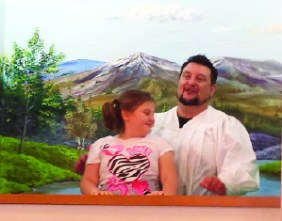
Pastor Brad Sloan baptizes his daughter, Delaney, at Dahlgren Baptist Church.

Pastor Brad Sloan baptizes his daughter, Delaney, at Dahlgren Baptist Church.

How did Dahlgren Baptist Church move from two baptisms in 2014 to 17 last year?

“I’ll give you the short answer: It’s all about Jesus,” said Pastor Brad Sloan.

His church is located in a small, predominantly Catholic village 15 miles southeast of Mt. Vernon, IL. “There were a few people who were like, man, I don’t know if you’ll ever see much growth there,” said Sloan, who was installed as pastor in August of 2014.

The church hasn’t yet seen massive growth, “but what we have seen are souls (saved).”

Dahlgren’s Awana program for children reaches kids in the community whose parents aren’t yet connected to the church. Last summer, the church held its first Vacation Bible School in 10 years, with 33 kids in attendance.

In 2015, Dahlgren Baptist Church hosted its first Vacation Bible School in 10 years.

In 2015, Dahlgren Baptist Church hosted its first Vacation Bible School in 10 years.

Through those outreach efforts and intentional Sunday school-based discipleship, Sloan is trying to inspire in his leaders a hunger for people to come to know Christ. In turn, the leaders challenge the students they’re discipling to examine what it means to have a relationship with Jesus.

“We’ve just had a lot of victory (in student ministry) when kids begin to be challenged: Hey, what do you believe about Christ?”

In 2015, the majority of Dahlgren’s baptisms were children (although the total also included a family and a grandmother, Sloan said). The kids are now participating in children’s church and youth activities, and are learning to share their faith. The church also works to engage parents as they come to pick up their children from church.

Sloan sees revival happening in his community, particularly in the schools, as students are being stirred to really live like Christ.

“There’s not one person in this little village that Jesus can’t impact,” he said, “and it’s up to us to introduce them to him.”

Stirring the Waters

After three years of declining baptisms, SBC leaders are calling it what it is—an evangelism crisis.

What happened to evangelism in the Southern Baptist Convention?”

The question, posed by SBC President Ronnie Floyd, came after the Annual Church Profile reports completed by Southern Baptist churches showed a third consecutive year of declining baptisms.

In fact, the total for 2014 (the most recent year for which national statistics are currently available) is the lowest number of baptisms since 1947. Southern Baptist churches baptized 305,301 people, a 1.63% decrease from the previous year. An in Illinois, the annual number of baptisms, which has hovered around 5,000, dropped to 4,400 in 2015.

“Deplorable” is how Floyd described the reality that even though there are more SBC churches than ever, and an ever larger population to reach with the gospel, it’s simply not happening—at least, not according to the baptism numbers.

Recently, Floyd and other SBC leaders have been increasingly vocal about how the numbers reflect an even bigger problem: an evangelism crisis.

“Lostness in North America is having a bigger impact on Southern Baptists than Southern Baptists are having on lostness,” New Orleans Theological Seminary President Chuck Kelley said at a recent chapel service.

The picture is bleak, but all is not lost, SBC leaders seem to agree. A turnaround is dependent on renewed appreciation for and dedication to evangelism in the Southern Baptist Convention and in individual churches. Church members need models, leaders who are soul winners themselves and can train people in the pews to share their faith.

“Let’s not be paralyzed,” Floyd wrote on his blog, urging Baptists to action. “Do something. Do more than you are doing now. Take a risk.

“Return to the importance of reaching and baptizing people.”

Mission drift

One reason some leaders cite for the SBC’s decline in baptisms, and overall in evangelism, is a culture that sidelines those things. In an address to the SBC Executive Committee in February, Floyd spoke about a critical shift that has brought the denomination to this point:

“Years ago, something happened where pastors and churches that reached and baptized people effectively came under the microscope of other Baptists who oftentimes did not have a heart for evangelism themselves. A culture of skepticism about evangelism began to creep into our convention. Evangelism began to die.”

Even the way we talk about evangelism is different, said IBSA’s Pat Pajak. The weekly opportunity to go out “soul winning” has been replaced with more politically correct titles such as outreach, or more often the practice has been lost altogether. “In the process, born-again believers have lost the passion and emphasis on reaching into the pagan pool and bringing the lost to Christ,” said Pajak, who leads the Church Consulting Team.

Recent research supports this: A 2012 study by LifeWay Research found that while 80% of Protestant church-goers believe they have a personal responsibility to share their faith, 61% hadn’t told anyone how to become a Christian in the previous six months. Nearly half (48%) hadn’t invited an unchurched person to attend a church event or service in six months.

LifeWay Research President Ed Stetzer broke down the research this way: “…The typical churchgoer tells less than one person how to become a Christian in a given year. The number for more than half of respondents was zero. The second most frequent answer was one.”

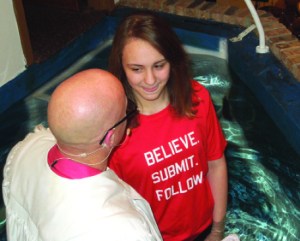
The shirt says it all -- Emily Zimmer is baptized by Pastor Tracy Smith at First Baptist Church in Mt. Zion.

The shirt says it all — Emily Zimmer is baptized by Pastor Tracy Smith at First Baptist Church in Mt. Zion, one of many congregations in Illinois that experienced large increases in baptisms in 2015.

To right the ship, SBC leaders have pointed first to the need for spiritual awakening—first in churches, then in the culture at large. But there are also solutions to be found at the denominational level and in local churches, starting with leaders.

Floyd recalled a time when only preachers who led strong evangelistic churches were invited to speak at the SBC Pastors’ Conference and annual meeting. Those leaders were also the ones nominated for denominational offices. In his November blog post about the state of evangelism in the SBC, Floyd seemed to call for a return to those principles.

“Quite honestly, I am not impressed by how many books a pastor sells, how many Twitter followers he may have, at how many conferences he speaks, how great of a preacher he is, or how much his church does around the world if he pastors or is associated with a church that has a lame commitment to evangelizing and baptizing lost people and reaching his own community with the gospel of Christ.”

At the local level, too, leaders can help reverse the decline by creating an environment that is conducive to evangelism, said IBSA’s Mark Emerson.

“The pastors who are effectively reaching people for Christ are creating an environment of evangelism in their churches,” said Emerson, whose Church Resources team equips churches in evangelism.

“They are making sure every ministry has an evangelistic purpose, they are designing their worship services to communicate the gospel and offer an opportunity for people to make a decision. These churches are training their members to effectively enter into gospel conversations.”

Modeling evangelism

Scott Foshie is one pastor currently training his congregation to have those gospel conversations. Steeleville Baptist Church will start evangelism training in April, based on the “Can We Talk?” program created by Texas pastor (and FBC Pastors’ Conference President) John Meador.

“When it’s time to bridge a conversation from small talk to gospel talk, that’s an awkward transition for people to make,” said Foshie, who has pastored the church since early 2015. The six-week curriculum combines training with practical experience; teams of three people go out into the community, visiting neighbors and practicing gospel conversations.

Foshie’s personal stake in the training goes beyond the fact that it’s happening at his church. As a student of the F.A.I.T.H. evangelism training tool, he led his future wife, Audra, to faith in Christ.

“Personal evangelism training is very important to me because it changed my life. So, I want people to experience that. Personal evangelism training unleashes the army of the Lord, (it’s) what God has called us to do.”

But first, people have to face down a common obstacle: fear. The pastor likened sharing the gospel to someone handing you the keys to their sports car and telling you to take it around town.

“What we need to teach them is, hey, you step out in faith, you begin to learn to share, you simply share, and the Holy Spirit’s going to help you,” Foshie said.

“Once people learn to share the gospel, it changes their life completely.”