ivoted

A look at the electoral map says it all. A swath of blue on the West Coast and Northeast, and mostly red in the vast middle. Except for Illinois and Minnesota. We live in a divided nation.

For Christians, the issue today is how do we live Christ-like, now that the nation has chosen a president after a divisive and nasty two-year contest. Can we begin, as one observer put it, to love our neighbor who has “the wrong political sign” in his yard? Or to pray for political leaders of all parties to overcome division for the sake of the nation?

White evangelicals, white Catholics, and Mormons all supported Republican Donald Trump according to exit polls, while Black Protestants and Latino Catholics went for Democrat Hillary Clinton in the November 8 presidential election.

At 81%, the majority support for Trump by white evangelicals was a surprise to some, after leading evangelical leaders split on the candidate. His conservative stance on moral and political issues traditionally important to born-again believers was at odds with his irreligious lifestyle.

Russell Moore of the SBC’s Ethics and Religious Liberty Commission, is one of the few Southern Baptists who spoke against Trump, based on the candidate’s behaviors. Moore consistently urged Southern Baptists to keep conservative politics from swamping biblical beliefs. And his view the day after the election? He tweeted congratulations and called for prayer.

“The most important lesson we should learn is that the church must stand against the way politics has become a religion, and religion has become politics,” Moore wrote on his blog. “We can hear this idolatrous pull even in the apocalyptic language used by many in this election—as we have seen in every election in recent years—that this election is our ‘last chance.’”

But Robert P. Jones, CEO of the Public Religion Research Institute, counters, “Trump’s line—‘Let’s make America great again’—and his last-minute saying—‘look folks, I’m your last chance’—was really powerful for white evangelicals who see their numbers in the general population slipping.

“White Christians are declining every year by a percentage point or more as a proportion of the population,” Jones told Religion News Service. “So when Trump says, ‘I’m your last chance, folks,’ there’s a real truth to that.”

Some analysts attribute Trump’s victory to a middle-class, middle-of-the-country rebuke of the Obama legacy and the liberal cultural shift during his administration, as exemplified by the legalization of same-sex marriage and the recent actions on transgender issues. Others say Clinton lost, in part, because she ignored evangelicals.

“We asked for the votes of evangelicals and the Clinton campaign didn’t,” said Michael Wear, who served as faith outreach director for President Barack Obama’s 2012 re-election campaign. “It’s a campaign, you ask for people’s votes. And Hillary asked for just about every vote except this group of voters,” he told World magazine.

More prayer, more power

Arkansas pastor Ronnie Floyd didn’t endorse Trump while he served as SBC President. But the week after he was succeeded by Tennessee pastor Steve Gaines, Floyd was one of a handful of SBC leaders who attended Trump’s meeting with nearly 1,000 evangelicals. Now, Floyd advises prayer.

“Please prioritize praying for Trump….(and) for Vice President-Elect Mike Pence,” Floyd wrote on his blog. “Pray for wisdom, future, security, protection and leadership that will be extended to our nation. Pray for Trump as he selects members for his cabinet and begins the appointments of hundreds of people.”

The next move by evangelicals is to “stay in the game,” says Ed Stetzer of the Billy Graham Center at Wheaton College. Evangelicals who helped give Trump the office have a responsibility to help mold his presidency.

“There are many evangelicals who voted for Trump, and many Evangelicals who advised him,” Stetzer wrote for Christianity Today. “It’s time to advise him now that immigrants are made in the image of God, women are not tools and toys, racial and religious prejudice must be confronted, and so much more.”

Stetzer noted the decided shift on the importance of a candidate’s character to evangelical voters who supported Trump. “The answer is not for us to change our views on character, it’s to help a flawed candidate become a President of character.

“Evangelicals elected Trump,” Stetzer said. “Now they need to call him to a better way,” Stetzer said.

Eric Reed is editor of the Illinois Baptist.

Well, here we are

ib2newseditor —  November 9, 2016

Old Glory Flag

Though the majority of the nation is still surprised and in shock, half the nation is angry and hurting, and way more than half the nation is still overwhelmingly discontent with the outcome of last night’s election, here we are. The election process is over. Half of the country helped elect what they consider to be “the lesser of two evils” and the other half is stunned that the victorious candidate is considered by anyone to be “the lesser of two evils”.

As I have spent time reflecting on this election – this crazy, unbelievable, disappointing, and astonishing election – I have found myself ending up at the same place over and over again.

Though (I hope) few, if any, Christians would actually say this, most seem to view their political party of choice as the primary agent of cultural change and hope for our nation. Then again, I know many who would actually say that. But the idea that the Democratic Party is the party of God because it prioritizes things like diversity, equality, harmony, and caring for the poor, or, likewise, the idea that the Republican Party is the party of God because it prioritizes things like religious freedom, pro-life movements, and a conservative supreme court – needs to go.

Now, let me be clear – part of the beauty of our democracy is that we all have the freedom to care about certain issues and vote our conscience. That freedom is a gift from God for which every American should be grateful. But, Christians cannot continue to allow the church to become as polarized as our nation. Yes, our nation is more polarized than it has been in a long time because of this election and the events surrounding it. But in the face of such polarization, the church ought respond with unification, re-commitment to the Kingdom of God and the gospel message, and submission to the Lordship of Jesus Christ. Our identity as the Church defines us infinitely more deeply and profoundly than our identity as Republicans or Democrats. To see so much passion and so much anger surrounding this election only reminds us that so many have slipped into the idolatrous idea that our government is our savior and king.

Neither candidate was messiah and neither party is God’s chosen agent of change in this world – His Church is that agent of change. Neither party will deliver us from evil – only God will. Neither party can save us from a downward spiral, only God can. Neither party can offer true hope, only God can. There is no easier day and no easier year to see these truths than on this day of this year.

American is not God’s chosen nation. The Democratic Party is not God’s chosen party. The Republican Party is not God’s chosen party. And most importantly, neither party is His great love. The Church alone is God’s chosen people, whom he has drawn to himself and called to be the greatest agent of change the world has ever seen. The church alone is God’s embassy of hope, left here to represent his kingdom in this foreign land.

As we begin a new four year “reign” under a new political regime, may we constantly remind ourselves that Jesus alone is King and that his gospel message is the only message that matters.

Noah Adams is associate pastor at Calvary Baptist Church in Elgin, IL. He is also the son of IBSA Executive Director Nate Adams and wife Beth. This article was originally posted on Noah’s blog, Honest Thoughts About Church.

The BriefingExplaining the evangelical vote for Trump or Clinton
Last week, Donald Trump said that if evangelicals vote, he would win the 2016 presidential election. But while he commands a clear lead over Hillary Clinton for their support, surveys also show American evangelicals are much more divided this year compared to previous elections. Recent survey findings show how evangelicals are voting in 2016 and why.

High court accepts transgender case
The Supreme Court announced Oct. 28 it will review a lower court opinion regarding the right of a student to use the public school restroom that matches her gender identity rather than her biological sex. Oral arguments in the case likely will take place in early 2017, and an opinion is expected before the court adjourns next summer.

Danger follows Christian refugees to Germany
The situation of Christian refugees in German shelters is “unbearable” according to an updated report released this month and co-authored by Open Doors Germany. The report documents 743 cases of discrimination, death threats, and physical assaults against Christians by Muslim refugees between February and May of this year and claims the findings are only “the tip of the iceberg.”

Hatmaker books pulled over LGBT views
LifeWay Christian Resources has discontinued resources featuring bestselling Bible study author Jen Hatmaker just days after she voiced approval of gay marriage and the gay lifestyle. The Southern Baptist Convention entity has published several resources by the popular speaker and reality television star, including the bestselling B&H Publishing book, “7: An Experimental Mutiny Against Excess.”

The remarkable Billy Graham
Evangelist Billy Graham turned 98 November 7. Graham’s most obvious legacy is the three million men and women who registered commitments for Christ at his crusades. Graham’s legacy has also taken forms that are hard to measure but important to remember. We see them especially in the realms of evangelical beliefs, everyday life, American politics, and Christian hope.

Sources: Christianity Today, Baptist Press, World Magazine, Baptist Press, Christianity Today

Lost in London

ib2newseditor —  November 7, 2016

london-sceneWhen you travel you have to make allowances for some of the local customs. In New Orleans, prepare for Cajun cooking and in coastal southern California enjoy the more relaxed pace of life. In foreign countries the differences can be even more pronounced. But if you’re traveling to another English speaking country it can’t be that different, right? Wrong.

A week the southwest of England shined a spotlight on some of those differences.

A crosswalk isn’t a crosswalk. It’s a Zebra (pronounced with a short “e” sound) crossing. Other types of pedestrian crossings are Pelican, Puffin, Toucan, and Pegasus (for horses and their riders.) Google them for fun.

No washcloths for you. Not all hotels provide “flannels” the English word for washcloths. They are considered too intimate an item to be washed and reused by another person, so bring your own.

Can I get ice with that? It’s true, most beverages are served lukewarm in England, except tea, which is hot of course. I was told that if you ask for a glass of ice to go with your Coke, you would get four cubes and a slice of lemon. That’s exactly what happened. It became a game to me to count the ice cubes. One nice server in London went over the apparent allotment and gave me five cubes.

We don’t have restrooms here. Don’t ask to use the public restroom or bathroom, they don’t have one. They do have a public toilet, or loo. It may cost you 20 or 30 thirty pence (about 35-50 cents), and may or may not be clean.

One word – scones. My fellow Americans, we have been lied to by bakery cafés (you know who you are). Scones are not hard triangular-shaped baked goods. No, they are soft and biscuit-like and so delicious topped with clotted cream (bad name, great taste) and jam.

Empty churches. Sorry folks, this one isn’t funny. England is filled with lovely old churches, but sadly, most have become tourist attractions. People line up for tours of Westminster Abby and St. Paul’s Cathedral and for the services, however most of those attending the services are tourists too.

The church grounds are beautifully landscaped and immaculate, and popular with the locals. They are great spots for enjoying a picnic lunch in the middle of a hectic work day.

Of course there are flourishing churches in England, but they are few and far between. England and the rest of western Europe culturally trend 5-10 years ahead of the United States. This isn’t a trend Christians in the U.S. shouldn’t follow.

Lisa Misner Sergent recently spent time in England and will be writing a series of articles about the state of Christianity and missions in that country in upcoming issues the Illinois Baptist newspapers.

Vote Yeah

Editor’s note: Messengers to the 110th Annual Meeting of the Illinois Baptist State Association passed a resolution encouraging Illinois Baptists to vote biblical values when they go to the polls.

WHEREAS, God has ordained government to reward good and to punish evil (Romans 13:1–5, 1 Peter 2:13–14); and

WHEREAS, Jesus described His followers as “the salt of the earth” and “the light of the world” (Matthew 5:13–16), indicating the Lord’s desire for believers to exercise a beneficent influence on their surrounding society; and

WHEREAS, believers in Illinois and in the United States enjoy a constitutionally granted opportunity to influence not only the nation, but also states, regions, and communities by voting for those seeking the country’s highest office and for other elected officials; and

WHEREAS, The Baptist Faith and Message affirms that “all Christians are under obligation to seek to make the will of Christ supreme in our own lives and in human society” and that “every Christian should seek to bring industry, government, and society as a whole under the sway of the principles of righteousness, truth, and brotherly love”; and

WHEREAS, ”every pastor is called to help his congregation think biblically about all aspects of life: including current cultural issues. The media, pop culture and political pundits relentlessly bombard your people with messages untethered from a Christian worldview. But you have the privilege of both helping your congregation filter those messages, and discipline your congregation in the practical theology of Christian living at the intersection of faith and politics.” (Christiana Holcomb, Alliance Defending Freedom); now, therefore, be it

RESOLVED, that Southern Baptists and all followers of Jesus Christ in the United States be reminded that the nation’s hope ultimately is not in political processes or governmental power, but in God alone; and be it further

RESOLVED, that the messengers to the Illinois Baptist State Association meeting in Broadview, Illinois, November 2-3, 2016, give thanks to God that He has placed us in a nation with freedom of expression and opportunity to influence our national and state governments, a freedom secured at a high price, even with shed blood on the battlefield; and be it further

RESOLVED, that we encourage Illinois Baptists and all followers of Jesus Christ to participate in the democratic process by voting; and be it further

RESOLVED, that we choose for our leaders wise leaders who reflect godly character; leaders who are righteous (Proverbs 16:12); are not greedy (Proverbs 29:4); practice self-control (Proverbs 31:4-5; 20:1); are sexually moral (Proverbs 31:3); have personal integrity (Proverbs 17:7; 20:28); fear God (Proverbs 1:7; 29:18); seek wisdom (Proverbs 8:15, 17:15; Romans 13:4; 1 Peter 2:14); and show compassion to the helpless (Proverbs 22:22-23, 29; 23:10-11; 29:7; 31:8-9); and be it further

RESOLVED, that we prayerfully urge our friends and neighbors to do likewise; and be it further

RESOLVED, that we prayerfully urge all candidates for political office to endorse the biblical values upon which society should rest; and be it finally

RESOLVED, that we commit ourselves to pray earnestly for God to bring spiritual, moral, ethical, and cultural renewal to our nation.

The Curse is Gone

ib2newseditor —  November 4, 2016

What one Illinois pastor (and Cubs fan) learned from the World Series

cubs-logoEmotions in Wrigleyville soared high in the late innings of Game 7. With a three run lead, coming off a blowout win in Game 6, victory seemed inevitable. But then, there’s the curse.
The night before, Aroldis Chapman had been controversially brought in to prevent any hope of a late game rally, and ensure there would be a Game 7. As Chapman took the mound, the Cubs were only four outs away from reversing the curse. And then it happened. Ramirez scored on Guyer’s double, then Rajai Davis’s two run homer tied the game, and as the rain began to fall one had to wonder if the heavens were weeping over the unshakable clutch of “the curse.”

In 1945 William Sianis was asked to leave Wrigley Field after complaints were made about the odor of his pet goat, Murphy. It was Game 4 of the World Series, and as Sianis and Murphy departed Wrigley, Sianis uttered the words; “You are going to lose this World Series and you are never going to win another World Series again. You are never going to win a World Series again because you insulted my goat.”

The Cubs lost the 1945 World Series to the Detroit Tigers beginning Major League Baseball’s longest championship drought and the legacy of the “Billy Goat Curse.” For the next seven decades, the Cubs would not even appear in a World Series.

The Bible, also, warns of a curse. It is a curse that came as the consequence of open rebellion against God (Genesis 3:14-19). It crushes all hope of victory. Our inability to tame our addictions and carry out what we know to be right creates endless cycles of crippling frustration, guilt, and shame.

But the “Curse of the Billy Goat, “it is no more. Ben Zobrist’s opposite field double off Bryan Shaw put the Cubs ahead for good in an 8-7 victory that clinched the World Series and crushed the curse for good.

But what about our curse? What can bring an end to the curse, its frustrations, guilt, and shame? When will we experience the catharsis of victory over sin? Perhaps, just as Ben Zobrist’s bat provided the answer to the Cub’s curse in Game 7, maybe his words can be the catalyst for deliverance and hope from the Curse of Sin:

In a 2013 interview with the Fellowship of Christian Athletes, Zobrist made the following statement, “We all need grace. We all need Christ. I still have a lot to learn about what the love of Christ is like. That it’s not just knowledge, but it’s allowing the truth to change you, allowing Christ’s message of grace and hope and love through the cross, that that message is the message that changes the way we look at everything in our lives.

The Apostle Paul said, “Christ redeemed us from the curse of the law by becoming a curse for us—for it is written, ‘Cursed is everyone who is hanged on a tree’” (Galatians 3:13). Now, for those who place faith in him, he has crushed the crushed the curse for good.

Major Dalton is pastor of First Baptist Church in Winthrop Harbor, IL.

Broadview | Whatever happens in the general election, preach the Word—and stick to the Word—speakers at the 2016 IBSA Pastors’ Conference exhorted their audience. The first day of the meeting at Broadview Missionary Baptist Church in metro Chicago coincided with the concluding games of the World Series, so several of the speakers got in on the Cubs banter, but ultimately the stuck to the Word.

david-sutton

David Sutton

“We think about what’s going on in our world today,” said pastor David Sutton of Bread of Life Missionary Baptist Church in Chicago, who also served as president and organizer of the event. “So much grief,” he said, referring to a record number of shootings in the city the previous weekend. “When I think about this being an election year, it seems to further exacerbate things—there are so many things we can allow to divide us—even where we live, if we live in a rural town or a large community.”

The theme for the conference is “Crossroads, our pathway to reconciliation,” building on the “Cross Culture” theme of the IBSA Annual Meeting which will follow the pastors’ gathering.

“I believe God has called us together for such a time as this, even as we stand together in such a divided time,” Sutton said, pointing out the dichotomies of Illinois’ geography and population. “We come from so many different groups and backgrounds, [but] even in our differences we can come together…. I heard one preacher say we may not agree on everything, but that doesn’t mean we can’t walk together hand-in-hand.”

The featured preachers built on that theme, repeatedly igniting the crowd of pastors from Northern and Southern Illinois, black and white and Hispanic and Asian, in cheers and applause.

fred-luter-2

Fred Luter

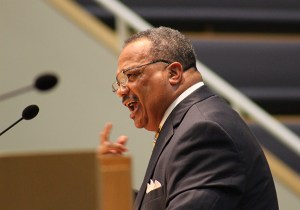
“If God can change you and me, the same God can change their lives,” said Fred Luter, pastor of Franklin Avenue Baptist Church in New Orleans, speaking of lost people, particularly those engaged in drugs, gang activity, and a litany of sinful lifestyles he enumerated.

“In your B.C. days, in other words, in your ‘before Christ’ days, what did it take to change you? Before you stopped drinking, before you stopped shacking up, before you stopped using the N-word, before you stopped going to casinos and playing the lottery (I hoped you stopped!)… you heard the gospel! You heard the gospel of Jesus Christ! You were transformed by the power of the gospel…. The same gospel can change our city and can change those knuckleheads in our streets!”

Luter, who served as the first African American president of the Southern Baptist Convention, urged the crowd: “Come on preachers, let’s preach the gospel of Jesus Christ! Come on teachers, let’s teach the gospel of Jesus Christ! Hallelujah, Jesus saves!”

scott-nichols

Scott Nichols

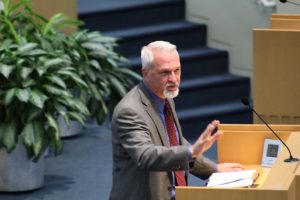
Illinois pastor Scott Nichols of Crossroads Community Church in Carol Stream, said “reconciliation is painful, hard work” but it’s our calling for “those in the grip of sin…because God’s done reconciliation in my life. Our purpose is not growing our church. The purpose is making us like Christ. The purpose is winning the world to Christ,” Nichols said.

Politics was overshadowed by Gospel in the preaching and in the breakout sessions. “Leave the political stuff alone, that is only going to divide,” said Ron Gray, pastor of The Connection Church in Chicago, in a breakout session.

“With all this is going on around us, someone should be asking ‘Is God trying to tell us something?” said H. B. Charles, Jr., a skilled expositor and pulpiteer from Jacksonville, Florida.

hb-charles3

HB Charles, Jr

“God speaks by his actions, but God also speaks by in his inactions.” There is the wrath that is due man’s rebellion, “and there is the wrath of abandonment” for those who persist in the sins listed in Romans 1, as God turns them over to the outcomes of their sins.

As several speakers said, whatever the outcome of the election on November 8, the next day God will still be on the throne and in charge. “I was tempted to label this sermon the unelected and unimpeachable king!” Charles said. “His almighty Son has already been appointed King, and he is not up for re-election.”

“Thank you, Lord!” came the reply from the pews.

By Marvin Del Rios

Editor’s note: This post is the last in a series on cross-cultural ministry, taken from a round table discussion between four Illinois pastors and leaders. Click here to read more from their conversation, published in the September 29 issue of the Illinois Baptist newspaper. 

marvindelriosMarvin Del Rios is pastor of iglesia Bautista Erie in Chicago. He will lead worship during the Thursday morning session of the Illinois Baptist State Association’s Annual Meeting at Broadview Missionary Baptist Church in Chicagoland, Nov. 2-3. The theme of the meeting is “Cross-Culture.”

Defining ‘cross-cultural ministry’
When I hear “cross-cultural ministry,” I go to the book of Acts, chapter 6, which talks about the differences between the Hellenistic Jews and the Jews that come from their own land. That is something that we are living within Hispanic or Latino churches right now, which is the way our generations relate to one another.

The first generation can become accustomed to a certain way of preaching, a certain way of leading worship, a certain way of “doing church” right. The second and third generations are more familiar with American culture, education, lifestyle, and language. What is happening is that there is unfortunately an exodus of the second and third generations that are leaving the church. Either they’re leaving completely and not coming back, or they’re going to a more English-based or multicultural church.

On a pastor’s responsibility
Even though I am called to go and preach to the nations, I have a burning desire to go and reach my second- and third-generation Latino culture. Unfortunately, there is a huge disconnect with the first, second, and third generations, even though we may speak the same language and may have some of the same traditions.

 We have tried to make our church a hub for the community.

Even though I am a second-generation Hispanic leading a predominately first-generation church, a few people that are second-generation have seen me model trying to minister and take care of that first generation. And now, the first generation is taking the extra step to learn a little bit more English. All of that happened with modeling. I could have said, “Fine, I’m concentrating on the second and third generations, and that’s it.” But we still have that need for the gospel for all generations and cultures. It is our responsibility to see it through and make it happen.

On inter-generational outreach
My approach has been to let get something going well with our second-generation people, so they can take it back to the first generation. Usually we hear about the first generation ministering to the second generation, but now it is starting to turn around.  Now it is the second generation ministering to the first generation. Because of that dynamic, we also are ministering to the young professionals in our community and trying to see where we can come out of our comfort zone.

We have tried to make our church a hub for the community. Now we are housing an AA meeting for families and a lot of contemporary culture kinds of programs. In a nutshell, the people in our community know we are there to serve. Is it happening really fast? No, I wish it would be faster. But it is getting to the point that we are seeing more of the gospel leading out, instead of the gospel just being planted in our church and staying there.

Missions opportunities to highlight gathering in Metro Chicago

Final preparations are under way for the 110th IBSA Annual Meeting November 2-3. The event at Broadview Missionary Baptist Church in metro Chicago will focus on cross-culture ministry opportunities in Illinois. The keynote speaker will be Dr. Jeff Iorg, president of Gateway Seminary of the SBC, called Golden Gate Seminary prior to its relocation from the San Francisco Bay Area to metro Los Angeles this year.

“Dr. Iorg is among the most compelling, thoughtful, and missional voices in Southern Baptist life today, especially when it comes to understanding post-Christian culture in America,” said IBSA Executive Director Nate Adams. “I’m so grateful that he is leading our West Coast seminary into the future, where pastors and leaders will engage values and cultures that are already very different from those of the past century.”

I hope this year’s Annual Meeting will bring to all of us a new vision and higher level of commitment to ‘cross culture’ with the gospel.

Iorg is a former church planter and state convention executive director in the Pacific Northwest. As a leader of Southern Baptist work on the West Coast, Iorg has addressed many of the cultural challenges now facing evangelicals in the Midwest. He has written frequently on theological and biblical perspectives on marriage, sexuality, and gender. His book “Building Antioch” shows from the New Testament how an ordinary believing congregation can become a transformational community.

“Illinois Baptists will come away from Dr. Iorg’s messages challenged and transformed, I’m sure,” Adams said.

The Wednesday evening session, including Iorg, will focus on a four-phase process for engaging ministry across cultural barriers. Adams will outline the plan and share testimonies and videos of Illinois churches carrying the gospel to people unlike themselves.

“My own recent trips to Chicago have reminded me again how diverse our churches are, and even more so how varied and challenging are the cultures that our churches need to reach,” Adams said. “I hope this year’s Annual Meeting will bring to all of us a new vision and higher level of commitment to ‘cross culture’ with the gospel.”

IBSA President Kevin Carrothers, pastor of Rochester First Baptist Church and Vice President Adron Robinson, pastor of Hillcrest Baptist Church in Country Club Hills, will also bring messages.

In addition to the session on the variety of ministry opportunities in Illinois, the meeting will include two business sessions on Wednesday afternoon and Thursday morning. Vision tours of Chicago-area ministry opportunities are available. Seating is limited, so online registration is encouraged.

Visit www.IBSAAnnualMeeting.org to learn more.

By Kevin Carrothers

Editor’s note: This post is one in a series on cross-cultural ministry, taken from a round table discussion between four Illinois pastors and leaders. Click here to read more from their conversation, published in the September 29 issue of the Illinois Baptist newspaper. 

kevin-carrothersKevin Carrothers is pastor of Rochester First Baptist Church and president of IBSA. He will deliver the president’s message Wednesday, Nov. 2, during the Illinois Baptist State Association’s Annual Meeting at Broadview Missionary Baptist Church in Chicagoland. The theme of the meeting is “Cross-Culture.”

On being an influential church
I was a couple of years into my ministry in Rochester when I sat down with a leader in town. I asked him, “What do you think about when you hear Rochester First Baptist Church? What comes to mind?” His words weren’t really a rebuke, but I didn’t like what he said. He said “You’re a nice little church.”

Well, we are a small church, unapologetically a small church, but that was his perception, a “nice little church.” Now, hopefully that has changed since then. Now, we’re “the church that does the party” (our annual fall festival). Or we’re the church that does VBS in the summer in a way that spreads the gospel to our community.

We don’t have to be the biggest church but we can still be the most influential church.

I don’t want to just be the nice little church, but we are still little. The word that I want is influence. We don’t have to be the biggest church but we can still be the most influential church.

On ‘incarnational’ ministry
God was incarnational with us—he sent Jesus to live among people. Likewise, we need to be incarnational. Sometimes I think that’s where we kind of miss the boat in the church. We think we have to come up with a new program or a new ministry. Instead, let’s find out who is doing something and go be involved in that.

For me personally, being incarnational is volunteering at my kid’s school. On my day off, I spend a couple hours at the schools and have a presence there. That makes an impact. It’s coaching Little League or youth basketball. You’re there with people. Then, you have to be intentional about making sure the gospel becomes known, about making sure that they know this is who you are.

It gets back to all the things we have been talking about. Cross-culturally we have to love our community; we have to show them that we care. We have to go where they are.