Archives For November 30, 1999

THE BRIEFING | Posted by Meredith Flynn

True_Love_Waits(From Baptist Press) A new documentary marks the 20th anniversary of “True Love Waits,” an abstinence movement that found its footing in American churches and has since made an impact in countries around the world. “True Love Waits: The Complicated Struggle for Sexual Purity” was produced by LifeWay Films; Jimmy Hester, LifeWay’s then-student ministry director, helped create True Love Waits in 1994.

“We knew from the beginning we wanted to address the criticisms as well as the successes of the True Love Waits movement,” Travis Hawkins, the documentary’s director, told Baptist Press. “We knew viewers would see through any spin we put on the story. We weren’t afraid to have an honest conversation.”

Susan Bohannon is one early “True Love Waits” committee who shares her story in the film. The young woman, who became a teen spokesperson for the movement, struggled in college with peer pressure and the commitment she’d made. Clayton King, author of the curriculum that will relaunch True Love Waits this year, told BP that Bohannon’s story exemplifies the need to return the movement to one focused on the purity found in Christ.

“I want people to know they are pure because Jesus purified them from sin, not because they have perfect behavior and have never had intercourse or looked at porn,” King said. “The good news is that temptation, lust, porn, sex, shame and guilt are no match for the grace that Jesus offers us.”

Read the full story at BPNews.net.

Other news:

Nun faces sentencing for protest at nuclear plant
Megan Rice, an 84-year-old nun, will be sentenced today for a break-in at the Y-12 nuclear weapons facility in Oak Ridge, Tenn. Rice and two other protestors who hung banners and painted messages on the walls of a bunker could receive six to nine years in prison, according to this Associated Press story.

Research examines Russian religion
With the world’s eyes on Russia during these Winter Olympics, Pew has found the nation is much more religious since the collapse of the Soviet Union. The number of adults identifying as Orthodox Christian increased from 31% to 72% between 1991 and 2008, according to Pew’s research. And the percentage claiming no religious affiliation fell from 61% to 18%. But the number of Russians who regularly attend church only increased from 2% in 1991 to 7% in 2008 (with a peak of 9% in 1998). Read more at Pewforum.org.

Wheaton students protest former lesbian’s testimony
Collegians at Christian university Wheaton College protested a Jan. 31 presentation by Rosaria Champagne Butterfield, a former Syracuse University professor and author of ““The Secret Thoughts of an Unlikely Convert.” The students’ actions indicate a “generational shift in attitudes about human sexuality,” writes  Baptist blogger Denny Burk.

The truth about camels
An archaeological discovery has led some scholars to renew questions about the Bible’s accuracy, Christianity Today reports. Researchers in Tel Aviv used carbon dating to determine that domesticated camels weren’t used in Israel until near the end of the 10th century B.C., almost 1,000 years after the biblical patriarchs. But some Bible scholars say their findings are “overstated,” CT reports.

Jeff_Jones_blog_calloutEditor’s note: This column is part of a Baptist Press series coinciding with the call to prayer issued by Frank Page, president of the Southern Baptist Convention Executive Committee.

HEARTLAND | Jeff Jones

Evan was involved in a small youth group at his home church until he went away to college. While at college his faith was tested, but eventually strengthened to the point that he felt compelled to return to his home church and share his passion for Christ with his youth group. He shared one night with 17 students who all were transformed as a result of hearing the simple 4-point message:

1. You must confess any known sin to God, and put right any wrong done to man.

2. You must put away any doubtful habit out of your life.

3. You must obey the Spirit’s promptings immediately.

4. You must confess your faith in Christ publicly.

This simple meeting began a movement of God which we now know as the Welsh Revival of 1904-05. Evan Roberts was a young college student who saw God’s Spirit work powerfully resulting in a “nation sweeping” movement. In five months, more than 100,000 people were saved. The country was changed so much that courts had no cases to try, police had no crimes to solve, the birth rate for unwed mothers dropped by almost half in two counties, and the churches were filled in every town. All this began with one college student fully surrendered to the Lord.

College Students

Most people today associate college students with some very dangerous and destructive behaviors such as drugs, alcohol, sex, parties and irresponsibility. Based on experience and encounters I’ve had with students on the college campus, some of these characterizations can be true. More than any other time in our history, the opportunities for sin and worldliness are available and acceptable in the culture in which we find ourselves. Collegians are surrounded not only by sinfulness, but increasingly they are practically expected to adhere to godlessness, which is advocated on almost every university campus in our nation.

But, if we are praying and believing God for spiritual awakening and revival, then more than anything, based on our understanding of how God has worked in all of history, we should beg God for the hearts and lives of college students. Almost every great movement of God has been sparked by the brokenness and desperation of college-aged individuals who long for God’s Spirit to bring revival. As a matter of fact, many revivals began on secular college campuses after Christian students came face-to-face with God in prayer. One campus would affect another campus, and then it would spread to churches and even to public arenas. The conviction of the Holy Spirit would wash over students, and they would become contagious as they boldly shared the Gospel as the basis of their transformed lives.

How can we pray for college students?

1. Pray that college students would understand the urgency to be submitted to the lordship of Jesus Christ every day. Ask God to protect them from a consumer approach to Christianity and the church so that they would see everything else as insignificant in comparison to knowing Christ and being found in Him.

2. Pray that college students would understand the demand of holiness on their lives that comes from Jesus. Pray that they take seriously the relationship of purity they have with the Father and seek to “be holy because I am holy.” Pray that repentance and forsaking of sin would be a habit that defines their walk with God.

3. Pray that college students would join together in prayer groups and seek God while calling out the names of students who are lost. Pray that the Spirit of God would open their eyes to the conditions around them, and burden them for their campuses.

4. Pray that college students would take responsibility and ownership of their faith, investing themselves in the lives of others who will come to Christ, share the Gospel and live holy lives as well. Paul’s charge to Timothy was, “No one should despise your youth; instead, you should be an example to the believers in speech, in conduct, in love, in faith, in purity” (1 Timothy 4:12).

5. Pray that God’s Spirit and His Word would become the standards from which students make life decisions such as whom to date, whom to marry, what occupation they will enter, what friendships they will value. The college years in our culture are when most adults make major decisions that shape the rest of their lives. Pray that they will follow Jesus in these choices.

College students are not the future of our church; they are the church. Take some time today to love, invest in and pray for the college students in your life.

This article originally appeared in Baptist Press Feb. 8, 2013. Jeff Jones is the Baptist Collegiate Ministry campus minister at the University of Memphis in Memphis, Tenn.

Kurt Crail, a volunteer from Ashmore Baptist Church, visits with school kids on Gibitngil Island in the Philippines.

Kurt Crail, a volunteer from Ashmore Baptist Church, visits with school kids on Gibitngil Island in the Philippines.

Editor’s note: Rex Alexander is in the Philippines this week with an Illinois Disaster Relief team, helping to rebuild a school damaged by Typhoon Haiyan. This is excerpted from an email update he sent today.

Friday, Feb. 14 | Today was Valentine’s Day in the Philippines. This was an exciting day for the kids because they wrote Valentines to each other and to our team members as well.

In the afternoon the entire school had a special assembly for Valentines and then some free time for games, etc. The principal of the school (who is a Christian) asked if I would bring a message to the school children about the difference between Valentine love and God’s love. So I gave a brief presentation about how we celebrate Valentine’s Day in America. Then I talked about God’s love which is greater than all other kinds of love.

I was able to give a clear gospel presentation and explained how everyone can accept God’s love by receiving his Son, Jesus. I was hoping that I was not “overstepping” my bounds in this public school setting. Then afterwards the principal received a Valentine from the school children and then she brought a message which was similar to mine. She quoted several scriptures and told that children that only God’s love will ever bring satisfaction to them. It was unexpected and pretty cool especially because we got to speak to the whole school! She is a bold Christian woman who loves her children and teachers.

Read more about the team’s work in the Philippines in the next issue of the Illinois Baptist, online at http://ibonline.IBSA.org.

Russell Moore, pictured here at the SBC's 2013 annual meeting,

Russell Moore, pictured here at the Southern Baptist Convention’s 2013 annual meeting, told Baptist leaders this week that marriage is more a Gospel issue than a political one.

Courts moving ‘very, very fast,’ Moore says

NEWS | Eric Reed

“I expected 2014 to be ‘the year of same-sex marriage,’ I just didn’t expect it to be in Utah, Oklahoma, and Kentucky,” said Russell Moore, president of the Southern Baptist Convention’s Ethics and Religious Liberty Commission.

His comments came on Wednesday, the same day a federal judge in Kentucky struck down a law which protected that state from recognizing same-sex marriages performed in other states. Courts in nine other stated have issued similar bans.

“This is moving very, very fast, and in some unexpected ways,” Moore said. He spoke by Skype to executive directors of SBC state conventions and editors of Baptist state newspapers meeting in Idaho.

Asked about his advice for pastors and denominational leaders, Moore said, “We need to equip our people to deal with same-sex marriage. And not just in the blue states, but in places like Mississippi and Alabama.”

Moore pointed to the battles in the courts as determinative for states that have not approved same-sex marriages or that have banned it. Ultimately the United States Supreme Court will decide. That’s why it’s important for Christians to be involved in court actions early in this process.

“The principle we ought to see is from the apostle Paul appealing to Caesar. His appeal was not about his rights as a Roman citizen, but for the ability to preach the Gospel—for everyone.”

The marriage issue is a Gospel issue, he said, more than a political issue.

Moore pointed to the impact of court rulings on the institutional level. The most vulnerable ministries are not the churches themselves, that they may be forced to perform same-sex marriages, but the institutions that operate as separate ministries of churches or denominations. He cited Kentucky’s Sunrise Children’s Services (that state’s Baptist children’s home) that faced a lawsuit over its hiring practices.

And, closer to home, Moore said individuals who refuse services to gay couples will be increasingly vulnerable. One example is the owner of a Washington state florist sued because she didn’t wish to provide flowers for a gay wedding.

“A government that can pave over the conscience of that florist or photographer can pave over the conscience of anyone,” Moore warned.

Moore addressed several other issues including immigration reform and abortion. He finds little real difference of opinion among national politicians on immigration and is optimistic that some meaningful fix can come within a year or so.

On abortion, Moore said he is “both optimistic and pessimistic.” He is optimistic that 40 years after Roe v. Wade the prolife movement is strong. The rallies he has attended since assuming leadership of the ERLC are “filled, filled, filled with young people.”

But Moore is pessimistic that the decision will be reversed, even though experts on both sides of the argument admit Roe v. Wade is what Moore called “bad law, a train wreck of a ruling.” Abortion activists remain well funded and well organized, he said.

Pro-life activists need to be watching the developments in abortion technology, he said. The next front for pro-life is not clinical, where abortions are performed, but chemical, drugs that make abortions more easily obtained.

Eric Reed is IBSA’s associate executive director, communications, and editor of the Illinois Baptist.

Pat_Pajak_blog_calloutCOMMENTARY | Pat Pajak

You might actually be tearing down the very thing you’re trying to build if you’re guilty of these teamwork killers:

1. Practicing the age-old adage: My way or the highway
When trying to build teamwork, don’t forget that everyone has an opinion. Oftentimes, the thoughts, ideas and suggestions that arise through team discussions can be helpful. Listen to and learn from your team, involve them in decision making, ask for their input, and embrace the reality that teamwork can often be better than “my way or the highway!”

2. Being all about the numbers
Make no mistake about it, numbers do matter and the bottom line is important, but it’s not the final measurement. The very best teamwork (strategies, goals, planning and effort) doesn’t always produce the expected results. Numbers become a problem when a leader puts so much focus on them that he or she forgets about the importance of the team – the people who are making those numbers happen. People matter more than numbers, and forgetting that fact destroys teamwork.

3. Talking without listening
If no one else can get a word in or share an opinion, there is no teamwork. A leader destroys the opportunity to build future leaders if he or she is always talking and never listening. If people are never heard, they will soon cease to share things that matter.

4. Changing things just for the sake of changing things
Change is good and sometimes necessary. But it must be based on a specific outcome. Any leader who takes this to another level by changing things just to let you know they’re in charge doesn’t really understand teamwork. Operating as a team requires a leader to explain why change is necessary, move carefully through the process, and be willing to admit that what the team is saying sometimes makes perfect sense. Failure to survey the impact, timing and necessity of change destroys teamwork. Get everyone on board before any change takes place.

5. Micro-managingThe quickest way to destroy a team is to micro-manage every decision, action and assignment. Team members know the difference between being given a responsibility, and being handed a predetermined to-do list. Leaders who care more about things being done exactly their way destroy the notion of teamwork. Are you really interested in building a team? Remember the word of Dr. John Maxwell: “People don’t care how much you know until they know how much you care.”

Pat Pajak leads IBSA’s church strengthening team.

THE BRIEFING | Meredith Flynn

Lily Eddington and Three Rivers Disaster Relief leader Ken Cummins picked up a new chainsaw after Lily wrote a story that raised more than $2,000 in donations.

Lily Eddington and Three Rivers Disaster Relief leader Ken Cummins picked up a new chainsaw after Lily wrote a story that raised more than $2,000 in donations.

The newest piece of equipment in Three Rivers Association’s disaster relief trailer came from an unlikely source: 10-year-old Lily Eddington.

The Shorewood fifth grader wanted to help the association purchase a new, bigger chainsaw for the team to use after disasters like the November tornadoes that affected many communities across Illinois. She wrote a story that has garnered just over $2,000 in donations, enough to purchase the new chainsaw, another smaller saw, and other needed safety equipment.

Lily has the inside track to knowing about such a specific need – her grandfather is Dan Eddington, Three Rivers’ director of missions. “She knew through my father that they needed help raising money for that,” said Lily’s dad, Matt. “And she came up with the idea of writing a story, and he took the idea and kind of ran with it. And it worked out really well.”

Her grandfather helped Lily publish the story in booklet form, with her own illustrations. The story centers on a family trapped in their home after a tornado. Sisters Megan and Brianna take shelter in the basement with their parents (plus their cat and hamster), but a large tree keeps them trapped inside after the storm passes.

“Then they heard a truck pull up,” Lily wrote. “On the side of the trailer they saw the words, ‘Three Rivers Baptist Association Disaster Relief.’

“Suddenly they heard, ‘Come on guys, we need to get this tree off the house.’”

Read the full story at IBSA.org.

Illinois workers join typhoon response
A team of Illinois volunteers is hard at work in the Philippines this week, helping rebuild a school damaged during Typhoon Haiyan last fall. The Disaster Relief leaders also are repairing rain water collection sites on Gibitngil Island, where there is no natural water source. The team starts each day with a boat ride from Cebu Island, where they’re staying, to Gibitngil. “People in small shack houses greet us all along the way and some have even posted signs on their homes thanking our team for helping to rebuild their school,” said Rex Alexander, state director of Disaster Relief for the Illinois Baptist State Association. Go to IBSA’s Facebook page for updates on the team’s work.

Barna: Majority of Christians unclear on calling
Less than half (40%) of practicing Christians have a clear sense of God’s calling on their lives, according to the Barna Group. And 48% of Christian Millenials (generally thought of as those born in the 80s and 90s) say they believe God is calling them to different work. That lack of clarity is the foundation for Barna’s three vocational trends for 2014.

Blog post puts church attendance under the microscope
Author Donald Miller blogged recently that he doesn’t attend church often. “…I don’t learn much about God hearing a sermon and I don’t connect with him by singing songs to him,” wrote Miller, who has chronicled his faith journey in “Blue Like Jazz” and several other books. “So, like most men, a traditional church service can be somewhat long and difficult to get through.” Miller added that he experiences intimacy with God through his work.

Southern Baptist professor and blogger Denny Burk was one of many who responded to Miller’s post, calling his decision “a recipe for spiritual suicide.” Miller responded, and Burk has posted the exchange on his blog.

Christianity Today lists 8 Olympians to watch
Check out CT’s list of Christian athletes competing in Sochi. “We don’t root for them because they’re on ‘Team Jesus,'” writes Laura Leonard, “but all the same it’s nice to see people at the peak of their field, on the world’s biggest athletic stage, turn the credit back to the One who gave us bodies to run and jump and spin on ice and imaginations to push the limits of those bodies to run faster, jump higher, and spin faster than we ever thought possible.”

Nate_Adams_blog_callout_2HEARTLAND | Nate Adams

Last month Directors of Missions and other associational leaders from around the state gathered at the IBSA Building for a time of leadership development, fellowship, and strategic thinking about how best to assist churches. Dr. Chuck Kelley, president of New Orleans Baptist Theological Seminary, was invited to speak to us on “Fostering a Positive Baptism Trend in an Association.”

To set the stage, Dr. Kelley reminded us that the number of baptisms in SBC churches overall has been on a 50-year plateau, and has now actually declined six of the past eight years. Nationwide data for 2013 is not yet available, but in 2012 baptisms declined 5.5% from 2011, to only 314,956. That’s the lowest level since 1948, when SBC churches reported only 6 million members rather than the current 16 million. In fact, to give those numbers some further context, baptisms totaled 445,725 in 1972, and 429,063 in 1959.

Here among IBSA churches, baptisms were actually up 3.1% in 2013 to 5,063, building on the previous year’s 2.6% increase. Still, 2013 is our churches’ first year above 5,000 baptisms since 2009. And in 2005, IBSA churches reported 6,499 baptisms.

While all of us were eager to hear what Dr. Kelley would suggest, none of us were really surprised when he said there are no easy answers to reversing the current baptism trend. I was personally grateful to hear him underscore that we shouldn’t seek to affix blame or pass the buck. Instead, we all need to focus passionately and sacrificially on the urgent need to reach people with the Gospel in an increasingly challenging environment.

While I don’t have space here to recap everything Dr. Kelley shared with us, I can share his alliterated outline. He said we need to Focus on Filling (of the Spirit, or revival), on Fruitfulness (intentional evangelism), on Faithfulness (a return to true discipleship), and even on Fighting (embracing the inevitable conflict that comes when change is needed, yet with Christ-like attitudes and righteousness).

All of these points hit home deeply with me, and couldn’t have come at a better time. Not only are we beginning a new year of ministry here at IBSA, and in all our churches, but we are also beginning our planning and budgeting for 2015. We can’t keep doing ministry as usual and expect a much different result.

As Dr. Kelley urged, we must persistently ask God to fill us afresh with His Spirit, and bring revival to our churches and spiritual awakening to our land. We must focus much more intentionally on fruitfulness, starting new Bible studies and Sunday School classes and evangelistic ministries, and equipping believers to courageously share the Gospel. We must more carefully embrace true discipleship, investing God’s Word deeply in those who will be faithful to live the Gospel and pay it forward into the lives of others. And yes, we must be so committed to a different level of fruitfulness that we are
even willing to engage the conflict that often seems to come with change, even in churches.

Those of us leading and serving churches today have lived most of our adult lives on the downwardly sloping plateau of this baptism trend. In many ways we have been maintaining our processes and doing church in comfortable ways, and if we simply continue our current patterns in the face of a changing culture, we will soon see the downward slope of the current trend steepen dramatically.

So as we prepare to plot one more year of baptisms on the chart of history, it is this urgency of reaching spiritually lost people with the Gospel that must compel us, and our churches. Baptisms may not be the only measure of fruitfulness, but they are a measure that we cannot be content to see in even gradual decline.

Nate Adams is executive director of the Illinois Baptist State Association.

CONVERSIONS COUNT – “We have to help our churches focus on bearing fruit, and to keep up with that as a measure of how they’re doing,” NOBTS President Chuck Kelley told associational leaders in Illinois. “Fruitlessness is becoming endemic in Southern Baptist Life.”

CONVERSIONS COUNT – “We have to help our churches focus on bearing fruit, and to keep up with that as a measure of how they’re doing,” NOBTS President Chuck Kelley told associational leaders in Illinois. “Fruitlessness is becoming endemic in Southern Baptist Life.”

The SBC’s declining numbers are real. But there are solutions, says seminary president Chuck Kelley.

NEWS | Eric Reed

Since he began studying and teaching evangelism more than 30 years ago, New Orleans Baptist Theological Seminary President Dr. Chuck Kelley, told associational leaders in Illinois in January, we’ve been quoting the same statistic: 30% of our churches are growing, and 70% of all Southern Baptist churches are plateaued or declining. “The difference today is the 70% aren’t so much ‘plateauted;’ our churches are declining. We are a convention at a crossroads.”

Kelley is one voice in a chorus of national leaders calling on Southern Baptists to end the decline in baptisms and missions giving in our churches that threatens fulfillment of our kingdom work and the future of the denomination itself.

The head of the convention’s executive committee, Dr. Frank Page, also delivered a stark address in January. “…You say, ‘What is our future?’ I do not know. I’m asked that every week by someone, and I say, ‘I cannot answer.’ If things do not change, I can tell you in 20 years we will be happy to have 27,000, not 47,000 churches,” Page said.

In a “State of the SBC” address at Midwestern Seminary, Page cited “fault lines” in the denomination, where pressure has built and the fabric of the organization is threatened. Among them are the arguments over the nature and authority of Scripture in the 1980s, and more recently the debate over Reformed theology, methods of funding missions, and democratic-based church governance.

The effect of these “fault lines” is seen in declining baptisms and a 20-year downward trend in missions funding through the Cooperative Program. “We have argued over issues that have taken away our evangelistic fervor to the point that now our baptismal rates have reached a low not seen since 1948,” Page said. “God help us.”

Southern Baptists baptized 314,956 people in 2012, the most recent tally available. That was a decline of 5.5%. The figure compares to the post-war baptismal rate, when Southern Baptists numbered 6 million, in contrast to today’s 16 million. A decade-long focus on evangelism after World War II produced the denomination’s greatest surge of conversions, peaking at 445,725 baptisms in 1972, and the steam to power the next six decades downhill from there.

Leaders are hopeful that a final tally on 2013 baptisms and Cooperative Program giving, due soon, will show a slight uptick, and perhaps end the slippery slope. And in Illinois, baptisms and giving are up for 2013.

Still, national leaders are now talking publicly and regularly about the SBC as a denomination that is plateaued and declining, mostly declining.

Page’s speech, now being viewed widely on the internet, comes on the heels of “an open letter” from LifeWay President Thom Rainer calling on members of what is still the largest Protestant denomination in the United States to recapture their zeal for evangelism.

“Where is the passion in most of our churches to reach the lost?” Rainer asked. “I thank God for our affirmation of the total truthfulness of Scripture. I thank God for orthodoxy. But I pray that it is not becoming a dead orthodoxy – an orthodoxy that has lost its first love.”

“I have no proposal,” Rainer summarized. “I have no new programs for now. I simply have a burden.”

Kelley’s proposal

The history of every church and denomination is growth, plateau, and decline, Kelley told associational leaders meeting at the Illinois Baptist State Association building January 27-28. Pointing to Methodists, Presbyterians, and other mainline

denominations, Southern Baptists for many years expressed thanks we weren’t following their decline. Now we are. “We are seeing a growing gap in the rhetoric about Southern Baptists and the reality of where we are,” he said.

And the declines are in all parts of the U.S. “We’re losing the South,” Kelley said. “You need to be aware that the South is becoming more like Illinois; large blocks of unreached people, and churches that are smaller.”

And a new generation that is not following their parents’ lead by staying in church after they reach adulthood.

Kelley likened the denomination’s downward turn to an airplane in a tailspin: beyond a certain point, the pilot can’t pull the nose upward and right the plane. “We’re nearing that point,” Kelley said.

He identified four factors in this precipitous decline, problem areas that also point to possible solutions:

Elephant 1: Awakening

“We have a power problem,” Kelley said. “We have gotten so used to working without the filling of the Spirit of God, we don’t know it’s not normal. Kelley called for church leaders to encourage prayer for spiritual awakening: “This is like stacking the firewood for God to light the fire.

“We need to have solemn assemblies, for our people to seek a move of God… If God isn’t moving, there is an issue within us,” he said, pointing to the need for repentance.

Elephant 2: Conversions

As the numbers have dropped, Southern Baptists have moved away from publically counting baptisms as a measure of our fruitfulness. While Kelley acknowledged there have been misuses of the system in the past, he said our churches must return to a focus on fruitfulness. Specifically, we need to see conversions as a measure of “what God is doing in our churches.”

“Many of our churches have the Sunday school attendance posted somewhere, and last week’s offering,” Kelley said, “but I have been in very few churches that have in a public place how many people they have baptized – and even fewer that have a public goal of how many they want to baptize.”

He offered three measures of fruitfulness: beyond conversions, churches should measure ministry to the community. “Most churches do not have a muscle set for ministry to the community,” he pointed out, but it is community ministry that opens doors for evangelism.

And churches should measure church planting, their own participation in the reproductive process that brings healthy new congregations into existence, with members fueled by the salvations of their lost family and friends.

Elephant 3: Discipleship

While the rhetoric in our high-point decades was about evangelism (“A million more in ’54!”), the real genius of the period, Kelley contends, was in our dis

ciple-making mechanisms: Sunday school and training union. These methods focused on making new believers into disciples, who then led more people to Christ.

But, he said following extensive study, “Every methodology has a shelf life, and as the methodology wore out its shelf life, we did not replace it…. Our discipleship processes have been dismantled, not intentionally, but by attrition. Our discipleship has become a patchwork that is reinvented every year. It’s a series of things, not a cohesive strategy.”

In the last 20 years, Kelley said there has been a “megashift” in SBC life from the priority of discipleship to the priority of worship. One result is under-educated people who call themselves Christian, but whose lifestyles are little different from unbelievers.

“When I grew up, we still had a sense of being a stranger is a strange land. We were counter-culture…. I’m not calling for a return to the sixties. I am saying we have to find for today what a distinctly Christian lifestyle looks like and teach our people what living distinctly Christian lives is, so that we have evangelism that will impact our society.”

One of our needed conversations is how we will lead our congregations to spiritual maturity in this new era.

Elephant 4: Fighting

Finally, Kelley pointed to a significant shift he has witnessed from the seminary campus: “Today’s seminary students are not interested in going into existing churches, because they are scared. They have seen the results and heard the horror stories of church fights,” Kelley said.

Yet, that’s where the need is, in existing churches that are plateaued or declining. “If a pastor comes to bring growth, there will be conflict. We need to have conversations about how to have conflict.”

Kelley said leaders need to help their churches process conflict in ways that bring positive change and do not harm the Body of Christ. “Not all church fights are the result of failure on the part of the pastor, or of having ungodly people in the pews. It is the result of change. Leading change creates conflict,” Kelley said.

It also turns declining churches – and denominations.

Mark_Warnock_blog_calloutCOMMENTARY | Mark Warnock

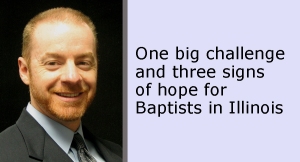
I resigned in December from my church, First Baptist Columbia, to return to my home state of Florida. God has burdened me with the vast lostness of South Florida, and impressed upon me a duty to be closer to my aging parents. I’m moving down to join a church planting movement in South Florida, and to shine my little Gospel light in that darkness.

This move brings to a close 17 years of ministry in Illinois – six-and-a-half years in Chicagoland, and eleven years in the Metro East. I leave behind a host of people at my church and throughout the state that I love and respect. As I leave Illinois, I see both a lingering challenge and a great hope.

The primary challenge I see is the same one the church faces everywhere: selfishness. On a personal level, a church level, and a denominational level, we must fight constantly the Satanic gravity of our own selfishness that wants to make our lives all about us, our churches all about us, and our denomination all about us.  Jesus our Savior came not to be served, but to serve, and He calls us to deny ourselves, to take up our cross and to follow Him.

God formed a church to be a light to the world, for His glory. He has graciously allowed us to cooperate as a denomination to pool our efforts to fulfill the Great Commission, for His glory. So to the leaders in Illinois: Do not stop calling us outward, to the lost. Remember Luke 15, and the priority of God our Father: “…there is joy in the presence of God’s angels over one sinner who repents.”

This fight to keep our eyes outward is not in vain, because there are signs of hope everywhere. Here are three I see:

Planting churches. I learned during my time at Columbia that one key to a healthy church is a steady stream of new converts. Like families, which continue to exist only if new babies are regularly born into them, churches begin to die without new spiritual life, and denominations begin to die without new churches.

I’m encouraged that God is calling men and women to devote their lives to starting new churches, and that IBSA is giving great priority to new church starts all across the state. Even more, I’m encouraged that increasingly, established IBSA churches are beginning to discover the joy and adventure of partnering with, supporting and working alongside church plants for the advancement of the Gospel.

Thinking students. I began teaching high school students at IBSA’s Super Summer in the late 90s. Many of the students I had in the early years are now pastoring or leading in churches across our state. I have been consistently impressed with the quality of the students in Illinois. They are passionate about the Gospel, hungry to be taught, and eager to love God with their minds. If our churches fail to equip our students with a clear understanding of the Gospel and the intellectual tools to be apologists in a hostile culture, we are in deep, deep trouble. The good news is that when presented with the challenge, our students – our future leaders – consistently rise to it.

A saving God. The real reason I have hope for the Gospel in Illinois and in South Florida? God keeps saving people. In my Monday night men’s group in Columbia, God kept saving some of the most unlikely men. In my first Sunday at my new church in West Palm Beach, I met a woman who came to church without an invitation, just stirred by the Spirit, and not knowing why she was there. She came to faith that week.

Consider Jesus’ answer to the scribes in Mark 2:17 who asked why He was eating with unlikely dinner guests – sinners and tax collectors. “Those who are well don’t need a doctor, but the sick do need one. I didn’t come to call the righteous, but sinners.”

No one is as passionate as our God to save sinners like us.

So to my colleagues in the Gospel across Illinois: Thank you for 17 years of friendship and love. Don’t lose heart. Let your light shine in the darkness. Keep speaking of Jesus. Keep fighting the good fight. Keep holding out the Gospel, because our God is willing and mighty to save.

Mark Warnock formerly served as associate pastor of First Baptist, Columbia.

Six Illinois volunteers, arriving in the Philippines this week, will help rebuild this school on Gibitngil Island.

Six Illinois volunteers, arriving in the Philippines this week, will help rebuild this school on Gibitngil Island. Photo is from the project’s Facebook page.

THE BRIEFING | Meredith Flynn

A team of six Illinois Disaster Relief volunteers will travel to the Philippines this week to help rebuild after last fall’s Typhoon Haiyan.

The group, composed of “blue cap” leaders from around the state, is part of a multi-week, multi-crew project to rebuild a school on Gibitngil Island. The team is the first from Illinois to join the long-term relief effort in the Philippines coordinated by Baptist Global Response. Keep up with their project here.

Other news:

Forum to focus on biblical sexuality
“The Gospel and Human Sexuality” is the theme of a Nashville summit planned for pastors and leaders this spring. The Southern Baptist Ethics and Religious Liberty Commission will host the April 21-23 meeting on marriage, family, purity, morality and culture.

“So many of the questions pastors grapple with today deal with situations that would not even have been possible a generation ago,” said ERLC President Russell Moore. “…We’ll talk about these questions, and how we can be faithful in ministry, Gospel-focused in engagement and Christ-shaped spiritual warriors in the ways we seek to wrestle with the principalities and powers of this age.” Read more at ERLC.com.

Blessed are the … athletic?
Just before the Super Bowl and Winter Olympics took over our TV screens, Americans weighed in on whether God rewards faithful athletes with health and success. Opinion is evenly split, according to the Public Religion Research Institute, with 48% saying yes and 47% disagreeing. But among white evangelicals, 62% believe God rewards faithful athletes. Read more at ChristianityToday.com.

Military’s religious climate questioned
The U.S. military has long been serious about protecting the religious freedom of its troops, said retired Gen. Doug Carver in submitted testimony before a House subcommittee last month. But Carver, who directs the North American Mission Board’s chaplaincy ministry, noted a climate within the military that could restrict religious liberty. Rep. Brad Wenstrup (R.-Ohio) summarized the prevailing concern: “There is a fine line between accommodation and respecting all religions and restricting religious freedom and that’s the line we are walking on here.”

Subcommittee chairman Joe Wilson (R.-S.C.) called for another hearing on the issue in the next 60 days. Read more at BPNews.net.

Bible-themed movies coming soon
2014 may well be the “Year of the Bible,” says culture writer Jonathan Merritt. At the movies, at least. Merritt lists five movies that will have the Bible front and center in the country’s consciousness, beginning with this month’s “Son of God.” Biblical biopics “Noah” and “Mary, Mother of Christ” are due late this year, along with “Exodus.” And although “Heaven is for Real” (April) isn’t based on the Bible, Merritt includes it on his list because “it will likely riff on popular Bible themes such as heaven, Jesus, and salvation.” Read more at JonathanMerritt.com.