Archives For November 30, 1999

Going public

Lisa Misner —  April 16, 2018

Hundreds across Illinois take the baptism plunge on One GRAND Sunday
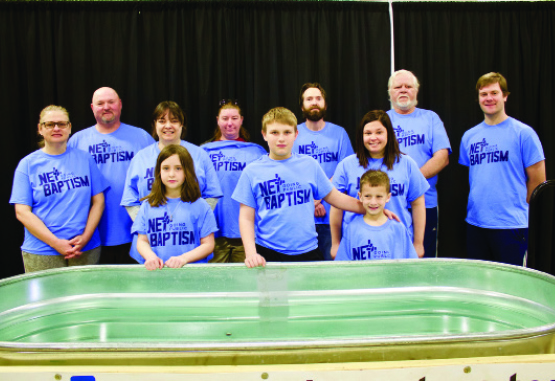
Net Church Staunton Group


Eleven people at NET Community Church in Staunton joined hundreds more that were baptized across the state on One GRAND Sunday April 8.

On Sunday, April 8, volunteers at NET Community Church carried a livestock feeding trough into the high school gymnasium where the church meets. The trough had a lofty purpose—11 people were baptized during the morning worship service. They wore shirts with the words “going public.”

“Their life stories were all very different, but their life conversion was the same,” said Pastor Derrick Taylor. “It was so exciting to witness each one going public with their new lives in Christ, thus declaring I’m not ashamed of the Lord Jesus Christ!”

Across Illinois, hundreds of people were baptized on the day dubbed “One GRAND Sunday.” IBSA’s Pat Pajak first shared the goal of 1,000
baptisms in one day last fall. As word came in of baptisms around the state, Pajak celebrated the 321 reported so far, and the renewed excitement about evangelism that seemed to characterize the day.

“The real purpose of One GRAND Sunday was to remind churches that our responsibility and privilege is to have gospel conversations outside the walls of the church,” said Pajak, associate executive director for evangelism. The day “was a reason to reignite our passion for the Great Commission and rejoice in both salvations and baptisms, which some of our churches had not seen for many years.”

Read a few of the many stories from a day focused on baptism, and on “going public” with faith in Jesus.

‘I’m serious about this’
Brittany Miller grew up going to church, but when she went away to college, it never became a priority, she says. Over the past year, she felt a pull to go back. When a co-worker told her about his new church, NET Community in Staunton, Brittany decided to check it out.

“The pastors were so, so dedicated and just really believed in what they were preaching,” she says. “And I liked how it was just taken right from the Bible.”

There was a disconnect, though. Everyone kept talking about salvation, an unfamiliar concept for Brittany.

Net Community Brittany Miller

Brittany Miller was baptized by her pastor, Derrick Taylor, on One GRAND Sunday.

“I kind of just kept it all to myself,” she remembers. “I didn’t want to ask too many questions, because I didn’t want anybody to think I was a non-believer. Because I believed.” A personal relationship with God, though, was something she didn’t have—yet.

At a small group Bible study one evening, Brittany got up the courage to ask her questions. The group’s leader, Nancy Taylor, pulled in associate pastor David Baker, and together, they walked Brittany through what it means to have saving faith in Christ.

“After hearing what salvation was, I knew that that was what I wanted,” she says. “I wanted that relationship with God; I wanted to deepen my knowledge of him. I wanted him to live through me.”

There was one hang-up, however. “I was so worried that I couldn’t do this because I was going to let God down. And I didn’t want to do that,” she says. “It took a while for the pastor to assure me that that is not how this works.”

After two hours of talking, she prayed to receive Christ. “It all makes sense now,” she says. “It was God pulling me, little by little, to that moment.”

Over the next days and weeks, Brittany started telling family and friends what had happened to her. They were supportive in some cases, and skeptical in others. In some cases, the news didn’t go over as well as she had hoped. Brittany says she’s leaning on her church family to deal with the relational difficulty. She also downloaded a Bible app on her phone, so encouragement is always nearby.

Her baptism April 8 was a way to publicly give God the glory for her faith, and a testimony to the people in her life, she says.

“I need to do this so these people know I’m serious about this.”

All in the family
Willow Krumwiede decided to be baptized so she could share her decision to follow Christ with her church family, among others. Her public profession of faith April 8 also had a profound impact on her dad.

Willow’s father, Tim, came to Grace Fellowship Church in Amboy on that Sunday morning to support his daughter. The church planned baptisms for the end of their first worship service, Pastor Brian McWethy explained, so Tim sat through the entire service that day. Unbeknownst to him, Willow, her fiancé Andrew, and their pastor were actively praying for his salvation.

Throughout the sermon on biblical baptism where McWethy explained why each person must choose to be baptized for themselves, Willow’s father faced his own life decisions. McWethy said he could see the Holy Spirit was at work in Tim’s life during that sermon.
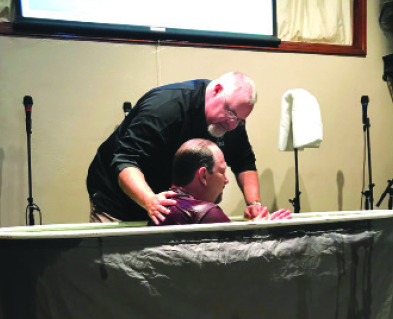
Grace Fellowship Amboy

Willow Krumwiede’s baptism at Grace Fellowship Church in Amboy compelled her dad, Tim, to profess his faith in Christ and be baptized.

As the band played an invitation of “O Come to the Altar”, Willow’s father stood up. He stepped forward and grabbed McWethy by the arms, saying, “I just surrendered my life to Jesus Christ.” McWethy was thrilled at the news. Before he could say much, Tim also said that he was ready to be baptized. Today.

So, a few minutes later, Tim followed his daughter into the baptismal trough. After everyone celebrated with them, McWethy asked Willow, “Did you have any idea this would happen?” Incredulous, she smiled and replied, “No.”

The pastor gives all glory to God. “There is power in his word. There is power in the gospel.” One GRAND Sunday’s emphasis on baptism helped him and his church to focus not only on baptizing, but also evangelism, McWethy said.

“If I’m gonna baptize somebody, they’ve got to get saved.” McWethy has found a renewed focus in sharing Christ daily because he was given the charge to renew his commitment to baptizing believers. “If it did nothing else, it got our minds thinking about the lost.”

‘One happy Grandma’
McKenzie Boston and Kaitlyn Warren are 15-year-old cousins whose “carefree” lifestyle completely changed when McKenzie’s mother suddenly passed away February 8.

McKenzie and Kaitlyn were brought up rarely going to church despite their mothers’ Christian upbringing. But during their visits with their grandparents, John and Carol Warren, the church-going became more frequent.

“I had a burden for all my children and grandchildren,” Carol said. “But I had especially been praying for my daughters and granddaughters.”

Carol wasn’t satisfied with just praying, however, and put her prayer into action. She wanted her children and grandchildren to know where her faith stood. “Every time they visited, I would take them to church.” Carol’s influence paid off and her daughters began attending Emmanuel Baptist Church in Carlinville—the church where they had both been baptized.

Emmanuel Carlinville

Pastor Cliff Woodman of Emmanuel Baptist Church in Carlinville baptizes McKenzie Boston.

The death of McKenzie’s mom came as a shock to the family. The young cousins started thinking more seriously about their own faith and what happens after life on earth. Kaitlyn’s mom, Cheryl, began talking to both girls about Jesus and the salvation he offered from ultimate death.

“The girls were ready by this time to have a relationship with Christ,” Carol said. She laughed, “But they wanted to wait for their grandmother to talk to them.”

On Friday, April 6, Carol talked through the Romans Road with her granddaughters and prayed with them as they received Christ. “It was such an answer to prayer!” she said. “And such a relief for me to know the hope of their salvation.” After talking to their pastor, Cliff Woodman, they prepared to publicly proclaim their salvation to the church on April 8—One GRAND Sunday.

“It was a very emotional time for us all,” Carol said. “But perhaps most especially for me.”

Carol had led her own daughters to the Lord years earlier and had seen the two of them get baptized. Now, she was watching her own granddaughters, whom she had also led to Christ, get baptized in the same church.

“It was very special for me,” Carol said. “I’m just one happy grandma!”

-IB Team Report

The Briefing

David Platt is ready to leave the IMB
When David Platt became a teaching pastor at a DC-area megachurch last year, onlookers wondered whether the president of the International Mission Board (IMB) could really do both jobs. Platt answered them announcing that he will end his three-and-a-half-year tenure at the IMB to work at McLean Bible Church as soon as the Southern Baptist missions agency can find his replacement.

Christian baker wins Calif. court battle
A California trial court has upheld a Christian baker’s right to refuse to create a wedding cake for a lesbian couple, but the decision comes as a similar case is already pending in the nation’s highest court. Tastries Bakery owner Cathy Miller’s freedom of speech “outweighs” the state of California’s interest in ensuring a freely accessible marketplace, Judge David R. Lampe said in his decision in the Superior Court of California in Kern County, one of the state’s 58 trial courts.

CBF nixes ‘absolute’ LGBT hiring ban, maintains it for leaders
The Cooperative Baptist Fellowship’s Governing Board has voted to lift the Fellowship’s “absolute prohibition” of hiring homosexual and transgender employees. But CBF “leadership positions in ministry” and missionary roles still will be limited to individuals “who practice a traditional Christian sexual ethic of celibacy in singleness or faithfulness in marriage between a woman and man,” according to a hiring “implementation procedure” also adopted by the Governing Board. Other positions will be open to “Christians who identify as LGBT.”

Beth Moore, other evangelical leaders publish a letter urging action on immigration
A diverse group of evangelical leaders have put their names on a full-page ad in the Washington Post urging the President and Congress to act on immigration and refugee policy. It has some of the same signatures who have long focused on the welcoming part of immigration. However, it also adds some interesting names, including Bible teacher Beth Moore and popular author Jen Hatmaker, two women who have become increasingly vocal in the Trump era.

Changes in abortion legislation sweeping the country
2017 saw more wins for pro-life legislation than pro-abortion legislation. Including those adopted in 2017, states have enacted 401 abortion restrictions since January 2011, according to the Guttmacher Institute. Legislators in 30 states have introduced abortion bans, with six states enacting new laws in 2017.

Sources: Christianity Today, Baptist Press (2), Washington Post, Stream

Fully staffed Court poised to rule on religious liberty issues

Christians and other conservatives hoped the U.S. Senate’s confirmation of 49-year-old Neil Gorsuch to the Supreme Court in April would tilt the court toward a favorable view of religious liberty concerns. As a U.S. Court of Appeals judge, Gorsuch’s rulings supported Hobby Lobby and other organizations that opposed—based on their religious convictions—healthcare legislation requiring their employee plans to cover abortions and abortion-inducing drugs.

So far, Gorsuch’s previous rulings have extended to his time on the High Court. In June, he was part of 7-2 ruling that found Christian schools should have the opportunity to be awarded government grants for playground upgrades. And this year, the court has agreed to hear the case of Jack Phillips, the Colorado cake artist who refused to design a wedding cake for a same-sex wedding celebration.

In 2017, other cases related to religious liberty played out elsewhere in the judicial system:

On Oct. 6, the Department of Health and Human Services issued new rules to provide relief from the requirement that employers provide their workers with coverage for contraceptives, including those that can potentially induce abortions. But a Dec. 15 ruling by a federal court in Philadelphia blocked enforcement of the new rules.

And late last year, the Oregon Court of Appeals ruled that the state did not violate the First Amendment rights of Aaron and Melissa Klein, who were fined $135,000 in 2015 for refusing to design and bake a cake for a lesbian couple’s commitment ceremony. The three-judge panel upheld a decision by the Oregon Bureau of Labor and Industries that found the Kleins’ refusal was based on unlawful discrimination against homosexuals.

While Gorsuch’s presence on the Supreme Court was a victory for religious freedom advocates, mixed results from other courts could indicate a contentious year ahead, and new territory for the church to navigate.

– With reporting from Baptist Press

The Briefing

J.D. Greear to be SBC president nominee again
Two years after withdrawing from a closely contested election for Southern Baptist Convention president, North Carolina pastor J.D. Greear once again will be nominated for SBC president, Florida pastor Ken Whitten announced Jan. 29. In a statement released to Baptist Press, Greear said, “I am again allowing my name to be placed in nomination” after “a lot of prayer, encouragement and counsel, with the consent of our [Summit] leadership team and Veronica my wife.”

Among themes Greear would emphasize as SBC president, he wrote, are “the Gospel above all” as the convention’s source of unity; “cultural and racial diversity”; “intentional, personal evangelism”; “church planting”; and “engagement of the next generation in cooperative giving and mission.”

After baptism gone wrong, court weakens church protections
A year ago, the Oklahoma Supreme Court decided a Muslim convert to Christianity couldn’t sue First Presbyterian Church in Tulsa for inadvertently alerting his would-be murderers with its online announcement of the baptism. Ten months later, the justices changed their minds, issuing a decision that the man could have his day in court. Last week, First Presbyterian has asked the state’s top court to take a third look at the case, arguing that the justices mixed up two separate issues of law: the ecclesiastical extension/church autonomy doctrine and the ministerial exception.

Barna: Atheism doubles among Generation Z
More than any other generation before them, Gen Z (born between 1999 and 2015) does not assert a religious identity. They might be drawn to things spiritual, but with a vastly different starting point from previous generations, many of whom received a basic education on the Bible and Christianity. And it shows: The percentage of Gen Z that identifies as atheist is double that of the U.S. adult population.

Same-sex couples fight citizenship battle
Two same-sex couples filed lawsuits this week against the U.S. State Department, arguing it unlawfully discriminated against them by denying their children U.S. citizenship. Since the Supreme Court’s 2015 Obergefell decision declaring same-sex marriage a constitutional right, LGBT advocates have been pushing back against laws that uphold the biological reality that every child is the genetic offspring of just one man and one woman and that a biological connection carries weight.

The internet has made Americans more casual about religion
A recent study by Baylor University has found evidence that the more we use the internet, the less likely we are to have a specific religious affiliation or to believe in and practice one religion exclusively. The study found that 55% of Americans don’t use the internet to access religious or spiritual content; another 23% said they do so at most once a month. Three-quarters of Americans said they never talk about their religious views on social media.

Sources: Baptist Press, Christianity Today, Barna Research, World Magazine, Gizmodo

Table Grace

It starts with a simple invitation.

“Have dinner with us.”

In a world where people tend to isolate themselves from their neighbors, Chad Williams and his family are recapturing an old-school concept to make a gospel difference in their community.

The family of five has a vision for biblical hospitality. They’re on a mission to bring people into their home and around their table to hear the gospel.

“They need Jesus, so we want them to come over to our house and see what it looks like to be a family that follows Christ,” said Williams, former family pastor at Tabernacle Baptist Church in Decatur and the new senior pastor of Rochester First Baptist Church.

“All of our flaws, all of our issues, our dirty house,” Williams said. “This is who we are.”

The Williamses try to designate one night a week to invite people to their home for a meal. It’s not fancy—tacos or chili. And it’s not necessarily reciprocated. But the family has been able to sow seeds of the gospel, and they’ve seen results. Recently, they invited a family from church to dinner. The father, not yet a Christian, engaged in several hours of conversation with the Williamses.

“If we really want to make an impact and get to know our neighbors, we’ve got to start engaging them in a way that they’re not expecting.” – Chad Williams, Rochester FBC

“He had a perception of who Christians were…as he got to spend time with us, there became this openness,” Williams said. A few weeks later, the man decided to follow Christ.

Asked if the commitment to spend time with others each week impinges on their family time, Williams said no, because it’s a shared commitment. The family is still at home, still sharing a meal together. They’re just inviting another family to join them. “We see this as part of our mission,” he said, “and we want to be on mission as a family.”

How can we help?
Chris Merritt and his wife, Alyssa, moved to Blue Mound, Ill., seven years ago. Both raised in central Illinois, the couple knew they wanted to live in a smaller town. Blue Mound, a community of around 1,200, is where they’re raising their two pre-teen sons.

Their church, Tabernacle Baptist in Decatur, sponsors two small groups in the region where the Merritts live. Along with their fellow life group members, the family is invested in building relationships in Blue Mound through community activities and by simply looking for opportunities to meet needs.

About a year ago, the Merritts approached their local school to see how they could help out. When the principal identified mentoring as an area of need, the couple and others from their church started a mentoring program.

“If I’m going to dedicate time for our children to be at these things, it’s logical for us to be there not just to support our children, but to build relationships in our community too.” – Chris Merritt, Tabernacle BC

“It’s just a regular, consistent positive influence of adults into kids’ lives who maybe need an extra positive influence,” said Merritt, who serves as church administrator at Tabernacle. The 12 students in the mentoring program have lunch every other week with their mentors. For that hour, he said, someone is asking them questions, encouraging them, and helping them make good decisions.

Outside of the mentoring program, the Merritts also are involved in Blue Mound through community sports leagues—the kids as players, and Merritt as a coach. He said being involved in the community through their kids’ activities is a natural choice. And they try to be intentional about making the most of their opportunities.

“If I’m going to dedicate time for our children to be at these things, it’s logical for us to be there not just to support our children, but to build relationships in our community too.”

Faith in action
Erica Luce credits her husband’s upbringing for her children’s willingness to serve their neighbors. “Dan spent his life serving others because his parents were so others-focused,” said the member of Delta Church in Springfield. That’s why their three children can often be found raking or shoveling to help a neighbor, or baking a welcome present for neighborhood newcomers.

“It’s given us so much room to speak truth into other people’s lives that are not really even seeking God,” Luce said. “They see faith in action, whether they want it or not.”

“It’s given us so much room to speak truth into other people’s lives that are not really even seeking God.” – Erica Luce, Delta Church

It’s been contagious on their block too, she said, recalling a time when her 12-year-son was shoveling a neighbor’s driveway and another neighbor came out to help.

Seeing the family home as missionary tool—whether it’s a place to invite people to, or a place missionaries are sent out of—is something Christians needs to recapture, Chad Williams said. Too often, we’ve lost the idea that our neighborhoods and workplaces are mission fields. Instead of seeing people’s need for Jesus, we see our co-workers and neighbors simply as people we interact with—and, if they’re hurting, we often don’t know it.

Rather than backing away from a culture that seems increasingly far from the gospel, Christian families have an opportunity to lean in closer, Williams said.

“If we really want to make an impact and get to know them, we’ve got to start engaging them in a way that they’re not expecting.”

Silent no more, abuse victims speak out

Movie producer Harvey Weinstein was only the first of countless celebrity men disgraced by allegations of sexual harassment and assault in 2017. And as the names added up—each seemingly more famous and more familiar and more unlikely than the last—so did the names and faces of their victims.

On social media, #metoo became a rallying cry for women who have been abused or oppressed or pushed aside or used by men in power. When Time named their most influential people of 2017, “the silence breakers” topped the list.

And lest those outside of Hollywood or Washington fall prey to a cavalier “who’s next” attitude, another hashtag soon appeared on Twitter: #churchtoo, used to denote people who have been abused by religious leaders, or those whose church has failed to support them when they reported an abusive situation.

In January, an associate pastor at non-denominational Highpoint Church in Memphis admitted an instance of sexual misconduct 20 years ago after the victim, then a high school student, shared her #metoo story. When the pastor, Andy Savage, spoke to his church the Sunday after the story broke, he received a standing ovation. His accuser, Jules Woodson, told The New York Times the ovation was “disgusting.”

“It doesn’t matter if I was his only victim,” Woodson said. “What matters is that this was a big problem and continues to go on.”

Late last year, more than 140 evangelical women signed on to a statement decrying abuse with the hashtag #SilenceIsNotSpiritual. “This moment in history is ours to steward,” reads the statement. “We are calling churches, particularly those in our stream of the Christian faith—evangelical churches—to end the silence and stop all participation in violence against women.”

As churches and their leaders move into a 2018 still reeling from scandal, the most pressing challenge may well be discerning how the Bible should inform and instruct Christians living in a #metoo culture. And answering this question: When a few women are silence breakers on behalf of a great many, what does that say about what the church is saying to and about women?

“The contributions of women in the advancement of the kingdom are essential and indispensable,” author and teacher Jen Wilkin said at a conference recently. “If we have crafted a vision for the church in which women are extra, in which women are nice but not necessary, we have a crafted a vision for the church that is foreign to the Scriptures.”

Churches challenged to baptize 1,000 on one day

One Grand social

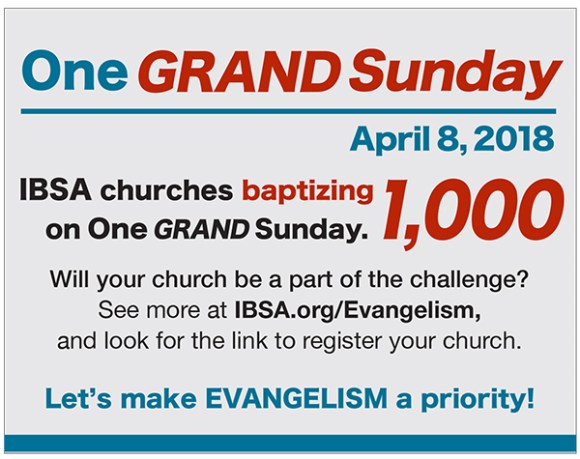
One thousand baptisms on a single Sunday. That’s the challenge behind One GRAND Sunday, an initiative designed to help IBSA churches train church members in evangelism, share the gospel, and follow-up with believer’s baptism.

One GRAND Sunday is scheduled for April 8, one week after Easter.

“Easter is normally a high attendance day, and the strategy of scheduling April 8 as One GRAND Sunday is to encourage people to return the following week to witness an historic event—their church being a part of 1,000 people being baptized on one day!” said Pat Pajak, IBSA’s associate executive director of evangelism.

The baptism-focused Sunday is part of a series of “Pioneering Spirit” challenges put before IBSA churches at the 2017 Annual Meeting. The evangelism challenge is for 200 or more IBSA churches to baptize 12 or more people each year, or to baptize more than the church’s previous three-year average. In other words, the commitment is for IBSA churches to become “frequently baptizing churches.” So far, 57 churches have accepted the challenge to engage new people with the gospel.

“Unfortunately, baptisms across our state have been declining over the past several years, and I would like to see One GRAND Sunday serve as a reminder that the church exists to evangelize and baptize those in the communities where God has planted them,” Pajak said.

The One GRAND Sunday emphasis coincides with a North American Mission Board-sponsored effort to promote gospel conversations, or opportunities to share the gospel. NAMB is urging Southern Baptists to have one million gospel conversations by next summer’s Southern Baptist Convention in Dallas. At gcchallenge.com, people can upload videos of themselves sharing about gospel conversations they’ve had, and get more information about gospel-sharing resources, like the “3 Circles” guide.

With just under three months left until April 8, Pajak suggested this timeline for churches preparing for One GRAND Sunday:

January: Collect your church’s baptism numbers for the past three years. Prayerfully set a new goal for this year.

February: Announce the baptism event and launch gospel conversations. Register your goal at IBSA.org/Evangelism. Conduct the training for church members. Consider teaching the “3 Circles” method.

March: Promote One GRAND Sunday. Personally follow-up with prospects and new believers. Teach about baptism, either personally or in a group setting.

April 8: Baptize!

April 9: Start over again.

One thousand is a large number, but Pajak put the goal in perspective. “What may look like a very lofty goal can easily be accomplished if every one of our 1,000 churches simply committed to baptizing one person.”

For more information about One GRAND Sunday and evangelism resources, or to register to participate in the April 8 emphasis, go to IBSA.org/Evangelism.

Jonathan DavisSeptember 2013 will forever be seared in my mind as when I received the phone call every seminarian hopes for: God had called me to my first pastorate.

Recognizing the weightiness of it all, one thing became quite apparent: I was going to need major help. In God’s providence, that help came in a multitude of ways. One in particular was John Piper’s book, “Brothers, We Are Not Professionals.”

With a passion and precision that he is known for, God used this veteran pastor to help shape my understanding of what it means to shepherd the flock of God. His thoughts on preaching were priceless, especially knowing I was to be responsible for the weekly preaching of God’s Word.

Within the wisdom of that book, one practical thought on preaching still reverberates in my ministry today. Piper made sure he preached on abortion at least once a year in his church.

“Pastors should put their lives and ministries on the line in this issue,” he writes. He was appalled at the “cowardice of some pastors when it comes to preaching against abortion.”

“If anyone should take up the cause of the unborn, it is the man of God in the pulpit.”

The gauntlet was thrown, and I felt the challenge deeply. I can’t fully explain it, but for me, reading those words was one of those moments when a truth concretized in an instant. I was resolved. There would be no cowardice on this issue on my watch.

Tony Merida (an author and pastor in North Carolina) said, “At its most basic level, expository preaching is preaching in such a way that the listeners get wet with God’s Word after the sermon.” Of this I was convinced. But it was Piper who convinced me that if I was going to discharge my pastoral duty faithfully, then I must make a point to preach the truth of God’s Word on the matter of abortion. He persuaded me that some topics are worthy of deliberate considering because they are just that important. The sanctity of human life is one of those topics.

God’s people are immersed in a culture of death. Whether it’s through the world at large, the onslaught of social media posts, or the inescapable daily news cycle, the spiritual forces of evil work overtime to diminish the value of life.

The cosmic powers over this present darkness are crafty in their attacks against the imago dei. They don’t care how they devalue life.

God’s ordained counter-offensive against this attack is preachers who lead their people by their preaching—empowered by the Spirit of God and armed with his Word. If anyone should take up the cause of the unborn, it is the man of God in the pulpit.

That’s not to say everyone else in the church is off the hook on this matter. But it is to say that if everyone else were to remain silent, there ought to be at least one champion for God’s image-bearers in the womb (and out of the womb, for that matter). That’s you, pastor.

In my own pastoral ministry, I have sought to lead in this way. Over the years, my definition of what I mean by “sanctity of life” has broadened. We generally think of it only being about abortion. But a legitimate category under sanctity of life is the desire for the flourishing of life.

This means in my preaching I’ve not only tried to expose the evil of abortion, but I’ve also sought to bear the gospel on racial reconciliation, proclaim the goodness of God’s design in gender, uphold the roles of men and women in the church and home, and lead God’s people in how to think through issues of euthanasia/suicide.

Now you might be thinking, “Why sanctity of life? Why this issue? Surely there are other matters to fight for as well.” If you think this, you’re right.

The sanctity of life is not the only issue. But it is worthy of a pastor’s prophetic voice in a world full of ears itching for teachers to suit their own passions.

My encouragement to you is the same mandate from Piper that fell on me: “Brothers, blow the trumpet for the unborn.”

Jonathan Davis is pastor of Delta Church in Springfield.

Some events from last year offer insight on issues facing evangelicals and church leaders

If evangelicalism is having an identity crisis, as some religious and cultural observers posit, the issue is whether “evangelical” means a person’s theological beliefs and practice, or is it adherence to a conservative political movement. It has at times meant both, and at points in 2017 we saw the movement struggling with itself over which is “the main thing.”

In this short collection of news stories from last year, we see how evangelicals balanced belief and practice. We witnessed the thumb-wrestling of “Big-E Evangelicalism,” inheritors of the socially conservative political force Moral Majority and keepers of its dwindling flame, and “little-e evangelicalism,” the smaller group who are not merely self-identified evangelicals, but whose core-group of beliefs about Scripture, Jesus, and their relationship to him directly affect their behaviors and drive their moral decision-making.

Donald Trump would not be president without evangelicals, more specifically Big-E Evangelicals, and the presence of some in his administration serves as a reminder of that. There is a group of cabinet leaders and others who meet weekly for Bible study. Spokeswoman (and preacher’s daughter) Sarah Huckabee Sanders is possibly the most visible Evangelical in the White House through her daily televised press briefings.

Trump’s appointment of Neil Gorsuch to the U.S. Supreme Court as a hoped-for advocate for religious freedoms was hailed by church leaders. And Southern Baptists were present on several occasions in 2017 when President Trump signed legislation affecting religious liberty.

But the December loss of a U.S. Senate seat by Republican Judge Roy Moore, Alabama’s Ten Commandments champion, to a pro-abortion Democrat has caused some pundits to wonder if the Big-E political/Republican alliance has weakened, and what that might mean for President Trump in the future. Given the special circumstances in that Senate race, moral accusations against Moore, another conclusion is that the biblical beliefs of little-e evangelicals trumped the Big-E political machine in the privacy of the voting booth.

Similarly, a Democrat easily won the governor’s race in Virginia, whose considerable Evangelical population had previously supported a string of GOP governors. Conservative analyst Stephen Mansfield wrote in a new book that the loss can be attributed partly to the disaffection of evangelicals.

“The young, probably in reaction to Trump and to some of the machinations on the Right, went strongly for the Democrat. I think that is an indication of future trends,” Mansfield said in an interview. “It will probably settle down, but I think that the social consciences of the young are raising some important questions.”

But can those assumptions be applied to the President himself, who a year ago got 81% of the white, evangelical vote? “He’s had about a 10-15% drop-off in support from the evangelical community since taking office,” Mansfield summarized. “So while there may be a sort of exaggerated self-reporting around the time when an evangelical casts a vote, there is some indication that there was never really that depth of devotion. I don’t think their support was ever very deep, and it seems to be weakening quickly.”

One conclusion is that little-e evangelicalism—personal, biblical belief and practice—is being separated from its Big-E political counterpart in this generation.

“Many have analyzed the weaknesses of the current iteration of this movement,” writes conservative Presbyterian pastor Tim Keller. “The desire by mid-twentieth-century leaders to foster more widespread cooperation between evangelicals and downplay denominational differences cut believers off from the past, some religion scholars have found…. This has made present-day evangelicals more vulnerable to political movements that appeal to their self-interest, even in contradiction to biblical teachings, for example, about welcoming the immigrant and lifting up the poor. However, evangelicalism is much more resilient than any one form of itself. The newer forms that are emerging are more concerned with theological and historic roots, and are more resistant to modern individualism than older, white Evangelicalism.”

Issues in Illinois
Governor’s race: Evangelicals disappointed by Gov. Rauner’s support for HB 40, which allows state-funding of abortions involving state employees and aid recipients, will be looking for a gubernatorial candidate to support in 2018.

Pro-life advocate Jeanne Ives of Wheaton said she would run against Rauner in part because of his signature allowing the abortion legislation. Ives handily won a January straw poll against Rauner among Chicago-area Republican leaders, but she faces an uphill climb against the well-funded incumbent. Seven Democrats are on the March 20 ballot with J.B. Pritzker the apparent leader.

The general election is in November.

Social issues: After successfully moving legalization of same-sex marriage through the Illinois General Assembly, State Senator Heather Steans and some other representatives are preparing to introduce legislation to legalize marijuana use in Illinois. Steans is using economic growth as an argument for legalization, citing a prediction that 250,000 jobs will be created in the “cannabis industry” by 2020. “As many of you may have heard, U.S. Attorney General Jeff Sessions announced last week that he was rescinding an Obama-era policy that discouraged U.S. attorneys from prosecuting operations in states that legalized marijuana,” Steans wrote to supporters. “This change will not diminish our efforts to legalize adult-use cannabis in Illinois.”

A public hearing is scheduled for late January.

The BriefingIllinois House urged to reject taxpayer-funded abortions
SpeakOut Illinois, a coalition of pro-life and pro-family organizations across the state,  urged lawmakers in the Illinois House to reject legislation allowing taxpayer money to be used for abortions. House Bill 4013 lifts the current prohibition on state workers’ health insurance plans from paying for elective abortions, as well as the prohibition on using public money to pay for elective abortions for Medicaid patients. The piece of legislation could be called up for a vote as early as this week.

How many Christians are in the new Congress?
Pew’s Religion & Public Life found that 90.7% of the 115th Congress identify as Christian, a statistic that has changed little in over a half century of keeping record. “The share of U.S. adults who describe themselves as Christians has been declining for decades, but the U.S. Congress is about as Christian today as it was in the early 1960s,” noted Pew. Of the 91% Christian majority, 31.4% are Catholic, 13.5% are Baptist, 8.5% are Methodist, 6.5% are Anglican or Episcopal, and another 6.5% are Presbyterian.

Multi-faith network rescuing women from Isis
A secret underground network operating in Iraq and Syria has reportedly freed more than 3,000 Yazidi women held captive in sexual slavery by Isis. Kurdish and Christian civilians make up the group, along with other ethnic minorities and families of the victims, NGO Yazda has claimed. Rescues are carried out through word of mouth, driven by Yazidis who have escaped capture or whose loved ones are still being held in Isis territory.

Gay couple to pastor historic DC Baptist church
Calvary Baptist Church, a progressive Baptist landmark in the heart of downtown Washington, has named a gay couple as co-pastors. Sally Sarratt and Maria Swearingen were presented to the congregation during worship services Jan. 8 and will begin their new jobs on Feb. 26. The 150-year-old church severed ties with the Southern Baptist Convention in 2012.

S. Baptists lead Congressional Prayer Caucus
Rep. Mark Walker, R.-N.C., will be the new House of Representatives co-chairman of the Congressional Prayer Caucus, it was announced Jan. 9. Sen. James Lankford, R.-Okla., the other co-chairman of the prayer caucus, and former Rep. Randy Forbes, R.-Va., made the announcement. All three are members of Southern Baptist churches.

Sources: Illinois Family Institute, Christian Post, Independent, Religion News Service, Baptist Press