Archives For November 30, 1999

Ready with a reason

ib2newseditor —  May 19, 2016

Crossover volunteers prepare for St. Louis

Steven_Glover[2]

Stephen Glover

Last summer, Steven and Robin Glover went home again—kind of. The Chicago couple and their children traveled to Columbus, Ohio, for the Southern Baptist Convention and Crossover, the annual evangelistic outreach held prior to the SBC.

Steven Glover, born and raised in Columbus, is an IBSA zone consultant in Chicagoland. His wife, Robin, is a writer and homeschool teacher to their four daughters. The Glovers lived in Ohio before moving to Chicago in January 2015, where Steven began a church planting internship at Uptown Baptist Church.

Each year before the SBC’s annual meeting, Uptown sends a team to work with a church in the convention host city. In Columbus, Uptown’s volunteers led a practicum on prayer, evangelism and discipleship at United Faith International Church. They gathered for training, then went out into the community to put into practice what they’d learned.

“Two groups comprised of 8-10 people targeted a neighborhood near the church for prayer walking as well as evangelism,” Steven said. “Upon arrival, the evangelism team had an immediate opportunity to share the gospel with young men hanging out in a local park who happened to be Muslims from Ethiopia.”

Glover and a man from the partnering church launched into an apologetics discussion with one of the young men who was interested in talking about his faith. They talked about Jesus, discussing the places where Islamic and Christian scriptures differed. “[We] took the opportunity to explain the purpose of Christ coming and the importance of his death, burial, and resurrection,” Glover said.

Nearby, his wife, Robin, and others on the team prayed for the conversation, even asking God for a break from the heat. “We were very hot and the sun was beaming down, so we prayed for a breeze,” she remembered. “Soon thereafter, there was a nice breeze and some light rain. The sun then returned to its work of warming.

“God was with us in Columbus. I was blessed to have joined him while he worked.”
Their Columbus experience gave the Glovers some advice for volunteers who will serve through Crossover in St. Louis.

“It is important that mission teams participating in Crossover 2016 be familiar with the demographic make-up of St. Louis,” Steven advised. “Through prior research, our mission team discovered that Columbus is known to have a large Islamic population, therefore, I brought with me a Quran (in English) to use in a witnessing conversation in order to establish the true identity and ministry of Jesus Christ.”

He referenced 1 Peter 3:15: “But sanctify the Lord God in your hearts and be ready always to give an answer to every man that asketh you a reason of the hope that is in you with meekness and fear” (KJV).

For a list of Crossover projects in Illinois, go to meba.org/crossover-st-louis-2016. Watch the Crossover St. Louis video at namb.net/crossover.

My history attending the annual Southern Baptist Convention is not as long or as deep as many. Occasionally I meet someone who will tell me, “This is my 40th SBC,” or “I haven’t missed a convention in 25 years.”

Though my father was a pastor and then director of missions, I didn’t attend my first SBC until 1992. That year the convention came to Indianapolis, as close as it had been in many years to the Chicago suburbs where we lived. A friend from church suggested going, “because it’s rarely so close.” Indeed, the SBC would not come within 500 miles of Chicago for another 10 years. So we went and took my dad along with us.

Little did I know that only five years later I would be flying to only my second SBC in Dallas, to be voted on as a vice president with the newly formed North American Mission Board. I haven’t missed an annual SBC meeting since then. This year, Lord willing, will be 20 in a row.

If you haven’t been to the convention before, or can’t go often, this is the year.

I share this personal history to say that I really do understand why the average person may not regularly attend the annual SBC. Unless there’s a controversy or crisis of some kind, the SBC is often left primarily to professionals who have travel budgets, and pastors who may direct part of their family vacation time there. Perhaps that’s why attendance at the SBC has only topped 10,000 three times in the last 15 years. Peak attendance during the conservative resurgence of the mid-1980’s was over 40,000.

But now, let me challenge you to attend the June 14-15 SBC in St. Louis this year. As my friend said, it will be years before it’s this close to Illinois churches again. If you haven’t been before, or can’t go often, this is the year.

More importantly, this year’s elections and other actions will be significant. It was announced just last week that Illinois’ own Doug Munton, pastor of First Baptist, O’Fallon, will be nominated as First Vice President. I’m really excited about that. I hope hundreds and hundreds of Illinois Baptists will be there to support this outstanding Illinois pastor for this national role.

The election for president this year also presents a significant choice between pastors with notable differences, not just in ministry experience, but in the areas of doctrinal conviction and missions cooperation. Illinois messengers will want to study these in advance of the convention, and arrive prepared to support the nominee who best represents not only their own churches’ practices and convictions, but also the direction that they feel is best for our Great Commission cooperation as Baptist churches in the future.

Normally Illinois ranks about 15th of 42 state conventions in the number of messengers it sends to the national SBC. But the last time the convention was in St. Louis (2002), Illinois ranked 5th, with 611 messengers from 193 churches. And in 1987, the previous time the SBC was in St. Louis, Illinois churches sent 1,373 messengers. Yet last year only 139 messengers from Illinois churches attended the SBC in nearby Columbus.

To encourage messengers to turn out in record numbers this year, IBSA will be hosting a reception for Illinois Baptists at the St. Louis convention center, on the Monday night following the Pastors’ Conference and just prior to the convention’s start on Tuesday morning.

Whether this year is your 40th SBC, or your very first, I hope you will make the SBC in nearby St. Louis a priority this year. What happens at the SBC is really up to folks like you and me.

Nate Adams is executive director of the Illinois Baptist State Association. Respond at IllinoisBaptist@IBSA.org.

SBC_VotingWith another call to prayer for the redemption of America, another missionary commissioning, and another bunch of resolutions on national politics and the precipitous slide in our national moral values, this might appear to be another fairly predictable meeting when the Southern Baptist Convention convenes in St. Louis June 14-15.

It isn’t.

The more significant news from the convention is not likely to come from its political statements or from protests by cultural liberals outside the hall. What can be said about the run for the White House, same-sex marriage, or sexual identity that hasn’t already been said? It will be in the election of an SBC president to succeed outgoing Arkansas pastor Ronnie Floyd that messengers will signal a turn.

Floyd has issued a “national call to prayer for spiritual leadership” in the Tuesday evening session. Floyd is using the mid-America location to address issues at the spiritual heart of America, in particular the need for evangelism and spiritual awakening, and renewed efforts at racial reconciliation. (See “What are the three greatest challenges facing the SBC?”)

By the time of the prayer gathering, messengers will already have selected a new president—and perhaps a new direction. At this crossroads, signs point to missions funding, evangelism and theology, and the age of denominational leaders.

The most obvious turn could be generational. Only recently has the “greatest generation” of Southern Baptists handed off leadership to their children, the Baby Boomers born after World War II. The possible election of 43-year-old J.D. Greear over Steve Gaines, 58, or David Crosby, 63, would confirm the handoff to Generation X, or the Baby Busters. These younger leaders, born after 1964, have already assumed leadership of the Convention’s two missions boards.

Leaders have reported that the demographics of convention attenders have shifted younger over the past decade. The meeting isn’t as gray as it used to be, and that’s good news observers say. These younger Southern Baptists are making their presence known through Baptist 21, SEND conferences, and other venues aimed at Busters and their quickly advancing successors, the Millennials. Electing one of their own could hasten the transition.

“One of the things God has put on my heart is that my generation needs to take personal responsibility for the agencies and the mission boards of the SBC and not just think of them as the SBC’s, but think of them as ours,” said Greear in his nomination announcement.

A second turning point for the Convention is the future of the Cooperative Program. Implicit in the election of a president is endorsement of his view of CP funding for missions and Southern Baptist work, whether it is whole-hearted and longstanding, recently renewed as part of the Great Commission Resurgence, or newly embraced as one of many ways of funding missions. The three candidates for president all speak highly of the Cooperative Program, but their churches have notable differences in their historic support of CP and their current giving levels.

Crosby’s response to a question from the Illinois Baptist is enlightening: “As SBC president, I will not talk or act as if a return to the society method of supporting our cooperative work is progress.” (See “What are the three greatest challenges facing the SBC?”) At its foundation, this is what a church’s record of CP support demonstrates: Is missions giving through Cooperative Program the main way Southern Baptist churches fund missions, or rather one of many ways?

And third, simmering under the surface in this election is the role of election in salvation and the future commitment to evangelism in the SBC.

“Listen very carefully: We have criticized evangelism right out of the Southern Baptist Convention,” Floyd told the SBC Executive Committee in February. “Years ago, something happened where pastors and churches that reached and baptized people effectively came under the microscope of other Baptists who oftentimes did not have a heart for evangelism themselves. A culture of skepticism about evangelism began to creep into our Convention. Evangelism began to die.”

This culture shift was framed by some as evangelism versus discipleship. Evangelism was criticized as “easy believe-ism” while discipleship was elevated. Discussion of the “sinner’s prayer” at the 2012 Pastors’ Conference was followed by Executive Committee CEO Frank Page’s appointment of an ad hoc panel to address the rise of Reform Theology and whether Calvinists and “Traditionalists” as they were called at that time could peacefully coexist in the SBC tent.

Gaines was an outspoken supporter of the “sinner’s prayer” style of personal commitment at the time, while International Mission Board President David Platt, then pastor of Birmingham megachurch The Church at Brook Hills was critical of evangelism that emphasized acts of conversion, such as “walking the aisle” at church, over discipleship of new believers that emphasizes personal recognition of God’s call and sovereignty in their salvation.

This election brings up that question again. Gaines and Crosby have traditional views on evangelism and conversion, while Greear’s theology is Reform. The church Greear pastors is evangelistic, baptizing 928 in 2014, but it is also active in the Acts 29 Network of church planting, which expects its members to hold Reform views. And of the three candidates, Greear has the greatest support among the rising group of younger, Reformed pastors in the SBC.

These three issues—and the candidates holding different views on them—stand before Southern Baptists at the crossroads.

– Eric Reed is editor of the Illinois Baptist

The Illinois Baptist editors asked the SBC Presidential candidates this question: What are the three greatest challenges facing the SBC? Here are their replies:

David CrosbyDavid Crosby
First Baptist Church, New Orleans

1. We must get out of our buildings and into our communities. We are plagued with the mentality that people “go to church.” This says that “church” is a location somewhere. We need the reverse: “Churches go to people.”

I want us to expand the presence of our churches in their communities. I will seek to foster strategies of compassion ministries that keep us in touch with neighbors in need and open wide the doors of loving witness. These ministries break down racial and class barriers and help our churches look more like our communities and more like heaven. This is our future.

2. We must bring a message of hope to our churches and our culture. The primary metaphor for being in the world as believers is not warfare. It is light. Anyone in darkness is thrilled to see a glimmer of light. Our warfare mentality has had the unintended effect of stealing hope from our hearts and our message. An angry and fearful posture in the world is unwise, unfounded, and unchristian. Losing the culture wars is no loss at all compared to losing the message of a living hope.

My daily reality is the hardscrabble world of urban New Orleans. I will lead the SBC from the perspective of this highly diverse and difficult mission field where God’s people shine like stars and loving engagement brings true hope.

3. We must be cooperative. Southern Baptists are distinguished from other groups in that they actually do mission together, not just independently. Cooperation, we believe, is biblical and is a superior strategy for accomplishing the world mission of the church.

The spirit of cooperation has waned, but the need for it has not.

As SBC President, I will not talk or act as if a return to the society method of supporting our cooperative work is progress. I will cultivate and promote a cooperative spirit. I will demonstrate cooperation by continuing to give a substantial percentage of the undesignated receipts of my church to our unified giving plan.


Steve GainesSteve Gaines
Bellevue Baptist Church, Memphis

Three of our greatest challenges in the SBC are: spiritual awakening, soul winning, and stewardship.

Regarding the second challenge, the SBC is in a 15-year downward trajectory in baptisms, the longest in SBC history. In 2014 we baptized 100,000 fewer people than in 1999. Regarding the third challenge, we recently called 1,000+ IMB missionaries home due to financial deficits.

In my opinion, the first challenge, our need for spiritual awakening, is the most important. If prioritized, it can solve the other two.

The SBC needs fresh wind and fire from heaven. That will only come when a spirit of prayer and repentance captivates our pastors, lay leaders, church members, associations, state conventions, and SBC entities.

I will seek to lead our SBC to prioritize passionate prayer in each person’s personal life, and encourage the development of specific prayer strategies for pastors, church members and all who serve in our SBC agencies. Without spiritual awakening, the SBC will continue to decline. God can do more in revival in one hour than we can do in years without it.

Both the early church (cf. Acts 2:1f) and missions (cf. Acts 13:1f) were birthed in prayer meetings. Prayer and revival caused the early church to win multitudes to faith in Jesus. Prayer and revival also made the early believers strong financial stewards who gave generously. When we pray, we will evangelize and make disciples. God will also activate his angelic army to defeat our enemy, the devil, and thus advance his kingdom in our churches, Convention and culture.

If chosen to lead the SBC, I will give myself wholeheartedly to help the SBC experience spiritual awakening to bring glory to God through souls being saved, people being discipled, financial resources being made available, and more missionaries being sent out to the ends of the earth.


JD GreearJ.D. Greear
The Summit Church, Raleigh-Durham

First and foremost, we need a continued re-awakening to the gospel. Historically, revival has begun not with lost people getting saved, but with the church getting “re-converted” to the gospel, which then leads to massive evangelism. I know we feel like we live in a dark age, but if we look at the last four awakenings in the Western world, we see that the conditions in our country are riper for revival now than at any other point since the Great Awakening.

The time is right. The harvest is ready. So we need to boldly ask God for what we know he wants to give us. And our entities need to respond accordingly. The Convention doesn’t exist for sake of the entities or the state conventions. It exists for the Great Commission. We must constantly re-evaluate everything we do in light of that.

Second, we need to bring a new generation of Southern Baptists to the table to partner with older generations in the cooperative missions of the SBC. There is a new wave of excitement about the SBC, but many newer generations of churches are still sitting on the sidelines. We need to take personal responsibility for the entities of the SBC and step up to own the mission. We must join with a faithful older generation to sacrificially give, support, and serve in these entities, boards, and institutions.

Third, we need to see diversification in the leadership of the SBC. About one in five churches in the SBC now is predominantly non-Anglo (praise God!), and we want to see our brothers and sisters from these non-Anglo backgrounds join us in leadership. I believe we are at a kairos moment in this. We should strive to see SBC leadership reflect the diversity of the SBC—culturally and racially, including younger and older, more traditional and more modern. We are united by The Baptist Faith and Message (2000) and our passion for the Great Commission. I believe that our greatest days are yet ahead!

Dr. Doug Munton, Senior Pastor of First Baptist Church of O’Fallon, Illinois

Dr. Doug Munton, Senior Pastor of First Baptist Church of O’Fallon, Illinois

Doug Munton, pastor of First Baptist Church, O’Fallon, Ill., announced April 26 he will be nominated for First Vice President of the Southern Baptist Convention.

Media release — Illinois Pastor Doug Munton to be Nominated for First Vice President of the Southern Baptist Convention 

“I am excited to hear that Doug will be nominated for this national role, after experiencing his strong leadership here in Illinois as our state convention president and as longtime pastor of one of our leading churches,” said Illinois Baptist State Association Executive Director Nate Adams. “Doug has all the qualities I would hope for in SBC leadership. He is a conservative, cooperative, humble, thoughtful, missions-hearted pastor who will lead both as statesman and by personal example.”

The nomination will be made by John Marshall, pastor of Second Baptist Church, Springfield, Mo., during the SBC’s annual meeting in St. Louis June 14-15.

Munton, 56, has pastored FBC O’Fallon for more than 20 years, during which time the church has grown from 550 to over 1,600 people in average attendance and has baptized about 2,000 people. In the 2014-15 reporting year, the church gave just over 8% of budget receipts through the Cooperative Program—Southern Baptists unified method of supporting missions and ministry.

He served as president of the Illinois Baptist State Association for two years, and is currently on the SBC’s Committee on Committees. His wife, Vickie, is the president of the Ministers’ Wives Conference this year at the Southern Baptist Convention in St. Louis. The Muntons have four adult children and will soon have their seventh grandchild.

Asked about his reasons for allowing his name to be submitted in nomination, Munton said, “I want to see a continued move in our Convention towards racial diversity and unity. I want to encourage our churches to participate in missions through support of the Cooperative Program. I hope to encourage prayer for a spiritual awakening in our convention and nation.”

The 2016 Southern Baptist Convention will be held at the America’s Center in St. Louis June 14-15. The election for First Vice President is slated for the Wednesday afternoon business session.

Statements from and about Doug Munton, Senior Pastor of First Baptist Church of O’Fallon, Illinois

See you in St. Louis?

ib2newseditor —  April 25, 2016

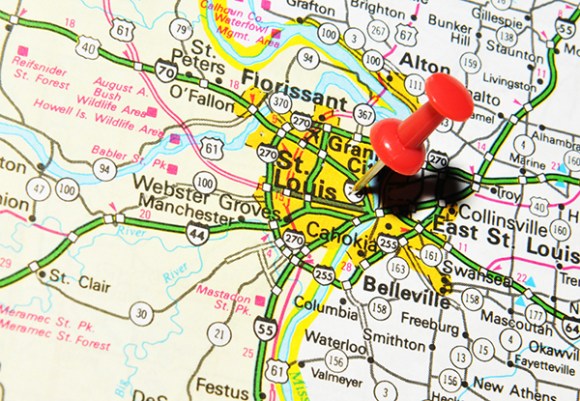
St. Louis map pin2

What takes place at the convention is important—in the meetings and in the streets.

When the national Southern Baptist Convention convenes in St. Louis on June 14, I’m hoping there will be a record number of messengers from Illinois churches present. Among the cities where the SBC has met in recent years, St. Louis is certainly the most accessible to a majority of Illinois churches. But convenience isn’t the main reason I’m hoping to see hundreds, even thousands of messengers from Illinois.

First, this is an important SBC presidential election year. As President Ronnie Floyd is completing his second one-year term, three pastors have announced their intent to be nominated. As in the campaign for U. S. President, there are clear and important differences to be found in the leadership records, public statements, and declared priorities of each person seeking to lead the SBC into the future.

In fact, this year’s candidates have notable differences, not just in ministry experience, but in doctrinal conviction and missions cooperation. Messengers will want to study these in advance of the Convention, and arrive prepared to support the nominee who best represents not only their own churches’ practices and convictions, but also the direction they feel is best for our Great Commission cooperation as Baptist churches in the future.

Through the Illinois Baptist, IBSA.org, and other channels, IBSA is providing churches with objective information about and from the SBC President nominees and other issues anticipated at the Convention. IBSA will host a reception for Illinois Baptists at the St. Louis convention center on Monday night following the Pastors’ Conference and just prior to the convention’s start on Tuesday morning. So please, stay engaged and informed!

It’s also important that representatives from your church arrive as registered messengers, and not just as guests. Remember to elect messengers in advance at a church business meeting and register them online if possible. If you need help with this process, contact us here at IBSA.

A second important reason for coming to St. Louis is the evangelistic opportunity called Crossover that takes place just prior to the Convention. In fact, many Illinois churches could participate in Crossover on Saturday, June 11, return to worship in their own churches on June 12, and return for the Pastors’ Conference and Convention the following week.

Metro East Baptist Association Director of Missions Ronny Carroll and others have been representing the Illinois side of the river in planning this emphasis, which includes a variety of volunteer opportunities. You can find a complete listing online at meba.org/crossover-st-louis-2016/.

The people of the cities where the annual SBC is hosted certainly notice when Southern Baptists come to town. The Southern Baptist Convention is a major event, often covered in the news. Church messengers saturate the convention center, hotels and restaurants, and sometimes outside protesters try to step into the spotlight to advance their agendas.

This very public setting provides a wonderful opportunity for thousands of evangelistic volunteers to come and bring the host city both sacrificial service and the good news of the gospel. What takes place in the reporting, worship and business sessions of the SBC meeting itself is vitally important, and worth our time as messengers from Illinois churches, especially this year. And what takes place out in the streets at Crossover can be eternally significant to those who may meet Christ there. It’s well worth our time, both in St. Louis and in our own communities. And these are two very good reasons why I hope I will see you in St. Louis.

Nate Adams is executive director of the Illinois Baptist State Association. Respond at IllinoisBaptist@IBSA.org.

The BriefingSouthern Baptists called to prayer
On June 14, the entire Tuesday evening session of the 2016 Southern Baptist Convention in St. Louis will be committed to praying for spiritual leaders, our churches, nation, and world. Southern Baptist Convention President Ronnie Floyd issued the call stating, “the critical need of the hour in America, the state of our churches, the needs of our pastors, the status of our evangelism or lack of it, and the exponential lostness of the world while we are bringing home hundreds of our missionaries… it is time to pray.”

New churches outpace dying ones
America is launching new Protestant churches faster than it loses old ones, attracting many people who previously didn’t attend church anywhere, new LifeWay Research studies show. More than 4,000 new churches opened their doors in 2014, outpacing the 3,700 that closed, according to estimates from 34 denominational statisticians.

Christian women most persecuted
A survey of 192 countries has demonstrated scientifically what many have long known anecdotally to be true: Christian women are more religious than Christian men. The lesser known fact: those women bear the brunt of persecution in the 50 countries where it is hardest to be a Christian.

Tax-exemptions for churches questioned
Massachusetts authorities have challenged the tax-exempt status of a Catholic shrine and retreat center. The center offers daily Masses, religious conferences, a soup kitchen for the hungry, and a Christmas festival of lights. The case which has gone to the state’s supreme court, begs a deeper question: Do religious organizations decide for themselves what they require for their devotional and educational missions, or do municipal tax authorities decide for them?

Porn labeled ‘public health hazard’
The effort to reverse the spread of sexually explicit material and its effects received a boost when Utah Gov. Gary Herbert signed a resolution saying pornography is establishing “a public health crisis.” The first-of-its-kind resolution, which National Center on Sexual Exploitation (NCOSE) helped craft and the state legislature approved unanimously, recognizes “the need for education, prevention, research, and policy change” to confront “the pornography epidemic.”

Sources: IB2news, Facts & Trends, Christianity Today, Boston Globe, BPnews.net

On June 14, the entire Tuesday evening session of the 2016 Southern Baptist Convention will be committed to praying for spiritual leaders, our churches, nation, and world. There, perhaps, has never been a time in our generation when we have needed to pray more than now.

The Greatest Night Ever

Testimonies poured in from across the nation after last year’s national call to prayer, where 7,000 Baptists cried out to the Lord together. A common testimony was, “This was the greatest moment I have ever experienced in a Southern Baptist Convention.” God was with us powerfully and everyone present knew He was!

2016AMLogo2016 National Call to Prayer

Last year was the first session, perhaps in our modern history, where an entire session of the Southern Baptist Convention was given to prayer. Due to the work of God among us last year, His present work today, the critical need of the hour in America, the state of our churches, the needs of our pastors, the status of our evangelism or lack of it, and the exponential lostness of the world while we are bringing home hundreds of our missionaries… it is time to pray.

Baptists need to pour into St. Louis by the thousands for this historic night of prayer. Those who can only attend this one night, please come. For the members of the 300 churches in the metro region of St. Louis, please come for this significant night.

Southern Baptists who are not able to come to St. Louis may join us as it is streamed live on the web at http://www.sbc.net.

3 Components of This National Prayer Gathering

1. Spiritual Leadership: We will pray for pastors and spiritual leaders in America… their lives, leadership, families, and ministries.

2. Revived Churches: We will pray for our churches in America… for racial unity in our churches and nation, and for the dry bones of spiritual life in our churches to come alive. Our God can turn any church around!

3. Nationwide & Global Awakening: We will pray for America… where we are in our nation spiritually, morally, politically, and for the next Great Spiritual Awakening in America as well as an explosion of the Gospel to bring about global awakening.

At the present time, the persons who will help me lead this gathering are listed below. Others may join us in leading as well. Pray for these persons by name, gather the people, and let’s come to St. Louis expecting God to move in our hearts so dynamically, people will say as they did in Acts 17:6, “These men who have turned the world upside down have come here too.”

2016-SBC-Call-to-Prayer.jpg

The above image is from the Pre-Convention issue of SBC LIFE, newsjournal of the Southern Baptist Convention. The print edition, published five times a year, is distributed free of charge to all pastors and will be mailed next week; the digital version is posted online and is accessible to everyone. Each issue contains vital information about our Southern Baptist ministries. If you do not receive SBC LIFE, click on the subscription tab at SBCLife.net to receive the print or access the digital version.

 – Ronnie Floyd is President Southern Baptist Convention. This article first appeared at RonnieFloyd.com.

Stirring the Waters

After three years of declining baptisms, SBC leaders are calling it what it is—an evangelism crisis.

What happened to evangelism in the Southern Baptist Convention?”

The question, posed by SBC President Ronnie Floyd, came after the Annual Church Profile reports completed by Southern Baptist churches showed a third consecutive year of declining baptisms.

In fact, the total for 2014 (the most recent year for which national statistics are currently available) is the lowest number of baptisms since 1947. Southern Baptist churches baptized 305,301 people, a 1.63% decrease from the previous year. An in Illinois, the annual number of baptisms, which has hovered around 5,000, dropped to 4,400 in 2015.

“Deplorable” is how Floyd described the reality that even though there are more SBC churches than ever, and an ever larger population to reach with the gospel, it’s simply not happening—at least, not according to the baptism numbers.

Recently, Floyd and other SBC leaders have been increasingly vocal about how the numbers reflect an even bigger problem: an evangelism crisis.

“Lostness in North America is having a bigger impact on Southern Baptists than Southern Baptists are having on lostness,” New Orleans Theological Seminary President Chuck Kelley said at a recent chapel service.

The picture is bleak, but all is not lost, SBC leaders seem to agree. A turnaround is dependent on renewed appreciation for and dedication to evangelism in the Southern Baptist Convention and in individual churches. Church members need models, leaders who are soul winners themselves and can train people in the pews to share their faith.

“Let’s not be paralyzed,” Floyd wrote on his blog, urging Baptists to action. “Do something. Do more than you are doing now. Take a risk.

“Return to the importance of reaching and baptizing people.”

Mission drift

One reason some leaders cite for the SBC’s decline in baptisms, and overall in evangelism, is a culture that sidelines those things. In an address to the SBC Executive Committee in February, Floyd spoke about a critical shift that has brought the denomination to this point:

“Years ago, something happened where pastors and churches that reached and baptized people effectively came under the microscope of other Baptists who oftentimes did not have a heart for evangelism themselves. A culture of skepticism about evangelism began to creep into our convention. Evangelism began to die.”

Even the way we talk about evangelism is different, said IBSA’s Pat Pajak. The weekly opportunity to go out “soul winning” has been replaced with more politically correct titles such as outreach, or more often the practice has been lost altogether. “In the process, born-again believers have lost the passion and emphasis on reaching into the pagan pool and bringing the lost to Christ,” said Pajak, who leads the Church Consulting Team.

Recent research supports this: A 2012 study by LifeWay Research found that while 80% of Protestant church-goers believe they have a personal responsibility to share their faith, 61% hadn’t told anyone how to become a Christian in the previous six months. Nearly half (48%) hadn’t invited an unchurched person to attend a church event or service in six months.

LifeWay Research President Ed Stetzer broke down the research this way: “…The typical churchgoer tells less than one person how to become a Christian in a given year. The number for more than half of respondents was zero. The second most frequent answer was one.”
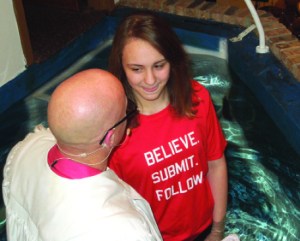
The shirt says it all -- Emily Zimmer is baptized by Pastor Tracy Smith at First Baptist Church in Mt. Zion.

The shirt says it all — Emily Zimmer is baptized by Pastor Tracy Smith at First Baptist Church in Mt. Zion, one of many congregations in Illinois that experienced large increases in baptisms in 2015.

To right the ship, SBC leaders have pointed first to the need for spiritual awakening—first in churches, then in the culture at large. But there are also solutions to be found at the denominational level and in local churches, starting with leaders.

Floyd recalled a time when only preachers who led strong evangelistic churches were invited to speak at the SBC Pastors’ Conference and annual meeting. Those leaders were also the ones nominated for denominational offices. In his November blog post about the state of evangelism in the SBC, Floyd seemed to call for a return to those principles.

“Quite honestly, I am not impressed by how many books a pastor sells, how many Twitter followers he may have, at how many conferences he speaks, how great of a preacher he is, or how much his church does around the world if he pastors or is associated with a church that has a lame commitment to evangelizing and baptizing lost people and reaching his own community with the gospel of Christ.”

At the local level, too, leaders can help reverse the decline by creating an environment that is conducive to evangelism, said IBSA’s Mark Emerson.

“The pastors who are effectively reaching people for Christ are creating an environment of evangelism in their churches,” said Emerson, whose Church Resources team equips churches in evangelism.

“They are making sure every ministry has an evangelistic purpose, they are designing their worship services to communicate the gospel and offer an opportunity for people to make a decision. These churches are training their members to effectively enter into gospel conversations.”

Modeling evangelism

Scott Foshie is one pastor currently training his congregation to have those gospel conversations. Steeleville Baptist Church will start evangelism training in April, based on the “Can We Talk?” program created by Texas pastor (and FBC Pastors’ Conference President) John Meador.

“When it’s time to bridge a conversation from small talk to gospel talk, that’s an awkward transition for people to make,” said Foshie, who has pastored the church since early 2015. The six-week curriculum combines training with practical experience; teams of three people go out into the community, visiting neighbors and practicing gospel conversations.

Foshie’s personal stake in the training goes beyond the fact that it’s happening at his church. As a student of the F.A.I.T.H. evangelism training tool, he led his future wife, Audra, to faith in Christ.

“Personal evangelism training is very important to me because it changed my life. So, I want people to experience that. Personal evangelism training unleashes the army of the Lord, (it’s) what God has called us to do.”

But first, people have to face down a common obstacle: fear. The pastor likened sharing the gospel to someone handing you the keys to their sports car and telling you to take it around town.

“What we need to teach them is, hey, you step out in faith, you begin to learn to share, you simply share, and the Holy Spirit’s going to help you,” Foshie said.

“Once people learn to share the gospel, it changes their life completely.”

Metro St. Louis leaders ready for Crossover partners

Crossover-Banner-smallSt. Louis | As Southern Baptists across the country turn their eyes to St. Louis, Ronny Carroll is more than ready to receive a few thousand extra laborers in order to achieve a great harvest.

“With the manpower coming, our churches can really pull off something God-sized,” said Carroll, executive director of missions for the Metro East Baptist Association, which serves the Illinois side of the St. Louis area. “The preparation alone has already given our churches a boost of energy and excitement in anticipation of what God’s going to do.”

Crossover St. Louis will take place on June 11, just before the 2016 Southern Baptist Convention (SBC) annual meeting, which will be held June 14-15 at the city’s America’s Center. Crossover will include more than 70 service and outreach projects throughout five counties in the St. Louis metropolitan area.

Prior to the 2015 SBC annual meeting in Columbus, Ohio, thousands of seeds were planted resulting in at least 345 people who made professions of faith. Carroll is hoping to double that this year.

“We are praying for 1,000 souls to come to Jesus and for 27 new churches to be established,” he said. “I believe God is going to do his job, we just need to be ready for his movement.”

Carroll said that during the last few months and even years, God has been paving the way for an epic revival of hope and healing to break out in St. Louis. And he said God has used Southern Baptists every step of the way.

“Look at all that has happened, in particular the flooding that occurred around Christmas, where Southern Baptists have been the hands and feet of Jesus,” Carroll said, referring to SBC Disaster Relief efforts in St. Louis just a few months ago. “At one level, Crossover will tie into the work that has already been done and add one more dimension to the truth that Southern Baptists, as individuals and as churches, really care about the people and the communities and quality of life they have. They are primed and ready to receive the eternal hope and salvation that Christ offers.”

And to do that, Carroll said the plan for Crossover St. Louis is to “keep it small, but make it huge.”

Crossover will impact churches in six different associations in both Missouri and Illinois. But, because of the unique needs within each association and community, the projects are indigenous to what will make the biggest impact in a given neighborhood.

“Each church has its own local vision and the 21 projects on our side of the river reflect the unique flavor of our communities,” Carroll said. “We are working with city officials and mayors for some of our cleanup projects and planning block parties, or fiestas, in some of our growing Hispanic neighborhoods.”

Tom Firasek, ministry and partnership coordinator for the St. Louis Metro Baptist Association, said organization-wise they are already miles ahead of where past Crossover events were at this stage of the preparation process.

“We met with Rich Halcombe (director of missions in Columbus) and other Columbus Southern Baptist leadership and spent the day learning what works, what doesn’t and what logistical needs might come up,” Firasek said.

“When you are about to support and rally behind 75 or so highly visible events at the same time, you want to be sure to orchestrate everything with excellence, while at the same time pointing to Jesus and proclaiming the gospel every step of the way.”

In addition, Firasek said between 100-150 seminary students will be joining the effort in St. Louis during the week leading up to Crossover.

“We would love to see God open up the needs and challenges of St. Louis so that some of these folks would consider planting their lives here or making ongoing partnerships here,” Firasek said. “In the metro area we have one church for every 7,500 people. We need more church starts.”

With Crossover St. Louis just a couple months away, Carroll said their biggest need is for more volunteers to commit to join them.

“If God’s leading you to be a part of Crossover, please commit to join us soon so we can get you partnered with a project,” he said. “Also, we would love for you to join us in prayer. We are praying God will flood us with his mercy and grace and that He will prepare the lost people to receive Jesus as their Lord and Savior.”

Carroll said they are also praying for churches to be ready to plug new Christians into their ministries and for church plants to grow quickly from the influx of new believers across St. Louis.

“God has already opened so many doors for the gospel to be presented in a mighty way here,” he said. “Pray that we will be faithful with the doors he’s opened.”

For more information on projects taking place during Crossover St. Louis visit the Metro East Baptist Association website at meba.org or visit namb.net/crossover.

Kayla Rinker is a freelance journalist in Missouri.