Archives For November 30, 1999

Greear Floyd Gaines2

JD Greear, Ronnie Floyd, and Steve Gaines.

There are three winners at the conclusion of the SBC presidential race: Steve Gaines takes the position and the responsibility; J.D. Greear takes the mantel as most Christ-like, and Southern Baptists leave St. Louis unified behind a single presidential candidate.

Greear’s action, withdrawing his name from the race after two ballots failed to produce a winner, was a first for longtime observers of the convention. Greear guaranteed two things: many of his supporters who are young and are new to SBC life are more likely stay engaged if they do not feel pushed out by the older, traditional constituency Gaines represents. And Greear guaranteed himself a place in SBC leadership for decades to come.

Would anyone be surprised if Greear ran unopposed in 2018? The 50% of SBC messengers who had backed Gaines could easily support in the next election the young man who did the very mature thing.

Deferring to the older candidate is indeed a mature move. And, in this case, it’s wise.

Both Greear and Gaines cited the need for unity in the denomination in this decision. “For the sake of our convention and our mission, we need to leave St. Louis united,” Greear said.

Gaines said he, too, had considered withdrawing. He quoted a close friend who said to him after the first day of the annual meeting, “We’re in a mess, aren’t we.” After two ballots, Gaines was still four votes short of a majority, because 108 ballots were disqualified by improper markings. Messengers at the best-attended convention in a decade or more were split right down the middle.

“It’s tricky,” Greear joked as he stepped to the podium to make his announcement, referring to a rap music video produced by a member of his church that some had construed as endorsements by several SBC-entity heads. The crowd laughed.

But it would be tricky to lead the denomination with the membership divided into two camps: established and traditional epitomized by Gaines, and younger and Reformed led by Greear.

For the sake of unity, Greear withdrew.

Gaines had offered to make the same move.

At 43, Greear will likely have another opportunity to be SBC president. Perhaps at 58, it is Gaines’s turn. With his mid-South megachurch platform, Gaines is likely to lead the convention in renewed evangelism, which Floyd and others have said is so vital.

And Greear has a little longer to bring his half of the SBC populace into leadership to form a new mainstream and identity, rather engage in a tug of war with the old guard over theology and tactics. “We are united by a gospel too great and a mission too urgent to let any lesser thing stand in our way,” Greear said.

The two men hugged on the platform, as Gaines was declared the winner by outgoing president Ronnie Floyd.

He could have as easily said, We all win.

– Eric Reed

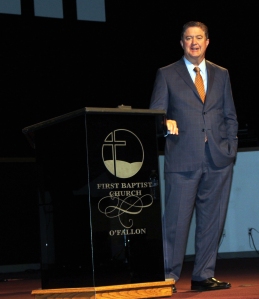
Steve GainesFirst Baptist Church in O’Fallon had a guest pastor in its pulpit Sunday morning. Memphis pastor and candidate for Southern Baptist Convention President Steve Gaines delivered the message at each of the church’s three morning worship services June 12.

The Bellevue Baptist Church pastor lamented Southern Baptist’s lack of focus on evangelism. “What’s happening in the Southern Baptist Convention is a tragedy,” Gaines declared. “We’re in a 17-year nose dive. This is unprecedented, we have more SBC churches, but fewer baptisms. If the people in those churches we’re planting aren’t evangelistic and soul-winning, we’re not going to reach this nation.”

His primary sermon text was taken from Acts 2:40-47. Gaines used Christ’s instructions for the church to exhort churches today to be more evangelistic.

He urged Southern Baptists to invite God back into their churches. “When God comes to church people start getting saved and baptized.” When people walk into a church “it doesn’t need to be dead. It ought to be alive with the power of God.”

Gaines stressed, “We should never plan a worship service to attract people. Instead, we should plan worship services that will attract the manifest presence of God – He will in turn will attract the people.”

Sharing Christ isn’t difficult he noted. “If you knew enough to get saved, you know enough to tell someone how to get saved.”

Prior to the sermon O’Fallon’s Pastor Doug Munton, who will be nominated to serve as the convention’s First Vice President at tomorrow afternoon’s meeting, introduced Gaines as his good friend. He then endorsed Gaines for Southern Baptist Convention President saying, “I’m biased, I believe Steve is the right guy, at the right place, at the right time.”

Gaines is one of three candidates who will be nominated for the job of SBC President tomorrow afternoon. David Crosby, pastor of First Baptist Church, New Orleans, LA, and JD Greear, pastor of the The Summit Church in Raleigh, NC, are also candidates.


Floyd_presidents_message

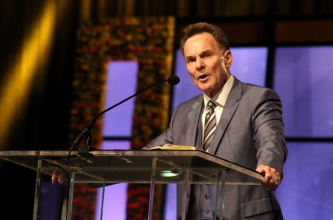
SBC President Ronnie Floyd at the 2015 SBC Annual Meeting in Columbus, Ohio.

When Ronnie Floyd was elected president of the Southern Baptist Convention, the denomination was coming to grips with the truth. After several years of describing many churches as “plateaued or declining,” leaders started speaking in frank terms about why, year after year, key measures like church membership, worship attendance, and baptisms were down denomination-wide.

“We are clearly losing our evangelistic effectiveness,” one Baptist leader said in 2014, the year Floyd was elected to his first term.

Things looked bleak, and for the first time in a while, the pressure wasn’t coming from outside opposition or controversy. Rather, the SBC seemed to be at an impasse.

Before his presidency, Floyd was already established as someone who could provide direction. As the pastor of a Southern megachurch, he led his congregation to a regional, multi-campus strategy and a new name—from First Baptist, Springdale, to Cross Church of Northwest Arkansas.

That is perhaps Floyd’s greatest legacy: He has reminded us that revival starts with prayer, and prayer starts with humility.

As chairman of the Great Commission Resurgence Task Force, Floyd helped lead Baptists to renewed commitment to a unified purpose—albeit with some difficult adjustments and plenty of debate over proposed funding changes between national agencies and state conventions.

But when Floyd was elected as SBC president, he looked not to drastic measures or sweeping changes—but to prayer. Unified, solidified, corporate prayer. Prayer that asked Baptists of all stripes to set aside differences for something greater than themselves: pleading with God for a great spiritual awakening.

Putting greater emphasis on the SBC annual meeting, Floyd called Baptists to Columbus, Ohio, in June of 2015 for a special prayer meeting to together confess sin—like racism and evangelism apathy—and to move forward as a humbled Convention that prioritized the work and mission of God.

In advance of the prayer meeting, which will happen again this summer in St. Louis, Floyd kept everyone in the loop through regular blog posts and columns distributed via Baptist Press and state Baptist newspapers. Throughout his presidency, he hasn’t hesitated to use the power of the pen (and keyboard) to inform, encourage, and challenge Baptists about the state of the SBC and our desperate need for spiritual awakening.

At the Southern Baptist Convention next weeek in St. Louis, the Tuesday evening session of the meeting will again be devoted to prayer. That is perhaps Floyd’s greatest legacy: He has reminded us that revival starts with prayer, and prayer starts with humility. For calling us together for that purpose, he deserves our thanks.

My history attending the annual Southern Baptist Convention is not as long or as deep as many. Occasionally I meet someone who will tell me, “This is my 40th SBC,” or “I haven’t missed a convention in 25 years.”

Though my father was a pastor and then director of missions, I didn’t attend my first SBC until 1992. That year the convention came to Indianapolis, as close as it had been in many years to the Chicago suburbs where we lived. A friend from church suggested going, “because it’s rarely so close.” Indeed, the SBC would not come within 500 miles of Chicago for another 10 years. So we went and took my dad along with us.

Little did I know that only five years later I would be flying to only my second SBC in Dallas, to be voted on as a vice president with the newly formed North American Mission Board. I haven’t missed an annual SBC meeting since then. This year, Lord willing, will be 20 in a row.

If you haven’t been to the convention before, or can’t go often, this is the year.

I share this personal history to say that I really do understand why the average person may not regularly attend the annual SBC. Unless there’s a controversy or crisis of some kind, the SBC is often left primarily to professionals who have travel budgets, and pastors who may direct part of their family vacation time there. Perhaps that’s why attendance at the SBC has only topped 10,000 three times in the last 15 years. Peak attendance during the conservative resurgence of the mid-1980’s was over 40,000.

But now, let me challenge you to attend the June 14-15 SBC in St. Louis this year. As my friend said, it will be years before it’s this close to Illinois churches again. If you haven’t been before, or can’t go often, this is the year.

More importantly, this year’s elections and other actions will be significant. It was announced just last week that Illinois’ own Doug Munton, pastor of First Baptist, O’Fallon, will be nominated as First Vice President. I’m really excited about that. I hope hundreds and hundreds of Illinois Baptists will be there to support this outstanding Illinois pastor for this national role.

The election for president this year also presents a significant choice between pastors with notable differences, not just in ministry experience, but in the areas of doctrinal conviction and missions cooperation. Illinois messengers will want to study these in advance of the convention, and arrive prepared to support the nominee who best represents not only their own churches’ practices and convictions, but also the direction that they feel is best for our Great Commission cooperation as Baptist churches in the future.

Normally Illinois ranks about 15th of 42 state conventions in the number of messengers it sends to the national SBC. But the last time the convention was in St. Louis (2002), Illinois ranked 5th, with 611 messengers from 193 churches. And in 1987, the previous time the SBC was in St. Louis, Illinois churches sent 1,373 messengers. Yet last year only 139 messengers from Illinois churches attended the SBC in nearby Columbus.

To encourage messengers to turn out in record numbers this year, IBSA will be hosting a reception for Illinois Baptists at the St. Louis convention center, on the Monday night following the Pastors’ Conference and just prior to the convention’s start on Tuesday morning.

Whether this year is your 40th SBC, or your very first, I hope you will make the SBC in nearby St. Louis a priority this year. What happens at the SBC is really up to folks like you and me.

Nate Adams is executive director of the Illinois Baptist State Association. Respond at IllinoisBaptist@IBSA.org.

SBC_VotingWith another call to prayer for the redemption of America, another missionary commissioning, and another bunch of resolutions on national politics and the precipitous slide in our national moral values, this might appear to be another fairly predictable meeting when the Southern Baptist Convention convenes in St. Louis June 14-15.

It isn’t.

The more significant news from the convention is not likely to come from its political statements or from protests by cultural liberals outside the hall. What can be said about the run for the White House, same-sex marriage, or sexual identity that hasn’t already been said? It will be in the election of an SBC president to succeed outgoing Arkansas pastor Ronnie Floyd that messengers will signal a turn.

Floyd has issued a “national call to prayer for spiritual leadership” in the Tuesday evening session. Floyd is using the mid-America location to address issues at the spiritual heart of America, in particular the need for evangelism and spiritual awakening, and renewed efforts at racial reconciliation. (See “What are the three greatest challenges facing the SBC?”)

By the time of the prayer gathering, messengers will already have selected a new president—and perhaps a new direction. At this crossroads, signs point to missions funding, evangelism and theology, and the age of denominational leaders.

The most obvious turn could be generational. Only recently has the “greatest generation” of Southern Baptists handed off leadership to their children, the Baby Boomers born after World War II. The possible election of 43-year-old J.D. Greear over Steve Gaines, 58, or David Crosby, 63, would confirm the handoff to Generation X, or the Baby Busters. These younger leaders, born after 1964, have already assumed leadership of the Convention’s two missions boards.

Leaders have reported that the demographics of convention attenders have shifted younger over the past decade. The meeting isn’t as gray as it used to be, and that’s good news observers say. These younger Southern Baptists are making their presence known through Baptist 21, SEND conferences, and other venues aimed at Busters and their quickly advancing successors, the Millennials. Electing one of their own could hasten the transition.

“One of the things God has put on my heart is that my generation needs to take personal responsibility for the agencies and the mission boards of the SBC and not just think of them as the SBC’s, but think of them as ours,” said Greear in his nomination announcement.

A second turning point for the Convention is the future of the Cooperative Program. Implicit in the election of a president is endorsement of his view of CP funding for missions and Southern Baptist work, whether it is whole-hearted and longstanding, recently renewed as part of the Great Commission Resurgence, or newly embraced as one of many ways of funding missions. The three candidates for president all speak highly of the Cooperative Program, but their churches have notable differences in their historic support of CP and their current giving levels.

Crosby’s response to a question from the Illinois Baptist is enlightening: “As SBC president, I will not talk or act as if a return to the society method of supporting our cooperative work is progress.” (See “What are the three greatest challenges facing the SBC?”) At its foundation, this is what a church’s record of CP support demonstrates: Is missions giving through Cooperative Program the main way Southern Baptist churches fund missions, or rather one of many ways?

And third, simmering under the surface in this election is the role of election in salvation and the future commitment to evangelism in the SBC.

“Listen very carefully: We have criticized evangelism right out of the Southern Baptist Convention,” Floyd told the SBC Executive Committee in February. “Years ago, something happened where pastors and churches that reached and baptized people effectively came under the microscope of other Baptists who oftentimes did not have a heart for evangelism themselves. A culture of skepticism about evangelism began to creep into our Convention. Evangelism began to die.”

This culture shift was framed by some as evangelism versus discipleship. Evangelism was criticized as “easy believe-ism” while discipleship was elevated. Discussion of the “sinner’s prayer” at the 2012 Pastors’ Conference was followed by Executive Committee CEO Frank Page’s appointment of an ad hoc panel to address the rise of Reform Theology and whether Calvinists and “Traditionalists” as they were called at that time could peacefully coexist in the SBC tent.

Gaines was an outspoken supporter of the “sinner’s prayer” style of personal commitment at the time, while International Mission Board President David Platt, then pastor of Birmingham megachurch The Church at Brook Hills was critical of evangelism that emphasized acts of conversion, such as “walking the aisle” at church, over discipleship of new believers that emphasizes personal recognition of God’s call and sovereignty in their salvation.

This election brings up that question again. Gaines and Crosby have traditional views on evangelism and conversion, while Greear’s theology is Reform. The church Greear pastors is evangelistic, baptizing 928 in 2014, but it is also active in the Acts 29 Network of church planting, which expects its members to hold Reform views. And of the three candidates, Greear has the greatest support among the rising group of younger, Reformed pastors in the SBC.

These three issues—and the candidates holding different views on them—stand before Southern Baptists at the crossroads.

– Eric Reed is editor of the Illinois Baptist

The Illinois Baptist editors asked the SBC Presidential candidates this question: What are the three greatest challenges facing the SBC? Here are their replies:
David CrosbyDavid Crosby
First Baptist Church, New Orleans

1. We must get out of our buildings and into our communities. We are plagued with the mentality that people “go to church.” This says that “church” is a location somewhere. We need the reverse: “Churches go to people.”

I want us to expand the presence of our churches in their communities. I will seek to foster strategies of compassion ministries that keep us in touch with neighbors in need and open wide the doors of loving witness. These ministries break down racial and class barriers and help our churches look more like our communities and more like heaven. This is our future.

2. We must bring a message of hope to our churches and our culture. The primary metaphor for being in the world as believers is not warfare. It is light. Anyone in darkness is thrilled to see a glimmer of light. Our warfare mentality has had the unintended effect of stealing hope from our hearts and our message. An angry and fearful posture in the world is unwise, unfounded, and unchristian. Losing the culture wars is no loss at all compared to losing the message of a living hope.

My daily reality is the hardscrabble world of urban New Orleans. I will lead the SBC from the perspective of this highly diverse and difficult mission field where God’s people shine like stars and loving engagement brings true hope.

3. We must be cooperative. Southern Baptists are distinguished from other groups in that they actually do mission together, not just independently. Cooperation, we believe, is biblical and is a superior strategy for accomplishing the world mission of the church.

The spirit of cooperation has waned, but the need for it has not.

As SBC President, I will not talk or act as if a return to the society method of supporting our cooperative work is progress. I will cultivate and promote a cooperative spirit. I will demonstrate cooperation by continuing to give a substantial percentage of the undesignated receipts of my church to our unified giving plan.


Steve GainesSteve Gaines
Bellevue Baptist Church, Memphis

Three of our greatest challenges in the SBC are: spiritual awakening, soul winning, and stewardship.

Regarding the second challenge, the SBC is in a 15-year downward trajectory in baptisms, the longest in SBC history. In 2014 we baptized 100,000 fewer people than in 1999. Regarding the third challenge, we recently called 1,000+ IMB missionaries home due to financial deficits.

In my opinion, the first challenge, our need for spiritual awakening, is the most important. If prioritized, it can solve the other two.

The SBC needs fresh wind and fire from heaven. That will only come when a spirit of prayer and repentance captivates our pastors, lay leaders, church members, associations, state conventions, and SBC entities.

I will seek to lead our SBC to prioritize passionate prayer in each person’s personal life, and encourage the development of specific prayer strategies for pastors, church members and all who serve in our SBC agencies. Without spiritual awakening, the SBC will continue to decline. God can do more in revival in one hour than we can do in years without it.

Both the early church (cf. Acts 2:1f) and missions (cf. Acts 13:1f) were birthed in prayer meetings. Prayer and revival caused the early church to win multitudes to faith in Jesus. Prayer and revival also made the early believers strong financial stewards who gave generously. When we pray, we will evangelize and make disciples. God will also activate his angelic army to defeat our enemy, the devil, and thus advance his kingdom in our churches, Convention and culture.

If chosen to lead the SBC, I will give myself wholeheartedly to help the SBC experience spiritual awakening to bring glory to God through souls being saved, people being discipled, financial resources being made available, and more missionaries being sent out to the ends of the earth.


JD GreearJ.D. Greear
The Summit Church, Raleigh-Durham

First and foremost, we need a continued re-awakening to the gospel. Historically, revival has begun not with lost people getting saved, but with the church getting “re-converted” to the gospel, which then leads to massive evangelism. I know we feel like we live in a dark age, but if we look at the last four awakenings in the Western world, we see that the conditions in our country are riper for revival now than at any other point since the Great Awakening.

The time is right. The harvest is ready. So we need to boldly ask God for what we know he wants to give us. And our entities need to respond accordingly. The Convention doesn’t exist for sake of the entities or the state conventions. It exists for the Great Commission. We must constantly re-evaluate everything we do in light of that.

Second, we need to bring a new generation of Southern Baptists to the table to partner with older generations in the cooperative missions of the SBC. There is a new wave of excitement about the SBC, but many newer generations of churches are still sitting on the sidelines. We need to take personal responsibility for the entities of the SBC and step up to own the mission. We must join with a faithful older generation to sacrificially give, support, and serve in these entities, boards, and institutions.

Third, we need to see diversification in the leadership of the SBC. About one in five churches in the SBC now is predominantly non-Anglo (praise God!), and we want to see our brothers and sisters from these non-Anglo backgrounds join us in leadership. I believe we are at a kairos moment in this. We should strive to see SBC leadership reflect the diversity of the SBC—culturally and racially, including younger and older, more traditional and more modern. We are united by The Baptist Faith and Message (2000) and our passion for the Great Commission. I believe that our greatest days are yet ahead!

Dr. Doug Munton, Senior Pastor of First Baptist Church of O’Fallon, Illinois

Dr. Doug Munton, Senior Pastor of First Baptist Church of O’Fallon, Illinois

Doug Munton, pastor of First Baptist Church, O’Fallon, Ill., announced April 26 he will be nominated for First Vice President of the Southern Baptist Convention.

Media release — Illinois Pastor Doug Munton to be Nominated for First Vice President of the Southern Baptist Convention 

“I am excited to hear that Doug will be nominated for this national role, after experiencing his strong leadership here in Illinois as our state convention president and as longtime pastor of one of our leading churches,” said Illinois Baptist State Association Executive Director Nate Adams. “Doug has all the qualities I would hope for in SBC leadership. He is a conservative, cooperative, humble, thoughtful, missions-hearted pastor who will lead both as statesman and by personal example.”

The nomination will be made by John Marshall, pastor of Second Baptist Church, Springfield, Mo., during the SBC’s annual meeting in St. Louis June 14-15.

Munton, 56, has pastored FBC O’Fallon for more than 20 years, during which time the church has grown from 550 to over 1,600 people in average attendance and has baptized about 2,000 people. In the 2014-15 reporting year, the church gave just over 8% of budget receipts through the Cooperative Program—Southern Baptists unified method of supporting missions and ministry.

He served as president of the Illinois Baptist State Association for two years, and is currently on the SBC’s Committee on Committees. His wife, Vickie, is the president of the Ministers’ Wives Conference this year at the Southern Baptist Convention in St. Louis. The Muntons have four adult children and will soon have their seventh grandchild.

Asked about his reasons for allowing his name to be submitted in nomination, Munton said, “I want to see a continued move in our Convention towards racial diversity and unity. I want to encourage our churches to participate in missions through support of the Cooperative Program. I hope to encourage prayer for a spiritual awakening in our convention and nation.”

The 2016 Southern Baptist Convention will be held at the America’s Center in St. Louis June 14-15. The election for First Vice President is slated for the Wednesday afternoon business session.

Statements from and about Doug Munton, Senior Pastor of First Baptist Church of O’Fallon, Illinois

The BriefingGeorgia governor to veto pastor protection bill

Georgia Governor Nathan Deal said he will veto legislation shielding opponents of same-sex marriage, after a groundswell of opposition from companies such as Coca-Cola, Disney, and the NFL threatening to boycott the state if it became law.

Crosby 3rd candidate for SBC president
Louisiana pastor David Crosby will be nominated for president of the Southern Baptist Convention, former SBC President Fred Luter announced. During the 20 years Crosby has pastored First Baptist Church in New Orleans, the congregation has given between 7 and 15% of its undesignated receipts through the Cooperative Program, Luter said.

Indiana bans Down’s Syndrome abortions
Indiana Governor Mike Pence signed a new pro-life bill into law that will, among other things, prevent the abortions of babies diagnosed with a disability or defect. “Some of my most precious moments as governor have been with families of children with disabilities, especially those raising children with Down syndrome,” said Pence.

Suspects, arms seized after attack on Pakistani Christians kills 72
Security forces, hunting for suspects in the deadly Easter Sunday bombing targeting Christians in a Lahore park, raided locations in three cities overnight and arrested suspected terrorists. A splinter group of the Pakistani Taliban, Jamat-ul-Ahrar, claimed responsibility for the attack and vowed more such attacks.

4 Wycliffe Associates Bible translators murdered
Four Wycliffe Associates workers have been killed in an attack by radicals in the organization’s office in the Middle East. Two of the Wycliffe workers were apparently killed by gunshots, while two others laid on top of the lead translator and died while “deflecting bludgeoning blows from the radicals’ spent weapons,” and managed to save his life.

Sources: Time, Baptist Press, MRCTV, CNN, Christian Post

David Crosby

David Crosby

New Orleans pastor David Crosby is the third candidate to be named as a nominee for Southern Baptist Convention president. On March 24, former SBC President Fred Luter announced he will nominate Crosby, pastor of First Baptist Church, to the post during the SBC Annual Meeting in St. Louis.

“I have watched David the last 10 years here in New Orleans as he has taken the leadership of all the churches and pastors of our city in helping to rebuild New Orleans, which everybody knows was totally destroyed [in 2005] in Hurricane Katrina,” Luter, pastor of Franklin Avenue Baptist Church in New Orleans, told Baptist Press.

Crosby joins previously announced candidates — J.D. Greear, pastor of The Summit Church in Raleigh-Durham, N.C., and Steve Gaines, pastor of Bellevue Baptist Church in Cordova, Tenn.

In contrast to Greear and Gaines, Crosby has lead his church to a higher percentage in Cooperative Program giving. According to Luter, during the 20 years Crosby has pastored First Baptist, the congregation has given between 7-15% of its undesignated receipts through the Cooperative Program. Annual Church Profile reports show First Baptist’s total missions giving to be at least 22% of its undesignated receipts annually over the past five years.

Greear’s church gives 2.4% of undesignated receipts to CP, while Gaines’ gives approximately 4.6% of undesignated receipts to CP.

First Baptist has averaged 658 people in Sunday morning worship services and 24 baptisms between 2011 and 2015. The Summit’s baptisms increased from 19 in 2002, when Greear arrived, to 928 in 2014. Bellevue has averaged 481 baptisms annually during Gaines’ tenure.

Crosby is married and has three children and eight grandchildren. He earned a master of divinity from New Orleans Baptist Theological Seminary and a doctor of philosophy from Baylor University.

March 2 Jimmy Scroggins, pastor of Family Church in West Palm Beach, Fla., announced he will nominate Greear, and March 9 Johnny Hunt, former SBC president and pastor of First Baptist Church in Woodstock, Ga., said he will nominate Gaines.

The 2016 Southern Baptist Convention will take place June 14-15 in St. Louis, MO. Current SBC President Ronnie Floyd is finishing his second term in the post. Floyd is pastor of Cross Church, Northwest Arkansas.

‘Tricky’ endorsements

Lisa Misner —  March 22, 2016

The young woman who summarized all of Baptist history in a five-minute rap video in 2013 has returned with a campaign video for J. D. Greear. Ashley Unzicker tells in beat-box rhyme how Southern Baptist Convention presidential candidate Greear would lead the massive SBC, saying “it’s tricky.” The rap is a parody of Run-D.M.C.’s “It’s Tricky” released in 1986.

Several leading SBC figures appear in the video, each repeating the line, “it’s tricky.”

They include the heads of three SBC entities: International Mission Board president David Platt, Ethics and Religious Liberty Commission president Russell Moore, Southeastern Seminary president Danny Akin and former SBC president Bryant Wright. Their sound bites appear to have been recorded by the entity heads on cell phones.

A disclaimer on the video says the opinions expressed are those of the rap-artist, and not necessarily the opinions of the Southern Baptist Convention, International Mission Board, North American Mission Board, Greear or his church. A card at the end requests the viewer “keep all angry comments, blog posts, and e-mails to yourself.” The rapper may mean that to be funny, but it appears she means it.

And no, we won’t.

We don’t expect the heads of SBC entities to endorse candidates for SBC office. The next SBC president will appoint the people who name trustees and board members for denominational entities. Indirectly, they affect the budgets. Appearing in a particular candidate’s video—even a funny one produced by a well-meaning church member—could be interpreted as an endorsement. Is that ethical?

What’s next? Should Frank Page, Paige Patterson, Chuck Kelley, and O.S. Hawkins form a quartet to sing on Steve Gaines’s behalf? For many reasons, let us hope not.

Expressing support for your friends is admirable; but when they could, even indirectly, affect the flow of money in your direction, well, it’s tricky.

–  The Illinois Baptist Editors