Archives For November 30, 1999

coffee cup with a world map

I am ashamed to admit that I haven’t always understood why being on mission both personally and as a church is so vital. I used to skip the “missions” chapel services in seminary because I wrongly believed that missions and being a pastor were two separate callings. I just wanted to be a pastor. Sadly, the first church I pastored wasn’t very mission-minded because I wasn’t.

However, I am now convinced that one of the vital roles of pastors and church leaders is to lead the church to fully embrace God’s call to be involved in their local community and beyond. My heart now understands that the church should be a strong community of mobilized missionaries. It is now my desire to lead the church through preaching, mission trips, and other creative ways so that missions becomes part of our church’s DNA.

I believe that one of the first ways to lead your church to be on mission is to be a leader who is on mission. I am convinced that when the leader of a church is passionate about the mission of God and living a missional life, that focus and zeal will naturally overflow into the hearts of those in the pew.

When a leader is passionate about the mission of God, that zeal will overflow to people in the pews.

All throughout Scripture we clearly hear God’s call to missional living. We see a clear gospel focus when Christ sends out the 12 disciples in Luke 9 and again when he sends out the 70 in Luke 10. We hear God’s heart when we read the Great Commission and Acts 1:8. In our head, we can know that God wants us to live this life with passion for the gospel, but it is so hard to keep the main thing the main thing.

When being on mission becomes part of the leader’s DNA, the church hears about it through his preaching, sees it through his life, and feels it through his tears for people who are lost without Christ.

Though my mind is now thoroughly convinced of the importance of leading my church to be on mission, I must continually remind my heart about God’s mission. Here are some of the practices that help my heart to be missions-minded:

Personally participating in at least one mission trip a year. These times are good for my walk with God. I need to see God move in ways I cannot explain. Often these trips become spiritual revivals for my heart. I try to alternate between going overseas and going somewhere in the U.S. each year.

Reading missions books and biographies of missionaries. Some of the books that make me cry are “10 Who Changed the World” by Daniel Akin, “The Insanity of God” by Nik Ripken, “The Hole in our Gospel” by Richard Stearns, and “Seven Men” by Eric Metaxas.

Attending missions training sponsored by IBSA, and conferences sponsored by the North American Mission Board. Some of the conferences that have recently helped my missions heart are NAMB’s Send Conference, the Midwest Leadership Summit hosted by IBSA, an IMB Missionary Commissioning service, and the IBSA and SBC Annual Meetings.

I’m not always looking for new programs or new ideas at these conferences, though I often come home with an idea for how we can do missions differently or better at Immanuel.

Talking with missionaries. I love hearing their heart, their struggles, and their successes. You can connect with church planting missionaries on a vision tour hosted by NAMB or IBSA, and the International Mission Board is always happy to send a missionary on furlough to preach at your church.

Most missionaries also send out regular e-mail prayer newsletters. While these messages remind me to pray for the missionary, they also encourage me as I read about some creative things others are doing all across the world for King Jesus.

Spending time with other believers who are on fire for Jesus and who are getting it done sharing the gospel. Often, these lunches and the time I spend with these kinds of believers greatly challenges me.

What a joy it can be when a church understands that God has commissioned them to be the light in a dark world. What a joy it can be when church members leave to plant churches, surrender to ministry, lead their co-worker to Christ, and go to the nations.

The steps you take to fuel your missions heart are steps toward God’s heart, enabling your entire church to be on mission! Keep chasing him, my friends.

– Sammy Simmons is pastor of Immanuel Baptist Church in Benton.

South_Asia

An mission team member teaches girls at a missions center in South Asia last March.

The best kind of advertising is free advertising, I’m pretty sure I heard in my college “Introduction to Public Relations” class. When it comes to missions, I think my professor knew what he was talking about.

Have you ever talked to someone who just got back from a mission trip? It’s like the old joke (that has been given new life with modern phenomena like veganism and CrossFit):

How do you know someone just got back from a mission trip (or is a vegan, or does CrossFit)?

MIO-box-smallDon’t worry, they’ll tell you about it.

And isn’t that a good thing? To share missions stories and try to help the people who weren’t there understand why you felt compelled to go—and probably go back? Even better, talking about a mission trip gives you an opportunity to challenge them to go.

Mark Emerson recently described a mission volunteer as a “living brochure.” The woman he was talking about, Lindsay McDonald, is a pastor’s wife from Casey, Ill., who went to South Asia in March with a small team from Illinois. The group shared the gospel in villages  where more than 90% of the population is Muslim.

Watch the Mission Illinois Offering video, Mobilizing Volunteers Worldwide, to learn more about Lindsay McDonald’s South Asia trip

They also visited community centers where women are learning job skills and Bible stories.

When the team got back to Illinois, they started telling their stories. The group is contagious, Emerson said, but in the best possible way. And people are catching what they have.

When the team got back to Illinois, they started telling their stories. The group is contagious, but in the best possible way.

I went to Haiti with an IBSA GO Team in 2013. When I got back to Illinois, it was all I talked about for a few weeks. My husband was on the team too, so we talked about it at home. I wrote about it in the Illinois Baptist. We shared with our community group and local church about the trip.

Haiti was constantly on our lips and on our hearts.

Before you get too impressed, I should confess that a weekend spent binge-watching Downton Abbey has had the same effect on me. Without meaning to, I start using the cadence and accent of early 1900s Britain. That’s what an immersive experience does: We adopt the passion and language of the experience that has captivated us.

We become living brochures. And in the best cases, what we’re advertising is the call to sacrifice time, money, energy, comfort, even safety, for the sake of taking the gospel to a place and a people deeply in need of it.

Free advertising, for a really great product.

Learn more about the Mission Illinois Offering and Week of Prayer September 11-18.

– Meredith Flynn is an editorial contributor to the Illinois Baptist

ChicaGO Week mobilizes youth to missions—and inspires me deeply.

Chicago Week Group

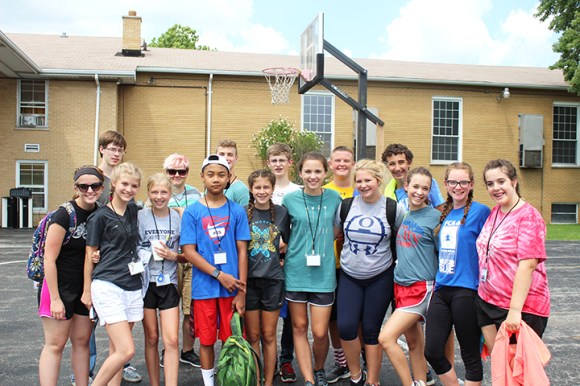
Photo op | Part of the group from First Baptist Church O’Fallon poses for a picture before starting the daily commute back to Judson University.

Two summers in a row now I have been completely immersed in the world of the Mission Illinois Offering – helping provide churches with state missions Bible studies, crafting guides for Illinois Baptists to prayerfully walk through with one another, and working to prepare hearts for giving and supporting missions right here in our own state.

MIO-box-smallThere is one area, though, which Mission Illinois giving supports that has become especially near and dear to me: ChicaGO Week.


I have had the opportunity to cover a number of incredible stories about work that IBSA churches are doing across the state – a small, rural congregation feeding thousands of people each month, urban church planters gathering together for mutual encouragement and solidarity, children whose Christlike actions have touched the lives of adults and entire communities.

Watch the MIO video, “Students on Mission in Chicago.”

But when I reflect on which stories have had the most impact on me personally – which testimonies and experiences have managed to stand out above all the rest – hands down they revolve around the selflessness and joy I’ve had the privilege to witness during ChicaGO Week.

As you can read about more in the upcoming August 22 edition of the Illinois Baptist, ChicaGO Week offers youth a unique opportunity to travel to this huge mission field and partner with local church planters whose goal is to reach the 9 million Chicagoland residents with the gospel, a large majority of whom don’t have a relationship with Jesus.

And trust me when I tell you that these students don’t take this partnership lightly.

Chicago Week Bubbles

Sports Camp | Local kids came to Transformation Church each day during ChicaGO Week as IBSA youth partnered with them to put on a sports camp — complete with bubbles and chalk drawing galore.

Last summer I watched as kids braved the summer heat and accomplished more yard work in a few hours than that church planter and his family could have gotten done all week. I thanked God for a young group of girls as they bravely talked to strangers and told others about Christ in this huge city they’d never even been to before. And this summer I couldn’t help but be filled with joy as 30+ students poured their time and energy into simply playing games with kids in the local community – eating ice cream together and showing them the love of Jesus.

Letting them know that they matter.

And the planters. The students during ChicaGO Week only get a brief glimpse into the daily lives of these church planters – seeing just a peek into the challenging, sometimes grueling and heartbreaking, yet oh so rewarding world of starting a new congregation. But getting to speak to these men and their families gives youth the opportunity to see the need for the gospel in our state, and it has given me such a greater appreciation for where my MIO dollar is going.

So I encourage you to give to the Mission Illinois Offering, and give generously. Because I’ve seen firsthand the life change and the souls that are won for the Lord when these planters have the resources they need to fulfill the mission that has been placed on their hearts.

Learn more about the Mission Illinois Offering and Week of Prayer.

– Morgan Jackson is an editorial contributor for IBSA and freelance writer living in Bloomington, IL.

Save

Ready for Rio

ib2newseditor —  August 5, 2016

Rio_2016_crop.jpgWith the Olympic Games set to kick off Aug. 5, Southern Baptist volunteers will be in South America to share the gospel both with local residents and with the thousands of visitors from across the globe.
“There exists no greater opportunity to reach people from over 200 nations in 30 days than the Olympic Games,” said John Crocker, a missions pastor from Alabama who is leading a mission team to Rio. Crocker’s team will engage Rio residents with the gospel through evangelistic block parties and Olympic pin trading.

“There is an openness by people to talk with one another and to talk about spiritual things,” said Sid Hopkins a retired director of missions from Georgia who ministers at the Games by distributing pins made especially for the Olympics that tell the story of Jesus.

“We have seen many people who come to the Olympic Games open to listen to the gospel because the atmosphere created is one of friendship on a global level. Ministry during the Olympics is simply electric.”

Pre-event publicity for the Olympics has been largely negative, due to concerns over the Zika virus, Brazil’s economic struggles, the fitness of Rio’s water supply, the Russian doping scandal, and other issues. But Brazil’s hosting of the 2014 World Cup proved to be successful, and Olympic organizers are banking on a repeat of that success in Rio.

Journalist Tim Ellsworth, former editor of the Illinois Baptist, will cover the Games for Baptist Press, focusing largely on Christian athletes who are competing, including diver David Boudia. He won gold in the 10-meter platform competition in 2012 and is looking to add to his medal count in both that event and the men’s 10-meter synchro competition with his partner Steele Johnson. Both men gave strong testimonies of their faith in Christ following the Olympic trials this summer.

“This is not what my identity is going to be in the rest of my life,” Johnson said. “Yeah, I’m Steele Johnson the Olympian, but at the same time, I’m here to love and serve Christ. My identity is rooted in Christ and not in the flips we’re doing.”

The Illinois Baptist blog, iB2news.org, will have more stories from Rio during the Olympic Games.

– From Baptist Press

Sandy WM outdoors

Sandy Wisdom-Martin during her tenure as IBSA’s women’s missions and ministries director.

The news spread quickly among Illinois Southern Baptists that one of their own daughters was named to serve as executive director/treasurer of Woman’s Missionary Union, SBC. Sandy Wisdom-Martin, an Illinois native who grew up near the small southern Illinois town of Marissa, was unanimously elected by the WMU executive board at a special-called meeting July 29-30 in Birmingham, Ala.

“My commitment has always been to walk where God leads,” Wisdom-Martin said in a press release from National WMU, “yet this has been a difficult process because I am in a very good place. I love the assignment God has given us (in Texas). This certainly caught my family by surprise and was not a part of our plan, but we believe God is sovereign and all the details of our lives are in His hands. I trust Him completely for the future.”

In the release she said what excites her most about this opportunity is to put total trust in the Father, serve Him with reckless abandon and see where the adventure leads.

“I don’t do what I do because of my employment,” Wisdom-Martin continued “I do what I do because I believe in the restoration of brokenness through hope in Christ. Through WMU, the only reason we do what we do is because he is risen and we must tell the good news.”

Evelyn Tully, IBSA WMU Director from 1985-2000, told the Illinois Baptist, “I am thrilled beyond words in Sandy’s selection as Executive Director of WMU, SBC.  Her missions commitment, her ministry lifestyle, and her exemplary relationships have uniquely prepared her for this tremendous responsibility.  I know Illinois missions-minded women will be her strong prayer supporters.”

Wisdom-Martin was the first recipient of the Darla Lovell Scholarship from Illinois WMU while studying at Southern Baptist Theological Seminary in Louisville, KY. While growing up she also served served on the state Acteens Panel, lead five Acteens Activator Teams, and was a seminary intern.

Wisdom-Martin served as IBSA women’s missions and ministries director from 2001-2010 before becoming executive director of WMU of Texas in 2010 through the present. While at IBSA she also served as president of Mississippi River Ministries and led the first international WMU Habitat for Humanity Team, which traveled to Ghana to build houses.

She and her husband Frank, who grew up in Sandwich, IL, are the parents of daughter Hannah.

Prior to coming to IBSA, she served as a Cooperative Program Missionary with the Arkansas Baptist State Convention from 1991-2001.

– Lisa Sergent with additional reporting from National WMU

Brandon McNeely, Sean Morecraft, Phil Nelson, and Dalton Sharro

Lakeland Baptist Church, Carbondale, SBC messengers: Brandon McNeely, Sean Morecraft, Phil Nelson, and Dalton Sharrow.

The world is currently experiencing its largest refugee crisis since the second world war with more than 65 million people displaced by war. The majority of these refugees come from the Middle East and Africa and are Muslim. It’s an issue that’s fraught with controversy

Last September, President Barack Obama pledged to bring 85,000 refugees to the United States with 10,000 coming from Syria. Southern Baptists took a stand on the issue, which has become a political hot potato in the race for U.S. president, at their annual meeting held this year in St. Louis June 14-15.

Resolution 12: On Refugee Ministry acknowledged the suffering refugees endure and Baptist’s historical role in refugee care, calling upon them to “minister care, compassion, and the Gospel to refugees who come to the United States.”

The resolution also called on the government to “implement the strictest security measures possible in the refugee screening and selection process.”

Phil Nelson, pastor of Lakeland Baptist Church in Carbondale, came to the convention as a messenger, bringing with him three young men from his church, Dalton Sharrow, Sean Morecraft, and Brandon McNeely. Resolution 12 (scroll down to read the full text of the resolution) in particular, caught their attention, said Nelson. “We saw the resolutions and we saw what’s going on with the Confederate flag and some others, and we thought that’s awesome the walls have come down, but we need to communicate to the world outside the ports of America that when our government and society is saying, ‘No, don’t come,’ we represent a different Kingdom.”

Together, the four wrote and proposed an amendment to further strengthen the resolution. Their amendment encouraged, “Southern Baptist churches and families to welcome and adopt refugees into their churches and homes as a means to demonstrate to the nations that our God longs for every tribe, tongue, and nation to be welcomed at His Throne…”

The resolution received immediate support from the leaders of evangelical refugee relief organizations.

“I applaud the Southern Baptist leaders who have urged their churches and members to demonstrate Christ’s love to refugees, perhaps the most unwanted, unwelcome and unloved people in our world,” said Richard Stearns, the President of World Vision U.S.

Stephan Bauman, President of World Relief, expressed his gratefulness and said, “We believe that the biblical mandate for welcoming those fleeing persecution is clear. We see the arrival of refugees as a remarkable opportunity for the Church to live out our faith.”

Speaking with the Illinois Baptist shortly after the amendment was approved, Nelson explained, “Our citizenship is in a different place. We want to communicate clearly we belong to a different Kingdom. It’s not an American Kingdom, it’s the Kingdom of God.  We want to tell all those who are orphans and refugees you’re welcome here. I don’t care what religion, what background, you’re welcome because we believe the gospel can rescue and save everyone.”

“When we first heard David Platt give his story about the refugee issues in Somalia and Syria and other places, I couldn’t stop weeping,” Nelson said, his voice breaking. “I started seeing the kids that had no place to go. All of a sudden I thought, we have 46,000 Southern Baptist churches, what would happen if each one of those churches said we’ll take a refugee. We’ll take a family.”

Nelson shared how another Southern Baptist pastor was part of their inspiration. As they were writing it, a friend of Nelson’s who is originally from India stopped to say hello. The friend, now a pastor in South Carolina, “came over here in 1990 as a Hindu, had his gods in a suitcase,” described Nelson.

That friend was a refugee when he came to the United States and learned about Christ. “It was a Baptist family that adopted him, let him come and live with them, where he saw the gospel lived out, and as a result gave up his Hindu background, gave up his Hindu gods,” Nelson told the Illinois Baptist. “Now he’s going back to India every year planting churches. I thought if we’re going to reach the nations, and we’re going to convince the world that the gospel is for everybody, we’ve got to set the standard and say, ya’ll come.”

Nelson encourages Christians to reach out to refugees settling into their communities. “We’ve got homes, we’ve got hearts, we don’t do bombs and bullets we do hearts and homes,” he said.

– Lisa Misner Sergent


RESOLUTION 12: ON REFUGEE MINISTRY

WHEREAS, The world is facing the largest refugee crisis since World War II, with over sixty million people displaced throughout the world and considered refugees; and

WHEREAS, War, violence, genocide, religious persecution, and other forms of oppression have contributed to massive people movements across the globe, as millions flee for their lives; and

WHEREAS, Southern Baptists have a long record of caring for and ministering to refugees throughout our history; and

WHEREAS, This history of refugee ministry includes the sponsoring of almost 15,000 refugees from 1975–1985, resulting in the starting of 281 ethnic churches and a 1985 resolution commemorating this decade of ministry; and

WHEREAS, There are expected to be 85,000 refugees coming into the United States in 2016 from four continents and the Caribbean; and

WHEREAS, Scripture calls for and expects God’s people to minister to the sojourner (Exodus 22:21–24; Exodus 23:9–12; Leviticus 19:33–34; Deuteronomy 10:17–22; Deuteronomy 24:17–22; Deuteronomy 26:5–13; Psalm 146:8–9; Matthew 25:35–40); now, therefore, be it

RESOLVED, That the messengers to the Southern Baptist Convention meeting in St. Louis, Missouri, June 14–15, 2016, encourage Southern Baptists to minister care, compassion, and the Gospel to refugees who come to the United States; and be it further

RESOLVED, That we encourage Southern Baptist churches and families to welcome and adopt refugees into their churches and homes as a means to demonstrate to the nations that our God longs for every tribe, tongue, and nation to be welcomed at His Throne (Revelation 5:9; Revelation 7:9-12; Psalm 68:5; James 1:27; Leviticus 25:35; Leviticus 19:33-34); and be it further

RESOLVED, That we call on the governing authorities to implement the strictest security measures possible in the refugee screening and selection process, guarding against anyone intent on doing harm; and be it finally

RESOLVED, That we affirm that refugees are people loved by God, made in His image, and that Christian love should be extended to them as special objects of God’s mercy in a world that has displaced them from their homelands.

Signs of Hope

ib2newseditor —  May 5, 2016

Illinois women on a mission in South Asia see lives changed by the story many there had never heard.

Editor’s note: In April, a team of women from Illinois traveled to South Asia to share gospel stories and witness how believers there are working to push back spiritual darkness. Lindsay McDonald, a pastor’s wife from First Baptist Church in Casey, captured the trip in words and pictures.

Okay, you can start,” Mim* says, leaning towards Gail Faulkner, who sits on the chair beside her. Having practiced the “Creation to Christ” story for months now, today is Gail’s opportunity to tell the gospel story that her team traveled nearly 8,000 miles to share.

“So, I should go ahead and start the story?” Gail confirms with Mim, a believer working to reach others in her country. About 20 women are gathered, clustered together on handcrafted floor mats.

A Hindu woman offered her simple, empty home for today’s story. The room is dark and still.

The women look expectantly at the visiting Americans and their translators and ministry partners—women from this country who have converted to Christianity.

“Yes, tell them. They are thirsty,” Mim responds with urgency.

S_Asia_women_no_text

Women here talk to each other while they prepare meals, wash clothes in the village pond, and care for their children. When the women in the last village on the last day were asked about how to apply the story to their lives, they said, “If we spend less time gossiping, we will have more time to share the gospel.”

Gail, a pastor’s wife from Bethalto, Ill., joined this mission team even when this part of the world wasn’t on her radar. She says God made it clear to her that it was her time to be on the team, and cleared her path of any financial obstacles to traveling thousands of miles from home.

Joining her on the team were six other women from Illinois and three from the Carolinas. They came from a variety of life stages: young mothers, grandmothers, retirees, professionals. All prepared and trained for months to bring the message of hope Isaiah prophesied to the Israelites thousands of years earlier: a perfect sacrifice, Jesus.

The Illinois volunteers came to partner with two missionaries serving in this densely populated country, and three national believers who served as their guides and interpreters. These Christians focus primarily on evangelism to Muslim women, who they can encounter more freely because of the culture here. The nation’s oral tradition is built on conversations and storytelling. Much like the story about to begin in this dark house.

Out of darkness

Life in South Asia is hard.

“Oppression is real and hope seems distant,” says Amy Neibel, a mission team member from First Baptist Church in Carmi. In this country in South Asia, 80% of the people live on less than $2 a day, and 40% live on less than $1.

Poverty is real.

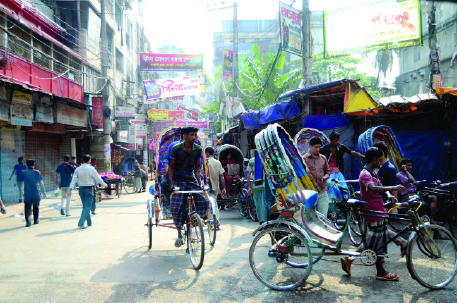
It bombards all of your senses—the smell of waste in the street, as adults and children sift through it, looking for items to recycle and sell. Cars honk in the dense traffic, and rickshaw drivers pedal passengers to and fro for a minimal wage.

Darkness is prevalent.

S_Asia_street_no_text.jpg

Sights of daily life whizzed past our van as we traveled the dusty, dirty, bumpy roads that are congested with chaos. Traffic, animals, people. Vendor after vendor sells fruit, meat and South Asian cuisine. Physically and mentally disabled adults lay on the side of the road, and beggars tap on the vehicle window looking for money.

“It is a place where you not only sense it, but also see the spiritual darkness on the faces of the people,” Amy says. The country is 98% Muslim and many haven’t heard about salvation through Jesus.Almost 16 million people hear the Muslim call to prayer fives times a day; some stop and pray and others proceed with their day.“Though you can sense the darkness, they are just like us—they are hurting,” team leader Kimberly Sowell says during a morning devotional. Sowell’s ministry, Bangladesh: For Faith and Freedom, supports job training for women and girls, offering them a way out of the hopelessness that is so prevalent.

“All of God’s people are called to be used of him but why do some not go?” Kimberly asks the team. They answer, We’re comfortable where we are. The missions call is for “other people.” There’s plenty of spiritual need at home.

Most of all, this place is hard.

“God is working here. That’s why there is persecution, if God wasn’t moving there would be no persecution,” says Mim.

Into the light

Walking is a part of the daily routine here. While out one day in the capital city and a nearby port city, Gail says, “I noticed there was no life. The faces of the women passing me were stoic. No expression. The lack of hearing the voices of children crushed my grandma’s heart. I’ve never been to an area where the noise of children playing, yelling, running and crying could not be heard.”

Stepping into the Light of Life and Light of Hope Learning Centers is a different story. Within these walls, there is life! Young smiles greet the team as they enter. They play Twister, Phase Ten, and Old Maid with the girls to teach them colors, animals, numbers, and occupations.

The ministry Sowell began in 2013 supports efforts to provide nutrition, hygiene, education and vocational training to young women. Here, they also hear the gospel, so they can find faith and freedom in Jesus Christ.

“The Light of Hope Learning Center is an amazing place full of laughter and love,” says Connie Lang, a volunteer from First Baptist of Casey, on her first international mission trip. “It is run by an amazing missionary, Susan Kirker,* who loves the girls and their mothers.

“As we built relationships with the girls, I loved hearing them recite the Bible story that was being taught to them,” Connie says. “This trip has been life-changing. I have grown closer to the Lord and have seen the power of prayer at work.

“I would love to go back again.”

While leaving the capital city headed to our next area of work on Friday, we had just started to pray for the city when we drove by a mosque. Hundreds of men were lying facedown praying to Allah. Our hearts were sick to see the lostness right before our eyes. It’s everywhere—less than 1% are believers. You can feel the spiritual darkness.

Both centers are funded by the International Mission Board, but they are run independently from one another, with different directors and school formats. Light of Life, located in the capital, has a school for at-risk girls during the day and brings in Muslim women in the afternoons for sewing lessons.

Light of Hope offers similar activities. Girls have the opportunity to sew in the mornings while earning a daily wage, and then attend school in the afternoon.

Both centers give hope to hopeless lives of the girls living in the city slums. “Yet it is even more than that,” Gail says. “The girls are offered a daily clean shower, two meals for the day, an education, sewing skills, Bible teaching and love.”

 Walking in new life

Back in the dark village house, the Hindu and Muslim women listen to the “Creation to Christ” story and then take turns repeating it, trying to commit it to memory. Since they live in an oral culture, many do not know how to read or write. Messages must be verbally transmitted in speech or song among friends and family, and then passed down through generations.

More than 30 women accepted Christ after hearing the stories the team shared. Several who believed have already set up a time to be baptized—a big step of obedience in a place where the decision to follow Christ could bring persecution.

“God showed himself mightily to the South Asians and our team,” said Niece Edwards from First Baptist, Carmi. “I was stretched as never before and learned more about God’s sustaining power.”

“Walking through this South Asian country during this season of my life, really displayed how I need to walk beside my husband with the purpose of harvest,” said team member Kathy Fullerton. “We need to be intentional with neighbors, strangers, friends, and family because the gospel can permeate cultural bounds. Jesus died for those in burkas and overalls alike.”

*Names changed.

Worth the risk

ib2newseditor —  May 2, 2016
A whirl of color – The Illinois mission team tries on pieces of the sari indigenous to the culture.

A whirl of color – The Illinois mission team tries on pieces of the sari indigenous to the culture.

As Carmen Halsey walked the roads of this South Asian country, she challenged herself to a game of sorts. “I’m a make eye contact, smile kind of person,” said IBSA’s director of women’s ministry and missions. Halsey tried to lock eyes with women she passed and see if she could get them to smile. But it never happened.

“I’ve never seen the face of oppression like what I saw there,” Halsey said, remembering how she tired of the multiple calls to prayer at the mosque, ringing out daily and reminding her mission team of how many people are walking in spiritual darkness.

Halsey’s trip to South Asia was actually years in the making. When she joined the IBSA staff in 2013, she mobilized women in the state around awareness and prevention of human trafficking—a focus started by National Woman’s Missionary Union.

In Illinois, Halsey has continued that emphasis, putting in place a task force to study the issue, create resources for churches, and facilitate mission trips in North America and internationally to be involved in rescuing victims of trafficking. The trafficking focus is how Halsey met Kimberly Sowell and Bangladesh: For Faith and Freedom.

The April trip, led by Sowell, gave Halsey and Illinois women an opportunity to see up-close trafficking prevention and rescue at the Light of Hope Center. But they also saw the importance of encouraging national Christians—South Asian women who have come to Christ and are now risking persecution to reach others with the gospel.

During their trip, the Illinois women saw in a new, real way the threats Christians face in other parts of the world. The awareness that believers in South Asia could lose their lives for their faith spurred the team on, Halsey said, and inspired “intense, beautiful” prayer. It also left Halsey wrestling with a bigger question: As Christians in the U.S., most of us don’t have a target on our backs. Why then are we not sharing here?

As the team ministered in a village one day, they were asked to pray for people who were sick. One woman went to get her son, a Muslim, so Halsey could pray for him. Halsey describes what happened next as her boldest moment. “I looked at him and said, ‘I will pray for you. But I have got to be clear: There is only one name I’ll pray to.”

In this place, where people are in desperate need of hope, only one Name can deliver it: Jesus.

For more information about IBSA mission opportunities, contact Carmen Halsey at (217) 391-3138 or CarmenHalsey@IBSA.org.

– Meredith Flynn

Six missionary families who have accepted God’s call are featured during the Annie Armstrong Easter Offering Week of Prayer for North American Missions, set for March 6-13. The goal for the 2016 Annie Armstrong Easter Offering is $70 million.

The Rager family

The Rager family

Three years ago Barry Rager was the pastor of a small Kentucky church. Most of his days were centered on important church business. He prepared sermons, visited sick members and mediated church disputes. All good work. All important work. All kingdom work.

“I was kind of like the coach saying, ‘Hey, reach the people you are with,’ but I wasn’t actually the one doing it,” Rager says.

Three years later, and his life couldn’t be more different. Living in the Mapleton-Fall Creek neighborhood of Indianapolis’ core, his mission field is everywhere.

A trip to Indianapolis for the 2008 Southern Baptist Convention first opened Rager’s eyes to the needs of the city. It wasn’t until 2012 that James Edwards came to him with an offer: “We want to plant a church in a major U.S. city, and we want you to be the planter.” Rager didn’t have to think hard about which city.

Edwards, pastor of Pleasant Valley Community Church, and the congregation felt the call to plant a church in an urban city, which eventually led to a strong calling for a church plant in Indianapolis. Edwards had met the Ragers on a playground where a strong friendship was formed. For years, the Ragers and Edwards encouraged and supported each other and their ministries. When Pleasant Valley felt God tell them to plant a church, they prayerfully considered who would lead the church plant.

“Barry Rager’s name continued to surface,” said Edwards. Pleasant Valley asked the Ragers to pray about planting a church in Indianapolis. “It was clear to Barry and Amy that God was calling them to plant a church in the heart of Indianapolis,” said Edwards. “Our strong inclination to partner with Barry and Amy came primarily through the leadership of the Holy Spirit.”

A once thriving city in the 1920s, by the 1960s many residents had moved to the suburbs.

Today, 41.5% of residents do not have a high school diploma. A 2013 NeighborhoodScout.com article called the northern half of the area the 17th most dangerous neighborhood in the U.S.

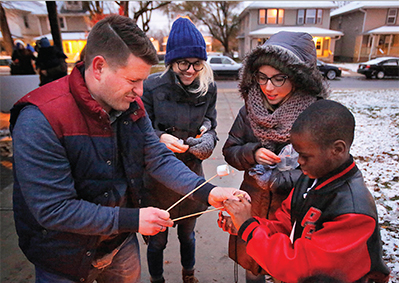
Indianapolis church planter Barry Rager (left) and New Circle Church use events like S’mores and Snow in the Park to reach a neighborhood many describe as dangerous.

Indianapolis church planter Barry Rager (left) and New Circle Church use events like S’mores and Snow in the Park to reach a neighborhood many describe as dangerous. The Ragers are North American Mission Board 2016 Week of Prayer Missionaries. NAMB photo by John Swain

Once the Ragers relocated to Indianapolis, they were told it would likely take them years to connect with their neighbors and build disciple-making relationships.

“When we moved in, we decided that we were going to be as open and positive as we possibly could be,” Amy Rager says. “Most of the people around here keep their blinds shut 24-7. They’re very closed. So we thought, you know what? Our blinds are going to be open. We’re going to act like we trust these people. We’re going to do anything we can to initiate that relationship.”

Before their boxes were even unpacked, the family showed up on their neighbors’ doorsteps with freshly-baked homemade cookies. They also invited their neighbors into their home for dinner.

As they continued to build community, the Ragers eventually started worship services with 40 people attending in September 2014. That was the launch of New Circle Church, Indianapolis. A year later their worship attendance more than doubled and they had seen 22 people baptized.

Barry focuses the church on a simple-yet-comprehensive mission—introducing people to Jesus, developing gospel-centered community and commissioning them to reach people for Christ.

“What I get to do is brag on Jesus and what He has done,” Rager says. “It is such an honor to brag on Jesus.”

“I think if it is never our intention to live on mission, then we won’t live on mission,” Rager says. “We have to be intentional in the way we use our time, and in the meetings we have with people.

– By Tobin Perry on www.AnnieArmstrong.com

Platt surprised by number, but financial position called ‘much healthier’

Richmond, Va. | David Platt’s report to the International Mission Board’s Board (IMB) of Trustees was the culmination of six month’s worth of efforts to undo the six year’s worth of overspending.

The IMB president, told trustees 1,132 total IMB personnel had accepted the Voluntary Retirement Incentive (VRI) or Hand Raising Opportunity (HRO).  The numbers broke down to 702 missionaries and 109 staff personnel accepting the VRI, and 281 missionaries and 40 staff accepting the HRO. The positions of 30 personnel in IMB’s Richmond communications office were eliminated in its mobilization restructure.

The total was nearly twice the minimum number the mission board needed to depart to balance its budget. As a result, the number of missionaries on the field are down to around 3,800, a number not seen 1992 when, according to Southern Baptist Convention (SBC) annual reports, the year ended with 3,893 international missionaries were serving.

Platt told reporters participating in a press conference via telephone February 24, “The numbers surprised me, for which I don’t have an explanation. We’ve put it in the hands of missionaries as much as possible… This a larger number than I or anyone else was anticipating. We called on people to pray so we’re going to trust in the Lord and his decision.”

While the press conference was taking place, Platt told reporters a severe storm was passing through and noted the lights were flickering on and off. A few minutes later the lights went out and a Tornado Warning Alert could be heard. The press conference was stopped for a half hour until the storm passed.

After discussing the numbers, Platt told the gathered media, “I want to talk about the number of missionaries who are left. Thousands of missionaries remain on the field, with thousands of years of collective experience. Everyone of them on the field has been placed there by God.”

IMB reported it had “consistently spent more money than it has received — a combined $210 million more since 2010…Because 80 percent of IMB’s budget is devoted to personnel salary, benefits and support expenses, leaders determined a need to reduce the total number of personnel by approximately 600-800 people to get to a healthy financial place in the present for sustained growth and engagement in the future.”

The Illinois Baptist asked what his reaction was to receiving almost double the number of resignations needed? “My heart is heavy but hopeful,” he answered. “Heavy in a sense that my heart is not to see less people on the field. My heart is heavy seeing the effects…It’s a hopeful confidence mingled with that heaviness.”

“What does this say about the confidence the missions force has in the new leadership?” the Illinois Baptist asked in a follow-up. Platt replied, “I’m very encouraged to see God working in the middle of all this. I have a hopeful confidence in what the IMB will be able to do in the future.

“I hope Southern Baptists see a serious desire to love and lead the IMB well…This is in no way a commentary on past leadership. Past leadership made a bold decision to put people on the field.”

Platt also addressed a question he said people have been asking, “How can you send thousands more when you just sent a thousand off the field?” His answer focused on what some would describe as marketplace missions, “limitless opportunities for people to work overseas and retire overseas.” In turn they would be funded by their paychecks and pensions. He also noted mission opportunities for students studying abroad.

One reporter expressed concerns from churches about the departure of so many missionaries leaving a “brain drain” on the field. Platt responded, “We encouraged missionaries returning to take their last days on the field to pour into our national partners and other IMB missionaries that were still there.”

Another reporter asked Platt if he saw this proposed use of self-funded missionaries as the IMB taking a societal approach to missions.

In his answer Platt noted, people who get jobs overseas and are paid by their businesses, universities provide scholarships to students, and countries in southeast Asia are seeking Westerners to retire there “rolling out the red carpet.” With these opportunities, he asked, “How can we not support the core paid missionaries with those around them that can help?”

He continued, “I can’t pray Matthew 7:9 and then tell people who want to serve with the IMB, ‘no.’ God’s created these other avenues…”

Platt also responded to a question regarding what kind of response he has heard from Southern Baptists. “I’ve not been surprised by the feedback from Southern Baptist pastors and church leaders,” he shared. “They’re thankful we’ve chosen to stewardship resources in the way we have…They’ve been very encouraging. Once they hear the big picture they say that makes sense, thank you for making that decision.”

He went on to say, “People aren’t happy about it. I’m not happy about it. It’s a hard reality for Southern Baptists to face that we don’t have the resources to keep more people on the field….I expect people to be upset that people are leaving the field but God’s leading us to greater financial stewardship.”

SBC President Ronnie Floyd told Baptist Press, “This reset is not regress or retreat. Southern Baptist churches must see this as a fresh calling to reaching the world for Christ. Now is the time to go forward with a clear vision and an aggressive strategy to make disciples of all the nations for Christ.”

Twenty-six new missionaries were appointed to the International Mission Board Feb. 23, in a service that was the first to be live-streamed.

The IMB Board of Trustees met February 22-24 in Richmond, Virginia.

IMB will host a livestream focused on “The Future of the IMB” Thursday, March 3, at 11 a.m. EST. For more information, visit IMB.org/live.