Archives For November 30, 1999

Personal belief, salvation, spiritual disciplines, formation

The BriefingTrump: ‘Moore Is Truly a Terrible Representative of Evangelicals’
Presumptive Republican presidential nominee Donald Trump lashed out at ERLC President Russell Moore with a tweet May 9. The tweet comes after Moore told “Face the Nation”that “the Donald Trump phenomenon” is an “embrace of the very kind of moral and cultural decadence that conservatives have been saying for a long time is the problem.” He also noted some conservatives “now are not willing to say anything when we have this sort of reality television moral sewage coming through all over our culture.”

Evangelicals feel abandoned by GOP
Some conservatives whose voting decisions are guided by their Christian faith find themselves dismayed and adrift now that Trump has wrested control of the Republican Party. Even progressive Christians — evangelicals and Catholics, among others — who don’t necessarily vote Republican are alarmed that Trump is attracting many voters who call themselves religious.

Justice Dept., NC sue over bathroom law
The Justice Department and North Carolina filed dueling lawsuits May 9 over the state’s controversial “bathroom” law, with the Obama administration answering an early-morning lawsuit filed by Republican Gov. Pat McCrory with legal action of its own.

51 Illinois families sue over transgender bathroom policy
A group of 51 families whose children attend a Palatine, IL high school filed a federal lawsuit attempting to reverse a policy that allows a transgender student to use girls’ bathrooms, locker rooms, and other sex-specific facilities. They are challenging a policy at District 211 that was mandated by the U.S. Department of Education to accommodate the transgender student, who was born male but identifies as a female.

111 Methodist clergy come out as LGBT
Dozens of United Methodist clergy members came out as lesbian, gay or bisexual on May 9, defying their church’s ban on “self-avowed practicing homosexuals” serving in ministry and essentially daring their supervisors to discipline them.

Bono wants Christian music to get honest
When U2 musician Bono reads Psalms he sees the full range of human emotions: anger, irritation, sadness, bliss. Bono, who has become more outspoken about his Christian faith in recent years, is advocating Christian music return to the raw and honest emotion of the Psalms.

Sources: Christian Post, Baptist Press, Washington Post, Fox News, Daily Signal, CNN, Huffington Post


Safe zoneRecently I had an opportunity to attend a conference at one of the schools in the Illinois State University system. The conference was very informative and what I learned should benefit IBSA churches. What I learned walking through the campus may have been an even greater education.

I always enjoy being on college campuses and find the atmosphere invigorating. It’s a world that’s insulated from the stressors of work, dedicated to learning, the exchange of ideas, and full of youthful energy. But as a Christian it seems less and less welcoming.

Posters on the walls of hallways advertised events featuring authors of books on “queer” studies and “Lavender Graduation” ceremonies which the Human Rights Campaign describes as “an annual ceremony conducted on numerous campuses to honor lesbian, gay, bisexual, transgender, and ally students and to acknowledge their achievements and contributions to the University.” The ceremony was scheduled to take place in a
few weeks in one of the rooms where my conference was meeting.

Different offices bore rainbow colored stickers emblazoned with the words, “Safe Zone.” Generally, they denote places where students can “safely” approach those inside about LGBTQ issues. I wondered how welcome I would be to walk inside and discuss Christ.

Like many of us, I consider myself well-read and informed, believing I know what’s going on in our country and culture. However, the reality of the situation hit me like a slap across the face. This is what many students from our churches encounter on their public university campuses everyday. Their beliefs are not celebrated and most likely not welcomed.

We must encourage and disciple the young people in our churches. We must do the same for them on our college campuses, and our churches must reach out to those on the campuses who do not know Christ. The culture is leading the next generation away from Christ, and we must speak truth into that culture—the truth that is Christ.

Christian college students can’t do it alone. Remember yourself as a student and the pressures you faced. Those pressures have only multiplied. Our churches must stand alongside them.

During a break between sessions, I found my way to the restrooms—one marked “men” and another marked “women.” I couldn’t help but wonder who I might encounter inside.

– LMS

The BriefingTransgender student wins restroom case appeal

In Virginia, federal appellate court has “for the first time ever” held that a public high school may not provide separate restrooms and locker rooms for students on the basis of biological sex alone, according to dissenting judge’s opinion. Although gender identity is not mentioned explicitly in Title IX, the judges said Supreme Court precedent requires that the Department of Education be allowed to interpret its own regulations where ambiguity exists.

#BoycottTarget reaches 500,000 signers
Less than a week after Target, the nation’s second-largest discount retailer, announced that transgender customers may use the restroom that “corresponds with their gender identity,” nearly 500,000 people have signed a #BoycottTarget online petition launched by the American Family Association.

Building the Museum of the Bible
When finished in 2017, the Museum of the Bible will be 430,000 square feet of exhibits dedicated to the Bible. The total cost will exceed $1 billion. The Green family, the same clan that owns the Hobby Lobby retail chain, has put up the seed money behind the project, including about $50 million to purchase the real estate on which the building sits in Washington, D.C.

Pro-abortion baby-shaped cookies
Pro-choicers go to great lengths not to use the term “babies” when it comes to unborn children. Which is what makes it ironic that a University of North Georgia pro-abortion group decide to feature cookies in the shape of said babies to promote keeping abortion legal.

Ga. fires physician for lay sermons
First Liberty Institute has filed a lawsuit for a bivocational lay minister and physician Eric Walsh, alleging the state of Georgia fired him because of sermons he delivered in the pulpit before his employment as a district health director. The termination violates Walsh’s rights to free speech, free exercise of religion and freedom of association guaranteed under the First Amendment, the suit asserts.

Sources: Baptist Press, Religion News, World Magazine, National Review, The Guardian, Baptist Press

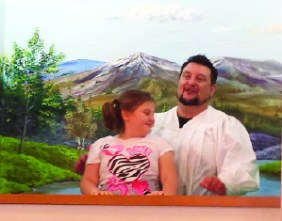
Pastor Brad Sloan baptizes his daughter, Delaney, at Dahlgren Baptist Church.

Pastor Brad Sloan baptizes his daughter, Delaney, at Dahlgren Baptist Church.

How did Dahlgren Baptist Church move from two baptisms in 2014 to 17 last year?

“I’ll give you the short answer: It’s all about Jesus,” said Pastor Brad Sloan.

His church is located in a small, predominantly Catholic village 15 miles southeast of Mt. Vernon, IL. “There were a few people who were like, man, I don’t know if you’ll ever see much growth there,” said Sloan, who was installed as pastor in August of 2014.

The church hasn’t yet seen massive growth, “but what we have seen are souls (saved).”

Dahlgren’s Awana program for children reaches kids in the community whose parents aren’t yet connected to the church. Last summer, the church held its first Vacation Bible School in 10 years, with 33 kids in attendance.

In 2015, Dahlgren Baptist Church hosted its first Vacation Bible School in 10 years.

In 2015, Dahlgren Baptist Church hosted its first Vacation Bible School in 10 years.

Through those outreach efforts and intentional Sunday school-based discipleship, Sloan is trying to inspire in his leaders a hunger for people to come to know Christ. In turn, the leaders challenge the students they’re discipling to examine what it means to have a relationship with Jesus.

“We’ve just had a lot of victory (in student ministry) when kids begin to be challenged: Hey, what do you believe about Christ?”

In 2015, the majority of Dahlgren’s baptisms were children (although the total also included a family and a grandmother, Sloan said). The kids are now participating in children’s church and youth activities, and are learning to share their faith. The church also works to engage parents as they come to pick up their children from church.

Sloan sees revival happening in his community, particularly in the schools, as students are being stirred to really live like Christ.

“There’s not one person in this little village that Jesus can’t impact,” he said, “and it’s up to us to introduce them to him.”

The BriefingBans on travel to Miss., N.C., called ‘ridiculous’

At least nine U.S. cities and five states have banned non-essential travel by government employees to North Carolina, Mississippi or both, claiming religious liberty bills adopted there discriminate against homosexual and transgendered persons. Pastors and other Christian leaders call the bans “ridiculous.”

Women share abortion stories with the Supreme Court
Twenty-five years ago, two women found themselves in the same position: freshmen in college, pregnant and scared of derailing all they had worked toward. Both women walked into a Dallas abortion clinic. It’s what happened when they walked out, and in the weeks and decades that followed, that places them on opposite ends of the most significant abortion case to be heard by the Supreme Court in a quarter of a century. These and other women are sharing their abortion stories through friend-of-the-court briefs in the case of Whole Woman’s Health v. Hellerstedt.

Colleges welcome diversity, except evangelical Christians
San Diego State University recently withdrew official on-campus recognition from an evangelical sorority and an evangelical fraternity, stripping them of the privileges that all other on-campus student organizations possess. The problem according to the university was that these Christian student organizations were engaging in discrimination because they restricted their members to Christians in agreement with their statements of faith.

The footnote that could split the Catholic church
Some believe a footnote in Pope Francis’ new exhortation on marriage and the family, Amoris Laetitia could cause fractures in the Catholic church. There is an ongoing debate in the church about admitting remarried couples to the Eucharist. The footnote could further inflame that debate. Francis wrote, “In certain cases, this can include the help of the sacraments. Hence, ‘I want to remind priests that the confessional must not be a torture chamber, but rather an encounter with the Lord’s mercy’.”

Bible makes list of books most challenged
On the latest list of books most objected to at public schools and libraries, one title has been targeted nationwide, at times for the sex and violence it contains, but mostly for the legal issues it raises. The Bible.

Sources: Baptist Press, Washington Post, World Magazine, Gospel Coalition, Fox News

Disliking their options, some evangelicals consider withdrawing from presidential politics this time around.

USA symbols mapWith eight months to go until the presidential election, a World magazine survey finds 8 in 10 evangelical leaders say they would vote for an outside third-party candidate as president over Democrat Hillary Clinton or Republican Donald Trump.
Meanwhile, Trump has been victorious in several southern states where voters identified heavily as evangelical, sparking a debate over the meaning of the word “evangelical.”

This tension has not been unnoticed by the media. A recent Yahoo Politics article declared, “Donald Trump’s candidacy has sparked a civil war inside American Christianity.” In an essay for the New York Times, Russell Moore, head of the Southern Baptist Ethics and Religious Liberty Commission, asked, “Have evangelicals who support Trump lost their values?” In the article he decries Trump’s past behaviors and urges Christians to vote according to biblical moral values.

World’s March survey of 103 evangelical leaders and influencers showed more than 50% said they would, on principle, “vote for a third-party candidate who had no chance to win.” The survey also found 76% would vote for Sen. Ted Cruz as president if he secured the Republican nomination. In the eight prior surveys, their choice had been Sen. Marco Rubio who has since ended his campaign.

The debate continues over the disconnect between evangelical leaders and some people in the pews. D. C. Innes, King’s College professor and World magazine contributor, told the Deseret News evangelicals support Trump because they believe they’ve lost the culture wars. “Evangelicals, for example, became politically engaged to preserve their way of life and they don’t feel they’ve gotten their support’s worth from politicians. Abortion, gay marriage—they’ve lost on every front,” said Innes. “The support for Trump is an act of desperation: Protect us. We’re not free to be Christians anymore, so you’ve got my vote.”

Turning to Trump, who is decidely not evangelical, is one option. At the other end of the spectrum is The Benedict Option. In 500 AD, after the fall of the Roman empire, Benedict moved to the city of Rome to continue his education. Disgusted by the decadence there, he left the city and withdrew from society. Benedict became a monk and started several monasteries, leading to the Catholic order that bears his name.

Rod Dreher, writing for the American Conservative, calls this “a communal withdrawal from the mainstream, for the sake of sheltering one’s faith and family from corrosive modernity and cultivating a more traditional way of life.”

A less severe option calls on Christians not to withdraw, but to focus on their churches as “counter-cultural communities of disciples who covenant to walk together for the sake of worship, catechesis, witness, and service.”

Nathan Finn of Union University says this movement (called the Paleo-Baptist Option because it draws from Baptist history) is necessary because “all Christians need to learn from each other, sharpen one another, and spur each other on to love and good deeds. We need each other as our respective traditions seek to follow Christ and bear witness to his kingship in a culture that is increasingly hostile to all forms of orthodox, full-throated, publicly engaged Christianity.”

Of course, considering either outright withdrawal from politics or shoring up “the Christian resistance against what the empire represents,” possibly by way of supporting a third-party run, is all conjecture at this point. With Super Tuesday behind us, and until both parties choose their nominees for the general election, believing evangelicals can only watch and pray for better options.

Pastor combats violence

Lisa Misner —  March 24, 2016

Takes to airwaves to save kids and streets

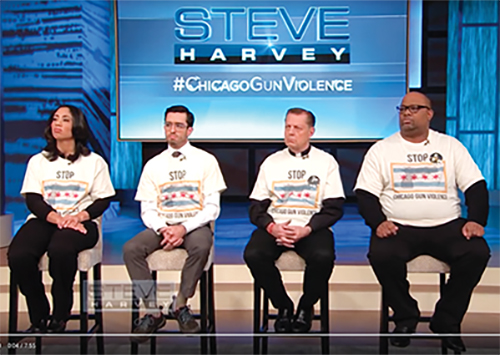
An IBSA pastor appeared on the “Steve Harvey Show” last month to bring attention to rampant gun violence in his city. Corey Brooks, who pastors New Beginnings Church on Chicago’s South Side, was part of a four-person panel on Harvey’s Feb. 15 episode, the whole of which was dedicated to violence in Chicago.

Chicago pastor Corey Brooks (right)

Chicago pastor Corey Brooks (far right), “The thing that will change and solve the problem of violence is the gospel.”

It’s a problem Brooks has been fighting for years, most notably during his 2011 campaign on the roof of a motel across the street from his church. “I was just tired of it,” Brooks said of the crime that riddled the motel. With only a tent to protect him from the Chicago winter, Brooks spent 94 days on the roof, until he had raised $555,000—enough money to buy the hotel and tear it down. His church is now raising money to build a community center in its place.

In 2015, Chicago had 468 homicides, the Chicago Tribune reported, the most of any U.S. city. More than 2,900 people were shot. Already in 2016, there have been 467 shooting victims in Chicago.

Brooks’s church sits in a neighborhood that one newspaper labeled in 2014 the city’s most dangerous. But when New Beginnings moved in to the location, they were looking for a place they could make a difference.

“We wanted an area that really needed the gospel, an area that really needed a lot of help,” Brooks told the Illinois Baptist. “God has really been good to us, and we’re doing the best we can do in that area. It’s difficult, but we’re working really hard.”

The church started a non-profit called “Project HOOD” that focuses on mentoring initiatives. It was Brooks’s time on the motel roof that first introduced him to talk show host Steve Harvey, who gave the pastor his Best Community Leader Award in 2012. Harvey’s foundation has since partnered with Project HOOD.

On the Feb. 15 episode of Harvey’s show, which tapes in Chicago, Brooks’s fellow panelists—a former school principal, a journalist, and a Catholic priest—came from very different walks of life than his own. But to solve the problem of gun violence, Brooks said, people are going to have to work together.

In fact, that’s why his church affiliated with the Illinois Baptist State Association in 2015. “I realized that this issue is a lot bigger than what an independent church can handle,” Brooks said. “You need to be aligned and partnering and collaborating with other groups that believe what you believe” so that you can bring needed resources into communities, he said.

“The thing that will change and solve the problem of violence is the gospel.”

Meredith Flynn is an editorial contributor to the Illinois Baptist.

We who handle holy things

Lisa Misner —  March 21, 2016

Jesus Christ crown of thorns and nail

Jesus wept. Standing in the cemetery with Martha and Mary, he didn’t pat the grieving sisters on the shoulder. He didn’t say, “I’ve got this.” Certainly he could have. Jesus knew that in a few moments he would order the great stone rolled away from the tomb and call a dead man from its greedy maw. He knew that this sign would portend his own resurrection and back up his statement: “I am the resurrection and the life.”

But when the sisters each said, “Lord if you had been here our brother wouldn’t have died,” it must have been like a knife under his ribs. He had delayed rushing to their brother’s deathbed on purpose so that the Father would be glorified. But in that moment, before the tomb, he grieved for the sisters and for his friend Lazarus. Jesus did not stand apart from their grief. He entered into it.

On a recent Wednesday, I faced this phenomenon myself: stand apart from the sorrow, or enter into it. First I visited with the family of a man who had learned two weeks earlier that he had only months to live. But the end came more quickly than that. On Saturday he was changing the brakes on his wife’s car; on Sunday he was in a coma. He believed in God, his wife said, but unlike her, he never accepted Jesus as his savior. She had carried this sad truth throughout their marriage. She had lived her faith before the man and witnessed to him many times. Many people had, and now it was too late.

An hour later I met with another man who had learned two weeks earlier that he had only months to live. He had questions about faith. He wanted answers about why Jesus had to die for everyone. But more important, he wanted to be certain of his own salvation. He wept over sin—his own—and we prayed for his salvation and assurance.

On the way home I thought about the contrasts between these two meetings. And I wondered when was the last time I saw someone weep over his own sin. It’s been a while. I’ve been there many times when people cried over the sins of others, and the impact of sin on the nation, but crying with the realization that their own sin is an offense to God? That their sin sent Jesus to the cross? It’s been a while. And stopped at a red light, I thought, How long since I cried over my own sins and my part in the sacrifice of Jesus?

We who handle holy things are like celebrity chefs who brag about their “asbestos fingers.” They’re so accustomed to grabbing hot pots without pot holders that their hands have become desensitized to the heat.

We stand so close the burning bush that it warms our toes but singes our eyebrows, and we hardly notice the difference. We climb the mountain like Moses to meet with God, and we approach the burning peak with such aplomb that the smoke and lightning don’t scare us. We reach out to prop up the house of God with unholy hands, hardly thinking that others who did so were struck dead.

And across a thousand Sundays in the course of our ministries, we offer up symbolic body and blood with little thought to the lambs whose throats were slit, whose lifeblood drained into bowls to sprinkle the altar, and whose bodies were burned in sacrifice for sins. “Without the shedding of blood there is no forgiveness for sin” is easier said over Welch’s than Red Cross. Strange as it sounds, in the rush to the Good News, it’s possible to skim past the realities of death. It’s possible to celebrate the Cross without mourning the blood dripping from God’s Ultimate Sacrifice. If we are not careful, all this handling of holy things becomes routine.

Even when we are careful.

Before we rush to the joys of Resurrection Sunday, let’s stop first at the reality of Crucifixion Friday. With sorrowful John and the weeping Marys at the foot of the Cross, let’s consider our own complicity, and enter in.

Eric Reed is editor of the Illinois Baptist newspaper.

The BriefingStates debate religious liberty protections
Within the last 24 months, state legislators have introduced almost 100 (and counting) “targeted laws”—legislation designed to give legal cover to business owners, religious schools, and ministries that affirm the sanctity of marriage between one man and one woman.

US to decide if Christians face genocide from ISIS
For two years, ISIS has been terrorizing Christians and other religious minorities in Syria and Iraq. March 17 Secretary of State John Kerry will have to tell Congress whether the United States will officially label ISIS’ actions a “genocide.”

ERLC, IMB urge prayer for refugees March 15
The March 15 focus of the campaign — #PrayForRefugees — comes on the fifth anniversary of the outbreak of hostilities in the Middle Eastern country. The ERLC and its partners are calling for churches, small groups, Christian organizations, families and individuals to pray for the more than 13.5 million Syrians who need humanitarian assistance as a result of the conflict.

Voters don’t care about candidates’ generosity
Americans contributed $358 billion to charity in 2014, according to Giving USA. How much did each current presidential candidate contribute to that record-setting sum? The candidates, for the most part, are not telling, and pollsters, the media, and voters are not asking.

Workplaces get chaplains
A number of companies have hired spiritual leaders to serve on their staffs. Though slightly less trendy than nap rooms and yoga classes, workplace chaplaincies are another attempt to make workers more productive by catering to their “whole” selves.

Sources: WORLD Magazine, Christianity Today, Baptist Press, The Atlantic, World Magazine

The BriefingNY Times asks: What does it mean to be evangelical?
Donald Trump’s popularity with evangelicals has led some church leaders to break with the term. The New York Times Opinion Page asked four evangelical writers to share what it mean to be an evangelical today.

Gary Smalley passes away
Best-selling author and world-renowned marriage and relationship expert Gary Smalley has died at age 75. Smalley passed away March 6 after a lengthy illness, his family announced on Facebook March 7.

Christianity Today apologizes for ‘son-in-law’ job posting
The flagship evangelical magazine Christianity Today has tweeted an apology after publishing a job listing for a son-in-law that raised some eyebrows on social media. The ad, which ran in the March edition, was bought by an unnamed Chicagoland church elder who is based in Wheaton, Ill., the magazine’s longtime home.

Millennials increasingly view the church negatively
Since 2010, millennials’ view of churches and other religious organizations as having a positive effect on the country has fallen 18 percentage points, according to Pew Research. In 2015, 55% of young adults believed churches have a positive impact on the country compared with 73% five years ago.

Florist who refused gay wedding gets appeal
The highest court in Washington state has agreed to hear the appeal of florist Barronelle Stutzman found guilty of violating state laws and the constitutional rights of a gay couple when she refused to arrange flowers for their wedding, citing religious beliefs.

Bible translators split over Trinity description
Wycliffe Associates (WA) is leaving Wycliffe Global Alliance (WGA), a partnership of more than 100 Bible translation agencies around the globe. WA cited several reasons for its decision, starting with controversy over the language used to describe Jesus. In some Bible translations, the language of Jesus’ relationship to God the Father (e.g. “Son of God”) is softened to stem confusion and anger from Muslims.

Sources: BPnews.net, Christianity Today, Facts and Trends, Focus on the Family, Religion News Service, New York Times