Archives For November 30, 1999

The Chicago vortex

nateadamsibsa —  January 12, 2015

HEARTLAND | Nate Adams

It’s January, and another “polar vortex” appears to be descending upon our heartland homes. Just a few days ago the temperature outside was flirting with 50 degrees. But then yesterday was barely above freezing, and as I write now it’s 16 degrees, heading for a low of 6 tonight, with wind chill temperatures that will require those dreadful minus signs in front of them.

Nate_Adams_Jan12So instead I’m choosing to think about next summer, and I encourage you to do so too. Now, in the dead of winter, is a perfect time to start planning a summer missions experience.

Your church may already have a plan for sending one or more groups on mission trips outside your own community this year. Many churches in Illinois have adopted an Acts 1:8 strategy, and are seeking to send mission groups to serve nearby in their local association, as well as elsewhere in Illinois, North America and internationally. These are modern day equivalents of the “Jerusalem, Judea, Samaria, and the Ends of the Earth” mission fields that Jesus spoke of in His last words on earth.

If your church doesn’t yet have a mission trip planned for this summer, and especially if you have teenagers in your church, let me suggest one option where most of the planning has already been done for you. It’s called ChicaGO 2015, and it will be hosted July 26-31 on the campus of Judson University in Elgin. You can find more detailed information on the IBSA website, or by calling or
e-mailing Rachel Carter (217-391-3101 or RachelCarter@IBSA.org). Even if you only have two or three who can go, they will be quickly welcomed into the larger group.

During ChicaGO 2015, your group will be housed on the Judson campus there in Elgin, but during the days you will explore one or more of Chicago’s 77 neighborhoods or diverse suburbs. Morning training sessions and evening worship experiences will allow you to meet some of the dynamic church planting missionaries that are seeking to advance the gospel in our nation’s third largest mission field. And during the day you will work right alongside them, and alongside other students and adults from Illinois churches that share your heart for advancing the gospel there.

Wherever you live in Illinois, ChicaGO 2015 is relatively nearby, and affordable. Planning and preparations for the week, such as meals and work projects, will have been done by IBSA before you get there. Participants can be both students and adults, and the environment is one that’s safe, and yet that will open your group’s eyes to the vast and diverse lostness that is Chicago.

You see, Chicago itself is a vortex, and not just in the winter. A vortex is defined either as a “whirling mass,” or simply as “something overwhelming.” That’s why, when the frigid air from the Arctic Circle whirls its way down into Illinois, we feel the overwhelming
brutality of its icy grip. But there is also a whirling mass of people in Chicago that are in the icy grip of lostness. Many have never heard the true gospel in a way they can understand, or from people that care enough to meet them where they are.

That’s why now, this winter, right in the middle of our polar vortex, is an ideal time to plan a summer mission trip. Perhaps you will join our church planters and me in the Chicago vortex next July. Or perhaps your church has identified a different vortex of lostness or two to enter. Last year more than 26,000 Illinois Baptists did. It warms my heart just to think about it.

Nate Adams is executive director of the Illinois Baptist State Association.

My best prayerwalking technique came from second graders.

PRAYER | Cheryl Dorsey

Editor’s note: This is the fourth and final post in a series on prayer and spiritual awakening. Read the previous posts: 2015: The Year of Prayer, Revise us, O Lord, and 15 prayer requests for your city.

One of my most profound prayerwalks took place with a pair of 7-year-olds. On that particular Saturday at our church, everyone had already paired up for the half-hour walk through our community of 500 homes. Leaving me with my son, Joseph, and a friend’s grandson, Antoine.

On school days, waking Joseph up was an ordeal. But on prayerwalking Saturdays, he beat me at getting up and ready to head to church. Amazing! We use the simple strategy – walking the neighborhoods around our church in two’s and three’s – to identify needs in our community and pray on the spot for people we encounter, that they might come to know Christ.

Joseph, Antoine and I began to walk three blocks around the church. I launched into a powerful prayer: “Lord, let your salvation come to this house! Send your power, Father. Change hearts, O God!” When I paused to allow the babies to get a word in edgewise, I heard this:

“Lord, help this little boy to help his mommy clean the front yard.”

And another saying, “Jesus, please give the little boy in this house a new Big Wheel because his is broken.”

And then, “Jesus, help them get these beer bottles out of the yard. They shouldn’t be drinking, Lord! Help them to stop.”

Even though I was towering over my prayerwalking partners, I felt seven inches tall.

That morning, the Holy Spirit taught me what prayerwalking is all about. He used Joseph and Antoine to teach me again what it means to pray “on site with insight,” which is how we encourage all our prayerwalking teams. Here’s what it looks like for us:

Each session starts with a 15-minute meeting at the church. This is when we distribute prayer guides, go over prayerwalking basics, and point everyone to a focal Scripture that will set the stage for the next hour.

We send pray-ers out from the church in two’s and three’s, instructing them to go as far as they can and be back in half an hour. As they go, we urge them to pray “on site with insight.” That’s God’s insight and not their own.

Prayerwalkers pray as they’re prompted by the things they encounter. Every street is different. Our prayers should feel conversational, low-key, but powered from on high. If folks across or down the street can hear us, we’re doing it wrong.

Each person in the groups takes a turn praying in short paragraphs, not soliloquies. I like it to making a prayer quilt – everyone brings a piece. If we encounter people along the way, we introduce ourselves and ask if they have any prayer needs. If they say yes, we ask permission to pray for them right there. Or, we take the names and requests back to the church to add to our prayer list for the week.

During our walk, we may pray, quote Scripture, or sing, all as the Spirit prompts the pray-ers. Once everyone is back at the church, we take 15-20 minutes to recap the experience. This is very powerful! Prayerwalking teams share what they encountered and how the Lord had them praying, as well as names they’re adding to the prayer list. As the teams report, a scribe records the headlines on a flip chart, chalkboard, or poster.

The Lord reveals his awesomeness as our teams often see a theme emerge. Even though they prayed on different streets, they see how God loves the community, and works in us through the Holy Spirit to “pray things out” over our neighbors. The prayerwalkers recognize that God has a plan, that they can hear his voice, and that he can use them to bless his people.

That first day I prayerwalked with Joseph and Antoine, I witnessed our youngest pray-ers interceding from their perspective. They prayed for the practical and immediate needs of the house we were passing by, and they hit some spiritual pay dirt. From that point on, they were my favorite prayerwalking partners that summer. I mention them often when I teach, saying kids pray differently because they see things from a different level.

They blessed me, and showed me that children have a place in our prayerwalking ministry. You don’t need to pontificate, just walk, see and pray.

Cheryl Dorsey is a prayer coordinator and pastor’s wife at Beacon Hill Missionary Baptist Church in Chicago Heights. She also serves as prayer leader for Chicago Metro Baptist Association. This column first appeared in the Spring 2015 issue of Resource magazine, online at http://resource.IBSA.org.

In a border town of Turkey, a Syrian family who fled from the civil war struggles to find food and shelter. IMB photo by Jedediah Smith

In a border town of Turkey, a Syrian family who fled from the civil war struggles to find food and shelter. IMB photo by Jedediah Smith

THE BRIEFING | Meredith Flynn

The International Mission Board’s pictures of the year show “light in the darkness” around the world. In the Philippines, hard hit by a typhoon just over a year ago; in Turkey, where a Syrian family tries to escape civil war (right); and in the Dominican Republic, where church planting efforts reach across geographical and cultural divides. See them all and more at IMB.org.


Almost 9.5 million people heard the gospel through the Billy Graham Evangelistic Association in 2014, and more than 1.6 million of those trusted Christ. “Our hearts overflow with gratitude to God for all He has done and is doing, and we are eager to keep pressing forward as He continues to open doors,” BGEA’s chief executive officer Franklin Graham wrote recently, The Christian Post reported.


Also from The Christian Post: Houston Baptist University will create a Center for American Evangelism, spearheaded in part by apologist Lee Strobel and directed by author Mark Mittelberg.


“I’ve been there, done that and I’d love to share with you a few reasons why, even though I’ve failed, I’m doing it again,” Trillia Newbill writes about her resolve to read the Bible in 2015. Read about the four step plan she chose at ERLC.com.


Most of us make and break them every year, but can New Year’s Resolutions actually be harmful? Author (and Billy Graham’s grandson) Tullian Tchividjian says yes, in this interview with Religion News Service. “When it’s up to you to go out and get the love you crave, create your own worth, or work at becoming acceptable to those you want to impress, life gets heavy,” Tchividjian told writer Jonathan Merritt. “New Year’s Resolutions are a burdening attempt to fix ourselves and make ourselves more lovable.”


The current basketball season has gone “in the opposite direction” L.A. Laker Jeremy Lin anticipated, he posted on his blog at the beginning of this year. But despite his slump, Lin—a known Christian—said he wants to live with more joy in the coming year. “…[T]hrough it all, I’ve been learning how to surrender the results to God, how to walk by faith and not by sight, how to be renewed through times of prayer/Scripture and how to fight for a life of joy in the midst of trials.”


HEARTLAND | Charles Lyons

Editor’s note: This is the third post in a series on prayer and spiritual awakening. Read “2015: The Year of Prayer,” and “Revise us, O Lord,” at ib2news.org.

A mid-1800’s revival that started with a small prayer meeting in New York City resulted in thousands upon thousands of people trusting in Christ. We need such a movement today, perhaps using several ideas from this list. Use personally, or with family devotions. Share it with your church prayer group of Bible study group. Share on Facebook.

City HallLead your church to pray for one item each Sunday for 15 Sundays. Use each one for a church prayer focus for a week each.

“Seek the welfare of the city where I have sent you into exile and beseech the Lord on its behalf. For in its welfare you will also have welfare.” (Jeremiah 29:7)

1. Invite the Holy Spirit to teach you to pray as He helps you to pray.

2. Pray for your pastor – his spiritual health, his marriage, his family, his vision, wisdom, and spiritual power. Ask God to enhance his ability to lead your church to reach your city or town.

3. Pray for your church family to enthusiastically engage in serving your community.

4. Pray the same for the pastors in your city.

5. Pray for the newest church you know and the oldest church.

6. Pray that your church family will impact your city or town in 2015 as never before.

7. Pray for your mayor – a sense of accountability to God, humble acknowledgement of need for wisdom, relationship to God, and desire for righteousness and integrity.

8. Pray the same for your police chief.

9. Pray the same for your fire chief.

10. Pray the same for your city council or your local elected official.

11. Pray the same for your superintendent of schools.

12. Pray for the schools closest to you, the high school and its principal, the grade school and its principal.

13. Pray for those who work in the healthcare system in your community – administrators, doctors, nurses, technicians.

14. Pray for your closest neighbors or friends to be saved and be fully devoted disciples of Jesus Christ.

15. Pray for a merchant or clerk you interact with on a regular basis.

Part 1

Part 2

Charles Lyons pastors Armitage Baptist Church in Chicago.

PRAYER | Phil Miglioratti

Editor’s note: This is the second in a series of posts on prayer and spiritual awakening. Read the first, “2015: The Year of Prayer,” here.

Read the headlines in Christianity Today and you’ll being praying for a revival. Read Time magazine and you’ll plead with heaven for a spiritual awakening.

From the church, we have reports of plummeting Sunday attendance: Polls once claiming 40% or more are now reporting a more accurate 17%. And the statistics about disappearing youth are even more appalling.

Plant in dried cracked mudAnd in the culture: States are redefining marriage. Economic collapse is rooted in a corrupt banking system. And for more examples of why we are desperate for a spiritual awakening, we need only to watch the evening news.

The Church needs to be revived. Not merely your congregation, but the Church across North America. A revival that spills out of our sanctuaries and brings spiritual awakening to the tributaries that feed and fuel our culture. Education. Business. Media. Family. Health Care. Entertainment.

But have we considered this: What if God is responding to our prayers for a revival and our pleas for an awakening, but we are failing to notice?

What if God is answering our calls for reviving the Church by His work of revising the Church? Could the revising work of the Holy Spirit be a preparing of the Church for some kind of non-traditional impact on our culture? Should we be looking for new ways the Church is influencing communities with God’s good news?

Since the 1980’s leaders have commented on how several trends have brought correction and health to the Church.

  • Worship has become, well, worship. We are learning to sing songs as an expression of praise and petition rather than as performance or for our entertainment.
  • In many congregations, prayer has matured from reciting lists of sick members to listening to the Spirit; from me, myself, and I, to the least, the lonely, and the lost.
  • Church planting has become a top priority in a growing number of evangelical denominations. The churches my daughters take my grandkids to are new and vibrant, unhindered by traditions and systems designed for 19th century cultures.
  • Cities are no longer merely zip codes. God has raised up “city reachers,” leaders with a citywide vision who call the Body of Christ in a community or city to serve better together in collaborative evangelism. The “100 Cities Invitation” hopes to catalyze acts of kindness and justice to demonstrate the Good News in 100 cities in 2016.
  • That same year, RESET, a new initiative led by under-35 leaders, will call young people to the National Mall in Washington, D.C. for repentance and revival. Could spiritual awakening of their generation be far behind?

In all this, I see God answering our pleas for revival by revising the Church in a Romans 12:2 way. Our methodologies are being transformed by the Holy Spirit’s renewing of our minds. We are rethinking the need to reconnect evangelism and discipleship. Even very small congregations realize they need to get our of their seats and into the streets with the prayer-care-share lifestyle of Christ-followers. We read more and more of a new generation of leaders who bring good news in very different ways that relate to our radically changed culture.

I see signs that God is responding to our “revive us again” supplication and the seeds He is planting for spiritual awakening. What signs do you see?

Part 1

Part 3

Phil Miglioratti heads the National Pastors’ Prayer Network and serves as IBSA’s prayer ministries consultant. This column first appeared in the Spring 2015 issue of Resource magazine, online at http://resource.IBSA.org.

THE BRIEFING | Meredith Flynn

Tis the season for best-of lists, and several interesting are already floating around the internet:

Other news:

“I’m proud of you,” Rick Warren told Mars Hill Church Dec. 28. Via video, Warren, pastor of Saddleback Church in Lake Forest, Ca., preached the final message members of the multi-site church will hear before Mars Hill disbands and several of the locations become independent congregations. “You know, anybody can follow Jesus when it’s a party,” Warren said. “The real test of spiritual maturity is how you handle the storms of life, the difficulties, and even the changes that you didn’t ask for.” Mars Hill Pastor Marc Driscoll resigned in October amid charges of unbiblical leadership.

“We can support the police and talk about how to make policing better at the same time,” writes Ed Stetzer. “We can seek to insert grace into these difficult moments.” The missiologist and president of LifeWay Research (and native New Yorker) reflected on his blog in the wake of the murders of two New York City police officers.

If the United States’ unchurched population was its own country, it would be the eighth most populous nation in the world, Barna reports in these “10 Facts About America’s Churchless.”

A positive note to end on: Seven NFL players participated in a holiday Bible giveaway, reports The Christian Post. “God placed us here for a reason. Use the time you have on this platform to spread His Word,” Tampa Bay Buccaneer Alterraun Verner told CP.

The_Briefing_ChristmasTHE BRIEFING | Grinches might have tried to ruin a nativity scene in Indianapolis, but organizers at the Indiana Masonic Home got back-up in the form of GPS monitors placed inside the Jesus statue and several others.

After Baby Jesus was stolen Dec. 6 (and returned Dec. 11), BrickHouse Security made the Masonic Home the latest recipient of its “GPS Jesus” tracking devices,  USA Today reports.


Speaking of festive holiday displays, a Christian group in South Korea has decided not to reconstruct a Christmas tree tower on the border between North and South Korea, Christianity Today reports. “The establishment of our Christmas tree [tower] was to be a religious event aimed at promoting peace,” Christian Council of Korea (CCK) senior official Hong Jae-Chul told reporters. “However, our pure intention caused undesirable misunderstanding that it would aggravate inter-Korean friction.”


Where are people a little less worried about big holiday displays? In New Jersey, apparently, where Liquid Church is planning a “spiritual flash mob” for Christmas Eve. Read the Christian Post story here.


“We tend to idealize holidays, but human depravity doesn’t go into hibernation between Thanksgiving and New Year’s,” blogs Russell Moore. The president of the Ethics and Religious Liberty Commission gives five pointers for those who face tension around the Christmas dinner table.


Every time a bell rings … It’s a Wonderful Life is on TV again. Especially this time of year. But there’s more to the classic movie than just serving as a staple of Christmas-time viewing. Critic Phil Boatwright says, “Without any sermons or altar calls, It’s a Wonderful Life reveals how God’s love transforms and sustains. For me, that makes it the best film of all time.”

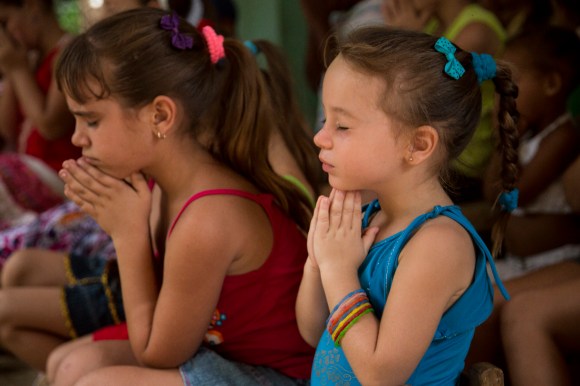
Cuban children learn to pray during a weekly meeting held in the home of two ladies with a passion to evangelize children. In 2010, the religious affiliation of Cuba was estimated by the Pew Forum to be 59.2 percent Christian (mostly Roman Catholic), 23.0 percent unaffiliated, 17.4 percent folk religion and the remaining 0.4 percent other religions. Wilson Hunter/IMB

Cuban children learn to pray during a weekly meeting held in the home of two ladies with a passion to evangelize children. In 2010, the religious affiliation of Cuba was estimated by the Pew Forum to be 59.2% Christian (mostly Roman Catholic), 23% unaffiliated, 17.4% folk religion, and the remaining 0.4% other religions. Wilson Hunter/IMB Photo from BPNews.net


NEWS |
President Obama’s announcement Dec. 17 that the U.S. will renew its relationship with Cuba had pundits talking about the political and economic implications. Meanwhile, many Christian leaders focused on what the decision could mean for Cuban believers.

Phil Nelson has traveled to Cuba 11 times since 2003, speaking about the gospel with college students and on one occasion, a university president.

“Everybody we met with, we talked with about the gospel,” said Nelson, pastor of Lakeland Baptist Church in Carbondale. The Cuban Christians he has worked with are “passionate about the gospel, unashamed about anything. They had a boldness that we just don’t know anything about here in the United States.”

Still, there is the specter of oppression, said Kevin Carrothers, who traveled with Nelson to Cuba in 2006. He remembers noticing from Cuban people and visitors to the country that no one wanted to draw attention to themselves. The stereotype most people apply to the Caribbean – bright clothing, a festive, celebrative atmosphere – didn’t hold water in Cuba, said the pastor of Rochester First Baptist Church.

Their mission team saw people come to Christ, though, including one woman who stopped them by the side of the road to ask for a drink of water. Nelson talked with her about the living water that Jesus offers; right there on the road, Carrothers said, she accepted Christ.

After Obama’s announcement, leaders weighed in on whether the decision would help or hurt people in the country. “This change is not going to help the Cuban people [under] a communist government in power for more than 50 years,” said Óscar J. Fernández, a Tennessee minister who holds political asylum from Cuba. “I will applaud if Cuba makes any concessions, but they are not [likely to do so],” he told Baptist Press.

But David R. Lema, whose family left Cuba for Spain when he was 7, said “any normalization of political ties between Cuba and the U.S., regardless of political implications or results, should prove beneficial for Christian work.”

“Travel for Americans going to Cuba would flow smoother and with less inconvenience—anyone that has gone to Cuba knows what I am talking about here,” Lema, director of New Orleans Baptist Theological Seminary’s Center for the Americas in Miami, told BP. “Churches and individuals will have more freedom to help the churches directly without having to worry about U.S. embargo violations.”

Carrothers said he didn’t know whether more mission teams will begin traveling to the Caribbean country. “What I do know, and what I think the reality is, is that where the church has been oppressed, and the church has been persecuted, the gospel has flourished.

“And that certainly was the case in Cuba, the gospel was flourishing in the midst of oppression.”

By Meredith Flynn, with additional reporting by Baptist Press

THE BRIEFING | “It’s business as usual” at First Baptist Church of Ferguson.

“We had a very normal Sunday, a fairly normal size crowd for worship, without any disruptions,” said Ron Beckner, the church’s associate pastor.

Nearly a week after violence erupted in the wake of a grand jury’s decision not to indict Ferguson police officer Darren Wilson, the church continues to go about the business of Gospel ministry.

The_BriefingWhile there are protests ongoing, Beckner said they have been “largely peaceful” following the Thanksgiving holiday. “We’re taking things one-step at a time and are hopeful the violent reaction has faded.”

Pastor Stoney Shaw led the church in prayer for the community, its residents, and leaders Sunday morning. Beckner said Shaw reminded the church that this Christmas and throughout the year, “Jesus is the harbinger of peace.”

The church will continue with its regular Wednesday evening programming this week which includes AWANAs, youth group, and prayer meeting. “We want to be as normal as we can be,” Beckner said. “We want to function as normally as possible unless we can’t.

“We’re continuing to do what we’re planted here to do. We’ll change and adapt as needed to minister to our community.”

Reported by Lisa Sergent. Click here for more on how to pray for Ferguson.


A Ferguson-focused Facebook post by football player Benjamin Watson garnered nearly 825,000 “likes” and more than 450,000 shares in the week after the New Orleans Saint published his thoughts on the verdict. “…[U]ltimately the problem is not a SKIN problem, it is a SIN problem,” Watson wrote. “…BUT I’M ENCOURAGED because God has provided a solution for sin through the his son Jesus and with it, a transformed heart and mind.”


Long-time Baptist leader and pastor Jim Burton writes about how the church must deal with disability in this Baptist Press column. Burton’s own experience in “the blue zone” (noting the color of handicapped parking signs) began with a 2013 diagnosis of Lou Gehrig’s disease, or ALS.


58% of Protestant senior pastors support immigration reform “that includes a path to citizenship for those who are currently in the country illegally,” according to a pre-election survey by LifeWay Research. While 87% of responders said the U.S. government has a responsibility to halt illegal immigration, 79% said Christians should assist immigrants, even those who are in the U.S. illegally.


Bob, Larry, and all their veggie friends are now streaming on demand in a brand-new Netflix series. The first five episodes of “VeggieTales in the House” debuted Nov. 26. “It’s been clear that if we want the characters and the ministry to stay alive, then they need to keep moving as kids move to viewing media in different ways, VeggieTales creator Phil Vischer told Baptist Press.


COMMENTARY | Josh Monda

This week marks the one-year anniversary of the EF-4 tornado that devastated parts of Washington, Ill. Brookport, New Minden, Diamond, Coal City and Pekin were among the other Illinois communities affected by powerful storms on Nov. 17, 2013.

This week marks the one-year anniversary of the EF-4 tornado that devastated parts of Washington, Ill. Brookport, New Minden, Diamond, Coal City and Pekin were among the other Illinois communities affected by powerful storms on Nov. 17, 2013.

Humanitarian effort void of the gospel of Jesus Christ does nothing to change one’s eternal destiny. Moments after making this statement during a sermon, a tornado would rip through our town, passing a quarter mile from our church.

The day of the tornado was not without trouble, even before the storm came through Washington. A month before, my father-in-law had been diagnosed with esophageal cancer. The day before the tornado, my 14-year-old daughter laid on my living room floor near death, and that evening was in the hospital.

Taking a full load in seminary, and trying to balance all that was going on in my life, I gathered our two young sons that Sunday morning and got them ready for church. The rest, as they say, is history. An EF-4 tornado hit our town as my congregation took shelter in the church basement.

It would have been easy then (and now) to focus on all that changed that day, or how everything after November 17 would be different than before. Indeed, a lot is different, even a year after the storm. Members of my church, deacons in my church, lost their homes. One of our deacons moved away, and for a small church, this is difficult.

Change has touched my family too. My daughter eventually recovered from the infection that put her in the hospital, but my father-in-law passed away before the tornado.

Not every change has been negative: After the storm, people seem more in tune to the needs of others, and thoughts about possessions have changed.

But my focus, and our church’s focus, is on something that will never change: the gospel of Jesus Christ. It was not by mistake that I would make the statement about humanitarian effort and the gospel moments before the tornado hit. Our focus has to be on the gospel.

When people are hurting, our focus must be the gospel.

When people are suffering, our focus must be the gospel.

When people know not where to turn, our focus is the gospel.

A tornado can change our circumstances, it can even change where we live. But a tornado will not transfer someone from the Kingdom of Darkness into the Kingdom of Light; only the gospel does this.

As a people, as a church, we can allow a tornado to either drive us to what truly makes a difference, or distract us from it. May our focus be on what makes a difference; may our focus be on the gospel of Jesus Christ.

Josh Monda is pastor of First Baptist Church in Washington.