THE BRIEFING | Meredith Flynn

doneenoughA report on a new LifeWay Research survey says what Martin Luther King, Jr., once said about Sunday morning in America is still true: “At 11:00 on Sunday morning when we stand and sing and Christ has no east or west, we stand at the most segregated hour in this nation.”

Released just before the national holiday in honor of King, the survey found more than 80% of churches are made up of one predominant racial group, but 67% of churchgoers say their church is doing enough to become ethnically diverse. And 53% disagree that their congregation needs to become more diverse.

“Surprisingly, most churchgoers are content with the ethnic status quo in their churches,” said Ed Stetzer, executive director of LifeWay Research, in the research report by Bob Smietana. “In a world where our culture is increasingly diverse, and many pastors are talking about diversity, it appears most people are happy where they are—and with whom they are.

“Yet, it’s hard for Christians to say they are united in Christ when they are congregating separately.”


In honor of MLK Day, ChurchLeaders.com gathered 25 of his “retweetable” quotes, starting with this one: “Every man must decide whether he will walk in the light of creative altruism or darkness of destructive selfishness.”


In the newest “Question and Ethics” podcast, Ethics and Religious Liberty President Russell Moore interviews actor David Oyelowo, who portrays Martin Luther King in a recently released movie. “…I think what you see in ‘Selma’ the film is not only was Dr. King a speaker of the word–we celebrate him as an orator–but he was a doer of it, and that’s the attribute I most admire in any Christian,” the actor says.


The U.S. Supreme Court said Jan. 16 it will soon hear arguments in an appeals court case concerning same-sex marriage. “Depending on the justices’ decision,” Baptist Press reports, “gay marriage could be legal throughout the country by the end of June or states could maintain their authority to define marriage as only between a man and a woman.”

Oral arguments about the appeals court decision, which concerns Kentucky, Michigan, Ohio and Tennessee, are expected in March or April, BP reports, with a decision before the Court’s summer adjournment.


“I did not die. I did not go to heaven.” Christianity Today reports on that retraction by 16-year-old Alex Malarkey concerning his book “The Boy Who Came Back from Heaven.”

Malarkey made his admission in a statement titled “An Open Letter to LifeWay and Other Sellers, Buyers, and Marketers of Heaven Tourism, by the Boy Who Did Not Come Back From Heaven.” LifeWay Christian Resources–an entity of the Southern Baptist Convention–told The Christian Post they “are returning to the publisher the few copies we have in our stores.”

The Post also notes that during their annual meeting last June, Southern Baptists adopted a resolution reaffirming “the sufficiency of biblical revelation over subjective experiential explanations to guide one’s understanding of the truth about heaven and hell.”


Colton Burpo, whose account of heaven also became a bestselling book and later a feature film, said he stands by his story. The Christian Post reports Burpo took to his website to say, “”I know there has been a lot of talk about the truth of other Heaven stories in the past few days.

“I just wanted to take a second and let everyone know that I stand by my story found in my book Heaven is for Real.”


The Seattle Seahawks’ unbelievable comeback in the NFC championship game Jan. 18 brought quarterback Russell Wilson to tears in his post-game interview. Before and after the victory, Russell, who is vocal about his Christian faith, tweeted his thankfulness and praise to God. “My pursuit of exellence is to honor Jesus!” Wilson tweeted Saturday, with the hashtag #ItsAllAboutHim.

After the game, he posted a praise chorus by Lenny LeBlanc: “There is none like You! No one else can touch my heart like You do! I can search for all of eternity, but there is none like You!”

Students at AWSOM listen to Bible study leader Courtney Veasey.

Students at AWSOM listen to Bible study leader Courtney Veasey.

HEARTLAND | The girls from Anna Heights Baptist Church were pretty quiet after AWSOM, said their leader, Judy Halter.

“Whenever you’re raising the bar like that, I think the girls are going to get quiet.” Halter and two fellow leaders brought 14 girls to the annual conference for young women. (AWSOM stands for “Amazing Women Serving Our Maker.”)

“I think it’s all about discipleship,” she said. “It really is, and that was a great missions and discipleship conference.”

With a deep theme for 2014. The most recent AWSOM focused on “the battle for your mind” and found its biblical basis in 2 Corinthians 10:5, a verse that calls Christians to “take every thought captive to obey Christ.”

“The more I study about biblical womanhood and research current world issues impacting women, the root cause always begins in a person’s thoughts,” said Carmen Halsey, IBSA’s director of women’s ministry and missions. “This year’s theme was intended to be a proactive stance in educating our young women and their leaders about the power of our thoughts, and the need to discover the Word and plant it deep inside, so that the Holy Spirit is armed and ready to do war.”

Planting the Word was main speaker Courtney Veasey’s role at AWSOM. The director of women’s academic programs at New Orleans Baptist Theological Seminary taught on the conference theme passage and others from the Bible, urging the girls toward victory in the battle, and a deeper dependence on God’s Word. AWSOM attendees also sat in on a variety of breakout sessions:

  • Dr. Olivia Johnson, a former police officer with a doctorate in criminal justice, talked the girls through a series of potentially dangerous situations they could face in the real world, training them on how to think through each situation and make smart choices.
  • Mother/daughter pair Amy and Amanda Neibel educated the students on human trafficking prevention. The Neibels are part of a leadership team established to raise awareness among Illinois women and churches about human trafficking.
  • Brenda Sommer, a licensed clinical professional counselor, taught on the role of Christian counseling and how girls can speak truth into the lives of friends who are struggling.
  • Halter cited Renee Smith’s session on CrossFit as one moment when things weren’t so quiet. Smith, a pastor’s wife from Mt. Zion, demonstrated easy exercises and gave tips for developing a healthy selfimage.

This year’s AWSOM conference is scheduled for November 6-7 in Springfield. For more information about upcoming opportunities for women and girls, go to http://www.IBSA.org/womensmissions.

Editor’s note: This piece is reprinted from Baptist Press (BPNews.net). Sanctity of Human Life Sunday is January 18. For resources, go to ERLC.com/life.

COMMENTARY | The claim of some pro-choice groups that Scripture does not address abortion would have surprised both Jews and Christians living in the first century. That’s because they were virtually unanimous that the Bible implicitly—though clearly—prohibited the killing of unborn children.

David_Roach_calloutAbortion advocates today tend either to deny this fact or remain gladly ignorant of it. For example, Planned Parenthood, America’s largest abortion provider, issued a “pastoral letter to patients” last spring stating, “Many people wrongly assume that all religious leaders disapprove of abortion. The truth is that abortion is not even mentioned in the Scriptures—Jewish or Christian—and there are clergy and people of faith from all denominations who support women making this complex decision.”

Of course, the Bible does not contain the direct commandment, “Thou shalt not have an abortion.” But based on passages like Psalm 139:14-16, Jeremiah 1:4-5, Amos 1:13 and others, ancient Jews and Christians believed it was clear that God cared for the unborn and regarded abortion as a sin.

Some may be surprised to learn that abortion existed more than 2,000 years ago, with surgical and chemical abortions performed in pagan cultures hundreds of years before Christ’s birth. The Greeks were among the first Ancient Near Eastern people to permit abortion, with Plato arguing in “The Republic” that pregnant women over 40 should be required to have abortions. In contrast to pagan cultures, Judaism emphasized the value of unborn and pre-born life dating back at least to the time of Moses, when God’s people protected infant males from being slaughtered at birth as Pharaoh ordered (Exodus 1:15-21).

In fact, some scholars believe Pharaoh’s command to kill Hebrew boys “on the birthstool” (Exodus 1:16) was actually a command to commit partial birth abortion, with “birth stool” functioning as a Hebrew euphemism for “birth canal.”

Either way, the Jewish culture of life was evident, and the Jews of Jesus’ time expressed their anti-abortion convictions. The Jewish work Sentences of Pseudo-Phocylides, written between 50 B.C. and A.D. 50, taught that “a woman should not destroy the unborn in her belly.” First Enoch, which was written in the first or second century B.C., said it was evil to “smash the embryo in the womb.”

Josephus, a Jewish historian born in A.D. 37, summarized, “The Law orders all offspring to be brought up, and forbids women either to cause abortion or to make away with the fetus.”

Early Christians agreed. The Didache, a first-century document that some church fathers argued should have been included in the New Testament, taught, “Thou shalt not murder a child by abortion nor kill them when born.” Another Christian writing considered for inclusion in the New Testament, the Epistle of Barnabas, said, “You shall not abort a child nor, again, commit infanticide.” Both of these documents were read aloud in some churches.

When Spanish bishops convened a council in approximately 305 in the city of Elvira, they voted unanimously to decree eternal excommunication for women who had abortions—a decision that reflected their just condemnation of the practice though it failed to reflect the biblical promise of forgiveness to post-abortive women who confess their sin and trust Christ as their Lord and Savior.

“If a woman conceives in adultery and then has an abortion, she may not commune again…because she has sinned twice,” the council decreed.

Among other early church leaders whose writings condemned abortion explicitly were Tertullian (c. 150-c. 229), Clement of Alexandria (c. 153-c. 215), Basil of Caesarea (c. 329-379), Jerome (c. 347-419) and John Chrysostom (c. 349-407).

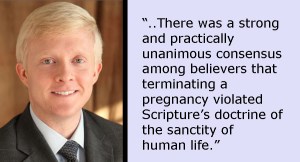
Perhaps one reason the New Testament writers did not address abortion was that they did not need to. For the first 500 years of Christianity, there was a strong and practically unanimous consensus among believers that terminating a pregnancy violated Scripture’s doctrine of the sanctity of human life.

A thousand years later, John Calvin demonstrated that the Christian tradition of opposing abortion was still alive and well. Commenting on Exodus 21:22-23, Calvin wrote, “The fetus, though enclosed in the womb of its mother, is already a human being, and it is almost a monstrous crime to rob it of the life which it has not yet begun to enjoy. If it seems more horrible to kill a man in his own house than in a field, because a man’s house is his place of most secure refuge, it ought surely to be deemed more atrocious to destroy a fetus in the womb before it has come to light.”

In the strictest sense, abortion advocates are correct: The Bible does not speak explicitly to abortion. But that should not leave believers in a state of moral confusion any more than the Bible’s failure to explicitly address money laundering or internet pornography. For more than 2,000 years, the Lord’s followers have extrapolated from biblical principles that some behaviors are obviously sinful. The united witness of Jews and Christians regarding abortion is a case in point.

Basil, Jerome, Chrysostom, Calvin and a host of other believers from every nation, tribe, people and tongue would scoff at the claim that Scripture is silent and that God’s people historically have been divided regarding abortion.

David Roach is chief national correspondent for Baptist Press.

THE BRIEFING | Meredith Flynn

International Mission Board workers called for prayer in the wake of devastating terrorist attacks in France, Baptist Press reports. “There exists today a delicate tension in France that teeters toward breaking, and [Wednesday’s] tragic events will likely serve to further stir up the tension,” said Mark Stone, a church planter in southern France. The outbreak of violence started Jan. 7 with a shooting that left 12 people dead at the headquarters of satirical newspaper Charlie Hebdo.

“We are praying that the outcry against these heinous acts committed by religious extremists will not become outcries against anyone who claims to have any sort of religious belief,” IMB worker Tara Chaney told Baptist Press.

“Right now, we are praying that the people of France will turn toward God and not away from Him.”


The_BriefingThe Muslim actor who will play Jesus in an upcoming National Geographic Channel said he didn’t believe Jesus would judge him for playing the part. “I cannot speak for Jesus, but I can quote his teachings and He said, ‘Love your neighbor as yourself,'” Haaz Sleiman told Entertainment Weekly. “…How would He react to me playing Jesus? He wouldn’t judge it. He wouldn’t judge His own enemy…playing this part highlights His teaching in a very nice way.”

Sleiman will portray Christ in “Killing Jesus,” a miniseries based on a book by Bill O’Reilly and Martin Dugard. Read the full story at ChristianPost.com.


North Korea is atop Open Doors’ annual World Watch List for the 13th consecutive year, followed by Somalia, Iraq, Syria and Afghanistan. The list tracks the countries “where it is most dangerous and difficult to be a Christian.”


“Under no circumstances have I been discriminatory or hateful towards any member of the department in the LGBT community or a member of the LGBT community at large,” former Atlanta Fire Chief Kelvin Cochran told Baptist Press Jan. 6. Cochran was fired after an investigation into his self-published book which briefly mentions homosexuality as an immoral behavior, BP reports. Cochran teaches Sunday school and serves as a deacon at Elizabeth Baptist Church, which is affiliated with the Georgia Baptist Convention.


Where do the majority of Congressional representatives fall, faith-wise? Pew Research breaks down the religious makeup of the current U.S. Congress in this full report.


Wondering what else happened in Louis Zamperini’s life that didn’t make it into the recently released feature film Unbroken? Check out this half-hour documentary from the Bill Graham Evangelistic Association about the war hero’s conversion to Christianity.


We’ll give this a few weeks to see how it checks out: LifeWay Research recently found only 15% of churchgoers said they would skip worship to watch their favorite football team.


The Chicago vortex

nateadamsibsa —  January 12, 2015

HEARTLAND | Nate Adams

It’s January, and another “polar vortex” appears to be descending upon our heartland homes. Just a few days ago the temperature outside was flirting with 50 degrees. But then yesterday was barely above freezing, and as I write now it’s 16 degrees, heading for a low of 6 tonight, with wind chill temperatures that will require those dreadful minus signs in front of them.

Nate_Adams_Jan12So instead I’m choosing to think about next summer, and I encourage you to do so too. Now, in the dead of winter, is a perfect time to start planning a summer missions experience.

Your church may already have a plan for sending one or more groups on mission trips outside your own community this year. Many churches in Illinois have adopted an Acts 1:8 strategy, and are seeking to send mission groups to serve nearby in their local association, as well as elsewhere in Illinois, North America and internationally. These are modern day equivalents of the “Jerusalem, Judea, Samaria, and the Ends of the Earth” mission fields that Jesus spoke of in His last words on earth.

If your church doesn’t yet have a mission trip planned for this summer, and especially if you have teenagers in your church, let me suggest one option where most of the planning has already been done for you. It’s called ChicaGO 2015, and it will be hosted July 26-31 on the campus of Judson University in Elgin. You can find more detailed information on the IBSA website, or by calling or
e-mailing Rachel Carter (217-391-3101 or RachelCarter@IBSA.org). Even if you only have two or three who can go, they will be quickly welcomed into the larger group.

During ChicaGO 2015, your group will be housed on the Judson campus there in Elgin, but during the days you will explore one or more of Chicago’s 77 neighborhoods or diverse suburbs. Morning training sessions and evening worship experiences will allow you to meet some of the dynamic church planting missionaries that are seeking to advance the gospel in our nation’s third largest mission field. And during the day you will work right alongside them, and alongside other students and adults from Illinois churches that share your heart for advancing the gospel there.

Wherever you live in Illinois, ChicaGO 2015 is relatively nearby, and affordable. Planning and preparations for the week, such as meals and work projects, will have been done by IBSA before you get there. Participants can be both students and adults, and the environment is one that’s safe, and yet that will open your group’s eyes to the vast and diverse lostness that is Chicago.

You see, Chicago itself is a vortex, and not just in the winter. A vortex is defined either as a “whirling mass,” or simply as “something overwhelming.” That’s why, when the frigid air from the Arctic Circle whirls its way down into Illinois, we feel the overwhelming
brutality of its icy grip. But there is also a whirling mass of people in Chicago that are in the icy grip of lostness. Many have never heard the true gospel in a way they can understand, or from people that care enough to meet them where they are.

That’s why now, this winter, right in the middle of our polar vortex, is an ideal time to plan a summer mission trip. Perhaps you will join our church planters and me in the Chicago vortex next July. Or perhaps your church has identified a different vortex of lostness or two to enter. Last year more than 26,000 Illinois Baptists did. It warms my heart just to think about it.

Nate Adams is executive director of the Illinois Baptist State Association.

NEWS | Andrae Crouch wrote songs so familiar now that most people probably have no idea where they originated. “My Tribute (To God Be the Glory),” “The Blood Will Never Lose Its Power,” “Jesus Is The Answer,” and “Soon and Very Soon,” to name just a few.

Crouch, 72, died yesterday after a heart attack January 3.

“Crouch was an innovator, a path-finder, a precursor in an industry noted for its conservative, often derivative approach to popular music,” wrote former Billboard editor Robert Darden in a tribute on ChristianityToday.com.

“He combined gospel and rock, flavored it with jazz and calypso as the mood struck him and the song called for it, and is even one of the founders of what is now called ‘praise and worship’ music. He took risks with his art and was very, very funky when he wanted to be.”

Those qualities are on display in this 2012 video of “The Blood,” performed by Crouch and a whole host of gospel music stars.

Newsweek_0112COMMENTARY | Meredith Flynn

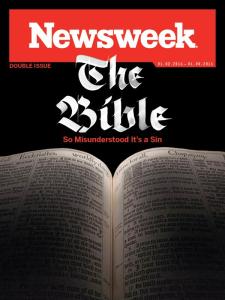
Christians who read Kurt Eichenwald’s Dec. 23 cover story might have been reminded of a well-known line from a comic strip:

“We have met the enemy, and he is us.”

The words, written by Pogo cartoonist Walt Kelly, weren’t about Bible-believers coming face to face with an article claiming to debunk some really famous stories. But read through the Newsweek article, paying particularly close to the pictures, and it might be difficult not to squirm in your seat or look over your shoulder.

We have met the enemy—or, at least, we know who Newsweek thinks it is. It’s us.

As Southern Seminary President Al Mohler and others have pointed out, the first two paragraphs of Eichenwald’s article read like an attack: “They wave their Bibles at passersby, screaming their condemnations of homosexuals. They fall on their knees, worshipping at the base of granite monuments to the Ten Commandments while demanding prayer in school.”

And those are just the first two sentences. What follows is mostly about the Bible, but tinged with the same hostility toward Christians, which also has been noted by numerous leaders and scholars. Mohler called it “one of the most irresponsible articles ever to appear in a journalistic guise.” Michael Kruger, president of Reformed Theological Seminary in Charlotte, said Eichenwald deserved a “slap on the journalistic wrist.”

But even for those who can’t counter every one of the anti-Bible arguments in the article or don’t care to debate its journalistic merits, if you can get past Eichenwald’s angry words, his piece can bring some valuable introspection. Because as soon as you realize you’re his enemy, you scroll past a photo of a protest by members of the infamous Westboro Baptist Church. Or controversial TV preacher Pat Robertson. Eichenwald lumps all Christians together, like it or not.

What else would you expect from a non-Christian, one might ask? It’s a good question, but the better question is, What is this non-Christian asking of us? Near the end of the article, Eichenwald puts forth two pleas:

Christians, know the Bible, he writes. (His stinging criticism suggests many of us “seem to read John Grisham novels with greater care” than God’s Word.) That’s good advice, even from a source that proved less than empathetic in his previous 8,500 words.

“And embrace what modern Bible experts know to be the true sections of the New Testament,” Eichenwald writes. “Jesus said, Don’t judge. He condemned those who pointed out the faults of others while ignoring their own. And he proclaimed, ‘Thou shalt love thy neighbor as thyself. There is none other commandment greater than these.’”

To that we would say Amen, and we’re glad Eichenwald acknowledges some biblical teaching is worthy of embrace. But there are plenty of modern scholars who believe the whole Bible is true. He should talk to some of them next time.

My best prayerwalking technique came from second graders.

PRAYER | Cheryl Dorsey

Editor’s note: This is the fourth and final post in a series on prayer and spiritual awakening. Read the previous posts: 2015: The Year of Prayer, Revise us, O Lord, and 15 prayer requests for your city.

One of my most profound prayerwalks took place with a pair of 7-year-olds. On that particular Saturday at our church, everyone had already paired up for the half-hour walk through our community of 500 homes. Leaving me with my son, Joseph, and a friend’s grandson, Antoine.

On school days, waking Joseph up was an ordeal. But on prayerwalking Saturdays, he beat me at getting up and ready to head to church. Amazing! We use the simple strategy – walking the neighborhoods around our church in two’s and three’s – to identify needs in our community and pray on the spot for people we encounter, that they might come to know Christ.

Joseph, Antoine and I began to walk three blocks around the church. I launched into a powerful prayer: “Lord, let your salvation come to this house! Send your power, Father. Change hearts, O God!” When I paused to allow the babies to get a word in edgewise, I heard this:

“Lord, help this little boy to help his mommy clean the front yard.”

And another saying, “Jesus, please give the little boy in this house a new Big Wheel because his is broken.”

And then, “Jesus, help them get these beer bottles out of the yard. They shouldn’t be drinking, Lord! Help them to stop.”

Even though I was towering over my prayerwalking partners, I felt seven inches tall.

That morning, the Holy Spirit taught me what prayerwalking is all about. He used Joseph and Antoine to teach me again what it means to pray “on site with insight,” which is how we encourage all our prayerwalking teams. Here’s what it looks like for us:

Each session starts with a 15-minute meeting at the church. This is when we distribute prayer guides, go over prayerwalking basics, and point everyone to a focal Scripture that will set the stage for the next hour.

We send pray-ers out from the church in two’s and three’s, instructing them to go as far as they can and be back in half an hour. As they go, we urge them to pray “on site with insight.” That’s God’s insight and not their own.

Prayerwalkers pray as they’re prompted by the things they encounter. Every street is different. Our prayers should feel conversational, low-key, but powered from on high. If folks across or down the street can hear us, we’re doing it wrong.

Each person in the groups takes a turn praying in short paragraphs, not soliloquies. I like it to making a prayer quilt – everyone brings a piece. If we encounter people along the way, we introduce ourselves and ask if they have any prayer needs. If they say yes, we ask permission to pray for them right there. Or, we take the names and requests back to the church to add to our prayer list for the week.

During our walk, we may pray, quote Scripture, or sing, all as the Spirit prompts the pray-ers. Once everyone is back at the church, we take 15-20 minutes to recap the experience. This is very powerful! Prayerwalking teams share what they encountered and how the Lord had them praying, as well as names they’re adding to the prayer list. As the teams report, a scribe records the headlines on a flip chart, chalkboard, or poster.

The Lord reveals his awesomeness as our teams often see a theme emerge. Even though they prayed on different streets, they see how God loves the community, and works in us through the Holy Spirit to “pray things out” over our neighbors. The prayerwalkers recognize that God has a plan, that they can hear his voice, and that he can use them to bless his people.

That first day I prayerwalked with Joseph and Antoine, I witnessed our youngest pray-ers interceding from their perspective. They prayed for the practical and immediate needs of the house we were passing by, and they hit some spiritual pay dirt. From that point on, they were my favorite prayerwalking partners that summer. I mention them often when I teach, saying kids pray differently because they see things from a different level.

They blessed me, and showed me that children have a place in our prayerwalking ministry. You don’t need to pontificate, just walk, see and pray.

Cheryl Dorsey is a prayer coordinator and pastor’s wife at Beacon Hill Missionary Baptist Church in Chicago Heights. She also serves as prayer leader for Chicago Metro Baptist Association. This column first appeared in the Spring 2015 issue of Resource magazine, online at http://resource.IBSA.org.

In a border town of Turkey, a Syrian family who fled from the civil war struggles to find food and shelter. IMB photo by Jedediah Smith

In a border town of Turkey, a Syrian family who fled from the civil war struggles to find food and shelter. IMB photo by Jedediah Smith

THE BRIEFING | Meredith Flynn

The International Mission Board’s pictures of the year show “light in the darkness” around the world. In the Philippines, hard hit by a typhoon just over a year ago; in Turkey, where a Syrian family tries to escape civil war (right); and in the Dominican Republic, where church planting efforts reach across geographical and cultural divides. See them all and more at IMB.org.


Almost 9.5 million people heard the gospel through the Billy Graham Evangelistic Association in 2014, and more than 1.6 million of those trusted Christ. “Our hearts overflow with gratitude to God for all He has done and is doing, and we are eager to keep pressing forward as He continues to open doors,” BGEA’s chief executive officer Franklin Graham wrote recently, The Christian Post reported.


Also from The Christian Post: Houston Baptist University will create a Center for American Evangelism, spearheaded in part by apologist Lee Strobel and directed by author Mark Mittelberg.


“I’ve been there, done that and I’d love to share with you a few reasons why, even though I’ve failed, I’m doing it again,” Trillia Newbill writes about her resolve to read the Bible in 2015. Read about the four step plan she chose at ERLC.com.


Most of us make and break them every year, but can New Year’s Resolutions actually be harmful? Author (and Billy Graham’s grandson) Tullian Tchividjian says yes, in this interview with Religion News Service. “When it’s up to you to go out and get the love you crave, create your own worth, or work at becoming acceptable to those you want to impress, life gets heavy,” Tchividjian told writer Jonathan Merritt. “New Year’s Resolutions are a burdening attempt to fix ourselves and make ourselves more lovable.”


The current basketball season has gone “in the opposite direction” L.A. Laker Jeremy Lin anticipated, he posted on his blog at the beginning of this year. But despite his slump, Lin—a known Christian—said he wants to live with more joy in the coming year. “…[T]hrough it all, I’ve been learning how to surrender the results to God, how to walk by faith and not by sight, how to be renewed through times of prayer/Scripture and how to fight for a life of joy in the midst of trials.”


HEARTLAND | Charles Lyons

Editor’s note: This is the third post in a series on prayer and spiritual awakening. Read “2015: The Year of Prayer,” and “Revise us, O Lord,” at ib2news.org.

A mid-1800’s revival that started with a small prayer meeting in New York City resulted in thousands upon thousands of people trusting in Christ. We need such a movement today, perhaps using several ideas from this list. Use personally, or with family devotions. Share it with your church prayer group of Bible study group. Share on Facebook.

City HallLead your church to pray for one item each Sunday for 15 Sundays. Use each one for a church prayer focus for a week each.

“Seek the welfare of the city where I have sent you into exile and beseech the Lord on its behalf. For in its welfare you will also have welfare.” (Jeremiah 29:7)

1. Invite the Holy Spirit to teach you to pray as He helps you to pray.

2. Pray for your pastor – his spiritual health, his marriage, his family, his vision, wisdom, and spiritual power. Ask God to enhance his ability to lead your church to reach your city or town.

3. Pray for your church family to enthusiastically engage in serving your community.

4. Pray the same for the pastors in your city.

5. Pray for the newest church you know and the oldest church.

6. Pray that your church family will impact your city or town in 2015 as never before.

7. Pray for your mayor – a sense of accountability to God, humble acknowledgement of need for wisdom, relationship to God, and desire for righteousness and integrity.

8. Pray the same for your police chief.

9. Pray the same for your fire chief.

10. Pray the same for your city council or your local elected official.

11. Pray the same for your superintendent of schools.

12. Pray for the schools closest to you, the high school and its principal, the grade school and its principal.

13. Pray for those who work in the healthcare system in your community – administrators, doctors, nurses, technicians.

14. Pray for your closest neighbors or friends to be saved and be fully devoted disciples of Jesus Christ.

15. Pray for a merchant or clerk you interact with on a regular basis.

Part 1

Part 2

Charles Lyons pastors Armitage Baptist Church in Chicago.