Annual conference aims to engage students in helping persecuted people around the world
Awsom

The lights in the room dimmed. Suddenly, there were loud, wailing sirens and the sounds of hovering aircraft and explosions. Shouts could be heard from each corner of the room as the girls yelled out, eagerly looking to find the rest of their lost family members.

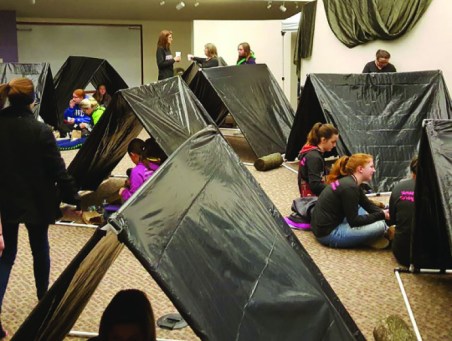
The IBSA Building was transformed into a refugee camp Nov. 5 for the annual AWSOM conference for young women (AWSOM stands for “Amazing Women Serving Our Maker”). Through an intensive, simulated overnight experience, this year’s AWSOM focused on helping the 222 students in attendance understand the plight of the refugee, and how they can help. Attenders also heard the stories of Christians who have lived with persecution (see boxes).

Alina Aisina – Central Asia

Aisina was born in a gospel-sensitive country in Central Asia to a Christian mother and an abusive, atheist father.
Aisina, her sister, and her mom eventually fled their city because their lives were threatened for what they believed. Aisina grew up with a lot of fear, she said, “Not knowing what tomorrow was going to bring and being afraid for my life.”
After receiving a shoebox from Operation Christmas Child, however, Aisina described the change in her life. While her physical life didn’t change, she said, her attitude did because she knew she wasn’t alone. She felt a loving Father looking after her by using strangers from another country to demonstrate Christ’s love for her through the shoebox.

After the simulated war broke out, the students, grouped in “families” of five, were instructed to find refuge in a neighboring country. They could only travel with limited items, however, and had to leave the rest of their belongings behind.

When the girls reached their temporary shelter, a setup of makeshift tents representing a refugee camp, they were given minimal supplies. Current and former missionaries dressed as border guards spoke only the language of the countries they served, to represent the foreign atmosphere to which refugees must adapt.

In the end, the family had to make the decision either to return home to their war-torn country, navigating elements such as land mines, or to apply for citizenship in the new country in hopes of building a new life.

The crisis is real
Prior to the simulation, International Mission Board missionary Christopher Mauger showed a brief aerial video clip documenting the plight of the Rohingya Muslims as they fled from Myanmar, formerly called Burma.

Mauger, who serves in Southeast Asia, described the situation as “desperate” and “unbelievable,” and as a crisis that “needs prayer.” “If they have to go down [to Bangladesh] for refuge, it’s really bad,” he said. “There’s nothing there.”

Mauger explained how “hundreds of thousands” of Rohingya Muslims have been exiting the country as a result of persecution from Myanmar’s government, which is Buddhist.

“For those who have a place to live, they are living in camps with plastic for roofing,” Mauger said. “They are crowded in small areas, food is scarce, and they don’t have any hygienic necessities.”

Mauger described how easy it is to get distracted with a situation like this by blaming the evil in this world. But by changing their perspective, he said, Christians can help. “We can tell these people about God,” he said, “by giving and supporting the Christian organizations that are helping in that area.”

Wendy – China

Wendy lives in China, where she partnered with Ronny and Beverly Carroll while they served as missionaries with the International Mission Board. The Carrollslive in Illinois, and Wendy visited Springfield to speak about the ministry she coordinates to help people long oppressed because of their beliefs.
During the Chinese Revolution in the 1960s, Wendy said, all forms of religion were repressed. While many Chinese Christians fled, others, including a man named Su, were imprisoned. After Su’s release 20 years later, Wendy’s ministry found him and helped him rediscover Christ. This was Su’s first encounter with a Christian in more than two decades.

Becki McNeely, a leader from Lakeland Baptist Church, said AWSOM “opened the students’ eyes to an increased awareness of the state of refugees.”

Several students echoed McNeely. One young woman described how it “must be hard to live in a persecuted country” after hearing the accounts of the speakers. Several more expressed their increased awareness of the refugee crises and were “saddened” at its reality.

Carmen Halsey, director of women’s ministry and missions, said IBSA is securing resources to inform churches about refugee issues. She added that she hoped the experience helped students to be able to “feel the psychological anguish caused by separation and flight” and to “see what forces people into refugee situations,” as well as adopting a more welcoming attitude towards refugees in their own country.

Go to vimeo.com/IBSA to view video from this year’s AWSOM conference.

-Andrew Woodrow

The Briefing

Housing allowance ruling allows 180 days for appeals
A federal district court judge in Wisconsin, as expected, has entered a final order declaring the minister’s housing allowance unconstitutional. The Dec. 13 order, however, has been stayed for 180 days after all appeals are exhausted, meaning it currently does not have any impact. Observers expect the government to appeal the order by Judge Barbara Crabb of the Western District of Wisconsin, who issued her ruling on Oct. 6 following a 2013 ruling she issued that was overturned.

New HHS abortion/contraception mandate rules blocked
In a Dec. 15 ruling, a federal court in Philadelphia blocked enforcement of the Trump administration’s new rules that exempt from the controversial requirement those employers that object based on their religious beliefs or moral convictions. The new regulations issued Oct. 6 by the Department of Health and Human Services (HHS) provided relief from a rule that requires employers to provide their workers with coverage for contraceptives, including those with mechanisms that can potentially induce abortions.

Johnson Amendment repeal removed from final tax bill
President Donald Trump’s biggest religious freedom policy promise to evangelicals—repealing the Johnson Amendment—will no longer take place via Republican tax reform. Senator Ron Wyden (D) announced Dec. 14 that the repeal included in the House version of the tax bill, which would allow churches and other nonprofits to endorse candidates without losing their tax-exempt status, was removed during the reconciliation process with the Senate version, which did not include a repeal.

Transgender teen suing Palatine school
Eighteen-year-old Nova Maday filed a lawsuit in Cook County Circuit Court Nov. 30, claiming that Township High School District 211 in Palatine has in the past denied the transgender teen use of the girls’ locker room during physical education class and more recently restricted Maday to an “unspecified private changing area within the locker room,” where no one else is required to dress.

Chick-fil-A performs works of necessity for stranded travelers
Atlanta-based Chick-fil-A answered the call from the city’s mayor and came to the rescue Sunday night to help feed thousands of stranded travelers at powerless Hartsfield-Jackson Atlanta International Airport. The Christian-owned fast-food chain is known for observing the Sabbath by closing its restaurants on Sunday, but it also recognizes that sometimes it is called to perform “works of necessity and mercy” on the Lord’s Day.

Sources: Baptist Press (2), Christianity Today, Chicago Tribune, World Magazine

Not waiting to worship

ib2newseditor —  December 18, 2017

jail cell

A worship service I attended recently was like no other I’ve ever seen. And I have seen quite a few.

When I arrived with the pastor and three other leaders, 10 minutes before the service was scheduled to begin, no one else was there. Then, precisely on time, about 70 worshipers arrived.

The first 10 minutes or so were “fellowship time,” as each and every worshiper joyfully entered, hugging the neck or shaking the hand of the pastor and leaders, including me as their guest.

As they did so, many of them volunteered to serve or lead during the service. The pastor noted each of their offers, and told some of them they would have to wait until next time, because we only had two hours to worship.

The good news has arrived, and those who have received it are free to celebrate.

Those who did join us in leading the service shared special music, or recited passages of Scripture they had memorized, or gave brief testimonies of God’s grace and goodness in their lives. One especially memorable man apologized for taking so long to slowly walk to the front, assisted by his cane. He said he was 71 years old, but more alive today than when he was 18, because of the Lord’s work in his life. He then sang a moving and joyful spiritual that had all of us clapping and joining in.

The open prayer time was passionate. One man transparently thanked God for recent victory over a temptation in his life, while another prayed through tears, thanking God for a healing contact from his ex-wife, the first one in 34 years.

When the pastor gave me an opportunity to speak, I found myself citing a passage from my own devotional time that week, rather than a more carefully rehearsed message. As I spoke from my heart and sought to apply that passage to their lives, the worshipers gave me their eager attention, and encouraged me with their amens and other signs of agreement.

Perhaps the most remarkable thing to me about that worship service, however, was that I was told there is a “waiting list” to enter it that is about four times larger than the room can hold. You see, that unusual worship service was within the walls of one of our Illinois prisons on a Saturday night, and those worshipers were its residents. The leaders were from one of our Baptist churches that has led a ministry there for over 20 years.

As Christmas now approaches, I am reminded that the good news of Jesus’ birth came first to a humble group of shepherds. They were in many ways “confined” themselves, in poverty, in low social status, with limited freedom or opportunity, and with little hope of a brighter future. Yet the Bible tells us they were also men who were “abiding” and “keeping watch.” When the good news about Jesus invaded their darkness one night, they eagerly received the news and ran to meet him.

That’s what I felt in prison that Saturday night. There was certainly a darkness, a sense of oppression as I walked through multiple security checkpoints. But inside, the good news had arrived, and those who had received it now enjoyed a freedom to worship and celebrate that is all too rare outside the prison walls.

As we encouraged those worshipers to share the good news about Jesus with others, as did the shepherds, their enthusiastic responses told me they already were. I guess that’s why there is a waiting list for the Saturday night worship service. And I guess it’s why we should all receive the good news humbly this Christmas, grateful that we do not have to wait to worship him.

Nate Adams is executive director of the Illinois Baptist State Association. Respond at IllinoisBaptist@IBSA.org.

Volunteers aid homeowners after year of historic storms

ILDR Feeding Unit

 Illinois Baptist Disaster Relief volunteers prepare a meal for Hurricane Harvey victims in Vidor, Texas. The Illinois volunteers prepared over 40,000 meals during their callout. Facebook photo

A difficult year for many people in the U.S. meant Illinois Baptist Disaster Relief (IBDR) volunteers were hard at work in 2017.

The most extensive callout was to Texas, where Hurricane Harvey left many homeowners displaced in August. Two childcare teams were the first Illinois units to deploy. They were stationed at the Dallas Convention Center, where they attended to children while their parents—refugees from flooding in Houston—stood in lines to meet with insurance companies and government agencies.

All other ILDR teams were sent to serve in the Vidor, Texas area. Two shower and laundry trailers from Franklin and Macoupin Associations were deployed. They provided 8,700 showers, and volunteers completed approximately 2,320 loads of laundry. Glenn and Sharon Carty spent three weeks in Vidor working with a laundry/shower trailer team. “You feel for the people and all they’re going through,” said Sharon. “But it’s the children who break your heart.”

IBDR: In 3 states and Puerto Rico

  • 14,401 man hours worked
  • 166 gospel presentations
  • 326 gospel tracts distributed
  • 161 Bibles given
  • 16 salvations recorded

Also in Texas, a 26-person mobile kitchen team based out of Living Faith Baptist Church in Sherman was staffed by volunteers from around the state and used to prepare over 40,000 meals.

As the callout continued, IBDR was asked by national Send Relief to take on a greater role. Dwayne Doyle, IBDR state coordinator, said, “IBDR incident command led the First Baptist Church, Vidor, Texas, joint ministry site between the new Send Relief program of the North American Mission Board and Southern Baptist Texas Convention Disaster Relief. During this time, our volunteers gave leadership to more than over 500 students from churches and universities across the nation.”

Illinois teams are continuing the work in Vidor, with more workers scheduled to return in January.

Earlier in the summer, heavy rains led to record flooding in Lake County, near the Illinois-Wisconsin border. Volunteers worked on nearly 150 homes, doing mold remediation in an effort to help homeowners get ready to rebuild. Their efforts have resulted in a church plant in Round Lake, as local Disaster Relief volunteers have followed-up with homeowners.

Disaster Relief volunteers also served in Illinois after early spring tornadoes in northern and southern parts of the state. Volunteer Don Kragness worked in the southern Illinois town of Vergennes. He summed up the motivation of many Disaster Relief volunteers when he told local television station WSIL, “We are here, basically, because we love Jesus and we want to serve him, and the best way we know how to serve him is to help people when they’re in need.”

Illinois has nearly 1,600 trained Disaster Relief volunteers. Their ministry is made possible through the generosity of churches and individual donors, and the volunteers themselves, who help provide equipment, supplies, and fuel for travel. To learn more about the callouts, training, and how to donate, visit IBSA.org/dr.

We had to terminate a deacon in a church I once pastored. No one wanted to do it, because he had served for forty years, and because his wife was one of the kindest, godliest women any of us knew. They were pillars in our church. But it had to be done.

The man would approach young women at church, hug them close, and ask if they wanted to go for a ride. “Would you like to go to the coast?” was code for who-knows-what, because no one took him up on the offer, so far as we knew. But the implication was uncomfortable and the hands-y hugging very inappropriate.

Even then, twenty years ago, we knew what we had to do. After meeting with his accusers, then him and his wife, we removed him from office. What would Jesus do about sexual harassment? Put a stop to it.

It’s surprising how little comment there has been recently from church leaders on the subject of harassment and the Christian’s responsibility. Perhaps because it’s patently obvious that sex belongs within marriage, and no one should harass anyone about anything. But given the proliferation of accusations, from Hollywood to the halls of Congress, perhaps we should review the subject—for ourselves and for our children.

What are we teaching young men about their behavior, and young women about their value? Jesus has a few lessons:

Jesus was respectful of women. Some of his last words from the cross concerned the salvation of lost men and the future care of his mother. Some of his most tender sayings were to women, “Little girl, arise,” “Daughter, your faith has made you well; go in peace.” And in the presence of Lazarus’s grieving sisters, Jesus wept.

Jesus was honest with women. The woman at the well in Samaria is a good example of this.  Pointing out the woman’s sexual past would be uncomfortable for most men, but in the context of ministry—especially as it related to her salvation—it was necessary. But we note that Jesus conducted a challenging conversation in a public place. And only as it related to sin, repentance, and forgiveness.

Jesus stood up for women. Jesus was willing to confront the accusers of the woman caught in adultery. As they took up stones to kill her, Jesus issued the warning that caused them to drop the rocks and walk away. The law said stone her, mercy said forgive her. And the truth was that no one in that circle was sinless—except Jesus. In this instance, the boys club was closed. The boys went home mulling their own complicity, and the woman was spared.

Jesus did not exclude women because of controversy. Here is the difficult part for men in leadership today: how to include women fully in the workplace without being overly familiar. Jesus’ entourage at times included his mother, Mary Magdalene, and several other women. Whether their traveling together was unusual for the time, I don’t know. But I do know that if not for the women, Jesus would have died with almost no one in attendance and there would have been no plans to prepare his body for burial. It was women who anointed his hair, washed his feet, ran to the tomb, and cried out his name upon recognizing him, resurrected, in the garden.

The easy answer for men fearful of accusations would be to isolate themselves from women in the workplace. And there is wisdom in the usual precautions: have glass installed in the office door, don’t spend time alone unnecessarily, don’t dine privately with women. Billy Graham’s “Modesto Manifesto” is a good guideline for men today; but it’s not an excuse to exclude women from ministry or leadership.

At the highest levels, with Vice President Mike Pence being a recent example, leaders who exercise caution are as likely to be criticized as those who exercise none. But, with the right motivations, standing up for women means being as concerned for their reputations as we are for our own.

My mother quit a job once after only a month. That was very unlike her. She was excited about the new post at the beginning, but quickly soured on it. “It wasn’t a nice place to work” was the only explanation she would offer to me as a pre-teen. Years later she gave an account that sounds much like the news stories we hear today. No one in management would listen: resignation was her only choice. What followed was months of unemployment and the beginning of a long rough patch for us as a family.

Actions have consequences far beyond the few people most closely involved. How differently it might all have turned out if someone in that scenario had stood up for the woman, and put a stop to the harassment.

Eric Reed is editor of the Illinois Baptist.

The Briefing

Christians divided on Jerusalem decision
President Donald Trump’s decision to recognize Jerusalem as the capital of Israel was met with strong reactions from Christians on both sides of the issue. While some applauded the Dec. 6 announcement, others worried it could increase hostilities in the Middle East. Trump also announced the U.S. will being the process of moving its embassy from Tel Aviv to Jerusalem.

Generation gap on support for Israel
While a majority of Americans with evangelical beliefs express at least some measure of positivity about Israel, many younger evangelicals are indifferent in their support for the country. According to a new survey by LifeWay Research, 77% of evangelicals 65 and older say they support the existence, security, and prosperity of Israel, but the number drops to 58% among those 18 to 34. And 41% have no strong views about Israel.

Baker gets High Court hearing
The Supreme Court will likely rule next year in the case of Jack Phillips, the Colorado cake artist who refused to design a wedding cake for a same-sex wedding celebration. During oral arguments Dec. 5, comments and questions from Associate Justice Anthony Kennedy were encouraging to lawyers supporting Phillips, Baptist Press reported.

Texas churches turned down for FEMA assistance
A judge ruled against three churches seeking federal aid after Hurricane Harvey, citing a policy of the Federal Emergency Management Agency that denies grants to facilities primarily used for religious activities. The Texas churches, who argue that FEMA’s policy is unconstitutional, have filed an appeal.

What we say vs. who we are
LifeWay Research found 24% of Americans self-identify as evangelicals, but only 15% are evangelical by belief. The survey also measured the percentage of people in each U.S. region who fall into the two categories.

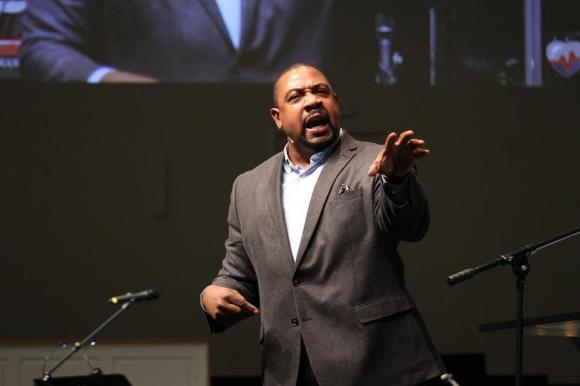
Pastor Curtis Gilbert

“If they (your church) keep putting a cape on you, and you keep letting them, then you need to be rebuked. Because you are nobody’s Superman.”
– Pastor Curtis Gilbert on how a pastor needs his people as much as they need him.

Ministry can be chaotic, said Belleville pastor Curtis Gilbert. In fact, it definitely will be. What pastors are called to is not a calling of ease or of superficial comfort, Gilbert told leaders at the 2017 IBSA Pastors’ Conference, but one that will call everything out of you.

The pastor of The Journey’s Metro East campus opened the conference with an encouragement to pastors to acknowledge the chaos, and to assess their lives and ministries in four key ways described by the apostle Paul in Titus 1:5-9. The Scripture passage was the foundation for the conference and its theme, “Time for a Check-Up.”

Gilbert urged pastors to evaluate their own love for Jesus, for the gospel, for their family, and for God’s people.

“Even the sheep that bite you are precious souls,” Gilbert said, adding that pastors can become arrogant and impatient when they stop viewing church members as God’s children, and when they forget that they themselves are every bit as much a sinner as their people. Don’t delegate all the shepherding to other people, Gilbert told pastors.

“Be with the sheep; it gives your preaching credibility,” he said, emphasizing that a pastor needs his people as much as they need him.

Joe Valenti spoke after Gilbert and smilingly accused him of stealing his message. “What he preached to you is what I’m going to preach,” said the student and missions pastor from Cuyahoga Valley Church in Broadview Heights, Ohio. “Namely, that if you would fall in love with the God of the gospel, if he would be your everything, then everything else comes out of that.”

Valenti, whose church is engaged in reaching unreached people groups with the gospel, quoted pastor and author John Piper, who has said, “You cannot commend what you do not cherish.” When pastors treasure the God of the gospel, Valenti said, relying on him for everything and never forgetting the first day they experienced his grace, “missions comes out.”

There are more than 11,000 people groups in the world, Valenti said, and more than 7,000 are still unreached with the gospel. That’s not a problem for the International Mission Board or for missionaries or for the Cooperative Program, he said. Rather, “We need to see the completion of the Great Commission as a personal problem.”

Pastor Brad Pittman

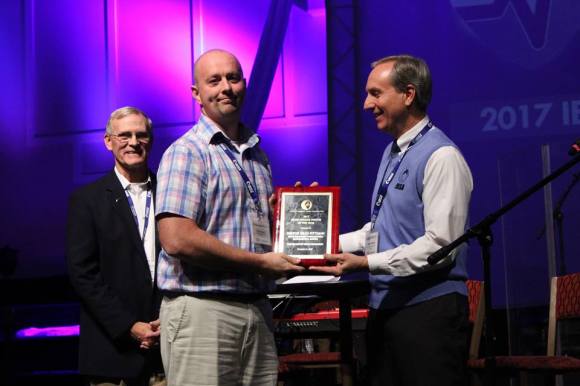
Brad Pittman (center), pastor of Grace Fellowship Church in Davis Junction, accepted this year’s IBSA Bivocational Pastor of the Year award this morning at the Pastors’ Conference in Decatur. 

In light of eternity
The mass shooting at First Baptist Church, Sutherland Springs, Texas, just two days before the conference began lent a heightened urgency to the meeting and the messages. Randy Johnson, pastor of Tabernacle Baptist Church in Decatur, preached on how to share the gospel as if it’s going to be your last opportunity, while Ed Stetzer, executive director of the Billy Graham Center at Wheaton College, told pastors the world they minister in is only getting darker.

The Christian worldview decreases a few percentage points every year, said Stetzer, former executive director of LifeWay Research and a long-time analyst of church and religion trends. And it’s probably going to get worse before it gets better, he added.

“I’m convinced that one of the reasons Southern Baptists are declining is that we have hidden our light under a bushel,” Stetzer said. But as aliens and strangers in the culture—as exiles—can we love people in the midst of cultural change, he asked. “If we can’t, we have a lot of explaining to do to Christians who have—for 2,000 years—done that.”

The 2018 IBSA Pastors’ Conference is Nov. 6-7 at First Baptist Church, Maryville. Officers are Bob Stilwell, president; Ben Towell, vice president; and Rayden Hollis, treasurer.

Global missions focus is December 3-10

LMCO Moscow.jpg

GROWING NEED – Moscow now has more Muslims than any other European city. Here, thousands gather for Friday prayers at the city’s Grand Mosque.

Every December since 1888, the Lottie Moon Christmas Offering has empowered Southern Baptists’ international missions work. This year’s Lottie Moon Offering and Week of Prayer feature people doing difficult work around the world—whether they’re reaching out to Muslims in Russia, starting a new church in Japan, or giving hope to refugees.

Reaching the unreached
When most people think of Russia, they may conjure up images of Romanov royalty, a parade of dictators like Stalin and Lenin or Brezhnev, or maybe cultural icons such as Mikhail Baryshnikov or Dostoyevsky. They don’t think of Muslims.

But Islam is part of the fabric of old Russia—it made it there 66 years before Christianity did. As a result, Muslim groups are indigenous to the North Caucasus region, an area between the Black and Caspian Seas situated on northern slopes of the mountain range that generally separates Europe from Asia. These people groups include 45 to 50 subsets of people and even more languages, making them very difficult to reach.

However many of them are moving into Moscow, Russia’s capital, which now has more Muslims than any other European city. Its newly reopened Grand Mosque can hold 10,000 worshippers.

“God says, ‘If you can’t go to them, I’ll bring them to you,’” said Elizabeth*, a Christian worker among Muslims in Moscow. “There’s no better time to be in the former Soviet Union. God is moving Muslims right under our noses.”

Seeing the impossible
International Mission Board missionaries Jared and Tara Jones knew that God could do a lot with something little. But they never imagined just how many doors he would open through their adopted infant son, Ezra.

In the East Asian country, 40,000 children live in orphanages, but parents rarely give up their rights so that a child can be adopted. But the Joneses knew God had placed a baby on their hearts, and they prayed. “We serve a God who makes doors where doors don’t exist,” Jared said. “And this little guy gives us multiple opportunities to talk about the Lord.”

Their son’s pediatrician was the key to another door—a church plant they had been praying about for years. One day, the doctor told Tara out of the blue that she wanted to start a church at her office and asked if Jared could lead it. Tara described it as a divine appointment. The first Sunday 70 people came. They’ve seen hearts changed and people keep coming.

Remembering the forgotten
Don Alan* says he remembers a refugee telling him once that he didn’t feel alive, but he wasn’t dead either—he was somewhere in between.

“Hopelessness is a universal feeling among refugees,” Don said. “They feel forgotten.” That’s why International Mission Board missionaries like Don, who serves in North Africa and the Middle East, and Seth Payton*, who works with refugees in Europe, spend their lives taking hope into those hopeless places.

“Refugees come to Europe looking for a better life, and many times they find nothing,” Seth said. Often, they’ve paid traffickers a high price for a long, miserable trip across the desert and then a dangerous boat ride across the Mediterranean Sea. If they make it alive, then they often can’t get jobs. They spend their days scrounging for food and their nights packed into an apartment with 15 other people.

“We pray that through this time God will open their hearts and draw them into his kingdom through the hope that he offers,” Seth said. “Hundreds of refugees from closed countries are becoming believers in Europe. So there are great things happening in the midst of a heartbreaking situation.”

Go to IMB.org/lottie-moon-christmas-offering for videos, stories, photos, and prayer requests for each day of the Week of Prayer for International Missions.

*Names changed.

– From IMB.org


Breen 4

Peter Breen, Special Counsel for the Thomas More Society, talks to reporters after the Dec. 6 court hearing.

A law firm representing religious liberty concerns has filed a lawsuit to stop the implementation of taxpayer-funded abortions through House Bill 40 (HB40) in Illinois on Jan. 1.

The Chicago-based Thomas More Society suit argue that the General Assembly has not set aside funds in the state’s budget to pay for the abortions and remain within the Balanced Budget requirements of the Illinois Constitution. It also contends, according to the Thomas More Society, that the law cannot become effective until June 1 because it missed a May 31 cut-off date for General Assembly action.

“We’ve got $1.7 billion more appropriations than we’ve got revenue coming in,” said Peter Breen, Special Counsel for the Thomas More Society. “I don’t see how we’re going to find the money to pay for these elective abortions.”

Initial arguments were heard in the Seventh Judicial Circuit Court December 6 at the Sangamon County Courthouse in Springfield. Breen asked when the state planned to implement HB40. Attorney’s representing the state replied they were not prepared to answer the question.

Associate Judge Jennifer Ascher set the next hearing for Dec. 28. If the state does not intend to implement HB40 on January 1, the Dec. 28 hearing will most likely be rescheduled due to the upcoming holidays.

The suit is being brought by numerous state legislators, pro-life organizations and the Diocese of Springfield.

Board 2

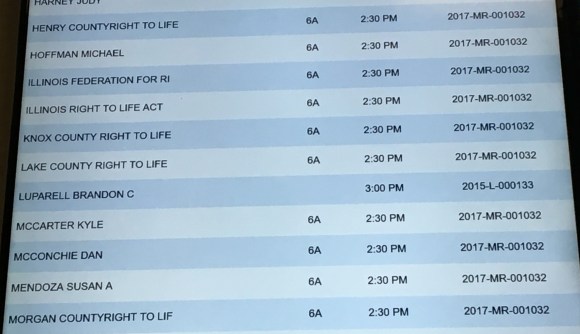
A screen at the Sangamon County County Court Complex in Springfield lists assigned courtroom and the defendants and plantiffs in Springfield Right to Life, et al v Felicia Norwood, et al.

Following the hearing, Breen, who is also a state representative (R-Lombard), was asked about the projected cost of implementing HB40. “Based on numbers from the Health and Family Services Department, it costs $750-$1,000 per abortion you’re looking at between 20-30,000 abortions [being performed].” He stated that would bring the total cost to $15-$30 million, funds not reimbursed by federal Medicaid.

Breen later said, “We’re always talking about how our children are our future. So how can you argue that somehow aborting more children is going to bring more value to the State of Illinois?”

When asked about the religious liberty aspects of HB40, Breen said, “This lawsuit is very specifically about public funds…We don’t have moral argument in court. We’re just looking at the misuse of public funds.”

The suit was filed on behalf of several legislators and pro-life groups who are opposing HB40, which would provide coverage for abortions through Medicaid and state employees’ health insurance plans.

In November, messengers to the IBSA Annual Meeting passed a resolution calling for the repeal of HB40, pledging support for “the rights of the unborn,” and claiming, “all human life is God-given and sacred, and should be protected by moral and righteous government.”

Illinois Gov. Bruce Rauner originally pledged to veto the HB40 if it came to his desk, but signed it into law Sept. 28—to the dismay of Christians and pro-life advocates. State Rep. Jeanne Ives (R-Wheaton) is working to get on the Republican primary ballot against Rauner in March.

“He lied to us,” Ives said in an Associated Press article last month. “None of us trust him anymore.”

– Lisa Misner Sergent

Why Chicago?

ib2newseditor —  December 7, 2017

chicago-cloud-sculpture

We may not verbalize the “why” question with the persistence of a young child, but we still look for a reason or substantial meaning when called to some action.

Through more than a dozen years in church planting, I’ve heard the “why” question. When a family gave five acres for a new church property to a local association in eastern North Carolina, many in nearby churches asked why, even as their buildings were nowhere near filling their seating capacity.

When I planted a church in Buckeye, Ariz., the North Carolina churches I invited to partner with us often wondered why they should care about planting a church in a community 2,000 or more miles away.

For nearly four years now, I have had the privilege of living in Chicago. During that time, I have mentored, coached and challenged many church planters here. I’ve also invited churches in more than a dozen states to get engaged in supporting church plants here in Chicago with prayer, action and finances.

“Why Chicago?” some ask, jesting, “Why not Hawaii? That would be a great mission trip!”

Yet there are three key answers:

The first reason is biblical. In Luke’s account of the Great Commission in Acts 1:8, Jesus tells His disciples and us, “But you will receive power when the Holy Spirit has come on you, and you will be my witnesses in Jerusalem, in all Judea and Samaria, and to the end of the earth” (CSB).

No matter where you live, major metropolitan areas like Chicago are located between you and “the end of the earth.” And frankly, because of political views and sensationalized news, Chicago in particular is to many in southern Illinois and elsewhere what Samaria was to the Jews: a place and people we’ve been trained or conditioned to dislike or even hate. Yet, even if it is Samaria to Christians, it’s a place and people to which Jesus has sent us to bear witness of Him and His Good News.

The second reason is practical. Cities like Chicago have, from their earliest settlement, become a home for immigrant people groups — many that are identified as “unreached and unengaged” by the International Mission Board.

Because of technology and ease of global travel from America’s major cities, many immigrants maintain a reach to and influence in their homelands. So, effectively evangelizing and discipling people in a city like Chicago gives us a reach into many parts of the world, including most of the peoples in the 10/40 window, a region between the 10th and 40th parallels across Africa and Asia where most of the people who have never heard the Gospel live.

Reaching Chicago and other metropolitan areas with the Gospel could bring a significant advance toward the global evangelization that Jesus promised in Matthew 24:14.

The final answer to “Why Chicago?” is missiological. Chicago is sometimes called the “most segregated city in America.” And while that is changing in some of the neighborhoods of the city, people groups are usually heavily concentrated in certain areas. Poles are heavily concentrated in the northwest neighborhoods and nearby suburbs. Chinatown, as you might guess, is home to mostly Chinese people, many of them still speaking Mandarin or Cantonese. Pakistanis are clustered along Devon Avenue in the northern part of the city. Professional millennials make up two-thirds of the population in the West Loop. Wicker Park is the epicenter of the hipsters.

High concentrations of people groups in a specific place give us a missiological advantage in reaching them. Even if it is a cross-culturally gifted southern boy and his family living among south Asian immigrants, winning one or two to Jesus could result in dozens who live nearby coming to faith in Christ. Given their close proximity to each other, bringing them together to a form a new church can happen very naturally.

While it may not be unique, Chicago is rare in giving us three good reasons to seize the opportunities for the Gospel that lie within our reach.

Dennis Conner directs IBSA church planting efforts in northeast Illinois. Beginning Jan. 1, Conner will transition to planting a church in Chicago’s South Loop neighborhood. This article first appeared in the Illinois Baptist and has been republished by Baptist Press.