(Editor’s note: New Orleans in Rear View. Now that we’re back home, our Illinois Baptist news team reflects on the question: What is the lasting value of the 2012 SBC?)

 Posted by Lisa Sergent
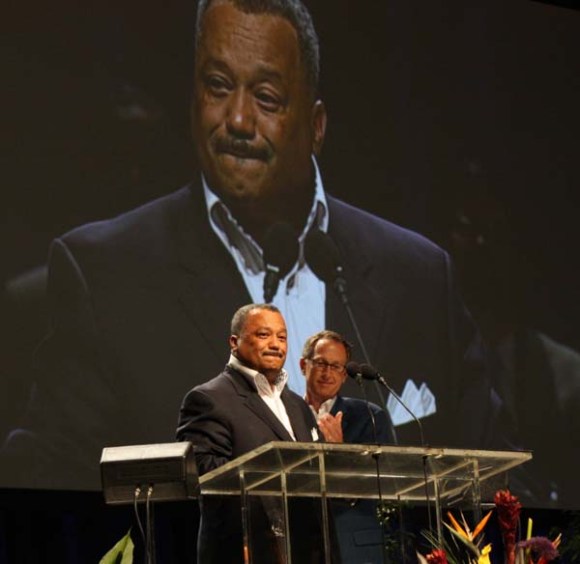
Pastor Fred Luter, the SBC's new president, receives a standing ovation from messengers at the convention's annual meeting.

Pastor Fred Luter, the SBC’s new president, receives a standing ovation from messengers at the convention’s annual meeting.

The 2012 SBC Annual Meeting in New Orleans was historic for many reasons.  The return of Southern Baptist Convention for the first time since Hurricane Katrina, the adoption of the “Great Commission Baptist” descriptor name, and the election of Pastor Fred Luter as convention president.

Luter’s election made headlines across the country because he is the first African-American to be elected President of the Southern Baptist Convention, a convention which some still associate with its birth in the support of slavery. But, as I listened to the various platform speakers, I began to grow concerned. Yes, Luter is an African-American, but this is not why he is president. Luter is president because of his character, leadership abilities, heart for Christ, and the way he has allowed God to lead him in his ministry.

One example of his leadership, commitment, and faith was seen in the aftermath of Hurricane Katrina when Franklin Avenue Baptist Church sat in 13 feet of floodwater. While some of the churches over 7,000 members remained in New Orleans, others were scattered to Baton Rouge and Houston. On the first and third Sunday’s of the month, he would preach an early morning service to members who gathered in First Baptist New Orleans church building. In the afternoon, he would travel to Baton Rouge to lead a service for more members. The second and fourth Sunday’s of the month saw Luter in Houston, Texas, leading church services for still more members. He did this for over two years until the Franklin Avenue’s building was ready for services again.

As Southern Baptists we need to focus on Luter’s God-given abilities and pray for him as he leads our convention. He is president because of the content of his character in the tradition of Dr. Martin Luther King Jr.’s dream. His election is a historic step for the Southern Baptist Convention, but his election is wonderful because he is a faithful man of God, whom God has already used and will continue to use in great and wonderful ways.


Your team of IB reporters

Your team of IB reporters.

Thank you for reading our coverage of the 2012 Southern Baptist Convention Pastors’ Conference and Annual Meeting. We’re hot, tired and hungry and heading for the airport. It’s been a great convention, we saw history made, unity after debate, a younger generation emerge, and commitment to the beliefs that make us Southern Baptist.

We have a lot of work to do when we get back home putting together a special edition of the Illinois Baptist. Also look online for more convention follow-up.

God bless

Good-bye NOLA

Meredith Flynn —  June 21, 2012

Posted by Meredith Flynn

It’s been quite a week here in New Orleans, especially for our SBC first-timer, Chris Flynn. As we get ready to head back to Illinois this morning, we talked a little about he’ll remember the week after the fog of long days and lots of sermons has lifted. Here’s what Chris said: “It was re-charging to be around so many people who are charged.”

I agree with him. Attending a Southern Baptist Convention is at once tiring and energizing. And I think the temporary things that drained us – the heat, late nights, too many beignets – will fade as we remember the important conversations that were had, the historical events we saw right in front of us, and the renewed sense of not being alone in this that we felt.

Thank you for reading along this week!

20120621-071545.jpg
Morning in New Orleans.

20120621-071717.jpg
Fred and Elizabeth Luter are introduced to the convention.

20120621-072242.jpg
A streetcar ride, our last New Orleans-y thing to do.

Posted by Eric Reed

(New Orleans) — As we come down to the wire on this annual meeting of the Southern Baptist Convention, I am reminded of my friend Martha who told her husband every year as he left to attend the convention, “Bring home a copy of the resolutions!” For her, the essence of Southern Baptist life is not so much in the election of officers or agency reports; it’s in the annual statements messengers make on the clarification of our beliefs, and the intersection of our faith with contemporary culture.

Sometimes it’s from the resolutions that mainstream media find statements that are perceived as critical of the culture, politics, and secular leadership. But it is also in these resolutions what we affirm our faith and the value of biblical principles and lifestyles in transforming our culture by godly standards.

This year, in the waning moments of the 2012 convention, we are affirming the doctrine of salvation, the doctrine of inerrancy, religious liberty—with attention to issues involving mandated health care and same-sex marriage, the value of human needs ministry, and the contributions of African Americans to Baptist history.

A lot of people went home early.

The hall was not full when these resolutions were debated and adopted. But they are worth our time and attention—because it’s often in these areas that our faith is lived out.

When Baptist Press publishes the resolutions, take time to read them.

And “bring them home.” 

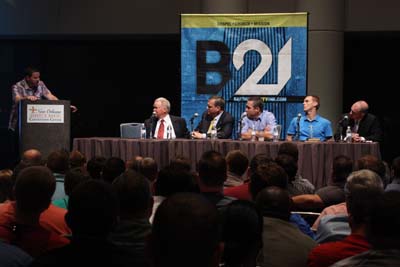
Paige Patterson, Al Mohler, J.D. Greear, David Platt and Danny Akin served as panelists during Baptist 21's luncheon for young leaders in New Orleans.

Paige Patterson, Al Mohler, J.D. Greear, David Platt and Danny Akin served as panelists during Baptist 21’s luncheon for young leaders in New Orleans.

At Tuesday’s Baptist 21 luncheon, hundreds of young people balanced turkey sandwiches and chocolate chip cookies on their laps as six Southern Baptist leaders reminded them of the price that was paid for the theological stability they enjoy today.

Paige Patterson, Al Mohler, Fred Luter, Danny Akin, J.D. Greear and David Platt weighed in during a panel discussion of the Conservative Resurgence (Southern Baptists’ return to orthodox doctrine beginning in the late 1970s) and the future of the SBC. As conversation continues to simmer over the surge of Reformed theology in the SBC, the panelists, who themselves represent a variety of theological perspectives, urged their listeners to hold fast to the inerrancy of Scripture.

“What was gained can be so quickly lost,” Mohler said. “It was excruciating, it was difficult, it was a near-fought thing, in the sense that it could have gone in the other direction. There was a victory that created a precious opportunity that’s a stewardship that we know can be lost at any time…

Every single year that passes is going to be more difficult, in terms of our cultural context. There are going to be issues we don’t even know to imagine today that your generation is going to have to imagine. It’s going to require the full wealth of conviction; if you do not nail your ministry to the foundational truth of the inerrancy of God’s word, you will – it’s not a question of if, it’s a question of when – you will go off the tracks.

It is essential from the very beginning to say, ‘This is where I’m going to stand, this is where I’m going to go in my ministry. This is a non-negotiable and quite frankly, I want the world to know it.”

20120620-135455.jpg

Posted by Meredith Flynn

(New Orleans) — Dr. Richard Tribble, interim pastor of Emmanuel Southern Baptist Church in Decatur, Ill., has become a familiar sight on the convention floor in New Orleans. Tribble made four motions Tuesday morning, and spoke against the SBC’s name change recommendation in the afternoon.

Tribble’s motions asked convention messengers to:

1. Limit the use of the podium microphone during the SBC’s annual meeting, requiring those nominating persons for office to use the floor microphones.

2. Require those nominating officers to also communicate to messengers the Cooperative Program giving percentage of the nominee’s church.

3. Ask the SBC Executive Committee to prepare a manual that would set official procedure for replacing a sitting officer of the convention, even if the convention isn’t in its annual meeting session.

4. Move the SBC’s annual meeting to a date later in June that wouldn’t conflict with Father’s Day.

His frequent trips to the mic made Tribble a kind of hero to people who agree with him, and even those who might not, but still appreciate his bold voice. As we sat near the convention hall’s Starbucks, several messengers stopped by to thank him. One even made a reference to “The Trouble with Tribbles,” an old episode of “Star Trek.” Tribble laughed good-naturedly, and admitting that it is draining to advocate change from the convention floor, but it’s what he’s called to do at this convention.

“I believe the motions that I made addressed real needs we have in the convention,” Tribble said. “They weren’t frivolous, they were well thought out. They spoke to areas that need attention, and I pray that we will get attention because I made them.”

Newly elected SBC President Fred Luter

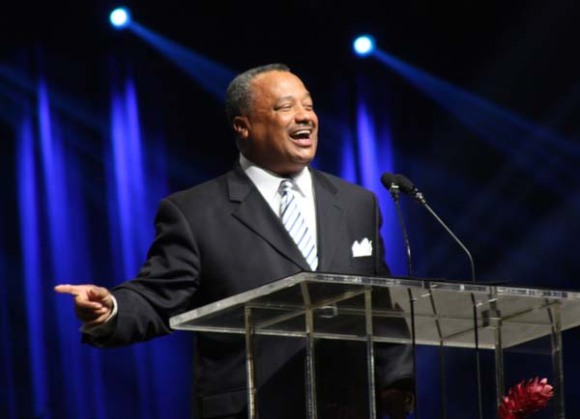
Pastor Fred Luter balances serious subjects with joyful repartee while preaching at the Pastors’ Conference on the eve of his election as SBC President.

Posted by Eric Reed

A newspaper profile of Fred Luter pointed out the ways he will be a new face for Southern Baptists. Beyond race, Luter will bring a smile as the chief representative of the denomination, something that is lacking in our history of leadership by serious, white middle-age pastors, the report said.

Not that Luter isn’t serious. He is very serious about the traditional values of Southern Baptists, both theologically and culturally. His sermon that closed the Pastors Conference on the eve of his election as theconvention’s first African American president was a fiery litany of the ills of times—broken homes, crime, racism, abortion, homosexual lifestyles—and the hope, the only hope we have in the gospel of Jesus Christ. But this energetic dance of oratory was punctuated by self-effacing confessions of personal sin and redemption, and joyous grins attesting the effects of Christ in his life.

Fred Luter is serious about the joy of his salvation.

“I love to laugh,” he told the reporter. “I love to have a good time.” And those who hear Pastor Luter preach know it’s true. “If anybody has joy, if anybody has peace and happiness, it should be us,” he said.

If the perception persists that “Baptists don’t have any fun, that we don’t laugh—we don’t have any joy, I would love to change that perception,” Luter said.
Luter is equally serious about making the fuller ethnic representation a fact of life in all areas of Southern Baptist life.

“If we stop appointing African Americans or Asians or Hispanics to leadership roles in this convention after my term is over, we failed. We absolutely failed,” Luter said at a news conference after his historic election.

Luter summarized his election as “a genuine, authentic move by this convention that says our doors are open, and the only way they can see that is not just putting up an African American president, but seeing other ethnic groups inother areas of this convention. Time will tell and I’ll be a cheerleader promoting that.”

Luter and others described his election, at a national convention held in his own hometown of New Orleans, as providential. After a lengthy season of prayer, Luter and his wife agreed to put his name forward as a candidate in January. No other candidates emerged, and Luter was elected unopposed on the first day of the annual meeting.

Messengers stood and applauded for several moments as the convention’s vote was cast for the lone candidate, cheering and whooping and waving their ballots in the air. Some wept at the election of the African American pastor, seen by many as a fitting sign of repentance of the denomination’s birth in a time of slavery.

“There will be some pitfalls,” Luter said of his service as SBC president, “but I hope I will learn from them and study more on things I anticipate being asked.” Already Luter has faced the national media, answering questions about the role of race in the mostly white denomination. Luter said he hopes to be known as a man of God who “loves being part of this convention.”

And he smiles when he says it.

20120620-114129.jpg

Posted by Meredith Flynn

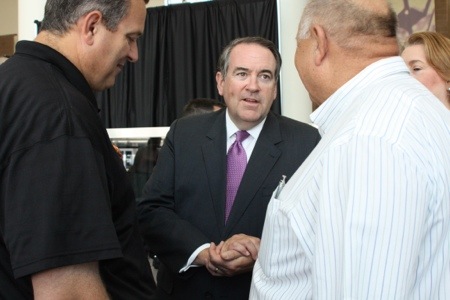
(New Orleans) Former Arkansas governor and U.S. presidential candidate Mike Huckabee posed for photos and shared warm words with Southern Baptists who happened upon him in the convention center’s Starbucks.

Huckabee is in town to speak at Southwestern Baptist Theological Seminary’s alumni luncheon today.

In this political season, he urged Southern Baptists to vote, and encouraged pastors to endorse Jesus, rather than any political candidate, from their pulpits.

“I would never encourage a pastor to endorse a candidate from the pulpit; they need to endorse Jesus from the pulpit. But they absolutely need to endorse God’s word and his principles, and make sure that people apply those principles to the candidates,” Huckabee said.

“And far more than asking Christians to gravitate to a candidate, ask the candidates to gravitate towards God’s truth. Don’t vote and support people that don’t support the sacredness of every life, and the autonomy and independence of people of faith.”

The name “Southern Baptist Convention” tells who we are, but it doesn’t tell what we do. The descriptor “Great Commission Baptists” tells what we should be doing.

Messenger on the floor of the convention speaking for adoption of informal “descriptor” name for optional use by churches. Name was adopted by 52% vote.

From the floor: Name Change

(New Orleans) — While debate continues over a resolution affirming “the sinner’s prayer,” and we wait to see if a fuller debate will develop over Reformed versus “Traditional” Southern Baptist Theology, what might be considered a less important vote by the convention—for second vice-president—may better signal how messengers really feel about the simmering theological arguments.

Messengers elected a pastor who was positioned as a unity candidate over the author of the statement on “traditional” Southern Baptist Theology by 20 percentage points.

Dave Miller is an Iowa pastor whose nominator described him as a man who could unite Southern Baptists, someone serving in a small church in a frontier territory of SBC work whose voice needs to be heard at the denominational table. He won in a run-off by 59.5% to 39.5%, defeating Eric Hankins, the Mississippi pastor who drafted a defense of Southern Baptist theology against inroads by Reformed theologians.

In an earlier round, messengers eliminated a third candidate, Brad Atkins, a pastor from South Carolina.