COMMENTARY | Mark Warnock

Editor’s note: Two Protestant denominations made important decisions on same-sex marriage this week. First, the Presbyterian Church USA narrowly defeated a motion to re-define marriage as being “between two people” instead of between a man and a woman. Then, the General Convention of The Episcopal Church approved a liturgy that can be used to bless same-sex unions during commitment services. Churches and denominations have traditionally opposed same-sex marriage, but as the lines become more and more blurry, columnist Mark Warnock looks at some ways Christians can answer the question: “Why do you believe what you believe?”

In the political discussion over same-sex marriage, religious views are almost always sidelined. Separation of church and state means, we are told, that religious reasons do not count. So when Christians talk in public about the Bible’s clear case against same-sex marriage, our position is dismissed as “religious” and therefore irrelevant.

But most people are deeply conflicted about same-sex marriage, especially in the privacy of the voting booth. Even as polling data shows growing support for same-sex marriage, voters keep saying no to constitutional amendments that would allow it.  The culture keeps saying it’s ok, but deep down it just doesn’t feel right.

We can and should attach reasons to that feeling.

But what happens when our biblical reasoning doesn’t get much traction in a culture biased against religion? We shouldn’t abandon biblical arguments, but we can show that the Bible’s position is well supported by historical experience and cultural practice.

Here are a few ideas:

Marriage came first, before governments and before religions. Thousands of years of experience have shown it to be good for society. When governments undermine marriage, however, the results are bad for society – alarmingly so. When states passed laws allowing “no-fault” divorce in the early 1970s, we were promised it wouldn’t affect other marriages and that the kids would be just fine.

That was a lie. No-fault divorce taught an entire generation that permanence in marriage is optional. The divorce rate rose immediately, and now, fewer adults are choosing to marry at all. And 40 years of research have proved that children are badly hurt by divorce.

The primary reason we have marriage is that it binds together the private dimension of sex and romance with the public dimension of parental responsibility. Once you separate marriage and parenting, there is no reason to have marriage any more.

Social trends like divorce have been pulling these dimensions apart, making marriage more and more about the private satisfaction of adults, and less and less about public responsibilities to children. Same-sex marriage takes the final step: marriage will become an entirely private affair stripped of its inherent public functions born of the creation of family. Thus, marriage becomes hollow, a public institution that serves no public function. It’s no wonder people are losing respect for what was once a holy, sacred estate.

Marriage is not to be entered into lightly or unadvisedly, the traditional wedding ceremony says. Nor should marriage be so unadvisedly redefined.

Mark Warnock is associate pastor of First Baptist Church of Columbia, Ill., and a Ph.D. student at Southern Baptist Theological Seminary.

THE BRIEFING | Meredith Flynn

Illinois marriage law gets court defender
A Chicago-based legal organization will work to uphold Illinois’ definition of marriage as being between a man and a woman.

The Thomas More Society was granted intervenor status by a state judge last week, meaning they will oppose the lawsuits brought by the American Civil Liberties Union and Lambda Legal on behalf of 25 gay and lesbian couples who were not allowed to marry in Cook County.

The couples say Illinois’ 1996 Marriage and Dissolution of Marriage Act (which defines marriage as being between a man and a woman) is unconstitutional, based on the state’s equal protection clause.

Soon after the lawsuits were filed, Peter Breen, executive director of the Thomas More Society, told World News Service the suits would not hold up in court under the constitutional arguments.

“Going around the will of the people is not the right way to change an institution that has thousands of years of history and is sound in its reasons for existing,” Breen said.

The society has filed a motion to dismiss the case, and oral arguments will be heard Sept. 27. Read the full story at BPnews.net.

Other news:

Presbyterian Church USA divided over same-sex marriage
By a very narrow margin, the Presbyterian Church USA (PCUSA) voted to maintain its definition of marriage as “between a woman and a man,” rather than change it to “between two people.” Delegates to the denomination’s General Assembly voted 338-308 against the recommendation to change the definition. The PCUSA last year lifted its ban on partnered gay clergy. Read more at christianpost.com.

New books focus on Christianity and politics
As campaigns heat up in advance of the upcoming party conventions, at least two authors are addressing how Christians interact with the political scene. Wheaton College professor Amy Black just released “Honoring God in Red or Blue: Approaching Politics with Humility, Grace and Reason.” And pastor and culture writer Jonathan Merritt’s “A Faith of Our Own” focuses on a younger generation’s attempts to reconcile social justice with conservative views. Read an interview with Merritt about the book on pastorsedge.com.

Economy still affecting giving to churches
A recent Barna Group study found 41% of adults surveyed have reduced their giving to non-profit organizations in the last three months, and 11% have stopped giving altogether. That’s an increase from 4% of Americans who said they had stopped giving in 2008. Go to barna.org for the full story.

Purdue QB promotes ‘Choose2’
Caleb TerBush, a senior quarterback at Purdue University, is wearing a blue Choose2 wristband in advertisements for the team’s upcoming season. TerBush’s father Ken is the pastor of Elm Ridge Missionary Baptist Church in East Peoria, Ill. Choose2, a ministry of the Illinois Baptist State Association, asks participants to pick two family members or friends who don’t know Christ and pray for them twice a day. Read more about the initiative at IBSA.org.

Not Meredith's closet

Not Meredith’s closet

HEARTLAND | Meredith Flynn

There’s a line in “Gidget” (the movie version with Sandra Dee, not the Sally Field TV show) that I love. Moondoggie, the surfer boy Gidget pines over, finally gets fed up with her antics and spats, “Do you know what your problem is?” He doesn’t wait for an answer before telling her:

“You’re just too much!”

It’s a fun scene and a silly line (and makes me long for the day when that was the worst insult you could hurl at someone), but lately, it’s had a lot of resonance in my life. Because I, with my full garage, storage shed, and four closets, am too much. Or at least, I have too much.

And I blame Jen Hatmaker for making me realize it. You may have seen her book “7” or read a recent review of it in the Illinois Baptist. It’s a great book, and worth your time, but read with caution because I promise you, everywhere you look, you’ll see areas where you’re living in excess. Let me confess (a few of) mine to you:

  1. At any given time, there are five to seven almost-empty cereal boxes in the pantry. (Rather than eat the “gravel” at the bottom of the box, I just buy a new one.)
  2. I have never met a cardigan sweater I didn’t need.
  3. I find it much easier to spend an hour looking up recipes I will never make on Pinterest than to read my Bible for a half hour.

Book "7"If pressed, I probably would have described each of these things as bad habits. But I didn’t see them as part of a spiritual problem (except for that last one). The basic premise of “7” is that we often need to downsize our “stuff” to receive more of what God wants for us.

The book chronicles the Hatmaker family’s efforts to simplify their lives in seven areas: food, clothing, possessions, spending, media, waste and stress. While I wouldn’t have diagnosed myself as “excessive” in any of those categories, I had felt the dullness Hatmaker writes about:

  • I talk about having no free time, but squander the hours I do have.
  • Even as I accumulate “stuff,” I continue to compare myself to others who seem to have more.
  • I am often numb to the material needs of people right in front of me.

I started to realize that maybe “excess” wasn’t as extreme a word as I once thought. Maybe the warning signs were all there, in every full drawer, bursting cabinet, and hard-to-close closet. I needed, and still need, fresh eyes to see the places in my life where I am just too much.

I’m thankful for the lesson, even as I choke down this cereal gravel from the bottom of the box.

COMMENTARY | Jay Ingram

As a former Journeyman missionary with the International Mission Board, I’ve had numerous people ask me, “What do week-long mission trips actually accomplish?” Well, if they are preceded and followed up with a long-term strategic prayer partnership, then a lot!

As I traveled to preach the gospel in Asian villages for two years, I can testify that my most fruitful time on the mission field was when my stateside prayer advocates were specifically praying for me that day or week (and they did this for two years).

Oftentimes, we fail to see the essential-ness of prayer in our daily lives. Maybe that’s why we reserve prayer to a formality in the church parking lot before the bus leaves or the Sunday before the trip. But once the trip over, what will we do to further the ministry? The unfortunate reality is that many mission teams and churches do not continue to pray for the ministry or locale to which they sent a mission team.

That’s why I propose that churches, small groups, and even families form strategic prayer partnerships with the ministry or communities with whom they will serve this summer.  People of all ages can be a practical part of this kind of ministry.

At Delta Church in Springfield, we have formed a partnership with the IMB’s Celtic Languages Team based in Wales. Since many people in our congregation won’t be able to participate in a mission trip to Wales, they remain a vital component of the partnership since they will be praying for the Holy Spirit to draw people to salvation.

Here are a few ways people in our church, and any congregation with a strategic prayer partnership, can stay involved:

1. Many missionaries and ministries send email updates each month or have prayer calendars. This is a great way to pray for urgent requests and long-term needs.

2. Current technology allows churches to connect live with missionaries from all over the world using Skype and other software. Use this opportunity to pray as an entire church for the missionary in real time.

3. Make examples.  If your church has partnered with NAMB or IMB missionaries, use their personal stories to promote the Lottie Moon and Annie Armstrong Offerings. This will remind our churches that “real live” missionaries are using their offerings to preach the gospel all over the world and remind them to pray for these efforts.

Make strategic, focused prayer a vital element of your church’s missions projects and trips. Whether your mission team is traveling around the world or staying local, a prayer partnership will extend your efforts well beyond the summer.

Jay Ingram is a member of Delta Church in Springfield.

THE BRIEFING | Meredith Flynn

In his own words: David Platt on the ‘sinner’s prayer’
David Platt has released two blog posts to explain his views on recent debate surrounding the “sinner’s prayer.”

Platt, pastor of The Church at Brook Hills in Birmingham, Ala., sparked controversy in a YouTube video earlier this year in which he called the prayer “superstitious,” and also delivered an intense message on the topic at the Southern Baptist Pastors’ Conference.

In the posts, Platt combats media accounts that he is “against” the sinner’s prayer, or that the issue stems from Reformed theological views that some people don’t have a chance for redemption in Christ.

“…Words really can’t describe how much a comment like this pierces my heart, for nothing (I hope and pray) could be further from the truth,” Platt wrote in the first post. “Any cautions I have expressed with a ‘sinner’s prayer’ have absolutely nothing directly to do with the doctrine of election, and I definitively don’t believe that certain people ‘actually have no chance for life in Christ.’”

So, does the sinner’s prayer ever fit into an evangelism strategy? Platt’s second blog post outlines the plan he teaches in his church’s evangelism and missions class, including how to lead someone to call out to God in repentance and belief. Read both posts at radical.net/blog.

Religious groups pledge to stand firm despite healthcare decision
After last week’s healthcare ruling, opponents responded to the Supreme Court’s decision to uphold the 2010 law, which requires insurance plans to cover contraceptives and sterilizations without cost to employees. O.S. Hawkins, president of GuideStone Financial Resources, said GuideStone “will never allow this Administration, or any other, to tell us that we have to provide abortive drugs like morning-after pills. … We will maintain our advocacy on behalf of ministers we are privileged to serve.” To read more about the Supreme Court’s decision and the fallout, go to bpnews.net.

What does the average American think about the Bible?
A new Barna study says younger adults are less likely to perceive the Bible as relevant and useful when compared with older adults. The 2012 State of the Bible survey, conducted by Barna for the American Bible Society, also found nearly half of Americans believe the Bible contains the same truths as the Koran and the Book of Mormon. Read more findings here.

Disaster Relief volunteers mobilize for action in Colorado, Florida
As monster wildfires rage in Colorado and other Western states while Hurricane Debby leaves massive flooding behind in north Florida, Southern Baptist Disaster Relief leaders are busy mapping responses in both parts of the country. Read more at bpnews.net.

Teen carries carries cross from Texas to Washington – on foot
Junior Garcia, a 19-year-old from Saginaw, Texas, has received permission to set up a 12-foot cross in Lafayette Park, across the street from the White House. And’s he’s taking it there by foot. Garcia and a team from Oasis International Church set out on “The Journey” June 7, and will hold a prayer service in the park to celebrate the end of their trip. Read the full story at christianpost.com.

HEARTLAND | Jim Rahtjen

Editor’s note: Reformed theology in the Southern Baptist Convention became a hot topic earlier this summer, when a group of leaders wrote a statement affirming “traditional” Southern Baptist theology. Columnist Jim Rahtjen explains how he was convicted of his own pride, and convinced that encouraging fellow ministers is more important than judging their views on secondary issues.

John answered and said, “Master, we saw someone casting out demons in Your name; and we tried to prevent him because he is not one of us.” But Jesus said to him, “Do not hinder him; for he who is not against you is for you.” Luke 9:49-50

I had no idea John’s statement and Jesus’ reply would dramatically change my life and ministry, but I’m immensely grateful it did.

I had been preaching through the book of Luke, this was the next passage. The week before, God showed me a mountain of spiritual pride in my life, and this week He would show me it was more like a mountain range.

In Luke 9, the disciples argued among themselves as to who was the greatest (a prideful game that I myself had played in my mind). John changed the subject and told Jesus of the disciples’ efforts to thwart the ministry of this man who was casting out demons but “wasn’t one of us.” Jesus told them to stop hindering him.

What a tragedy! This man had a calling he couldn’t fulfill because the disciples hindered him. The disciples had a calling of their own which they neglected in order to hinder this man.

God showed me myself in this passage when I prepared to preach it. You see, in those days, I defined myself by my theology; consequently, if a brother wasn’t of my theological persuasion, if he “wasn’t one of us,” I’d look down at him with an attitude of superiority. The Lord illustrated this to me the next week as I attended the Southern Baptist Convention.

At the convention, I saw a man who was my mentor in college. He invested deeply in my life teaching me one-on-one how to grow spiritually, have a quiet time, and study and apply the Bible to daily life. He loved Jesus, loved me, and loved to quote his favorite preacher, Charles Spurgeon. I still deeply love this man, see him as a spiritual father and seek his counsel today.

At the convention, I also ran into another mentor who invested in me as I began to serve in ministry. He taught me one-on-one how to faithfully serve as a minister and deepen my spiritual walk. He introduced me personally to Well-known theologians who began to shape my theology. He loved Jesus, loved me, and loved to quote one of his favorite preachers, Charles Spurgeon.

Because of their common investment in my life, and their mutual respect for Charles Spurgeon, I thought it would be great for them to meet. I mentioned to my first mentor that my second mentor was at the convention. I told him about some of the men to whom he had introduced me.

He bristled and asked, “Is he a Calvinist? Are YOU a Calvinist?” And over the next few days, without knowing my mentor, he made several unflattering assumptions about him based solely on a stereotype of Calvinists. I thought, “But you don’t know him. You’d love him. He’s one of us!”

The next day, when I saw my second mentor, he had same reaction in reverse. I told him about my first mentor’s appraisal of Calvinists. He bristled and said, “Oh, don’t tell me he’s an Arminian!” And then he began to make inaccurate assumptions of my mentor, based on a stereotype of Arminians. Again, I thought, “No, you’ve got him all wrong. You’d love this man. He’s a brother!”

My mind went back to the lesson from the passage I had just preached. Rather than encouraging a man, the disciples allowed their bias to get in the way. They saw him as an opponent and tried to hinder him, rather than seeing him as an ally in God’s Kingdom.

From that moment, I asked the Lord to help me to tear down that mountain of pride in my life that causes me to judge a brother by his theology rather than know and encourage him. I came to better understand what Jesus said to John: “Stop hindering him. He who’s not against you is for you.”

Jim Rahtjen is chairman of the IBSA Board of Directors.

By Nate Adams, IBSA Executive Director

I can usually measure the value of a meeting by the follow-up actions I note for myself as a result of it. If I don’t write anything down, the meeting was probably pretty pointless. If the meeting moves me to action or change, it may have been worthwhile.

So let me share with you a few of my follow-up notes from the recent Southern Baptist Convention in New Orleans, at least as they relate to the major issues discussed at this year’s annual meeting. You can read about these issues in the July 2 of the Illinois Baptist or at IBSA.org.

My notes about the informal name “Great Commission Baptists” as an alternative to “Southern Baptists” could be summarized simply by the phrase “wait and see.” Clearly a large number of churches feel that having an alternate name, even an optional one, is not a positive thing. But the majority that voted to endorse the alternate name gave those who wish to try it out a new tool to potentially reach people for whom the term “Southern” may be a barrier.

For now, I plan to “wait and see” how many churches embrace the new name, especially here in the Midwest. I suspect we will continue using the “Illinois Baptist” identity in our communications more than either of the others.

My notes about the various issues that have the Calvinist vs. Arminian theology debate at their root simply say, “stay above the fray.” Both outgoing President Bryant Wright and SBC Executive Committee President Frank Page served us well, I thought, when they essentially stated that the Baptist Faith and Message is big enough for both strains of theological thought, and that there is more danger in our heart attitudes about either position than in the doctrinal differences themselves.

Some time ago I came to the personal conclusion that Calvinist theology describes salvation more from God’s perspective outside time, and that Arminian theology describes salvation more from man’s perspective within time. I’m sure that those for whom that explanation is not sufficient will continue this centuries-old debate. I plan to try and stay above the fray of that argument, and pray it does not distract us from our far more important Great Commission task.

Finally, you may not think I need follow-up notes from the election of Fred Luter as the SBC’s first African American president. But I found I did. Tuesday night, just after Pastor Luter’s election, I attended a dinner with the African American Fellowship of Southern Baptists that included SBC entity executives and state executive directors like myself from all over the country.

Even during that dinner, I formed several follow up notes for myself: Don’t just sit with people you know – get to know some new African American brothers and sisters. Learn to understand and appreciate the history and the pain, the culture and the passions of African American churches and their leaders, especially those that have chosen to be part of the Southern Baptist family. Relax and enjoy different worship and preaching styles – God wants to speak to you through those too! Recognize how important it is to make sure African American leaders are participating in Southern Baptist life, both in key discussions and in key leadership positions. Develop more personal, not just professional, relationships with African American pastors and leaders.

As I said, I can measure the value of a meeting by the follow-up actions I note for myself. If the meeting truly moves me to action or change, it may have been worthwhile. My follow through on these notes has the potential to make this year’s SBC meeting truly worthwhile. I hope these notes for needed future action help you too.

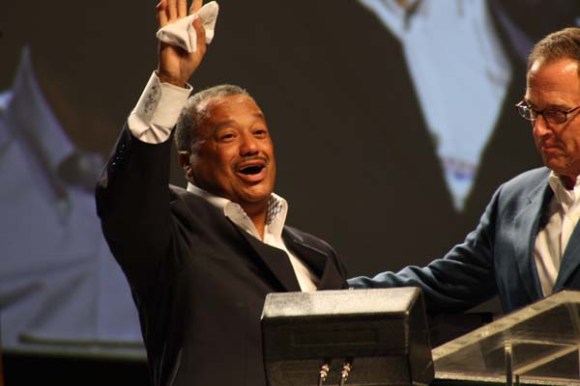
“To God be the Glory! Great things He has done! Thank you, I love you.” – SBC President Fred Luter on his election.

“To God be the Glory! Great things He has done! Thank you, I love you.” – SBC President Fred Luter on his election.

The face of the Southern Baptist Convention has changed. He’s African American, the first minority president in the denomination’s 167-year history. More important, given the challenges before him, he’s smiling. 

 Fred Luter was elected by acclamation at the annual meeting in New Orleans on June 19. He ran for the presidency of the 16-million member convention unopposed.

The denomination that was born out of a break between slave-owning Baptists in the South and northern abolitionists finished the repudiation of racism begun 16 years earlier by naming the New Orleans native, a pastor known for fiery preaching, effective leadership, and a winsome ability to work across cultural lines, as its first black president. 

“God has given me a gift in building bridges through the years, and my prayer is that, someway, somehow, I can get groups on this end [and] groups on this end…and meet together,” Luter said after his election. His diplomatic strategy, joy. 

“I love to laugh,” he told a reporter. “I love to have a good time.”

This joy in the face of adversity has seen Luter through difficult tasks before, including rebuilding Franklin Avenue Baptist Church, a large congregation decimated by Hurricane Katrina in 2005. “If anybody has joy, if anybody has peace and happiness, it should be us,” he said, referring to Christians. 

Because no other candidate ran against Luter, the convention recording secretary came to the microphone to cast the official ballot of the entire convention for Luter, but outgoing president Bryant Wright welcomed messengers to participate in the historic moment by raising their own ballots.

They did. 

And approximately 8,000 people stood to their feet for several minutes of clapping and cheering and, for many, weeping “That was such a wonderful and historic moment …. I was moved to tears of joy as were the African-American pastors I was sitting with,” said Michael Allen, pastor of Uptown Baptist Church in Chicago.   

As Bryant brought Luter to the platform on a wave of adulation, it was evident this was everyone’s decision. Now the question looms, can Luter ride this wave to bring lasting change in the denomination that faces declining membership and offerings, and the need for broader appeal in an increasingly diverse American culture. 

“I think he’ll do a great job, and I think he’ll work at trying to build up the Kingdom of God through the Southern Baptist Convention,” said Marvin Parker, pastor of Broadview Missionary Baptist Church, a large mostly African-American congregation in metro Chicago. “I expect there to be a greater outreach winning souls for Christ, I really expect a great increase because I think he’ll attract more folks with his style of preaching and all.” 

Other actions 

The 2012 convention was historic for reasons other than the barrier-breaking election. One issue that threatened to divide the convention in recent months was the prospect of a name change. 

Messengers approved “Great Commission Baptists” as a descriptor name that can be used in place of “Southern Baptists,” an adjustment many in the north and west see as necessary for effective ministry. The issue was debated on the convention floor until it passed by a narrow majority, 52.78 percent.

Chairman of the name change task force Jimmy Draper presented the recommendation to the convention. Draper told the Illinois Baptist the motivation for the informal change is “missional.” 

“We’re not going to be more evangelistic just because we have a new descriptor. But who among us could be against focusing on the Great Commission?” Draper said. “It’s something that would point us in the right direction, and would always be descriptive of who we are as Southern Baptists. We are, without apology, a Great Commission people.”

The annual meeting wasn’t the forum for debate on Reformed theology that some thought it might be, but messengers did engage in deep discussions about how people come to a saving relationship with Jesus. Alabama pastor David Platt told the stories of two active members of his church who realized they had never come to true faith in Christ. He pleaded with Southern Baptists to reexamine their understanding of repentance and belief.

“They represent a pandemic problem across contemporary Christianity, and some of you have the same story. You made a decision, prayed a prayer, signed a card, got baptized, you thought you were a Christian, you were told you were a Christian, and now you know that you were not. You were deceived.”

Platt sparked conversation about the “sinner’s prayer” months before the convention, in a YouTube video that resulted in a resolution establishing the sinner’s prayer as a biblical expression of repentance and faith. That resolution, along with another that addressed pre-convention debate between Calvinists and non-Calvinists, was recommended by the SBC Resolutions Committee to emphasize cooperation said Chairman Jimmy Scroggins. 

“Southern Baptists are going to have to agree on the essentials. We’re going to have to disagree on certain things, but what we really want to do is lock arms and fight the darkness.”

Other resolutions included statements on same-sex marriage (affirming traditional marriage while discouraging hurtful language in dealing with homosexual issues) and religious freedom (including repudiation of requirements by the Obama health care act requiring religious institutions to provide contraception and other services contrary to their beliefs as part of their employees’ insurance benefits). 

Reports by the SBC’s six seminary presidents, the heads of the International Mission Board, North American Mission Board, LifeWay, GuideStone, and the Executive Committee of the SBC were received without objection and with few questions from the messengers.

(Editor’s note: New Orleans in Rear View. Now that we’re back home, our Illinois Baptist news team reflects on the question: What is the lasting value of the 2012 SBC?)

 Posted by Meredith Flynn

David Platt, pastor of The Church at Brook Hills in Birmingham, Ala., delivers a Pastors' Conference message in New Orleans on true repentance and salvation.

David Platt, pastor of The Church at Brook Hills in Birmingham, Ala., delivers a Pastors’ Conference message in New Orleans on true repentance and salvation.

Before the convention, many (especially us press types) were buzzing about how a growing debate over Reformed theology might come up from the floor. The answer: It didn’t really pan out like we thought it might, at least in terms of a heated debate.

Instead, Pastors’ Conference speakers and panelists at some of the surrounding meetings encouraged Southern Baptists to work together, even if it means crossing theological lines. And some, most notably Alabama pastor David Platt, spoke passionately about the bigger fish we have to fry.

During his message Monday afternoon, Platt referenced a YouTube video from a message he preached at an inter-denominational conference earlier this summer. On the widely-watched video, Platt said the sinner’s prayer is a “superstitious” prayer that never appears in Scripture, and called into question some traditional evangelism methods.

In his message at the Pastors’ Conference, Platt admitted that as a young pastor, he would be wise to watch his words. But then he stayed true to what he said briefly in the video, pleading with Southern Baptists to preach the true Gospel, full of the messages of repentance, belief, discipleship, and global mission.

Two days later, after some debate on the convention floor, messengers approved a resolution upholding the “sinner’s prayer” as a biblical means to salvation.

How we lead people toward a saving knowledge of Christ, and where we find the conviction of our own salvation, is the most important conversation we can have, in my view. I’m grateful for the discussion, and look forward to watching and listening as God moves us closer to His heart for people.

(Editor’s note: New Orleans in Rear View. Now that we’re back home, our Illinois Baptist news team reflects on the question: What is the lasting value of the 2012 SBC?)

Posted by Eric Reed

Parents watch the convention proceedings from the "stroller section," a cordoned-off area for families with young children.

Parents watch the convention proceedings from the “stroller section,” a cordoned-off area for families with young children.

Descending the escalator on the final day of the convention, I watched on the floor below me as a four-year-old had a meltdown. He wasn’t alone. His sister, a couple of years younger, perched in a carrier seat atop a stroller, teared up, and eventually wailed.

I felt the same way. We were all tired. The only difference between us was, I couldn’t get away with a meltdown.

Landing at the foot of the two-story escalator, I was suddenly in a sea of small children. “Don’t run!” the father of one said futilely. “There are grown-ups here.”

Really?

Not as many grown-ups as children, it seemed at times. This was a convention of young people. Once the domain of people with hair in various shades of gray and blue, this gathering was marked by a large percentage of young adults, many of whom bought their families. (There were strollers everywhere, even a “stroller section” roped off near the platform.) And their presence was felt in all the proceedings of the convention.

Perhaps the Pastors Conference foreshadowed a shift we should notice. Opening on Fathers Day, the line-up included sons introducing their better-known fathers as conference speakers. “Dad’s gonna bring the heat!” one son said before his father preached. But in one notable reversal, it was the father, a former convention president, who introduced his up-and-coming son. There was a changing of the guard, it seemed.

The most challenging and emotionally gripping moments among the pre-meeting sermons came from the youngest preacher, in his early 30s.

The debate over use of “the sinner’s prayer” started with young people, as an older generation’s tried and accepted method is challenged. 

And it is young people who raised debate over Reformed theology and Calvinism. A young pastor (age 40, son of a past SBC president) drafted a response and coined the phrase “Traditionalists” to describe his (and many elders’) Southern Baptist theology.

Many messengers speaking from the floor mics during the business sessions were younger pastors. 

This emergence of young people in SBC life was clearest at the Baptist 21 panel discussion (and turkey po-boy lunch). “21” in the name refers to 21st century, but it might have characterized their age. Fully half the people in the SRO crowd of nearly 1,000 were in their 20s and 30s.

For watching the panel discussion, the Conservative Resurgence of the 1980s was ancient history. Like WW2. Many of them were not born at the time today’s senior convention leaders stopped what they described as a left-leaning drift and returned the denomination to biblical inerrancy. For these young people, Judge Paul Pressler and Dr. Paige Patterson are historical figures to be honored (which they were at the luncheon).

For a few minutes in New Orleans, the convention’s past met its future. And it was clear in that moment that this is not your grandfather’s SBC.

Or even your father’s.

It belongs to the kids.