Archives For November 30, 1999

Former SBC president to head Executive Committee

By Meredith Flynn

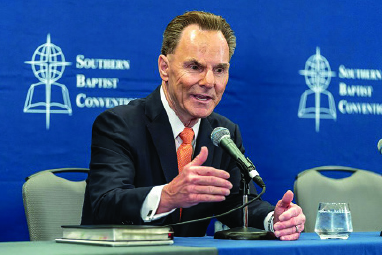
Ronnie Floyd BP

When Ronnie Floyd began his tenure as president and CEO of the Southern Baptist Executive Committee this month, he immediately became a key piece of how the denomination will respond to major challenges: preventing sexual abuse in churches and caring for survivors; building leadership that reflects the diversity of Southern Baptist churches; and reigniting a passion for evangelism amid years of declining baptisms and church membership.

The search team that nominated Floyd, 63, chose him because of his decades of leadership and his vision for the SBC. They’re counting on the longtime pastor’s experience to help the SBC navigate challenges, now and in the future.

“We needed a proven leader,” said Adron Robinson, pastor of Hillcrest Baptist Church in Country Club Hills and president of IBSA. Robinson, who also serves as one of Illinois’ two representatives on the Executive Committee, was vice chairman of the search committee. He noted Floyd’s decades of pastoring a vibrant, baptizing, church-planting church.“That type of sustained leadership of a healthy ministry said a lot about his leadership capacity.”

Floyd, who was elected April 2 by a vote of 68-1, pastored Cross Church in northwest Arkansas for 33 years. He is a former president of the Southern Baptist Convention (2014-2016), and also chaired the Great Commission Task Force (2009-2010) and the Executive Committee (1995-1997). He succeeds Frank Page as head of the Executive Committee. Page resigned in March 2018 after confessing a morally inappropriate relationship.

The search team believed Floyd’s experience is needed now, Robinson said, as the SBC addresses sexual abuse and tries to help churches care well for victims and prevent future incidences. A February report in the Houston Chronicle detailed hundreds of cases of sexual abuse involving Southern Baptist church leaders and volunteers.

“It’s ungodly, it’s sinful, it’s criminal and obviously we would be against it,” Floyd said during post-election meetings with various Baptist leaders and groups. “But how we get to the common path of what we do, that has become the issue.”

In February, the Executive Committee approved an amendment to the SBC Constitution that would designate churches that exhibit indifference toward sexual abuse to be not in friendly cooperation with the SBC. To become part of the Constitution, messengers to the 2019 and 2020 SBC annual meetings must approve the ammendment by a two-thirds majority.

In a Facebook Live session following his election, Floyd said Southern Baptists seem poised to unite at the 2019 SBC annual meeting in Birmingham, Ala., and make “as declarative a statement as we can make to our culture about what we believe about this issue” of sexual abuse.

‘Balanced bullpen’
Floyd’s experience as an SBC leader and megachurch pastor made his nomination unsurprising to many discussing the nearly year-long process online. But the men tapped to fill recent leadership posts are Gen X-ers, and some are associated with more Reformed theology. Floyd is neither, which Robinson said should give the SBC a “balanced bullpen” of leadership.

“I think it’s good to have a diversity of leadership styles: Reformed, traditional, Calvinist, and non-Calvinist, and we all need to work together for the glory of God.”

At a press conference following his election, Floyd acknowledged his years of experience in his response to a question, posed by the Illinois Baptist, about the generational differences between him and other current leaders. “The search committee felt they needed a seasoned leader for such a time as this in Southern Baptist life,” Floyd said.

At this time, only two of five key vacancies in SBC leadership remain unfilled. Paul Chitwood, 46, was named president of the International Mission Board in November, and Adam Greenway, 41, assumed leadership of Southwestern Baptist Theological Seminary in February. Search committees are seeking leaders for New Orleans Baptist Theological Seminary following the retirement of Chuck Kelley, 66, and LifeWay Christian Resources, whose president, Thom Rainer, 63, left in February.

Robinson said the vision Floyd presented for the SBC is “multigenerational, multiethnic, and multilingual.” At the 2015 Southern Baptist Convention in Columbus, Ohio, then-SBC President Floyd gathered pastors and leaders from multiple ethnic groups to pray corporately for racial reconciliation. The next year, he invited National Baptist Convention President Jerry Young and other leaders to engage in a panel discussion on racial unity in America.

His frequent communication with Baptists through blog posts and social media was a hallmark of Floyd’s SBC presidency, and Robinson said that will continue as Floyd assumes his new role.

“I think that’s going to be part of his mission, to get the story of the SBC out to the rest of the world. To highlight the things we’re doing well, so that we’re not just known for what we’re against, but what we’re for, and what we’re doing to fulfill the Great Commission.”

That charge to make disciples of all nations—given by Jesus to his followers in Matthew 28:19-20—is the “missional vision” of Southern Baptists, Floyd said after his election. “It will be to that end, that end of reaching the world that I will give my life…in this next season—100 percent, from before daylight until exhaustion, until Jesus comes or until he calls me home.”

– Meredith Flynn, with reporting from Baptist Press

Trusting God in dark days

Lisa Misner —  April 11, 2019

By Adron Robinson

Read: Psalm 25

When facing the dark days of life, to whom can you trust your soul?

We don’t know the exact circumstances of this psalm, but we know that David wrote it at a time when he was being attacked by his enemies. The attacks left him isolated from friends, hated by foes, and discouraged in heart. Yet, in one of the darkest times of his life, David made up his mind to trust in God.

Because God alone is able to deliver him from his enemies, David pleads for the Lord to save him from the shame of defeat (Ps. 25:1-3). David knows that God has a track record of faithfulness, so he puts his soul in the hands of the only one whom he could trust.
Next, David prays that God will direct him (vv. 4-15). He asks God to lead him into his divine will, while releasing him from the snare of his enemies.

David’s prayer is for God to reveal his will so that David can pursue God’s will. David doesn’t want to live outside of God’s will, so he asks God to order his steps. And on our dark days, we should pray the same way. David Livingstone once said, “I’d rather be in the heart of Africa in the will of God than on the throne of England out of the will of God.”

Finally, David prays for God to defend him from his enemies (vv. 16-25). In his darkest days, David asks God to guard his life and rescue him from his enemies. He places his faith in God to be his refuge. Out of gratitude for all God did, David is determined to live with integrity and uprightness.

When dark days come, don’t turn from God, turn to God. He alone is faithful to protect your soul.

Prayer Prompt: God, thank you for being the always faithful presence in our lives. May we turn to you on our darkest days, and may you lead us in the way everlasting.

Adron Robinson pastors Hillcrest Baptist Church in Country Club Hills and is president of IBSA.

There are two kinds of worship interruptions, said IBSA’s director of worship and technology Steve Hamrick—avoidable and unavoidable. Some interruptions just can’t be helped—the power goes out, a baby cries, or someone in the audience forgets to turn off their phone. But most worship interruptions, Hamrick said, can be avoided with effective planning.

“Worship interruptions are things that happen in corporate worship that distract people from the gospel and from connecting with Christ,” Hamrick said. Could it be spiritual warfare? “Yes, but often it’s poor planning.”

Hamrick offered these ideas for avoiding worship interruptions:

1. Pray for the people leading worship and for the congregation.

2. Plan. What gear is needed for the worship service? What special logistics or set-up are needed to make it work? Communicate those needs with staff and volunteers.

3. Predict. What interruptions could happen? What has happened in the past, and how can you avoid the same challenges?

4. Prepare. Know your worship plan. Work through transitions, and think through technology, video, lighting, and print materials. Create a worship checklist with needs and special circumstances for the different worship elements.

5. Practice with the technology you plan to use, including sound, video, and lighting. Approach practice as if it’s a real worship experience (and it should be).

6. Present (perform) and trust God with the results.

Worship leaders can also prepare in advance by creating an environment that encourages success for the whole team. Hamrick advises leaders to communicate the importance of each team member’s ministry by creating job descriptions for individual roles.

Avoid overwhelming your team by recruiting multiple people to work on a single service. For example, one works at the desk while someone else produces (listening, advising, and looking ahead to what happens next). Resist having one person run sound and video at the same time, if possible.

Finally, Hamrick said, handle interruptions with grace. They’re inevitable, and the tech team likely will be the first to recognize the problem.

Sign up for IBSA’s online Resource Center at IBSA.org.

In times of crisis, this heady Christian doctrine can become deeply personal—and reassuring.

By Eric Reed

Empty tomb

The empty tomb. Pastor Jon McDonald of First Baptist Church of Casey led a tour of Israel in January. His wife, Lindsay, is a gifted professional photographer. She shared from her album some scenes that serve to illustrate this article.

Prologue
May I tell you a secret? When I close my eyes, I still see my wife on her deathbed.

Please stay with me. This article gets much more upbeat soon, but I have to start at this point so you will know why resurrection is so important to me right now. And it’s not because I want to get a jump start on the Easter celebrations. My need to understand resurrection has become very personal.

It’s been five months since my wife died. We spent her last three weeks in Room 101 at the hospice here in town. When I close my eyes, I sometimes—make that often—see her laying on the hospital bed in silhouette against the window. Each day as the sun passed over the building toward her west-facing window, the outside light would become quite bright. And I, sitting on the opposite side of the bed in a vinyl chair, would stare at her, and beyond her into sunlight.

I can muster other scenes from those weeks: Her sister sitting on the sofa under the window texting relatives. Our dog coming for a visit. Friends praying and doing their best to cheer us. One couple bringing a guitar and my wife singing hymns from memory, even third verses, when she was unable to say much else.

And I can see the night when I played Gaither songs on YouTube, and during “We Shall Behold Him,” my wife lifted both arms upward and pointed. “What do you see?” I asked. “A glimpse of heaven? Your mother?” Eyes closed, she nodded. She was eager to see her mother and old friends from the church where she grew up.

Then she lowered her arms and clasped her hands together. “Do you want me to pray?”
She nodded.

I prayed kind of like Jesus prayed on the cross at the very end, commending her spirit to the Father.

From that time, she hardly moved. I sat there for most of two days waiting for her body to catch up with her soul, staring across her prone figure into the light.
That’s the image I see.

That’s why resurrection has become not just a doctrine, but an urgency to me. The Resurrection of Jesus? Certainly. What is our faith without it? But also my wife’s resurrection, and my own. Whole libraries have been written on the Resurrection of Jesus, but relatively little on the resurrection of believers, and even less about resurrection as a necessary present-time action.

For me this year, Easter is not just a happy dance outside an empty grave, but a time of seeking earnestly the assurance of things to come, the affirmation of reunion, and a down payment on glory. In the meantime, resurrection—not as a future event, but here and now—becomes enough to get us through the here and now.

If you’ve wondered whether you can make it through today, much less tomorrow, then join me as we think about resurrection.

Gethsemane

Gethsemane

One word changes everything
Weeping outside her brother’s tomb, Martha insisted that if Jesus had hurried on, Lazarus would still be alive. His first words to her were cold comfort. Her response to the promise that Lazarus would rise again seems to be more a protest than an affirmation. “I know that he will rise again in the resurrection on the last day,” she said. But she was more concerned about the present day.

Jesus’ reply turns her to the truth standing before her: “I am the resurrection and the life. Whoever believes in me, though he dies, yet shall he live, and everyone who believes in me shall never die. Do you believe this?”

If the religious leaders standing there in the cemetery heard Martha’s statement, some would have applauded, others would have shaken their heads. The Pharisees believed the righteous dead would be raised at the end, while the Sadducees argued there was no resurrection at all.

Martha’s reply hinges not on the teachings of the major schools of Jewish thought, but on the words that Jesus has just applied to himself. He is life (zoe in Greek), and he is the very thing that guarantees life.

A friend of mine phoned across the country to tell his parents their grandchild had been born, a beautiful baby they called Anastasia. The proud dad heard his own father, a seminary professor, laughing from a thousand miles away.

“Well, son,” the older man said, “that little girl will always stand up to you. And no one will ever back her down.” He chuckled some more. “You named her anastasis, the Greek word meaning to stand up again.”

When Jesus called on Lazarus to come out of the tomb, Martha and Mary and the crowd around them saw anastasis in action. Lazarus stood up again.

More important, that’s what Jesus did soon after at his own Resurrection—stand up again. It’s a simple phrasing for a complex event: anastasis describes plainly the pivotal point in history, for, as one observer said, without the Resurrection of Jesus, Christianity is quite literally dead.

The Father calls, Arise! and Jesus stands up. The One who lay down his life for our sake takes it up again and emerges from the place of death into life everlasting. As he does, Jesus proves to the world that he is the Christ.

Resurrection is proof that Jesus is alive. So much for claims that robbers stole his body: The grave was sealed and guarded. So much for the swoon theory: Jesus didn’t pass out, he died. The soldier’s gash in Jesus’ side proved it, as water separated from blood gushed out. And if more proof were needed, the grave clothes were still in the grave, and the head cloth was neatly wrapped and laid aside by one who sat up, stood up, and no longer needed it. So much for mouldering in the grave: He is not here, he is risen!

Jesus’ declaration that he is the resurrection was proven on Resurrection morning. But the question of what that means in our hour of need remains.

A down payment on our future
Baptists are not a creedal people, so not many of our churches recite the Apostles’ Creed on a regular basis. Yet, we find in those summaries of the Christian faith a statement that the early church fathers felt was crucial to their belief in Jesus: “I believe in…the resurrection of the body…” Likewise, the Nicene Creed lists “resurrection of the dead.”

From the fourth century onward, believers needed to state aloud, along with their systematic beliefs about the Father, Son, and Holy Spirit, their own hope for themselves. This was true in a largely illiterate culture, so leaders built the statements into the worship services. This was a necessary response to various movements in the early centuries of the church that denied or misconstrued the deity of Jesus, and belittled the future hopes of his followers.

“Jesus was raised from the dead, and we will be too!” If the worship service had been a pep rally, that would have been the cheer, starting in 325 A.D.

This simple statement affirming the resurrection is based on verses in the Gospels and Epistles, of which Paul’s masterwork is 1 Corinthians 15. What the apostle says briefly in Romans 6:5—“For if we have been united with him in a death like his, we shall certainly be united with him in a resurrection like his”—is unpacked in 58 verses to the Corinth church.

You can’t blame the Christians in Corinth for sounding a little selfish. “We believe in Jesus,” they might have said, “but what’s going to happen to us?”

Paul reminds them that his teaching about Jesus is of “first importance”—“that Christ died for our sins in accordance with the Scriptures, that he was buried, that he was raised on the third day…” (1 Cor. 15:3-4). Whatever they may understand about their own coming resurrection is based on Jesus’ resurrection. Paul calls him the “first fruits” of the believers, in the same way that the first grains of the harvest forecast much more to come. (Around here, we would be more likely to talk about the first ripe tomato of summer or the first ear of corn.) There is such joy when the first fruits come in, because it’s only the beginning of harvest season and celebration.

Paul continues the agricultural imagery.

“‘How are the dead raised? With what kind of body do they come?’….What you sow does not come to life unless it dies. And what you sow is not the body that is to be, but a bare kernel, perhaps of wheat or of some other grain. But God gives it a body as he has chosen, and to each kind of seed its own body….So is it with the resurrection of the dead. What is sown is perishable; what is raised is imperishable. It is sown in dishonor; it is raised in glory. It is sown in weakness; it is raised in power” (vv. 35-38, 42-43).

“The analogy of the seed enables Paul to walk a fine line,” scholar Richard Hays wrote, “asserting both the radical transformation of the body in its resurrected state and yet its organic continuity with the mortal body that precedes it.”
That should be good news to us.

Sea of Galilee

Sea of Galilee

Will I know my mother?
In her final week, I asked my wife again if she was scared. Of death itself? “No,” she responded, “but dying is coming quicker than I expected, and dying isn’t so easy.” She knew that her faith in Jesus as Savior would see her through to heaven, “but,” she said, “will I know my mother?”

I was surprised by that question. I thought she knew that for certain, but now she needed reassurance. I rifled through my pastoral answers: Paul says, “For now we see through a glass, darkly; but then face to face: now I know in part; but then shall I know even as also I am known” (1 Cor. 13:12 KJV).

  • Mary recognized Jesus after his Resurrection when he spoke to her. The pair walking on the road to Emmaus recognized Jesus. He was somehow changed, but he was still Jesus.
  • Thomas saw Jesus a week after his first appearance to the disciples. Meeting them a second time in the upper room, the scars showed that his glorified body was still his body. In some way it was still his earthly body—changed, transformed, glorified, but still his.
  • From his boat, Peter saw Jesus at a distance barbequing a beachside breakfast. Realizing who it was, Peter jumped into the water to swim to him, and left the others to row the boat in.

In these scenes from Easter morning forward, we see that resurrection—his and ours—proves God cares about the person and our personhood. He’s not just keeping the ethereal, spirit-y part of us, but he promises the preservation of all that makes us us. The questions that come up about the deceased whose bodies are destroyed or lost or cremated are rendered irrelevant by these truths: We are all made of dust and to dust we will return, but God has promised to this dust that it will stand again. In the biblical examples we have, the person was known by those who saw him. Organic continuity.

My wife wanted to hear that. “Will I know my mother in heaven?” was a way of saying, Will Mom still be Mom? Will I still be me?

Frankly, it was a word I needed too. I needed assurance that at the resurrection of the dead, a body ravaged by cancer is somehow transformed into something immortal and incorruptible and glorious. God promises to raise us from the dead, preserves yet transforms us, and that action assures us we will be together again.

When and how, we don’t know for sure, but we’re sure it’s coming. And like my wife said, it seems to be coming more quickly than I expected.

“For the Lord himself will descend from heaven with a cry of command, with the voice of an archangel, and with the sound of the trumpet of God. And the dead in Christ will rise first. Then we who are alive, who are left, will be caught up together with them in the clouds to meet the Lord in the air, and so we will always be with the Lord” (1 Thessalonians 4:16-17).

As if there was any doubt. “I will arise and go to Jesus; he will embrace me in his arms,” the hymnwriter said. Or as Paul concluded his Thessalonian note: “Therefore encourage one another with these words.”

The Resurrection of Jesus foretells the resurrection of his followers. For me in recent months, that has proven to be a powerful, bankable promise from God. (See Philippians 3:10-11.) But what about the meantime? What does resurrection mean to us right now?

Baptism

The River Jordan

Throw some wood on the fire
Let’s be careful that this article doesn’t take a sharp, unwarranted turn at this point. That said, here is a road we should go down, if only briefly.
With Christ’s resurrection on one end of the timeline, and the promise of our own on the other end, what’s in the middle? I find an answer in that word we most often translate as resurrection: anastasis.

Literally the word means “stand up!” While linked theologically to life after death in many New Testament uses, it’s also a simple command to those who are sitting, resting, or, perhaps, lollygagging.

  • When Jesus called Matthew to be his disciple, the tax collector “arose” and followed him (Matthew 9:9).
  • Jesus told Jairus’s little girl to get up from her deathbed and she “arose” (Mark 5:42).
  • Jesus said the prodigal son came to his senses and “arose” to go to his father (Luke 15:18, 20).
  • Jesus told the one healed leper who returned to give thanks to “arise” and go his way (Luke 17:19).
  • The Holy Spirit told Philip to “arise” and head south for his divine appointment to share the gospel with the Ethiopian eunuch (Acts 8:26).
  • And on the road to Damascus, Jesus commanded Paul to “arise” and go into the city for further instructions (Acts 9:6).

For those mired in grief, daydreaming about what might be, or lamenting what never was, this imperative is a big help. Stand up. In other words, until that final morning when we all stand up, there’s a lot of daily getting up to do and serving to fulfill Jesus’ mission.

There’s a lot of work to be done.

I’m still thinking about a story Pastor Ralph Schultz of Fieldon Baptist Church told at the Sandy Creek Association’s fall meeting. When he was a teenager, his family home was heated by a wood stove. Just before bedtime, his father would stoke the fire to keep the house warm overnight. Ralph would be snug in his bed and sleep soundly for several hours, but as morning approached, he would discover he was awake and thinking, “Someone needs to throw some wood on the fire.”

In a few minutes, Ralph’s father would call out from his own bedroom, “Son, get up and throw a log on the fire!”

“The house was cold, we needed someone to throw some wood on the fire,” Ralph said, “and I realized that ‘someone’ was me.”

Anastasis.

Epilogue
Maundy Thursday will mark six months since my wife died. On that day before Good Friday, I will retire some of my small grief rituals. Soon afterward, the dog and I will move to a new house in hopes of creating some fresh memories. And on Resurrection Sunday, I will arise and run with the disciples to the empty tomb, then beyond, seeking the Risen Savior.

“He is not here, he is risen,” I will hear.

And one day, by God’s grace, we will be risen too.

Eric Reed is editor of Illinois Baptist media and IBSA’s associate executive director for Church Communications.

By Whitman H. Brisky

red leaves church steeple

What happens to church property when most of its members depart, leaving only an unpopular pastor and a few of his close friends and family to determine its use? Unfortunately, in all too many cases, the congregation essentially shuts down as an active ministry, converts the property to cash, and then pays the remaining funds to (or for the benefit of) the pastor. Frequently the money is paid out as salary for doing very little since the congregation is now defunct. Even worse, in some situations we have seen, the pastor seems to deliberately drive the bulk of the congregation away so that he can sell the property for his own personal benefit without having to account for the money.

We are even aware of an example where a single minister became pastor of three separate congregations and drove the members of all three away leaving him with the property. While this situation would normally not occur in denominations with relatively strong connections because the denomination would step in, it is all too common among independent congregations and in denominations with much looser structures.

Whether the pastor is truly a wolf in shepherd’s clothing, intentionally driving most of his congregation away so that he can profit personally from the sale of the property, or simply a poor pastor, the result is the same: the destruction of a congregation, the sale of church property often for secular use, and the waste of assets which should be used to build the Kingdom.

What can Christian lay people do to avoid this kind of situation in their own congregations? First, build strong, independent lay leadership for the congregation and resist attempts by the pastor to “pack” the board with his own supporters. This will ensure that there is a strong independent board to check the pastor, offer guidance if he seems to be taking a wrong path, and if necessary, initiate the pastor’s removal.

The second way congregations can help prevent this kind of situation is to exercise great care in selecting a pastor. This should include a careful check of his background and prior employment. Frequently these wolves in shepherd’s clothing move from church to church, repeating the process multiple times. A call committee should be very reluctant to hire a candidate who has left his prior church worse off than when he arrived. It would be wise to talk to some people who left the candidate’s prior church to find out why they left.

Third, the church’s bylaws should be reviewed and updated to ensure that a pastor, with or without a compliant board, could not use parliamentary tricks and super majority requirements to prevent the majority of a congregation from supervising or removing an unpopular or incompetent pastor. The bylaws should not allow a pastor to unilaterally remove anyone from membership or limit a member’s voting power.

Fourth, there should be a written contract with each pastor not only detailing the compensation and other benefits he will receive, but also specifying what he is expected to do and the conditions under which he can be terminated. This ensures that a civil court can and will enforce decisions which are consistent with that contract.

And lastly, make sure that the church treasurer, and other people charged with handling the money of the church, are independent of the pastor and that their work is independently reviewed (preferably by a third party accountant) to ensure that financial transactions are properly recorded.

Taking these common sense steps will not only help avoid the wolf in shepherd’s clothing, but also strengthen the church congregation generally—particularly its lay leadership, which can also lead to more effective evangelism and ministry. Even if you already have a wolf in shepherd’s clothing, it might not be too late. You should contact an attorney experienced in handling these matters before you walk away from a congregation.

The firm offers a free newsletter on religious liberty issues at www.mauckbaker.com.

Whitman H. Brisky is a partner with the Chicago-based law firm of Mauck & Baker, which handles cases involving churches and religious liberty. He has practiced law in Illinois since 1975, after graduating from the Northwestern University School of Law in Chicago. He frequently represents churches and pastors, and is an ally with Alliance Defending Freedom (ADF). According to his company biography, Brisky was brought to the Lord after wandering into a Presbyterian church where the pastor preached a sermon entitled “Has Anyone Been Saved Here Lately?” At the end of the service Brisky could respond enthusiastically, “Yes, me!”


By Andrew Woodrow

Chatham bakers

Volunteers serving in Chatham baked cookies for first responders.

Hundreds of young volunteers scattered across Illinois March 9 for a day of hands-on mission projects. IBSA’s annual Children’s Mission Day sent kids around the state to serve by baking cookies for first responders, visiting with residents at assisted living facilities, helping at local food banks, and dozens more projects.

At Chatham Baptist Church, nearly 70 children from six different churches gathered before heading to their project sites. Missy Doyle has organized Children’s Mission Day in the Springfield area for the past two years. As a former missionary, its value goes beyond helping children serve for one day. It’s about teaching the children the value and purpose of ministry.

“Missions is very close to my heart,” said Doyle, who serves as president-elect of Illinois Woman’s Missionary Union and is the wife of IBSA’s Dwayne Doyle. “And while what these kids do may seem small on a grand scale, it can spark a greater ministry. If we can get these kids to start thinking about missions at an early age, I’m all for it.”

That vision is why Woodland Baptist Church in Peoria has participated in Children’s Mission Day for the past five years. “Our church values missions,” said volunteer Laura Lee. “And it’s important for us to teach our kids to learn about it too—to learn about serving others, and getting a chance to see others who have different challenges than what they experience in their own lives.”

When they’re given a chance to serve others, kids enjoy it, said Jerry Weber, associate pastor at Chatham Baptist. “This gives the kids an opportunity to see life a little differently.”

After they finished their projects, the kids came back to the church and had an opportunity to share with each other what the day meant to them. Many said it taught them how to be kind, how to show Jesus’ love, and how to help others. Others said they discovered that people appreciated their service.

Doyle said she even heard people talking about taking Children’s Missions Day back home. “If we can drive an hour to do this here, then we can certainly do this in our own community as well,” one volunteer said.

“One baby step at a time,” Doyle said. “What we want these kids to see here is that they can emulate similar ministries in their own city or neighborhood. It builds from there. And the vision grows over the years to the point that they can share the gospel with whomever they meet.”

For more information about resources and events for children, go to IBSA.org/Kids.

Children’s Mission Day, March 2019 from IL Baptist State Association on Vimeo.


It’s been 10 years since the murder of Maryville First Baptist’s Pastor Fred Winters. Illinois Baptists were shocked when the beloved pastor was gunned down while preaching the Sunday morning message from the pulpit.

Serving on the IBSA staff, I first got to know Pastor Fred when he served two terms as IBSA vice president and then another two as president. He was always easy going and willing to answer questions for articles in the Illinois Baptist. I remember running into him and his wife, Cindy, one year at the Southern Baptist Convention where they were planning to hand out water to gay rights supporters protesting the convention. He talked about how it would be a good way to show Christ’s love.

First Baptist Maryville recently held a memorial service to mark the anniversary of his death. I was among the hundreds who attended the service, looking on as old friends came together to remember the pastor who grew the church from 35 to over 1,200. Illinois pastors have often said how Pastor Fred’s teaching from his experience “breaking the barriers” enabled them to grow stronger churches. Fred was always willing to share of his experience and himself.

In video testimonies, friends, church members, and former staff bore witness to the difference Pastor Fred had made in their lives, how his burden for the lost became their burden for the lost, how his vision became their vision.

The most poignant moment of the evening came when Cindy addressed the assembly. She shared how she and her daughters, with God’s help, journeyed through their grief and continue to do so. Their faith has been made stronger having learned not to give up.

Still, she likened the evening to biting into a chocolate tomato—“sweet at first on the outside and kind of sour and bitter on the inside.” Such a strange comparison and yet, such a truism. Isn’t that how we all feel in some way? Not only about Pastor Fred, but our own lost loved ones remembered? Whether through death, divorce, separation, or other kinds of loss, what a taste remembrance can leave in your mouth.

Winters’s life and legacy of faith was worthy of celebration. At the end of the service, it was easy to imagine Pastor Fred among the great cloud of witnesses in Hebrews 12, cheering Illinois Baptists on as they run the race sharing Christ with their friends and neighbors just like he did.

Final walks

Lisa Misner —  March 25, 2019

Beth and WillyBy Nate Adams

We adopted our dog Willy as a scraggly shelter puppy eight years ago. Our veterinarian looked him over during his first visit and said, “This little guy looks like he was made out of spare parts.” Willy was never very coordinated, and one eye didn’t work very well, if at all. At 17 months, when his other eye suffered a detached retina, he became completely blind.

I’ve admitted many times since then that my first thought was to look for a money-back guarantee from the shelter. I wasn’t sure we wanted a dog that couldn’t see a ball, much less catch one.

But I married a tender-hearted, compassionate wife who immediately declared that Willy needed us. Her grace gave him value, and he has continued to be a sweet and obedient companion to our family since that day. He is my wife’s prayer walking partner. He’s her conversation starter and relationship builder with our neighbors. And occasionally, he’s even a sermon illustration for me.

Now, six and a half years later, the vet tells us that Willy is in his last days. Each time Beth or I head out the door with him, we know it is one of our final walks.

But Willy doesn’t seem to have a clue about his mortality. Though his appetite and energy are fading, he slowly rises and follows us wherever we are in the house. He walks as well as he can when we take him outside. He asks for attention with his paw when he needs something. And he seems completely content just to be with us.

Nearing death is a sobering thing to think about, at least for those who don’t feel they’re nearing it yet. I remember as a young boy accompanying my dad to a nursing home each Sunday afternoon. I was learning to play the piano, and our church had a portable keyboard that I thought was cool. So I would play songs for the residents to sing, and then my dad would share a brief devotional.

At the time, I guess I wondered why we bothered to go, or why the people there bothered to come and listen. Some of them didn’t sing. Some didn’t seem to be able to walk, or even to talk. They just smiled at me while I played, or closed their eyes and nodded their heads. Many were eager to speak to me before we left each week, and to thank me for coming, maybe even more than they thanked my dad. But he didn’t seem to mind. He told me most of them didn’t have little boys that could visit very often.

Willy has taught or reminded me of many spiritual truths during his brief life. Though he is extremely limited in what he can offer in return for our care, he loves us and wants to be near us. He’s obedient, and sweet-spirited. He follows very close to us, wherever we go and whatever we ask him to do.

And now, as we go on our final walks with Willy, he has caused me to remember some anonymous, sweet, devoted saints from my boyhood. Though they too were very limited physically, they still lived each day knowing and loving their Master, wanting to be near him and to obey him, and smiling at the little boys he sent, who were learning to play the piano.

I hope that during my own final, frail walks with my Master I will be able to love and serve him with the devotion of the faithful, elderly saints I have now known throughout my life. I will be grateful if I can simply imitate the devotion of a blind dog named Willy, who somehow understood he was rescued by grace, and therefore walked faithfully with his Master.

Nate Adams is executive director of the Illinois Baptist State Association. Respond at IllinoisBaptist@IBSA.org.

Divine disobedience

Lisa Misner —  March 21, 2019

By Adron Robinson

Read: Acts 4:13-22

What do you do when obeying the Word of God means disobeying human governments and authorities? That is the question Peter and John faced. When commanded by the Sanhedrin, the religious and cultural leaders of their day, to disobey the Word of God, they responded with divine disobedience. “Whether it is right in the sight of God to listen to you rather than to God, you must judge, for we cannot but speak of what we have seen and heard” (Acts 4:19–20 ESV).

Like Peter and John, the church is called to follow in the footsteps of our Lord, to stand up and speak truth to a culture that seeks to quiet the voice of God and impede the Kingdom of God. We must follow in the countercultural footsteps of Jesus and transform our culture for the glory of God. When the world commands us to keep quiet, we are to stand on the Word of God and be a witness to a watching world.

This divine disobedience is not a 21st- century idea or a first-century idea. It is part of the character and calling of the children of God. When the Hebrew midwives defied Pharaoh’s order to abort the Hebrew babies, that was divine disobedience. When Shadrach, Meshach, and Abednego refused to worship Nebuchadnezzar’s idol and were tossed into the fiery furnace, that was divine disobedience.

There are recent examples. When Harriet Tubman launched the Underground Railroad to free slaves, that was divine disobedience. When Rosa Parks refused to give up her seat on the bus, that was divine disobedience.

Dr. Martin Luther King Jr. said: “One has not only a legal, but a moral responsibility to obey just laws. Conversely, one has a moral responsibility to disobey unjust laws.” Throughout history, the people of God have practiced divine disobedience, because we are called to obey the laws of God, even if it means disobeying the laws of man.

Prayer Prompt: Father God, you have called the church to be your witness to the world. Give us holy boldness to stand on your Word, when the world tries to pressure us into disobedience. Help us Father to fight against abortion, racism, injustice, and every evil of this culture by living out the gospel to a dying world that needs the good news of Jesus Christ.

Adron Robinson pastors Hillcrest Baptist Church in Country Club Hills and is president of IBSA.

A month for baptisms

Lisa Misner —  March 18, 2019

The countdown is on for spring evangelism emphasis

A time to pray 2

Churches across Illinois and the SBC will focus this spring on praying for people who don’t know Christ. Last year, IBSA churches (including Staunton’s Net Community Church, seen in this file photo) baptized more than 650 people during a statewide emphasis.

March signals a new season, and in many IBSA churches, a new opportunity to focus on evangelism leading up to Easter.

Last year, One GRAND Sunday resulted in more than 650 baptisms during the Easter season. This year, IBSA’s Pat Pajak is asking churches to celebrate One GRAND Month in April, preceded by 30 days of prayer for people who don’t know Christ.

“Eight out of 10 unsaved people say they are open to a gospel conversation,” said Pajak, associate executive director for evangelism. “And research tells us that four out of five will come to an Easter service if someone will invite them.”

Pajak is urging Illinois Baptists to spend March praying for one person who doesn’t know Christ, and to begin thinking about how to invite them to an Easter service. The singular prayer emphasis is part of “Who’s Your One?” an emphasis across the Southern Baptist Convention urging every Christian to share the gospel with one person this year.

“While almost every believer knows that the Great Commission instructs us to make disciples, and we are willing to obey the teachings and instructions found in God’s Word, far too many Christians have forsaken the responsibility of witnessing and left it to be done by others,” Pajak said.

“Who’s Your One?” employs what Pajak has called an “each one reach one” strategy. “It can be done anywhere, anytime, with anyone,” he said. “The idea is listening and looking for the right opportunity to turn an everyday conversation into a gospel presentation.”

At WhosYourOne.com, pastors and church members can access free resources, including a guide to 30 days of prayer for people who need to hear the gospel.

For April, Pajak suggested a week by week schedule to maximize Easter impact:

April 7: Invite church members to write the name of one person they plan to invite to an Easter service on a 3×5 card (passed out with the bulletins). At the end of the service, invite the entire church to come forward and place their cards on the altar and join together in a time of corporate prayer—asking the Lord to move the people on the cards to respond to an Easter invitation. Leave the cards. The pastor or staff can gather them and pray for the people for the remainder of that week.

April 14: Write out a personal invitation and include an Easter service promo flyer or card. Mail it to the person you’ve been praying for and planning to invite. If you are going to provide a ride or an after-church meal, tell them in the invitation and ask for an RSVP.

April 21: Get ready for a great Easter Sunday! If the person you invited doesn’t have a Bible, surprise them with one as a gift and perhaps deliver it on Saturday, so they will be able to bring it to church with them on Easter Sunday.

April 28: If the person you invited made a decision to follow the Lord, encourage them to be baptized along with others on the Sunday following Easter (churches can also consider offering baptism all four Sundays in April). Make it a real celebration! Invite them out to lunch after the service and let them know you are available to walk with them in their new faith. Be sure to help them get enrolled in a Sunday school class or small group.

For more information about One GRAND Month, go to IBSA.org/Evangelism.