Archives For November 30, 1999

If mission team members could share Christ in London, we can share Christ here at home.

If mission team members could share Christ in London, we can share Christ here at home.

HEARTLAND | Serena Butler

One of the questions we ask of mission trip applicants is, “Why do you want to go on this trip?” Someone once asked me, “Why do you take people on mission trips?” I could provide a couple of answers. One might be to expose people to a different culture and learn that there are fellow Christ-followers living in other parts of the world. Another might be so that we can take the Gospel to a location that does not have as much access to the Gospel as we do here in the United States. Yet another is to challenge the participants to rely on God like they have never done before.

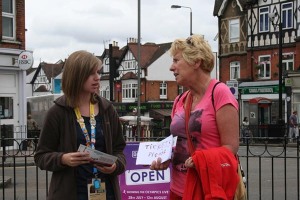
One of the purposes of our trip to London was to expose the participants to evangelism techniques they could bring home with them and use in their own community. Sometimes we are willing to try new things on a mission trip because it is all a part of the adventure. We will stand in a busy train station and ask people if they are willing to take a survey, with the goal of leading them into a spiritual conversation, but we would not do that at home. Would we transform our sanctuary into a coffee-house for the purpose of reaching out to our community and walk every street in our town to personally invite each resident to attend that coffee-house? I don’t know, but I know the members of Southfields Baptist Church did that in preparation for the London Olympics. I was challenged by their determination.

Southfields Church is just a 15-minute walk from the front gates of the All England Lawn Tennis Club, home to Wimbledon. It is also a stone’s throw from the main Tube (London’s subway) station nearest the tennis site. For years the church never thought to minister to the visitors to Wimbledon, until the Olympics came to town. It gave them a new perspective and drive. Now, after the success of the Big Screen Olympic Lounge, they’re planning to provide the same outreach each year during the Wimbledon Championships. So, what can we learn from our friends from across the Pond?

Will the Olympics come to Clinton, Illinois? Probably not. But Clinton is home to the Pork and Apple Festival each year. Thousands of people come each year to Morton to catapult a pumpkin through the air. Millions visit the State Fairs in Springfield and Du Quoin. Many of our communities host yearly events that draw people from nearby towns.  What can your church do to creatively reach those people? Will it take work? Absolutely!! Will the work be worth it? If the gospel is shared and Christ’s love is made known … definitely, positively, YES!!!

I have challenged the London team to put into practice here at home what they learned there.

If they can start a spiritual conversation on an underground ride through the city, then they can start one with a co-worker. God will give us the strength to overcome our fears and take the first step. Then we just have to keep taking steps forward and follow the leading of the Holy Spirit wherever He leads.

A mission trip should not end when we come back home. The mission trip should be the first step in a new chapter in our life that teaches and trains us to re-evaluate how we are ministering and sharing the Gospel at home. May we be as bold and creative as our British friends who strove to share the Gospel with the world when it came to their city.

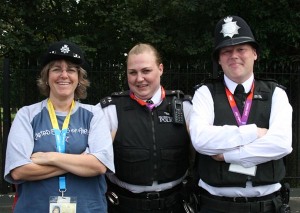
London Bobbies were among the many people Serena and the mission team members met.

These two Bobbies were among the many people Serena and the mission team members met and shared the Gospel with during their trip to London.

COMMENTARY | Serena Butler

Wow, what a trip! With everyone safely home and sleeping in our beds, we now have time to sit back and reflect on our time in London. As I sat last night and watched some of the Games on TV, I couldn’t help but think about all that took place. I found myself trying to pick out the Team Great Britain participants in the various events. As they mentioned places like Horse Guard Parade, I had visions of the Tube stations that service that venue.

But more than the Games themselves, my mind went back to the people we met. My thoughts and prayers were with people like the newspaper stand guy at Kings Cross who gave the team directions to the church on the first day. Or the Muslim man who Ian spoke with and, then another group encountered, who final made his way into Café Eden. A German and an Australian stumbled across Kings Cross Church while looking for a place to fulfill their traditional religious duties, and heard the truth about God wanting a relationship with us, not just traditional practices. One brought her friends to the Café the next day and even returned for church on Sunday.

I thought about Edgar who stopped into Southfields that first night to watch the Opening Ceremonies because he was lonely and wanted to watch with people from around the neighborhood instead of in his flat by himself. Throughout the week, he returned every day and many of us had the chance to have conversations with him about how much God loves him and understands his loneliness; and encouraged him to seek a relationship with God and to continue coming to the church.

Geraldine, the women I talked to on the Tube one morning, was also on my mind.  She had been baptized as a child, but had been away from church for a long time. We talked on the platform before boarding the Tube, where I had the chance to share the Gospel with her. We rode the train together and continued our conversation, and then just before she got off at her stop, she asked me to pray for her. I pray that God will bring others across her path to water the seed and finally bring her to the point of salvation.

There are so many others, like the ball girl from Wimbledon, the Pakistani man who volunteered at tennis venue, the lady in charge of the Southfields Tube Station, the head gamesmen at Wimbledon, the survivor of Sept. 11, the Bobbies who patrolled the area around the Southfields church, the Jehovah’s Witness who talked to Maddie for over an hour, the Muslim man I shared with at the station, the Muslim girl who Mari-Sue shared the Gospel with who missed her stop because she was so interested, and the hundreds of others whom we shared with while we were there. I am sure each team member has a list of their own.

But I am also reminded of the church leaders we met, encouraged, and were challenged by. Pete and Don at Kings Cross work so hard to minister in that hard neighborhood. May God continue to bless their efforts. Melissa and Nick and the other members at Southfields, may they continue to grow in their boldness to share Christ in their community.

Before I left, Melissa took me aside and told me that the church leaders have been discussing the possibility of opening the coffeehouse again during the annual Wimbledon Tennis Tournament. They were encouraged by our willingness to go out and invite others to come and to share the Gospel with them. They are seeking wisdom and asking God to help them reach out more to those who live in Southfields.

So many good things happened with so many hearing the Gospel! It is my prayer that the Holy Spirit will continue to work in the lives of everyone we met.

Pioneer Territory

Lisa Misner —  August 10, 2012
IBSA Executive Director Nate Adams and his son, Ethan, at Yellowstone National Park.

IBSA Executive Director Nate Adams and his son, Ethan, at Yellowstone National Park.

ILLINOIS MISSION OFFERING | Nate Adams

Since reading Robert Lewis’s book “Raising Modern Day Knights” several years ago, I’ve been taking special father-son trips with each of our three sons – before high school, after high school, and after college.  Our youngest son Ethan graduated from high school in June, and so last month he and I set out for Yellowstone National Park in northwest Wyoming – the first trip there for either of us. 

Yellowstone was Ethan’s choice.  He said he wanted to go somewhere none of our family had been before, and to see and do some things I hadn’t already experienced with one of his older brothers.  He was looking for pioneer territory. 

And we found it.  Because Yellowstone is the nation’s oldest national park, it has for generations been protected from development, and preserved in its natural state.  Yes, there are roads, and along them a few lodges and campgrounds where carefully restrained visitors can stay and experience the park.  But Yellowstone is still far more wilderness than civilization.

Spiritually speaking, our Illinois mission field is, like Yellowstone, more wilderness than civilization.  And our churches are outposts in what is still very much a pioneer territory, especially for Southern Baptists, but really for all of evangelical Christianity.  The gospel simply has not advanced or spread as far here as it has in other parts of the nation. 

Though Illinois has been a state for almost 200 years and Baptists have been here even longer, the vast and growing population, especially of Northern Illinois, continues to dwarf the number of churches and believers.  Today the ratio of Southern Baptist churches to population in Mississippi and Alabama is 1:1400, and 1:1700 as far north as Kentucky.  Yet here in Illinois the ratio is 1 church for every 12,700 in population.  And of course on average our churches here are much smaller.

That’s why I invite your church to enthusiastically promote the Illinois Mission Offering this fall, and to ask every devoted church member to give generously through it.  Right now Illinois Baptists have 80 new churches in some stage of development or launch, and dozens of additional sites identified where churches are needed.  Your state staff is traveling tirelessly among hundreds of existing churches, equipping them in evangelism, education, leadership, discipleship, worship, student ministry, missions, and more.  And due to lower Cooperative Program receipts and reduced funding from the North American Mission Board, the Illinois Mission Offering is more important than ever. 

Last year the IBSA family of churches stepped up and gave a record Illinois Mission Offering that was almost 17% higher than the previous year.  That $65,000 increase has helped soften the blow of a $265,000 annual funding reduction from the North American Mission Board that began in 2012.  Still it was necessary to trim back staff and ministries that serve churches here in Illinois.  A strong 2012 Illinois Mission Offering will be our primary resource for continuing and strengthening ministries that no longer receive funding from the North American Mission Board.  Your gifts will help us know how much you value those ministries. 

We live in a pioneer territory.  We have chosen to be Biblical, evangelical Christians, to be Illinois Baptists, where there is more spiritual wilderness than civilization.  Unlike Yellowstone, where the natural state is one of beauty and grandeur, the natural state of our mission field is one of spiritual darkness.  Most of the people who live here with us are lost.  They don’t know Jesus yet. 

We’re not tourists here.  We’re more like park rangers who live on site, year round, for the sake of the park’s natural inhabitants.  When the park closes for the winter and most others go home, we bundle up and press on.  We stick together, we cooperate, and we share and sacrifice.  We’re not preserving the natural state of our mission field.  We’re heaven bent on transforming it.

Nate Adams is executive director of the Illinois Baptist State Association.

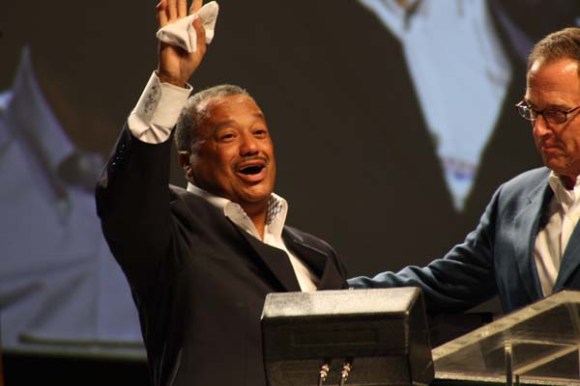
“To God be the Glory! Great things He has done! Thank you, I love you.” – SBC President Fred Luter on his election.

“To God be the Glory! Great things He has done! Thank you, I love you.” – SBC President Fred Luter on his election.

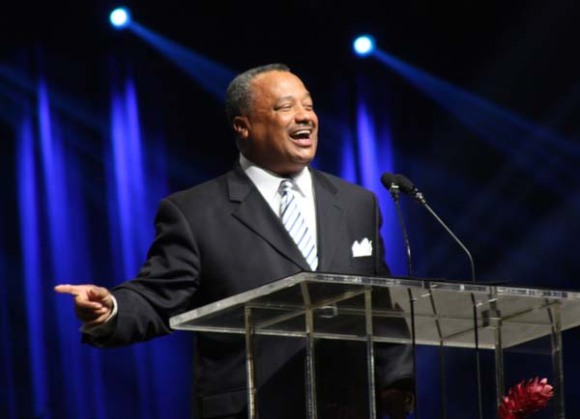
The face of the Southern Baptist Convention has changed. He’s African American, the first minority president in the denomination’s 167-year history. More important, given the challenges before him, he’s smiling. 

 Fred Luter was elected by acclamation at the annual meeting in New Orleans on June 19. He ran for the presidency of the 16-million member convention unopposed.

The denomination that was born out of a break between slave-owning Baptists in the South and northern abolitionists finished the repudiation of racism begun 16 years earlier by naming the New Orleans native, a pastor known for fiery preaching, effective leadership, and a winsome ability to work across cultural lines, as its first black president. 

“God has given me a gift in building bridges through the years, and my prayer is that, someway, somehow, I can get groups on this end [and] groups on this end…and meet together,” Luter said after his election. His diplomatic strategy, joy. 

“I love to laugh,” he told a reporter. “I love to have a good time.”

This joy in the face of adversity has seen Luter through difficult tasks before, including rebuilding Franklin Avenue Baptist Church, a large congregation decimated by Hurricane Katrina in 2005. “If anybody has joy, if anybody has peace and happiness, it should be us,” he said, referring to Christians. 

Because no other candidate ran against Luter, the convention recording secretary came to the microphone to cast the official ballot of the entire convention for Luter, but outgoing president Bryant Wright welcomed messengers to participate in the historic moment by raising their own ballots.

They did. 

And approximately 8,000 people stood to their feet for several minutes of clapping and cheering and, for many, weeping “That was such a wonderful and historic moment …. I was moved to tears of joy as were the African-American pastors I was sitting with,” said Michael Allen, pastor of Uptown Baptist Church in Chicago.   

As Bryant brought Luter to the platform on a wave of adulation, it was evident this was everyone’s decision. Now the question looms, can Luter ride this wave to bring lasting change in the denomination that faces declining membership and offerings, and the need for broader appeal in an increasingly diverse American culture. 

“I think he’ll do a great job, and I think he’ll work at trying to build up the Kingdom of God through the Southern Baptist Convention,” said Marvin Parker, pastor of Broadview Missionary Baptist Church, a large mostly African-American congregation in metro Chicago. “I expect there to be a greater outreach winning souls for Christ, I really expect a great increase because I think he’ll attract more folks with his style of preaching and all.” 

Other actions 

The 2012 convention was historic for reasons other than the barrier-breaking election. One issue that threatened to divide the convention in recent months was the prospect of a name change. 

Messengers approved “Great Commission Baptists” as a descriptor name that can be used in place of “Southern Baptists,” an adjustment many in the north and west see as necessary for effective ministry. The issue was debated on the convention floor until it passed by a narrow majority, 52.78 percent.

Chairman of the name change task force Jimmy Draper presented the recommendation to the convention. Draper told the Illinois Baptist the motivation for the informal change is “missional.” 

“We’re not going to be more evangelistic just because we have a new descriptor. But who among us could be against focusing on the Great Commission?” Draper said. “It’s something that would point us in the right direction, and would always be descriptive of who we are as Southern Baptists. We are, without apology, a Great Commission people.”

The annual meeting wasn’t the forum for debate on Reformed theology that some thought it might be, but messengers did engage in deep discussions about how people come to a saving relationship with Jesus. Alabama pastor David Platt told the stories of two active members of his church who realized they had never come to true faith in Christ. He pleaded with Southern Baptists to reexamine their understanding of repentance and belief.

“They represent a pandemic problem across contemporary Christianity, and some of you have the same story. You made a decision, prayed a prayer, signed a card, got baptized, you thought you were a Christian, you were told you were a Christian, and now you know that you were not. You were deceived.”

Platt sparked conversation about the “sinner’s prayer” months before the convention, in a YouTube video that resulted in a resolution establishing the sinner’s prayer as a biblical expression of repentance and faith. That resolution, along with another that addressed pre-convention debate between Calvinists and non-Calvinists, was recommended by the SBC Resolutions Committee to emphasize cooperation said Chairman Jimmy Scroggins. 

“Southern Baptists are going to have to agree on the essentials. We’re going to have to disagree on certain things, but what we really want to do is lock arms and fight the darkness.”

Other resolutions included statements on same-sex marriage (affirming traditional marriage while discouraging hurtful language in dealing with homosexual issues) and religious freedom (including repudiation of requirements by the Obama health care act requiring religious institutions to provide contraception and other services contrary to their beliefs as part of their employees’ insurance benefits). 

Reports by the SBC’s six seminary presidents, the heads of the International Mission Board, North American Mission Board, LifeWay, GuideStone, and the Executive Committee of the SBC were received without objection and with few questions from the messengers.

(Editor’s note: New Orleans in Rear View. Now that we’re back home, our Illinois Baptist news team reflects on the question: What is the lasting value of the 2012 SBC?)

 Posted by Meredith Flynn

David Platt, pastor of The Church at Brook Hills in Birmingham, Ala., delivers a Pastors' Conference message in New Orleans on true repentance and salvation.

David Platt, pastor of The Church at Brook Hills in Birmingham, Ala., delivers a Pastors’ Conference message in New Orleans on true repentance and salvation.

Before the convention, many (especially us press types) were buzzing about how a growing debate over Reformed theology might come up from the floor. The answer: It didn’t really pan out like we thought it might, at least in terms of a heated debate.

Instead, Pastors’ Conference speakers and panelists at some of the surrounding meetings encouraged Southern Baptists to work together, even if it means crossing theological lines. And some, most notably Alabama pastor David Platt, spoke passionately about the bigger fish we have to fry.

During his message Monday afternoon, Platt referenced a YouTube video from a message he preached at an inter-denominational conference earlier this summer. On the widely-watched video, Platt said the sinner’s prayer is a “superstitious” prayer that never appears in Scripture, and called into question some traditional evangelism methods.

In his message at the Pastors’ Conference, Platt admitted that as a young pastor, he would be wise to watch his words. But then he stayed true to what he said briefly in the video, pleading with Southern Baptists to preach the true Gospel, full of the messages of repentance, belief, discipleship, and global mission.

Two days later, after some debate on the convention floor, messengers approved a resolution upholding the “sinner’s prayer” as a biblical means to salvation.

How we lead people toward a saving knowledge of Christ, and where we find the conviction of our own salvation, is the most important conversation we can have, in my view. I’m grateful for the discussion, and look forward to watching and listening as God moves us closer to His heart for people.

(Editor’s note: New Orleans in Rear View. Now that we’re back home, our Illinois Baptist news team reflects on the question: What is the lasting value of the 2012 SBC?)

Posted by Eric Reed

Parents watch the convention proceedings from the "stroller section," a cordoned-off area for families with young children.

Parents watch the convention proceedings from the “stroller section,” a cordoned-off area for families with young children.

Descending the escalator on the final day of the convention, I watched on the floor below me as a four-year-old had a meltdown. He wasn’t alone. His sister, a couple of years younger, perched in a carrier seat atop a stroller, teared up, and eventually wailed.

I felt the same way. We were all tired. The only difference between us was, I couldn’t get away with a meltdown.

Landing at the foot of the two-story escalator, I was suddenly in a sea of small children. “Don’t run!” the father of one said futilely. “There are grown-ups here.”

Really?

Not as many grown-ups as children, it seemed at times. This was a convention of young people. Once the domain of people with hair in various shades of gray and blue, this gathering was marked by a large percentage of young adults, many of whom bought their families. (There were strollers everywhere, even a “stroller section” roped off near the platform.) And their presence was felt in all the proceedings of the convention.

Perhaps the Pastors Conference foreshadowed a shift we should notice. Opening on Fathers Day, the line-up included sons introducing their better-known fathers as conference speakers. “Dad’s gonna bring the heat!” one son said before his father preached. But in one notable reversal, it was the father, a former convention president, who introduced his up-and-coming son. There was a changing of the guard, it seemed.

The most challenging and emotionally gripping moments among the pre-meeting sermons came from the youngest preacher, in his early 30s.

The debate over use of “the sinner’s prayer” started with young people, as an older generation’s tried and accepted method is challenged. 

And it is young people who raised debate over Reformed theology and Calvinism. A young pastor (age 40, son of a past SBC president) drafted a response and coined the phrase “Traditionalists” to describe his (and many elders’) Southern Baptist theology.

Many messengers speaking from the floor mics during the business sessions were younger pastors. 

This emergence of young people in SBC life was clearest at the Baptist 21 panel discussion (and turkey po-boy lunch). “21” in the name refers to 21st century, but it might have characterized their age. Fully half the people in the SRO crowd of nearly 1,000 were in their 20s and 30s.

For watching the panel discussion, the Conservative Resurgence of the 1980s was ancient history. Like WW2. Many of them were not born at the time today’s senior convention leaders stopped what they described as a left-leaning drift and returned the denomination to biblical inerrancy. For these young people, Judge Paul Pressler and Dr. Paige Patterson are historical figures to be honored (which they were at the luncheon).

For a few minutes in New Orleans, the convention’s past met its future. And it was clear in that moment that this is not your grandfather’s SBC.

Or even your father’s.

It belongs to the kids.

(Editor’s note: New Orleans in Rear View. Now that we’re back home, our Illinois Baptist news team reflects on the question: What is the lasting value of the 2012 SBC?)

 Posted by Lisa Sergent

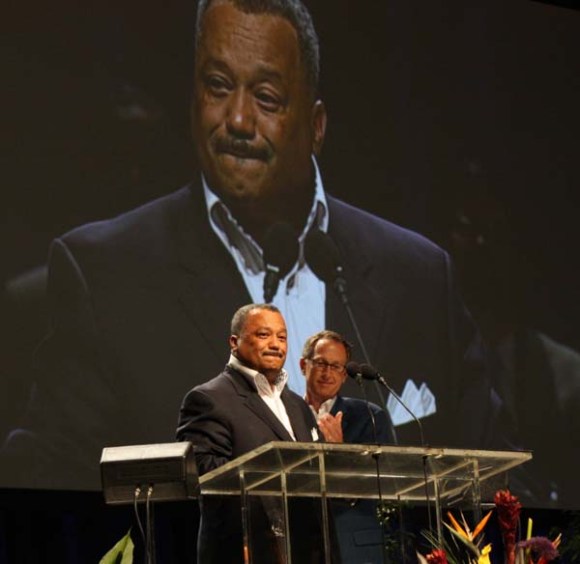
Pastor Fred Luter, the SBC's new president, receives a standing ovation from messengers at the convention's annual meeting.

Pastor Fred Luter, the SBC’s new president, receives a standing ovation from messengers at the convention’s annual meeting.

The 2012 SBC Annual Meeting in New Orleans was historic for many reasons.  The return of Southern Baptist Convention for the first time since Hurricane Katrina, the adoption of the “Great Commission Baptist” descriptor name, and the election of Pastor Fred Luter as convention president.

Luter’s election made headlines across the country because he is the first African-American to be elected President of the Southern Baptist Convention, a convention which some still associate with its birth in the support of slavery. But, as I listened to the various platform speakers, I began to grow concerned. Yes, Luter is an African-American, but this is not why he is president. Luter is president because of his character, leadership abilities, heart for Christ, and the way he has allowed God to lead him in his ministry.

One example of his leadership, commitment, and faith was seen in the aftermath of Hurricane Katrina when Franklin Avenue Baptist Church sat in 13 feet of floodwater. While some of the churches over 7,000 members remained in New Orleans, others were scattered to Baton Rouge and Houston. On the first and third Sunday’s of the month, he would preach an early morning service to members who gathered in First Baptist New Orleans church building. In the afternoon, he would travel to Baton Rouge to lead a service for more members. The second and fourth Sunday’s of the month saw Luter in Houston, Texas, leading church services for still more members. He did this for over two years until the Franklin Avenue’s building was ready for services again.

As Southern Baptists we need to focus on Luter’s God-given abilities and pray for him as he leads our convention. He is president because of the content of his character in the tradition of Dr. Martin Luther King Jr.’s dream. His election is a historic step for the Southern Baptist Convention, but his election is wonderful because he is a faithful man of God, whom God has already used and will continue to use in great and wonderful ways.

Your team of IB reporters

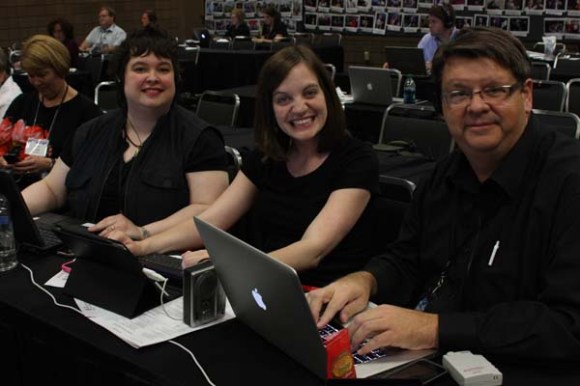
Your team of IB reporters.

Thank you for reading our coverage of the 2012 Southern Baptist Convention Pastors’ Conference and Annual Meeting. We’re hot, tired and hungry and heading for the airport. It’s been a great convention, we saw history made, unity after debate, a younger generation emerge, and commitment to the beliefs that make us Southern Baptist.

We have a lot of work to do when we get back home putting together a special edition of the Illinois Baptist. Also look online for more convention follow-up.

God bless

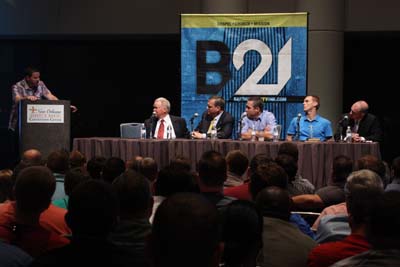
Paige Patterson, Al Mohler, J.D. Greear, David Platt and Danny Akin served as panelists during Baptist 21's luncheon for young leaders in New Orleans.

Paige Patterson, Al Mohler, J.D. Greear, David Platt and Danny Akin served as panelists during Baptist 21’s luncheon for young leaders in New Orleans.

At Tuesday’s Baptist 21 luncheon, hundreds of young people balanced turkey sandwiches and chocolate chip cookies on their laps as six Southern Baptist leaders reminded them of the price that was paid for the theological stability they enjoy today.

Paige Patterson, Al Mohler, Fred Luter, Danny Akin, J.D. Greear and David Platt weighed in during a panel discussion of the Conservative Resurgence (Southern Baptists’ return to orthodox doctrine beginning in the late 1970s) and the future of the SBC. As conversation continues to simmer over the surge of Reformed theology in the SBC, the panelists, who themselves represent a variety of theological perspectives, urged their listeners to hold fast to the inerrancy of Scripture.

“What was gained can be so quickly lost,” Mohler said. “It was excruciating, it was difficult, it was a near-fought thing, in the sense that it could have gone in the other direction. There was a victory that created a precious opportunity that’s a stewardship that we know can be lost at any time…

Every single year that passes is going to be more difficult, in terms of our cultural context. There are going to be issues we don’t even know to imagine today that your generation is going to have to imagine. It’s going to require the full wealth of conviction; if you do not nail your ministry to the foundational truth of the inerrancy of God’s word, you will – it’s not a question of if, it’s a question of when – you will go off the tracks.

It is essential from the very beginning to say, ‘This is where I’m going to stand, this is where I’m going to go in my ministry. This is a non-negotiable and quite frankly, I want the world to know it.”

Newly elected SBC President Fred Luter

Pastor Fred Luter balances serious subjects with joyful repartee while preaching at the Pastors’ Conference on the eve of his election as SBC President.

Posted by Eric Reed

A newspaper profile of Fred Luter pointed out the ways he will be a new face for Southern Baptists. Beyond race, Luter will bring a smile as the chief representative of the denomination, something that is lacking in our history of leadership by serious, white middle-age pastors, the report said.

Not that Luter isn’t serious. He is very serious about the traditional values of Southern Baptists, both theologically and culturally. His sermon that closed the Pastors Conference on the eve of his election as theconvention’s first African American president was a fiery litany of the ills of times—broken homes, crime, racism, abortion, homosexual lifestyles—and the hope, the only hope we have in the gospel of Jesus Christ. But this energetic dance of oratory was punctuated by self-effacing confessions of personal sin and redemption, and joyous grins attesting the effects of Christ in his life.

Fred Luter is serious about the joy of his salvation.

“I love to laugh,” he told the reporter. “I love to have a good time.” And those who hear Pastor Luter preach know it’s true. “If anybody has joy, if anybody has peace and happiness, it should be us,” he said.

If the perception persists that “Baptists don’t have any fun, that we don’t laugh—we don’t have any joy, I would love to change that perception,” Luter said.
Luter is equally serious about making the fuller ethnic representation a fact of life in all areas of Southern Baptist life.

“If we stop appointing African Americans or Asians or Hispanics to leadership roles in this convention after my term is over, we failed. We absolutely failed,” Luter said at a news conference after his historic election.

Luter summarized his election as “a genuine, authentic move by this convention that says our doors are open, and the only way they can see that is not just putting up an African American president, but seeing other ethnic groups inother areas of this convention. Time will tell and I’ll be a cheerleader promoting that.”

Luter and others described his election, at a national convention held in his own hometown of New Orleans, as providential. After a lengthy season of prayer, Luter and his wife agreed to put his name forward as a candidate in January. No other candidates emerged, and Luter was elected unopposed on the first day of the annual meeting.

Messengers stood and applauded for several moments as the convention’s vote was cast for the lone candidate, cheering and whooping and waving their ballots in the air. Some wept at the election of the African American pastor, seen by many as a fitting sign of repentance of the denomination’s birth in a time of slavery.

“There will be some pitfalls,” Luter said of his service as SBC president, “but I hope I will learn from them and study more on things I anticipate being asked.” Already Luter has faced the national media, answering questions about the role of race in the mostly white denomination. Luter said he hopes to be known as a man of God who “loves being part of this convention.”

And he smiles when he says it.