Archives For November 30, 1999

Beloved camp integral to spiritual growth for current church leaders, and those yet to come

Every summer, Judy Halter takes a busload of elementary schoolers from Anna, Ill., to Lake Sallateeska Baptist Camp, where they spend a week learning about Jesus and what it means to tell other people about him.

She even got her commercial driver’s license so she could drive the bus. Halter understands well the value of investing in young lives.

“I was saved when I was six years old,” said Halter, a member of Anna Heights Baptist Church. “But finally, at eight or nine years old, after I came to Lake Sallateeska and the missionaries came and spoke to us, I finally got it. I understood the Great Commission, and that we were called to go, and not just stay when we follow Christ.

“And it was life-changing at that point for me.”

Halter’s “favorite place in the world” turns 75 this year. As Lake Sallateeska marks the milestone anniversary, children and students and adults across Illinois continue to stream to the IBSA-owned retreat. They go for the scenery, the activities, the friendships, and the opportunity to grow closer to Jesus and his mission.

“This place has housed missionaries. This place has birthed missionaries,” Halter said. “And hopefully it will continue to birth tomorrow’s missionaries and send them out into all the world as our Lord commanded.”

Lake Sallateeska dining hall

Volunteers completed much of the work during a recent round of renovations at Lake Sallateeska that included a new façade for the game room.

Transformation place
In 1928, Illinois Woman’s Missionary Union (WMU) began holding youth camps at a lake outside of Pinckneyville owned by Dr. F.B. Hiller. In 1942, WMU bought the 40-acre property for $4,800.

The camp was dedicated on July 7 of that year, and later renamed after a visiting missionary from Oklahoma explained the meaning of her name, “Sallateeska.” The word, which means “keep looking up,” gave the camp its name.

Over the past 75 years, the camp has expanded to 163 acres. Cabins on the campground can sleep 200 people, and the Sallateeska Inn, added in 2000, offers 16 rooms of hotel-style lodging. More recent renovations nearly doubled the size of the dining hall, among other improvements.

Lake at Lake Sallateeska

Long-time camp attenders and staff speak of the camp’s value as a retreat, a place to get away from distractions and get closer to God.

“I think the camp is a place where you can get away from your normal routine,” said Mark Lee, pastor of Beaucoup Baptist Church in Pinckneyville and a former manager of Lake Sallateeska. “You just get to come out here, and your thoughts are a little different, because you’re not thinking about everyday pressures, and everything that’s going on around you. And you can focus on the Lord, your relationship with him.

“You generally sit under preaching every night and teaching. There’s singing. There seems to be more freedom to worship sometimes here [for] kids. I think it just gets people away from that normal routine, and gives [them] an opportunity to get closer to God.”

Conference Center

For many campers who experienced a getaway at Sallateeska, the camp is where they first met Christ.

“I remember being a little girl, and for the first time going to camp being really, really nervous,” recalled Lyndee Joe. “That was the year when I was 10 years old that I was saved.”

Joe, who grew up at Chatham Baptist Church, later served at Lake Sallateeska as a counselor, a program manager, and a camp missionary. She guided others as they made the same commitments she made at camp. She remembered one such story of transformation that happened in Sallateeska’s swimming pool. A young girl came up to her and said, “I need Christ in my life.”

“And she was saved at that pool, right there on the spot,” Joe said. “She didn’t care that we were all swimming around and the kids were goofing off around her.”

Nate Adams attended Royal Ambassador (RA) Camp at Lake Sallateeska when he was eight or nine years old. “It was a week of transformation,” said IBSA’s executive director, who credits his church RA leader, Ray, with getting him to go to camp.

“It was all the things we had been talking about week after week—missions and spiritual growth and what it means to be a godly Christian boy and man,” Adams said. “And in that week at Lake Sallateeska, it all came together, and it was a time of spiritual change for me.

“And I think Lake Sallateeska has been a place of spiritual transformation for many, many, many people like that since then.”

Just the beginning
For many campers, the initial commitment to Christ made at camp is just the beginning. Philip Hall has managed Lake Sallateeska since 2008, but his experience with the camp started years ago. The son of an RA leader, Hall grew up going with his dad to take the big kids to camp.

When he became a big kid and camper himself, God used Sallateeska to confirm his call to ministry. Now, he’s deeply invested in running the camp in such a way that the next generation of pastors and missionaries and Sunday school teachers can hear from God while they’re at camp.

Boating

“I don’t get to be the one sharing the gospel every time,” Hall said. “I’m not necessarily the one preaching every time. But our ministry is just to clear the path of distractions. It’s the whole purpose that they come out to the country anyway.”

Lake Sallateeska is hallowed ground for those who have experienced a new understanding of God, and have sensed a call to join him in his mission. Judy Halter’s days as a camper sparked a missions calling that has taken her on short-term trips to Botswana, Jamaica, and the Dominican Republic. For Lyndee Joe, her time at Sallateeska has helped her come full circle in her walk with Christ—from meeting him, to learning to love his Word, to learning to share it with other people.

“We’re seeing people come from this camp who are giving their life to Christ, giving their life to go on the mission field,” said Joe, who served as an International Mission Board Journeyman missionary to South Africa. “We’re seeing people who are going to this camp as a child, and then turning around, getting to high school age and starting Christian clubs in their schools.

“I think [Lake Sallateeska] is vital in the life of Southern Baptists in the state of Illinois because it’s giving our students a passion for the gospel. And they’re taking that passion and they’re running with it.”

As the Lake Sallateeska team embarks on their next season of ministry, Hall said their goal is to continue the commitment and legacy that started 75 years ago.
“My hope for the future is that we just continue to hear from the Lord [and] be faithful with what we have. It’s a stewardship, a talent,” he said, referencing Jesus’s parable in Matthew 25.

“I truly hope, when my time is over, to pass on a facility and a ministry that’s better than it was when I got it, to the next runner, to carry out this race.”

Bob-Harrington---BourbonStreet

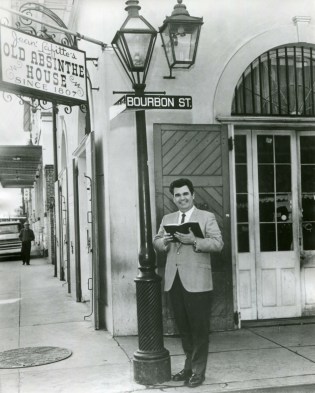
Famed New Orleans evangelist Bob Harrington, known by many as “the Chaplain of Bourbon Street.”

Forgiveness is a significant theme in God’s Word.

The Bible tells us: “As far as the east is from the west, so far has He removed our transgressions from us” (Psalm 103:12). “I, even I, am He who blots out your transgressions for My own sake; and I will remember not your sins” (Isaiah 43:25). “He [Jesus] was delivered up because of our offenses, and raised because of our justification” (Romans 4:25). “If we confess our sins, He is faithful and just to forgive us our sins and to cleanse us from all unrighteousness” (1 John 1:9).

Scripture is clear; God’s forgiveness is for all, but each one of us must receive His forgiveness personally.

Our family has experienced forgiveness in a clear and visible way. My dad, Bob Harrington, was dramatically converted on April 15, 1958, when I was only 6 years old. He attended a revival meeting in his hometown of Sweet Water, Ala., to find some insurance prospects, and instead he found the Lord. During the fifth stanza of “Just As I Am,” Dad was forgiven of his sin and saved by the grace of God.

He preached his first sermon three days later and led his parents to faith in Jesus Christ. My mother, sister and I followed Dad in faith and became active in church. The Lord called my dad to ministry and led him to attend New Orleans Baptist Theological Seminary.

In a chapel service, then-NOBTS President Leo Eddleman presented a challenge to students: “Any pocket of sin is a mission field, and the closest Christian to it is a missionary.” Dad responded to that call and began a ministry in the French Quarter of New Orleans. In 1962, he was proclaimed by the mayor “The Chaplain of Bourbon Street.”

His ministry expanded in the 1960s and 1970s from the second block of Bourbon Street to nationwide crusades and national television. Many people were converted and called to the ministry through his personal soul-winning and powerful preaching. God used Bob Harrington to share His gift of forgiveness with thousands of others.

At the peak of Dad’s ministry, “the devil threw him a pass and he ran for defeat” (drawing from his own words). He left the Lord, left the ministry, left my mother and left our family. What a painful time for each of us.

God immediately spoke to me about forgiveness. I needed to forgive my dad even though he did not ask for forgiveness. Initially I did not want to forgive him, but later I chose to obey God’s clear command. We prayed faithfully for Dad’s restoration for 17 years before he returned to the Lord. What a time of rejoicing for our family! We were a part of his redemption story as Dad sought forgiveness from each of us.

After Dad returned to the Lord, he again had “fun being saved” and became “happy in the Lord.” He was bold in his witness and called to preach to others like him who had left the Lord and needed to get right with Him. He titled his message on prodigals, “Loving the Left Back Right.” What a beautiful picture of forgiveness!

In his later years, Dad had dementia. He was completely at peace in his condition. He spent his days sitting in his big red chair watching television.

As I walked into his little house one afternoon, God gave me a vivid example of total forgiveness. A divorced couple on the Jerry Springer program was screaming at each other. Dad looked up at me and said, “Isn’t it wonderful that no one in our family has ever been divorced? We all love each other.” Wow! Who would have ever thought that such truth could come from a Jerry Springer moment? Dad himself had been divorced twice, but God had forgiven him and taken his sin out of his conscious thoughts. What a perfect picture of forgiveness! When God forgives, our sin is completely removed.

My sister and I rejoice in the forgiveness of God which allowed our family to be reunited and our dad to have joy until his last breath. To our knowledge, Dad had no memory of the time he was away from the Lord. He talked often about our family years ago and remembered many amazing days of ministry. When once asked by a reporter what led him back to the Lord, Dad sincerely replied, “I have never left the Lord. I have always loved Him.” God literally removed his sin and blotted it from his memory, so he remembered it no more. I will always be grateful for being a part of a real-life story of forgiveness!

This article first appeared at BPnews.net.

Sylvan-Kathy-Knobloch-Mark-Emerson

Mark Emerson (right) led prayer for Sylvan Knobloch and his wife, Kathy, during a retirement celebration in November. Knobloch said he’s not certain exactly what shape life after retirement will take, other than he “wants to be a good grandparent.” The Knoblochs have two adult children and six grandkids.

Sylvan Knobloch, currently the Illinois Baptist State Association’s longest-tenured employee, will retire at the end of this year after 38 years in the areas of campus ministry, church health, and leadership development.

Knobloch was honored at a Nov. 27 retirement dinner in Springfield, where friends and co-workers celebrated his work over the years—and the nearly one million miles he has traveled as a consultant for IBSA churches.

Bob Dickerson, pastor of First Baptist Church, Marion, and a one-time co-worker of Knobloch’s at IBSA, spoke during the dinner and cited the familiar passage in Matthew—“Well done, good and faithful servant.”

A native of Waterloo, Ill., Knobloch was working as a pastor and volunteer campus minister in Bowling Green, Ohio, when he met then-IBSA campus ministry director Bob Blattner at a missions conference. A few months later, Blattner asked him to consider leading student ministry at Eastern Illinois University. Knobloch, who had been looking for a full-time campus ministry position, sensed God was opening a door.

He worked in Charleston from 1979 until 1988, when he moved with his wife, Kathy, and their two children to Carbondale to direct ministry at Southern Illinois University. In 1993, then-IBSA Executive Director Maurice Swinford offered Knobloch the opportunity to join the Springfield-based staff as director of discipleship, singles ministry, and senior ministry, a job move that later morphed into a long stint in the areas of church/minister relations and church health. In those capacities, Knobloch helped churches and pastors navigate conflict, negotiation, and reconciliation.

He helped establish a severance process by which churches can ease a difficult transition for their pastor. He also aided individual ministries through Rekindling the Call retreats designed to refresh and renew pastors and their spouses.

In 2016, he took on the area of leadership development and helped IBSA continue to establish processes to help churches identify emerging leaders and equip current leaders by making available a spiritual gift and personality profile.

On the eve of his retirement, Knobloch talked to the Illinois Baptist about the joys of 38 years of ministry, the challenges still facing Illinois Baptists, and the journey toward true understanding between pastors and churches.

Illinois Baptist: What have been the greatest joys of your years of ministry in Illinois?

Sylvan Knobloch: One of the most significant joys from my years of campus ministry has been seeing the numerous students from the Baptist Student Union continue to serve faithfully in their respective churches across Illinois.

Another great joy is witnessing church growth and renewal in congregations that I worked with over the years. It is gratifying to know I played a small part in their transition.

IB: How have you seen churches and communities in Illinois change over the past 38 years, as far as how churches do ministry?

SK: There is more diversity in both the types of pastoral leadership and the types of churches. A growing number of pastors today simultaneously serve two churches, while other churches have more than one campus.

The single-staff pastor is not a new phenomenon, but many of these pastors today are serving in declining and aging congregations. Often these churches are resistant to the changes needed to reach younger families.

IBSA is meeting this challenge by encouraging ministers to build relationships with other pastors and to support each other through cohorts.

IB: What are some other challenges facing IBSA leaders today?

SK: Pastors need relationships. Pastors and staff today often are not going away to one of the six SBC seminaries for education like they did 38 years ago. Today’s minister often chooses to take advantage of online seminary degrees; a decisive advantage is the minister remains in Illinois serving their churches. But on the negative side, these pastors miss out on the relationships that develop naturally on the seminary campus.

IB: If you could tell church members one thing about their pastor, what would it be?

SK: I would ask search committees to spend time getting to know their pastoral candidate before calling him. He will be doing life with you; therefore, consider the iceberg. Don’t merely look at what is above the waterline, but consider what is below, the unseen: character, ministry goals, and dreams. Church leaders should ask the new pastor how they can help him succeed.

IB: If you could tell a pastor one thing about his church, what would it be?

SK: I would encourage him to spend time with church leaders to understand their dreams and goals, both for their church and for their own lives. Pray for ways you can enable each leader to become all he/she is called to be.

The prerequisite for this is for the pastor to have self-awareness, to understand his emotions and their impact on others. In this way, he will become an effective leader.

Meeting Of Bible Study Group

The month-long prayer emphasis “In All Things Pray” opens 2018 on the Southern Baptist Convention calendar, encouraging churches to pray corporately for 60 minutes at least weekly in January.

Standing on Acts 1:8 and 2 Chronicles 7:14, In All Things Pray encourages 10 minutes of Scripture reading, public leadership and worship; 20 minutes of vocalized prayer requests, and 30 minutes of guided prayer in each hour-long service, event organizers said.

“We are hopeful churches will use the 10-20-30 corporate prayer model in at least one of their weekly gatherings during January,” said Roger “Sing” Oldham, SBC Executive Committee vice president for convention communications and relations. “The 10-20-30 model is very interactive and is ideal for a midweek prayer service.”

Oldham represents the Executive Committee on PrayerLink, a national organization of prayer ministry leaders that helped the Executive Committee develop this year’s prayer focus.

“We think people will be refreshed by spending a complete hour in focused prayer,” Oldham said, “and encouraged at how quickly a one-hour time of prayer will pass, perhaps spurring them on in their personal times of prayer at home.”

Four categories of prayer concerns drawn from Acts 1:8 are offered among resources at InAllThingsPray.net for suggested use, all or in part.

Family and friends

Target this group by creating a prayer list of family members to pray for daily. Using the CrossRoads Prayer Evangelism ministry referenced at InAllThingsPray.net, encourage congregants to list five friends and track their prayer and outreach targeting the individuals. Ask church members to write on note cards the names of unchurched and lost family members, bring the cards to the altar and place them before the Lord.

Church and community:

Lead church members in praying specifically for evangelistic events on the first half of the church’s 2018 calendar, such as Vacation Bible School, revivals or special music programs. The church’s continued health, ministry teams and committees are among other suggested prayer concerns.

The United States and its peoples:

Read 1 Timothy 2:1–6 aloud during the morning worship service and encourage prayer for the nation. Mention the names of elected officials during the pastoral prayer. Ask the Lord to call from within your congregation members who will serve as pastors, missionaries and church planters. Pray for the different ethnicities living within the nation and for the racial reconciliation that is possible only through salvation in Jesus Christ.

The world and its people groups:

During the pastoral prayer, petition the Lord on behalf of those within the congregation who may be sensing a call to international ministry. Ask the Lord to give International Mission Board trustees and leaders divine wisdom and guidance in challenging Southern Baptists to be on mission with God. Ask for wisdom and mercy for international missionaries working in dangerous locations.

PrayerLink is composed of prayer coordinators from Southern Baptist entities and the Executive Committee, the Woman’s Missionary Union, state Baptist conventions, and Southern Baptist ethnic and language fellowships. PrayerLink collaborates with groups represented in its membership to foster a Great Commission prayer mindset among Southern Baptists and other Christ-followers, and to promote Great Commission prayer ministries for Southern Baptist churches.

Additional resources and promotional materials are available at InAllThingsPray.net.

This article first appeared at BPnews.net.

800px-Sangamon_County_Courthouse_2017

Sangamon County Courthouse, Springfield, Ill. Source: Wikicommons

Attorneys for the Thomas More Society are appealing a judge’s decision to grant a motion Dec. 28 by the State of Illinois to dismiss a case to stop the implementation of HB40 on Jan. 1. Associate Judge Jennifer M. Ascher of Sangamon County’s Seventh Judicial Circuit Court in Springfield denied the request for an emergency injunction and temporary restraining order and preliminary injunction. HB40 uses taxpayer funds to pay for abortions for through Medicaid and the state employees’ health insurance plan.

Thomas More Society counsel Peter Breen based his arguments on the original date in May when the bill was scheduled for a vote in the Senate, but was recalled only to be held for a vote in September. He also disputed the state’s ability to fund the bill according to the state’s balanced budget law.

“We respectfully disagree with the court’s ruling and will seek an immediate appeal,” Breen stated after the ruling. “The Illinois Constitution was clearly violated here.”

Read our previous coverage of the lawsuit


Building them up

ib2newseditor —  December 28, 2017
Graffiti2

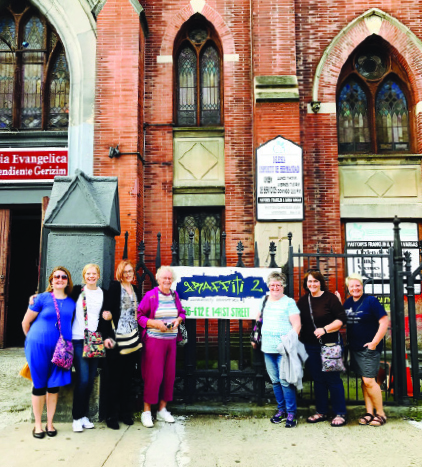
In September, a group of seven Illinois pastors’ wives navigated the New York subway every day to get to the Graffiti 2 headquarters in the Bronx, where they assisted with behind-the-scenes work needed to facilitate outreach programs for kids and adults. Photos by Andrea Hammond

Subway

Riding in the subway.

For Illinoisans who live outside the Chicago city limits—or don’t often visit—the hustle and bustle of New York City would likely bring on a good dose of culture shock.

For Terry Kenney, a pastor’s wife in Beardstown, her recent mission trip to the Big Apple brought back memories of her childhood in Chicago.

“New Yorkers do not think anything about walking” to get from place to place, said Kenney, whose husband, Brian, pastors First Southern Baptist Church in Beardstown. For the team of seven pastors’ wives from Illinois, navigating the city streets and the subway and taxis was a new, stretching experience. But a positive one.

“I never had a desire to go to New York,” Kenney said, “but now I’m going to take my husband back and let him see it.”

City reachers
The Illinois team was in the city to partner with Graffiti 2, a community ministry based in the South Bronx. Started a decade ago, Graffiti 2 is an offshoot of Graffiti Church, a Southern Baptist church planted in the early 1970s. The Graffiti ministries are grounded in a mission to meet the physical and spiritual needs of New Yorkers.

Toward that end, Graffiti 2 runs an after-school program for kids in the neighborhood, and also has started a jobs program that gives people the skills they need to learn and succeed in a career.

Standing in front of an intricate stained glass window in Graffiti’s new headquarters, the Illinois women watched one of Graffiti’s artisans at work at her sewing machine. The goods produced by Graffiti 2 artisans are sold through WorldCrafts, a fair-trade ministry of Woman’s Missionary Union.

Herself a seamstress, Kenney said it was nice to climb upstairs in the old church building and see where the artisans work, and hear about their needs. The Illinois team also helped Graffiti 2 with some administrative tasks resulting from their recent move to the building.

“We prayer-walked around their neighborhood in the South Bronx before meeting artisans and touring their new location,” said Andrea Hammond, a pastor’s wife from Grace Southern Baptist Church in Virden. “We experienced how they impact their community for Christ by finding out what their needs are, meeting them, then sharing Christ through those needs.”

Calling in common

stainglass

At the Graffiti 2 headquarters in the Bronx, artisans create fair-trade products and learn career skills.

Carmen Halsey came up with the idea for the New York mission trip as she was brainstorming ways to help pastors’ wives connect with one another. Inspired by the concept of “destination weddings,” Halsey, IBSA’s director of women’s missions and ministries, wanted to find a place that would let wives retreat to an attractive location, while also working together to fulfill a mission.

As they worked together on a large mailing project for Graffiti 2, Halsey said, the women had an opportunity to hear each other’s stories, and share their own. That was the special part, she said, watching the multi-generational group support each other and get to know one another.

“It’s a lonely job,” Terry Kenney said of being a pastors’ wife. There aren’t too many people you can confide in, she said, and the New York trip let the women open up to one another. That part of the trip was helpful for Ailee Taylor, who serves with her husband, Derrick, at NET Community Church, the congregation they planted in Staunton last year.

“I have not been a pastor’s wife for very long, and it is a group of women that I have not been around before,” she said. “In addition to learning and serving alongside the team at Graffiti 2, I was able to connect and grow alongside other women that share the role of pastors’ wives.”

The trip also had benefits that are transferable to her own ministry in Illinois.

“Even though New York is an urban environment, I learned things that apply to my rural environment,” Taylor said. “I also learned that we have a lot of things that we easily take for granted in Illinois.”

The mission trip was a renewing experience, she said, using decisive words for how she felt about returning to Illinois: “Filled, challenged, and fired up.”
For more information about upcoming missions opportunities for adults, students, and kids, go to IBSA.org/missions.

God and sinners reconciled

ib2newseditor —  December 25, 2017

Even now God is at work, drawing sinners to himself

Reconciled

Michelangelo lay on his back 17 years painting the ceiling of the Sistine Chapel, paint dripping on his face as if it were a drop cloth. The result was a masterpiece, and at its center this moment of reconciliation: God reaching down to Adam. In the Second Adam, we see God reaching down to man, not at his creation, but for his salvation.

“So it is written, The first man Adam became a living being; the last Adam became a life-giving spirit.”
– (1 Cor. 15:45)

Hark! the herald angels sing,
“Glory to the newborn King!”
Peace on earth, and mercy mild,
God and sinners reconciled

At Christmastime, the familiar refrain echoes in our churches, our stereos, even our shopping malls. It’s so familiar, in fact, that the magnitude of the concepts in Charles Wesley’s hymn may be easy to overlook. Even at Christmas.

God and sinners, reconciled. Listen up, the angels say. Lend an ear. This is big news.

Wesley’s original intent was to set his “Hymn for Christmas Day” to a slower, more solemn tune. He also wrote verses we don’t sing today, including one in particular that is steeped in imagery of dark and light, of sin and holiness, of the differences between us and Christ.

Wesley’s verses aren’t very Christmas-y, at least not in a tinsel and trees, lights and presents kind of way. But it’s easy to imagine it sung in a hushed stable, long after everyone should be asleep, when the import of what’s just happened is becoming ever more clear.

Come, desire of nations, come,
Fix in us thy humble home;
Rise, the woman’s conquering seed,
Bruise in us the serpent’s head.

Now display thy saving power,
Ruin’d nature now restore;
Now in mystic union join
Thine to ours, and ours to thine.

The “mystic union” Wesley describes is at work every time a sinner turns to Jesus. We’re reconciled to him in one sense of the word—a broken relationship is repaired—but there’s more.

Our purposes are also aligned with his. Our very nature is back in step with our Creator’s.

Hark indeed.

Once empty, now full
Matt Mevert and his wife, Andrea, grew up going to church. In fact, they went to the same church. They were married there and raising their family there, until recently, when something shifted.

“I started to realize that there was something missing, but I don’t even think I realized it before,” said Matt, who owns an auto shop in Steeleville.

The Meverts came to a place in their lives where they realized worshiping God and praying to him could be personal and dynamic—that they could have a relationship with him.

They were baptized Dec. 10 at Steeleville Baptist Church in front of their new church family and their three sons.

For while we were still helpless, at the right time, Christ died for the ungodly (Rom. 5:6, CSB).

“All around us, we are surrounded by people who have a God-sized hole in their hearts,” said Scott Foshie, the Meverts’ pastor. “We are all made to enjoy a relationship with him, but our sin has separated us and we are enslaved by it.”

But God proves his own love for us in that while we were still sinners, Christ died for us (Rom. 5:8).

For Matt and Andrea, a host of factors led to their decision to follow Christ. Their oldest son joined a Bible study and started asking questions about the Scriptures. They attended a summer revival and felt God moving them to make a new commitment to him. And they started studying the Bible.

“At that point, you can’t get enough of it,” Mevert said of the Bible. “You start studying and making opportunities to learn more all the time.”

How much more then, since we have now been declared righteous by his blood, will we be saved through him from wrath. For if, while we were enemies, we were reconciled to God through the death of his Son, then how much more, having been reconciled, will we be saved by his life (Rom. 5:9-10).

“In Matt’s case, while he grew up in church, he realized that even though he knew a lot about God, he didn’t know God personally,” Pastor Foshie said. “He was lacking the experience of being born again and experiencing the saving power of knowing Jesus.

“The Holy Spirit revealed Matt’s need to be born again, and he responded in simple faith.”

And not only that, but we also rejoice in God through our Lord Jesus Christ, through whom we have now received this reconciliation (Rom. 5:11).

“Without Jesus, our lives are empty and meaningless,” Foshie said. “Those of us who know him need to use the Christmas season (and every season) to offer the Good News that we can come to Christ and truly be reconciled to him.”

Mild he lays his glory by,

Born that man
no more may die.

Born to raise the sons of earth,

Born to give them second birth.

Hark!

Partners in reconciliation
In her work at Angels’ Cove Maternity Center, Carla Donoho sees people in need of reconciliation. With their families, and with God. But it often doesn’t come easily.

“Accepting the love of a Heavenly Father is foreign and difficult when many have no father in their lives or the ones they have do not represent love,” said Donoho, who directs Angels’ Cove, a ministry of Baptist Children’s Home and Family Services.

“For those who have come from difficult circumstances, either from their own doing or acts of someone toward them, seeing the love of God through his people is a miracle.”
Apostle Paul describes that miracle in 2 Corinthians, and gives a clear directive to those who have experienced Christ’s reconciliation.

Everything is from God, who has reconciled us to himself through Christ and has given us the ministry of reconciliation (2 Cor. 5:18).

“Nothing thrills me more than to see one of ‘ours’ come to know Jesus as the loving Savior who has given himself for them,” Donoho said. “Those who feel so unloved, rejected, and unwanted realize they are a child of the True King. This is true reconciliation.”

Scott Foshie heard the message of reconciliation at nine years old from his grandmother, Lois, when she was suffering from cancer. Even if she lost the battle, she told him, she knew she would be with Jesus because she had given her life to him, and he had forgiven her sin.

“When she told me that she hoped I had that kind of relationship with Jesus too, I began to think,” Foshie recounted. “That was when I realized that while I knew facts about God, I didn’t really know him. I needed to begin a personal relationship with Jesus.”

The ministry of reconciliation is at work whenever a Lois or a Carla Donoho or a Pastor Scott or a Matt Mevert shares the work of Christ in their own lives.

That is, in Christ, God was reconciling the world to himself, not counting their trespasses against them, and he has committed the message of reconciliation to us (2 Cor. 5:19).

At the manger, God extended reconciliation through his son, Jesus. On the cross, the offer of reconciliation is completed through Jesus’s death for the world’s sins. Charles Wesley married two holy days—Christmas and Easter—and the reconciliation seen in both with another of his hymns for Advent, “Come Thou Long Expected Jesus.”

Come, Thou long expected Jesus
Born to set Thy people free;
From our fears and sins release us,
Let us find our rest in Thee.

Israel’s strength and consolation,
Hope of all the earth Thou art;
Dear desire of every nation,
Joy of every longing heart.

-Meredith Flynn

Annual conference aims to engage students in helping persecuted people around the world

Awsom

The lights in the room dimmed. Suddenly, there were loud, wailing sirens and the sounds of hovering aircraft and explosions. Shouts could be heard from each corner of the room as the girls yelled out, eagerly looking to find the rest of their lost family members.

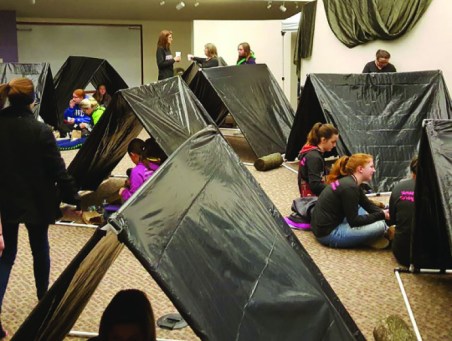
The IBSA Building was transformed into a refugee camp Nov. 5 for the annual AWSOM conference for young women (AWSOM stands for “Amazing Women Serving Our Maker”). Through an intensive, simulated overnight experience, this year’s AWSOM focused on helping the 222 students in attendance understand the plight of the refugee, and how they can help. Attenders also heard the stories of Christians who have lived with persecution (see boxes).

Alina Aisina – Central Asia

Aisina was born in a gospel-sensitive country in Central Asia to a Christian mother and an abusive, atheist father.
Aisina, her sister, and her mom eventually fled their city because their lives were threatened for what they believed. Aisina grew up with a lot of fear, she said, “Not knowing what tomorrow was going to bring and being afraid for my life.”
After receiving a shoebox from Operation Christmas Child, however, Aisina described the change in her life. While her physical life didn’t change, she said, her attitude did because she knew she wasn’t alone. She felt a loving Father looking after her by using strangers from another country to demonstrate Christ’s love for her through the shoebox.

After the simulated war broke out, the students, grouped in “families” of five, were instructed to find refuge in a neighboring country. They could only travel with limited items, however, and had to leave the rest of their belongings behind.

When the girls reached their temporary shelter, a setup of makeshift tents representing a refugee camp, they were given minimal supplies. Current and former missionaries dressed as border guards spoke only the language of the countries they served, to represent the foreign atmosphere to which refugees must adapt.

In the end, the family had to make the decision either to return home to their war-torn country, navigating elements such as land mines, or to apply for citizenship in the new country in hopes of building a new life.

The crisis is real
Prior to the simulation, International Mission Board missionary Christopher Mauger showed a brief aerial video clip documenting the plight of the Rohingya Muslims as they fled from Myanmar, formerly called Burma.

Mauger, who serves in Southeast Asia, described the situation as “desperate” and “unbelievable,” and as a crisis that “needs prayer.” “If they have to go down [to Bangladesh] for refuge, it’s really bad,” he said. “There’s nothing there.”

Mauger explained how “hundreds of thousands” of Rohingya Muslims have been exiting the country as a result of persecution from Myanmar’s government, which is Buddhist.

“For those who have a place to live, they are living in camps with plastic for roofing,” Mauger said. “They are crowded in small areas, food is scarce, and they don’t have any hygienic necessities.”

Mauger described how easy it is to get distracted with a situation like this by blaming the evil in this world. But by changing their perspective, he said, Christians can help. “We can tell these people about God,” he said, “by giving and supporting the Christian organizations that are helping in that area.”

Wendy – China

Wendy lives in China, where she partnered with Ronny and Beverly Carroll while they served as missionaries with the International Mission Board. The Carrollslive in Illinois, and Wendy visited Springfield to speak about the ministry she coordinates to help people long oppressed because of their beliefs.
During the Chinese Revolution in the 1960s, Wendy said, all forms of religion were repressed. While many Chinese Christians fled, others, including a man named Su, were imprisoned. After Su’s release 20 years later, Wendy’s ministry found him and helped him rediscover Christ. This was Su’s first encounter with a Christian in more than two decades.

Becki McNeely, a leader from Lakeland Baptist Church, said AWSOM “opened the students’ eyes to an increased awareness of the state of refugees.”

Several students echoed McNeely. One young woman described how it “must be hard to live in a persecuted country” after hearing the accounts of the speakers. Several more expressed their increased awareness of the refugee crises and were “saddened” at its reality.

Carmen Halsey, director of women’s ministry and missions, said IBSA is securing resources to inform churches about refugee issues. She added that she hoped the experience helped students to be able to “feel the psychological anguish caused by separation and flight” and to “see what forces people into refugee situations,” as well as adopting a more welcoming attitude towards refugees in their own country.

Go to vimeo.com/IBSA to view video from this year’s AWSOM conference.

-Andrew Woodrow

The Briefing

Housing allowance ruling allows 180 days for appeals
A federal district court judge in Wisconsin, as expected, has entered a final order declaring the minister’s housing allowance unconstitutional. The Dec. 13 order, however, has been stayed for 180 days after all appeals are exhausted, meaning it currently does not have any impact. Observers expect the government to appeal the order by Judge Barbara Crabb of the Western District of Wisconsin, who issued her ruling on Oct. 6 following a 2013 ruling she issued that was overturned.

New HHS abortion/contraception mandate rules blocked
In a Dec. 15 ruling, a federal court in Philadelphia blocked enforcement of the Trump administration’s new rules that exempt from the controversial requirement those employers that object based on their religious beliefs or moral convictions. The new regulations issued Oct. 6 by the Department of Health and Human Services (HHS) provided relief from a rule that requires employers to provide their workers with coverage for contraceptives, including those with mechanisms that can potentially induce abortions.

Johnson Amendment repeal removed from final tax bill
President Donald Trump’s biggest religious freedom policy promise to evangelicals—repealing the Johnson Amendment—will no longer take place via Republican tax reform. Senator Ron Wyden (D) announced Dec. 14 that the repeal included in the House version of the tax bill, which would allow churches and other nonprofits to endorse candidates without losing their tax-exempt status, was removed during the reconciliation process with the Senate version, which did not include a repeal.

Transgender teen suing Palatine school
Eighteen-year-old Nova Maday filed a lawsuit in Cook County Circuit Court Nov. 30, claiming that Township High School District 211 in Palatine has in the past denied the transgender teen use of the girls’ locker room during physical education class and more recently restricted Maday to an “unspecified private changing area within the locker room,” where no one else is required to dress.

Chick-fil-A performs works of necessity for stranded travelers
Atlanta-based Chick-fil-A answered the call from the city’s mayor and came to the rescue Sunday night to help feed thousands of stranded travelers at powerless Hartsfield-Jackson Atlanta International Airport. The Christian-owned fast-food chain is known for observing the Sabbath by closing its restaurants on Sunday, but it also recognizes that sometimes it is called to perform “works of necessity and mercy” on the Lord’s Day.

Sources: Baptist Press (2), Christianity Today, Chicago Tribune, World Magazine

Not waiting to worship

ib2newseditor —  December 18, 2017

jail cell

A worship service I attended recently was like no other I’ve ever seen. And I have seen quite a few.

When I arrived with the pastor and three other leaders, 10 minutes before the service was scheduled to begin, no one else was there. Then, precisely on time, about 70 worshipers arrived.

The first 10 minutes or so were “fellowship time,” as each and every worshiper joyfully entered, hugging the neck or shaking the hand of the pastor and leaders, including me as their guest.

As they did so, many of them volunteered to serve or lead during the service. The pastor noted each of their offers, and told some of them they would have to wait until next time, because we only had two hours to worship.

The good news has arrived, and those who have received it are free to celebrate.

Those who did join us in leading the service shared special music, or recited passages of Scripture they had memorized, or gave brief testimonies of God’s grace and goodness in their lives. One especially memorable man apologized for taking so long to slowly walk to the front, assisted by his cane. He said he was 71 years old, but more alive today than when he was 18, because of the Lord’s work in his life. He then sang a moving and joyful spiritual that had all of us clapping and joining in.

The open prayer time was passionate. One man transparently thanked God for recent victory over a temptation in his life, while another prayed through tears, thanking God for a healing contact from his ex-wife, the first one in 34 years.

When the pastor gave me an opportunity to speak, I found myself citing a passage from my own devotional time that week, rather than a more carefully rehearsed message. As I spoke from my heart and sought to apply that passage to their lives, the worshipers gave me their eager attention, and encouraged me with their amens and other signs of agreement.

Perhaps the most remarkable thing to me about that worship service, however, was that I was told there is a “waiting list” to enter it that is about four times larger than the room can hold. You see, that unusual worship service was within the walls of one of our Illinois prisons on a Saturday night, and those worshipers were its residents. The leaders were from one of our Baptist churches that has led a ministry there for over 20 years.

As Christmas now approaches, I am reminded that the good news of Jesus’ birth came first to a humble group of shepherds. They were in many ways “confined” themselves, in poverty, in low social status, with limited freedom or opportunity, and with little hope of a brighter future. Yet the Bible tells us they were also men who were “abiding” and “keeping watch.” When the good news about Jesus invaded their darkness one night, they eagerly received the news and ran to meet him.

That’s what I felt in prison that Saturday night. There was certainly a darkness, a sense of oppression as I walked through multiple security checkpoints. But inside, the good news had arrived, and those who had received it now enjoyed a freedom to worship and celebrate that is all too rare outside the prison walls.

As we encouraged those worshipers to share the good news about Jesus with others, as did the shepherds, their enthusiastic responses told me they already were. I guess that’s why there is a waiting list for the Saturday night worship service. And I guess it’s why we should all receive the good news humbly this Christmas, grateful that we do not have to wait to worship him.

Nate Adams is executive director of the Illinois Baptist State Association. Respond at IllinoisBaptist@IBSA.org.