
Archives For November 30, 1999

Vote Yeah

Editor’s note: Messengers to the 110th Annual Meeting of the Illinois Baptist State Association passed a resolution encouraging Illinois Baptists to vote biblical values when they go to the polls.

WHEREAS, God has ordained government to reward good and to punish evil (Romans 13:1–5, 1 Peter 2:13–14); and

WHEREAS, Jesus described His followers as “the salt of the earth” and “the light of the world” (Matthew 5:13–16), indicating the Lord’s desire for believers to exercise a beneficent influence on their surrounding society; and

WHEREAS, believers in Illinois and in the United States enjoy a constitutionally granted opportunity to influence not only the nation, but also states, regions, and communities by voting for those seeking the country’s highest office and for other elected officials; and

WHEREAS, The Baptist Faith and Message affirms that “all Christians are under obligation to seek to make the will of Christ supreme in our own lives and in human society” and that “every Christian should seek to bring industry, government, and society as a whole under the sway of the principles of righteousness, truth, and brotherly love”; and

WHEREAS, ”every pastor is called to help his congregation think biblically about all aspects of life: including current cultural issues. The media, pop culture and political pundits relentlessly bombard your people with messages untethered from a Christian worldview. But you have the privilege of both helping your congregation filter those messages, and discipline your congregation in the practical theology of Christian living at the intersection of faith and politics.” (Christiana Holcomb, Alliance Defending Freedom); now, therefore, be it

RESOLVED, that Southern Baptists and all followers of Jesus Christ in the United States be reminded that the nation’s hope ultimately is not in political processes or governmental power, but in God alone; and be it further

RESOLVED, that the messengers to the Illinois Baptist State Association meeting in Broadview, Illinois, November 2-3, 2016, give thanks to God that He has placed us in a nation with freedom of expression and opportunity to influence our national and state governments, a freedom secured at a high price, even with shed blood on the battlefield; and be it further

RESOLVED, that we encourage Illinois Baptists and all followers of Jesus Christ to participate in the democratic process by voting; and be it further

RESOLVED, that we choose for our leaders wise leaders who reflect godly character; leaders who are righteous (Proverbs 16:12); are not greedy (Proverbs 29:4); practice self-control (Proverbs 31:4-5; 20:1); are sexually moral (Proverbs 31:3); have personal integrity (Proverbs 17:7; 20:28); fear God (Proverbs 1:7; 29:18); seek wisdom (Proverbs 8:15, 17:15; Romans 13:4; 1 Peter 2:14); and show compassion to the helpless (Proverbs 22:22-23, 29; 23:10-11; 29:7; 31:8-9); and be it further

RESOLVED, that we prayerfully urge our friends and neighbors to do likewise; and be it further

RESOLVED, that we prayerfully urge all candidates for political office to endorse the biblical values upon which society should rest; and be it finally

RESOLVED, that we commit ourselves to pray earnestly for God to bring spiritual, moral, ethical, and cultural renewal to our nation.

The Curse is Gone

ib2newseditor —  November 4, 2016

What one Illinois pastor (and Cubs fan) learned from the World Series

cubs-logoEmotions in Wrigleyville soared high in the late innings of Game 7. With a three run lead, coming off a blowout win in Game 6, victory seemed inevitable. But then, there’s the curse.
The night before, Aroldis Chapman had been controversially brought in to prevent any hope of a late game rally, and ensure there would be a Game 7. As Chapman took the mound, the Cubs were only four outs away from reversing the curse. And then it happened. Ramirez scored on Guyer’s double, then Rajai Davis’s two run homer tied the game, and as the rain began to fall one had to wonder if the heavens were weeping over the unshakable clutch of “the curse.”

In 1945 William Sianis was asked to leave Wrigley Field after complaints were made about the odor of his pet goat, Murphy. It was Game 4 of the World Series, and as Sianis and Murphy departed Wrigley, Sianis uttered the words; “You are going to lose this World Series and you are never going to win another World Series again. You are never going to win a World Series again because you insulted my goat.”

The Cubs lost the 1945 World Series to the Detroit Tigers beginning Major League Baseball’s longest championship drought and the legacy of the “Billy Goat Curse.” For the next seven decades, the Cubs would not even appear in a World Series.

The Bible, also, warns of a curse. It is a curse that came as the consequence of open rebellion against God (Genesis 3:14-19). It crushes all hope of victory. Our inability to tame our addictions and carry out what we know to be right creates endless cycles of crippling frustration, guilt, and shame.

But the “Curse of the Billy Goat, “it is no more. Ben Zobrist’s opposite field double off Bryan Shaw put the Cubs ahead for good in an 8-7 victory that clinched the World Series and crushed the curse for good.

But what about our curse? What can bring an end to the curse, its frustrations, guilt, and shame? When will we experience the catharsis of victory over sin? Perhaps, just as Ben Zobrist’s bat provided the answer to the Cub’s curse in Game 7, maybe his words can be the catalyst for deliverance and hope from the Curse of Sin:

In a 2013 interview with the Fellowship of Christian Athletes, Zobrist made the following statement, “We all need grace. We all need Christ. I still have a lot to learn about what the love of Christ is like. That it’s not just knowledge, but it’s allowing the truth to change you, allowing Christ’s message of grace and hope and love through the cross, that that message is the message that changes the way we look at everything in our lives.

The Apostle Paul said, “Christ redeemed us from the curse of the law by becoming a curse for us—for it is written, ‘Cursed is everyone who is hanged on a tree’” (Galatians 3:13). Now, for those who place faith in him, he has crushed the crushed the curse for good.

Major Dalton is pastor of First Baptist Church in Winthrop Harbor, IL.

Broadview | Whatever happens in the general election, preach the Word—and stick to the Word—speakers at the 2016 IBSA Pastors’ Conference exhorted their audience. The first day of the meeting at Broadview Missionary Baptist Church in metro Chicago coincided with the concluding games of the World Series, so several of the speakers got in on the Cubs banter, but ultimately the stuck to the Word.

david-sutton

David Sutton

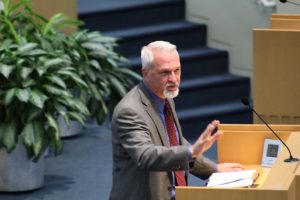
“We think about what’s going on in our world today,” said pastor David Sutton of Bread of Life Missionary Baptist Church in Chicago, who also served as president and organizer of the event. “So much grief,” he said, referring to a record number of shootings in the city the previous weekend. “When I think about this being an election year, it seems to further exacerbate things—there are so many things we can allow to divide us—even where we live, if we live in a rural town or a large community.”

The theme for the conference is “Crossroads, our pathway to reconciliation,” building on the “Cross Culture” theme of the IBSA Annual Meeting which will follow the pastors’ gathering.

“I believe God has called us together for such a time as this, even as we stand together in such a divided time,” Sutton said, pointing out the dichotomies of Illinois’ geography and population. “We come from so many different groups and backgrounds, [but] even in our differences we can come together…. I heard one preacher say we may not agree on everything, but that doesn’t mean we can’t walk together hand-in-hand.”

The featured preachers built on that theme, repeatedly igniting the crowd of pastors from Northern and Southern Illinois, black and white and Hispanic and Asian, in cheers and applause.

fred-luter-2

Fred Luter

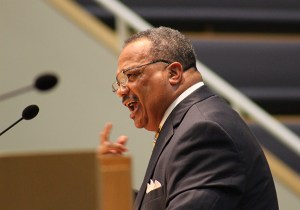
“If God can change you and me, the same God can change their lives,” said Fred Luter, pastor of Franklin Avenue Baptist Church in New Orleans, speaking of lost people, particularly those engaged in drugs, gang activity, and a litany of sinful lifestyles he enumerated.

“In your B.C. days, in other words, in your ‘before Christ’ days, what did it take to change you? Before you stopped drinking, before you stopped shacking up, before you stopped using the N-word, before you stopped going to casinos and playing the lottery (I hoped you stopped!)… you heard the gospel! You heard the gospel of Jesus Christ! You were transformed by the power of the gospel…. The same gospel can change our city and can change those knuckleheads in our streets!”

Luter, who served as the first African American president of the Southern Baptist Convention, urged the crowd: “Come on preachers, let’s preach the gospel of Jesus Christ! Come on teachers, let’s teach the gospel of Jesus Christ! Hallelujah, Jesus saves!”

scott-nichols

Scott Nichols

Illinois pastor Scott Nichols of Crossroads Community Church in Carol Stream, said “reconciliation is painful, hard work” but it’s our calling for “those in the grip of sin…because God’s done reconciliation in my life. Our purpose is not growing our church. The purpose is making us like Christ. The purpose is winning the world to Christ,” Nichols said.

Politics was overshadowed by Gospel in the preaching and in the breakout sessions. “Leave the political stuff alone, that is only going to divide,” said Ron Gray, pastor of The Connection Church in Chicago, in a breakout session.

“With all this is going on around us, someone should be asking ‘Is God trying to tell us something?” said H. B. Charles, Jr., a skilled expositor and pulpiteer from Jacksonville, Florida.

hb-charles3

HB Charles, Jr

“God speaks by his actions, but God also speaks by in his inactions.” There is the wrath that is due man’s rebellion, “and there is the wrath of abandonment” for those who persist in the sins listed in Romans 1, as God turns them over to the outcomes of their sins.

As several speakers said, whatever the outcome of the election on November 8, the next day God will still be on the throne and in charge. “I was tempted to label this sermon the unelected and unimpeachable king!” Charles said. “His almighty Son has already been appointed King, and he is not up for re-election.”

“Thank you, Lord!” came the reply from the pews.

By Marvin Del Rios

Editor’s note: This post is the last in a series on cross-cultural ministry, taken from a round table discussion between four Illinois pastors and leaders. Click here to read more from their conversation, published in the September 29 issue of the Illinois Baptist newspaper. 

marvindelriosMarvin Del Rios is pastor of iglesia Bautista Erie in Chicago. He will lead worship during the Thursday morning session of the Illinois Baptist State Association’s Annual Meeting at Broadview Missionary Baptist Church in Chicagoland, Nov. 2-3. The theme of the meeting is “Cross-Culture.”

Defining ‘cross-cultural ministry’
When I hear “cross-cultural ministry,” I go to the book of Acts, chapter 6, which talks about the differences between the Hellenistic Jews and the Jews that come from their own land. That is something that we are living within Hispanic or Latino churches right now, which is the way our generations relate to one another.

The first generation can become accustomed to a certain way of preaching, a certain way of leading worship, a certain way of “doing church” right. The second and third generations are more familiar with American culture, education, lifestyle, and language. What is happening is that there is unfortunately an exodus of the second and third generations that are leaving the church. Either they’re leaving completely and not coming back, or they’re going to a more English-based or multicultural church.

On a pastor’s responsibility
Even though I am called to go and preach to the nations, I have a burning desire to go and reach my second- and third-generation Latino culture. Unfortunately, there is a huge disconnect with the first, second, and third generations, even though we may speak the same language and may have some of the same traditions.

 We have tried to make our church a hub for the community.

Even though I am a second-generation Hispanic leading a predominately first-generation church, a few people that are second-generation have seen me model trying to minister and take care of that first generation. And now, the first generation is taking the extra step to learn a little bit more English. All of that happened with modeling. I could have said, “Fine, I’m concentrating on the second and third generations, and that’s it.” But we still have that need for the gospel for all generations and cultures. It is our responsibility to see it through and make it happen.

On inter-generational outreach
My approach has been to let get something going well with our second-generation people, so they can take it back to the first generation. Usually we hear about the first generation ministering to the second generation, but now it is starting to turn around.  Now it is the second generation ministering to the first generation. Because of that dynamic, we also are ministering to the young professionals in our community and trying to see where we can come out of our comfort zone.

We have tried to make our church a hub for the community. Now we are housing an AA meeting for families and a lot of contemporary culture kinds of programs. In a nutshell, the people in our community know we are there to serve. Is it happening really fast? No, I wish it would be faster. But it is getting to the point that we are seeing more of the gospel leading out, instead of the gospel just being planted in our church and staying there.

Missions opportunities to highlight gathering in Metro Chicago

Final preparations are under way for the 110th IBSA Annual Meeting November 2-3. The event at Broadview Missionary Baptist Church in metro Chicago will focus on cross-culture ministry opportunities in Illinois. The keynote speaker will be Dr. Jeff Iorg, president of Gateway Seminary of the SBC, called Golden Gate Seminary prior to its relocation from the San Francisco Bay Area to metro Los Angeles this year.

“Dr. Iorg is among the most compelling, thoughtful, and missional voices in Southern Baptist life today, especially when it comes to understanding post-Christian culture in America,” said IBSA Executive Director Nate Adams. “I’m so grateful that he is leading our West Coast seminary into the future, where pastors and leaders will engage values and cultures that are already very different from those of the past century.”

I hope this year’s Annual Meeting will bring to all of us a new vision and higher level of commitment to ‘cross culture’ with the gospel.

Iorg is a former church planter and state convention executive director in the Pacific Northwest. As a leader of Southern Baptist work on the West Coast, Iorg has addressed many of the cultural challenges now facing evangelicals in the Midwest. He has written frequently on theological and biblical perspectives on marriage, sexuality, and gender. His book “Building Antioch” shows from the New Testament how an ordinary believing congregation can become a transformational community.

“Illinois Baptists will come away from Dr. Iorg’s messages challenged and transformed, I’m sure,” Adams said.

The Wednesday evening session, including Iorg, will focus on a four-phase process for engaging ministry across cultural barriers. Adams will outline the plan and share testimonies and videos of Illinois churches carrying the gospel to people unlike themselves.

“My own recent trips to Chicago have reminded me again how diverse our churches are, and even more so how varied and challenging are the cultures that our churches need to reach,” Adams said. “I hope this year’s Annual Meeting will bring to all of us a new vision and higher level of commitment to ‘cross culture’ with the gospel.”

IBSA President Kevin Carrothers, pastor of Rochester First Baptist Church and Vice President Adron Robinson, pastor of Hillcrest Baptist Church in Country Club Hills, will also bring messages.

In addition to the session on the variety of ministry opportunities in Illinois, the meeting will include two business sessions on Wednesday afternoon and Thursday morning. Vision tours of Chicago-area ministry opportunities are available. Seating is limited, so online registration is encouraged.

Visit www.IBSAAnnualMeeting.org to learn more.

By Kevin Carrothers

Editor’s note: This post is one in a series on cross-cultural ministry, taken from a round table discussion between four Illinois pastors and leaders. Click here to read more from their conversation, published in the September 29 issue of the Illinois Baptist newspaper. 

kevin-carrothersKevin Carrothers is pastor of Rochester First Baptist Church and president of IBSA. He will deliver the president’s message Wednesday, Nov. 2, during the Illinois Baptist State Association’s Annual Meeting at Broadview Missionary Baptist Church in Chicagoland. The theme of the meeting is “Cross-Culture.”

On being an influential church
I was a couple of years into my ministry in Rochester when I sat down with a leader in town. I asked him, “What do you think about when you hear Rochester First Baptist Church? What comes to mind?” His words weren’t really a rebuke, but I didn’t like what he said. He said “You’re a nice little church.”

Well, we are a small church, unapologetically a small church, but that was his perception, a “nice little church.” Now, hopefully that has changed since then. Now, we’re “the church that does the party” (our annual fall festival). Or we’re the church that does VBS in the summer in a way that spreads the gospel to our community.

We don’t have to be the biggest church but we can still be the most influential church.

I don’t want to just be the nice little church, but we are still little. The word that I want is influence. We don’t have to be the biggest church but we can still be the most influential church.

On ‘incarnational’ ministry
God was incarnational with us—he sent Jesus to live among people. Likewise, we need to be incarnational. Sometimes I think that’s where we kind of miss the boat in the church. We think we have to come up with a new program or a new ministry. Instead, let’s find out who is doing something and go be involved in that.

For me personally, being incarnational is volunteering at my kid’s school. On my day off, I spend a couple hours at the schools and have a presence there. That makes an impact. It’s coaching Little League or youth basketball. You’re there with people. Then, you have to be intentional about making sure the gospel becomes known, about making sure that they know this is who you are.

It gets back to all the things we have been talking about. Cross-culturally we have to love our community; we have to show them that we care. We have to go where they are.

By John Yi

Editor’s note: This post is one in a series on cross-cultural ministry, taken from a round table discussion between four Illinois pastors and leaders. Click here to read more from their conversation, published in the September 29 issue of the Illinois Baptist newspaper. 

john-yiJohn Yi is IBSA’s second-generation church planting catalyst in Chicago, founder of a community ministry in Maywood, and a leader at Bethel SBC, a church plant in Mt. Prospect. Visit John at the virtual vision tour sponsored by the IBSA Church Planting Team during the IBSA Annual Meeting Nov. 2-3 at Broadview Missionary Baptist Church in Chicagoland.

On living where you serve
I think my wife and I always knew that once we got to the place where we would set down our roots ministry, we would have to live in the community where we were going to do our work.

We were not going to be commuting. That was something we had both experienced in our young adult years—traveling to go to church. In fact, until we lived in Maywood and started our ministry there, I don’t think I had ever lived and gone to church in the same town.

…the sacrifice might mean having to pull up your roots and go to a place that feels very uncomfortable and unnatural to you.

We lost some other comforts in the move too. A lot of our friends are away from us too.  We were distant from the people with whom we felt comfortable.

On becoming a community church
We still live in Maywood. And in the years since our move there, we’ve learned the sacrifices were worth it. I think in order to be cross-cultural, there has to be a weighing of what is not necessary for the sake of ministry. We have done that at our church, Bethel SBC, too. Part of us wanting to become a community church means we really have to become less Korean.

In Korean churches it is almost a universal practice to have a lunch fellowship after the worship service and it is almost always Korean food. When I first proposed not doing Korean food anymore, there was an uproar. I’m like, “Why can’t we just do sandwiches or order pizza once in a while, or do spaghetti and meatballs?”  That’s how it was at the beginning, but now I can’t even remember the last time we had a Korean meal at church.  Our members have really taken to this idea that we really have to make it more accessible. We want to get rid of all the barriers, and I think that is one of the sacrifices we have to sometimes make.

And sometimes, the sacrifice might mean having to pull up your roots and go to a place that feels very uncomfortable and unnatural to you.  We know missionaries do that all the time when they go to a foreign country, but when you weigh the value of the gospel and the Kingdom of God, I think sometimes those things that seemed so important to us start to lose their luster.

Which church are you?

ib2newseditor —  October 26, 2016


By Adron Robinson

Editor’s note: This post is one in a series on cross-cultural ministry, taken from a round table discussion between four Illinois pastors and leaders. Click here to read more from their conversation, published in the September 29 issue of the Illinois Baptist newspaper. 

adron-robinsonAdron Robinson is pastor of Hillcrest Baptist Church in Country Club Hills and vice president of IBSA. He will deliver the annual sermon on Thursday, Nov. 3, during the Illinois Baptist State Association’s Annual Meeting at Broadview Missionary Baptist Church in Chicagoland. The theme of the meeting is “Cross-Culture.”

On finding an identity
Every church is going to be “that” church. People are going to say that’s the church that does this, or that church does that. As leaders, we need to get out front in defining what our church is going to be known for. John 13:35 just comes to mind: “By this all people will know that you are my disciples, if you have love for one another.” Your church needs to be known for showing your community God’s love in some way.

Your church needs to be known for showing your community God’s love in some way.

I grew up next door to a church. The church’s driveway was right in between it and the house where I was raised. Growing up, I thought the driveway was ours because we never saw church people until Sunday. On Sunday, they would come in and park on the street and fill up the driveway. They would be in the building all day and you would hear the music, but the rest of the week, the building was empty.

The church was just “that” church next door. When they came around on Sunday, they were “those” church people.  The complaint among the neighbors was that they took up all our parking. Other than that, they had no interaction whatsoever with the block, not to mention the rest of the community.

On engaging your community
Churches can do a great service to their community just by being good neighbors, and engaging people around them. Go be a coach, or just be a parent watching your kids play on a local sports team. Let people see the love of Christ in you. You don’t have to always be carrying a big Bible around, but just get to know people and start the relationships and let your love for the Lord be seen amid those interactions. You do much more for the gospel that way.

I think we try to reinvent the wheel too much. The community is already gathering together; go to those areas and take the gospel with you.

The BriefingVideo gambling’s big in Illinois
Add up all the video gambling machines scattered in small venues across Illinois — there are more than 24,000 machines, the equivalent of 20 casinos — and you’re talking real money. The amount of money left over after paying video gambling winners for the first time exceeded $1 billion in fiscal 2016. That’s a 27% increase, making video gambling the hot hand in Illinois’ gaming industry.

Liberty students rebel
Now, Liberty students are opposing their leader’s presidential endorsement, writing in a Washington Post opinion piece, “In January, Liberty University President Jerry Falwell Jr. endorsed Donald Trump for president of the United States. As Liberty students, we watched as the leader of our school loudly and proudly advocated for a man many of us felt compelled to oppose. Trump’s flagrant dishonesty, consistent misogyny and boastful unrepentance made many of us feel the need to publicly express disagreement with President Falwell’s endorsement.

Refugees resettled at record rate
Last month, World Relief nearly doubled the number of refugees it resettles in the United States in a typical month. In the past 12 months, the evangelical agency handled a caseload of 9,759 refugees—its largest total since 1999. The milestone comes at the same time as major setbacks to the effort to ban Syrian refugee resettlement in Indiana and Texas.

State must fund Planned Parenthood
A federal judge Thursday blocked a Mississippi law that prohibited Medicaid payments to any healthcare provider that offers abortions. Two Planned Parenthood affiliates filed suit against the law, which blocked all Medicaid funding, including payments for non-abortion services such as birth control, to any facility affiliated with an abortion provider.

U.N. to appoint LGBT advocate
The lesbian, gay, bisexual and transgender agenda is gaining traction at the United Nations, as it organization prepares to vote on appointing an “independent expert” to “assess the implementation of existing international human rights instruments with regard to ways to overcome violence and discrimination against persons on the basis of their sexual orientation or gender identity, and to identify and address the root causes of violence and discrimination.”

Sources: Chicago Tribune, Washington Post, Christianity Today, World Magazine, Baptist Press

The Faith Frontier

ib2newseditor —  October 24, 2016

Illinois has come a long way, but we still have a way to go

Illinois IL State United States of America 3d Animated State Map

When Illinois became a state in 1818, fewer than 100 people lived in Chicago, and less than that at Calhoun. The hubs of activity were places such as Kaskaskia, on the banks of the Mississippi River. The town swelled to 7,000 when it became the first state capital for one year. Then bustling Vandalia was the capital for 20 years, until Abraham Lincoln and a few others had the capital moved to Calhoun in 1839. Calhoun had been renamed after Springfield, Massachusetts, a center of trade, creativity, and innovation. They had high hopes for their new Springfield—and for all of Illinois.

Catholic priests came to the area early, following French trappers and traders into St. Louis and later Chicago, building a few churches and converting a few Native Americans. The trappers were largely unconverted. Baptists and some Methodists were on scene by 1781, starting the first Protestant congregation in Illinois and building a Baptist meeting house at New Design, across from St. Louis on the river.

Illinois was a frontier state 200 years ago. Today, in many ways, it still is.

Almost 13 million people live in Illinois. But in terms of faith, the state is wild and untamed. At least 8 million residents do not know Jesus Christ. As the population grows, the percentage who identify with any religion at all continues to decline.

The state’s population hubs are our largest mission fields, especially metro Chicago and metro East St. Louis. Our cities are teeming centers of commerce and education, with growing populations of immigrant peoples.

The last census showed Hispanic and Asian populations are the fastest growing ethnic groups in the state. In fact, the Hispanic population grew in all but one of Illinois’ 102 counties.

In Illinois, nine people groups are unreached with the gospel because of language and cultural barriers, but literally millions of English-speaking and culturally mainstream people have never heard the message of salvation in a way they have understood and believed.

On our college campuses, for example, almost 900,000 students represent a mission field with enormous potential, and historically the lowest percentage of believers among young adults ever.

The cultural withdrawal from the Christian faith is felt all across Illinois—in cities and university settings, in small towns and crossroads communities. The northwest quadrant of Illinois is one of the least-Christian areas in the nation. And scattered across the state, there are nine counties that have no Southern Baptist congregation, 12 counties have only one, and many more have minimal evangelical presence.

In 40% of Illinois counties, less than 1% of the population identifies as Southern Baptist.

By faithful, regular, systematic giving to missions through the Cooperative Program, Baptists together serve as missions pioneers, in our frontier territory in Illinois and around the world, wherever the gospel is needed.