Archives For November 30, 1999

Open empty tomb. Watercolor painting

The day of Jesus’ resurrection has always been an orienting point for Christians. From the beginning, it was the day for their weekly gatherings. Later it became a pivotal day in the annual Christian calendar.

Prior to Easter each year, we reflect on Jesus’ perfect submission — from His victory over Satan’s temptations in the wilderness to His ultimate act of obedience on the cross. We examine our own devotion and deal intentionally with the temptations and distractions that keep us from full obedience.

Then, on Easter, the commemoration of Jesus’ resurrection pivots us from contemplating the humility of the suffering Lamb to celebrating the power of the risen Lamb; from identifying with the crucified Servant to exalting the victorious Savior.

This shift is rooted in the events that occurred on the very day of Jesus’ resurrection, beginning with the question posed to the women who went to His tomb: “Why are you looking for the living among the dead?”

Easter posture is not, however, merely standing and facing the resurrected Lord. It is standing and facing our future because of His resurrection.

It is true that the question had something to do with their location at the tomb. Luke reports, however, that the women had “inclined their faces to the ground” and that this posture prompted the messengers’ question. Why? Because early Christians knew they lived in a world governed by the words of Genesis 3:19: “You will eat food by the sweat of your brow until you return to the ground, since you were taken from it; for you are dust, and you will return to dust.” The women’s posture that morning was entirely reasonable in light of these words. Each and every body laid in a tomb would return to the ground, the dust.

A change had occurred that morning, however, that the women’s posture did not reflect. Jesus’ resurrection had brought about a new posture. The women should not be inclined toward the ground looking for Jesus but standing and facing Him as their risen Lord.

Easter posture is not, however, merely standing and facing the resurrected Lord. It is standing and facing our future because of His resurrection.

Forty days prior to Easter, some Christians have ash placed on their foreheads and hear the words: “Remember that you are dust and to dust you shall return.” They are reminded of the brevity of life and the urgency of present obedience.

The question is good for you to hear: Why do you seek for the living among the dead?

If you have been to a funeral this past year, you don’t need an ashen symbol to remind you of the brevity of life or that death still grips creation. As you inclined your face toward the body that was to be placed in the ground, you were confronted with the fact that this is not how God created that person. The eulogies testified to the fact that there is no one in the world who spoke, sang, laughed or loved like the one whose body lay in the casket.

It is at just this point where the women’s lesson is vital for us because the Easter posture is a posture of hope. Death results in the body returning to the ground — for now. Sorrow and grief are real — for now. Because of Jesus’ resurrection, however, we can stand and face our future with hope. The apostle Paul says it this way: “But now Christ has been raised from the dead, the firstfruits of those who have fallen asleep. For since death came through a man, the resurrection of the dead also comes through a man. For as in Adam all die, so also in Christ all will be made alive. But each in his own order: Christ, the firstfruits; afterward, at His coming, those who belong to Christ” (1 Corinthians 15:20-23).

Are you struggling to face your future? Maybe you have experienced a great tragedy in your life: the death of a friend or family member, a diagnosis of a terminal disease. Maybe the loss of someone or something that has provided security has shaken your confidence in the future: the betrayal of a close friend or spouse, the loss of a job. Maybe anxiety is just your persistent struggle; you struggle to face the future even in the absence of crises.

The question is good for you to hear: Why do you seek for the living among the dead?

Allow the fact of Jesus’ resurrection to give you the confidence to face your future. With His resurrection in mind, stand up and face your future with hope.

Christopher Graham is assistant professor of theology at Criswell College and its program director for the master of divinity degree and master of arts in theological and biblical studies. This article is adapted from the Southern Baptist TEXAN (www.texanonline.net), newsjournal of the Southern Baptists of Texas Convention.

Jesus is our great hero

ib2newseditor —  April 14, 2017

Hero

All of my life, I have looked for heroes whom I could love, respect, and follow. There is an old photo of me as a small boy with my brother, standing in the backyard with towels pinned around our necks. We were trying to be like Superman, ready to fight against the bad guys and fight for justice. He was probably the first hero we had as children.

During my teenage years, I played the guitar and wrote songs, so my heroes became famous musicians who displayed their lyric artistry in recordings and concerts. When I entered the ministry, I turned to those pastors and authors whose words had profoundly shaped me. They became my heroes to admire and emulate. Later, when I became a classroom teacher, I loved to read stories about the great teachers and their influence on students.

It seems that no matter what stage of life I was in, I was constantly looking for and looking up to heroes.

I know I am not alone in my search for heroes. It’s something we all do throughout our lives. But what is more intriguing is that no one ever instructs us on the need to find and emulate heroes. In addition, no one ever explains to us the characteristics our heroes should have. We seem to be wired to look for men and women whose lives display something good, beautiful, and noble — something that tastes of glory. Think about the heroes you have admired, and you will see something of those same qualities.

Our hero worship, however wrongly directed, is an understandable longing for what has been tragically lost.

But there is something else even more intriguing. We have all engaged in something that can best be described as hero worship. It’s not just that we love, honor, and respect our heroes. We do something to them akin to worship, putting them on a pedestal and expecting things from them that they cannot possibly give. The disappointment that comes is inevitable, yet we keep hoping for heroes to come and save the day, whether it’s the new church pastor, the new government official, or the new company boss. Our search for and disappointment with our heroes can generate enormous confusion. I know it has for me.

The Bible shines a unique and penetrating light on this confusion. Paul says that “all have sinned and fall short of the glory of God” (Rom. 3:23, CSB). The idea of falling short is that we are missing something and are now destitute and lacking. What are we missing? The glory of God. We were meant to bathe in that glory and then radiate it out as His image-bearers, but in turning away from Him, we lost the glory and now live in sin and shame. Yet, the longing for glory never leaves us, so when we sense a glimmer of that glory in someone else, however faintly, the draw is magnetic.

Without deliberation or hesitation, we immediately know that this is what humans were meant to be like, what we, in fact, were meant to be like. Our hero worship, however wrongly directed, is an understandable longing for what has been tragically lost. But the Bible’s story of glory doesn’t end there.

He loved and served and gave without expecting anything in return for Himself.

Enter Jesus. John states that he saw the glory of Jesus, the glory of being God’s unique Son, the glory that took on flesh and came to dwell among us. (See John 1:14.) And how did that glory dwell among us? As the hero we have all longed for. Everything Jesus did was heroic.

He spoke the truth, even when it made Him enemies.

He did good works wherever He went, healing the sick, freeing the demon-possessed, and preaching a message of hope. He loved and served and gave without expecting anything in return for Himself.

And in the end, Jesus gave His life away for the sake of the entire world. He chose to take our place by bearing our sin and shame so that we could be set free. He did everything we ask of a hero and so much more. He is not only the King of kings and Lord of lords, but truly the Hero of heroes.

What should our response be to the Savior of our soul? Our misdirected hero worship should rightly reside and remain on Him. He is the great Hero we have all been looking for, the One who perfectly lived in the Father’s glory and radiated it out to all. Our hearts long to find someone to respect, honor, adore, and love. Because of Christ’s defeat over death and sin, we can now place that longing on Him and never again be disappointed. Yet, in the end, He will do something even more marvelous, something with eternal significance: He will turn us into creatures filled with glory like Himself. We will one day feel again the glory we tragically lost — the glory that will move us to our purest worship of Jesus, our Great Hero.

Bill Delvaux, author of Landmarks (B&H) and Divided (Thomas Nelson), leads Landmark Journey Ministries as a speaker, small group coach, and spiritual director. This article first appeared in Mature Living, a publication of LifeWay Christian Resources. Learn more at LifeWay.com/magazines.

the crown of thorns of Jesus Christ and a nail on the Holy Cross

April is typically a dismal month, often dark and rainy, snaps of the cold still hanging on.

Easter is a bit like April, offering something dark and something bright. Our Good Fridays fill us with mourning and lament, a fresh reminder of the evil that Satan brought to bear on the world 2,000 years ago. Imagine the agony of the disciples who had experienced both the triumphant words of Jesus’ new kingdom and the stunning arrest and crucifixion of their long-promised Messiah.

And, yet, those same disciples — scared, fearful, scattered — gathered in a room and on a mountain top and saw, improbably, their same Messiah. He was apparently alive. They touched Him. They ate fish with Him. They saw His footsteps in the sand. A new day was indeed coming. The kingdom He promised was here.

We live in both a Good Friday world and an Easter world. Our God isn’t dead, but the vestiges of death still hang over the cosmos.

But, like April, there would be both darkness and light in this new era of the church. They’d preach a message of repentance and hope, of a kingdom here and yet not fully here. They’d endure persecution and scorn but could look through the raindrops of peril and see the bright rays of heaven.

This is what the church has been doing ever since. We live in both a Good Friday world and an Easter world. Our God isn’t dead, but the vestiges of death still hang over the cosmos. Sickness, disease, famine still strike. Evils of racism, poverty, and violence turn image-bearers of God against each other. Is there hope? people wonder aloud. And every Easter, we turn our eyes toward a naked figure on a cross and an empty hole in a middle-Eastern hillside.

We say on Easter that there is another story about the world. A story that both encompasses the deep grief of a twisted world and the deep longing of hearts that yearn for a new world to come. That new world is both here in the people God is calling to Himself in Christ, and it’s coming in the fully consummated kingdom to come.

So as Christians, we look past the sorrow and pain of the present world because we know that, in Christ, a better world is both here and is to come. We mourn death on Good Friday and celebrate the death of death on Easter. We point a confusing world to a better story than the one they’re telling themselves.

Every raindrop of sorrow, every storm of evil, every flood of disappointment is only a temporary experience. One day the skies will open and the heavens will flood the earth with the joy of the Lord.

Daniel Darling is the vice president for communications for the Ethics & Religious Liberty Commission of the Southern Baptist Convention. This article first appeared in HomeLife, a publication of LifeWay Christian Resources. Learn more at LifeWay.com/magazines.

silhouette of cross

I was completely blindsided after being called into a meeting at my church with another woman in leadership who had been upset with me for months. But sadly, I had no idea until she told me in our meeting that morning.

Months earlier, someone told her I didn’t agree with her leadership style. But that wasn’t what I’d said in a team meeting with several other leaders. Our women’s ministry director had asked my opinion about leadership training, and I shared my thoughts, but nothing I said was directed at her.

We both volunteered countless hours in ministry, pouring our hearts and lives into women in our church. All the while, we were on the same team, and I assumed we fully supported one another. But now the trust we had built for years was unraveling.

Driving home, my spirit felt crushed. It felt like I just didn’t have it in me to keep pouring out with the risk of being misrepresented and misunderstood again. I wasn’t strong enough or resilient enough. And I was exhausted from the hurt I felt and hurt I had caused.

By God’s grace, I chose to die to my fears and rise again in His courage by relying on Christ in me to navigate this very difficult relationship, leadership, and ministry situation.

That afternoon, I sat in my home office in tears. Laying my head down on my desk, I told God, I can’t do this anymore. I’m done.

After telling Him all the reasons why it was time for me to quit, a truth buried deep in my heart rose to the surface: “I have been crucified with Christ, and I no longer live, but Christ lives in me. The life I now live in the body, I live by faith in the Son of God, who loved me and gave himself for me” (Galatians 2:19b-20).

With my eyes closed, I pictured Jesus crucified. Arms stretched wide and willing. Willing to give His life no matter what it cost Him. Willing to be misunderstood, misrepresented, questioned, rejected, betrayed, and hurt beyond comprehension.

Tears streaming down my cheeks, I thought about Jesus on the cross. And I sensed Him asking me to die to my fears and let Him live His life and grace through me. My eyes still closed and dripping with emotion, I saw the scene of Golgotha with Jesus nailed in cruciform. But this time, there was a shadow of the cross behind Him, and I sensed the Holy Spirit telling me to lie down on the floor in the shadow of the cross.

I had never had this kind of encounter with God, but I sensed it was His way of showing me how to die to my fears. How to live crucified with Christ and find strength in His resurrection power, exchanging my brokenness for His humility and strength.

Lying in the shadow of the cross, I rested and waited for strength to get up again. Strength to stand at the crossroad and decide. Would I walk away from God’s calling on my life or allow Jesus to live His life through me? Would I protect myself from getting hurt again or live by faith in the One who died for me?

Being misunderstood and misrepresented makes it especially difficult to stay the course and pour ourselves out for Christ and others.

On our own we aren’t enough. Not strong enough, resilient enough, or humble enough. But Christ in us is more than enough.

Jesus didn’t die on the cross just to get us out of hell and into heaven. He died on the cross to get Himself out of heaven and into us! That is resurrection life — and the very place we get our enough. When we’ve been crucified with Christ, we no longer live, but Christ lives in us, and the life we live, we can choose to live by faith in the One who loved us and gave Himself for us.

By God’s grace, I chose to die to my fears and rise again in His courage by relying on Christ in me to navigate this very difficult relationship, leadership, and ministry situation. It was far from easy, but I can look back and say it was good because God was in it, and over time our friendship was restored.

Relationships are hard. Being misunderstood and misrepresented makes it especially difficult to stay the course and pour ourselves out for Christ and others. Jesus knew it would be because He faced the same temptation to walk away. Yet, He stayed the course and He stayed on the cross.

This Easter, let’s remember Jesus’ willingness to give up His life for us, knowing He would rise again and, therefore, we could, too. Let’s receive the resurrection power Christ offers as we open our hearts wide to Him and the life He wants to live through us. Let’s allow Him to be our enough, for indeed He is.

Renee Swope is the best-selling author of “A Confident Heart” and a contributing author of the (in)courage blog and “Craving Connection,” a new release from B&H Publishing. This article first appeared in HomeLife, a publication of LifeWay. Learn more at LifeWay.com/magazines.

The BriefingCoptic Christians pray, persevere after Egypt church bombings

As Coptic Christians bury an estimated 44 killed in terrorist bombings during Palm Sunday services in Egypt, the oldest Coptic church in the U.S. is praying for both the families of the Christian “martyrs” and the Islamic State (IS) that has claimed responsibility for the deaths. The attacks at St. George’s Church in Tanta and at St. Mark’s Cathedral in Alexandria also wounded more than 125 worshippers.

Uproar after Britain drops ‘Easter’ from egg hunt
A move in Britain to rebrand a national Easter egg hunt as simply an “egg hunt” to appeal to non-Christian children has drawn condemnation from the Church of England and Prime Minister Theresa May. “This marketing campaign … highlights the folly in airbrushing faith from Easter,” said a statement from the Church of England sent to The Washington Post. A church spokeswoman told The Post that senior church leaders vehemently opposed the change.

Strike on Syria called ‘just,’ prayer urged
Following a U.S. missile strike against Syria, Southern Baptists pledged prayer and claimed the action was appropriate retribution for deadly chemical attacks allegedly carried out by the Syrian military. Former U.S. Army Chief of Chaplains Douglas Carver said the strike “met the ‘just war’ criteria for military actions.” Ethics & Religious Liberty Commission President Russell Moore said the Syrian regime’s “murderous terrorism … threatens to further unravel the already precarious situation in the Middle East.”

Muslim birthrate to outpace Christian by 2035
More babies were born to Christian mothers than to members of any other religion in recent years, reflecting Christianity’s continued status as the world’s largest religious group. But this is unlikely to be the case for much longer: Less than 20 years from now, the number of babies born to Muslims is expected to modestly exceed births to Christians, according to new Pew Research Center demographic estimates.

Vatican & US church officials back gay-friendly book
The Vatican’s point man on family issues and a U.S. cardinal who is close to Pope Francis have both blurbed a new book by a Jesuit priest and popular author that calls on the Catholic Church to be more respectful and compassionate toward gay people. They called it “brave, prophetic, and inspiring” and a “much-needed book.”

Sources: Baptist Press, Washington Post, Baptist Press, Pew Forum, Religion News Service

O, Death

ib2newseditor —  April 10, 2017

Rolled away stone.

Several years ago, my father died on the first of April, just a few days before Easter. And so each year now, April and Easter roll in and bring me an emotional mixture of grief yet hope, sadness yet joy. At this time of year, I acutely feel both the promise of life, and the inevitability of death.

When I returned home from my dad’s funeral, the church I was serving as interim pastor sensitively asked if I would be ready to preach as soon as Easter Sunday. I assured them I wanted to. I believed, deeply, in resurrection and eternal life, and I was eager to declare that boldly from the pulpit, both for the congregation and for myself. I wanted to publicly join the Apostle Paul in defiantly asking death where its victory and sting are, now that Jesus has conquered it.

But I was also still feeling immersed in the reality and pain of my dad’s death, and my sermon outline showed it. My first three points were simple, and somber. Death is definite. Death is designed. Death is difficult. I preached those first three points through the misty eyes of fresh grief.

If I could get through this sermon, maybe, just maybe I’d find hope.

Of course, I was working my way to a fourth point, and a hope-filled conclusion. Yes, death is definite, and designed, and difficult. But death is also defeated! I knew that to be the ultimate truth, the ultimate promise, the ultimate miracle. Yet during those painful days, it was as if I needed to admit those first three points as much as I needed the assurance of the fourth.

I needed to acknowledge, in fact to proclaim, the inescapability of death. Everyone needs to understand that everyone dies. I also needed to place the providential plan of death squarely at God’s feet. Because of our sin, it is God’s good and merciful design that everyone dies. And I needed, from my own deeply personal experience that year, to acknowledge how terribly painful death is, especially for those who lose someone they dearly love. If we do not have a sound theology of death, we will not have a sound theology of eternal life.

I learned that year that death is like a terrible, dark canvass, but a necessary one on which the story of resurrection and life can be brightly and beautifully painted. Without the reality and severity of death, the promise of resurrection and new life means very little. It is the depth, and finality, and “no exceptions” nature of our mortality that makes resurrected life so supremely valuable.

In other words, I had never valued Jesus’ resurrection more profoundly than when my dad died. The true victory and joy of Sunday is for those who have experienced the loss and despair of Friday.

So if you are entering April or Easter this year with a fresh experience of death, don’t be afraid to feel that pain deeply, with a holy grief. Only through death could Jesus remove the penalty of our sin. Only through death to our old selves can we be raised to a new and abundant life. And only through the death of our earthly bodies can we receive our new heavenly bodies.

As I learned eleven years ago in a profound new way, Easter is of necessity a matter of both life, and death. But because of Jesus’ resurrection, we can stare death right in the face and ask where its victory and sting are. Death is simply a role player in the Easter story, a story that ends with the greatest victory in all of history—victory in Jesus.

Nate Adams is executive director of the Illinois Baptist State Association. Respond at IllinoisBaptist@IBSA.org.

Gorsuch-C-Span_screen_grab

Cutline: Senate confirms Neil Gorsuch to Supreme Court after rules change in a 54-45 vote April 7.
Screen capture from C-Span

Judge Neil Gorsuch was confirmed Friday, April 7, by the U.S. Senate as the next justice of the Supreme Court. Gorsuch, 49, is known to be an advocate of religious freedom, as evidenced by his support for Hobby Lobby and other organizations that opposed—based on their religious convictions—healthcare legislation requiring their employee plans to cover abortions and abortion-inducing drugs.

Gorsuch currently serves on the U.S. Court of Appeals for the 10th Circuit. He will be sworn in to the high court on Monday, April 10, replacing Justice Antonin Scalia, who died in 2016 after 20 years on the Court. Last year, former President Barack Obama nominated Judge Merrick Garland to succeed Scalia, but the Republican-majority Senate refused to hold a hearing on the nomination.

President Donald Trump nominated Gorsuch in February, garnering praise from many Christian leaders, including Albert Mohler, president of The Southern Baptist Theological Seminary in Louisville, Ky.

“Make no mistake; this is a very important nomination,” Mohler said on a February episode of his podcast, “The Briefing.” “And for those of us who are looking for a particular way of looking at the Constitution that is in keeping with Justice Scalia’s tradition, and for those of us who care about the sanctity and dignity of human life, we have to understand this win in terms of the nomination is absolutely monumental…”

Gorsuch’s confirmation by the Senate came after Republicans invoked the “nuclear option,” changing the rules for filibustering of a Supreme Court candidate so that only a simple majority was needed to proceed with the nomination. His confirmation passed by a 55-45 vote.

“The confirmation of Judge Neil Gorsuch to the Supreme Court is good news,” said Ethics and Religious Liberty President Russell Moore. “I am confident he will protect the Bill of Rights, especially our First Freedom of religious liberty. Judge Gorsuch’s judicial record, statements in confirmation hearings and his reputation for brilliance and integrity all commend him to sit on the nation’s highest court. I pray that he will serve for decades with principled commitment to the Founders’ vision of natural rights and ordered liberty.”

Gorsuch’s confirmation came after Senate Republicans invoked the “nuclear option,” changing the rules for filibustering of a Supreme Court candidate so that only a simple majority was needed to proceed with the nomination.

As the Court’s newest justice, Gorsuch will soon hear another religious liberty case, this one dealing with a Missouri preschool fighting for their right to take part in a government funding program. Trinity Lutheran Church of Columbia, Inc., sued the state after being denied participation in a grant program that helps non-profit organizations provide safer recreational space for kids, Fox News reported. The preschool applied for the funding in order to be able to replace its gravel playground surface with recycled rubber.

Many are calling the case, scheduled to be heard April 19, the biggest case of this Court session.

After Gorsuch’s confirmation, FoxNews.com released a list of five cases he’ll hear in his first month. In addition to the Missouri case, Gorsuch will weigh in on:

Weaver v. Massachusetts and Davila v. Davis
Both concern the Sixth Amendment and a defendant’s rights. After Kentel Weaver, then 16, killed a 15-year-old boy, the public and his family were locked out of court proceedings while a jury was selected. Weaver’s legal team did not object, which his current team says constitutes inadequate representation and a violation of his Sixth Amendment rights.

In the second case, lawyers for death-row inmate Erick Davila, who was convicted of killing a 5-year-old girl and her grandmother in a 2008 drive-by shooting, received ineffective counsel during his trial.

Maslenjak vs. U.S.
After it was discovered she made false statements about why she and her family came to the U.S., Bosnian refugee Divna Maslenjak was stripped of her U.S. citizenship—even though her statements were found to be immaterial to the decision to grant her citizenship.

California Public Employees’ Retirement System v. ANZ Securities, Inc.
The case deals with whether the California Public Employees’ Retirement System’s class action lawsuit concerning the 2008 collapse of Lehman Brothers should have been barred because it was ruled to have been filed too late.

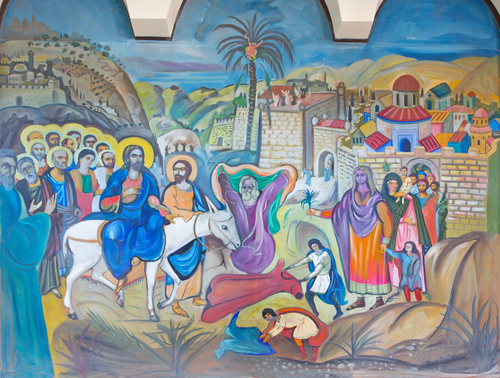
BETHLEHEM, ISRAEL - MARCH 6, 2015: The modern fresco of Palm Sun

The modern fresco of Palm Sunday in Syrian orthodox church by artist K. Veniadis (1987).

The crowd is often wrong. Popular opinion frequently misses the truth. And unfortunately, it seems that unrighteousness is usually trending.

From the earliest days of human history that has been so. The crowd was wrong in the days of Noah, as it was in the gathering at Babel. Godliness was often forsaken in the days of the prophets, and the dominant culture was usually wrong in the days of the early church.

But the crowds that gathered as Jesus entered Jerusalem on that first Palm Sunday got it gloriously right.

The crowds that gathered in the city just days later would call for the murder of Jesus. Many political and religious leaders would exult in the His crucifixion. But on that first Palm Sunday the gathered people welcomed the Messiah and Savior of the world.

Let’s note three ways the crowd got it right on that first Palm Sunday as we consider our response to Jesus on this Palm Sunday.

The crowd was right to give honor

The people got word that Jesus was entering the city and they immediately stepped forward to honor Him. He entered on a borrowed donkey which both fulfilled Old Testament prophecy and spoke to humility. People rushed to cushion each step by placing palm branches and even their own cloaks on the ground before Him.

We rightly honor Jesus by our care for the things of God. When we care more about the glory of the Lord than our own comfort, we honor Him. When we sacrifice our time and energy and possessions, we honor Him. When we look for ways to bless His work, we honor Him.

I pray you will honor the Lord with your life this Palm Sunday and Easter season. Honor Him by loving the things that matter. Honor Him with your sacrifice for the things that count. Honor Him with a bent knee and a giving heart. On Palm Sunday we remember all that Jesus is and all that He has done. And we honor that memory and that mission as we gather with the crowd.

The crowd was right to worship

The people began a spontaneous worship service as Jesus passed by on the first Palm Sunday. They sang out snatches of the Psalms. Their cries of “Hosanna” — a word of praise from the Hebrew word for “salvation” — rang out above the noise. They sensed the working of God to save mankind from sin and could not contain songs of loudest praise.

I hope you will worship the Lord joyfully this Palm Sunday and Easter season. He is worthy of all your praise. By His death, we can find life. By His work, we can find meaning and purpose in the work of our lives. By His resurrection, we have power over death and the grave. We have ample reason to praise our Messiah, Savior and Lord.

When you gather for worship on Sunday, remember who Jesus is and what He has done. And praise Him from the depth of your heart. Jesus told the skeptical Pharisees who hated this praise that the rocks would cry out if the people didn’t. We have a reason to sing and a reason to shout and Palm Sunday reminds us of this privilege. Let no stone be needed to take your place in worship. Praise His name fully and powerfully.

The crowd was right to proclaim

Matthew’s Gospel tells us the city was shaken by the crowd’s praise. People asked who it was that passed by. The crowd proclaimed, “This is the prophet Jesus from Nazareth in Galilee!” (Matthew 21:11).

We gather in worship on Palm Sunday and the Easter season to proclaim the message of Jesus. We proclaim the Gospel message that Jesus is God’s only begotten Son, that He died to pay the penalty for our sins, that He was buried but that He rose from the dead on the third day. We proclaim Christ as our Savior and as our King. We proclaim that He is the only hope for the world. We proclaim that He will return one day to claim His own and that those who repent of their sins and place their faith in Him will live for eternity with Him in heaven. This is our proclamation in song and sermon and life.

The crowd got it right on that first Palm Sunday. Let’s gather this week with other believers and all those who will hear and, together, honor and worship and proclaim the name of Jesus. There will be no need for stones to take our place.

— Doug Munton is pastor of First Baptist Church O’Fallon and first vice president of the Southern Baptist Convention. This column first appeared in Baptist Press.

The BriefingSenate lets states defund Planned Parenthood
For more than 40 years, the federal government has made funds available through Title X grants for organizations that provide family planning services. Through this program, the federal government can fund healthcare organizations directly or award grants to states, which choose money recipients. Days before President Barack Obama left office, he ordered the Department of Health and Human Services to block 13 conservative states from denying Planned Parenthood Title X funding. The Senate voted to rescind that order March 30.

VP Pence’s ‘Billy Graham Rule’ angers Internet
One line from a Washington Post profile of Second Lady Karen Pence is garnering reactions from many on social media. Ashley Parker’s profile of Indiana’s former First Lady cites a 2002 Mike Pence interview with The Hill. In it, the former Indiana congressman and governor said he never eats alone with a woman other than his wife, Karen. Pence also said he wouldn’t attend an event where alcohol would be served without her by his side.

Reprimand of Air Force colonel sparks protest
U.S. Air Force Col. Michael Madrid was reprimanded in 2016 for his Christian religious beliefs about marriage and sexuality. The Air Force originally cleared him in 2014 of charges that he made unsubstantiated derogatory comments against homosexuality to an openly gay airman. But when Madrid was placed under the command of Maj. Gen. John E. McCoy two years after the case was closed, McCoy accused Madrid of having lied during the investigation and disciplined him without any new evidence.

Judge grants man right to become genderless
A 27-year-old video game designer has become the first American to gain legal designation as “genderless” following a ruling by an Oregon judge. The game designer known as Patrick Abbatiello who is now legally designated agender, also got legal approval to become mononymous — meaning only having one name instead of a given name and a surname — and is going by the name “Patch.”

Polar bear ‘prays’ next to cross
Jessica Andrews was scanning through dozens of photos she took of a polar bear roaming around her backyard when she came across one that stopped her in her tracks. The large animal was squatting beneath a white cross, its paws together and raised skyward as it looked up in a seemingly reverential pose.

 Sources: World Magazine, Indy Star, Baptist Press, NBC News, Toronto Sun

Praying at sunset

In the past year, I have recovered a lost word and a lost practice. With all that has happened in global events, national politics, and on a personal level, “praying” hasn’t seemed enough. I’m learning to beseech.

The word is not often used these days. Its popularity in print peaked in 1827, then began a steady decline until 2000. In 2001, the people who count these things noted a slight uptick in published usage that continues until today. And while they did not note a reason for increased beseeching, it seems right to point out that 2001 is the year marked by the September 11 terrorist attacks. If only for a short while, we Americans fell to our knees to plead with God on behalf of our nation. Praying became pleading, pleading became begging, begging became beseeching.

Shakespeare used the word so often that when literary scholars were trying to determine a link between his writing and Christopher Marlowe’s, they searched “beseech” as a marker of Shakespeare’s hand. (For Marlowe, they searched “glory droopeth.”)

Beseech is commonly used in the King James Version of the Bible. It means a variety of “asks” from simple plea to intense begging.

“O Lord, do save, we beseech You…”

Psalm 118:25

Paul urges, “I beseech you therefore, brethren, by the mercies of God, that ye present your bodies a living sacrifice, holy, acceptable unto God,” while Jonah pleads, “Therefore now, O LORD, take, I beseech thee, my life from me; for it is better for me to die than to live.”

But more recent translations have minimized its use. The New American Standard Bible, still touted as the most literal among English language translations, uses beseech 10 times to indicate something more than simple asking. In most instances, it’s life or death:

Faced with death, Hezekiah beseeches the Lord. Seeing the decline of his homeland, Nehemiah beseeches the Lord. A leper, suffering and shunned, beseeches Jesus for healing. Jesus tells his followers to beseech the Lord of the Harvest to send workers into His field. And a few times in the Psalms: “The cords of death encompassed me, And the terrors of Sheol came upon me…Then I called upon the name of the Lord: “O Lord, I beseech You, save my life!” (116:3-4).

Pray, plead, beg, beseech. To ask someone to do something in a serious or emotional way, Merriam-Webster says. The Cambridge English dictionary adds: Ask in such a way that shows you need it very much.

Like the needy people in California about to be put out on the street: “Hundreds beseech East Palo Alto council to end evictions,” the October 2016 headline read. Or from war-ravaged Aleppo: “‘Help us pull our country back from the brink of the abyss,’ Syrian Christians beseech.”

In California it worked; in Syria the few who remain are still beseeching.

And if we need another picture: there’s Jesus at Gethsemane. “My soul is overwhelmed with sorrow to the point of death,” he said to his closest disciples. And to his Father, “if You are willing, take this cup away from Me—nevertheless, not My will, but Yours, be done.” And “in anguish, He prayed more fervently, and His sweat became like drops of blood falling to the ground.”

The word beseech is not used here, but its meaning was never clearer. Faced with the impossible, he prayed more fervently, and so too should we.

Eric Reed is editor of Illinois Baptist media.