Archives For November 30, 1999

The Next Generation

NextGen

Reaching the next generation with the gospel is not easy. Those born in 2000 or after are teenagers now. The Millennials, who started coming of age after 2000, are giving way to the “Centennials,” or Generation-Z. They have grown up in a very different world, one where the number of people who claim no religious affiliation at all is about 20% and growing. Jack Lucas joined IBSA as leader of next-gen ministry. IBSA aids churches in reaching children with the gospel, and equipping students as tomorrow’s leaders through VBS, missions events, Youth Encounter in three locations, AWSOM for teen girls, Summer Worship University, and a full summer schedule of camps at Lake Sallateeska and Streator Baptist Camps.

Pray for next-gen director Jack Lucas, worship director Steve Hamrick, camp managers Philip Hall and Mike Young and their ministry teams.

Learn more about the Mission Illinois Offering.

Give to the Offering. If your church promotes and receives a Mission Illinois Offering, we encourage you to give that way. If not, you can also give here — www.IBSA.org/GiveToMIO.

Watch “Now More Than Ever.”

Why evangelism is needed now

ib2newseditor —  September 11, 2017

The ‘blue map’ tells our story

The blue mapThis map is becoming familiar around the Illinois Baptist State Association. We call it ‘the blue map.’ With just a few brush strokes, it clearly illustrates the need for evangelism in Illinois.

The map shows the percentage of people in each county who self-identify as Southern Baptist.

Our strength as a denomination is in the southern half of the state, where in most counties at least 5% of the population is SBC. In some places, the percentage is higher than that, but with so little of this map shaded dark blue, it’s easy to understand why Southern Baptists—and evangelicals overall—are in the minority in Illinois.

The farther north we travel, the less ‘Baptist’ the state is, even as the population explodes. The gray circles show our most populous places. And in stark contrast, the white and lightest blue-shaded counties show places where there are few or no SBC churches.

The need is great all across Illinois, but especially in the cities and Northwest Illinois.

“In many parts of Illinois, Baptists are outnumbered by Muslims, Mormons, eastern religions, and people with no faith at all,” Nate Adams, executive director of the Illinois Baptist State Association said. “In fact, at least 8-million of our 13-million neighbors in Illinois do not know Jesus Christ.”

That’s why at IBSA, we often say, “Evangelism is the point of the plow.” As a ministry-support and missions-sending organization, IBSA’s missionaries and staff are engaged in many activities that assist local Baptist churches in Illinois.

The partnership we share with almost 1,000 churches, mission congregations, and church plants is vital to strengthening Baptist work in Illinois. But whatever the ministry activity, the reason behind it is equipping IBSA churches, leaders, and members to share the gospel with people who do not yet know Jesus as their personal savior.

The missionaries whose photos appear in this prayer guide each have different specialties. Church planting, age-graded discipleship, and missions mobilization are just a few. But their work has the same chief purpose: advancing the gospel.

For example, when Illinois Baptist Disaster Relief teams are cutting trees felled by storms and digging out mud-packed houses after floods, somewhere nearby a trained DR chaplain is sharing Jesus with a suffering homeowner. And many times, they find Christ in their crisis.

Who trained the chaplains? Who organized the volunteers?

You did.

By giving through the Mission Illinois Offering, you enable state missionaries to do their work in Illinois. You provide supplies for VBS training and children’s camps. You send expertise to churches in need of stronger leadership. You recruit and equip church planters to start congregations where they are desperately need. And the list goes on and on.

Your gifts through the Mission Illinois Offering stay here in Illinois: teaching students, equipping leaders, planting churches, and, at all times, advancing the gospel.

Won’t you give through the Mission Illinois Offering? Your partnership in advancing the gospel in Illinois is needed now, more than ever.

Learn more about the Mission Illinois Offering.

Praying for Illinois’ Northwest Quadrant

John Mattingly

John and Jacki Mattingly have served around the Quad Cities for almost three decades. He has served as pastor, director of missions, and now heads church planting in the quadrant of our state that has captured his heart. This region is a mix of cities, small towns, and rural crossroads, including Quincy, Peoria, and Rockford, with a higher percentage of lostness than any other region in Illinois. Many counties have no Southern Baptist church and little evangelical witness. John continues seeking God’s direction in identifying the next location to plant a new church. And he is looking for people who will move here and commit their lives to church planting and pastoral ministry in the Northwest.

Pray for John as he helps plant new churches, plus John Sedgwick, Brian McWethy, and Joe Gardner who serve here, and IBSA’s Church Planting leader Van Kicklighter.

Learn more about the Mission Illinois Offering.

Give to the Offering. If your church promotes and receives a Mission Illinois Offering, we encourage you to give that way. If not, you can also give here — www.IBSA.org/GiveToMIO.

Watch John Mattingly’s story, “Spiritual Need in the Northwest.”


White common daisy flower isolatedAs warm weather descended on San Francisco that year, so did the hippies, as many as 100,000 of them. The Haight-Ashbury District became ground zero for a festival that lasted for weeks: young people with flowers in their tresses singing and dancing and cavorting in public spaces, doing a little protesting of the Vietnam War, and smoking a lot of what their mothers wouldn’t approve.

They called it the ‘summer of love.’

Ironically, that summer in 1967 was also marked by fear and terror and rioting, as large sections of Detroit went up in flames just as Watts in Los Angeles had two years earlier. In Detroit, the violence that started after police raided an unlicensed bar ended with 2,000 buildings destroyed, more than 7,000 people arrested, over 1,000 injured, and 43 deaths. Free love on the West Coast, and unrestrained hate in the Midwest.

Here, 50 years later, we have witnessed another season of dichotomy, a tense summer of issues—and people—in conflict. The political tensions and threats of nuclear attack were topped by violent marches in Charlottesville that killed one young woman and revealed the breadth of a racial rift in America that few imagined existed.

As is 1967, the summer of 2017 was on some fronts a summer of hate. But from our vantage point, we can say, too, it was a summer of love.

There were stories in our pages that attested that: mission trips around the world where the love of Christ was shared. In downstate Cairo and Brazil and many other places, people received Christ as Savior. We saw children learn about Jesus at IBSA camps and Vacation Bible Schools everywhere.

And to cap it all, the eclipse. Carbondale was epicenter this time as millions from Oregon to South Carolina looked upward, many seeming to search for something beyond themselves. A famed Chicago weatherman wept on air for the beauty of nature. More important, Baptists in southern Illinois shared Christ, and lost people came to faith.

When they look back on the summer of 2017 to give it a name, no one will look at the protests and nuclear threats and political martial arts and call it ‘the summer of love.’ But seeing the totality of our Christian outreach this season, and the genuine outpouring from God’s heart, maybe we will.

-Eric Reed

The Briefing

Trump meets with SBC’s Ezell, other relief leaders
President Donald Trump met with leaders of the three largest disaster relief organizations in the United States at the White House Sept. 1 to discuss relief efforts in south Texas in the wake of historic flooding and other damage left by Hurricane Harvey. Kevin Ezell, president of the North American Mission Board (NAMB), represented Southern Baptist Disaster Relief (SBDR) at the 25-minute private meeting in the Oval Office with the president and First Lady Melania Trump.

Nashville Statement signers stand for marriage
Signers of the Nashville Statement, a declaration affirming Biblical teaching on human sexuality, defended their position from other Christian and secular opponents this week. The Council on Biblical Manhood and Womanhood (CBMW) released the statement online Aug.29. The initial 150 evangelical leaders who signed it asserted the church needed clarity amid widespread confusion about a Biblical understanding of sex, sexuality, and morality.

Ministry sues over ‘hate group’ label
One Christian ministry has apparently had enough of the Southern Poverty Law Center’s disparaging “hate group” characterization. D. James Kennedy Ministries filed a lawsuit in an Alabama federal court alleging the Southern Poverty Law Center (SPLC) “trafficked in false and misleading descriptions” of the ministry and that other entities also named in the suit perpetuated the libel.

H.S. coach loses prayer case
A federal court has ruled that a Washington state high school football coach violated the U.S. Constitution by taking a knee at the 50-yard line and praying after games. Joe Kennedy lost his job as an assistant football coach at Bremerton High School in 2015 after the school district suspended him for his post-game prayers. Kennedy sued and accused the school of violating his free speech. The 9th Circuit Court of Appeals ruled that the district’s suspension was justified.

Most churched (& unchurched) cities in America
For six of the last seven years, the American Bible Society has named Chattanooga, Tenn., the nation’s most Bible-minded city. This year, it was the only American city where at least half the population was classified as Bible-minded. Almost 6 in 10 residents (59%) are regular churchgoers. Overall, almost 4 in 10 Americans (38%) are active churchgoers who have attended a service in the past seven days.

Sources: Baptist Press, World Magazine, Baptist Press, Fox News, Facts & Trends

Marci Coble

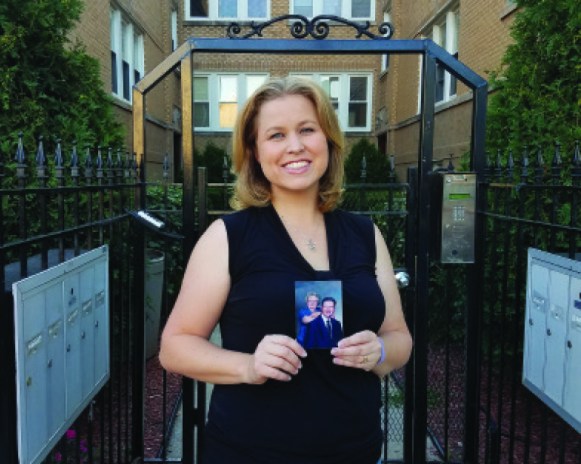
Standing outside their Chicago condo, Marci is holding a photo of her grandparents. Her grandfather, Maurice Swinford, led church development for IBSA and ultimately served as executive director.

The strategy is simple. Lost people know lost people. They hang out with lost people. If you lead one lost person to faith in Christ, suddenly you have broken into a whole new circle of people who need Jesus. And the most effective witness to the gospel is someone whose life has been changed by salvation in Jesus Christ—especially if it’s happened recently.

That’s why the Illinois Baptist State Association continues to invest in church planting as an important and effective strategy for evangelism. There are lots of places in a state of 13 million people where there is little or no evangelical witness.

IBSA is identifying 200 places and peoples that need Jesus. With at least 8 million lost people living just next door, it won’t be hard to put those pins on the map. For Bryan and Marci Coble, that pin landed in the Irving Park area of Chicago, far away and far different from her small hometown in Chatham.

Marci Coble was raised near Springfield under a strong Baptist influence. Her grandfather, Maurice Swinford, was on IBSA’s staff 15 years and served as executive director from 1988 to 1993. “He was always making sure I knew who Jesus is,” Marci says with a tear in her eye. She was a GA and Acteen, and worked one summer at Lake Sallateeska Baptist Camp.

“I was allotted a lot of opportunities and a lot of blessings that I probably wouldn’t have had without his influence and without being his granddaughter—even my call to missions.”

She is almost as emotional describing Chatham Baptist Church. “I grew up there, I was baptized there,” Marci says. “Bryan and I were married there. They shaped me and molded me and I’m blessed to call that my home.”

So when Marci’s husband, Bryan, suggested when he finished his seminary studies that they move to Portland, Ore., to plant a new church, Marci’s brows furrowed. She was willing to go wherever God led them—in fact, they visited the Pacific Northwest on a vision tour—but might God lead them to Chicago?

“Bryan had set up an appointment in Portland. And we received a note from my grandmother with an article from IBSA letting us know they need church planters in Illinois too.” Marci laughed. “And we were like, ‘Oh, that’s so sweet. I love Grandma.’” But the message stuck.

“I didn’t want to come to Chicago,” Bryan readily confesses. “I was raised 60 miles south of St. Louis and grew up a St. Louis Cardinals fan. When we started to pray about Chicago, God actually told me—this may sound crazy,” he says as an aside, “to get a Chicago Cubs hat and wear it for 30 days.”

Bryan shifts the Cubs hat on his head, as if he’s adjusting to the fit.

“My heart started to change,” the Missouri transplant says as a smile breaks out. “My love for this city and my burden for this city started to grow. We love this city so much. We love the people of this city so much,” he says.

A similar feeling started growing back in Chatham, Marci’s home church in suburban Springfield. The town of 11,000 is one-seventh the size of the Cobles’ new neighborhood. And for the church members there, Chicago has seemed like someone else’s responsibility.

“To be honest with you, Chicago has always seemed very distant to us,” says Pastor Milton Bost. But having a hometown girl serving as a missionary in the big city has changed things.

“I think Bryan and Marci are kind of pioneers for us,” Bost says.

Chatham has become heavily involved in the Cobles’ planting work 200 miles away. “Folks from Chatham came up to help us do this,” Bryan says on a rainy Saturday morning in April. A children’s playground in the center of their neighborhood is also the epicenter of their planting work. “(We) hand out flyers, hand out cookies, talk to people, build relationships.” The park is covered in people wearing green T-shirts declaring their love for the area.

“We want the community to know that we love them, we’re here to invest in them first and foremost,” Marci says.

The couple moved their two boys there last year—in time for the Cubs’ World Series win. They began surveying the city and seeking God’s direction. In the spring the Cobles bought a small condo in a pre-war three-floor building, and started meeting the neighbors—Hispanics, Anglos, and some Asian people. Their goal is to launch a Bible study, then a church, in the recreation building at the park.

“Chicago is a world city. It has high influence not just within the state of Illinois, but in the world,” Bryan says. “We need to be able to reach these people with the gospel. We do it in love, so that they will hopefully come to know Christ and be changed by the gospel. And the world with them.”

Learn more about the Mission Illinois Offer and Week of Prayer September 10-17 at www.MissionIllinois.org.

Watch the video, “A Heart for the City.”


The Mission Illinois Offering and Week of Prayer is September 10-17, but there are plenty of opportunities for prayer ahead of that week. In fact, all of September is a good time to focus on God’s work through Baptists in Illinois.

Devote time to prayer every Sunday or Wednesday in September. Share mission facts and videos on the mission stories. Our main focus is evangelism and church planting in Illinois. Review the statistics about lostness in Illinois. These are not just numbers, they are people.

Pray for salvation. Check Wikipedia for the population of your county or town. According to the experts, more than two-thirds (say 65%) of those people do not know Jesus Christ. Do the math. Pray for their salvation. While you’re at it, make a list of people you know who need Jesus.

Pray for the missionaries by name. Use the daily devotions as brief prayer prompts in worship services and in personal prayer. They are in the MIO Prayer Guide/bulletin insert, online, and printed in the special Illinois Baptist wrapper on the outside of the Aug. 14 issue.

Schedule a special prayer meeting for state missions. Some churches use the Wednesday during the Week of Prayer, others use Sunday morning or Sunday night. Or pick another time, day or night.

Spread the responsibility. Ask Sunday school teachers and small group leaders to focus prayer on state missions during September. Ask the missions team or WMU or men’s group to pray for state missions in their September meeting.

Focus on Romans 10:14.
“How, then, can they call on him they have not believed in? And how can they believe without hearing about him? And how can they hear without a preacher?” (CSB)

Pray each section of the verse:
• For the Holy Spirit to open hearts to believe;
• for the gospel to be shared; for the church planters;
• for gospel witnesses to respond to the call to
missions and evangelism, especially in Illinois.

We could plant so many more new churches and reach so many more lost people in Illinois if there were more future leaders in the pipeline.

Learn more about the Mission Illinois Offering at MissionIllinois.org.

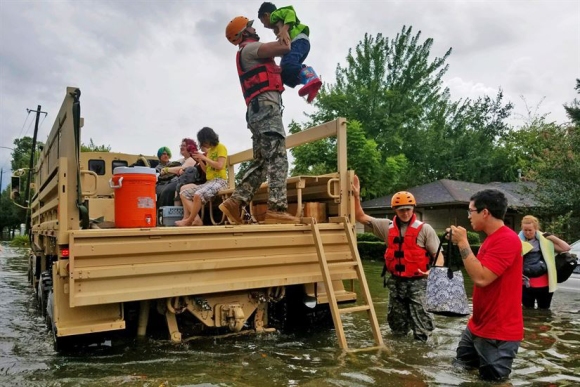
Harvey-National-Guard-rescue

Texas National Guard soldiers rescue residents in heavily flooded areas of Houston after Hurricane Harvey on Aug. 27. National Guard photo by Lt. Zachary West

Trained disaster relief volunteers representing the Illinois Baptist State Association (IBSA) are preparing to respond to victims Hurricane Harvey. Disaster Relief volunteers are taking kitchen trailers where they can prepare between 10,000-20,000 meals a day to the Houston area.

Illinois Baptist Disaster Relief State Director Dwayne Doyle said, “While the rain is still falling, we are preparing to go, both for immediate response and to provide long term assistance to flood victims. The immediate needs for people in shelters are food service and child care. Southern Baptists prepare the meals that other national relief agencies distribute.”

Two teams of child care workers departed for Dallas Wednesday (Aug. 30) to care for children in shelters, which allows parents to work with FEMA and other agencies. “We provide the service so parents can work on getting their lives back together,” Doyle said.

Southern Baptists’ response to this unparalleled disaster will continue for months, perhaps years. “We have three central Illinois training sessions planned and we are arranging training sessions in Chicagoland and southern Illinois for volunteers who will stay long term and assist flood victims,” shared Doyle.

Illinois Baptists have 1,600 trained disaster relief volunteers belonging to 37 teams based around the state. The teams include mobile kitchen, child care, chaplaincy, chainsaw, flood recovery, laundry and shower units along with a disaster relief command and communications trailer, and a search and rescue unit. Southern Baptist Disaster Relief is the third largest relief agency in the United States.

To learn more about disaster relief training opportunities, visit www.IBSA.org/DR.

###

If you’d like more information or to schedule a phone or radio interview, contact: Lisa Sergent at (217) 391-3119 or LisaSergent@IBSA.org. Later, we should be able to provide onsite interviews with leaders in various parts of the state and a list of departure times for volunteer relief teams heading to Texas.

The Illinois Baptist State Association is comprised of nearly 1,000 member churches and 35 local associations. Headquartered in Springfield, it is affiliated with the Southern Baptist Convention.

John Mattingly

John Mattingly

Lost people matter to John Mattingly, especially those who live in the northwest quadrant of Illinois. John served as a pastor in Joy, Ill., then as director of missions for Sinnissippi Baptist Association, and now serves as IBSA’s church planting director for the region that includes Peoria, Rockford, and the Quad Cities. John takes his role as a strategist for church planting seriously. John and his wife, Jacki, sold their home so they could be unencumbered and mobile.

“A pastor’s got to come and be part of the community,” Mattingly said. Currently, that’s in Sterling, where the couple has helped restart a faltering congregation.

“John and Jacki are just a unique couple,” said Van Kicklighter, IBSA’s associate executive director of church planting. “I think part of their passion for people in northwestern Illinois comes from a deep sense that God has planted them (there).”

Mattingly is one of eight IBSA church planting catalysts working with more than 80 church planters across Illinois. Last year, IBSA and ministry partners started 16 new churches. IBSA has identified more than 200 places and people groups in Illinois that need a church. (Their work is supported, in part, by the Mission Illinois Offering.)

New churches are needed because in some places, there simply aren’t enough. Of 102 Illinois counties, 10 counties have no Southern Baptist church, and another 12 have only one. There are large sections of the state with little evangelical witness, especially in northwest Illinois and in the cities. And new churches are needed in other places too, because new congregations are effective at reaching unchurched people.

“If we are going to reach northwest Illinois, I really believe that we’re going to have to develop an appetite for risk,” Mattingly said. “Risk means that we don’t know what’s going to happen.” And that makes the northwest corner “a frontier area.” Part of his job is finding church planters who will come to this mix of cities and rural communities.

“People in northwest Illinois deserve every opportunity to hear the good news of Jesus just like someone on the other side of theglobe,” Kicklighter said of the area where factories once booming have closed, and churches once common have dwindled.

“Our communities are open to the gospel of Jesus Christ,” Mattingly concurred. “All we need are some people who will come and take some risks.”

The Mission Illinois Offering and Week of Prayer is September 10-17. Learn more about the Mission Illinois Offering.

Proposal2v.jpg

There was one point during the Southern Baptist Convention meeting in Phoenix when three thoughts of mine collided:

• How can this many people make a well-informed and well-reasoned decision?

• In the social media era, how can we make it possible for even more people to participate on a level that young adults have come to expect?

• And, then, how can we continue this very expensive system of having fewer and fewer people travel halfway or more across the country to attend?

The collision came late on Tuesday, when young messengers were pleading for the crowd in the hall to consider the weight of public opinion (read: Twitter) in their debate over alt-right racism. (“What will the people out there think of us?”) In my head, I could hear old people saying, “Who cares? This is not their decision, it’s ours—Southern Baptists—and in particular the ones who paid to travel to Phoenix to speak up and to vote.” (Maybe it was just me, speaking on behalf of old people.)

But to the young messengers pleading on behalf of the masses, it was important, because they are used to the hearing from the masses on every issue: like, heart, thumbs up, smiley face, colon/capital P tongue-sticking-out. (Yes, my emoticon reference is dated.)

Executive Committee President Frank Page told the messengers, proudly, that the Convention is an anomaly: “This is a deliberative body, the largest openly deliberative body that still exists,” Page said. “But know that the Executive Committee also deliberates carefully at multiple levels dealing with each of the issues before they’re ever presented to you, from small groups to medium-size [groups] to the large plenary sessions. Our Executive Committee members are not rubber-stampers. They ask questions, they deliberate, they discuss and sometimes disagree. So know that we hold your trust carefully and we count it to be precious.”

That’s an uneasy balance for Baptists whose theology makes us accustomed to voting on almost everything—even changing the light bulbs.

The first national Baptist body in the U.S. was the Triennial Convention, founded in Philadelphia in 1814. They met every three years. When Southern Baptists broke off in 1845, they chose to meet every year, and to include as many people as possible by sending messengers rather than electing representatives. (It is a small but important distinction.)

But technology and airline costs are pressing on our expectations: Remembering conventions with 15,000 and more regularly in attendance, we want more participants than the 5,000 who flew to Phoenix. And technology would make that possible. Yet, we do not want our denomination making knee-jerk statements at every cultural twist and turn. Theology doesn’t demand an annual meeting cycle or populist group-think.

I know these impulses seem to be in conflict: more participation, and more-reasoned debate. But watching the clock tick as debate on an unexpected resolution took time from discussion on the decline in baptisms and a renewed call to evangelism, it became clear that a relatively few people in a distant city can make reactionary decisions. Next time, the outcome might not be so positive.

(Editor’s Note: Modest Proposal 1 on merging the mission boards can be read here.)

-Eric Reed