Archives For November 30, 2016

Marci Coble

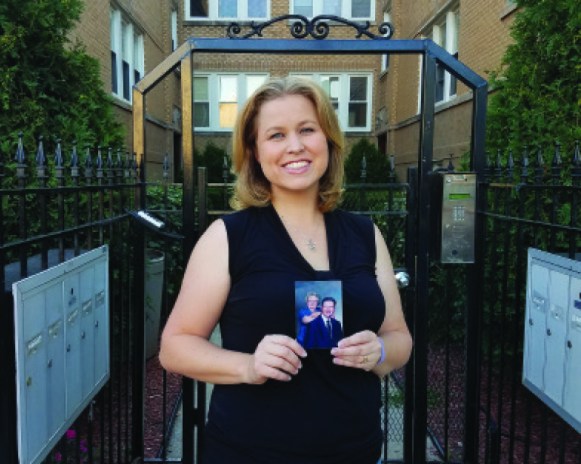
Standing outside their Chicago condo, Marci is holding a photo of her grandparents. Her grandfather, Maurice Swinford, led church development for IBSA and ultimately served as executive director.

The strategy is simple. Lost people know lost people. They hang out with lost people. If you lead one lost person to faith in Christ, suddenly you have broken into a whole new circle of people who need Jesus. And the most effective witness to the gospel is someone whose life has been changed by salvation in Jesus Christ—especially if it’s happened recently.

That’s why the Illinois Baptist State Association continues to invest in church planting as an important and effective strategy for evangelism. There are lots of places in a state of 13 million people where there is little or no evangelical witness.

IBSA is identifying 200 places and peoples that need Jesus. With at least 8 million lost people living just next door, it won’t be hard to put those pins on the map. For Bryan and Marci Coble, that pin landed in the Irving Park area of Chicago, far away and far different from her small hometown in Chatham.

Marci Coble was raised near Springfield under a strong Baptist influence. Her grandfather, Maurice Swinford, was on IBSA’s staff 15 years and served as executive director from 1988 to 1993. “He was always making sure I knew who Jesus is,” Marci says with a tear in her eye. She was a GA and Acteen, and worked one summer at Lake Sallateeska Baptist Camp.

“I was allotted a lot of opportunities and a lot of blessings that I probably wouldn’t have had without his influence and without being his granddaughter—even my call to missions.”

She is almost as emotional describing Chatham Baptist Church. “I grew up there, I was baptized there,” Marci says. “Bryan and I were married there. They shaped me and molded me and I’m blessed to call that my home.”

So when Marci’s husband, Bryan, suggested when he finished his seminary studies that they move to Portland, Ore., to plant a new church, Marci’s brows furrowed. She was willing to go wherever God led them—in fact, they visited the Pacific Northwest on a vision tour—but might God lead them to Chicago?

“Bryan had set up an appointment in Portland. And we received a note from my grandmother with an article from IBSA letting us know they need church planters in Illinois too.” Marci laughed. “And we were like, ‘Oh, that’s so sweet. I love Grandma.’” But the message stuck.

“I didn’t want to come to Chicago,” Bryan readily confesses. “I was raised 60 miles south of St. Louis and grew up a St. Louis Cardinals fan. When we started to pray about Chicago, God actually told me—this may sound crazy,” he says as an aside, “to get a Chicago Cubs hat and wear it for 30 days.”

Bryan shifts the Cubs hat on his head, as if he’s adjusting to the fit.

“My heart started to change,” the Missouri transplant says as a smile breaks out. “My love for this city and my burden for this city started to grow. We love this city so much. We love the people of this city so much,” he says.

A similar feeling started growing back in Chatham, Marci’s home church in suburban Springfield. The town of 11,000 is one-seventh the size of the Cobles’ new neighborhood. And for the church members there, Chicago has seemed like someone else’s responsibility.

“To be honest with you, Chicago has always seemed very distant to us,” says Pastor Milton Bost. But having a hometown girl serving as a missionary in the big city has changed things.

“I think Bryan and Marci are kind of pioneers for us,” Bost says.

Chatham has become heavily involved in the Cobles’ planting work 200 miles away. “Folks from Chatham came up to help us do this,” Bryan says on a rainy Saturday morning in April. A children’s playground in the center of their neighborhood is also the epicenter of their planting work. “(We) hand out flyers, hand out cookies, talk to people, build relationships.” The park is covered in people wearing green T-shirts declaring their love for the area.

“We want the community to know that we love them, we’re here to invest in them first and foremost,” Marci says.

The couple moved their two boys there last year—in time for the Cubs’ World Series win. They began surveying the city and seeking God’s direction. In the spring the Cobles bought a small condo in a pre-war three-floor building, and started meeting the neighbors—Hispanics, Anglos, and some Asian people. Their goal is to launch a Bible study, then a church, in the recreation building at the park.

“Chicago is a world city. It has high influence not just within the state of Illinois, but in the world,” Bryan says. “We need to be able to reach these people with the gospel. We do it in love, so that they will hopefully come to know Christ and be changed by the gospel. And the world with them.”

Learn more about the Mission Illinois Offer and Week of Prayer September 10-17 at www.MissionIllinois.org.

Watch the video, “A Heart for the City.”


The Mission Illinois Offering and Week of Prayer is September 10-17, but there are plenty of opportunities for prayer ahead of that week. In fact, all of September is a good time to focus on God’s work through Baptists in Illinois.

Devote time to prayer every Sunday or Wednesday in September. Share mission facts and videos on the mission stories. Our main focus is evangelism and church planting in Illinois. Review the statistics about lostness in Illinois. These are not just numbers, they are people.

Pray for salvation. Check Wikipedia for the population of your county or town. According to the experts, more than two-thirds (say 65%) of those people do not know Jesus Christ. Do the math. Pray for their salvation. While you’re at it, make a list of people you know who need Jesus.

Pray for the missionaries by name. Use the daily devotions as brief prayer prompts in worship services and in personal prayer. They are in the MIO Prayer Guide/bulletin insert, online, and printed in the special Illinois Baptist wrapper on the outside of the Aug. 14 issue.

Schedule a special prayer meeting for state missions. Some churches use the Wednesday during the Week of Prayer, others use Sunday morning or Sunday night. Or pick another time, day or night.

Spread the responsibility. Ask Sunday school teachers and small group leaders to focus prayer on state missions during September. Ask the missions team or WMU or men’s group to pray for state missions in their September meeting.

Focus on Romans 10:14.
“How, then, can they call on him they have not believed in? And how can they believe without hearing about him? And how can they hear without a preacher?” (CSB)

Pray each section of the verse:
• For the Holy Spirit to open hearts to believe;
• for the gospel to be shared; for the church planters;
• for gospel witnesses to respond to the call to
missions and evangelism, especially in Illinois.

We could plant so many more new churches and reach so many more lost people in Illinois if there were more future leaders in the pipeline.

Learn more about the Mission Illinois Offering at MissionIllinois.org.

Harvey-National-Guard-rescue

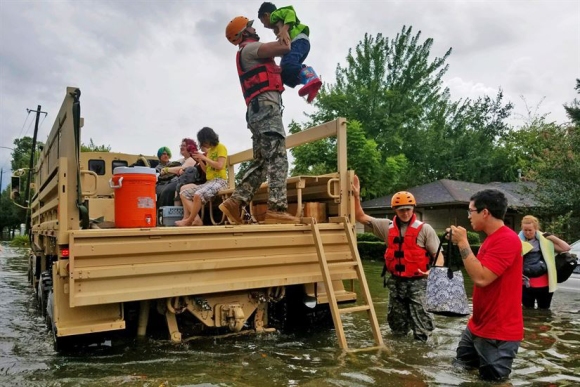
Texas National Guard soldiers rescue residents in heavily flooded areas of Houston after Hurricane Harvey on Aug. 27. National Guard photo by Lt. Zachary West

Trained disaster relief volunteers representing the Illinois Baptist State Association (IBSA) are preparing to respond to victims Hurricane Harvey. Disaster Relief volunteers are taking kitchen trailers where they can prepare between 10,000-20,000 meals a day to the Houston area.

Illinois Baptist Disaster Relief State Director Dwayne Doyle said, “While the rain is still falling, we are preparing to go, both for immediate response and to provide long term assistance to flood victims. The immediate needs for people in shelters are food service and child care. Southern Baptists prepare the meals that other national relief agencies distribute.”

Two teams of child care workers departed for Dallas Wednesday (Aug. 30) to care for children in shelters, which allows parents to work with FEMA and other agencies. “We provide the service so parents can work on getting their lives back together,” Doyle said.

Southern Baptists’ response to this unparalleled disaster will continue for months, perhaps years. “We have three central Illinois training sessions planned and we are arranging training sessions in Chicagoland and southern Illinois for volunteers who will stay long term and assist flood victims,” shared Doyle.

Illinois Baptists have 1,600 trained disaster relief volunteers belonging to 37 teams based around the state. The teams include mobile kitchen, child care, chaplaincy, chainsaw, flood recovery, laundry and shower units along with a disaster relief command and communications trailer, and a search and rescue unit. Southern Baptist Disaster Relief is the third largest relief agency in the United States.

To learn more about disaster relief training opportunities, visit www.IBSA.org/DR.

###

If you’d like more information or to schedule a phone or radio interview, contact: Lisa Sergent at (217) 391-3119 or LisaSergent@IBSA.org. Later, we should be able to provide onsite interviews with leaders in various parts of the state and a list of departure times for volunteer relief teams heading to Texas.

The Illinois Baptist State Association is comprised of nearly 1,000 member churches and 35 local associations. Headquartered in Springfield, it is affiliated with the Southern Baptist Convention.

John Mattingly

John Mattingly

Lost people matter to John Mattingly, especially those who live in the northwest quadrant of Illinois. John served as a pastor in Joy, Ill., then as director of missions for Sinnissippi Baptist Association, and now serves as IBSA’s church planting director for the region that includes Peoria, Rockford, and the Quad Cities. John takes his role as a strategist for church planting seriously. John and his wife, Jacki, sold their home so they could be unencumbered and mobile.

“A pastor’s got to come and be part of the community,” Mattingly said. Currently, that’s in Sterling, where the couple has helped restart a faltering congregation.

“John and Jacki are just a unique couple,” said Van Kicklighter, IBSA’s associate executive director of church planting. “I think part of their passion for people in northwestern Illinois comes from a deep sense that God has planted them (there).”

Mattingly is one of eight IBSA church planting catalysts working with more than 80 church planters across Illinois. Last year, IBSA and ministry partners started 16 new churches. IBSA has identified more than 200 places and people groups in Illinois that need a church. (Their work is supported, in part, by the Mission Illinois Offering.)

New churches are needed because in some places, there simply aren’t enough. Of 102 Illinois counties, 10 counties have no Southern Baptist church, and another 12 have only one. There are large sections of the state with little evangelical witness, especially in northwest Illinois and in the cities. And new churches are needed in other places too, because new congregations are effective at reaching unchurched people.

“If we are going to reach northwest Illinois, I really believe that we’re going to have to develop an appetite for risk,” Mattingly said. “Risk means that we don’t know what’s going to happen.” And that makes the northwest corner “a frontier area.” Part of his job is finding church planters who will come to this mix of cities and rural communities.

“People in northwest Illinois deserve every opportunity to hear the good news of Jesus just like someone on the other side of theglobe,” Kicklighter said of the area where factories once booming have closed, and churches once common have dwindled.

“Our communities are open to the gospel of Jesus Christ,” Mattingly concurred. “All we need are some people who will come and take some risks.”

The Mission Illinois Offering and Week of Prayer is September 10-17. Learn more about the Mission Illinois Offering.

Proposal2v.jpg

There was one point during the Southern Baptist Convention meeting in Phoenix when three thoughts of mine collided:

• How can this many people make a well-informed and well-reasoned decision?

• In the social media era, how can we make it possible for even more people to participate on a level that young adults have come to expect?

• And, then, how can we continue this very expensive system of having fewer and fewer people travel halfway or more across the country to attend?

The collision came late on Tuesday, when young messengers were pleading for the crowd in the hall to consider the weight of public opinion (read: Twitter) in their debate over alt-right racism. (“What will the people out there think of us?”) In my head, I could hear old people saying, “Who cares? This is not their decision, it’s ours—Southern Baptists—and in particular the ones who paid to travel to Phoenix to speak up and to vote.” (Maybe it was just me, speaking on behalf of old people.)

But to the young messengers pleading on behalf of the masses, it was important, because they are used to the hearing from the masses on every issue: like, heart, thumbs up, smiley face, colon/capital P tongue-sticking-out. (Yes, my emoticon reference is dated.)

Executive Committee President Frank Page told the messengers, proudly, that the Convention is an anomaly: “This is a deliberative body, the largest openly deliberative body that still exists,” Page said. “But know that the Executive Committee also deliberates carefully at multiple levels dealing with each of the issues before they’re ever presented to you, from small groups to medium-size [groups] to the large plenary sessions. Our Executive Committee members are not rubber-stampers. They ask questions, they deliberate, they discuss and sometimes disagree. So know that we hold your trust carefully and we count it to be precious.”

That’s an uneasy balance for Baptists whose theology makes us accustomed to voting on almost everything—even changing the light bulbs.

The first national Baptist body in the U.S. was the Triennial Convention, founded in Philadelphia in 1814. They met every three years. When Southern Baptists broke off in 1845, they chose to meet every year, and to include as many people as possible by sending messengers rather than electing representatives. (It is a small but important distinction.)

But technology and airline costs are pressing on our expectations: Remembering conventions with 15,000 and more regularly in attendance, we want more participants than the 5,000 who flew to Phoenix. And technology would make that possible. Yet, we do not want our denomination making knee-jerk statements at every cultural twist and turn. Theology doesn’t demand an annual meeting cycle or populist group-think.

I know these impulses seem to be in conflict: more participation, and more-reasoned debate. But watching the clock tick as debate on an unexpected resolution took time from discussion on the decline in baptisms and a renewed call to evangelism, it became clear that a relatively few people in a distant city can make reactionary decisions. Next time, the outcome might not be so positive.

(Editor’s Note: Modest Proposal 1 on merging the mission boards can be read here.)

-Eric Reed

The Briefing

Iceland Down syndrome abortions called ‘a tragedy’
Southern Baptists involved with special needs ministry are lamenting a report that virtually 100% of babies diagnosed with Down syndrome in Iceland are aborted. According to CBS News, Iceland “has on average just one or two children born with Down syndrome per year” out of a population of 330,000. The reason for the lack of Down syndrome births is that genetic testing leads nearly all mothers whose children are expected to have Down syndrome to opt for abortion.

Illinois town shuts down VFW raffle over gambling
A drawing for a VFW raffle with a prize topping $1 million was called off hours before a winner was due to be picked, with organizers citing a legal snag. The VFW hall in the small town of Morris, Ill., said they “did not get shut down” and will resume ticket sales and the drawing “as soon as possible.”

Banned from Farmer’s Market for stance on marriage
The Tennes family joins a growing list of florists, photographers, filmmakers, and cake bakers who have lost a portion of their livelihood for upholding a Biblical definition of marriage. Last May, Alliance Defending Freedom filed a federal lawsuit on behalf of the Tenneses, stating their religious views have no bearing on their involvement in the East Lansing Farmer’s Market and the city violated their constitutional rights.

New president on bringing back Baylor
Linda Livingstone, the newly minted president of Baylor University, inherited more than just the world’s largest Baptist university and its 16,000-plus students when she took the helm in June. A few weeks earlier, a former Baylor volleyball player filed what was then the latest in a long string of Title IX lawsuits against the university alleging she was gang-raped by members of the football team. A previous lawsuit alleged that 31 football players for the Waco, Texas, university were involved in as many as 52 acts of sexual assault against fellow students.

Muslim divorce law in India ‘unconstitutional’
For hundreds of years, Muslim men in India could divorce their wives by repeating the word “talaq,” Arabic for divorce, three times. Now, the Supreme Court declared the practice unconstitutional. A five-judge bench moved to block instant divorce for six months, pending a law banning the practice to be debated in parliament.

Sources: Baptist Press, Chicago Tribune, World Magazine, Christianity Today, Washington Post

Eclipse through glasses

As eclipse-watchers turned their eyes to the skies Monday, Aug. 21, much of the attention in Illinois was focused on the southern part of the state, where several communities laid in the eclipse’s “path of totality.” In Carbondale, just north of the point of longest duration for the total eclipse, churches worked together to share the gospel with thousands of people who traveled to the region for the event.

“As we see this amazing event today that God has made, let’s point people to see the Son who paid for our sin so that we can have eternal life!” Pastor Scott Foshie posted on Facebook. Foshie, pastor of Steeleville Baptist Church and an IBSA zone consultant in southern Illinois, helped facilitate an area-wide evangelistic effort to hand out 50,000 eclipse-themed gospel tracts.

The churches of Nine Mile Baptist Association, working in partnership with IBSA, had the tracts printed and mobilized volunteers to get them into the hands of eclipse-viewers in a multi-day outreach effort. The tract was designed to serve as a souvenir of the eclipse experience. “This is going to be the easiest thing you’ve ever passed out in your life,” Lakeland Baptist Church Pastor Phil Nelson said in a video promoting the outreach.

“They’re coming to see this eclipse, but God wants them to meet his son Jesus…I can’t think of an easier way to tell somebody about Jesus,” Foshie said. “All you’ve got to do is smile, walk up to them, and say, ‘Would you like to have this souvenir? God bless you.’ I mean, it’s that simple, and then we’ve planted a gospel seed.”

In addition to the tracts, pray-ers were stationed at four points in Carbondale—Lakeland, Murdale Baptist Church, FBC Elkville, and the Baptist Student Center at Southern Illinois University. The volunteers, standing next to six-foot crosses, prayed for cars as they entered the city. It was estimated around 90,000 people would be in Carbondale for the eclipse.

Many churches in the region partnered together for the outreach, Foshie said. “It was encouraging to see so many jump in and respond to our call to partner with us to share the gospel. This kind of partnership to reach the lost is what led Southern Baptists to join together in cooperation, and it is what keeps our ties strong.”

Foshie had heard of a young woman in Goreville who gave her life to Christ after receiving the tract, and reported volunteers had also handed them out to crowds that gathered in Carbondale, Pinckneyville, Chester, Ellis Grove, Steeleville, and other places in southern Illinois.

“It has been so encouraging to see so many churches and pastors pull together to plant gospel seeds in this way. I think God has used this ministry to bring us closer together. No doubt, he will continue to use this increased cooperation and closeness to reach the lost for Christ in more ways in the future.”

-Meredith Flynn

Sharing Jesus everywhere

ib2newseditor —  August 21, 2017

Pat Pajak praying

Pat Pajak will make you cry. Why? Because he cries.

Whenever there’s talk about how many people in Illinois don’t know Jesus, you can count on Pat to get choked up. And whenever Pat tells how he had the privilege of sharing the gospel with someone—and that someone accepted Jesus as Savior—tears will flow. His shoulders shake up and down. His voice cracks. And for a moment, the story stops. But he catches a breath, and continues.

And invariably, the person he’s witnessing to agrees that they need Jesus, and prays to receive him as Savior.

The biker. The nurse. The couple at the gas station on the way to North Carolina. “I believe in witnessing opportunities wherever you’re at,” Pajak said.

Pat Pajak has a gift. Some would say his gift is evangelism, but that’s only part of it. Pat makes lostness in Illinois—vast, unfathomable, and seemingly almost too big to tackle—become real, and personal, and up-close.

“Lostness” is people, and Pat knows them personally. Even if he doesn’t, he’ll sidle up to them and ask if they go to church anywhere. And that leads to real conversation about knowing—and believing in—Jesus Christ.

Whether it’s 8 million people in a state of 13 million, or the nurse at the Decatur hospital where he had heart surgery, lost people matter to Pat, because they matter to God.

After three decades as a pastor of growing evangelistic churches, and another leading church strengthening in Illinois, Pat today serves as associate executive director of evangelism for IBSA.

Winning Illinois, one by one
For some people, simply walking across the room to start a conversation feels like taking a risk. Taking the next step—turning a conversation toward the gospel—may feel even riskier. But that’s what we’re all called to do. Share the gospel.

And for many IBSA churches and their members, that’s where Pat Pajak comes in.
Pat will train more than 200 churches in soul-winning this year. And through IBSA’s Pastor’s Evangelism Network, Pat will help mentor more than 100 pastors. Encouraging pastors who encourage their churches in faith-sharing is Pat’s specialty.

“The easiest way, I think, to impact lostness in Illinois, is to build friendships with people where they begin to trust you,” he said.

For Pat and his wife, Joyce, that level of trust was established in a crisis more than 30 years ago, when a house fire claimed their infant son and a pastor soon led them to Jesus. Not every conversion comes after crisis, but Pat finds opportunity to share Christ in tough times, even his own.

“After Memorial Day last year, I had a heart attack…and quadruple bypass surgery,” he said. And since he believes in sharing Christ wherever you happen to be, that included the ICU and later the cardiac rehab unit. Eventually, he led eight nurses to faith in Jesus Christ in a three-month period.

“I said, ‘Will you allow me to pray with you?’” he recalled from an encounter with Gina. “So I shared the Romans Road with her and asked if that made sense to her. She said yes, and she prayed and asked Jesus Christ to come into her heart.”

Pat wells up when he tells the story. “I saw her today and she hugged me and said, ‘I love you.’”

From complete stranger to sister in Christ.

“What a difference it would make if our church (members) decided, ‘I have the responsibility of sharing Christ, not just my pastor,’” he said.

With support from the Mission Illinois Offering and Week of Prayer, IBSA is equipping pastors, church members, and church planters to share the gospel. “Now is the moment,” Pajak said, because people in Illinois need Jesus Christ. “We just need to capture that.”

In other words, now more than ever.

Learn more about the Mission Illinois Offering at MissionIllinois.org.

totaleclipsecolumbiasc.com

totaleclipsecolumbiasc.com

When the sun goes dark Aug. 21, southern Illinois will be one of the best places to catch the first total solar eclipse visible from the U.S. since 1979. Churches in the region, along with others across the country, are planning to use the event as an opportunity to share the gospel.

Everyone in the contiguous U.S. will be able to see at least a partial eclipse, but the 70-mile-wide “path of totality,” in which a total eclipse will be visible, will pass through 14 states, including Illinois. Makanda, Ill., located just south of Carbondale, has been cited as the “greatest point of duration,” or the place where the eclipse will be visible the longest—2 minutes and 38 seconds, according to a city website devoted to sharing eclipse information.

Lakeland Baptist Church in Carbondale hosted an area-wide prayer and worship rally Aug. 14 to spiritually prepare for the influx of people. And Nine Mile Baptist Association, through a partnership with IBSA, plans to distribute 50,000 gospel tracts during the weekend prior to the eclipse. Additionally, people will be stationed at each of Carbondale’s four entry points to pray over every car that enters the city. “We want to cover our city in prayer,” said Lakeland Pastor Phil Nelson.

Elsewhere in the eclipse’s path, churches are utilizing the unique ministry opportunity to meet spiritual needs in their community—whether it’s inviting eclipse viewers to use their parking lots, or using the event to launch future ministries.

In Casper, Wyo., Mountain View Baptist Church and College Heights Baptist Church have partnered with Child Evangelism Fellowship of Central Wyoming to purchase copies of a DVD titled “God of Wonders,” which explains how creation reveals God and how salvation is available through Jesus Christ. Church members will distribute the DVDs during the eclipse along with 3,000 evangelistic bookmarks.

“Additionally,” Mountain View pastor Buddy Hanson said, “if our parking lot is utilized for eclipse watchers, we will take that opportunity to try and share the gospel.”
In Lincoln, Neb., the launch of Hope City, a North American Mission Board church plant, is set to correspond with the eclipse. The congregation’s first service is slated for Aug. 20. That day and during the eclipse, the church will distribute 2,000 “college survival kits” at the University of Nebraska-Lincoln.

First Baptist Church in Hendersonville, Tenn., will host a gospel concert on Sunday, Aug. 20, and is inviting people to watch the eclipse from their parking lots the next day. “We have already handed out over 4,000 eclipse viewing glasses and have several hundred more for those needing them,” said Executive Pastor Bruce Raley.

Beginning just after 10 a.m. local time in Lincoln Beach, Ore., the total eclipse will take approximately an hour and a half to pass over Oregon, Idaho, Wyoming, Montana, Nebraska, Iowa, Kansas, Missouri, Illinois, Kentucky, Tennessee, Georgia, North Carolina, and South Carolina. Viewers are strongly encouraged to wear eclipse glasses or other protective eyewear.

– From Baptist Press, with additional reporting by the Illinois Baptist

The Briefing

Charlottesville violence: SBC leaders urge prayer
Southern Baptist pastors and leaders denounced racism and called for prayer in the wake of white nationalist protests that turned into violence and death in Charlottesville, Va. Steve Gaines, president of the Southern Baptist Convention (SBC), described the rally as “a gathering of hate, ignorance and bigotry. “

Pro-life billboard reaches Chicago’s South Side
The Illinois Family Institute has rented a large billboard on the south side of Chicago with the message: “Abortion Takes Human Life.” It’s located at 59th and Wentworth, overlooking the Dan Ryan expressway (I-90/I-94), just 3 miles south of the White Sox Stadium, west of The University of Chicago and the Museum of Science and Industry. The message will be seen 3.86 million times during the month of August, reaching residents all around Chicago’s south side.

Stericycle cancels contracts with abortion centers
The nation’s leading medical waste disposal company has cut ties with hundreds of abortion centers, according to a pro-life activist group. Stericycle, which has a record of hauling aborted fetal waste despite a company policy against doing so, recently reiterated its policy against taking fetal remains and told the group Created Equal that it has “canceled hundreds of contracts with women’s clinics” over the past few years.

Iranian youths mass converting to Christianity
The massive rise of Christianity in Iran, especially among youths, continues despite the Islamic government’s efforts to suppress the faith. Even Islamic leaders admitted that more and more young people are choosing to follow Christ. According to Mohabat News, which reports on the persecution and state of Christianity in Iran, the “exponential rate” of Christian growth has been a factor for the last couple of decades.

Two-thirds of Americans say they’re sinners
Two-thirds of Americans (67%) say they are sinners, according to a new study from LifeWay Research. Most people aren’t too happy about it—only 5% say they’re fine with being sinners. As America becomes more secular, the idea of sin still rings true, said Scott McConnell, executive director of the Nashville-based group. “Almost nobody wants to be a sinner.”

Sources: Baptist Press, Illinois Family, World Magazine, Christian Post, Christianity Today