Archives For November 30, 2017

Global missions focus is December 3-10

LMCO Moscow.jpg

GROWING NEED – Moscow now has more Muslims than any other European city. Here, thousands gather for Friday prayers at the city’s Grand Mosque.

Every December since 1888, the Lottie Moon Christmas Offering has empowered Southern Baptists’ international missions work. This year’s Lottie Moon Offering and Week of Prayer feature people doing difficult work around the world—whether they’re reaching out to Muslims in Russia, starting a new church in Japan, or giving hope to refugees.

Reaching the unreached
When most people think of Russia, they may conjure up images of Romanov royalty, a parade of dictators like Stalin and Lenin or Brezhnev, or maybe cultural icons such as Mikhail Baryshnikov or Dostoyevsky. They don’t think of Muslims.

But Islam is part of the fabric of old Russia—it made it there 66 years before Christianity did. As a result, Muslim groups are indigenous to the North Caucasus region, an area between the Black and Caspian Seas situated on northern slopes of the mountain range that generally separates Europe from Asia. These people groups include 45 to 50 subsets of people and even more languages, making them very difficult to reach.

However many of them are moving into Moscow, Russia’s capital, which now has more Muslims than any other European city. Its newly reopened Grand Mosque can hold 10,000 worshippers.

“God says, ‘If you can’t go to them, I’ll bring them to you,’” said Elizabeth*, a Christian worker among Muslims in Moscow. “There’s no better time to be in the former Soviet Union. God is moving Muslims right under our noses.”

Seeing the impossible
International Mission Board missionaries Jared and Tara Jones knew that God could do a lot with something little. But they never imagined just how many doors he would open through their adopted infant son, Ezra.

In the East Asian country, 40,000 children live in orphanages, but parents rarely give up their rights so that a child can be adopted. But the Joneses knew God had placed a baby on their hearts, and they prayed. “We serve a God who makes doors where doors don’t exist,” Jared said. “And this little guy gives us multiple opportunities to talk about the Lord.”

Their son’s pediatrician was the key to another door—a church plant they had been praying about for years. One day, the doctor told Tara out of the blue that she wanted to start a church at her office and asked if Jared could lead it. Tara described it as a divine appointment. The first Sunday 70 people came. They’ve seen hearts changed and people keep coming.

Remembering the forgotten
Don Alan* says he remembers a refugee telling him once that he didn’t feel alive, but he wasn’t dead either—he was somewhere in between.

“Hopelessness is a universal feeling among refugees,” Don said. “They feel forgotten.” That’s why International Mission Board missionaries like Don, who serves in North Africa and the Middle East, and Seth Payton*, who works with refugees in Europe, spend their lives taking hope into those hopeless places.

“Refugees come to Europe looking for a better life, and many times they find nothing,” Seth said. Often, they’ve paid traffickers a high price for a long, miserable trip across the desert and then a dangerous boat ride across the Mediterranean Sea. If they make it alive, then they often can’t get jobs. They spend their days scrounging for food and their nights packed into an apartment with 15 other people.

“We pray that through this time God will open their hearts and draw them into his kingdom through the hope that he offers,” Seth said. “Hundreds of refugees from closed countries are becoming believers in Europe. So there are great things happening in the midst of a heartbreaking situation.”

Go to IMB.org/lottie-moon-christmas-offering for videos, stories, photos, and prayer requests for each day of the Week of Prayer for International Missions.

*Names changed.

– From IMB.org


Breen 4

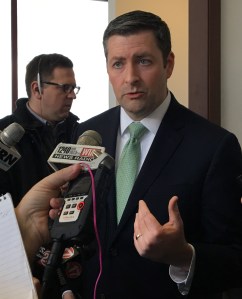
Peter Breen, Special Counsel for the Thomas More Society, talks to reporters after the Dec. 6 court hearing.

A law firm representing religious liberty concerns has filed a lawsuit to stop the implementation of taxpayer-funded abortions through House Bill 40 (HB40) in Illinois on Jan. 1.

The Chicago-based Thomas More Society suit argue that the General Assembly has not set aside funds in the state’s budget to pay for the abortions and remain within the Balanced Budget requirements of the Illinois Constitution. It also contends, according to the Thomas More Society, that the law cannot become effective until June 1 because it missed a May 31 cut-off date for General Assembly action.

“We’ve got $1.7 billion more appropriations than we’ve got revenue coming in,” said Peter Breen, Special Counsel for the Thomas More Society. “I don’t see how we’re going to find the money to pay for these elective abortions.”

Initial arguments were heard in the Seventh Judicial Circuit Court December 6 at the Sangamon County Courthouse in Springfield. Breen asked when the state planned to implement HB40. Attorney’s representing the state replied they were not prepared to answer the question.

Associate Judge Jennifer Ascher set the next hearing for Dec. 28. If the state does not intend to implement HB40 on January 1, the Dec. 28 hearing will most likely be rescheduled due to the upcoming holidays.

The suit is being brought by numerous state legislators, pro-life organizations and the Diocese of Springfield.

Board 2

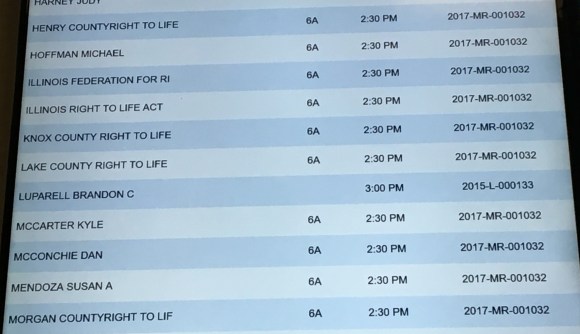
A screen at the Sangamon County County Court Complex in Springfield lists assigned courtroom and the defendants and plantiffs in Springfield Right to Life, et al v Felicia Norwood, et al.

Following the hearing, Breen, who is also a state representative (R-Lombard), was asked about the projected cost of implementing HB40. “Based on numbers from the Health and Family Services Department, it costs $750-$1,000 per abortion you’re looking at between 20-30,000 abortions [being performed].” He stated that would bring the total cost to $15-$30 million, funds not reimbursed by federal Medicaid.

Breen later said, “We’re always talking about how our children are our future. So how can you argue that somehow aborting more children is going to bring more value to the State of Illinois?”

When asked about the religious liberty aspects of HB40, Breen said, “This lawsuit is very specifically about public funds…We don’t have moral argument in court. We’re just looking at the misuse of public funds.”

The suit was filed on behalf of several legislators and pro-life groups who are opposing HB40, which would provide coverage for abortions through Medicaid and state employees’ health insurance plans.

In November, messengers to the IBSA Annual Meeting passed a resolution calling for the repeal of HB40, pledging support for “the rights of the unborn,” and claiming, “all human life is God-given and sacred, and should be protected by moral and righteous government.”

Illinois Gov. Bruce Rauner originally pledged to veto the HB40 if it came to his desk, but signed it into law Sept. 28—to the dismay of Christians and pro-life advocates. State Rep. Jeanne Ives (R-Wheaton) is working to get on the Republican primary ballot against Rauner in March.

“He lied to us,” Ives said in an Associated Press article last month. “None of us trust him anymore.”

– Lisa Misner Sergent

Why Chicago?

ib2newseditor —  December 7, 2017

chicago-cloud-sculpture

We may not verbalize the “why” question with the persistence of a young child, but we still look for a reason or substantial meaning when called to some action.

Through more than a dozen years in church planting, I’ve heard the “why” question. When a family gave five acres for a new church property to a local association in eastern North Carolina, many in nearby churches asked why, even as their buildings were nowhere near filling their seating capacity.

When I planted a church in Buckeye, Ariz., the North Carolina churches I invited to partner with us often wondered why they should care about planting a church in a community 2,000 or more miles away.

For nearly four years now, I have had the privilege of living in Chicago. During that time, I have mentored, coached and challenged many church planters here. I’ve also invited churches in more than a dozen states to get engaged in supporting church plants here in Chicago with prayer, action and finances.

“Why Chicago?” some ask, jesting, “Why not Hawaii? That would be a great mission trip!”

Yet there are three key answers:

The first reason is biblical. In Luke’s account of the Great Commission in Acts 1:8, Jesus tells His disciples and us, “But you will receive power when the Holy Spirit has come on you, and you will be my witnesses in Jerusalem, in all Judea and Samaria, and to the end of the earth” (CSB).

No matter where you live, major metropolitan areas like Chicago are located between you and “the end of the earth.” And frankly, because of political views and sensationalized news, Chicago in particular is to many in southern Illinois and elsewhere what Samaria was to the Jews: a place and people we’ve been trained or conditioned to dislike or even hate. Yet, even if it is Samaria to Christians, it’s a place and people to which Jesus has sent us to bear witness of Him and His Good News.

The second reason is practical. Cities like Chicago have, from their earliest settlement, become a home for immigrant people groups — many that are identified as “unreached and unengaged” by the International Mission Board.

Because of technology and ease of global travel from America’s major cities, many immigrants maintain a reach to and influence in their homelands. So, effectively evangelizing and discipling people in a city like Chicago gives us a reach into many parts of the world, including most of the peoples in the 10/40 window, a region between the 10th and 40th parallels across Africa and Asia where most of the people who have never heard the Gospel live.

Reaching Chicago and other metropolitan areas with the Gospel could bring a significant advance toward the global evangelization that Jesus promised in Matthew 24:14.

The final answer to “Why Chicago?” is missiological. Chicago is sometimes called the “most segregated city in America.” And while that is changing in some of the neighborhoods of the city, people groups are usually heavily concentrated in certain areas. Poles are heavily concentrated in the northwest neighborhoods and nearby suburbs. Chinatown, as you might guess, is home to mostly Chinese people, many of them still speaking Mandarin or Cantonese. Pakistanis are clustered along Devon Avenue in the northern part of the city. Professional millennials make up two-thirds of the population in the West Loop. Wicker Park is the epicenter of the hipsters.

High concentrations of people groups in a specific place give us a missiological advantage in reaching them. Even if it is a cross-culturally gifted southern boy and his family living among south Asian immigrants, winning one or two to Jesus could result in dozens who live nearby coming to faith in Christ. Given their close proximity to each other, bringing them together to a form a new church can happen very naturally.

While it may not be unique, Chicago is rare in giving us three good reasons to seize the opportunities for the Gospel that lie within our reach.

Dennis Conner directs IBSA church planting efforts in northeast Illinois. Beginning Jan. 1, Conner will transition to planting a church in Chicago’s South Loop neighborhood. This article first appeared in the Illinois Baptist and has been republished by Baptist Press.

The Briefing

Supreme Court: Christian baker vs gay weddings
The case of a Christian baker in Colorado who refused to make a cake for a same-sex wedding gets its big day in court December 5. Advocates on both sides anticipate the case will set a nationwide precedent for whether the government can require businesses, organizations, and individuals to act against their own sincerely held religious beliefs—particularly following the legalization of same-sex marriage and equal rights granted to LGBT Americans.

Canadian Christian law school pleads case to court
The Canadian Supreme Court began hearing a high-profile religious freedom case on December 5 that will determine the fate of an evangelical law school in suburban Vancouver. Trinity Western University’s plans to launch a law program—a first for a Christian institution in Canada—were stalled for four years, as the school faced legal challenges over its campus covenant, which bars sexual activity outside of traditional marriage.

Fight not over to stop taxpayer-funded abortions in Illinois
Opponents of Illinois law HB40, which would allow state funding of abortion on demand for state employees and Medicaid recipients, have filed suit on behalf of pro-life organizations. Republican Gov. Bruce Rauner signed the law earlier this year, and the Thomas More Society filed suit last week.

Pence, Iraqi archbishop discuss aid to Christians
Vice President Mike Pence met with a leading Chaldean Archbishop to discuss how the U.S. government can best help the Iraqi Christian community in the aftermath of attackes by the Islamic State. Chaldean Archbishop of Erbil Bashar Warda oversees the archdiocese that has sheltered and aided thousands of Christians forced to flee their home three years ago. Iraqi Christians have been begging for funding to not only provide humanitarian assistance but also reconstruction aid. There are as many as 20,000 Christian families still in need of help to return home.

Egypt churches get permission to build after 20 years
Authorities in southern Egypt have allowed 21 churches to expand and rebuild, after a wait of about two decades. Some attribute this gesture to Vice President’s Mike Pence scheduled visit to the country later this month. The Minya Governor has approved 21 applications of churches in rural Minya governorate over the last six months. A local source was quoted as saying that Egypt’s President Abdel Fattah el-Sisi is keen to “show the U.S. that Egypt is standing with the Christians and that there is no persecution in Minya governorate.”

Sources: Christianity Today (2), World Magazine, IB2news,  The Christian Post (2)

The vital few

ib2newseditor —  December 4, 2017

Pioneering Spirit logo

I don’t specifically remember the first time I heard about the “80/20 principle,” but I do recall finding it fascinating. Simply put, the principle states that, for many events, roughly 80% of the effects come from 20% of the causes, or that 80% of sales come from 20% of clients, or that 80% of the wealth is owned by 20% of the population, and so on.

When management consultant Joseph Juran began popularizing the 80/20 principle in 1941, he more formally named it the Pareto principle, after Italian economist Vilfredo Pareto, who published his own 80/20 observations in a paper at the University of Lausanne in 1896. Pareto showed that approximately 80% of the land in Italy was owned by 20% of the population, a principle that he first observed while noting that about 20% of the peapods in his garden contained 80% of the peas.

The 80/20 principle often resonates with pastors and church leaders, too. Not always, but many times, 80% of the work in a church seems to come from 20% of the volunteers, or 80% of the giving comes from 20% of the givers, or 20% of the congregation seems to require 80% of the pastor’s time.

We’re praying for at least 200 churches to make fresh commitments in four key areas.

Likewise in associational life, 80% of an association’s support can come from 20% of its churches. In fact, here in Illinois, 20% of IBSA churches currently provide about 80% of Cooperative Program giving. I suspect that further study would reveal many more 80/20 dynamics, both within and among churches.

The reality that the 80/20 principle underscores is that many, many things—from responsibility to productivity to generosity—are not evenly distributed within a group. Many groups have what Joseph Juran began referring to as “the vital few,” who carry the heaviest load in the group.

It’s the urgent need for more of those “vital few” churches here in Illinois that has led us to challenge IBSA churches to four “Pioneering Spirit” commitments during our state’s bicentennial next year. Between now and next November, we are praying for at least 200 churches who will register fresh commitments to church planting, evangelism, missions giving, and leadership development.

We call this going new places, engaging new people, making new sacrifices, and developing new leaders. Details, as well as registration information, can be found at the new pioneeringspirit.org website. Two hundred churches would not only match our state’s bicentennial, it would represent just over 20% of our churches.

These Pioneering Spirit challenges are simple, but they’re not easy. They challenge us to pray for, or partner with, or plant one of the 200 new churches that are needed in Illinois today. They challenge at least 200 churches to set a baptism goal that exceeds their previous 3-year average, and then focus intently on sharing the gospel. They challenge at least 200 churches to percentage missions giving through the Cooperative Program that increases each year toward 10%. And they challenge 200 churches to intentional processes that develop tomorrow’s pastors, church planters, and missionaries.

Apparently, at times, Joseph Juran referred to the 80/20- or Pareto-principle as “the vital few and the trivial many.” But later in life, he was said to prefer “the vital few and the useful many,” indicating a newfound appreciation for the necessity of the whole and not just the few.

I really appreciate that distinction, because I see value and uniqueness in every IBSA church, and understand there are many factors that influence what a church chooses or is able to do in a given area. Still, I think we have yet to see the impact we could have on our 200-year-old mission field, if at least 200 churches would step up and join the vital few.

Nate Adams is executive director of the Illinois Baptist State Association. Respond at IllinoisBaptist@IBSA.org.

800px-Sangamon_County_Courthouse_2017

A hearing is set for the lawsuit on December 7 at the Sangamon County Courthouse (pictured) in Springfield. Photo licensed under the Creative Commons Attribution-Share Alike 4.0 International license. Larry D. Moore

A law firm representing religious liberty concerns has filed a lawsuit to stop the January 1 implementation of taxpayer-funded abortions in Illinois.

The Chicago-based Thomas More Society filed suit in the Sangamon County Circuit Court on behalf of several legislators and pro-life groups who are opposing House Bill 40, which would provide coverage for abortions through Medicaid and state employees’ health insurance plans. Illinois Governor Bruce Rauner originally pledged to veto the bill if it came to his desk, but signed it into law Sept. 28—to the dismay of Christians and pro-life advocates.

The lawsuit argues the General Assembly has not set aside funds in the state’s budget to pay for the abortions and remain within the Balanced Budget requirements of the Illinois Constitution. It also contends, according to the Thomas More Society, that the law cannot become effective until June 1 because it missed a May 31 cut-off date for General Assembly action.

“Regardless of your feelings about abortion, it is incredibly fiscally irresponsible to enact a law designed to spend millions of dollars that Illinois does not have,” said Thomas More Society Special Counsel Peter Breen in a press release. “The state legislative process has steps that must be correctly followed in order to prevent budget-busting laws like this from being ramrodded through. It is part of our civic process of checks and balances.”

The suit, filed in the Sangamon County Circuit Court, is “brought on behalf of hundreds of thousands of Illinois taxpayers, represented by county and statewide pro-life organizations, the Springfield Catholic Diocese, and a group of Illinois legislators from across the state,” according to the press release. A hearing is set for December 7 at the Sangamon County Courthouse.

In November, messengers to the IBSA Annual Meeting passed a resolution calling for the repeal of HB 40, pledging support for “the rights of the unborn,” and claiming “all human life is God-given and sacred, and should be protected by moral and righteous government.”

After Rauner signed the measure into law, IBSA Executive Director Nate Adams said in a statement, “I join with Illinois Baptists and many others in Illinois who stand for the unborn in expressing great disappointment with the action of Governor Bruce Rauner on Illinois House Bill 40. Taxpayers’ money should not be used to fund abortions in any circumstance.”

Conservative legislators also have criticized Rauner’s actions on HB 40, including State Rep. Jeanne Ives (R-Wheaton), who is working to get on the primary ballot against Rauner in March.

“He lied to us,” Ives said in an Associated Press article last month. “None of us trust him anymore.”

If implemented, HB 40 also amends the Illinois Abortion Law of 1975 to remove language declaring that an unborn child is a human being from the time of conception, and would allow Illinois to continue to perform abortions should the U.S. Supreme Court overturn Roe vs. Wade.

-Lisa Misner Sergent