Archives For November 30, 1999

Floyd calls Trump prexy ‘our moment’

National Prayer Service in Washington DC

SBC Pastors Ronnie Floyd (center left) and David Jeremiah (center right) exit the platform and prepare to greet President Trump at the conclusion of the National Prayer Service Jan. 21 at the National Cathedral in Washington DC. Fox Phoenix screen capture

“Right now we’ve got a shot to really make a difference,” Ronnie Floyd told his congregation on Sunday. “God has given us a moment. It’s time to pray more than we’ve ever prayed in our country…to pray more with stronger conviction that every life matters to God.”

Floyd was just one of the notable Southern Baptist pastors participating in inaugural ceremonies for incoming President, Donald Trump. The pastor of Cross Church in Northwest Arkansas was one of the evangelical advisors to Trump.

Noting the current discord in the nation, Floyd said, “This is not about Democrats and Republicans. It’s about spiritual warfare; right and wrong. It’s not about what it appears to be about, it’s not about flesh and blood.

“You don’t announce you’re going to put pro-life judges on the Supreme Court and expect the world to receive it,” Floyd said in a video posted at his website.

Southern Baptists were prominent at the National Prayer gathering on Saturday following the inauguration, both in their placement in the program and on the platform among the 26 religious leaders invited to participate in the event.

Floyd and David Jeremiah, pastor of Shadow Mountain Community Church in El Cajon, Calif., sat on the dais of the National Cathedral, just behind the Episcopal celebrants who were leading the service and in front of the choir loft. Jeremiah read from Romans 5, the passage about character, endurance, patience, and hope. And Floyd read Psalm 23 from the King James Version.

Prestonwood Baptist Church pastor Jack Graham was one of the speakers in the “prayers of the people,” reading a scripted prayer on behalf of “those who serve.” And a granddaughter of Billy Graham, Franklin’s daughter Cissie Graham Lynch, read a similar prayer in a procession that included a rabbi, representatives of several Protestant denominations, and several Eastern religions.

Ramiro Peña, pastor of Christ the King Baptist Church in Waco, Texas, wrapped up the litany of prayers with The Lord’s Prayer. In an unofficial count, Southern Baptists outnumbered other faiths among clergy participating in the inauguration and prayer service. The interfaith service held an an Anglical cathedral had distinctly evangelical touches. Melania Trump led a standing ovation for the solo singer of “How Great Thou Art,” and the service concluded with “Great Is Thy Faithfulness,” which Vice President Mike Pence and his wife, Karen, sang from memory.

On Inauguration Day, Robert Jeffress, pastor of First Baptist in Dallas, delivered the sermon at the private prayer service prior to the swearing-in ceremony. He titled the sermon, “When God Chooses a Leader,” taking the message from Nehemiah 1:11.

“When I think of you,” Jeffress said to Trump, “I am reminded of another great leader God chose thousands of years ago in Israel. The nation had been in bondage for decades, the infrastructure of the country was in shambles, and God raised up a powerful leader to restore the nation. And the man God chose was neither a politician nor a priest. Instead, God chose a builder whose name was Nehemiah.”

He noted the first step God instructed Nehemiah to take in rebuilding the nation was building a wall around Jerusalem to protect is citizens. “You see, God is not against building walls,” Jeffress shared. Jeffress recalled sitting with Trump on a jet, eating Wendy’s cheeseburgers, and talking about the challenges facing the USA. Jeffress was an early supporter of Trump.

He told the incoming President and Vice President to look to God for strength and guidance: “…the challenges facing our nation are so great that it will take more than natural ability to meet them. We need God’s supernatural power.

“The good news is that the same God who empowered Nehemiah nearly 2,500 years ago is available to every one of us today who is willing to humble himself and ask for His help.”

He instructed them, “God says in Psalm 50:15 ‘Call upon Me in the day of trouble I shall rescue you and you will honor Me.’”

– Staff Report, with info from Baptist Press, RonnieFloyd.com, FirstDallas.org, and C-SPAN.

The BriefingIllinois House urged to reject taxpayer-funded abortions
SpeakOut Illinois, a coalition of pro-life and pro-family organizations across the state,  urged lawmakers in the Illinois House to reject legislation allowing taxpayer money to be used for abortions. House Bill 4013 lifts the current prohibition on state workers’ health insurance plans from paying for elective abortions, as well as the prohibition on using public money to pay for elective abortions for Medicaid patients. The piece of legislation could be called up for a vote as early as this week.

How many Christians are in the new Congress?
Pew’s Religion & Public Life found that 90.7% of the 115th Congress identify as Christian, a statistic that has changed little in over a half century of keeping record. “The share of U.S. adults who describe themselves as Christians has been declining for decades, but the U.S. Congress is about as Christian today as it was in the early 1960s,” noted Pew. Of the 91% Christian majority, 31.4% are Catholic, 13.5% are Baptist, 8.5% are Methodist, 6.5% are Anglican or Episcopal, and another 6.5% are Presbyterian.

Multi-faith network rescuing women from Isis
A secret underground network operating in Iraq and Syria has reportedly freed more than 3,000 Yazidi women held captive in sexual slavery by Isis. Kurdish and Christian civilians make up the group, along with other ethnic minorities and families of the victims, NGO Yazda has claimed. Rescues are carried out through word of mouth, driven by Yazidis who have escaped capture or whose loved ones are still being held in Isis territory.

Gay couple to pastor historic DC Baptist church
Calvary Baptist Church, a progressive Baptist landmark in the heart of downtown Washington, has named a gay couple as co-pastors. Sally Sarratt and Maria Swearingen were presented to the congregation during worship services Jan. 8 and will begin their new jobs on Feb. 26. The 150-year-old church severed ties with the Southern Baptist Convention in 2012.

S. Baptists lead Congressional Prayer Caucus
Rep. Mark Walker, R.-N.C., will be the new House of Representatives co-chairman of the Congressional Prayer Caucus, it was announced Jan. 9. Sen. James Lankford, R.-Okla., the other co-chairman of the prayer caucus, and former Rep. Randy Forbes, R.-Va., made the announcement. All three are members of Southern Baptist churches.

Sources: Illinois Family Institute, Christian Post, Independent, Religion News Service, Baptist Press

Baseball and Baptists

ib2newseditor —  August 10, 2016

Busch Stadium

I’m a St. Louis Cardinals fan and have been ever since I can remember. Growing up almost everyone I knew rooted for the Cardinals with the exception of a few odd Kansas City Royals fan.

I grew up watching their games on TV and listening to them on the radio in the family car. My parents would take us to Cardinal games to cheer our team on. When I moved to Illinois I stayed loyal to my team. I was even blessed to marry a fellow Cardinals fan and we continue the tradition of watching, listening, and going to games together.

We may be fans of different teams and squabble like siblings among ourselves, but we’ll always be a part of something greater in our Southern Baptist family through Christ.

I wouldn’t dream of supporting any other team. I am a member of Cardinals Nation, which feels like being part of a family. The atmosphere of camaraderie at the games is exciting. After games, we’ve spent the night at hotels near Busch Stadium and have gone down to breakfast to find the Cardinal mascot Fredbird the Redbird greeting people and posing for pictures with hungry fans.

At one time we even had Cardinal vanity plates on our car. I can remember being stopped at a red light a few times and having the person in the car next to us motion for the window to be rolled down. When we complied they would ask, “What’s the score?” Trips to games on I-55 often include pulling into a rest stop or restaurant. Fans decked out in Cardinal red apparel, who are perfect strangers, strike up conversations with each other about the team and the game they are on way to see.

I can relate this feeling and experience with being a Southern Baptist. My mother started attending our local Baptist church when I was just a few years old. She faithfully took all three of us kids for years until my father became a Christian when I was 12. Then church truly became a family affair. We all were part of a loving church family that worshiped, laughed, cried, and grew together.

Our own church family was part of a larger family of churches in our association, state convention, and national SBC. When we visit other churches and gather for annual meetings and conventions, we feel that same kinship as Christians and as Southern Baptists.

There is much more involved in my being a Southern Baptist than there is my being a Cardinal fan. The beliefs of my Baptist family and its commitment to the Lord are at the core of my being. In my life I’ve studied other denominations and visited their houses of worship, but none have the same belief in God and seek to follow him the way Southern Baptists do.

I suspect the same is true of many of you who are fans of the Cubs, White Sox, and other teams. We may be fans of different teams and squabble like siblings among ourselves, but we’ll always be a part of something greater in our Southern Baptist family through Christ.

-Lisa Sergent

Ready for Rio

ib2newseditor —  August 5, 2016

Rio_2016_crop.jpgWith the Olympic Games set to kick off Aug. 5, Southern Baptist volunteers will be in South America to share the gospel both with local residents and with the thousands of visitors from across the globe.

“There exists no greater opportunity to reach people from over 200 nations in 30 days than the Olympic Games,” said John Crocker, a missions pastor from Alabama who is leading a mission team to Rio. Crocker’s team will engage Rio residents with the gospel through evangelistic block parties and Olympic pin trading.

“There is an openness by people to talk with one another and to talk about spiritual things,” said Sid Hopkins a retired director of missions from Georgia who ministers at the Games by distributing pins made especially for the Olympics that tell the story of Jesus.

“We have seen many people who come to the Olympic Games open to listen to the gospel because the atmosphere created is one of friendship on a global level. Ministry during the Olympics is simply electric.”

Pre-event publicity for the Olympics has been largely negative, due to concerns over the Zika virus, Brazil’s economic struggles, the fitness of Rio’s water supply, the Russian doping scandal, and other issues. But Brazil’s hosting of the 2014 World Cup proved to be successful, and Olympic organizers are banking on a repeat of that success in Rio.

Journalist Tim Ellsworth, former editor of the Illinois Baptist, will cover the Games for Baptist Press, focusing largely on Christian athletes who are competing, including diver David Boudia. He won gold in the 10-meter platform competition in 2012 and is looking to add to his medal count in both that event and the men’s 10-meter synchro competition with his partner Steele Johnson. Both men gave strong testimonies of their faith in Christ following the Olympic trials this summer.

“This is not what my identity is going to be in the rest of my life,” Johnson said. “Yeah, I’m Steele Johnson the Olympian, but at the same time, I’m here to love and serve Christ. My identity is rooted in Christ and not in the flips we’re doing.”

The Illinois Baptist blog, iB2news.org, will have more stories from Rio during the Olympic Games.

– From Baptist Press

It’s time to speak up

ib2newseditor —  August 3, 2016

Adron RobinsonThe week of July 4, 2016, was a very dark week in America. It began with my wife and me celebrating Independence Day with our family and watching the local fireworks display. But there would be a different type of fireworks in the days to come.

On July 5, a Baton Rouge police officer pinned down Alton Sterling and shot him several times while he was on the ground, killing him in front of witnesses.

The very next day in Minnesota, Philando Castile was pulled over in a routine traffic stop and shot multiple times by a police officer. Castile’s girlfriend videotaped the aftermath of the shooting and broadcast it live on Facebook for the world to see.

If those incidents weren’t enough, on July 7, at the end of a peaceful protest of these killings, an armed gunman ambushed Dallas police officers, killing five and wounding seven others.

How can the church remain silent when the sin of racism is screaming so loudly?

It truly was a dark week in America. As I sat at my desk praying about how to process these events and address these issues with my congregation, God led me to Matthew 5:13-16.

We live in a dark and decaying world, and the darker the world gets, the more it needs the church to be salt and light. Light shines brightest in darkness, and God has providentially placed the local church in the community to shine the light of the gospel to a world that desperately needs that light.

The killings of African Americans at the hands of police officers, and the denial of justice to the families of those slain, reveal the high level of personal and institutional racism in America.

The truth of the matter is that an encounter with the police is a life or death matter for many people of color in America. We pull over praying. Praying that the officer who stops us will uphold the law and not manipulate it to cover up his own racial prejudice. Praying that we will be treated the same way every other citizen of this country is treated. But most of all, we are praying that we are not killed by the very people our taxes pay to serve and protect us.

This is not the experience of my non-minority brothers and sisters. And it should not be the experience of anyone created in the image of God.

My question is, how can the church remain silent, when the sin of racism is screaming so loudly? How can we stand by as injustice continues against those we say are our brothers and sisters in Christ?

We cannot remain silent. In order for there to be change in our culture, the church must stop being silent and step up and be the church. In Matthew 5:13-16, Jesus calls us to be counter-cultural Christians. This means the church is called to influence our culture with the gospel of Jesus Christ.

Christians and only Christians are the salt of the earth. Christians and only Christians are the light of the world. Christians and Christians alone are responsible for stopping corruption and slowing down the decay of this world.

Notice Jesus did not say “you and the government,” “you and the police department,” or “you and the Supreme Court.” There is only one hope for this world, and that hope is in people of God preventing decay and penetrating darkness.

We need to stop making excuses, stop being divided, stop being deceived by the darkness of this culture, and begin shining the light of righteousness and loving our neighbor as ourselves. We will never overcome a hateful world unless we learn to love one another.

Dr. Martin Luther King Jr., said, “Darkness cannot drive out darkness; only light can do that. Hate cannot drive out hate; only love can do that.” If we love our neighbor as ourselves, we cannot remain silent as our neighbors are being slain in the streets. And we must address the racism in our world, even if it is in our own hearts.

In Acts 10:34, Peter says, “Truly I understand that God shows no partiality.”

I pray that soon and very soon, the church would do the same.

– Adron Robinson is senior pastor of Hillcrest Baptist Church in Country Club Hills and vice president of IBSA.

Fractured alliances

ib2newseditor —  July 11, 2016

Fractured alliances

As the national political conventions approach, it’s time for evangelicals to decide. For some, it’s a choice they’d rather not make.

With the national conventions for both major American political parties just days away and the nominees all but a foregone conclusion, the only remaining question is how voters in November will react to this most unusual presidential election.

Christian voters in particular have yet to coalesce behind either candidate, although a June meeting between presumptive Republican nominee Donald Trump and nearly 1,000 evangelicals signaled things may be changing, at least for some conservative leaders.

And Trump’s announcement of an evangelical advisory committee, including several Southern Baptists, reverberated around the Twitter-sphere, shaking the unified front Baptists had shown just days before at the 2016 Southern Baptist Convention in St. Louis.

The divide is growing between conservatives who support Trump over Hillary Clinton’s liberal ideals, and those who say they won’t vote for the businessman-turned-reality TV star with a penchant for saying whatever is on his mind. Along with the differences among Christians, some pundits see a growing split between the traditional “religious right” and the Republican party.

“In the coming weeks, we are going to be learning a great deal more about the presidential candidates,” forecasted Southern Seminary President Albert Mohler in a recent edition of his Briefing podcast. “But it’s also increasingly true that we’re going to be learning a great deal about ourselves as evangelical Christians in America.

“Perhaps we’d better brace ourselves for what we’re going to learn.”

Meeting the Donald

On June 20, Donald Trump met in New York City with nearly 1,000 Christian leaders, including immediate past president of the Southern Baptist Convention Ronnie Floyd and newly elected president Steve Gaines, along with several other Southern Baptists.

The gathering, emceed by former Republican candidate Mike Huckabee, included a Q&A time with Trump, who has won over conservative voters in the primaries even as Christian leaders have decried his volatile speaking style and confession last year that he wasn’t sure he had ever asked God for forgiveness of his sins.

Following the meeting, Trump named a 25-member evangelical advisory board, which includes Floyd and at least seven fellow Southern Baptists. Floyd is among the members of the board who say their participation doesn’t constitute an endorsement of the candidate, rather “as an avenue to voice what matters to evangelicals,” he told The Christian Post.

Floyd also cited several key issues that compelled him to participate on Trump’s advisory board, including Supreme Court appointments, the sanctity of human life, religious liberty, Israel and the Middle East, and racial tension.

But many Christian and conservative leaders took issue with the meeting and the participation of those appointed to the advisory board. Russell Moore, president of the Ethics and Religious Liberty Commission and a recent Trump target on Twitter, took on the seeming divide between Trump’s public persona and his coziness with evangelicals:

“If you wondered why younger, theological, gospel-centered evangelicals reacted (negatively) to the old guard Religious Right, well, now you know,” Moore tweeted June 21, following up with, “If character matters then character matters.”

Moore wasn’t the only voice to question the authenticity of Trump’s relationship with Christians. Writing for The Federalist online, film critic Rebecca Cusey described reading through the meeting transcript, “thinking maybe Trump might exhibit some charm, some thoughtfulness in a smaller setting that is lost on the large stage, something that would explain why people who profess to believe in Jesus would be so taken in by Trump.

“Sadly, no. The transcript is shocking in its pandering: of Trump to evangelicals, yes—we expected that—but also in their pandering to Trump.”

Floyd acknowledged the widespread criticism, blogging a few days after the meeting that his short time out of the office of SBC president had been in some ways more difficult than leading the denomination for two years. He listed several Bible characters who had opportunity to speak into the lives of national leaders, including Old Testament prophet Daniel.

“What if Daniel had refused to acknowledge King Nebuchadnezzar and acted like he was too righteous to relate to him?” Floyd asked.

Similarly, Richard Land, who preceded Moore as president of the ERLC, asked critics of the Trump meeting what they would have the advisory team do instead of participate when asked.

“Would they really have us spurn the opportunity to give spiritual counsel and advice to Mr. Trump and his team?” Land wrote in a column for The Christian Post. “How would that be obedience to our Saviour’s command to be the salt of the earth and the light of the world?”
Fractured alliances 2

 Weighing other options

Some evangelicals are looking to Democratic candidate Hillary Clinton as an alternative to Trump, in spite of her policies on abortion and LGBT issues that run counter to traditionally-held conservative views.

Thabiti Anyabwile, in a column for The Gospel Coalition, said in May he planned, for the time being, to vote for Clinton. “…However we might evaluate her as a leader or her platform as a vision for America, we could say more or less the exact same things about Trump—with one glaring exception,” wrote Anyabwile, pastor of Anacostia River Church in Washington, D.C.

“We have no way of predicting Trump’s behavior from one hour to the next. None. Except to predict that the behavior will be vile and repulsive for any person who cares about civility, truth, and the dignity of the office.”

Deborah Fikes, executive advisor to the World Evangelical Alliance, gave Clinton her endorsement in June, saying of Trump, “…I worry that allowing religious and ethnic intolerance here in America will undermine our ability to have a prayer of fighting it around the world.”

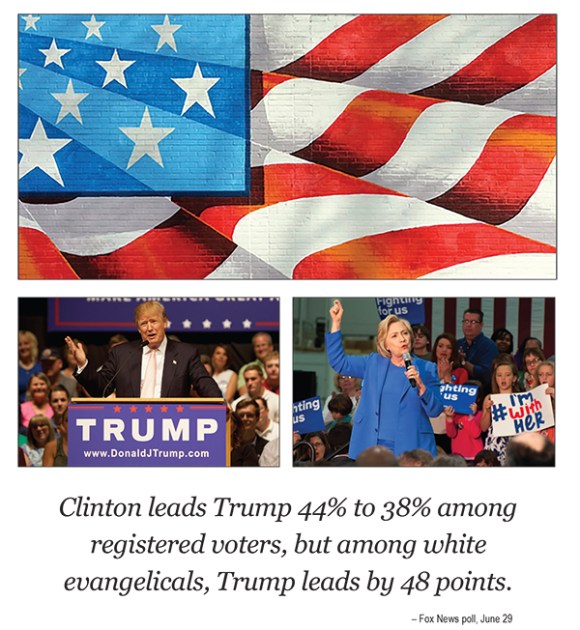
Still, Trump has branded himself as the candidate most invested in religious liberty and other Christian concerns. So far, a majority of voters agree: A June poll by CBS found Trump leads Clinton among evangelical voters by a margin of 62% to 17%.

However, as Religion News Service’s analysis of the poll pointed out, Trump’s 62% is lower than the percentage of white evangelical voters who favored George Bush (79%), John McCain (73%) and Mitt Romney (79%) in the last three elections.

Gallup polling from May found the two candidates neck and neck among those who identify as “Protestant” or “Other Christian”—36% had a favorable opinion of Clinton, and 38% had a favorable opinion of Trump. Both candidates’ numbers were slightly lower among the “Highly religious”—35% for Clinton and 37% for Trump.

For those voters who don’t foresee an appealing option for November, Christian and conservative leaders have floated other ideas, including third-party candidates, write-in voting, and abstention. Alan Noble, a professor at Oklahoma Baptist University, wrote for Vox that “unless a third-party candidate with broad appeal emerges, evangelical Christians would be better served by abstaining from that vote and shifting their energy toward electing people to Congress and local and state governments who have the opportunity to restrain whichever candidate is elected as needed.”

But many Christian leaders have been vocal about getting out the vote, even for candidates that are less than ideal. On his tour of state capitals, evangelist Franklin Graham has urged Christians to vote, but hasn’t endorsed specific candidates. Graham has instead warned against inactivity, citing a statistic that reports 20 million evangelicals did not vote in the 2012 presidential election.

In Springfield, Graham told several thousand gathered in front of the Capitol, “Our job as Christians is to make Christ felt in every [area] of life—religious, social, economic, political.”

Keep the lines open

No matter who believers support in the election, said Wheaton College’s Ed Stetzer, the rhetorical tone should be loving.

“In years past, I generally had to encourage evangelicals to avoid scorning fellow evangelicals who voted Democrat. Now, perhaps we need exhortation to avoid scorning those who vote for Donald Trump….Rather than looking down with scorn on evangelical Trump supporters, perhaps we should sit down with them, listen to them, and hear their concerns.”

Mohler prescribed similar action in his June 22 podcast, urging Christians to think through the issues at hand.

“In this difficult political season, evangelicals must not demonize one another as to how we’re thinking through these issues, but I must plead with all evangelicals that we must indeed think through these issues carefully and faithfully, and think very biblically and candidly.”

To fail to remember oneness in Christ and fall instead into factions and camps could result in a loss of the unity achieved during the recent Southern Baptist Convention, wrote Pastor Ted Traylor following the meeting with Trump, which he attended. At the June 14-15 convention in St. Louis, Baptists united around one presidential candidate, Steve Gaines, after another, J.D. Greear, bowed out prior to a second run-off election.

Now, as Baptists consider another election, Traylor, pastor of Olive Baptist Church in Pensacola, Fla., advised them to think carefully in a blog post titled, “What I learned from a conversation with Donald Trump.”

“There has been much vitriol on social media about the Trump meeting within the tribe of Southern Baptists. We left our convention last week in unity. Demonizing each other over secular politics will quickly destroy what we saw and hailed as God-given unity. We are in the Gospel business.

“However, as we render to Caesar what is his we must be wise, kind and discerning.”

Almost a thousand evangelical Christian leaders gathered in New York City Tuesday to meet with presumptive Republican presidential nominee Donald Trump. Among them were a number of prominent Southern Baptists. Eight were among the 25 leaders appointed to Trump’s evangelical advisory panel.

They are: Ronnie Floyd, immediate past president of the Southern Baptist Convention and pastor of Cross Church in northwestern Arkansas; Jerry Falwell Jr., president of Liberty University; Jack Graham, pastor of Prestonwood Baptist Church in Plano, Texas, and a former SBC president; Robert Jeffress, pastor of First Baptist Church in Dallas; David Jeremiah, pastor of Shadow Mountain Community Church; Richard Land, president of Southern Evangelical Seminary and former Ethics and Religious Liberty Commission president; James MacDonald, pastor of Harvest Bible Chapel in Chicago, which only recently joined the SBC; and Jay Strack, motivational speaker and founder and president of Student Leadership University.

Being on the advisory board does not amount to a full public endorsement (Falwell, Jr. is the only one who has publicly endorsed Trump) , however to many it does imply a tacit endorsement. Some have been critical of the leaders’ action, to which Land replied via an editorial in the Christian Post. “What would our critics have us do?,” he asked. “Would they really have us spurn the opportunity to give spiritual counsel and advice to Mr. Trump and his team? How would that be obedience to our Savior’s command to be the salt of the earth and the light of the world? (Matthew 5:13-16). After all, as Evangelicals we all believe that the heart of the king “is in the hand of the Lord . . . He turneth it whithersoever He will” (Proverbs 21:1).”

Current ERLC president, Russell Moore, has been a vocal opponent of Trump, tweeting Tuesday afternoon, “If you wondered why younger, theological, gospel-centered evangelicals reacted neg to the old guard Religious Right, well, now you know.”

And, a few minutes later, “Forget the politics. Forget the country. An unrepentant lost person pronounces himself to be a believer. And you stand there and applaud?”

At last week’s Southern Baptist Convention, in the President’s message, Floyd stated, “Our nation is divided. We are known more for being the divided states of America than the United States of America. The national political races we have observed over this past year personify the fractured, dysfunctional condition in America relationally.”

Floyd also led a panel on Pastor’s and Politics at the convention. He introduced the panel saying, “Disagreement doesn’t have to result in a strained relationship with brothers and sisters in Christ…This presidential panel is an attempt to address this conversation.”

Graham, who was one of the panelists urged Southern Baptists not to sit at home but to get involved in the process. “One concern we should all have 30-40 million stayed home and did not participate…This is a critical election for the future of America,” he said.

He pointed to three primary issues Christians should be looking at when voting for a presidential. They are choosing Supreme Court justices, belief in the sanctity of life, and maintaining religious liberty. Graham noted, “We must not abdicate our responsibility to pray and to vote.”

There words appeared to be at odds with other convention leaders. At the B21 Luncheon during the convention, Moore and Albert Mohler, president of the Southern Baptist Theological Seminary were among the panelists speaking. Replying to a question about the 2016 U.S. presidential elections, Mohler said, “I find myself in a situation I’ve never found myself in as a Christian. I’m going to find myself unable to vote for either candidate.”

Moore agreed and said he plans to write in a name on his ballot.

One thing is certain, there will be continued disagreement regarding the presidential election. Another thing is also certain, many in the U.S. appear to be having flashbacks to 1976 and having their own Howard Beale, “Network” moments in this election cycle.

– Lisa Misner Sergent

TentI often find myself at denominational functions looking around the room and wondering, “What is it that really brings us together here?” Is our unity based simply on an expressed common desire to reach the lost? Or do we gladly join together in mission because we have deeply shared doctrinal convictions?

I’ve found some guidelines in a couple of the smallest books in the Bible, 2 and 3 John. One way to read these short letters (which combine for a total of just 28 verses) is to put them side-by-side as two crucial lessons in cooperation.

First, here is some background to both books: a church planting movement is taking root in the Roman world furthered by traveling missionaries who depend upon support from other Christians, primarily in the form of food and lodging.

In 2 John the tone and feel is one of caution: “Many deceivers have gone out into the world.” “Watch yourselves.” The emphasis is on getting the gospel right. Specifically, some of these traveling missionaries “do not confess the coming of Jesus Christ in the flesh,” what has been referred to as the “Gnostic heresy.” John speaks soberly of remaining in Christ’s teaching and not going beyond it. He then directs genuine believers: “If anyone comes to you and does not bring this teaching, do not receive him into your home… for the one who says, ‘Welcome’ to him shares in his evil works.” In other words, don’t cooperate with everyone!

The tenor is different in 3 John. Here John is commending a “dear friend” for his generosity to certain missionaries. The emphasis in this mini-epistle is on getting the gospel out. “You will do well to send them on their journey in a manner worthy of God.” These missionaries “set out for the sake of the Name” and trusted God to provide through his people. “Therefore, we ought to support such men,” says John. He even calls out a guy named Diotrephes for his independent spirit. “He not only refuses to welcome the brothers himself, but he even stops those who want to do so.” Don’t be like Diotrephes. Don’t cooperate with no one!

2 John teaches us not to make our tent too big. 3 John encourages us not to draw our circle too small. We need both messages.

Notice the disproportionate amount of times the words truth and love occur in these two short letters. We absolutely cannot disconnect them. There are people who have great drive, but do not have good doctrine. We have to be discerning about who we partner with. On the other hand, there are Christians who are cranky and overly separatist. We must be large-hearted and kingdom-minded.

Because of 2 John I know that the Apostle John would applaud the “Conservative Resurgence” in the SBC. Is it not amazing that we have six top-notch seminaries that are committed to robust and orthodox theological training?

At the same time, based on 3 John, I am pretty certain that the Apostle would thoroughly endorse the concept of the Cooperative Program and be thrilled with our North American and International Mission Boards. It is wonderful that we have state and local associations. And is it not telling that we have Directors of Mission and not District Superintendents? We are the people who come up with campaigns like “Million More in ’54.” And I love that I live in what was once a Strategic Focus City, now a SEND City.

However, we have not always gotten this balance right. At times I have seen people approved for work in the SBC based on their passion without an examination of their doctrine. And at other times I have seen people who were well qualified turned away because of a technicality.

In all of our missional zeal, may we never fudge on doctrinal clarity. And in making sure we are all on the same page about what the gospel is, may we make sure we are doing whatever it takes to get the gospel out. If we are truly faithful to Scripture, we will heed the lessons of both 2 and 3 John. But there just might be something to the fact that 2 John comes before 3 John.

Nathan Carter is pastor of Immanuel Baptist in the University District of Chicago.

Platt surprised by number, but financial position called ‘much healthier’

Richmond, Va. | David Platt’s report to the International Mission Board’s Board (IMB) of Trustees was the culmination of six month’s worth of efforts to undo the six year’s worth of overspending.

The IMB president, told trustees 1,132 total IMB personnel had accepted the Voluntary Retirement Incentive (VRI) or Hand Raising Opportunity (HRO).  The numbers broke down to 702 missionaries and 109 staff personnel accepting the VRI, and 281 missionaries and 40 staff accepting the HRO. The positions of 30 personnel in IMB’s Richmond communications office were eliminated in its mobilization restructure.

The total was nearly twice the minimum number the mission board needed to depart to balance its budget. As a result, the number of missionaries on the field are down to around 3,800, a number not seen 1992 when, according to Southern Baptist Convention (SBC) annual reports, the year ended with 3,893 international missionaries were serving.

Platt told reporters participating in a press conference via telephone February 24, “The numbers surprised me, for which I don’t have an explanation. We’ve put it in the hands of missionaries as much as possible… This a larger number than I or anyone else was anticipating. We called on people to pray so we’re going to trust in the Lord and his decision.”

While the press conference was taking place, Platt told reporters a severe storm was passing through and noted the lights were flickering on and off. A few minutes later the lights went out and a Tornado Warning Alert could be heard. The press conference was stopped for a half hour until the storm passed.

After discussing the numbers, Platt told the gathered media, “I want to talk about the number of missionaries who are left. Thousands of missionaries remain on the field, with thousands of years of collective experience. Everyone of them on the field has been placed there by God.”

IMB reported it had “consistently spent more money than it has received — a combined $210 million more since 2010…Because 80 percent of IMB’s budget is devoted to personnel salary, benefits and support expenses, leaders determined a need to reduce the total number of personnel by approximately 600-800 people to get to a healthy financial place in the present for sustained growth and engagement in the future.”

The Illinois Baptist asked what his reaction was to receiving almost double the number of resignations needed? “My heart is heavy but hopeful,” he answered. “Heavy in a sense that my heart is not to see less people on the field. My heart is heavy seeing the effects…It’s a hopeful confidence mingled with that heaviness.”

“What does this say about the confidence the missions force has in the new leadership?” the Illinois Baptist asked in a follow-up. Platt replied, “I’m very encouraged to see God working in the middle of all this. I have a hopeful confidence in what the IMB will be able to do in the future.

“I hope Southern Baptists see a serious desire to love and lead the IMB well…This is in no way a commentary on past leadership. Past leadership made a bold decision to put people on the field.”

Platt also addressed a question he said people have been asking, “How can you send thousands more when you just sent a thousand off the field?” His answer focused on what some would describe as marketplace missions, “limitless opportunities for people to work overseas and retire overseas.” In turn they would be funded by their paychecks and pensions. He also noted mission opportunities for students studying abroad.

One reporter expressed concerns from churches about the departure of so many missionaries leaving a “brain drain” on the field. Platt responded, “We encouraged missionaries returning to take their last days on the field to pour into our national partners and other IMB missionaries that were still there.”

Another reporter asked Platt if he saw this proposed use of self-funded missionaries as the IMB taking a societal approach to missions.

In his answer Platt noted, people who get jobs overseas and are paid by their businesses, universities provide scholarships to students, and countries in southeast Asia are seeking Westerners to retire there “rolling out the red carpet.” With these opportunities, he asked, “How can we not support the core paid missionaries with those around them that can help?”

He continued, “I can’t pray Matthew 7:9 and then tell people who want to serve with the IMB, ‘no.’ God’s created these other avenues…”

Platt also responded to a question regarding what kind of response he has heard from Southern Baptists. “I’ve not been surprised by the feedback from Southern Baptist pastors and church leaders,” he shared. “They’re thankful we’ve chosen to stewardship resources in the way we have…They’ve been very encouraging. Once they hear the big picture they say that makes sense, thank you for making that decision.”

He went on to say, “People aren’t happy about it. I’m not happy about it. It’s a hard reality for Southern Baptists to face that we don’t have the resources to keep more people on the field….I expect people to be upset that people are leaving the field but God’s leading us to greater financial stewardship.”

SBC President Ronnie Floyd told Baptist Press, “This reset is not regress or retreat. Southern Baptist churches must see this as a fresh calling to reaching the world for Christ. Now is the time to go forward with a clear vision and an aggressive strategy to make disciples of all the nations for Christ.”

Twenty-six new missionaries were appointed to the International Mission Board Feb. 23, in a service that was the first to be live-streamed.

The IMB Board of Trustees met February 22-24 in Richmond, Virginia.

IMB will host a livestream focused on “The Future of the IMB” Thursday, March 3, at 11 a.m. EST. For more information, visit IMB.org/live.

Denominational tags have fallen on hard times. History and tradition have become baggage.

I would be surprised if you know of a new church that can be identified with any recognizable branch of Christianity. If you can get creek, river, brook, or tree into your church name, for sure it will grow. The more bland, comforting, serene; the more easily confused with a country club or a rock band your church name is, the more in tune with the times you appear.

And the latest trend has moved beyond nature: Bridge. Liquid. Radiance. Paradox. Propulsion.

In the interest of transparency, I began a move to change our church name 15 or 20 years ago, then I chickened out. Baptist is still our middle name.

Here is my attempt to give a bit of context and explanation for our church name to a deep blue, urban, postmodern population.

What’s in a name?
John the Baptist, eccentric prophet. William Carey, linguist, humanitarian extraordinaire. Fredrick Douglas, abolitionist-orator. Charles Spurgeon, urban crusader. Nannie Helen Borroughs, women’s leader. Walter Rauschenbusch, social justice warrior. Lottie Moon, China champion. Martin Luther King, renowned activist. Billy Graham, global evangelist. Mahalia Jackson, vocalist without equal. Rick Warren, mega-church pastor, best-selling author. Baptist is a name associated with colorful, controversial, influential figures here and around the world.

There are approximately 32 million Baptists in the U.S., half of them are “Southern Baptists,” over 100 million in the world. As for “The Baptist Church,” there isn’t one. Each Baptist congregation is independent, autonomous, self-governing. Many churches participate in larger entities, but those affiliations do not infringe upon congregational self-determination. Yes, this lends itself to some craziness and confusion; it is what it is.

Baptists are not self-named. Our persecutors began using this label in derision beginning in the 1400s. Theologically and historically, Baptists are those who hold the Word of God, the Scriptures, the Bible, as sole authority in all matters of faith, church order, and practice rather than looking to tradition, human hierarchies, committees, or governments.

Many historians seemingly fail to notice that many who came to America for religious freedom, instituted the same state church systems, persecuting those who did not adhere, repeating the sins of the governments they fled.

In U.S. history, Rhode Island, the first colony with complete religious freedom, was founded by Baptist Roger Williams. Williams’s life was a crusade for freedom of conscience and religious liberty. He founded Rhode Island in 1636 after purchasing the land from the Narragansett Indians.

A refuge from religious persecution, Rhode Island became home to the first Jewish synagogue in America and a sanctuary for Quakers who were being persecuted and killed by anti-Quaker laws in Massachusetts and other colonial territories. Rhode Island was an open door to all people, a safe harbor in a sea of tyranny and oppression.

In the flurry of activity around the colonies becoming states, the constitution presented for ratification did not provide for religious liberty. Baptists supported the proposed constitution on the condition an amendment on religious freedom would be added.
Finally, Massachusetts and Virginia became the pivotal states in the process. James Madison was running for the state legislature of Virginia against Baptist pastor John Leland.

Madison was about to lose the election. Leland knew this. He also knew without Madison’s golden voice and political influence there would be no constitution. With victory already in his hand, Leland dropped out of the race, giving Madison an open road on the promise that he would pursue language providing for religious liberty.

So sympathetic was Congress, urged on by President Washington, that they made it their first business to consider the issue Baptists were pressing. As a result, the line of the First Amendment reads, “Congress shall make no law respecting an establishment of religion or prohibiting the free exercise thereof…”

Baptist then is not a “brand name” so much as it is a historical, theological descriptor of people who adhere to biblical authority over human authority and are advocates of religious liberty for all.

Charles Lyons pastors Armitage Baptist Church in Chicago.