Archives For November 30, 1999

coffee cup with a world map

I am ashamed to admit that I haven’t always understood why being on mission both personally and as a church is so vital. I used to skip the “missions” chapel services in seminary because I wrongly believed that missions and being a pastor were two separate callings. I just wanted to be a pastor. Sadly, the first church I pastored wasn’t very mission-minded because I wasn’t.

However, I am now convinced that one of the vital roles of pastors and church leaders is to lead the church to fully embrace God’s call to be involved in their local community and beyond. My heart now understands that the church should be a strong community of mobilized missionaries. It is now my desire to lead the church through preaching, mission trips, and other creative ways so that missions becomes part of our church’s DNA.

I believe that one of the first ways to lead your church to be on mission is to be a leader who is on mission. I am convinced that when the leader of a church is passionate about the mission of God and living a missional life, that focus and zeal will naturally overflow into the hearts of those in the pew.

When a leader is passionate about the mission of God, that zeal will overflow to people in the pews.

All throughout Scripture we clearly hear God’s call to missional living. We see a clear gospel focus when Christ sends out the 12 disciples in Luke 9 and again when he sends out the 70 in Luke 10. We hear God’s heart when we read the Great Commission and Acts 1:8. In our head, we can know that God wants us to live this life with passion for the gospel, but it is so hard to keep the main thing the main thing.

When being on mission becomes part of the leader’s DNA, the church hears about it through his preaching, sees it through his life, and feels it through his tears for people who are lost without Christ.

Though my mind is now thoroughly convinced of the importance of leading my church to be on mission, I must continually remind my heart about God’s mission. Here are some of the practices that help my heart to be missions-minded:

Personally participating in at least one mission trip a year. These times are good for my walk with God. I need to see God move in ways I cannot explain. Often these trips become spiritual revivals for my heart. I try to alternate between going overseas and going somewhere in the U.S. each year.

Reading missions books and biographies of missionaries. Some of the books that make me cry are “10 Who Changed the World” by Daniel Akin, “The Insanity of God” by Nik Ripken, “The Hole in our Gospel” by Richard Stearns, and “Seven Men” by Eric Metaxas.

Attending missions training sponsored by IBSA, and conferences sponsored by the North American Mission Board. Some of the conferences that have recently helped my missions heart are NAMB’s Send Conference, the Midwest Leadership Summit hosted by IBSA, an IMB Missionary Commissioning service, and the IBSA and SBC Annual Meetings.

I’m not always looking for new programs or new ideas at these conferences, though I often come home with an idea for how we can do missions differently or better at Immanuel.

Talking with missionaries. I love hearing their heart, their struggles, and their successes. You can connect with church planting missionaries on a vision tour hosted by NAMB or IBSA, and the International Mission Board is always happy to send a missionary on furlough to preach at your church.

Most missionaries also send out regular e-mail prayer newsletters. While these messages remind me to pray for the missionary, they also encourage me as I read about some creative things others are doing all across the world for King Jesus.

Spending time with other believers who are on fire for Jesus and who are getting it done sharing the gospel. Often, these lunches and the time I spend with these kinds of believers greatly challenges me.

What a joy it can be when a church understands that God has commissioned them to be the light in a dark world. What a joy it can be when church members leave to plant churches, surrender to ministry, lead their co-worker to Christ, and go to the nations.

The steps you take to fuel your missions heart are steps toward God’s heart, enabling your entire church to be on mission! Keep chasing him, my friends.

– Sammy Simmons is pastor of Immanuel Baptist Church in Benton.

Princesses and Hot Dogs

A lesson in leadership from a bold five-year-old.

A few days ago I saw a brief news story about a dance class for five- and six-year-olds, where the instructor had invited the little girls to wear costumes at their next rehearsal. She dubbed it “Princess Day,” knowing how many of her tiny dancers would enjoy dancing as princesses, and also how many of them already had princess costumes.

What helped the story go viral and hit the headlines, however, was the photo of seven little girls in princess costumes standing with one very unique little girl, dressed in a hot dog costume. Five-year-old Ainsley chose to come to Princess Day not with a tiara on her head, but with a stripe of mustard down her front. One of the many captions and tweets that circulated with the photo simply read, “In a world of princesses, dare to be a hot dog.”

“In a world of princesses, dare to be a hot dog.”

There are so many things that encourage me about this story. First, there is the individuality, confidence, and boldness of the little girl. Many times I have found myself wanting, even needing, to be the hot dog in a group of princesses. I had a minority opinion, or a different point of view, or simply knew that the direction of the group was not right. It’s just easier to conform than to stand alone.

Then there was the dad who encouraged little Ainsley. He later tweeted, “No parent is ready to learn that their daughter is trending…Best part is it was all her idea!” The courage and confidence to be different, and the empowerment to act on that difference, often comes from those closest to us.

But for me, the most encouraging character in this little real-life drama was dance teacher Sarah, who was suddenly placed in the position of leading a group with a non-conformist. Sarah could have taken offense at the little girl who didn’t follow instructions or apparently respect her position as teacher. She could have sent her home, or embarrassed her in front of the class, or not included her in the dance or the picture.

Instead, this good-natured teacher embraced the little hot dog’s uniqueness, accepted both her and her costume into the group, and proudly took the picture that ended up making her class famous.

In doing so, Sarah challenged me as a leader. And I think she should challenge all of us who lead as pastors, Sunday school teachers, and ministry leaders. As hard as it is to be the hot dog in a group of princesses, it may be even harder to effectively lead a group of presumed princesses when a hot dog shows up.

That hot dog may be the deacon with an outreach idea that would take a church outside its comfort zone. It may be the sincere new believer in a Sunday school class who asks questions that don’t have tidy or pat answers. It may be the church member who presses an uncomfortable budget issue in a business meeting, when it would be easier to just vote yes and go home.

A confident, secure leader embraces multiple points of view and even minority opinions as ways to potentially make the final decision or outcome even better. An insecure leader wants only quick, compliant agreement.

After the picture became famous, teacher Sarah revealed that Ainsley was actually wearing a princess costume underneath her hot dog costume. Ainsley explained that she was still a princess on the inside. I found that to be an extra encouragement. When we’re patient and accepting of hot dogs, even on Princess Days, we often find that deep down they want to dance too. And God may even use them, or you or me, to make the dance more famous.

Nate Adams is executive director of the Illinois Baptist State Association. Respond at IllinoisBaptist@IBSA.org.

Sad truth: Pastors are sinners tooCOMMENTARY | John Gibson was fun and funny. He was smart and caring. He was a good teacher and a fine preacher. He was also troubled. He wrestled with depression for many years, and recently we learned he struggled with pornography.

That came to light because John confessed it in his suicide note.

I said “no way” when LifeWay Research President Ed Stetzer predicted 400 pastors might resign on the Sunday after 32 million names were revealed in the hacking of adulterous hook-up site Ashley Madison. Again I said “no way” when others predicted a wave of suicides among those outed in August.

In the end, Patheos blog reports, three Christian leaders resigned and one died.

I knew the man who died.

John Gibson was a few years ahead of me at New Orleans Baptist Theological Seminary. If memory serves, he was working on a doctorate and served as grader for my evangelism professor. He left to pastor a church, and some years later returned to New Orleans to serve on staff and eventually to teach. Some people knew of his struggle with depression. There aren’t many secrets on a seminary campus.

But apparently his wrestling with sexual addiction was not widely known. Gibson’s wife, Christi, said her husband knew he would lose his job when his name appeared on the hacked list, and he couldn’t face the humiliation.

Christi found his body in their seminary campus home on August 24. Then she had to tell their two children.

“There is brokenness in every single one of us. We all have things that we struggle with,” she told CNN last week. “It wasn’t so bad that we wouldn’t have forgiven it, and so many people have said that to us, but for John, it carried…such shame.”

Gibson’s family shared some of his story in a service at the seminary chapel. “My dad was a great man,” son Trey, 24, said. “He was a great man with struggles. My dad reached a point of such hopelessness and despair that he took his own life.”

“I still believe it could have been fixed,” Gibson’s wife said to cable news viewers. “It could have been healed.”

As a newsman, not much surprises me anymore. As a pastor, not much disappoints me, except the lack of grace when people need it most. To the sad truth that pastors are sinners, we offer this good news: Jesus died to save sinners.

Including pastors.

DER

THE BRIEFING | Meredith Flynn

Boy Scouts of America President Robert Gates said last week that the organization should end its ban on gay leaders, a move that some Baptist leaders said was inevitable following the Scouts’ decision two years ago to allow gay-identifying youth to join.

The_Briefing“Back when they changed their thinking regarding the boys themselves, I knew that within a year or so they would reverse their stand with the leadership,” Georgia pastor Ernest Easley, chairman of the SBC Executive Committee in 2013, told Baptist Press. That year, messengers to the Southern Baptist Convention adopted a resolution affirming “the right of all families and churches prayerfully to assess their continued relationship with the BSA,” and urging the removal of leadership who sought the policy change “without seeking input from the full range of the Scouting family.”

Gates said May 21 that “Between internal challenges and potential legal conflicts, the BSA finds itself in an unsustainable position, a position that makes us vulnerable to the possibility the courts simply will order us at some point to change our membership policy. We must all understand that this probably will happen sooner rather than later.”

Mentioning councils already operating in defiance of the policy on gay leaders and the Supreme Court’s expected decision on same-sex marriage this year, Gates said, “We must deal with the world as it is, not as we might wish it would be.” The councils’ charters could be revoked, he said, but “such an action would deny the lifelong benefits of scouting to hundreds of thousands of boys and young men today and vastly more in the future. I will not take that path.”

Gates’ remarks reflect “an attitude that has infected many faith-based and religious organizations—and even entire Christian denominations,” blogged Joe Carter of the Ethics and Religious Liberty Commission. “Like Gates, many religious leaders simply lack the courage to stand up to internally destructive dissidents for fear of losing the broader organization.”


LA Governor signs executive order for religious liberty
After legislators in his state struck down a religious freedom bill May 21, Louisiana Gov. Bobby Jindal signed an executive order designed to protect “people, charities and family-owned businesses with deeply held religious beliefs that marriage is between one man and one woman.”

“We don’t support discrimination in Louisiana and we do support religious liberty,” Jindal said in the order. “These two values can be upheld at the same time.”


Gallup: Support for same-sex marriage at all-time high
60% of Americans support same-sex marriage, Gallup reported last week, up from 55% in 2014. The pollster also found Americans continue to overestimate the number of people who are gay or lesbian.


Theology debate among Arizona churches goes public
A group of churches in Arizona are working across denominational lines against the “progressive Christianity” they see evidenced at a sister church, Bob Smietana reports at ChristianityToday.com. The campaign, which includes a sermon series delivered at eight churches and advertised in the local paper, opposes the theology of The Fountains, a United Methodist church in Fountain Hills, Arizona. Pastor David Felten’s views include support for LBGT rights and rejection of the Virgin Birth, according to CT.


IMB missionary remembered in Malawi
An International Mission Board missionary who died of malaria last week is being remembered as “a mother to all.” Susan Sanson, 67, had been serving in Malawi with her husband, Billy, since 2000. The couple had no children, “but she didn’t feel the gap because we were all [her] children,” posted one student who knew her from her ministry at Chancellor College in Zomba, Malawi.


Illinois pastor details journey through anxiety
In an interview on Crossway.org, Joe Thorn, pastor of Redeemer Fellowship in St. Charles, shares about what he calls “the most difficult season in my personal life,” when anxiety got so bad he considered leaving ministry.


Millennials slightly less tuned in to TV
Barna’s report on what we watch on TV is fun and full of interesting facts, like the number of hours of television Millennials watch compared to older adults. (It’s two hours a day versus five for people 69 and over.) Other findings: Procedural shows scored big among Boomers and Elders, and almost everyone likes “The Big Bang Theory.”

Evangelistic_churches_3HEARTLAND | The average Southern Baptist church in the Midwest has 54 people in worship on Sunday mornings, and baptized three last year. But a North American Mission Board study found the top evangelistic churches in the region are charting a different course, said Joel Southerland, NAMB’s executive director of evangelism strategies.

The Midwest’s top evangelistic churches with less than 250 in worship attendance averaged 119 in worship and had 23 baptisms. Churches with more than 250 in worship averaged 71 baptisms.

Southerland shared findings from the NAMB study of the top 20 evangelizing churches in every U.S. state at the Illinois Baptist State Association’s Evangelism Conference in March, and in a breakout session at the Midwest Leadership Summit earlier this year. The study resulted in a list of “7 Secrets of Top Evangelistic Churches in the SBC.”

  1. It has a lot to do with the pastor. NAMB studied the pastors of top evangelistic churches and found that the majority described their leadership style as “charismatic” or “transformational,” outranking innovative, command and control, servant, situational, laissez-faire and pace setter.

The pastors they studied were at the churches 10-plus years on average, Southerland said, and 70% of them preach a sermon series on evangelism every year. More than half (55%) put more emphasis on evangelism than discipleship, and 90% share the gospel outside the church at least once a month.

  1. Top evangelistic churches are really good at the Sunday morning experience. Of the pastors surveyed, 93% described their worship as lively and celebratory, 95% were contemporary or blended in worship style, and 96% said they intentionally cultivate a guest-friendly atmosphere. And 70% give an invitation at the end of the service.

Southerland outlined several worship takeaways: make church exciting, work on the quality, be intentionally evangelistic on Sunday morning, and aim for something better than “friendly.” People aren’t looking for friendly, he said, they’re looking for friends.

  1. These churches are actively engaged and serving the community, no matter the size of the congregation. Of the pastors surveyed, 88% said they were well engaged in the community. Of mid-sized top evangelistic churches, 30% attempt service-based ministry efforts to share the gospel regularly, as do 37% of large churches.

It’s OK to start small with community engagement, Southerland counseled, just start somewhere. And preferably not in a vacuum. Talk to community leaders about the needs are, and how your church can help. Involve non-Christians, using the service as an opportunity to share the gospel with them.

  1. Top evangelistic churches communicate well, internally and externally. The average pastor makes too many assumptions about how much people know, Southerland said. They assume the congregation knows the church’s vision, that members are as passionate about reaching people as the pastor, and that they don’t need constant motivation.

But all of those things—and more—need to be communicated. Luckily, more avenues for communication exist now than ever before. Of the top evangelistic church pastors surveyed, 97% use a church Facebook account regularly, Southerland cited. Half of pastors and staff intentionally “friend” guests on Facebook.

  1. Virtually all top evangelistic churches make a big deal out of baptisms—97%, the NAMB survey reported. And 79% of pastors of churches in the mid-size church category preach a yearly sermon on baptism, as do 74% of large-church pastors.

The takeaways, Southerland said, are to preach at least once on baptism every year, provide a forum for people to give their own, recorded testimonies, help baptismal candidates invite family and friends to the service, and train your church to celebrate new spiritual life.

  1. They treat guests really well. In non-evangelistic churches, Southerland said, the service is for the members and guests just happen to be there. Evangelistic churches are the opposite; of the congregations NAMB surveyed 67% of mid-size churches and 85% of large churches had a person responsible for “first impressions” ministry targeted to visitors.

A large majority (70%) emailed, called and sent written mail to a guest within seven days of their visit.

  1. Top evangelistic churches emphasize inviting and personal evangelism. The pastors of the churches NAMB studied were very busy mobilizing their church members to be a witness in the community; 50% offered evangelism training, and 70% of their guests came to church as a result of a personal invitation from a member. Among mid-sized churches, 62% have visitation or organized outreach at least once a month, and 58% of large churches do the same.

Churches that train members in personal evangelism, Southerland said, baptize two-and-a-half times more people than those that don’t.

The value of a verbal witness cannot be underestimated, he said during a message at the IBSA conference. Especially when most people are broken and looking for a solution to their problems.

“We are far too timid when it comes to sharing the gospel. We are too scared of the culture.” But, “The culture is not near as bad as it could be or will be someday. We’re to take the gospel to the culture and change the culture with Jesus Christ.”

COMMENTARY | Heath Tibbetts

“So what do you think about demons?” This was the random text message my 21-year-old brother sent me a few months back. I replied, “They sound scary, and they’re totally real.”

He called and told me of his friend, John, who believed he was being harassed by a demon. John doesn’t go to church, but he decided to call a few of the local pastors in his town, asking them what he should do. In each instance, the pastor didn’t believe his story, and offered nothing further.

Heath_Tibbetts_Feb26John lives out of state from my brother and me, so I offered to call. Soon, he was explaining his story to me. Let’s put it this way…YIKES! The hairs on my neck stood at attention as John explained this entity’s ability to take a visible shape while bringing him feelings of dread and even depression. He was now worried that this “entity” (I told him demon was the correct term) would attempt to possess him, and he was highly fearful.

I’ve heard of pastors who have blown off these types of stories. A previous pastor I served with said he had received a call from someone who thought they had a demon in their house. When I asked him what he was going to do, he replied, “Not go over there!” This didn’t sit well with me. Jesus spent many days defeating demons who were bringing hopelessness and harm to people all over Israel (Matthew 8:16, Luke 11:20, bunches of others). The Bible spoke of demons as a real threat, and I was shocked that our church didn’t act accordingly.

After telling John I believed him, I asked about his relationship to God. He admitted to having none, though he had been growing more curious about spiritual things. And as John continued to talk, I realized these attacks had intensified during this newfound curiosity. Long story short, I shared with John the Good News of Jesus and he willingly repented of his sins over the phone and placed his trust in Jesus. Then, we had a crash course in Holy Spirit theology. I told him that according to 1 Corinthians 6:19, no one can ever possess him now that he has become a temple of the Holy Spirit. John hung up the phone sounding much more confident about the future.

In fact, in the three months since John accepted Christ, he’s experienced a great change. Because the local pastors didn’t offer hope, he was unwilling to attend their churches. I’ve been discipling him by phone, texts, and e-mails. He reports no visits from this demon since his salvation, and he is reading his Bible and spending time in prayer. John is also finding new plans opening up for his life. He is moving to a new city in February to continue his education, and the first question he asked me was, “How do I find a good church when I get there?”

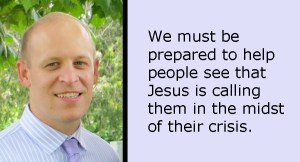
What is the takeaway for us? First of all, there were pastors who had an unbeliever call them for hope and they offered NONE. We have the hope of salvation and purpose in Jesus. When an unbeliever approaches us, no matter their dilemma, we must be prepared to help them see that Jesus is calling them in the midst of their crisis.

Secondly, if the Bible warns us of something, we had better take it seriously! Satan and his demons are real and they are working tirelessly to deceive, depress, and destroy souls. We must remain aware that spiritual warfare is going on all around us. Sometimes we can see it more clearly than others, but we are not fighting against people, but against “the spiritual forces of evil,” according to Ephesians 6:12. God has called us to be
warriors for the gospel who will help the hurting and broken find hope in Jesus Christ. As Peter said, let us always be prepared to share the hope that lies within us.

Heath Tibbetts pastors First Baptist Church in Machesney Park.

HEARTLAND | Eric Reed

When I said to my co-workers, “Well, let’s go meet a thousand of our closest friends,” I didn’t know how true that statement would be. We left our offices and drove the four blocks to Springfield’s Crowne Plaza Hotel, site of the 2015 Midwest Leadership Summit. And like so many of our Baptist gatherings, this one felt like Homecoming Week at Sandy Creek Church. We saw dear friends from across Illinois, and some we knew from the other dozen states in attendance.

Eric_Reed_Feb9But I never expected to see Woodie.

After all, it’s been 35 years. And the last time I saw Woodie, he was a Mormon. In Alabama. Go figure. Woodie and his siblings were fourth-generation Reformed Latter Day Saints (RLDS) living in a fishing town on the Gulf Coast. We all went to high school together. Although our school was a ministry of a conservative fundamentalist church, no one made an issue of Woodie’s religion. All his family
were clean-cut, well-mannered, and better behaved than many in our class who claimed to be Christians. I remember Woodie as a great guy, a good football player, and very well liked. But lost.

Woodie came to that truth while in college. Through a campus ministry he came to a life-saving faith in Jesus Christ and left his family’s religion. Later, he attended Mid-America Seminary and was called to ministry. Eventually Woodie moved to Lamoni, Iowa, the place where Latter Day Saints founder Joseph Smith once lived and present-day home to the RLDS college. Woodie had attended that college for a couple of years until he began question the RLDS religion.

Returning in 1991, Woodie started a Baptist student ministry, reaching out to RLDS students and others.

Eventually he pastored First Baptist Church of Lamoni, the sponsor of his college ministry, for nine years, and just recently was called to lead Calvary Baptist Church in Clinton, Iowa. Woodie said God is opening doors to Brazilian soccer players (in Iowa!) because his son plays soccer and his wife is originally from Brazil. Go figure.

That’s why he was at the Midwest Leadership Summit and standing in the hallway outside the ballroom at the Springfield Crowne Plaza. Woodie is a Southern Baptist pastor in the Midwest, looking for fresh ideas, inspiration, and encouragement.

I stand amazed by all God has done in Woodie’s Christian life and Baptist ministry. And I’m so glad God brought our paths to cross again.

I should be more amazed that 35 years after high school—even though Woodie hasn’t changed much—I recognized him standing there. But that’s the Lord’s doing too.

Go figure.

Eric Reed is IBSA’s associate executive director for the Church Communications team, and editor of the Illinois Baptist newspaper.

Leaders debate in wake of grand jury decisions

THE BRIEFING | Meredith Flynn

The Christian Post reports on a disagreement among some Southern Baptist leaders, following a grand jury’s decision not to indict Police Officer Darren Wilson in the death of Missouri teenager Michael Brown.

The_Briefing“Seems to me that racial reconciliation is a good thing and is a social issue, not a doctrinal or theological issue, and certainly not a “gospel demand,'” blogged Texas pastor Randy White. “If there is something Biblical that expresses racial reconciliation as a gospel demand, I’ve missed it.”

White’s Nov. 26 post at randywhiteministries.org was in response to Southern Seminary vice president Matthew Hall, who wrote about racial injustice after a Missouri grand jury decided not to indict former Ferguson police officer Darren Wilson in Brown’s death. Hall blogged the gospel demands racial reconciliation and justice, and gave five reasons why Christians ought to heed its instruction on the issues.


“…It’s high time that we start listening to our African-American brothers and sisters when they tell us that they’re experiencing a problem in this country,” Russell Moore said after a Staten Island grand jury did not indict Officer Daniel Pantaleo in the death of Eric Garner. In a Questions & Ethics podcast recorded after the verdict was announced Dec. 3, the Ethics and Religious Liberty Commission President denounced racial divisions in and among churches.


As a 13-year-old, Christian rapper Lecrae went free after harassing people with a pellet gun, he said in a Dec. 3 Facebook post. “One officer decided not to arrest me years ago but instead challenged me to get in my Bible.” The post was published on the same day as the Cleveland funeral of 12-year-old Tamir Rice, who was shot and killed by a police officer while carrying a pellet gun.


A Southern Baptist pastor in Florida was killed Dec. 4 by a gunman who also took the lives of two women. Baptist Press reported police arrested Andres Avalos in Bradenton two days after the murders of Pastor Tripp Battle, Amber Avalos (Andres Avalos’ wife), and Denise Potter. Battle was the pastor of Bayshore Baptist Church in Bradenton; his father-in-law, Keith Johnson, was formerly on staff at FBC Machesney Park and Vale Church (Bloomington) in Illinois.


Six in ten Americans say the government shouldn’t define or regulate marriage, according to this recent LifeWay Research study, and more than half say clergy should no longer be involved in the state’s licensing of marriage.


A group of religion leaders, including Pope Francis, have pledged to do everything they can to end human slavery by 2020.


Religion News Services wonders how Christians will respond to “Unbroken,” the Louis Zamperini biopic from director Angelina Jolie. The film reportedly doesn’t deal with Zamperini’s Christian faith, chronicled in Laura Hillenbrand’s 2010 book from its beginnings at a 1949 Billy Graham Crusade.


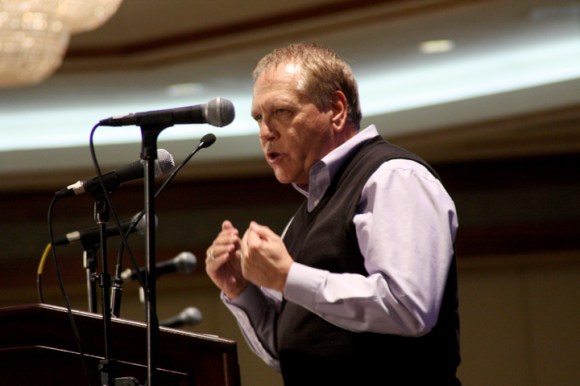
Larry Thompson, pastor of First Baptist Church in Ft. Lauderdale, Fla., is preaching at the IBSA Pastors' Conference on the "seismic" spiritual shift described in Acts 10. Follow the Pastors' Conference at Facebook.com/IllinoisBaptist.

Larry Thompson, pastor of First Baptist Church in Ft. Lauderdale, Fla., is preaching at the IBSA Pastors’ Conference on the “seismic spiritual shift” described in Acts 10. Follow the Pastors’ Conference at Facebook.com/IllinoisBaptist.

HEARTLAND | Meredith Flynn

In two out of three Southern Baptist congregations, fewer than 100 people gather for worship on Sunday morning. Megachurches may get more attention, but small churches are the backbone of the SBC, Frank Page has said.

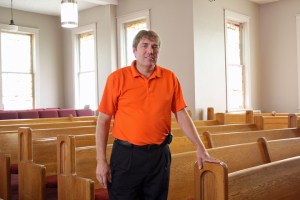
Illinois pastor Cliff Woodman is part of a new advisory council on small and bivocational churches.

Illinois pastor Cliff Woodman is part of a new advisory council on small and bivocational churches.

Still, small church pastors often feel overlooked and marginalized, left out and under-resourced. A new advisory council assembled by Page, president of the SBC Executive Committee, exists to communicate the unique needs of these categories of churches with denominational leaders.

“I will not allow the Southern Baptist Convention to forget who we are,” said Page during the first meeting of the Bivocational and Small Church Advisory Council. “Part of my goal in this is to elevate the role of the small church pastor and the bivocational pastor, period. And that’s going to happen.”

Illinois pastor Cliff Woodman is part of the 21-member council, which will work over the next three years to develop a report on the statistics that define Southern Baptist churches. The group, one of several Page has brought together in his first four years as Executive Committee president, represents a large majority of Southern Baptist churches.

“Some would say 35,000 of our 46,000 churches, maybe more than that, are in the two categories of small church or bivocational,” Page said at the Sept. 11-12 meeting in Atlanta. For the council’s purposes, he defined a small church as one with 125 people or fewer in Sunday school attendance. The group also looked at research on the percentages of SBC churches by worship attendance. According to 2013 data, 68% of Southern Baptist churches have 100 or fewer people in worship, compared to 78% of IBSA churches and missions.

Woodman, now pastor of Emmanuel Baptist Church in Carlinville, spent more than 25 years as a bivocational pastor at Harmony Baptist Church in
Medora. He told the Illinois Baptist small church and bivocational pastors (most who also work a second job) often feel out-of-the-loop. Sunday school curriculum may feel tailored to larger churches with more people and more classroom space, for example, and large church pastors often are the ones invited to speak at meetings or conferences.

But non-megachurches can be effective churches. Woodman, whose Carlinville church reported an average worship attendance of 145 in their 2013 Annual Church Profile, is leading Emmanuel to look closely at what makes a congregation healthy. He referenced LifeWay President Thom Rainer’s 2013 book “I Am A Church Member,” which outlines members’ responsibilities to their congregation.

“If a church member’s not supposed to look at ‘what’s in it for me,’ then maybe churches ought to stop looking at ‘what’s in it for me,’” Woodman said. The better question is, “What can I do for the bigger body?”

Major shift toward bivocational
Page has used a “fault lines” analogy to describes areas of SBC life where there are rifts between different groups. One of those fault lines, he said in the Atlanta meeting, is related to church methodology, or how churches do church. The discussion centered on bivocational ministry, a strategy Page called “the wave of the future.” It’s also the wave of the past.

Southern Baptist churches have long relied on bivocational pastors to lead churches. Decades ago, many pastors were farmers; today, they also drive school buses, deliver the mail, and run small businesses.

“I’m convinced that in the 21st Century, the best stewardship model is bivocational,” Page said. “We’ve got a lot of students coming out of seminary now who have no intention of being full support.” In other words, they’re prepared to work more than one job to make ends meet.

That news was encouraging to Woodman. There was a day, he said, when “the underlying current was that the bivocational guy wasn’t good enough to have a full-time church.” Page shared with the group that some Christian universities are now training students to be pastors along with learning another vocation.

While there will always be churches that want their pastor to be full-time, Woodman said, bivocational ministry is imperative if Southern Baptists want to extend the reach of churches into more communities. “And we’re going to have to do a better job at it,” he said, and at preparing future leaders for it. Because bivocational pastoring is “a different game.”

Quit the comparison game
Small church pastor Job Dalomba posed a pointed question in an April blog post: “We have to ask ourselves an honest question: Do we want to see the glory of God shining from larger churches or do we just want their numbers, resources and notoriety to be our numbers, resources and notoriety?”

The SBC Voices post by Dalomba, pastor of a new, small church in Southaven, Mississippi, called for small church pastors to stop comparing themselves to men who lead larger congregations, and to pray for those big churches too.

It’s a strategy the congregation at Emmanuel has utilized this year. A church’s prayer requests are a good measure of its health, Pastor Woodman said. “Throw them up on the wall, and see what your prayer requests do. And when you get done, you begin to think about what does that tell you your view of God is.

“And in essence, you’ll find in most churches that he’s healer, a physician; he’s an employment agency; he’s Triple A. But what’s lacking is that he’s a savior.”

Woodman’s congregation was already praying by name for people who don’t know Christ when he arrived as pastor last year. To that focus, they’ve added regular prayer for sister churches in Macoupin Baptist Association. The prayers are scripted, with a focus on reaching people who don’t know Christ. Woodman is hopeful the strategy will help build a spirit of teamwork between his church and others in the community, he told SBC Life earlier this year.

“When we started praying for our sister churches, that helped us be healthier. If we as pastors and churches would take the same attitude, then we’d stop looking at what others were doing for us, and we’d start doing for others.”

With reporting by Baptist Press and SBC Life. Meredith Flynn is managing editor of the Illinois Baptist newspaper, online at http://ibonline.IBSA.org.