Archives For November 30, 1999

Taking the risk

ib2newseditor —  November 17, 2016

Serving Christ has always been dangerous. He said it would be. Now, even telling the stories of missionaries puts them in danger.

London | We can’t tell you their names. We can’t tell you where they live. We can’t really even tell you where they work. They are missionaries.

Times have changed. We all know social and cultural values have recently experienced massive upheavals in western nations. Religion has played a major role in these changes. Missions work is no longer tolerated in places it once was. Working to fulfill the Great Commission can no longer be done so openly.

We can’t tell you their names. We can’t tell you where they live. We can’t really even tell you where they work. They are missionaries.

Coinciding with these cultural shifts are changes within the Southern Baptist Convention’s largest missions sending agency. The International Mission Board (IMB) is adapting the way it does missions. When IMB President David Platt stepped into the role in 2014 he soon discovered the agency was facing a budget overspend of more than $200 million. Personnel costs would have to be greatly reduced with action being taken quickly. With a major and largely voluntary staff reduction in 2015, going from nearly 5,000 missionaries and staff to 3,800, IMB expects have a balanced budget in 2017.

The changes included cutting most of the communications team serving in Richmond, and replacing them with a small team of young communication specialists stationed at points all around the world. With them comes new strategies for engaging Southern Baptists with missionaries that take into account the risky business of gospel witness.

Not your mother’s mission magazine
You may have noticed the stories about IMB missionaries have changed. Remember Commission magazine, with its glossy photos and National Geographic style? Today’s mission stories are not written in a long, detailed format anymore. We don’t often see photographs of missionaries’ faces. The name of the countries where they serve may not be reported. There is a good reason for this. A very good reason.

horse-and-rider

SHADOW AND LIGHT – This photo from IMB’s
Instagram account shows their new communication strategy: show the missions concept, but protect the identity of the missionary. Posted with the photo is a brief message from the missionary: “Pray for God to provide me with a teammate willing to work in rough, remote places so we can reach the mountain shepherd people.”

Almost a dozen state Baptist convention newspaper editors met with members of the Board’s media network in London recently. The chief topic was security concerns.

“There’s spiritual warfare on the front lines,” a member of the media team shared. “A battle is going on against the spread of the gospel.”

For example, one missionary took all the necessary precautions. But when a photo that had been taken years earlier was found online it led to his undoing. Somehow a person in the country where the missionary was serving connected it with some other information online to learn the missionary’s true identity. It almost cost him his life.

He walked, unsuspecting, into a meeting and found the atmosphere was charged with anger. People once friendly were now menacing as they kept him there for hours shouting, “Is this you? Did you say this?” When he was finally allowed to leave, he gathered his family and they fled the country. His identity had been compromised and it was no longer safe for them to continue to spread the gospel message in that country.

The missionary life can require living in countries where it’s dangerous to be a Christian. But it can also be risky living in “safe” countries among those same people groups that are hostile to Christians. There are parts of Africa and Asia that have always been high risk and high security for missionaries. With the increased mobilization of people, now it’s not just there, it’s everywhere.

“There’s spiritual warfare on the front lines. A battle is going on against the spread of the gospel.”

In other cases, the country may feel it is already a Christian nation and therefore does not need to admit anyone into the country for the express purpose of doing mission work. In those places, missionaries enter as workers who are in the country to do charity work or other vocations.

Tell the old, old story—differently
If you visit the International Mission Board’s website, IMB.org, you can read its mission statement, “Our mission is evangelizing, discipling, and planting reproducing churches among all peoples in fulfillment of the Great Commission.”

In today’s world, technological advance has produced security issues, so can the missions stories be told to the people back home in the pews? It’s becoming more and more challenging. Things aren’t as simple as when Lottie Moon would write about her work in China and send the letter to Annie Armstrong to be copied (and recopied) by hand or typewriter, and distributed across the United States.

For years the National Woman’s Missionary Union’s prayer calendar in Missions Mosaic magazine has contained a birthday prayer calendar for missionaries. It listed their names and the countries where they served. In recent years, fewer real names or locations can be shared. Quite often a pseudonym will be used along with a region of the world, “South Asia,” for instance.

While the IMB remains committed to telling the story back home, they are having to become more and more creative in doing so. Lengthy articles are now less common and story vignettes are better vehicles not only due to safety concerns, but also for ever shrinking attention spans.

“The missionary life, missions sending, it’s always changing.”

This has caused the IMB to shift the way it creates the content of a story, looking more at the concept that describes the missions work. As a member of the media team said, “There are avenues of telling the story without focusing on people in specific locations. We’ve had to shift the way we’re doing content altogether.”

The use of social media including Instagram, Facebook, and Twitter is proving to be a good way for Southern Baptists to stay informed about missions. It connects with younger generations who need also to learn the importance of giving to missions through the Cooperative Program.

The IMB website has undergone a complete retooling and now sports a fresh look that supports this challenging new media world.

Another change is in the reporting on the safety of missionaries after breaking news events. Southern Baptists often express interest in how an event affects missions efforts in those areas. According to their website, “Due to security considerations for IMB personnel and the national believers with whom they work, we usually don’t discuss their locations. However, with any breaking news event, we are in contact with anyone who might be affected, due to travel or other reasons, to confirm their safety and security.”

A media team member summed it up: “The missionary life, missions sending, it’s always changing. There are always new security challenges necessitating a new way of telling their stories. Most of our missionaries, we can’t print their names.”

Lisa Misner Sergent will focus on London, a world city with many people groups, in her next report.

Offering Day

ib2newseditor —  September 18, 2016

Mission Illinois Offering  Week of Prayer Day 8

MIO-box-smallToday many churches across the state will collect the Mission Illinois Offering. With a goal of $475,000, the ministries in this prayer guide depend on faithful giving in order to continue reaching people for Christ. The Mission Illinois Offering is the most direct channel through which Illinois Baptists can fund mission work close to home and really invest in the things important to us here.
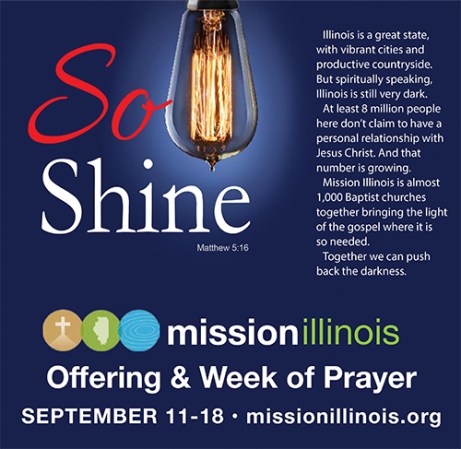
Mission Illinois encourages the work of local congregations, is built on solid Baptist doctrine, and helps share Christ in every setting where IBSA missionaries serve. Missions giving through this offering helps equip and mobilize people to reach our specific mission field—the lost and unreached people in Illinois.

Pray for IBSA Executive Director Nate Adams and all the missionaries and staff of IBSA. Pray for generous giving during your own church’s offering for state missions.

Learn more about the Mission Illinois Offering

Watch Nate Adams’ video, “Turn on the light.”

coffee cup with a world map

I am ashamed to admit that I haven’t always understood why being on mission both personally and as a church is so vital. I used to skip the “missions” chapel services in seminary because I wrongly believed that missions and being a pastor were two separate callings. I just wanted to be a pastor. Sadly, the first church I pastored wasn’t very mission-minded because I wasn’t.

However, I am now convinced that one of the vital roles of pastors and church leaders is to lead the church to fully embrace God’s call to be involved in their local community and beyond. My heart now understands that the church should be a strong community of mobilized missionaries. It is now my desire to lead the church through preaching, mission trips, and other creative ways so that missions becomes part of our church’s DNA.

I believe that one of the first ways to lead your church to be on mission is to be a leader who is on mission. I am convinced that when the leader of a church is passionate about the mission of God and living a missional life, that focus and zeal will naturally overflow into the hearts of those in the pew.

When a leader is passionate about the mission of God, that zeal will overflow to people in the pews.

All throughout Scripture we clearly hear God’s call to missional living. We see a clear gospel focus when Christ sends out the 12 disciples in Luke 9 and again when he sends out the 70 in Luke 10. We hear God’s heart when we read the Great Commission and Acts 1:8. In our head, we can know that God wants us to live this life with passion for the gospel, but it is so hard to keep the main thing the main thing.

When being on mission becomes part of the leader’s DNA, the church hears about it through his preaching, sees it through his life, and feels it through his tears for people who are lost without Christ.

Though my mind is now thoroughly convinced of the importance of leading my church to be on mission, I must continually remind my heart about God’s mission. Here are some of the practices that help my heart to be missions-minded:

Personally participating in at least one mission trip a year. These times are good for my walk with God. I need to see God move in ways I cannot explain. Often these trips become spiritual revivals for my heart. I try to alternate between going overseas and going somewhere in the U.S. each year.

Reading missions books and biographies of missionaries. Some of the books that make me cry are “10 Who Changed the World” by Daniel Akin, “The Insanity of God” by Nik Ripken, “The Hole in our Gospel” by Richard Stearns, and “Seven Men” by Eric Metaxas.

Attending missions training sponsored by IBSA, and conferences sponsored by the North American Mission Board. Some of the conferences that have recently helped my missions heart are NAMB’s Send Conference, the Midwest Leadership Summit hosted by IBSA, an IMB Missionary Commissioning service, and the IBSA and SBC Annual Meetings.

I’m not always looking for new programs or new ideas at these conferences, though I often come home with an idea for how we can do missions differently or better at Immanuel.

Talking with missionaries. I love hearing their heart, their struggles, and their successes. You can connect with church planting missionaries on a vision tour hosted by NAMB or IBSA, and the International Mission Board is always happy to send a missionary on furlough to preach at your church.

Most missionaries also send out regular e-mail prayer newsletters. While these messages remind me to pray for the missionary, they also encourage me as I read about some creative things others are doing all across the world for King Jesus.

Spending time with other believers who are on fire for Jesus and who are getting it done sharing the gospel. Often, these lunches and the time I spend with these kinds of believers greatly challenges me.

What a joy it can be when a church understands that God has commissioned them to be the light in a dark world. What a joy it can be when church members leave to plant churches, surrender to ministry, lead their co-worker to Christ, and go to the nations.

The steps you take to fuel your missions heart are steps toward God’s heart, enabling your entire church to be on mission! Keep chasing him, my friends.

– Sammy Simmons is pastor of Immanuel Baptist Church in Benton.

Focus on state missions starts September 11

Wrap cover artOver the course of almost five years, I have traveled to the far corners of Illinois looking for stories. Mostly they’re stories to support the Mission Illinois Offering & Week of Prayer, stories of God’s people whose work is made possible by the missions commitment of Baptists in our state. My partner in this venture, videographer Paul Wynn, and I joke that we’ve spent the last five Mother’s Days together. His kids are grown now, so his wife doesn’t mind if he’s away from home on her holiday. Maybe having a quiet house is what makes it a holiday for her.

On those May weekends and many others, we have visited new churches and compassion ministries. We’ve been from Elgin to East St. Louis, Davis Junction to Iuka, Plainfield to Metropolis, and many points in between. We’ve talked with pastors and joyful believers they’ve led to Christ. We’ve followed teenagers who braved city streets, sharing the gospel with strangers for the first time. And we’ve heard story after story from IBSA missionaries whose life-changing work brings them—and sometimes all of us—to tears.

I suppose the numbers should be compelling enough: There are 13 million people in Illinois, and at least 8 million of them do not have a faith relationship with Jesus Christ. I lived in Chicagoland 15 years, and there the “numbers” are ever before you. So many people. So few believers. I learned what it means to be in the minority, because Christians are so far outnumbered.

The biblical command should be convicting: Jesus said, “Go.” Isn’t that enough?

But what is most convincing is the stories. The stories and the people who share them convince me afresh every year that our mission work in Illinois is vitally important, worth our personal service and our prayer and our giving and our going.

Calling all churches

Hart Family

Hart Family, church planters in Breese, IL

I admit I felt out of place at a bar in Breese, Illinois, but it was Sunday morning and technically the bar wasn’t open. They were having church, and I knew the songs. I’m still smiling about how the young church planter and his wife started a church—in a bar—in his hometown—which, as most hometowns do, knew too much about him. I celebrated when he sent word a couple of weeks later that the church baptized its first new believers in a horse trough.

Their story is featured in our collection for the 2016 Mission Illinois Offering & Week of Prayer.
• Plus, there’s the story of a pastor’s wife we met in Casey soon after her international mission trip to aid oppressed women in South Asia.
• And the student group making its second trip from Sherman to the big city streets during ChicaGO Week.
• And the pastor planting another church nearby his downtrodden neighborhood, hoping to reach unreached people with another chance at hope in Christ.

These stories will all be featured in the Illinois Baptist. And they are included in the Mission Illinois Offering prayer guide for September 11-18, which will be distributed in participating churches. A week of devotions also is included in the special supplement that wrapped this edition of the newspaper. And all the materials are on our new website: missionillinois.org.

Our statewide goal this year is $475,000. The offering supports IBSA’s missions work, including the areas we’re highlighting this year: church planting in rural Illinois, students reaching Chicago, mobilizing Illinois volunteers for missions worldwide, and sharing Christ with unreached people. Yes, there are people in Illinois who have never heard.

Please encourage your church to participate in the Mission Illinois Offering & Week of Prayer. And please pray about your own gift for state missions. If you’re like me, the stories will convince you.

See all videos and mission study materials at missionillinois.org. Contact MIO@IBSA.org if we can help your church observe the Week of Prayer for state missions.

Kevin Ezell, president of the North American Mission Board

Kevin Ezell, president of the North American Mission Board

Columbus | Missionaries aren’t sent out on their own. Or even solely through the power of missions agencies like the North American and International Mission Boards. Churches–supporting, sending churches–are central to the process.

David Platt, president of the International Mission Board

David Platt, president of the International Mission Board

That was the main idea behind this morning’s Sending Celebration, hosted by Southern Baptists’ two mission agencies following brief reports by both. Instead of their traditional separate presentations highlighting missionaries, NAMB and IMB joined forces to celebrate people serving around the world, and the churches who have helped send them. In hopes that more will catch the vision for how they can be engaged with taking the gospel to the world.

Worship leaders Shane & Shane

Worship leaders Shane & Shane

“Churches almost unknowingly begin to farm out missions to missions organizations,” Platt said. “But this is not how God designed it.” You won’t see IMB or NAMB in the New Testament, he said. Instead, you see churches like the one at Antioch.

“We want to see 46,000-plus Antiochs,” Platt said at the beginning of the sending celebration.

As worship artists Shane & Shane led music from the stage, slides introduced church planters serving across North America and others working across the globe. As their slides showed on giant screens in the convention hall, many of the missionaries stood, illuminated only by simple, book-shaped lights fanned out in front of them.

At the end of the service, they stood again together, and people sitting around them stood and prayed over them as Platt and Ezell led from the stage.

“Not one of us is guaranteed today, much less tomorrow,” Platt had said during his final charge to those in the audience. “So, brothers and sisters, let’s make it count. Let’s make our lives and our churches and churches in this convention count.”

The_BriefingTHE BRIEFING | Meredith Flynn

A new Barna study explores what kinds of worship spaces are most attractive to Millennials, and what words describe their ideal church. Not surprisingly, not every answer matches up: 77% chose “sanctuary” compared to 23% who answered “auditorium.” And 67% of Millennials chose “classic” over “trendy” to describe their idea church. But modern and casual also won out over traditional and dignified.

Barna points out this “cognitive dissonance” evident in the survey: “Many of them aspire to a more traditional church experience, in a beautiful building steeped in history and religious symbolism, but they are more at ease in a modern space that feels more familiar than mysterious.”


After the Sixth Circuit Court of Appeals became the first such court to uphold states’ rights to ban same-sex marriage, Southern Baptist ethicist Russell Moore said it’s now up to the Supreme Court to take up the issue, The Christian Post reported.


From ChristianityToday.com: “The Pakistani state has to act proactively to protect its minorities from violence and injustice,” Prime Minister Nawaz Sharif said after a Christian couple was beaten and burned to death one week ago. A mob attacked Shahzad Masih and Shama Bibi, who was five months pregnant, over accusations that Bibi had burned the Qur’an.


Christian Kenneth Bae returned to the U.S. over the weekend after two years of imprisonment in North Korea, CNN reported. “Kenneth has been in God’s care all this time, and we are thankful that he brought him home,” Bae’s sister, Terri Chung, told reporters. “He only has the best wishes and intentions for that country, still.”


The organizers of International Day of the Bible are calling for people around the world to read Scripture out loud at noon on November 24.


Baptist Press reports Golden Gate Baptist Theological Seminary has finalized the purchase of its new, larger campus in Southern California and is on schedule to relocate its main campus from the Bay Area by June of 2016. The seminary will request a name change—to Gateway Seminary of the Southern Baptist Convention—during the 2015 SBC Annual Meeting in Columbus, Ohio.


International Mission Board President David Platt launched his new podcast series, Radical Together, on Nov. 3. “Every 2 weeks, 30 minutes of Word to exhort you to pray, give, & go however God leads in the world,” he tweeted.


Things are looking up for church giving, according to survey by LifeWay Research. More than half of the Protestant churches surveyed reported still feeling the negative impact of the economy, but two-thirds are meeting or exceeding their budgets for 2014. And 74% report offerings at or above 2013 levels.

Erich_Bridges_blog_calloutHEARTLAND | Erich Bridges

She wants desperately to return to the hurting people she loves.

Laura Miles* is a missionary on hold. At least, she sometimes feels that way.

Miles spent two terms overseas with her husband, in places where the people she served are experiencing hard times and the threat of worse. It tears her up inside to watch from a distance their suffering. But for now she’s back home, where she and her husband minister to young adults in a local church.

“We really felt like it was a lifetime calling,” Miles said of the first stint abroad. “We went over and just loved the people, loved the ministry. We have a definite heart for Muslims. We felt like we really connected, but about halfway through the Lord was telling us we needed to go back and [prepare] for long-term career ministry.”

They thought God would lead them back to the same place, “but it wasn’t long after leaving that we felt that door kind of shut,” Miles said. “We prayed and prayed. We were very impatient with the Lord. We wanted to know where and what was next. We realized we weren’t trusting in Him, so we committed to resting in serving where we were until He revealed the next location.”

When the time was right, they went to a different country and ministered there for three years. “We left everything, sold everything, and we thought it was going to be long-term,” she recalled.

Once again, however, they sensed the Lord drawing them home — this time to reach out to American millennials searching for God’s purpose for their lives. Young women who look to Miles for guidance and inspiration confirm that she’s doing a pretty good job.

Still, a hurting, darkness-enveloped world calls to her.

“Honestly, my heart is on the field somewhere,” she admitted. “So I’m trying to seek out, ‘Lord, who do You want me to be right now while I’m here? Whenever You want to send me back somewhere, I’m ready.’ But until then, it’s about trying to be faithful where you’re at, with whom you’re given.”

The missionary call of God is as clear as glass. He called Abraham to leave his home for a place yet to be revealed (Genesis 12). Abraham obeyed, setting in motion a divine plan that would bless all nations. Jesus called His followers to make disciples among all peoples (Matthew 28:19-20), a command to His church that still stands. The New Testament refers 195 times to a “calling.”

But God’s specific calling to individuals is more mysterious. It arrives in His time, not ours. It might be dramatic or quiet. It might come gradually or in a single, powerful moment. It is personal, tailored to one’s gifts and experiences. It might involve traditional avenues of mission service, or using your professional skills to share the Gospel in the secular marketplace.

“God’s call involves a personal response to the witness of the Holy Spirit within us,” according to “Exploring your Personal Call,” an IMB document shared with potential missionary candidates. “In this sense, the call of God is inward, personal and even secret. People accurately say, ‘God has laid this on my heart.’ There is a sense of ‘oughtness’ or divine compulsion toward a task or occupation. This kind of conviction led Isaiah to utter [in Isaiah 6:8] the memorable words, ‘Here am I. Send me!'”

“This inward call can come in a variety of ways: through reading Scripture, through concentrated prayer, through special events or a special person, or through life’s experiences,” the IMB document reads. “However this personal call comes, it must be followed by a commitment to do that which God intends.”

Obedience, then, is the key. God calls us first to Him, not to a place or a people. Location comes later, and it may change. Abraham didn’t know where he was going; he only knew the One who was calling.

“No one, in other words, has a call to a particular place,” writes author and speaker Joan Chittister. “The call of God is to the will of God.”

Day by day, Laura Miles is learning that truth. What about you?

*Name changed. Erich Bridges is an International Mission Board global correspondent. He blogs at Worldview Conversation.

marriage_buttonsTHE BRIEFING | Lisa Sergent and Meredith Flynn

Vote possible during fall veto session

Same-sex marriage could be on the legislative agenda this week as the Illinois General Assembly returns to Springfield for their fall veto session. Meanwhile, people on both sides of the issue plan to make their voices heard at the Capitol.

At issue is SB10, or the Religious Freedom and Marriage Fairness Act, which was passed in the Senate last spring but stalled when it wasn’t called for a vote in the House. Supporters of the bill are calling on the House to vote on it during the fall veto session or in January 2014 when the regular session begins. Due to legislative rules, if passed this fall, same-sex marriages could begin in June 2014. However, if voted on and passed in January, such marriages could begin in February 2014.

In preparation for a possible vote, groups supporting same-sex marriage will rally at the Capitol October 22 for the “March on Springfield for Marriage Equality.” The next day, the Illinois Family Institute (IFI) will host a “Defend Marriage Lobby Day” for supporters of traditional marriage. On the schedule are prayer gatherings in front of the Lincoln statue and inside the Rotunda, and an opportunity to lobby legislators on behalf of traditional marriage.

A major concern of pro-traditional marriage groups is the religious liberty of those who oppose same-sex marriage, should the bill pass in Illinois.

Earlier this month, the Chicago Tribune hosted a marriage equality debate where State Rep. Greg Harris (Chicago), sponsor of SB10, told those gathered he believed the bill protected the rights of religious institutions opposed to same-sex marriage.  But some doubt whether individuals are similarly protected.

Peter Breen, senior counsel with the Thomas More Society, countered Harris by sharing the story of Jim Walder, a bed and breakfast owner in Paxton, Ill., who is being sued for refusing to rent out his facility for a same-sex civil union ceremony. The argument against Walder is that Illinois businesses are governed by the Human Rights Act, passed in 1979, which forbids discrimination based on many factors, including sexual orientation.

The Illinois Family Institute and others argue that the Human Rights Act and SB10 protects individuals from discrimination in regard to sexual preference, but not religious conviction.

Same-sex marriage is legal in 14 U.S states and the District of Columbia. Last month, New Jersey became the latest state to allow same-sex marriage after a state judge ruled that because it already allows civil unions for same-sex couples, the state is illegally preventing them from receiving federal benefits. Same-sex marriage ceremonies officially began in New Jersey October 21.

Other news:

Illinois volunteers join flood relief efforts in Colorado

IBSA Disaster Relief teams have joined with teams from 22 other Baptist state conventions to help Colorado residents clean up their homes after they were damaged by recent flooding.

Veteran disaster relief volunteer Butch Porter called it “the worst devastation” he’s ever seen. “It seemed like a tsunami of mud came down from the mountains and destroyed everything in its path,” he said. Butch and his wife, Debbie, are members of a team from First Baptist Church, Galatia, that served for five days in Lyons, Colorado.

Debbie shared the story of one young man, Brian, who needed help removing the waist-deep mud that had settled in his garage. He and his aunt had had worked for two days shoveling out the mud, but only had a small corner cleared.

“When we pulled up and started getting out of the van he looked deflated,” the retiree laughed. “You could tell he thought, ‘All these old people, they can’t do anything.’”

The team spent two days working at his home, and removed all the mud from his garage. His aunt, a Christian, had been witnessing to him and team members continued along the same track. While he had not accepted Christ by the time they left to return home, Debbie believes he is very close.

“I told him, “Your aunt is right, she’s trying to tell you that you need to get closer to God. You need to accept Him.’ I have a feeling we made a big difference and that his aunt will finish the work.”

Read the full story in the October 21 edition of the Illinois Baptist, online here.

Bad choices dog many of us
Nearly half of Americans feel weighed down by a bad decision they made at some point, according to a new study by LifeWay Research. The survey found 47% of respondents are still dealing with the consequences of a bad decision, including 51% of self-identified born-again, evangelical or fundamentalist Christians. The better news: 84% of those surveyed believe God gives second chances. Read more at LifeWayResearch.com.

Mormon missionaries top 80,000
Relaxed age restrictions on Mormon missionaries have resulted in a drastic increase in the number of people serving around the world, according to a report on The Washington Post’s On Faith blog. The Church of Jesus Christ of Latter-day Saints announced earlier this month that 80,000 missionaries are now on the field, 22,000 more than the previous year. The number of women serving has more than doubled since the age requirement was dropped from 21 to 19 last year. Read more at the On Faith blog.

Moody drops faculty alcohol ban
Moody Bible Institute in Chicago this summer lifted a ban on alcohol and tobacco use by its 600 faculty members and employees. Marketing vice president Christine Gorz told The Christian Post, “Employees of Moody are expected to adhere to all biblical absolutes, but for behaviors that Scripture does not expressly prohibit, Moody leaves these matters to the employee’s biblically-informed conscience.” Students at the 127-year-old school are still required to abstain. Read more at ChristianPost.com.


COMMENTARY | Meredith Flynn

On some Wednesday evenings, if I listen really hard, I can still hear it:

Girls in action, girls in action, missions growing and mission action. Praying, giving money, so the world may know that Jesus loves…

The jaunty chorus bounced out of a third floor classroom at our church every Wednesday at 6:45 p.m., heralding the beginning of our weekly GA meeting. It was in GA’s – the aforementioned Girls in Action – that I first learned most of what I still understand about missions.

This year, as the organization created by Southern Baptist Woman’s Missionary Union celebrates its 100th birthday, I’ve been remembering the most important piece of information I received from GA’s: I could do missions.

Every week our teacher, Mrs. Briggs, led us through 45 minutes of good things: international snacks, missionary stories, and the occasional letter from an overseas pen pal. As we prayed and ate and learned and gave, missionaries became more real to us. They were our heroes, yes, but they were also normal people who even wrote us letters sometimes. So, as I grew up and became a normal person, I never questioned that if God so purposed, he could use me as a missionary.

That’s why missions education is still important, because we are far more likely to try the things we think we can do. We GA’s (and the RA’s in the boys’ class next door) heard week after week that there is always something we can do to support the advance of the Gospel. We lost the excuses of “I can’t,” or “The task is too big,” or “I’m just one person.” The ways Southern Baptists cooperate to reach the world are compelling, even to a third grader. And when we saw that we had a place within that cooperative system, the missions potential felt limitless.

Every Wednesday night now as I sit in my community group (where, sadly, we have not once had egg rolls or baklava), I’m reminded of the lessons I learned more than 20 years ago. Mrs. Briggs and her volunteers played a part in my decision to go on my first international mission trip this summer. And their counsel back then reminds me that I’m called and equipped to be on mission, here and now.

Meredith Flynn is managing editor of the Illinois Baptist newspaper.

One in five Americans reported experiencing a mental illness in a single year; one in 10 takes an antidepressant.

One in five Americans reported experiencing a mental illness in a single year; one in 10 takes an antidepressant.

“…The day that I’d prayed would never happen, happened.”

In an interview last month with CNN’s Piers Morgan, Rick Warren recalled standing with his wife, Kay, in their son’s driveway in April, waiting for police to confirm their worst fears – Matthew, 27, had committed suicide after a long struggle with mental illness.

“We were sobbing. We were just sobbing,” Warren said.

The interview was the Warrens’ first since their son’s death, but the couple has been vocal on social media and from Saddleback’s pulpit about Matthew’s life and their grief. They’re also speaking out about the long-held stigma against mental illness in the church.

“It’s amazing to me that any other organ in your body can break down and there’s no shame and stigma to it,” Warren said in his first sermon back at Saddleback after a leave of absence. “But if your brain breaks down, you’re supposed to keep it a secret. …If your brain doesn’t work right, why should you be ashamed of that?”

Following Matthew Warren’s death, his parents created a fund in his name, in part to help develop resources for churches to use as they reach out to struggling families in the community and in the congregation.

There are many people in churches suffering from mental health issues, says Hal Trovillion, a former counselor and current pastor of First Baptist Church in Manteno, Ill. “The thing is that those people tend to feel as though others look at them badly, because of whatever their situation,” he says.

“The church needs to just turn that around. What many of them need is simply love and acceptance and a welcoming heart and help to deal with the issues at hand.”

Read the full cover story from latest issue of the Illinois Baptist and access the e-reader edition here.

Wife of Amish schoolhouse shooter shares hope in new book

Marie Monville’s quiet life crumbled violently in 2006, when her husband shot 10 young girls in an Amish schoolhouse in Nickel Mines, Pennsylvania. Her new book, “One Light Still Shines,” tells her story since that day, with a focus on how God sustained her family.

“Within the eye of the storm, the presence of God came and settled upon me,” Monville writes on her blog, whisperandwonder.wordpress.com. “Although I ‘knew’ God all my life, this moment of desperation propelled me to now KNOW him like never before.”

“One Light Still Shines” was released Monday, September 30, by Zondervan. Read more about on CNN’s Belief blog.

Missionary family trapped in Kenyan mall during terrorist attack

When terrorists seized a mall in Nairobi, Kenya, on September 21, a Southern Baptist missionary couple and their five children were inside. Baptist Press reports International Mission Board missionaries Chris and Jamie Suel and their kids had walked into Westgate Shopping Mall shortly before the terrorists. The Suels separated to shop before the attack began, and were reunited after five harrowing hours. The seige lasted three days and resulted in as many as 200 deaths. Read more at BPNews.net.

Jewish prayer book believed to be oldest ever found

The Green Collection, a biblical archive headed by Hobby Lobby president Steve Green, has identified what their scholars say is likely “the oldest Jewish prayer book ever found.” The manuscript is dated circa 840 C.E. and is in its original binding, the Green Collection reported in a press release. The prayer book will eventually be displayed at a Bible museum in Washington, D.C., scheduled to open in 2017. Read more at ChristianityToday.com.


Are you religious, spiritual or secular? College students weigh in

A new study found college students are pretty evenly divided on how they describe themselves spiritually, ChristianPost.com reports. The email survey was conducted by the Institute for the Study of Secularism in Society and Culture at Trinity College (Hartford, Conn.), whose researchers asked: “In general, would you describe yourself more as a religious, spiritual or secular person?” 32.4% answered “spiritual;” 31.8% said “religious;” and 28.2% identified themselves as “secular.”

The research is based on the responses of 1,873 students representing 27 states and 38 colleges. Read the full story at ChristianPost.com.