Archives For November 30, 1999

Columbus, Ohio | Meredith Flynn

The most personal testimony shared publicly during the 2015 Southern Baptist Convention in Columbus, Ohio, came from a source most Baptists probably had never heard of prior to the meeting.

Rosaria Butterfield (second from left) was part of a panel discussion on same-sex marriage at the 2015 Southern Baptist Convention.

Rosaria Butterfield participated in a panel discussion Wednesday afternoon with some very familiar faces—men that have been instrumental in calling Baptists to a deeper reliance on the gospel when it comes to understanding how it intersects with cultural issues.

When it was her turn to speak, she delivered the truth, plain and simple:

“I often tell people I was not converted out of homosexuality,” said Butterfield, a former lesbian. “I was converted out of unbelief. And then the Lord started working on some other stuff.”

One reporter in the press room later commented they were glad Butterfield had been in Columbus, so that more people could hear her story. Her past and, in a different way, her present—her husband pastors a Reformed Presbyterian Church—set her apart from her audience in Columbus. But as she nodded encouragingly as the other panelists talked, and when she delivered the short version of her testimony with an almost-constant smile, the value of hearing from a new voice at the Southern Baptist Convention was clear.

As a professor at Syracuse University, Butterfield said she had finished the book she needed to write to achieve tenure and turned her attention to what she really wanted to write: “a critique of the religious right from a lesbian feminist point of view.”

In the process, she met a Christian pastor and his wife who invited her into their home (and visited hers) and truly befriended her. At first, “I thought I simply got free research assistants,” Butterfield told the audience in Columbus.

But after two years and reading through the Bible seven times, she said, “The Bible simply got to be bigger inside me than I. And one of the things that I realized was that I wanted Jesus.”

Butterfield’s fascinating testimony, detailed in her book “The Secret Thoughts of an Unlikely Convert: An English Professor’s Journey Into Christian Faith,” stands alone as encouragement to churches trying to reach out to their neighbors with genuine love and the truth of the gospel.

But it was what she said later in the discussion that could prove to be most helpful. In just a few minutes, Butterfield laid out a prescription for how the church can minister compassionately to the LGBT community:

Make your Christian community an accessible community. That means giving up ownership of our time, Butterfield said, and also gaining a more “collective” understanding of sin.

She quoted 1 Corinthians 10:13, about God providing a way of escape from temptation. “What if your home is the way of escape?” she asked.

Share “the means of grace” in a public way. How can Christians make repentance more known (and understood) among their neighbors?

Get to know the Bible—better than we do now. Time with the Lord is “a public community service,” Butterfield said. It’s how Christians get ready to speak a word of truth.

“Don’t deny the power of the gospel to change lives and to travel at the grassroots level,” Butterfield said near the end of the conversation. “Your friendships matter.”

For those listening to her story in Columbus, the power of the gospel was undeniable.

Watch the panel discussion, held during the Wednesday afternoon session of the Southern Baptist Convention, at http://live.sbc.net.s3-website-us-east-1.amazonaws.com/ondemand.html.

THE BRIEFING | Meredith Flynn

The uproar over Indiana’s Religious Freedom Restoration Act continued as lawmakers introduced changes to the bill that opponents say put business owners at risk to be forced to compromise their beliefs.

The original RFRA, signed into law March 26 by Gov. Mike Pence, came under national fire from corporations, celebrities, and others who said it would allow discrimination against gay people. Supporters of the law said it would protect the religious liberty of business owners by shielding them from government action if they refused to provide services for same-sex weddings.

The_BriefingThe changes to the law, signed by Pence one week after he approved the original RFRA, say “no member of the public may be refused services by a private business based on sexual orientation or gender identity,” Baptist Press reports.

The controversy, wrote Philip Bethancourt of the Ethics and Religious Liberty Commission, has served to make religious liberty “a new culture war wedge issue.”

“One indication of this change is the frequent use of ‘religious freedom’ in scare quotes, suggesting that it is merely a cover for something more malicious,” Bethancourt wrote on ERLC.com. “Danger arises when our first freedom becomes a second-class culture war issue.”


Christians in Kenya grieved on Easter Sunday for 148 people killed at a university last week by terror group al-Shabaab. The Associated Press reported on the Easter service at Our Lady of Consolation Church in Garissa, where Bishop Joseph Allessandro said, “We join the sufferings of the relatives and the victims with the sufferings of Jesus. The victims will rise again with Christ.”

During the April 2 terror attack at Garissa University College, the shooters separated Christian students from Muslims and killed the Christians, AP reported.


What do Americans believe about Jesus? According to new research by Barna, most say he was a real person, a little over half believe he was God, and 62% say they have made a personal commitment to him that is still important in their life today.


And what about the church? LifeWay Research found that while 55% of Americans say the church in America is declining, 65% believe attendance is admirable.


More interesting research: Pew says current trends forecast that Muslims will almost equal Christians in number by 2050, and the global percentage of “nones” who have no religious affiliation will actually decrease.


“We’ve got a long way to go” on race relations, said Ethics and Religious Liberty Commission President Russell Moore at a March summit on racial reconciliation and the gospel. “Our sin keeps wanting us to divide up. But to the faithful, Jesus promises, ‘You will be called overcomers.’” Read the Illinois Baptist‘s coverage of the summit here at ib2news.org.


Did you catch the premiere episode of “A.D.: The Bible Continues” on Sunday? Christianity Today is recapping each installment of the new miniseries produced by Mark Burnett and Roma Downey, which details the history of the early church following Jesus’ death and resurrection.

HEARTLAND | Nate Adams

As Easter approaches each year, I frequently find myself returning to the music of “Jesus Christ Superstar.” Perhaps it’s because I was a teenager in the 1970’s, when Andrew Lloyd Webber’s groundbreaking rock opera was immensely popular. They say the music of our teen years can shape us for the rest of our lives, and certainly hearing these songs again brings back many memories and emotions.

Nate_Adams_April6But really more than the music, it has been Tim Rice’s lyrics that have stuck with me. To this day I can recite most of the words Rice penned over 40 years ago, including the powerful dialogue where Pilate angrily demands of Jesus, “Why do you not speak when I have your life in my hands? Why do you stay quiet? I don’t believe you understand!”

Jesus’ reply in the rock opera, though imaginary, is consistent with the Bible’s message. “You have nothing in your hands,” Jesus meekly replies. “Any power you have comes to you from far beyond. Everything is fixed, and you can’t change it.”

Those simple words powerfully convey the confidence and courage of Jesus as he went to the cross for us, and also the providence and sovereignty of God in securing our salvation. Each time I hear them, they make me want to cheer for God and His great victory on our behalf.

To their credit, Webber and Rice took moments like that from the passion week of Christ and, with some admitted license and imagination, placed them in the contemporary music and language of their day. The result was memorable, and therefore enduring.

And yet, as critics and Christians alike noted even during the height of its popularity, Jesus Christ Superstar has one obvious and major shortcoming. It concludes with the crucifixion.

Apologists for the rock opera observed that the ending was deliberately left to the faith or skepticism of the observer. Even Christians noted with appreciation that it at least served to place the name of Jesus on peoples’ lips, and the story of his life in their minds and hearts, in many cases for the first time.

But there was no resurrection. No Easter. No delivering the good news that death was not the end for Jesus and that it need not be the end for those who believe in him.

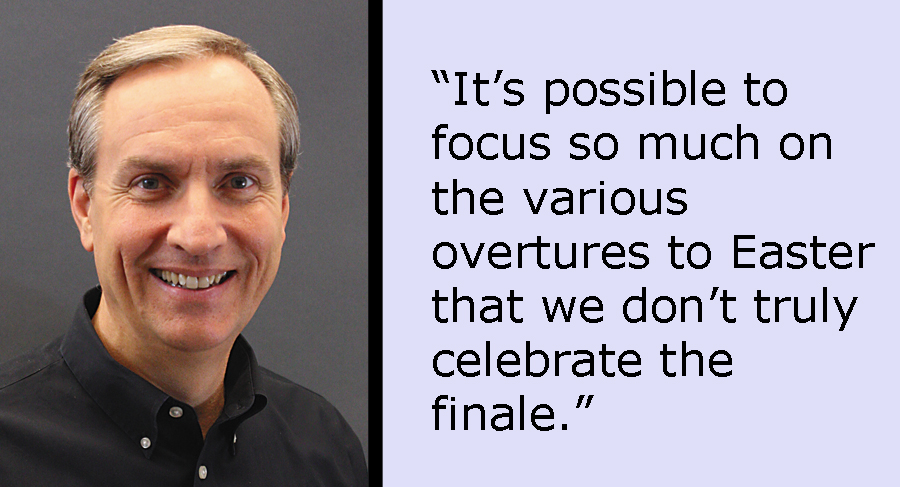
Yes, ultimately Jesus Christ Superstar sadly reminds us that it’s possible to stop the story too soon. It’s possible to focus so much on the various overtures to Easter that we don’t truly celebrate the finale.

It happens all around us. Immediately after Valentine’s Day, the candy and toy aisles at every store in town switch their ruby red treats and treasures over to the pastel, Easter versions. Clothing catalogs tell us that we need something new to wear. And florists and garden centers remind us that a properly decorated Easter requires lilies. All these traditions paint the days before Easter with an elaborate pageantry. Then the big day comes, and we are left to wonder whether all the preparation overshadowed Easter itself.

We can even do it in our churches. For weeks we can invest in preparing musicals, programs, decorations, and children’s activities designed to help us celebrate Easter. All these things are good. But they are not the finale. They are not the really big part of the story that must be celebrated and that must be told.

The title song from Jesus Christ Superstar is sung by, of all people, Judas, near the end of the rock opera. In it he asks Jesus, “Who are you? What have you sacrificed?” In our churches and in our conversations with others, we need to make sure to get to the part of the story that answers those questions with truth and faith and confidence. As important as what happened before Easter is, it’s what happens after Easter that makes all the difference.

Nate Adams is executive director of the Illinois Baptist State Association.

Tony_EvansNashville, Tenn. | “Jesus reversed over 800 years of racial discord in 24 hours,” Tony Evans preached this afternoon at the ERLC’s Summit on the gospel and racial reconciliation.

Walking his listeners through John’s account of Jesus’ encounter with the Samaritan woman at the well, Evans, pastor of Oak Cliff Bible Fellowship in Dallas, made application to modern times:

Jesus met the woman on common ground, at Jacob’s well (John 4:6). “Jews didn’t like Samaritans, Samaritans didn’t like Jews, but since they both loved Jacob, that’s where he stopped,” Evans said. The Old Testament patriarch was viewed as the father of both Orthodox Jews, and the pariah Samaritans.

He didn’t hide who He was. The woman at the well knew Jesus was Jewish (John 4:9), even though he didn’t say it. But though he looked and talked like a Jewish man, Evans noted, he didn’t act like one to the woman, who other Jews would have viewed as an outcast. Nor did he try to be something he wasn’t.

God is not asking you to stop being different than you are to reach somebody different than you are, Evans said. He doesn’t want white people to be black or vice versa. “He’s asking both to be biblical.”

Jesus earned the right to deepen the conversation. “Because he was willing to drink out of her cup” at the well, Evans said, “he has now earned the right to take a normal discussion about water and turn it into a discussion about eternal life” (John 4:13-14).

Jesus was about his father’s business. Father God plays an integral role in the story of the woman at the well. The conversation changed when the Samaritan woman brought Him up, trying to change the subject when Jesus reveals he knows her current situation (John 4:19-20).

Jesus uses the opportunity to show her what she’s always known to be true about her history, her background, and her identity isn’t, in fact, true. Jesus’ words apply to the racial absolutes we live by too, Evans inferred.

“Black is only beautiful when it’s biblical, and white is only right when it conforms with holy writ,” he said.

Many more Samaritans believed in Jesus because of the woman’s testimony, John writes. How can the reversal detailed in the story happen in just 24 hours, Evans asked. Because Jesus was about his father’s business.

Watch the Summit online at live.erlc.com.

Postmodern Martyrs

eric4ibsa —  March 16, 2015
Artwork by Kerry Jackson

Artwork by Kerry Jackson

The call to live–and die–for Christ in the age of terrorism. Are we ready?

By Eric Reed

THE WORLD | The scene is chilling, even a month after it happened: 21 men in orange jumpsuits are led along a beach in Libya by masked men holding knives over their heads, then to their throats. The men in orange are captives, Egyptians working in Libya; more important, they are Christians, Coptic Christians, with up to 20 million adherents, whose branch of the faith dates to the third century AD.

The masked men in black are ISIS rebels, part of the radical faction of Islamic extremists marching across Iran, Iraq and Syria, and taking control of towns and regions ceded by Al-Qaida in the battle with American and indigenous forces over the past decade.

The men in orange are forced to kneel, ordered to recant their faith in Jesus Christ, and when they refuse, they are pushed face down into the sand and the knife blades are placed against their throats.

Mercifully, the video ends there for American television viewers, but for the men in orange there is no mercy.

They are beheaded.
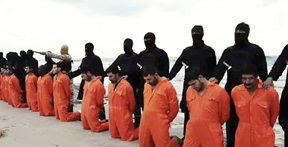
Coptic_ChristiansAnd we, believers watching in disbelief, are little comforted by the great distance between us and the bloodstained beach as we come to the twin realizations that ISIS is on the move with a brutality that the world has not seen in a long time, and we have entered a new era of martyrdom.

A growing threat here?
Sixteen past presidents of the Southern Baptist Convention joined current president Ronnie Floyd in sending an open letter to President Obama, urging the U.S. to “take the necessary actions now” against the ISIS terrorists. They called ISIS “a continuing threat to world peace in a way unknown to us since the Nazis of World War II…”

The March 1 letter came two weeks after the beheading of the Egyptian Christians, and a week after the report that ISIS captured more than 200 Assyrian Christians, including women, children and elderly people. “People are frightened, people are concerned,” concurred Frank Page, SBC Executive Committee President, who said he is often asked about the threat of ISIS. Page’s signature was one of the 17 on the letter.

The concern Page cites is not only about the abominable acts by Islamic extremists abroad—killing a young, female American aid worker, burning a Jordanian pilot alive—it’s about the growing threat on our own shores as young adults, Americans included, are wooed, recruited, and radicalized via the Internet to join ISIS forces in the Middle East. And if not there, to carry out terrorist acts here.

A Somali militant group, al-Shabab, released a video in late February calling for Muslims to attack malls in Britain, Canada, and the Mall of America in Bloomington, Minn. “Hasten to heaven,” the video advised, by disrupting the safety of “disbelievers” (meaning non-Muslims) “in their own land.”

U.S. Homeland Security Secretary Jeh Johnson said such groups are “relying more and more on independent actors to become inspired” and “attack on their own.” The threats should be taken seriously.

If this seems like an exaggeration of the growing threat, one only needs to consider the Boston Marathon bombing in April 2013. On trial now is Dzhokhar Tsarnaev, charged with the attack that killed three people and injured 260.

“The defendant’s goal that day was to maim and kill as many victims as possible,” said Assistant U.S. Attorney William Weinreb during opening arguments. “He believed that he was a soldier in a holy war against Americans. He believed he had taken a step toward reaching paradise. That was his motive for committing these crimes.”

Tsarnaev, with his older brother, was said to be “self-radicalized,” not identifying with a specific terrorist group, but with extremist Islamist beliefs and the wars in Iraq and Syria.

It is those new radicals who are hardest to identify and who may pose the greatest threat in the West. What seemed distant and improbable now feels near and possible. And the threat causes Christians to ask, are we ready?

Wish we’d all been ready
Since we first saw the 1972 film “A Distant Thunder,” many evangelicals have expected their faith would bring them to this moment. Recall the Christian teenagers, converted after they were “left behind” in the rapture, are clad in white. They are led to some secret place to face their death, and the film cuts from their horrified faces to their means of execution, the gleaming blade of a guillotine.

Didn’t we all gasp at that point? Naïve believers in the 1970s hardly imagined their deaths could be worse, but the untelevised portions of the ISIS video say otherwise.

Pastor Robert Jeffress of First Baptist Church of Dallas summarized the terrorist threat in an interview with Fox News: “These Islamists will not rest until they’ve exterminated every Jew and every Christian from the face of the earth, and if you think that is hyperbole, just listen to what they said on that Libyan beach after they butchered those 21 Christians.”

And the Pew Research Center reports threats against Christians worldwide are on the rise. In fact, “…Christians are at the top of the list,” researcher Peter Henne said. “Christians were harassed in 102 countries when you look at either governments or social groups.” Pew also reports an increase in anti-Semitism. “Overall we found that Jews are harassed in 77 countries around the world when you look at both government and social harassments together….It’s also a seven-year high of the number of countries in which Jews were harassed.” Pew’s example: Europe, where Jews were harassed in 34 of the region’s 45 countries.

We do not desire to traffic in fear, but the possibility of martyrdom on our own shores is increasingly real; and it forces us to consider what we may not have given serious thought in a long time: It could be us. It could be me.

And that demands a new theology of martyrdom.

The end of symbolic martyrdom
When Jesus called his followers to take up the cross, he was issuing a call to follow him, even unto death. Many have done so. The apostles died tragically at the hands of oppressors. Scripture reports that James the son of Zebedee was executed by Herod. The deaths of others were told by early church historians and tradition:

Andrew was crucified.

Peter was crucified upside down.

James the son of Alphaeus was stoned, then clubbed to death.

Thomas was run through with spears.

And Paul, it is believed, was beheaded in Rome, to name a few.

Jesus, the Savior-Martyr, was followed willingly and courageously by many across the centuries. And in the 20th century, we have the witness of Lutheran pastor Dietrich Bonhoeffer, who was hanged in a Nazi concentration camp for standing against Hitler’s Third Reich. But somehow, his forbearance in the face of a monolithic, systemic, political evil 70 years ago seems different from what we have seen recently.

We ask, is the death of these Copts the harbinger of the ordinary-believer martyr?

Certainly we are witnessing the death of the symbolic martyr, where the faithful Christian is willing to sacrifice social approval or career advancement in the name of the gospel; where the dutiful believer picks up his cross and marches to the marketplace, willing to suffer the slings and arrows of foulmouthed and hedonistic co-workers—but keeps his life. After all, Paul told Timothy that “in the last days, perilous times will come” and those who desire to live a godly life will be persecuted (2 Timothy 3:1, 12).

Many Christians have assumed the call to suffer for Christ meant the loss of religious liberties, particularly in the West. But now, we’re talking literal martyrdom. Since the murders of 12 students at Columbine High School in 1999, including Cassie Bernall and Rachel Scott who were credited with holding fast to their faith at gunpoint, martyrdom in the postmodern era has had a new face.

Today, the Christian faith really is a matter of life and death in ISIS-held regions of the Middle East, as several missions groups report the killing of indigenous children as their Christian parents refuse to deny Jesus.

And in the rest of the world, believers are challenged to take up the cross, not only in the spiritual sense, but in very real ways, here and now. Paul’s words in Philippians, “For me to live is Christ, and to die is gain,” take on stark new meaning.

So does Romans 8: “Because of You we are being put to death all day long…” And the need to hold to the promise written by a man facing his own execution: “For I am persuaded that not even death or life…hostile powers…or any other created thing will have the power to separate us from the love of God that is in Christ Jesus our Lord!”

What to do now
In the meantime, we pray.

“We ought, indeed, to pray for the gospel to go forward, and that there might be a new Saul of Tarsus turned away from murdering to gospel witness,” wrote Russell Moore, president of the SBC’s Ethics and Religious Liberty Commission.

“At the same time, we ought to pray, with the martyrs in heaven, for justice against those who do such wickedness. Praying for the military defeat of our enemies, and that they might turn to Christ, these are not contradictory prayers because salvation doesn’t mean turning an eye away from justice.”

Additional reporting by Lisa Sergent

Look for more on this topic in the newest issue of the Illinois Baptist, online at http://ibonline.IBSA.org.

THE BRIEFING | Meredith Flynn

As Egypt responded to the apparent beheadings of Egyptian Christians with airstrikes on ISIS in Lybia, believers in the west used social media to grieve for the 21 Coptic Christians believed to have been killed.

The_Briefing“These are my brothers, faithful unto Christ even unto death, Russell Moore posted on Instagram with an image from ISIS’ video of hostages and their captors. “King Jesus puts heads back on, and puts worlds back together. Maranatha,” wrote the president of the Ethics and Religious Liberty Commission.

In a guest post on thegospelcoalition.org, Southern Seminary professor Tom Schreiner offered a biblical meditation on the executions of the Christians.

“Paul says that ‘to live is Christ, and to die is gain’ (Phil. 1:21). Still, the matter is not simplistic, and life is not easy,” Schreiner wrote. “We ‘weep with those who weep’ (Rom. 12:15). Paul said that if Epaphroditus had died he would experience ‘sorrow upon sorrow’ (Phil. 2:27). Grief floods the hearts of those left behind.”


Only 22% of people agree with President Barack Obama’s 2014 statement that terror group ISIL (or ISIS) “is not Islamic,” LifeWay Research reported in a series of surveys conducted last fall. But almost half of Americans also say the group is not a true reflection of the nature of Islam.


CNN will start a six-part series March 1 that the news channel says “discovers fascinating new insights into the historical Jesus, utilizing the latest scientific techniques and archaeological research.” The Christian Post reports the series, titled “Finding Jesus: Faith, Fact, Forgery,” will feature commentary from Ivy League theologians and Los Angeles pastor Erwin McManus, among others.


Illinois’ Baptist Children’s Home and Family Services recently achieved Hague accreditation for its adoption program, meaning BCHFS can continue to do home studies for adoptions in countries that require it. The accreditation is also a first step toward being able to complete adoption placements internationally, but adoption specialist Regina Thompson stressed the agency isn’t equipped to do so now.

“Our main reason for getting Hague accredited,” Thompson said, “was so that we could continue to do international home studies.”


Christianity Today reports Family Christian Stores – the largest chain of Christian bookstores in the U.S. by number of stores – has filed for bankruptcy, but “does not expect to close any stores or lay off any employees.”

“We have carefully and prayerfully considered every option,” President and CEO Chuck Bengochea said in a Feb.11 statement. “This action allows us to stay in business and continue to serve our customers, our associates, our vendors and charities around the world.”

HEARTLAND | Eric Reed

When I said to my co-workers, “Well, let’s go meet a thousand of our closest friends,” I didn’t know how true that statement would be. We left our offices and drove the four blocks to Springfield’s Crowne Plaza Hotel, site of the 2015 Midwest Leadership Summit. And like so many of our Baptist gatherings, this one felt like Homecoming Week at Sandy Creek Church. We saw dear friends from across Illinois, and some we knew from the other dozen states in attendance.

Eric_Reed_Feb9But I never expected to see Woodie.

After all, it’s been 35 years. And the last time I saw Woodie, he was a Mormon. In Alabama. Go figure. Woodie and his siblings were fourth-generation Reformed Latter Day Saints (RLDS) living in a fishing town on the Gulf Coast. We all went to high school together. Although our school was a ministry of a conservative fundamentalist church, no one made an issue of Woodie’s religion. All his family
were clean-cut, well-mannered, and better behaved than many in our class who claimed to be Christians. I remember Woodie as a great guy, a good football player, and very well liked. But lost.

Woodie came to that truth while in college. Through a campus ministry he came to a life-saving faith in Jesus Christ and left his family’s religion. Later, he attended Mid-America Seminary and was called to ministry. Eventually Woodie moved to Lamoni, Iowa, the place where Latter Day Saints founder Joseph Smith once lived and present-day home to the RLDS college. Woodie had attended that college for a couple of years until he began question the RLDS religion.

Returning in 1991, Woodie started a Baptist student ministry, reaching out to RLDS students and others.

Eventually he pastored First Baptist Church of Lamoni, the sponsor of his college ministry, for nine years, and just recently was called to lead Calvary Baptist Church in Clinton, Iowa. Woodie said God is opening doors to Brazilian soccer players (in Iowa!) because his son plays soccer and his wife is originally from Brazil. Go figure.

That’s why he was at the Midwest Leadership Summit and standing in the hallway outside the ballroom at the Springfield Crowne Plaza. Woodie is a Southern Baptist pastor in the Midwest, looking for fresh ideas, inspiration, and encouragement.

I stand amazed by all God has done in Woodie’s Christian life and Baptist ministry. And I’m so glad God brought our paths to cross again.

I should be more amazed that 35 years after high school—even though Woodie hasn’t changed much—I recognized him standing there. But that’s the Lord’s doing too.

Go figure.

Eric Reed is IBSA’s associate executive director for the Church Communications team, and editor of the Illinois Baptist newspaper.

Danielle and Jonathan Spangenberg portray Mary and Joseph at Living Faith Baptist Church’s living nativity scene Dec. 6.

Danielle and Jonathan Spangenberg portray Mary and Joseph at Living Faith
Baptist’s living nativity scene Dec. 6.

HEARTLAND | Meredith Flynn

“Start tending the sheep!” The warning is issued from a pint-sized shepherd on this chilly Saturday night in the parking lot of Living Faith Baptist Church.

The shepherds are a middle stop of the church’s drive-through nativity experience, and these kids in belted tunics have been waiting for the first car to arrive at their scene. Inside the cars, families listen to a CD of the Christmas story they received as they drove in; each track corresponds to a different scene. Outside, the shepherds act it out, tending their sheep like any other day, until a heavenly host appears above them.

“Christmas seems to be the most hectic time, the most stressful time of year,” says Pastor Adam Cruse. “And so, really, we want to bring it back to what is Christmas truly all about? The simple message of Christmas is about a savior who came into the world, and so we just wanted people to come back to the focus of it all.”

Living Faith planned to do the nativity last year, but were snowed out, making this year the “second annual attempt,” according to associate pastor Daniel Waters. A few minutes before this year’s performance is set to start at 5:30, cars begin lining up at the edge of the parking lot. Turning off their lights, they drive single-file past several scenes: Mary and Joseph hearing individually from angels; the couple with their new baby and the manger, shepherds tending their flocks; and wise men from the east visiting the family.

The last two scenes don’t feature any actors. In the corner of the parking lot stand three empty crosses, the middle one slightly larger with a white cloth wrapped around it. Next to the crosses, a small trailer has been fashioned into an empty tomb.

“We didn’t want to just focus on the Christmas scene, because it’s very easy to forget what Christ did and why he came,” Cruse said. “He came to die on the cross and then to come out of the grave, so we wanted to depict those scenes as well.”

Nate_Adams_Dec15HEARTLAND | Nate Adams

Have you ever found yourself heading into the Christmas season feeling blue? I have. In fact, this was one of those years.

I couldn’t put my finger on exactly why I felt down, other than the fact that several things haven’t turned out the way I would have hoped this year. It appears some of the key measurements we set for our work at IBSA are not going to be met. In arenas outside IBSA that I care about, several decisions were made this year that were very different than what I thought best. Several people disappointed me. Even as I looked around for things I could call personal successes, well, I just couldn’t think of many.

The second factor that contributed to my blueness was just the sheer volume of work and challenges that seemed to still lay before me. After working so hard and seeing so little of the success I was looking for, it was hard to find the energy to dig in again.

In my blueness, I turned to music for some encouragement and reassurance. I found on my iPhone a playlist of 13 songs titled “Colorado Renewal 2013” that I had made two summers ago, during some personal retreat time. The first song, “Disappear,” by Bebo Norman, quickly gave expression to what I was feeling:

On a day like this I want to crawl beneath a rock
A million miles from the world
, the noise, the commotion – that never seems to stop.
And on a day like this
I want to run away from the routine
Run away from the daily grind
that can suck the life, right out of me.
I only know one place I can run to…

A place to run to is what I was looking for. And the song didn’t disappoint.

I want to hide in You, the way, the life, the truth so I can disappear
And love is all there is to see coming out of me
, and You become clear as I disappear.

For the next few minutes, I ran to Jesus, and disappeared there. I found sweet relief in the reality that Jesus’ completed work on the cross is all I need. I don’t have to earn or deserve anything more. Hidden in Him, everything returns to its proper perspective.

Then, just as the words of the first verse helped me express my discouragement, the words of the second verse helped me set a new direction, and a new motivation for the future.

I don’t want to care about earthly things
Be caught up in all the lies that trick my eyes
, they say it’s all about me
I’m so tired of it being about me.

As I looked back on the things that were making me blue at Christmas time, I realized they really were all about me, and what I could accomplish or control, what I could perhaps call success. And I realized that somehow I had indeed been deceived into thinking that my work, my successes, or even my ministry were the sources of my joy.

I recently watched a documentary about Bing Crosby that credited his classic “White Christmas” with being the song that first secularized Christmas. Until then, most Christmastime songs were sacred, Christ-centered. But after White Christmas, lots of writers and composers began creating sentimental Christmas songs with someone or something other than Christ as their focus. Of course one of those was Elvis Presley’s now famous lament, that it will be a “Blue Christmas without you.”

A Christmas season that depends on successes, or other people, or anything other than Jesus is bound to be blue. Maybe that’s one reason the shepherds fled their work and their despair and their longing and “came with haste” to the manger. That’s exactly where I want to run to and disappear this Christmas.

Nate Adams is executive director of the Illinois Baptist State Association.

Why my family puts a shoebox under the Christmas tree

HEARTLAND | Serena Butler

UNCLE BENNY – The Butler family remembers the best reason to celebrate Christmas.

UNCLE BENNY – The Butler family remembers the best reason to celebrate Christmas.

Where do babies come from? It’s a question children have been asking through the ages and one that parents have found some creative ways of answering. My family has a unique explanation for a baby’s arrival to its new family.

When my dad, Charles, was about two years old, his mother was expecting a baby. The day came for the birth, and the doctor was summoned to the farmhouse in northern Florida. My grandfather took my dad and his older sister out into the fields to take a walk so that they would not be in the house during the delivery. A little while later, when they returned home, my newborn Uncle Benny was there. Because the family did not have a cradle for the baby, Uncle Benny was placed in a shoebox. So, if you were to ask little Charles Butler where babies come from, he would tell you that the doctor brings them in a shoebox.

Seventy-five years ago, Benjamin Harrison Butler was born and placed in a box. Two thousand years ago, another baby was born and placed in a box. Benny was a gift to his family. Jesus was a gift to the world.

This is the time of year when Christians remember the gift of the Christ-child. We hang lights, put up trees, and buy gifts for one another. We plan special worship services and send cards to family and friends. But we must remember that Christmas would not exist if it weren’t for the crucifixion and resurrection. The birth means nothing without the death. For this is the gospel, that Jesus died for our sins and rose from the dead, conquering the power of sin in our lives.

Grace, mercy, forgiveness, and new life are the true gifts given through Christ. But we celebrate the gift at its beginning, the birth.

2 Corinthians 5:17-18 says, “The old life is gone; a new life has begun! And all of this is a gift from God, who brought us back to himself through Christ. And God has given us this task of reconciling people to him.” When we accept the gift, our life is changed forever. In fact we are given a new life. And this new life is a gift from God.

We know that. We have heard it through numerous sermons and devotions. We know it through our own life experiences. But how often do we ignore the next part? Once we have received the gift of salvation, we then are given the responsibility of passing that gift on to others. The verse tells us that we have been “given the task of reconciling people to him.” That means sharing the gospel.

Christmas shopping season is upon us. We will visit malls and shop online. Some of us will spend hours making gifts to be given to loved ones. But the clothes we give will be outgrown or wear out. The toys will break or be cast aside. The electronics will become outdated.

Jesus is the one gift that will never fade away. It is truly the best gift anyone could receive. Paul describes it this way: “Thank God for this gift too wonderful for words!” (2 Corinthians 9:15)

A few years ago, my dad told the story of Uncle Benny’s birth to his Sunday school class. He also related it to the birth of Christ and how he was placed in a box. A few weeks later the class gave my dad a present. It was a baby doll in a shoebox to represent both Uncle Benny and the baby Jesus.

Now, if you were to visit the Butler home at Christmas and look under the tree, you would see a baby doll, dressed in blue, in a shoebox. He is named Uncle Benny, but he is a reminder to our family that the greatest gift of all is Jesus, a baby who was born and placed in a box. It is also a reminder that the baby should not stay with us, but we should be giving Jesus to others.

So, as you look for that perfect gift this Christmas, don’t overlook the gift you already possess. Jesus is the gift that is always the right size, won’t wear out or go out of style, and will be exactly what they were wishing for.

Serena Butler is Upper Midwest regional manager for Operation Christmas Child. She formerly served as IBSA’s director of missions awareness and Illinois WMU.