Archives For November 30, 1999

Summit gathers 1,000 church leaders for learning, encouragement, and reminder of shared mission

MLS main session

Springfield | Ministry in the Midwest has ups and downs, successes and struggles. The work of advancing the gospel in a diverse, large region requires creativity, perseverance, and a willingness to sacrifice personal preference.

With their common calling in mind, more than 1,000 leaders from 13 Midwest states gathered in Springfield Jan. 23-25 at the Midwest Leadership Summit, a meeting organized every three years by Southern Baptist state conventions in the region.

“We share the same love for our communities and vision to see people come to Christ,” said Tim Burgess, a pastor in Mt. Vernon, Mo., “and getting together is a great reminder that we are not working at this alone.”

The large-group sessions and more than 90 breakouts tackled specific ministries—college campuses, church planting, missions, women, youth, and Disaster Relief, to name a few. Underlying each session was the need to advance the gospel in a culture that’s moving farther away from biblical truth. In our culture of change, one thing has stayed the same, said Detroit’s Darryl Gaddy.

“You look around and notice that nothing stays the same,” said the urban church planting specialist in his keynote address to open the Summit. “Nothing is as it was ten, five, or even two years ago.

“But actually there is one thing that does stay the same. Sin. Oh, the consistency of brokenness. It never takes a vacation. But friends, we are the church. And we, like Peter who raised the lame man up in the name of Jesus Christ, are called to speak into the brokenness.”

Gaddy urged Midwest leaders to be “agents of change” in their communities, which will require obedience when it’s not convenient, becoming less so others can become more, and giving up their rights to someone else—Jesus.

“We have received information for our heads, inspiration for our hearts, and implementation for our hands,” Gaddy said. “Let’s not leave here the same way we came.”

God at work
Like the Midwest itself, leaders in Springfield for the Summit represented a wide variety of contexts, including places where new churches are making inroads into previously unreached communities. North American Mission Board President Kevin Ezell facilitated a discussion with four planters who took to the main stage to talk about strategy, cooperation, and the power of prayer.

“There is a quote that I always go to when I think about our church,” said David Choi, pastor of Church of the Beloved in Chicago. “When men work, they work. But when men pray, God works. The great church planter is the Lord. Recruit prayer warriors to lift up your ministry because that’s truly the secret sauce.”

In a few years, Choi’s church has grown from one—himself—to encompass hundreds meeting for worship every weekend. He credited God for the growth, and the prayers of people who live far from his city but have made it a point to lift up Church of the Beloved.

Ezell also introduced Paul Sabino, pastor of Candeo Church on the campus of the University of Northern Iowa in Cedar Falls. Sabino is part of The Salt Network, a family of next-generation churches working together to plant churches in major university cities.

“We are seeing the power of God on us and it’s like holding a Dixie cup; it’s overflowing and we can’t contain it,” Sabino said. “Jesus said he would make us fishers of men. The fish are on college campuses and they are hungry. They are crying out for the living God to impact their lives.”

The focus on church planting was encouraging for Christine Watkins, who came to the Summit as a member of Jachin Baptist Church, a 10-month-old church plant in Flint, Mich. Her husband, Derrick, is pastor of the church named for a word found in 1 Kings 7:21. Jachin means “the Lord will establish,” Watkins said.

“I think attending this summit and hearing all the great knowledge and stories of how God has blessed young church plants is part of how God is opening doors and giving direction in how he is going to establish our church.”

‘Pray bigger prayers’
Jeff Iorg, President of Gateway Seminary in Ontario, Ca., understands what it means to advance the gospel in difficult environments.

“Much of what you are experiencing now in the Midwest we experienced 30 years ago in California,” he said during the Summit’s final session. “It seems like an impossible task with formidable obstacles…Yet, I’m here to tell you the gospel is advancing on the West Coast, and healthy churches are growing with denominational influence and cooperation.”

Iorg said the reason for the gospel’s advancement, especially in a hostile cultural environment, can be found in John 14.

“Jesus said in verse 12, ‘I assure you: The one who believes in me will also do the works that I do. And he will do even greater works than these, because I am going to the Father.’

“‘And he will do even greater works than these’—that is quite a sober declaration of Scripture,” Iorg said. “Do you believe the word of God? Do you believe Jesus meant what he said?”

Iorg encouraged leaders to pray and ask God for what is worthy to be asked for in Jesus’ name and to surrender control to the Holy Spirit.

“Confess your powerlessness and ask the Holy Spirit for the filling, guiding, and directing,” he said. “So often, we start to rely on our own strategic plans. That’s not going to work. We must depend on the filling of the Holy Spirit to get the mission done.”

The last step to advancing the gospel in this cultural environment is to teach people to read, understand, and obey the Bible. Iorg said the only time he has seen people transformed is when they engage God’s Word.

“No games, no gimmicks,” Iorg said. “Pray bigger prayers in the name of Jesus. Work in the Holy Spirit’s power and trust him to do supernatural things in you. And find a way to teach people to internalize the Word of God. That’s it. Now let’s go home and do it.”

Kayla Rinker is a freelance writer living in Missouri.

Back to basics

ib2newseditor —  January 15, 2018

The recent holiday season gave me a little more time than usual to watch football on TV. As the regular season gave way to playoffs and bowl games, it seemed pre-game analysts spent increasing amounts of time discussing “what it will take to win” the next, tougher game. The more serious the consequence of the game, and the fewer games that remain, the more critical it seems to be able to think, and not just play.

Yet as I’ve listened to experts talk again and again about what it takes to be successful, it seems they often come back to the same basic advice. Focus on fundamentals. Block and tackle well. Everyone do your assignment. Establish the ground game. Everything else you need for success will flow from there.

In these big games, will there be an occasional trick play, or a key turnover, or a missed call that influences the game? Probably. But everyone seems to agree that the best you can do to prepare for victory is simply get back to the basics.

Now is the time to consider what it takes to be truly effective in our mission.

I found myself wondering if there is a reminder, even an exhortation, for churches to consider here. Among the most “basic” practices of Baptist churches as we follow the Lord and pursue his mission are celebrations of the Lord’s Supper and believer’s baptism. Yet these can sometimes seem like occasional, even rare, ceremonies, rather than the very blocking-and-tackling basics on which the rest of church life is built.

More than an occasional or routine ceremony, the Lord’s Supper was given to us to be a time of frequent, intimate church fellowship and worship, one that draws each participant to introspection and confession of sin, and to a carefully considered reminder of the price Jesus paid for that sin. The Lord’s Supper is, in itself, a symbol-rich proclamation of the gospel message, one that should, each time, lead us to humble worship and gratitude, and fresh motivation to live out our salvation and to share Jesus with others.

What if we got that “basic” right, every one of us, in every church, every time we celebrated the Lord’s Supper?

If we did, I think it would have a dramatic effect on the other, more neglected, “basic” of baptism. Think of it this way: What if a church were to schedule baptism celebrations as often as it scheduled Lord’s Supper celebrations? More importantly, what if that church adjusted all its other priorities with the goal of seeing at least one person baptized by that time?

In fact, what if the church filled its baptistery on that date, no matter what? If no one was ready to be baptized, the church would simply pray in lament over the unstirred waters, and ask the Lord to guide them to a different result next time.

If the core, blocking-and-tackling tasks of the church are to remember the redeeming sacrifice of Jesus, and continue his mission of seeking and saving the lost, then maybe we need to get back to the basics of the Lord’s Supper and baptism. Maybe we need to let them drive our churches’ priorities and resources and schedules more than the things that drive them now.

As the football analysts remind us at this time of year, the closer we get to the end, and the fewer days that remain, the more critical it is to reflect carefully on what it takes to be truly effective in our mission. That careful reflection will almost always lead us back to the basics, and then forward to victory.

Nate Adams is executive director of the Illinois Baptist State Association. Respond at IllinoisBaptist@IBSA.org.

God and sinners reconciled

ib2newseditor —  December 25, 2017

Even now God is at work, drawing sinners to himself

Reconciled

Michelangelo lay on his back 17 years painting the ceiling of the Sistine Chapel, paint dripping on his face as if it were a drop cloth. The result was a masterpiece, and at its center this moment of reconciliation: God reaching down to Adam. In the Second Adam, we see God reaching down to man, not at his creation, but for his salvation.

“So it is written, The first man Adam became a living being; the last Adam became a life-giving spirit.”
– (1 Cor. 15:45)

Hark! the herald angels sing,
“Glory to the newborn King!”
Peace on earth, and mercy mild,
God and sinners reconciled

At Christmastime, the familiar refrain echoes in our churches, our stereos, even our shopping malls. It’s so familiar, in fact, that the magnitude of the concepts in Charles Wesley’s hymn may be easy to overlook. Even at Christmas.

God and sinners, reconciled. Listen up, the angels say. Lend an ear. This is big news.

Wesley’s original intent was to set his “Hymn for Christmas Day” to a slower, more solemn tune. He also wrote verses we don’t sing today, including one in particular that is steeped in imagery of dark and light, of sin and holiness, of the differences between us and Christ.

Wesley’s verses aren’t very Christmas-y, at least not in a tinsel and trees, lights and presents kind of way. But it’s easy to imagine it sung in a hushed stable, long after everyone should be asleep, when the import of what’s just happened is becoming ever more clear.

Come, desire of nations, come,
Fix in us thy humble home;
Rise, the woman’s conquering seed,
Bruise in us the serpent’s head.

Now display thy saving power,
Ruin’d nature now restore;
Now in mystic union join
Thine to ours, and ours to thine.

The “mystic union” Wesley describes is at work every time a sinner turns to Jesus. We’re reconciled to him in one sense of the word—a broken relationship is repaired—but there’s more.

Our purposes are also aligned with his. Our very nature is back in step with our Creator’s.

Hark indeed.

Once empty, now full
Matt Mevert and his wife, Andrea, grew up going to church. In fact, they went to the same church. They were married there and raising their family there, until recently, when something shifted.

“I started to realize that there was something missing, but I don’t even think I realized it before,” said Matt, who owns an auto shop in Steeleville.

The Meverts came to a place in their lives where they realized worshiping God and praying to him could be personal and dynamic—that they could have a relationship with him.

They were baptized Dec. 10 at Steeleville Baptist Church in front of their new church family and their three sons.

For while we were still helpless, at the right time, Christ died for the ungodly (Rom. 5:6, CSB).

“All around us, we are surrounded by people who have a God-sized hole in their hearts,” said Scott Foshie, the Meverts’ pastor. “We are all made to enjoy a relationship with him, but our sin has separated us and we are enslaved by it.”

But God proves his own love for us in that while we were still sinners, Christ died for us (Rom. 5:8).

For Matt and Andrea, a host of factors led to their decision to follow Christ. Their oldest son joined a Bible study and started asking questions about the Scriptures. They attended a summer revival and felt God moving them to make a new commitment to him. And they started studying the Bible.

“At that point, you can’t get enough of it,” Mevert said of the Bible. “You start studying and making opportunities to learn more all the time.”

How much more then, since we have now been declared righteous by his blood, will we be saved through him from wrath. For if, while we were enemies, we were reconciled to God through the death of his Son, then how much more, having been reconciled, will we be saved by his life (Rom. 5:9-10).

“In Matt’s case, while he grew up in church, he realized that even though he knew a lot about God, he didn’t know God personally,” Pastor Foshie said. “He was lacking the experience of being born again and experiencing the saving power of knowing Jesus.

“The Holy Spirit revealed Matt’s need to be born again, and he responded in simple faith.”

And not only that, but we also rejoice in God through our Lord Jesus Christ, through whom we have now received this reconciliation (Rom. 5:11).

“Without Jesus, our lives are empty and meaningless,” Foshie said. “Those of us who know him need to use the Christmas season (and every season) to offer the Good News that we can come to Christ and truly be reconciled to him.”

Mild he lays his glory by,

Born that man
no more may die.

Born to raise the sons of earth,

Born to give them second birth.

Hark!

Partners in reconciliation
In her work at Angels’ Cove Maternity Center, Carla Donoho sees people in need of reconciliation. With their families, and with God. But it often doesn’t come easily.

“Accepting the love of a Heavenly Father is foreign and difficult when many have no father in their lives or the ones they have do not represent love,” said Donoho, who directs Angels’ Cove, a ministry of Baptist Children’s Home and Family Services.

“For those who have come from difficult circumstances, either from their own doing or acts of someone toward them, seeing the love of God through his people is a miracle.”
Apostle Paul describes that miracle in 2 Corinthians, and gives a clear directive to those who have experienced Christ’s reconciliation.

Everything is from God, who has reconciled us to himself through Christ and has given us the ministry of reconciliation (2 Cor. 5:18).

“Nothing thrills me more than to see one of ‘ours’ come to know Jesus as the loving Savior who has given himself for them,” Donoho said. “Those who feel so unloved, rejected, and unwanted realize they are a child of the True King. This is true reconciliation.”

Scott Foshie heard the message of reconciliation at nine years old from his grandmother, Lois, when she was suffering from cancer. Even if she lost the battle, she told him, she knew she would be with Jesus because she had given her life to him, and he had forgiven her sin.

“When she told me that she hoped I had that kind of relationship with Jesus too, I began to think,” Foshie recounted. “That was when I realized that while I knew facts about God, I didn’t really know him. I needed to begin a personal relationship with Jesus.”

The ministry of reconciliation is at work whenever a Lois or a Carla Donoho or a Pastor Scott or a Matt Mevert shares the work of Christ in their own lives.

That is, in Christ, God was reconciling the world to himself, not counting their trespasses against them, and he has committed the message of reconciliation to us (2 Cor. 5:19).

At the manger, God extended reconciliation through his son, Jesus. On the cross, the offer of reconciliation is completed through Jesus’s death for the world’s sins. Charles Wesley married two holy days—Christmas and Easter—and the reconciliation seen in both with another of his hymns for Advent, “Come Thou Long Expected Jesus.”

Come, Thou long expected Jesus
Born to set Thy people free;
From our fears and sins release us,
Let us find our rest in Thee.

Israel’s strength and consolation,
Hope of all the earth Thou art;
Dear desire of every nation,
Joy of every longing heart.

-Meredith Flynn

Not waiting to worship

ib2newseditor —  December 18, 2017

jail cell

A worship service I attended recently was like no other I’ve ever seen. And I have seen quite a few.

When I arrived with the pastor and three other leaders, 10 minutes before the service was scheduled to begin, no one else was there. Then, precisely on time, about 70 worshipers arrived.

The first 10 minutes or so were “fellowship time,” as each and every worshiper joyfully entered, hugging the neck or shaking the hand of the pastor and leaders, including me as their guest.

As they did so, many of them volunteered to serve or lead during the service. The pastor noted each of their offers, and told some of them they would have to wait until next time, because we only had two hours to worship.

The good news has arrived, and those who have received it are free to celebrate.

Those who did join us in leading the service shared special music, or recited passages of Scripture they had memorized, or gave brief testimonies of God’s grace and goodness in their lives. One especially memorable man apologized for taking so long to slowly walk to the front, assisted by his cane. He said he was 71 years old, but more alive today than when he was 18, because of the Lord’s work in his life. He then sang a moving and joyful spiritual that had all of us clapping and joining in.

The open prayer time was passionate. One man transparently thanked God for recent victory over a temptation in his life, while another prayed through tears, thanking God for a healing contact from his ex-wife, the first one in 34 years.

When the pastor gave me an opportunity to speak, I found myself citing a passage from my own devotional time that week, rather than a more carefully rehearsed message. As I spoke from my heart and sought to apply that passage to their lives, the worshipers gave me their eager attention, and encouraged me with their amens and other signs of agreement.

Perhaps the most remarkable thing to me about that worship service, however, was that I was told there is a “waiting list” to enter it that is about four times larger than the room can hold. You see, that unusual worship service was within the walls of one of our Illinois prisons on a Saturday night, and those worshipers were its residents. The leaders were from one of our Baptist churches that has led a ministry there for over 20 years.

As Christmas now approaches, I am reminded that the good news of Jesus’ birth came first to a humble group of shepherds. They were in many ways “confined” themselves, in poverty, in low social status, with limited freedom or opportunity, and with little hope of a brighter future. Yet the Bible tells us they were also men who were “abiding” and “keeping watch.” When the good news about Jesus invaded their darkness one night, they eagerly received the news and ran to meet him.

That’s what I felt in prison that Saturday night. There was certainly a darkness, a sense of oppression as I walked through multiple security checkpoints. But inside, the good news had arrived, and those who had received it now enjoyed a freedom to worship and celebrate that is all too rare outside the prison walls.

As we encouraged those worshipers to share the good news about Jesus with others, as did the shepherds, their enthusiastic responses told me they already were. I guess that’s why there is a waiting list for the Saturday night worship service. And I guess it’s why we should all receive the good news humbly this Christmas, grateful that we do not have to wait to worship him.

Nate Adams is executive director of the Illinois Baptist State Association. Respond at IllinoisBaptist@IBSA.org.

Thanks for everything on blackboard

There are a few verses that most Christ followers at least sort of know by heart. Verses like John 3:16. Or Hebrews 11:1. Or this one:

“Be joyful always; pray continually; give thanks in all circumstances, for this is God’s will for you in Christ Jesus” (1 Thessalonians 5:16-18).

It’s a strange passage coming from someone like the apostle Paul. He’s been bitten by snakes, shipwrecked, beaten within an inch of his life on numerous occasions, abandoned by his friends on some occasions, maligned by people he cared about on others. And yet, Paul stresses the obedience of joy and thankfulness almost as much as he stresses grace and faith.

And make no mistake—it is an issue of obedience. Often we think of joy and gratitude in the realm of feelings. Either we feel joyful or thankful, or we don’t. When we feel it, we do it. But obedience doesn’t work that way.

Obedience is doing regardless of whether you’re feeling. Thankfully, as we grow in Christ, we find the Lord not only bringing about in us the correct actions but also the correct feelings that come alongside those actions. But until we are made right and whole again, it is left to us to give ourselves to the sanctifying work of the Holy Spirit by continuing to do, even (and perhaps most especially) when we do not feel.

So, your gratitude—just like mine—is not a question of whether you feel thankful, but whether you are willing to obey this command from the Lord.

But there is another issue here to examine during this season set aside for giving thanks—whether there is a difference between giving thanks IN all circumstances and giving thanks FOR all circumstances.

Gratitude isn’t a matter of how we feel in the moment, but a measure of our obedience.

If there is, it means that no matter what situation you find yourself in, there is always something to be thankful for. You may not be thankful for the suffering, the pain, the hardship or the persecution, but there are other things to lift your heart. When you consider everything that the Lord is, all that he continues to do in the world, and the next world waiting for the believer, there are plenty of reasons to say “thanks,” no matter what happens to be going on.

If there’s not a difference, it means you believe that every circumstance, regardless of how devastating or marvelous, has come from God. And since you know that God is for you, not against you, then you can be thankful for the circumstance, even if you are doing so in faith. You are thankful because you believe that ultimately good will come of it.

I think people love Jesus and believe both of these things. And at the end of the day, both sets of believers are thankful.

In my own life, I have seen how, over time, you become more thankful “for.” Over time, and with perspective, you begin to see the invisible hand of God moving in times that, in the moment, you could not see. You begin to reflect on God’s providential care and love and wisdom even when he may have seemed so significantly absent. You see how he has shaped you and guided you into a deeper experience of Jesus. And so, over time, you become thankful “for.”

To bring it full circle, notice that the command here is to give thanks in all circumstances. That’s what you can do right now, even if you don’t feel like it. You can practice the discipline of gratitude, finding the grace of God, in general and in particular, at work in your life.

But as you do that, think back a bit. Think back to those moments when you thought you would never have another reason to feel thankful again. Think back, and then look and see the redemptive hand of God at work because of those times. And maybe this is the year that you are not only obediently thankful in, but also being thankful for.

Michael Kelley is director of groups ministry for LifeWay Christian Resources. He is on Twitter at @_michaelkelley and online at michaelkelley.com, where this article first appeared.

– From Baptist Press

Andreson-Ponce

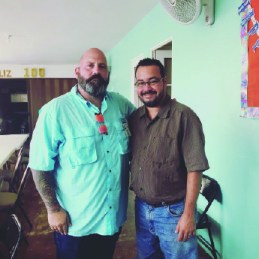
Chicago pastor Dave Andreson (left) met Puerto Rican church planters while serving on the island in October, including Jose Ponce, pastor of Iglesia Bautista Resurrección in Isabela.

Arecibo, Puerto Rico | In October, Southern Baptist volunteers began relief efforts in Puerto Rico after the U.S. territory sustained devastating damage from the one-two punch of Hurricanes Irma and Maria.

The volunteers are working through Southern Baptist Disaster Relief and the North American Mission Board’s (NAMB) Send Relief initiative, but their work is unlike other Disaster Relief projects.

“The circumstance is so unusual that we have to take the full responsibility of this response on our own,” said David Melber, president of Send Relief. “That means buying and shipping the food, renting warehouse space, sending the kitchen equipment, and then providing the volunteers to do the cooking. We are forging our entire response by ourselves.”

Chicago church planter Dave Andreson spent a week in Puerto Rico as a trained Disaster Relief chaplain. Andreson, a U.S. Army veteran, couldn’t shake the growing burden he felt for the island. “I had to get there,” said the pastor of Resurrection City Church in Chicago’s Avondale neighborhood.

While plans to send volunteers to Puerto Rico were on hold immediately after the storms, Andreson attended a two-day Disaster Relief training at Lake Sallateeska Baptist Camp in southern Illinois. One week later, with Baptist volunteers able to get into Puerto Rico, Andreson boarded a flight from Chicago to San Juan.

McKnight

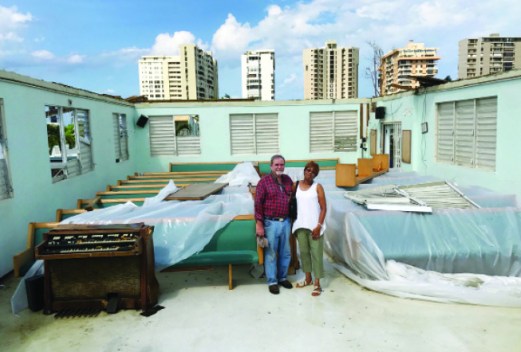
Pastor George McKnight and his wife, Debbie, pause for a photo at Green Island Baptist Church in Puerto Rico, which lost its roof and was flooded during Hurricane Maria’s sweeping destruction.

He served with a Disaster Relief team from Virginia in Arecibo, a city 50 miles west of San Juan in northern Puerto Rico. The team stayed at First Baptist Church there and spent their days cleaning out homes and removing downed trees. Andreson said the teams are working under the leadership of local pastors who understand the people and needs in their communities.

Since the hurricanes, Andreson said, many people are leaving Puerto Rico. Their workplaces are still without power, most schools are still closed, and if you have running water, it’s not safe to drink. FBC Aricebo has already lost about 40 people. One church planter Andreson talked to is worried his young congregation won’t survive.

But the Chicago pastor said he believes Puerto Rico is primed for the gospel. “Physical suffering makes us aware of physical need, and those physical needs always open the door by which the word of God, the gospel proclaimed, makes us aware of our spiritual need,” Andreson said.

“This is a horrible thing that happened, but it’s a good gift from God by which the gospel will go forward. Now more than ever, the church in Puerto Rico, the church of Jesus Christ, has an opportunity to shine the light of Christ.”

The punishing hurricane season has left its mark in other parts of the U.S., including Florida and in Texas, where Illinois teams have served in the aftermath of Hurricane Harvey. For more information about Illinois Baptist Disaster Relief opportunities and training, go to IBSA.org/dr. To learn more about opportunities in Puerto Rico through Send Relief, go to sendrelief.net.

– Meredith Flynn, with reporting from NAMB

red leaves church steeple

This past June, Southern Baptist Convention President Steve Gaines put together a task force charged with recommending how we might deal with the alarming decline in baptisms in our Convention. What a daunting task it is. Baptisms have declined precipitously for the past 17 years. We have gone from more than 400,000 baptisms per year, to less than 300,000. The needs in America are greater than ever, but our effectiveness in meeting those needs has plunged. This ought to greatly concern all of us who care about the Great Commission and this land in which we live.

The task force’s first meeting, held at Southwestern Baptist Theological Seminary in Ft. Worth, Texas, was both disquieting and encouraging. We stared the terrible problem of lostness in the teeth. It is daunting. But we prayed long and hard to the God who is greater than our problems. Dr. Paige Patterson, chair of our group, called us to prolonged periods of prayer and seeking the Lord’s guidance. The Lord’s power and direction, after all, is what we most need. These times of prayer were so refreshing to my soul.

We heard from all the members of the task force—and there are some outstanding people on this team. Each member spoke about some aspect of evangelism. I was moved by their passion and insight and clarity. We began the process of thinking through what might be recommended to our churches at the convention next June. Subsequent meetings will begin to hone in on those possible recommendations more directly.

The SBC’s Evangelism Task Force has a big challenge: Helping churches recapture their evangelistic zeal.

Two things have become crystal clear to me. I speak for no one on the task force but myself, but these two things seem obvious to me. First, we have lost our focus on leading people to faith in Jesus Christ. Second, we need a renewed passion for evangelism. I will give my thoughts briefly to each:

1. We have lost our focus on leading people to faith in Jesus Christ. Evangelism is hard. It takes work and effort and intentionality. It doesn’t happen without commitment to it. Evangelism, it seems, is the first thing that goes when a church faces controversy or problems or challenges. It doesn’t happen unless it is a concerted focus in our lives and churches.

Dr. Gaines uses the term “soul winning.” It comes from the Bible passage I learned in the old KJV as a boy: “He that winneth souls is wise.” We don’t hear that term so often anymore. Come to think of it, we don’t hear about evangelism in any form as much anymore. We are far more likely to hear about church planting or discipleship or worship—all good and important things. But evangelism is spoken of less often in our Baptist circles, it seems to me.

I know this in my own life: If sharing the gospel is not high on my radar it is not practiced in my life. I can fill my life with meetings and sermon preparation and dealing with a myriad of problems. And, if I am not conscious about it, I can forget about sharing the gospel with those around me. Somehow, evangelism must again become a focus of my church and your church, of my life and your life.

2. We need a renewed passion for evangelism. Passion is a powerful force. Passion changes our thoughts, our dreams, and our actions. It changes our lives and it changes our churches. Let’s get passionate about sharing the message of the gospel. Let’s get passionate about seeing lost people saved. Let’s be so passionate about evangelism that it changes our thoughts, our dreams, and our actions.

I want more passion for evangelism in my personal life and in my church family. As a pastor, I want my church to know that I am sharing my faith and I want my church members to join me in sharing the gospel. Without evangelistic passion, we will just go about the routine business of the church without doing the primary business of the church!

Perhaps that passion will show itself in strategic decisions or training programs or events. But passion always makes a difference. Let’s pray for more evangelistic passion personally and corporately.

Will you pray for the Evangelism Task Force when you think of it? It will take a work of God to turn our Convention to greater effectiveness. But by God’s power we can see that change made. My prayer is that God will use our group toward that end.

Doug Munton is pastor of First Baptist Church, O’Fallon, and a former first vice president of the Southern Baptist Convention.

The road ahead

ib2newseditor —  October 30, 2017

A tough but exciting journey awaits us

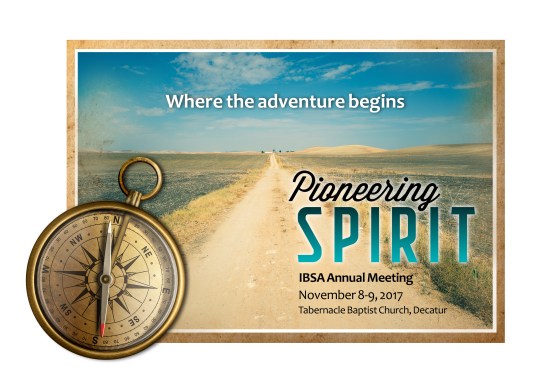
Postcard art w adventure inserted

If we were to drive west from Illinois, whether along Interstate 70 from St. Louis, 72 from Springfield, or 80 from Chicago, the experience would be largely the same. We would continue in a long, straight line for a very long time, rolling over a few hills and rivers in Missouri or Iowa before settling into the even longer, even straighter, seemingly eternal plains of Kansas or Nebraska and eastern Colorado. Then we would see the mountains.

Imagine what early pioneers must have thought when the amazing barrier of the Rocky Mountains first appeared on the horizon. No doubt many of them turned south or north for a while, hoping to find a way around. They knew the experience, equipment, and skills that had carried them across the slowly elevating plains would not take them over those mountains. They would need to find a pass, a way through. And even that journey would be like none they had faced before.

As we Southern Baptists in Illinois now approach our state’s bicentennial year, our journey is much the same. We have been on a long, flat path for years—in number of churches, in baptisms, in church plants, in giving, and in most measures of church involvement and growth. That’s not a criticism. It’s just a description of our recent journey.

Along the way, hardly noticeable until just recently, the altitude has gradually increased and the climb has grown steeper. So many cultural dynamics have grown counter to Christian faith, and perhaps especially to Baptist faith. We too can turn to the left or to the right for a while. But to truly advance from the plains of our status quo up into the mountains our mission now faces, I believe we must dig deep and find a new, pioneering spirit.

Go to new places
In Illinois Baptist mission life, going new places means taking the gospel to the counties and cities and communities where Baptist or even evangelical churches don’t yet exist or have a strong presence. It means church planting.

IBSA churches have numbered right around 1,000 for decades, even while planting around 20 new churches a year. With those one thousand churches baptizing between four and five new believers each, we reach about 4,000 to 5,000 people per year. Yet Illinois has 13 million people, and at least 8 million of them don’t claim to have a personal relationship with Jesus Christ. And most of them do not live near our existing churches. To leave the flatland of our status quo and reach the lost people of Illinois, we must increase and accelerate the number of new churches being started. We must place a gospel witness near them.

Pioneering Spirit Challenge #1: Will your church adopt at least one of the 200 places where a new church is needed? Your commitment can be to pray, or to partner with others to get that church started, or to be the primary planting church. Will you pray, partner, or plant?

Engage new people
Establishing healthy, new churches in the places where they are needed is one important commitment of a pioneering spirit. The first Baptists arrived in Illinois during a time when it was extremely difficult and even dangerous just to survive and eke out a living. Yet they considered it a priority to share the gospel and to start new Baptist churches. Four of those churches that were in existence when Illinois became a state in 1818 are still serving their communities today!

But being blessed—and burdened—with a pioneering spirit also leads churches, both new and established, to intentionally and consistently engage new people with the gospel message. With a sense of urgency, they will evangelize.

Sadly, it’s possible even for a well-intentioned church to lose its passion for evangelism, and become more of a church of settlers than a church of pioneers. They worship, and study, and fellowship, and even serve one another and the community. But very little energy goes into seeking and saving the lost.

Consider this: The almost 1,000 IBSA churches baptized about 4,000 people last year, four per church on average. But over 300 churches reported no baptisms at all. The remaining churches that reported baptisms averaged seven each. If non-baptizing churches simply reached the same number of people with the gospel that baptizing churches did, 7,000 people would come to know Christ next year. And just imagine what would happen if the churches already baptizing seven or more started baptizing monthly!

By intentionally shifting their focus toward evangelism, churches that have settled can become pioneering churches again.

Pioneering Spirit Challenge #2: Will your church commit to turning itself inside out into your community, training its members to intentionally have gospel conversations and evangelistic events, and asking God to increase the number of baptisms you see each year? Will you do whatever it takes to become a more frequently baptizing church?

Make new sacrifices
Going to new places and engaging new people is costly. It’s one reason so many stay where they are—and settle. Many early pioneers packed literally everything they owned into a wagon, and some sacrificed it all to get to their destination. A pioneering spirit sees the value of moving toward those new places and new people, and is willing to give sacrificially to make it happen.

Going to a new place of mission effectiveness here in Illinois will be costly too, especially if God inspires more churches and raises up more leaders, planters, and missionaries to go to new places and engage many new people. Fortunately, we as Illinois Baptists have a wonderful, reliable, tested vehicle in which to entrust our sacrifices. The Cooperative Program (some call it CP Missions) prioritizes missions in Illinois by investing 56.5% of its gifts here, while also sending 43.5% to be combined with others’ gifts and take the gospel throughout North America and the world.

Today the average IBSA church gives about 7% of its undesignated offerings to local and worldwide missions through the Cooperative Program. As with baptisms, that average is the result of some churches sacrificing far more, and some sacrificing far less. At one time, 10% was the accepted norm for Cooperative Program missions, and at one time IBSA churches averaged giving 11% rather than 7%. Simply stated, a return to that 10% standard could result in over $3 million more to missions next year.

Pioneering Spirit Challenge #3: Will your church commit to a new level of sacrificial missions giving through the Cooperative Program? Will you challenge your members to faithful tithing and life stewardship, so that generous giving transforms their own lives, as well as others’?

Develop new leaders
A pioneering spirit must be multi-generational. Very few destinations that require true, pioneering effort can be fully attained in one lifetime. Our parents’ generation brought us this far into our Baptist missionary journey in Illinois, and now we lead and will go a little farther before entrusting the journey to our children. That’s why a pioneering spirit must invest in the development of new leaders, even as it sacrifices and gives its all now.

It seems that churches used to have more systematic ways of developing new leaders. Sunday nights were invested in church leadership training programs. Wednesday nights were often invested in missions education programs that developed boys and girls, and young men and women, for tomorrow’s missionary and church leadership roles.

We should be grateful for churches that still develop tomorrow’s leaders in this way, while not necessarily wishing the same programs or methods on others. But today, more than ever, we must ask ourselves with a new seriousness, “How are we systematically and intentionally developing leaders for tomorrow’s churches?”

Pioneering Spirit Challenge #4: Will your church commit to the intentional developing of younger leaders who will be tomorrow’s pastors, and church planters, and missionaries? Will you join with other Baptist partners like IBSA who can help you develop these young leaders for tomorrow’s church?

Facing our mountains
Last summer I traveled to Loveland, Colorado, in part to scout out Long’s Peak, a 14,259-foot mountain that will hopefully, next year, be the thirty-first and most difficult “fourteener” I climb. As I headed west from the Interstate and flatlands of Loveland, I could not immediately see the pass up into the mountains. But soon I noticed that the road was following a stream, and then a mighty, rushing river. There was barely room for a road in some places, but the water had cut enough of a path through the rock that we could now follow it up to previously impossible heights. We eagerly forged ahead.

To leave the flat trends of our recent journey as Illinois Baptists may seem impossible at first. Our 200-year-old mission field is more lost now than ever. And developing new leaders while making new sacrifices to engage new people in new places with the gospel—well, that’s no easy path. But I believe the living water of God’s own Spirit has already made a way for us. If we are filled with his Pioneering Spirit and will follow him forward by faith, even into difficult places, I believe God has new heights planned for us here in Illinois.

Nate Adams is executive director of the Illinois Baptist State Association. The challenges outlined here will be presented in the Annual Meeting.

Greg Zanis.jpg

Greg Zanis drove from Illinois to Nevada to install a memorial under the iconic “Welcome to Las Vegas” sign.

When President Kennedy was assassinated in 1963, a Fresno pastor climbed the bell tower of the church and began pulling the rope. When he descended much later exhausted from sounding the alarm, he found the sanctuary filled with mourners, looking up to him for a hopeful word. That was on a Friday afternoon. The following Sunday churches everywhere were packed with people who needed help understanding the tragedy. It was called “the Sunday with God.”

On October 8, 2017, we had another Sunday with God.

We’ve had a lot of them, especially in the past two decades. Their names become shorthand for inexplicable tragedy: Columbine, New Town, Wedgwood, Emanuel AME, Boston Marathon, Pulse Nightclub. And the signal event in this category is clearly the terrorist attacks on September 11, 2001. Churches were full the next Sunday and for several months afterward with people asking “Why?” and wondering how God could let this happen. And all these years later we might add—again.

In Las Vegas on Sunday night, October 1, it happened again. A gunman high above an open-air concert killed 58 people with high-powered assault weapons and injured more than 500 others before turning the gun on himself. He left victim’s families, the survivors, and a nation to try to make sense of the utterly senseless.

How can we respond to what we struggle to explain—or even understand?

A retired carpenter from Aurora expressed his grief in the same way he has since his father-in-law was murdered in 1996: he built crosses. His truck loaded with 58 crosses, each with a red heart and the name of one of the 58 victims, Greg Zanis drove from Illinois to Nevada to install a memorial under the iconic “Welcome to Las Vegas” sign. He has built such a memorial at every mass shooting since Columbine High School. His crosses are indeed welcome in places where people need to be pointed Christ-ward.

A young man who escaped the shooting told a network interviewer, “I was an agnostic going into that concert, but after what happened there, I believe in God. It’s a miracle that any of us survived.” His comment exemplifies the baseline responses to crisis: you either blame God or you embrace him; run from God or run to him.

Las Vegas pastor Vance Pittman was honest with his congregation on the Sunday morning after the killings. “The temptation of our humanness is to run from God in moments of tragedy, but the psalmist reminds us that those are the moments we should run to God.”

Pittman, who founded Hope Church in the city 17 years ago, admitted his own wrestling with the massacre. “Anyone who didn’t simply isn’t human,” he told the crowd in the packed sanctuary. “It’s OK to ask God some hard questions…He can handle it.”

He then pointed to Psalm 62. “Where is God in the midst of tragedy?” Pittman asked. “He’s right there in the midst with us… ‘God is my refuge.’” He cited the experience of two police officers. One said to the pastor, “It’s nothing short of a miracle that more people were not killed. It’s almost like someone spread their wings over that crowd and protected them.”

A thoroughly biblical response to events such as this must address the role of evil, “an act of pure evil,” as President Trump described it two days later in Las Vegas. God created a perfect world, but willful humans introduced sin. Taken to its natural ends, man inflicts that sin on others. Such monstrous evil may seem beyond us, but in all honesty it’s not. Only God restrains lawlessness in any of us. While at times he may not intervene in the ways we wish, God is still on the scene, in the business of saving humanity. In this world where evil is rampant—be it war, massacre, or the aftermath of disaster—God is still working his purpose out.

“Nowhere is this seen more clearly than looking at the cross,” Pittman said to his searching crowd. “The cross of Jesus is the single greatest act of evil and injustice in this world, and yet God—in his sovereignty—has caused it to be now seen as the greatest demonstration of love and goodness the world has ever experienced.”

– Eric Reed (with thanks for quotes from The Las Vegas Journal-Review, CNN, and Baptist Press)

The Briefing

Calif. OKs third gender, protects religious liberty
Calif. Gov. Jerry Brown signed Senate Bill 179, which adds a third gender option on official state identification documents for those who reject the designation of male or female and opt instead to be considered “nonbinary.” Among his vetoes, meanwhile, was Assembly Bill 569, which would have made it illegal for religious organizations to prohibit their employees from having abortions or engaging in sex outside marriage.

Mo. Satanist challenges pro-life laws as ‘religious tenets’
Pro-abortion activists have adopted a new legal strategy against pro-life laws in Missouri, challenging them as violations of religious liberty protections. In 2016, a self-avowed Satanist sued the state, claiming its abortion regulations are “religious tenets” and therefore a violation of the Establishment Clause of the First Amendment of the U.S. Constitution and Missouri’s Religious Freedom and Restoration Act (RFRA). The case now heads to the state’s Supreme Court for what could be a final decision.

Apple removes pro-life prayer app
Tech giant Apple removed a pro-life prayer app from its App Store following backlash from pro-abortion advocates. Human Coalition’s app, still available on the Google Play Store, displays a list of prayer requests, such as, “Someone considering abortion in Dallas, Texas.” When users signal with a swipe of their thumb that they’ve prayed for the situation, the app updates a daily tally of prayers. The group said Apple removed the app shortly after unfavorable media reports appeared on news outlets Slate and the New Statesman.

African-American leaders defend Col. baker
A group of African-American have spoken out in defense of Colorado Christian baker Jack Phillips as his religious freedom case will be argued before the United States Supreme Court in December. Three conservative African-American public policy groups launched a new website titled WeGotYourBackJack.com in support of Phillip’s First Amendment right. Using videos and images, the campaign’s message emphasizes the incomparable struggle between African-American civil rights and LGBT rights.

Museum of the Bible: lots of tech, ‘very little Jesus’
The Museum of the Bible, a massive new institution set to open Nov. 17, is just as notable for what it includes as for what it leaves out. While the $500 million museum sports vivid walk-through recreations of the ancient world, one of the world’s largest private collections of Torahs, and a motion ride that sprays water at you, it doesn’t encourage visitors to take the Bible literally. And on floor after gleaming floor of exhibitions, there is very little Jesus.

Sources: Baptist Press, World Magazine (2), The Christian Post, The Washington Post