Archives For November 30, 1999

Seminary president to present cross-cultural message

jeff-iorgJeff Iorg, president of Gateway Seminary of the Southern Baptist Convention, will be in Chicagoland to help IBSA Annual Meeting attenders interpret the gathering’s “Cross-Cultural” theme.

Now in his thirteenth year as seminary president, Iorg said his time in the San Francisco Bay Area, where the seminary was headquartered until it relocated south this year, taught him how widespread is the need for the gospel—even as cultural barriers abound.

“I learned the gospel is needed everywhere, no matter the cultural choices which may be offensive or challenging to our faith,” Iorg said. “It’s easy to get sidetracked on lesser issues, but the gospel is still our primary message.”

Through theme interpretations during the meeting and the annual Wednesday evening worship service, Iorg will speak on why and how Christians are called to cross cultural boundaries for the sake of the gospel.

Prior to his time at Gateway (known until this year as Golden Gate Theological Seminary prior to its relocation to the greater Los Angeles area), Iorg has also served as a pastor, church planter, and executive director of the Northwest Baptist Convention, headquartered in Washington state. For 10 years, he was chaplain for the San Francisco Giants. (Fun fact: Iorg is the proud recipient of three World Series rings.)

He is the author of six books, including “The New Marriage Culture” and “The Case for Antioch,” which focuses on how the early church model applies to modern churches seeking to transform their communities.

At the Annual Meeting, Iorg will explore how cultural shifts affect the means by which Christians take the gospel to people who don’t know Christ.

“Baptists and other evangelicals should aspire to share the gospel with every person, in every culture, by every means possible,” Iorg told the Illinois Baptist. “The inclusiveness and expansiveness of the Great Commission are both non-negotiable.

“We need to recapture both the vision and the passion for getting the gospel to every person in the world.”

With the IBSA Annual Meeting just weeks away, pastors and church members who plan to serve as messengers at the Nov. 2-3 meeting are encouraged to make preparations now. See the checklist below for a step-by-step plan of how to get ready for Chicago.

The meeting at Broadview Missionary Baptist Church is preceded by the annual IBSA Pastors’ Conference, which begins Tuesday, Nov. 1 at 1 p.m. and will feature preachers H.B. Charles, Fred Luter, Scott Nichols, and Jonathan Peters. The Pastors’ Conference also will include breakout sessions on cross-culture ministry and evangelism.

“Cross-Culture” is the theme of the Annual Meeting, which begins at 1:15 p.m. on Wednesday, Nov. 2. Jeff Iorg, president of Gateway Seminary of the Southern Baptist Convention, will help interpret the meeting’s theme throughout the sessions, and will join IBSA Executive Director Nate Adams and other guests for Mission Illinois: “Cross-
Culture” on Wednesday evening.

The meeting also will feature preaching by Kevin Carrothers, IBSA president and pastor of Rochester First Baptist Church, and Adron Robinson, IBSA vice president and pastor of Hillcrest Baptist Church in Country Club Hills.

Meeting attenders will have an opportunity to see Chicago missions and ministry sites on vision tours planned for Nov. 1 and Nov. 3. Space is limited; go to IBSA
annualmeeting.org to sign up and choose your route (Northside, Southside, Westside, Suburban, or a Chicago sampling).

IBSA also will offer dine-in meal opportunities during the Pastors’ Conference and Annual Meeting. See details below and order meal tickets at IBSAannualmeeting.org/meal-tickets.

Check the website, IBSAannualmeeting.org, for all other meeting details, including information about travel, parking, and hotel accommodations. And take note of the other meetings also scheduled Nov. 1-3:

Young Leaders Network
When: Tuesday, Nov. 1, 9:30 p.m.
Where: Broadview Baptist Church
Menu: Wings ‘n things

Pastors’ Wives Luncheon
When: Wednesday, Nov. 2, 9 a.m. to noon
(Coffee fellowship begins at 8:30 a.m.)
Where: Broadview Fellowship Hall
Cost: $15; send check made out to IBSA Pastors Wives to Stevi Smith, 1302 W. Robinson St., Harrisburg, IL 62946
RSVP: Pre-registration is not required, but strongly recommended by Monday, Oct. 24. E-mail Lindsay McDonald at lmcdonald_31@hotmail.com.

Church Planters Breakfast
When: Thursday, Nov. 3, 7 a.m.
Where: Broadview Fellowship Hall
Cost: This is a free breakfast for planters and spouses, but pre-registration is appreciated.
RSVP: RachelCarter@IBSA.org, (217) 391-3101

Directors of Missions/Moderators Breakfast
When: Thursday, Nov. 3, 7 a.m.
Where: Broadview Fellowship Hall
RSVP: If you have received an invitation, please RSVP to LindaDarden@IBSA.org or (217) 391-3137.

annual-mtg-checklist


A popular hotel chain is running a television commercial that cleverly depicts several groups of people trying to decide whether or not to attend a wedding. One is a group of bridesmaids, who clearly aren’t thrilled about the turquoise dresses the bride has chosen. Another group is former boyfriends of the bride, wondering why on earth they all got invited. And one sad lady simply doesn’t want to see Uncle Joe dance in public again. I think it might be Uncle Joe’s wife.

The musical background for the commercial is a rock song from the 1980’s. Over and over that song chants the simple question, “Should I stay, or should I go?”

Because Chicago is our state’s largest and most diverse mission field, we all need to get more familiar with, and comfortable in, this world class city.

As the November 2-3 IBSA Annual Meeting approaches, I imagine there are Illinois Baptists asking themselves that same question. For the first time in several years, the meeting is being hosted near Chicago, at Broadview Missionary Baptist Church. The drive will be quite a distance for those in other parts of the state, just as last year’s location in Marion was a long drive for northern churches.

And of course some will not want to brave the congestion and the traffic. In fact, I don’t know any Chicagoland natives who look forward to that part.

The message of the hotel chain’s commercial is that their comfortable, affordable hotels give even reluctant travelers reasons to go, rather than stay home. So let me suggest some reasons to go to the IBSA Annual Meeting this year.

We need to see and care about and partner with its churches.

First, the challenging theme of this year’s gathering is “Cross Culture.” The program will intentionally showcase the diversity of Illinois Baptists and also point to multiple cultures in our state that desperately need the gospel. There’s no better place in Illinois to receive the challenge to “cross culture” than in Chicago.

Second, because Chicago is our state’s largest and most diverse mission field, we all need to get more familiar with, and comfortable in, this world class city. We need more practice going there. We need to better understand its neighborhoods, its problems, its needs, and its people. We need to see and care about and partner with its churches.

Third, a lot of advance preparation has already gone in to making your stay in Chicagoland as easy as possible. Broadview is a wonderful, generous church, with lots of parking and lots of practice hosting large events. Catered meals have been arranged on site at the church to make the dinner hour easier and more convenient. Nearby hotels have provided very reasonable rates that include breakfast. And Broadview’s near west suburban location makes it a wonderful home base for seeing more of the city, either on your own or as part of two pre-planned vision tours.

Should you stay or should you go?

I could go on and on, but let me cite just one more reason, one that really applies to every Annual Meeting, regardless of location. It’s just very, very good for our Baptist family in Illinois to be together. Throughout the year, we as pastors and leaders and devoted church members work hard in our various local contexts to fulfill the Great Commandment and the Great Commission of Jesus. As the year draws to a close, it is good for us to assemble, and network, and be inspired, and remember that we are not alone in this mission.

Should you stay or should you go? If at all possible, you should go. It may surprise you what the Lord has done across our state over the past year. And it may surprise you how he and the fellowship of your brothers and sisters in Christ will inspire you for the year to come. I look forward to seeing you there.

For more information about the IBSA Annual Meeting and Pastors’ Conference, visit www.IBSAAnnualMeeting.org.

Nate Adams is executive director of the Illinois Baptist State Association. Respond at IllinoisBaptist@IBSA.org.

Come to Chicago

ib2newseditor —  October 3, 2016

Annual Meeting to focus on reaching across cultures—and opportunities in Illinois

am_2016_logoWhen the lawyer—trying to get out of his moral obligation—said, “Who is my neighbor?”, Jesus’ response produced an even greater responsibility: be willing to cross cultures in order to help another.

The requirements of love in the story he told of the good Samaritan might seem excessive if Jesus himself had not already fulfilled them. The priest in the parable refused to cross the road to aid a dying man, yet Jesus chose to cross the border into forbidden territory to help an immoral woman.

For a faithful Jewish man, this was not one, but three violations of custom and law.

“Now he had to go through Samaria,” the apostle John records (John 4:4). Had to? In what way?

Good Jews avoided Samaria. They took the long way around on a trip from Judea to Galilee just to avoid their despised half-cousins the Samaritans. But Jesus felt some compulsion to travel through the forbidden region. It was there in the town of Sychar that Jesus met and spoke to the woman who was rejected by the rest of the town because of her bad behavior. First he asked her for a drink of water, then he offered her living water.

What compelled Jesus to go through Samaria?

The easy answer is love, but love is not always easy.

It’s not just ethnicity
The IBSA Annual Meeting in November will focus on cross-cultural ministry. Sharing the gospel across cultures to people of all languages, ethnicities, nationalities, and people groups is our high calling. But no one ever said it would be easy.

What better place to do this work of reconciliation than Illinois?

We live in a multi-cultural world. As the missiologists often tell us, the world is at our doorstep. Every race, religion, and people group is represented in America—and most of them, too, in Illinois. From the first beep of Telstar and the first flickering satellite images from another hemisphere, the world in our lifetimes has become a relatively small place. Figuratively speaking, and often literally, we live elbow to elbow with people very different from ourselves. The melting pot of America has become a stew bowl of people and beliefs, not mixing so much as existing side by side, sometimes peaceably, sometimes not.

If 2016 has taught us anything it is that bringing cultures together is complicated.

Misunderstanding is probable, real understanding is not. (Watch any newscast for examples.) But the Bible has taught us that bringing cultures together—in Christ—is the goal.

“There is neither Jew not Greek, slave nor free, male nor female, for you are all one in Christ Jesus” (Galatians 3:28). And Jesus himself accomplished this, “who has made the two one and has destroyed the barrier, the dividing wall of hostility” (Ephesians 2:14).

What better place to do this work of reconciliation than Illinois?

With 13 million residents and at least 8 million of them without a faith relationship with Jesus Christ, the call to be reconcilers and gospel ambassadors rings loud. But it is often drowned out by clashes of race and place, divergent views on social justice, and the widening economic divide. Add growing political arguments in an atmosphere of distrust, and we might say the task of spiritual reconciliation is as challenging in the 21st century as it was in the first. The main difference between then and now, between Samaritans and Illinoisans, is sheer volume.

Which was a neighbor to the man in need? “The one who had mercy on him.”

In Illinois our cultural divides are not only ethnic. There is the upstate-downstate dichotomy, Chicago versus everything south of I-80, Northside versus Southside, city verses suburbs, the political tug-of-war between red and blue, between Springfield and the rest of the state. And if we Christians aren’t careful, the prevailing social and political prejudices spill over into our attitudes—and even into our churches.

And one more observation: crossing cultures is not only reaching across barriers to other ethnicities and language groups. It’s also reaching out to people who hold different views on sexual and moral issues, those in lifestyles that Christ-followers believe are unbiblical. It means reaching across the back fence to neighbors who look and sound a lot like us, but whose lost condition characterizes their whole lives. For people who live in a Christian culture and try to behave in Christly ways, embracing anyone outside the church is a cross-cultural experience.

But that is our calling.

9-12-16-ib-facesWelcome to Samaria
When Jesus was telling the lawyer about eternal life, how a changed life produces love for one’s neighbors, he chose to make a Samaritan the hero of the story. “Samaritan” was virtually a curse word when it described the woman at the well. “Samaritan woman” was doubly offensive. The disciples were stunned to find Jesus talking to such an outcast, but none dared confront him on it.

Neither did anyone object when Jesus said it was a Samaritan that helped a Jewish man who had been robbed and beaten and left half dead. But they were surely surprised that the Samaritan was commended for his actions rather than the priest and the Levite who crossed the road to avoid the bloody, unclean wretch, and thereby kept the law. The invective “Samaritan” was redeemed and the merciful man made a model. The Good Samaritan.

What compelled the Samaritan to help a hurting man, likely an enemy of his people, a Jew? Love is the ready response, but Jesus pointed to mercy: that holy mixture of God’s grace motivated by unfailing love, extended to mankind.

Which was a neighbor to the man in need? “The one who had mercy on him.”

The 2016 Annual Meeting in suburban Chicago offers opportunity to see Illinois—our great mission field—with fresh eyes. This vast state with its world-class cities and fruitful, abundant plains calls for multiple approaches to ministry. One size doesn’t fit all our mission fields, but one calling does: Go.

– Eric Reed is editor of the Illinois Baptist


pastors_conference_2016As IBSA messengers, committee members, and officers ready for the IBSA Annual Meeting, preparation is busily underway for another meeting that takes place just prior to it. The IBSA Pastors’ Conference begins Tuesday, November 1, at 1 p.m. at Broadview Missionary Baptist Church in Broadview, the site of the Annual Meeting. It finishes Wednesday morning, November 2, before noon and the start of the Annual Meeting later that afternoon.

The Pastors’ Conference is a time for pastors to recharge by listening to inspiring preaching, to learn from their peers, and to renew old friendships as well as start new ones. The president of this year’s conference is David Sutton, pastor of Bread of Life Missionary Baptist Church in Chicago. Other officers are Brian Smith, vice president, pastor of Second Baptist Church, Granite City, and Bob Stillwell, treasurer, pastor of First Baptist Church, Paxton.

The theme for this year’s meeting is “CROSSROADS: Our pathway to reconciliation,” taken from 2 Corinthians 5:14-21.

Conference speakers include H.B. Charles, Jr., pastor of Shiloh Metropolitan Baptist Church in Jacksonville, Fla.; Fred Luter, pastor of Franklin Avenue Baptist Church in New Orleans and past president of the Southern Baptist Convention; Scott Nichols, pastor of Crossroads Community Church in Carol Stream, Ill.; and Jonathan Peters, pastor of First Baptist Church of Columbia, Ill.

Learn more about the Pastors’ Conference

Breakout sessions to cross cultures
Conference speakers will also lead eight breakout sessions, including:

IBSA staff members and former International Mission Board missionaries Dwayne Doyle and Mike Young will teach “On Mission in Another Culture,” offering basic principles to increase effectiveness while sharing Christ in another culture.

In his session, “Coming Together at the Crossroads,” Fred Luter will discuss the need for racial reconciliation and share practical ways pastors can lead their congregations toward biblical reconciliation.

“Crossing Cultures and Building Partnerships,” led by IBSA’s Dale Davenport, will help pastors learn how they can establish a partnership with an IBSA church in a different culture. Pastors can begin to form such partnerships at the conference.

IBSA’s Mark Emerson will lead “Develop Fresh Evangelism Strategy for Today’s Changing Culture.” Participants will learn how to develop an overall evangelism strategy for their churches using practical evangelism tools.

Vision tours of ministry opportunities
In addition to the breakout sessions, attenders can take a “Vision Tour” of ministry opportunities in Chicagoland on Tuesday from 3:30 p.m. to 6:30 p.m. The tour includes dinner. Choose from Northside, Southside, Westside, or suburban routes.

A fifth tour on Thursday, starting at noon, will offer a “Chicago sampling.” Lunch is included.

Register for the tours online at IBSAannualmeeting.org. Look under the “Vision Tours” tab at the top of the homepage.

Food and fellowship
A meal will be served Tuesday evening, so attenders can stay on the Broadview campus and not lose their parking spaces. Chicago’s famous Giordano’s will cater deep-dish pizza for $10 per person. Seating is limited. Tickets may be purchased at IBSAannualmeeting.org. Look under the “Quick Links” tab for “meal tickets.”


Pastors’ Conference Speaker Bios

H.B. Charles, Jr. is the lead pastor and preacher at Shiloh Metropolitan Baptist Church in Jacksonville and Orange Park, Florida. He has served there since the fall of 2008 and is responsible for the areas of preaching-teaching, vision casting, and leadership development. Prior to his call to Shiloh Church, H.B. led Mt. Sinai Missionary Baptist Church in Los Angeles for almost 18 years, succeeding his late father. Pastor Charles regularly speaks at churches, conferences, and conventions around the country, and has authored or been a contributing author of several books.

Fred Luter has served as senior pastor at Franklin Avenue Baptist Church in New Orleans since 1986. Luter received his Doctor of Ministry at New Orleans Baptist Theological Seminary and was elected the Southern Baptist Convention’s first African American President on June 19, 2012—holding the position for two years until June of 2014. In 2015, Dr. Luter was named national African American ambassador for the North American Mission Board. His role includes involving more African American churches in the SBC and in church planting.

Scott Nichols is senior pastor at Crossroads Community Church in Carol Stream, Illinois—a congregation he planted almost 15 years ago in October of 2001. Nichols holds a Bachelor’s degree in theology from Southwest Baptist University, a Master of Arts in ministry from Moody Bible Institute Graduate School, and is also currently working towards his Doctor of Ministry degree from The Southern Baptist Theological Seminary. His loves in ministry include preaching, leadership development, and evangelism. Nichols says his joy will be to finish strong and honor God with all he is and does in life.

Jonathan Peters has served as the senior pastor at First Baptist Church in Columbia, Illinois, since 1998. A native of Chicago, Jonathan came to Christ as a student at Southern Illinois University in Carbondale, and then went on to graduate from Southwestern Baptist Theological Seminary in Fort Worth Texas. Peters recently led his church in a multi-million dollar relocation project.

Bringing down walls

ib2newseditor —  September 26, 2016

Four pastors discuss what it means to be ‘one in Christ’ today

Jesus issues a clear directive in Acts 1:8 to take the gospel to the ends of the earth. His command seems simple enough: Go and tell everyone about me. But when the ends of the earth move in next door, differences in language, religion, customs, and culture can quickly build walls between people who have the gospel and people who need to hear it.

The 2016 IBSA Annual Meeting will explore issues surrounding cross-cultural ministry, including real-life stories of pastors and churches who have sacrificed their own cultural comfort for the sake of the gospel.

The Illinois Baptist sat down with four such leaders for a special roundtable discussion about the cultural idols we all have, why the church seems to be last to change, and how to be a good neighbor. The following interview was edited for space.

9-12-16-ib-panel-photo

Around the table: (left to right)
– Kevin Carrothers, pastor of Rochester First Baptist Church and president of IBSA
– Marvin Del Rios, pastor of Iglesia Bautista Erie in Chicago and a leader in the movement to reach second- and third-generation Hispanic peoples
– John Yi, IBSA’s second-generation church planting catalyst in Chicago, founder of a community ministry in Maywood, and a leader  at Bethel SBC, a church plant in Mt. Prospect
– Adron Robinson, pastor of Hillcrest Baptist Church in Country Club Hills and vice president of IBSA

Illinois Baptist: Let’s start by defining the big topic. When we talk about ministering cross-culturally for the sake of the gospel, what does that mean to you?

Adron Robinson: In Ephesians 2, when Paul says that we are all one body of Christ, he is telling believers that we are all one new culture, and it is about tearing down our cultural idols in order to be that body of Christ.
We all have inherent cultural idols. We all come from culture and we all come with that assumption that the way we grew up is the way everybody should grow up. The gospel shows us that there is a new normal.

Marvin Del Rios: I go to the book of Acts, chapter 6, what we see between the Hellenistic Jews and the Hebrews. That is something we are living within the Hispanic and Latino churches right now. Unfortunately, the first generation can get stuck in a certain way of preaching, a certain way of leading worship, a certain way of doing church. What is happening is that there is an exodus of the second and third generations from the church. My thing with cross-cultural ministry is that even though I am called to go and preach to the nations, I have a burning desire to go and reach my second- and third-generation Latino culture.

IB: Do you as pastors feel the pressure to lead in that way, to help your churches to move beyond those inherent cultural biases?

Kevin Carrothers: I will certainly agree that that is our responsibility. I was talking to Pastor Adron earlier about Jeremiah 29 and how God spoke through Jeremiah about the exile. The verse that sticks out in my mind is Jeremiah 29:7. It says, “Seek the welfare of the city I have deported you to; pray to the Lord on its behalf for when it has prosperity, you will prosper.”

Sometimes we feel like we are living in exile wherever we are. But we are called to wherever we are. God has planted us there, and we need to have transformational ministry in our communities. That does mean crossing all kinds of cultural divides.

Robinson: The other side of that, of God telling them to seek the welfare of the city, is them overcoming their nationalism.

Carrothers: That’s right.

Robinson: For them, Jerusalem was the pinnacle. God says, “Well, now you are in Babylon and you are to make Babylon a better place. You have been planted there sovereignly for a purpose.” Part of that is laying down our love for our old culture and doing what God has called us to do in a new context.

IB: We know that communities change over the years—your churches have experienced those shifting demographics in their neighborhoods. How does community change affect a church’s ability to reach across cultures?

Robinson: Hillcrest started as an Anglo church in an Anglo community. As the community transitioned to a more blended community, the church is always the last thing to change. The community was predominately African-American and the church was still predominately Anglo. They become known in the community as “that” church, not “our” church.

When they called me as pastor, the first thing we started to do is to try to reach our neighbors. Our first priority was to get out and meet the community and build relationships so that we could have conversations about faith going forward. We connected with a high school across the street. We connected with City Hall. We started to look for ways to be incarnational. How can we take the gospel out to other places?

IB: You mentioned the church is always the last thing to change. Do you think that’s true of most churches?

Robinson: Yes, I think that’s most churches. I think we downplay how big of an idol comfort really is to us. As communities transition, churches can easily fall into the “us versus them” mentality. This is our church, we have always been here. Yeah, but the purpose of the church is to reach the community with the gospel. So if the neighborhood changes, you have new neighbors to reach.

Del Rios: We don’t change fast enough and then when we do decide to change, we are already five to ten years behind. Then we are doing the catch-up game, and I think that’s where we as leaders get tired. We feel like we are in the hamster wheel running around doing nothing.

Yi: I think the big secret that we need to bring out into the open is that every church is “that” church, it’s just a matter of which “that” you are going to be. I still remember when you talked about a church, it was, “That’s the Catholic church, that’s the Baptist church, that’s a Methodist church.” But it’s not like that anymore. I think that churches can be more proactive about helping the community define what they are.

Working around church planters, one of the things we see is leaders being very proactive about what they want their church to be known as, what their niche is. Of course, in churches, we are not supposed to be public relations people, but I think we do have to be concerned, not just with what do the people outside the church think of us, but also what do our own members think of us. What kind of church are we? I think there is a lot we can do to help shape that. We do not have millions of dollars to create that public image, but we do have a currency and that’s the way we do our ministry. The way we engage our neighbors.

Robinson: I think John touched on something important: Every church is going to be that something. People are going to say that’s the church that does this or that church does that. You need to get out front in defining what your church is going to be known for. John 13:35 comes to mind. “By this all people will know that you are my disciples, if you have love for one another.”

Carrothers: Probably where our church has struggled the most is that we have to give away without expecting anything in return. We have done a fall festival for nine years, but it hasn’t brought a single member into the church. People have asked me why we keep doing this if we are not seeing people come into the church. My response is, if you can come up with something else where we can speak into 300-500 people’s lives in our community, then I’m all ears. Well, nobody has taken me up on that yet because we are speaking to 80 people on Sunday morning.

IB: Is expecting something in return one of those cultural idols we talked about?

Robinson: The corporate model, which is an idol from the world. One of the budget shifts Hillcrest made as far as reaching the community was to stop doing events for how much we can get back. We are doing whatever it is to extend the gospel to our community, which means that we are going to have to spend some money and sacrifice in order to reach our neighbors with the love of Christ. It’s not all going to come right back. You’re not going to have an event today and 50 new neighbors come in next week.

Yi: If you can get your congregation to think that way, that the church really is a non-profit organization, that we are not doing ministry for profit, that’s a success too. Just getting that shift in thinking.

Robinson: Getting the membership to embrace discipleship.

Carrothers: Absolutely. That’s a kingdom value.

Del Rios: We established a Halloween outreach at the church three years ago. We open the doors and the kids come in with their families. We have a little table for kids’ activities, something very simple, and they get candy and they can leave. Then, as they are leaving, the parents are there and we have adults there to have simple conversations. Some lead to gospel conversations.

Now, how many have joined the church out of the last three or four years during that process? None. But this Saturday there was a block party in our neighborhood and I went to visit and just talk to a couple of folks I know. The people I talked to introduced me to other folks, and the other folks said, “You’re the church with the Halloween stuff going on. You’re the church that gave us hot chocolate and that Spanish coffee that was delicious.” Yes, we are the church. Are they coming in? They are not, but they associate us with the church on Halloween that had the great Spanish coffee and they came in and they listened to a gospel conversation. Not a Bible-banging conversation, but a gospel conversation.

Carrothers: Isn’t it interesting that one of the things Paul talks about in Romans 12 is hospitality?

Del Rios: Yes.

Carrothers: Isn’t the heart of hospitality giving away without expecting anything in return?

Robinson: In Acts 2, we see the church breaking bread together going house to house. It’s relationships when you read the Gospels. Jesus shares his life with 12 people. He teaches them by example what it looks like to have a relationship with God and they go out and spread the gospel with more people. They are living together, eating together, hanging out together all day long. Our churches are so “Sunday meeting, Wednesday meeting.” See you next Sunday, see you next Wednesday. We started to incorporate intentional hospitality to the life of the church.

Watch for Part 2 on this blog Thursday, September 29, 2016

– Meredith Flynn, editorial contributor

Churches take up five gospel challenges for the coming year

At the IBSA Annual Meeting, churches take up five gospel challenges for the coming year.What are the building blocks of an effective ministry, one that reaches people who are far from God? And how can churches play their role in building God’s kingdom here on earth, and in Illinois?
Surrounded by large Lego-style building blocks, IBSA Executive Director Nate Adams said the answers to those questions are largely familiar.

“The problem is not that we don’t know what to do, the problem is that we’re not doing it,” Adams said during the Wednesday evening session of the IBSA Annual Meeting. The worship service was all about five keys to effective, redemptive ministry: Expanded VBS, Witness Training, Outreach Events, New Groups, and Evangelistic Prayer.

At the close of the service, meeting attenders were invited to commit to one or more of the ministry challenges, and pinpoint on a map of Illinois where they want to see God build his kingdom.

Adams introduced each building block, and an Illinois pastor told how his church had seen God work through that specific ministry. Here are their stories:


Build a better VBS
Scott Foshie, Steeleville Baptist

“VBS is one of the most effective evangelistic tools in our church life,” Foshie said, introducing the first building block. “It reaches kids, parents and grandparents.”

In their 2015 Vacation Bible School, Steeleville church members shared the gospel in many different settings, including small and large groups, and saw 32 professions of faith. “As we followed up with families, we’ve had 10 baptisms,” said Foshie.

Research shows 30% of Christians accept Christ before age 13, and 70% do so by age 18. These statistics demonstrate the need for child evangelism. The most proven way to do this is through Vacation Bible School. Yet, last year 45% of IBSA churches did not host a VBS.

Adams implored churches to help one another with VBS. “If you’re doing one yourself can you help someone else do one? Can we come alongside and help you?” he asked.

Foshie said it’s important to start planning early and to come together in evangelistic prayer. When you do this, “people come to know Jesus,” he said.

“VBS is the low hanging fruit,” said Adams. “If your church is going to do one thing this year—do VBS.”


Go tell the Good News
Sammy Simmons, Immanuel, Benton

Immanuel Baptist holds an attractional evangelistic event every year—alternating a living nativity with a summer block party.

“There are 26,000 lost people in our county,” Simmons said. “Evangelistic events allow us to do all hands on deck. They allow our people opportunities to serve…all weekend or sometimes a week-long event. Our people love to serve.”

Six weeks before this summer’s block party, Simmons began a sermon series on sharing the gospel. He asked every Sunday school class to get involved as well.

One of the ways church members learned to share the gospel was using the “Three Circles” method, a strategy for starting spiritual conversations. Using that method at the block party, Simmons said, “One of our deacons led a cop to Christ.”

Church members followed up with attendees who had completed cards stating they do not attend church. “Over the next four weeks we saw eight individuals come to know Christ,” Simmons said.

After the pastor finished sharing his church’s story, Adams noted, “The church ought to be a place where we teach one another and learn from one another how to share our faith….The hardest thing is starting a spiritual conversation, the second hardest thing is sharing a spiritual conversation.”


Start a new group
Carlton Binkley, FBC, Woodlawn

On a typical Sunday morning, 85-90 people show up for worship at FBC Woodlawn, but the church regularly saw only eight people coming to its weekly prayer meeting. There was no step in place to assimilate new people into the body of Christ, Binkley said.

The pastor became convicted that they needed to be imitating the church in Acts 2, “[meeting] from house to house…breaking bread together, fellowshipping with one another, being in community.”

So they traded in their Wednesday night prayer service in order to start in-home Bible studies across the county.

It began with three groups the first semester, then grew to seven; now they’re about to launch their ninth group and average almost 90 people each week.

With 100% of the congregation involved in a small group, the outcomes are evident: They’ve had eight baptisms in the last year, people are learning ministry skills through discipleship, and the hope is for these groups to lead to church planting efforts.

“We just want to see Jefferson County come to Christ,” Binkley said, “and we think [God] is going to do it through small group ministry.”


Pray intentionally
Roger Teal, Grace Fellowship, Benton

The theme “Build Your Kingdom Here” is an evangelistic prayer in and of itself, Adams said. Pastor Roger Teal’s church has watched God work through their commitment to pray for people who don’t yet know Christ.

Teal explained how his church recently moved locations. Claiming the passages in Ezra 3 where the Israelites built an altar for their church before the actual building, he decided, “We’re going to do that.”

So the congregation cut down a tree, went to the exact spot where the altar would be in their new church, and “started writing names down of people they knew they wanted to see come to know Jesus as Lord and Savior,” Teal said.

Although the building is still not complete, the altar is finished. And the names written on it are seen every Sunday as people walk past. A young man named Garret Mahan, whose name is on the altar, came to know Christ and was baptized by his grandfather, Rick Webb (pictured below). Garrett has since answered a call to ministry.

The altar has served to keep the names of lost people in front of the congregation where they cannot be forgotten or ignored.

When someone at Grace comes to know the Lord, his or her name gets circled. With three so far, Teal said they have a lot more to go. “But, we’ve got three names that are circled.”


Dots on a map

At the end of the worship service, Adams asked everyone in the sanctuary to consider which of the five ministry challenges they’ll take up in the coming year. He invited them to walk down the aisle and place a commitment card near a large map of Illinois, and then to use a post-it note to indicate where in the state they are praying God will build his kingdom.

As the service concluded and people slowly made their way out of the sanctuary, the map remained as a reminder of that prayer.

Build Your Kingdom.

Here.

– Team report by Illinois Baptist staff

Amid the chaos, praise

Lisa Misner —  November 20, 2015
Amid the chaos, praise

Representatives of 24 congregations lined the platform at FBC Marion. They were from churches newly affiliating with IBSA.

“The most chaotic three minutes of the year.” 

That’s my label for the annual photo of churches affiliating with the Illinois Baptist State Association at the IBSA Annual Meeting. Each year, the pastors of a dozen or so churches line up across the front of a hotel ballroom or church sanctuary for a wide-angle shot where no one is looking in the same direction, someone’s eyes are closed, and there’s a blur on the right side because someone moved during the picture.

It’s fun, it’s joyful, but it’s never been a good photo.

This year, the chaos was doubled (at least). Twenty-four new churches joined IBSA officially during the Wednesday evening session of the meeting, representing a variety of people groups and languages. So, our photo team’s instructions of “move to the left” and “everyone look here” only seemed to add to the confusion.

And it seemed that each pastor and church had a support team or sponsoring congregation there to capture the moment, resulting in a logjam of people near the altar steps where everyone was supposed to line up for a formal portrait.

After several minutes of trying to arrange everyone, those of us trying to take that formal portrait could only throw up our hands and laugh along with everyone on the stage. It was the kind of moment you only experience with family. Everyone knew it was chaotic, but the joy of being together, and welcoming new members to the family, transcended the language barriers and general confusion.

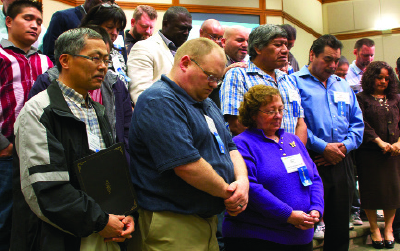
The best pictures actually came after everyone stopped looking at the camera, when the pastors and leaders bowed their heads there on the steps to pray together. In the stillness, you could see the diversity of the group, and the fellowship they felt for one another.

One pastor wore traditional clothing of his country. Another put his hand on the shoulder of the person in front of him. The group reflected the differences in any family, and the solidarity the members feel because of a shared calling and commitment to, well, act like family.

This year’s family photo isn’t going to win any contests for composition or lighting. If you look closely enough, you can probably tell it’s not perfectly in focus. It’s a bit of a mess, as far as pictures go. A glorious, holy mess.

– MDF

God uses healthy congregations to build his kingdom in Illinois. But what makes a church healthy so that it grows by making disciples? Studies show these five commitments are the building blocks for kingdom growth.

IBSA Annual Meeting1. Can I get a witness?

Numbers to think about:

  • 73% of born again Christians say they have a personal responsibility to share their faith with others.
  • 52% have actually done so in the past year, according to Barna research.

If we believe hope in Jesus Christ is the greatest news a person could receive, why do 31% of adults never evangelize? For many people the answer is they don’t know how. And they lack confidence.

When churches focus on intentionally training believers to effectively share their faith, members start to gain confidence in becoming active disciple-makers.

2. Welcoming newcomers, discipling new believers

Christ-followers need Christian community. “We often fail to realize the importance of new groups in light of a church’s discipleship emphasis,” said Eric Geiger of LifeWay. They “generate excitement…provide a fresh point of focus for the church family.”

Studies show that believers actively involved in a group actually pray, serve, give, and read their Bible more than those not plugged in to regular community.

The Millennial generation, especially, places a high value on relationships­­­–most citing group activities as main reasons they stay connected to the church.

3. Prayer is over all we do

More than 95% of those who pray to accept Jesus have been regularly prayed for by someone else for a significant amount of time, according to the Billy Graham School of Evangelism. Without effective prayer, a church cannot be effective in evangelism. As author and pastor Richard Krejcir said, “Prayer is our key to God’s door. It is…essential in our witnessing. It is the work of Christ through the work of the Spirit that saves.”

When churches put an emphasis on the power of witnessing through prayer, the body experiences great growth individually as well as corporately.

4. Start with the kids!

Vacation Bible School is the single most effective evangelistic tool churches have. LifeWay VBS specialist Jerry Wooley reports nearly 3 million people participated in Vacation Bible School in 2014, and 80,000 children made professions of faith.

In addition, 1 million unchurched individuals were identified.

Young people are most likely to accept Jesus Christ as Savior:

  • 43% of Americans come to Christ before age 13, and
  • 64% do so before their 18th birthday.

So why not bring the biggest need (salvation) together with the best opportunity (VBS)?

Last year, 432 IBSA churches didn’t hold a Vacation Bible School. For them, faithful old VBS is new territory!

And for all churches, there are opportunities and resources to expand VBS to weekends and weeknights, Winter VBS, and joint VBS with other churches in parks, backyards, and apartment complexes.

5. Events connect churches and communities

The call to reach the whole world with the gospel starts right here, right in the community around your church. That’s your Jerusalem.

Although there is no one-size-fits-all outreach event for every congregation, churches with successful community involvement do have one thing in common: they make outreach the priority.

  • Add an additional worship service
  • Send members into the community to meet needs
  • Host a bake sale, volunteer at a 5k, serve at a homeless shelter.

Whatever outreach looks like for your community, do it! Be the hands and feet of Jesus.

Does your church need to make a fresh commitment to any of these areas?

Prioritize these building blocks for your church and visit the Church Resources Team at the IBSA Annual Meeting. They’ll give you resources to take back to your church.

Be sure to attend the evening session at 7 p.m. Wednesday evening, November 11 to learn more even more. Or contact the Church Resources Team for assistance with your fresh commitments to effective ministry.

Each building block has potential in God’s hands to build up your church—and His Kingdom!

Visit www.IBSA.org/IBSA2015 to learn more about the Nov. 11-12 IBSA Annual Meeting and the Nov. 10-11 Pastors’ Conference at Marion FBC. #IBSA15

The IBSA Pastors’ Conference and Annual Meeting are next week (November 10-12) at First Baptist Church in Marion. Find out how to make the most of your time there.

  1. Tweet the Annual Meeting. Or Facebook it,  but be sure to use #IBSA15. Share what you’re learning and what inspires you. See something that you may have missed. Tweet the Pastors’ Conference with #BuiltUp.
  2. Go to the Pastors’ Tailgate Party. Grab a bowl of chili or chicken and noodles cooked up by an IBSA Disaster Relief feeding team. Learn what they do, why they do it, and how you can be a part of it. It wouldn’t be a tailgate party without subs, sliders, nachos and other delicious treats. You’ll enjoy food, fun and fellowship Tuesday from 4:30-6 p.m. – all for just $5.
  3. Pray ahead of the meeting, during, and after it. Ask God to bless the meeting and everyone attending. Pray for the pastors and churches in our state. Pray also for people who don’t know Christ – there are more than 8 million of them in Illinois. The prayer room will be open in Room C1, just inside the chapel.
  4. Get the building blocks for church growth – Lego-style. Visit the Church Resources Team in the chapel and pick up resources you can take back to your church to create evangelistic prayer strategies, lead effective witness training, host outreach events, bring a renewed focus on Vacation Bible School, and start new small groups and classes. You might even play a video game build your own masterpiece while you’re there.
  5. Network. You’re at a meeting with 100s of other pastors from cities and churches of all sizes, different backgrounds, full-time and bi-vocational, plus some just like you. Take the opportunity to talk with them about what they’ve experienced, achieved, and hope to do. Talk one child of the King to another about how to help and encourage each other.
  6. Invest in yourself and your church. Attend the Pastors’ Conference, listen to the speakers, and go the breakout sessions. Take notes to help you remember important points to bring back to your church and community for growing  His Kingdom.
  7. Check out the exhibit hall. Want to see what kind of exhibit the Church Planting Team has cooked up this year? Need to know about the services GuideStone Financial Services provides? Interested in the programs of study Baptist colleges and seminaries offer? Plus, there’s an IBSA Dessert Reception in the exhibit hall following the Wednesday evening session. Yum!
  8. Women’s Ministry. Ladies, you’re not left out. The Ministers’ Wives’ Conference and Luncheon is Wednesday morning and will feature powerful testimonies. Come by the Women’s Ministry exhibit for all kinds of sweet treats and resources. Join the Women’s Ministry Sampling Party Thursday morning at 7:45 in Room S100. Plus, the LifeWay Bookstore will be right next door in Room S101.
  9. Participate in democratic process. IBSA is your association. Vote on new board members, budgets, and resolutions (you can even submit one!). Elect association officers and learn how your denomination works.
  10. Welcome newly affiliating churches. Established churches and some that have only recently constituted have gone through the credentials process and will be voted on during the meeting. There are 23 churches asking to join yours in IBSA.