Archives For November 30, 1999

COMMENTARY | Nate Adams

When hundreds of churches convene next month for the IBSA Annual Meeting in Decatur, we will assemble under the theme “Mission Illinois.” For me, however, it’s more than a meeting theme. In the days ahead, I hope the mantra of Mission Illinois will begin to represent a fresh new vision of why we as churches choose to cooperate, and how we measure our effectiveness as a state association.

For several years now, we as the churches and leaders of IBSA have focused our energies on four key priorities: strengthening churches, starting churches, sending Christians into their Acts 1:8 mission fields, and stimulating stewardship among churches so we can do our part with other Southern Baptists to fund the larger missions efforts of the SBC.

Our goals within those key priorities have been aggressive, and we haven’t always attained them. But for the most part we are training more leaders with fewer staff, starting a steady number of new churches with lower national funding, and directly assisting more churches in their evangelism and missions efforts in spite of higher travel costs and a challenging economy.

But we as an association of churches still long to see increases in indicators such as baptisms, worship and Bible study participation, and the net number of IBSA churches – all of which have remained relatively flat over the past few years. We don’t care about numbers for numbers’ sake, but because they are indicators of missional advance, church health, and Kingdom expansion. We want to see lostness decrease and the accessibility of Bible-believing churches increase.

So I’ve been asking myself, and would invite you to ask with me, what might need to change? How might we adjust our efforts in this mission we call Illinois?

I don’t claim to have it figured out yet, or that I can do it alone. More often than not, I feel like our blind dog Willy that I described in the last issue. In fact, our mission here in Illinois is partly what I had in mind when I wrote, “There are times when it seems that I just can’t see things, or can’t see where things are going, with the clarity or certainty I would like. Things in my family, my work, my church, things in Baptist life, things in our nation, things on the world scene – all seem to be less predictable, less comfortable than in the past.”

That certainly is an environment where faith and dependence on God for vision are desperately needed, as Willy’s situation illustrates. And so I have not been hasty to propose a new mission statement or declare a new direction. I’m praying and thinking, listening and observing, drafting and revising, waiting and praying. And I invite you to join me, and to e-mail, write or call with your thoughts or ideas.

In the next couple of issues, I’m going to share a little more of what I think “Mission Illinois” might mean as a vision for our future as IBSA churches. On one hand, it’s hard for me to imagine that strengthening churches and starting churches and sending Christians on mission, and stimulating faithful stewardship among churches will not still be primary priorities. On the other hand, I can’t help but believe that God wants to do more through our cooperation than we are currently experiencing.

So please join me in prayer and creative thinking as we approach this year’s IBSA Annual Meeting. For us as Illinois Baptists, Mission Illinois must be more than an annual meeting theme. It must become a rallying cry for reinvigorated, purposeful cooperation that actually impacts the lostness of our Illinois mission field.

COMMENTARY | Immediately after the Pew Forum released new findings about the current state of American Protestantism, writers and thinkers took to their blogs to warn us not to put too much stock in the so-called shift, at least not for the reasons we might think.

“…Many will likely trumpet this as a huge shift. It’s not. This is simply the natural progression of what is taking place in our context,” said LifeWay’s Ed Stetzer of the research, which states that for the first time in history, Protestants are not a majority in the United States. Rather, the 48% that claim to be Protestants are a plurality at the top of a list of choices that also includes Catholic (22%), Mormon (2%), Orthodox (2%) and “Other Faith” (6%). That means nearly 20% of Americans aren’t affiliated with any faith, the highest percentage ever in Pew Center polling.

“A big part of what is happening is that the ‘Nominals’…are shifting and becoming the ‘Nones,'” Stetzer wrote. “This makes sense, as the cultural currency (in other words, the value a society places on identifying as a Christian) is decreasing. And thus, we see a movement away from Christian identity as a cultural value.”

Stetzer identifies these three main points from the research:

1. “On a growing basis, identifying oneself as a Christian is not a means to societal advancement but can actually be a means to societal rejection.”

2. What he calls the “squishy middle,” or nominalism, is going away. Southern Seminary’s Russell Moore also blogged about this following the Pew Center’s research. “Most of the old-line Protestant denominations are captive to every theological fad that has blown through their divinity schools in the past thirty years-from crypto-Marxist liberation ideologies to sexual identity politics to a neo-pagan vision of God—complete with gender neutralized liturgies.

“What we should pay attention to instead may be the fresh wind of orthodox Christianity whistling through the leaves-especially throughout the third world, and in some unlikely places in North America, as well. Sometimes animists, Buddhists, and body-pierced Starbucks employees are more fertile ground for the gospel than the confirmed Episcopalian at the helm of the Rotary Club.”

3. “It is still a vast overstatement to see this as a collapse of the Christian faith in North America,” Stetzer wrote. “The reality is that evangelicals have been relatively steady as a percent of the population over the last few years, however there is still great cause for concern here – and for action.”

That action must take shape as a willingness to seize opportunities explain exactly what a Christian is, Stetzer said. “…As society moves away from Christian identification, let’s meet them on the road and say, ‘We did not believe in that expression of Christianity anyway. Let me tell you about Jesus and how he changes everything.'”

Editor’s note: Trevin Wax is managing editor for LifeWay’s “The Gospel Project.” This column is excerpted from Baptist Press.

COMMENTARY | Trevin Wax

It’s Wednesday night, and I’m helping our kids get their shoes on, jackets on, and Bibles ready as we’re about to rush to church. I hustle them out the door, tell my wife we’re waiting for her in the car, and then load them into the van.

Along the way, I tell Timothy (our 7-year-old): “Watch out for the puddle in the driveway. Zip up your jacket. Open the door for your sister.” He gives me the exasperated look that smacks of a bad attitude, and I ask him what his problem is.

He lets me know: “People tell me what to do all day long. Before school. During school. At lunch. During class. When I get home. I just get tired of everyone else being in charge.”

“So you want to be in charge?” I ask him.

“Yes. I want to be in charge and make my own decisions,” he tells me.

Thinking this might be a good time to wax philosophical, I say, “Well, son, that day is coming. But right now, other people are in charge, and the reason we’re in charge is because God has told us to be. God wants us to do our best to help shape you into the kind of person who can make wise, God-honoring choices on your own.”

He nods. He knows.

But I keep going.

“One day, you’ll leave home. You’ll go off to college, and no one is going to be telling you what to do every day. You’ll be on your own, making decisions. And I want you to be ready for that day.”

At this, the weariness of the day overcomes Timothy, and the vision of such independence overwhelms him. He wails. Big tears coming down.

“That makes me so sad! I don’t want to leave home!” He is hysterical. “Why do you say that? I don’t want to think about that.”

I sigh, put my hand to my head, and try not to smile. So much for waxing philosophical. Now, it’s time to reassure him.

“Timothy, that day is far away, and by the time you get there – trust me – you’ll want to be on your own, making those kinds of choices.” He is comforted. Crisis averted. I make a mental note: “Don’t bring up college again.”

Afterward, my wife and I were talking about that conversation, laughing about how the thought of independence overwhelmed our son. As adults, we can look ahead to his future and can envision him as an independent young man, mature in his faith, making wise choices.

As a child, our son wants to get there, but he can’t imagine what that would be like. The very thought of being an adult scares him. There are too many unknown variables.

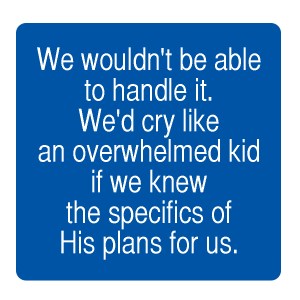
And then, I realize why God doesn’t tell us everything about our future. He lays out the vision of who we will be – people walking in a manner worthy of Christ, bearing fruit in every good work, and increasing in the knowledge of God. But He doesn’t tell us everything this journey will entail. He doesn’t tell us everything we will accomplish along the way.

Sometimes I’ve wondered why God doesn’t reveal the specific plan He has for all of our lives. Now, I realize it’s a good thing He doesn’t.  We’d wonder how in the world He will manage to make us resemble Christ in so many surprising ways.

And the thought of the suffering, pain and responsibility it will take to get us there – to form us into that kind of person … well, if college is enough to overwhelm a 7-year-old, then maybe the specifics of how we will become more like Christ over a lifetime would be too much to handle.

Better instead to listen to the loving voice of our Father, who seals us with His Spirit and promises to renew our humanity day by day as He remakes us into the image of His Son.

Better instead to take our baby steps as we wobble down the journey of life, basking in our Father’s good pleasure, trusting in His Son’s sacrifice when we fall, and leaning on the power of the Spirit to pick us back up again and to help us continue the walk.

God gives us the big picture of our future. And it’s glorious!

But He chooses not to fill in all the details for us. And that’s a good thing.

THE BRIEFING | Meredith Flynn

U.S. Homeland Security Secretary Janet Napolitano recently called North American Mission Board President Kevin Ezell to thank him for the work Southern Baptist Disaster Relief workers have done in the wake of Hurricane Isaac.

“She called to say how much she appreciates everything Southern Baptist Disaster Relief volunteers are doing and to acknowledge that our efforts are a key part of the response,” Ezell said. “The investment Southern Baptists have made in disaster relief over the years has helped us become a key partner in times of crisis.”

Baptist Press reports that in the days since Isaac hit, Disaster Relief feeding teams have cooked and delivered more than 130,500 meals at field kitchens in Louisiana and Mississippi. Volunteers have also recorded 78 chainsaw, 54 mud-out and 8 roofing jobs; provided almost 2,200 showers and laundry loads for victims and volunteers; provided childcare for 41 children; and made 2,231 ministry contacts and 47 Gospel presentations.

Isaac-related outreach has led to at least five professions of faith and nine other faith-related decisions. Read more, including New Orleans pastor and SBC President Fred Luter’s response, here.

Other news:

Democrats wrestle with God language at national convention
God is back in the official platform of the Democratic party, but some evangelical and minority leaders are wondering if they still belong in their party.

The Christian Post reports that the flap over leaving God out of the platform at the Democratic National Convention (and then voting to put Him back in) has left some African American and Hispanic Christian Democrats worried their party will be labeled “the party that booed God.” (After a motion was approved to put “God” language back in the party’s platform, some delegates booed audibly.)

The news site blackchristiannew.com posted a column by Libertarian party leader Wayne Allen Root questioning whether the party can recover from the moment. “There is room for thousands of delegates at the Democratic Convention. Tens of thousands including the media. On Wednesday, the radical forces in the Democratic Party made it clear there is no room for God,” Root wrote.

Leaders also are concerned about other planks of the party’s platform, including abortion and same-sex marriage, and how they might affect the Democrats’ ability to connect with evangelicals this November. Read more at ChristianPost.com.

Iranian pastor freed after years in jail
Youcef Nadarkhani, a pastor who spent more than 1,000 days in jail, was acquitted of the apostasy charges against him and released Sept. 8. Nadarkhani was sentenced to death in Iran in 2010 for converting from Islam to Christianity, and was given several opportunities to recant his faith in court. He refused each time, and says he was never a Muslim. Although he was cleared of the apostasy charges, he was found guilty of converting Muslims to Christianity, which would have carried a three-year jail sentence. But Nadarkhani was released on time served. Read the full story at BPNews.net.

Death of IMB worker in Jordan ruled foul play
Cheryll Harvey, who had served 24 years with the International Mission Board in Jordan, was killed during a robbery attempt at her apartment in Irbid, Jordan’s second largest city. Police have arrested a suspect. Harvey, 55, originally from Texas, established the ESL language center in Jordan, where 300-400 college students study each semester.

“Cheryll was greatly loved by both our personnel in the Middle East and by her many students,” IMB President Tom Elliff said. “We are faced once again with a sobering reminder of the brevity of life and the importance of faithfully serving the Lord to the very end of our time on earth. Cheryll has left for us a great example that we should follow.” Read more about Harvey’s life at BPNews.net.

Professor and statesman Roy Fish dies at 82
Dr. Roy Fish
, who served Southwestern Baptist Theological Seminary for nearly 50 years, passed away Sept. 10 at the age of 82. News of Fish’s death prompted words of admiration and memorial from many SBC leaders. “Dr. Roy Fish was at once a fabulous lecturer and the most consistent soul winner I know,” said Southwestern President Paige Patterson. “He lit a fire under thousands of students.” Read more here.


A lamp in the dark

Meredith Flynn —  September 10, 2012

HEARTLAND | Esther Eggley

You are my lamp, O Lord; the Lord turns my darkness into light. (2 Samuel 22:29, NIV)

One year, my parents, sister and I took a camping trip traveling through the Southwest. Our first night in the Rocky Mountains, we pitched our tent in a small campground. The restrooms were on the other side of a small wooded area. And the cloud cover made for an extremely dark night.

Some time late in the night, my Dad and I decided to make a trip to the restrooms. We carried a flashlight, taking the longer route on the paved road to avoid meeting up with any unknown critters in the woods.

On our return trip, I heard a voice speaking in a loud whisper coming from the woods. It was calling my name. I couldn’t see anyone, and I didn’t recognize the voice. My heart started beating fast. I knew my dad was startled too, because he stopped suddenly and aimed the light into the woods. As the light came around, we saw a figure robed in white, beckoning me. When the light revealed the whole being, there stood my mother in her white housecoat. She had decided to meet us at the restrooms but didn’t want to wake the camp by calling my name too loudly. My father was quick to point out how unwise it was to be traipsing through the woods in the mountains in the middle of the night with a flashlight, but even worse, without one.

Life sometimes makes my heart race. Confronting unknown voices, obstacles and situations is frightening. When I remember that as I study God’s Word, He turns my darkness into light through understanding.

Let this be our prayer: Thank you God, that you have not hidden yourself from us. You sent your son so we could see you. You gave us the Bible to reveal the things we need in our walk with You.

Esther Eggley serves on IBSA’s Church Planting team.

COMMENTARY | Southern Seminary’s Russell Moore blogged about home and hurricane names as Isaac waged war on the Gulf Coast. Isaac means “laughter,” and as Abraham’s promised son, isn’t his name more fitting for a joyous occasion than a hurricane? Moore writes:

Hurricane Ishmael, now that would be more appropriate, I think to myself. Ishmael is, after all, the son of exile, the son of the “will of the flesh” seeking to accomplish God’s work on its own.

But, the more I think of it, maybe Isaac is the right name. Isaac’s story, after all, seems horrific and tragic. In order for Abraham to receive God’s blessing, he must lay on the altar every hope that he can see of being blessed: including God’s promise of this son. God doesn’t accept that sacrifice, we know. But Isaac ultimately dies, and so do all of his children. And, in the biblical story, erased also is the very Promised Land itself. The people of God are left without patriarchs, without kings, and without even the security of home.

As I watch the hurricane Isaac bounce around the weather maps, that’s what I fear, I suppose: the loss of home.

Read his full post at RussellMoore.com.

HEARTLAND | Meredith Flynn

Just when I thought I’d gotten them all…

Do household chores ever teach you lessons? Mine do. Especially the ones I don’t do very often or very well, and as a newlywed and new homeowner, that’s almost everything.

For instance, I just spent two years hours weeding the yard. A summer’s worth of busy weekends coupled with Central Illinois’ desert-like conditions have left us living on a brown, scratchy rectangle of something that used to be grass, I think. Nothing has grown for months – except weeds. Tall, scraggly, thorny and thriving. I told myself I’d spend an hour pulling as many as I could.

And for a few minutes, it went well. I felt hearty and worthwhile, like a real Midwesterner working her land. But it all went south when I looked around and realized it looked the same as it had 20 minutes ago. I quickly spiraled into this cycle: see a weed (“this is bad”), bend down to pull it (“this is really bad”), somewhat successfully get it out of the ground (“well, OK, that was a good one), see the next one (“this is bad”).

I went on like that for a few minutes before an even more dangerous thought crept into my head: How did we ever let it get this bad?

You know where I’m going with this. I knew it right there in the yard. My morning of manual labor runs pretty parallel to my spiritual life (and maybe yours too). We see something we don’t like, try to get rid of it, have some success in overcoming it, right before we see the next thing. And all the while, the question haunts us: How did it get this bad? Without me even knowing it? It might be one nagging sin, or a mindset, or a bad habit. But, when looked at through the lens of trying to extinguish it forever, it can be enough to send us running indoors.

And I thought about it plenty of times that morning, just turning in my work gloves and moving on to the next, hopefully easier, task. What kept me there was that God was talking. Not audibly, but the lesson was clear, and here’s what He was saying: I’m here, I’m here, I’m here. Not necessarily to help you weed the yard, but as you see things in your life that shouldn’t be there, I’m here. And as you work on removing those things, I’m here. On the good days and the bad ones too. And when you see the next thing we need to work on, I’m here.

Sanctification isn’t done in an hour, as much as I wish it could be. But God is a patient and present gardener, much more patient and present than I’ll ever be. He sticks with His task of transforming us, and even lets us have a part in it. What area is He showing you that needs some work? And how is He sustaining you in the process?

COMMENTARY | Daniel Waters

Editor’s note: Just two weeks after a mass shooting at a Colorado movie theater, the country was rocked by a similar crime when a gunman opened fire in a Sikh temple in Wisconsin Sunday, killing six people and wounding four others. In this column, Daniel Waters shares his experience in another place of worship – a Baptist church in Texas – that was devastated by violence, and how God has answered a really big question in his life: How could a good God let this happen?

The recent, terrible shootings have left many asking, “Where was God?” and “How can a good God allow such a terrible thing to happen?” I know that, regardless of the correct theological answer, for people who go through an ordeal like that, the pain will not soon dissipate.

I asked the same questions when as a young man I went through a similar tragedy. At the beginning of my senior year of high school, I attended a city-wide worship service at Wedgewood Baptist Church in Fort Worth, Texas, to celebrate See You At The Pole. This was September 15, 1999. That evening, while we worshiping and reflecting on that morning’s success, a gunman entered the sanctuary and started firing. Seven people were killed and more were injured. I was devastated.

When I returned home that night I asked God those questions, and He led me to open my Bible to Psalm 27. “The Lord is my light and my salvation, whom shall I fear? The Lord is the stronghold of my life of whom shall I be afraid?” God was telling me that He holds my life and the only safe place is in His hands. If I had given the lordship of my life to God, I had to trust Him even when everything around me was failing.

This word from God comforted me. But the question, “Why would a good God allow this terrible thing to happen to me?” still had to be answered, and I had to grapple with His sovereignty in order to ever move on from that night. My journey to answer that question showed me a lot about God’s character, my relationship with Him, and the state of our fallen world.

Here’s what I determined: When I asked God, “How could You, a loving God, allow this to happen?” He showed me the problem has to do with the nature of love. If love can’t be chosen, it doesn’t exist. Under the umbrella of His sovereignty, God has allowed men relative freedom to be stewards of his creation and to choose to follow Him.

But if you can choose love, you can also chose hate, which is really only love of the wrong object – usually one’s self and one’s desires.

God showed me we suffer because we all choose to love things other than God. Because God loves the world, this suffering is only temporary; His sovereignty is displayed in his authority to judge everyone by His standard, to punish the wicked and make all things right. In Revelations 21:4, God tells us that, “He will wipe every tear from their eyes, and there will be no more death or sorrow or crying or pain. All these things are gone forever.”

When we face such heartache, it seems impossible to move forward. But thank God there is hope and healing when you place your faith in a God who makes the impossible, possible, and can answer even the hardest questions in our darkest hours.

Daniel Waters is associate pastor of Living Faith Baptist Church in Sherman.

HEARTLAND | Lisa Sergent

I’m amazed and even jealous when I hear people talk about their family’s Christian heritage. They recall learning about Jesus from their grandmother, hearing about their great-grandfather’s dedication to tithing as a child, and listening as their father led Bible study each evening before they went to bed. Others talk about holding Sunday morning services at family reunions. Their children are raised in church and make professions of faith before they are out of elementary school. All of their family members know Christ.

My family doesn’t have a rich Christian heritage. I didn’t grow up in a bad home; my parents were and still are very loving and, I believe, quite wonderful. I am blessed to call them my mom and dad. I just didn’t grow up surrounded by a Christian family.

My father’s parents were not Christians, but thought if they were “good” people they would go to heaven. My mother’s parents argued about religion from the very start of their marriage, he being Catholic and she, a member of the Christian Church. Because of their arguments my mother and her sister were not allowed to go to church. They rarely if ever talked about God in the home.

Thankfully, my branch of our family tree “branched out” from tradition. My mom became a Christian shortly after I was born, and my father when I was 12. (I met Christ three years earlier). My brother and sister came to believe in Him, too. But many of our family members still don’t know Him.

I have one relative who dismissively calls the story of Noah and the flood, “that old myth.” Another steadfastly maintains, “As long was we are good, God will send us all to heaven.” My heart aches for my paternal grandfather who died without making a commitment to Christ (to our knowledge).

So, with my parent’s generation, my family is just beginning to start its Christian heritage. Now, I see my parents teaching my nephews and niece about Jesus. I listen as they sing songs about Him and are eager to pray. My sister-in-law became a Christian after their first child was born and joins my brother in raising their children in church. My brother-in-law knows Christ, and I married a wonderful Christian man. It is my hope that my nephews and niece will one day have their own children who will reap the joy of being part of a Christian family and become Christians themselves.

If you are a product of a Christian heritage – rejoice and thank God for that heritage. Pray for new Christians and those Christians who do not have such a heritage and that they will be start of generations of their family living for Christ.

(Editor’s note: New Orleans in Rear View. Now that we’re back home, our Illinois Baptist news team reflects on the question: What is the lasting value of the 2012 SBC?)

 Posted by Meredith Flynn

David Platt, pastor of The Church at Brook Hills in Birmingham, Ala., delivers a Pastors' Conference message in New Orleans on true repentance and salvation.

David Platt, pastor of The Church at Brook Hills in Birmingham, Ala., delivers a Pastors’ Conference message in New Orleans on true repentance and salvation.

Before the convention, many (especially us press types) were buzzing about how a growing debate over Reformed theology might come up from the floor. The answer: It didn’t really pan out like we thought it might, at least in terms of a heated debate.

Instead, Pastors’ Conference speakers and panelists at some of the surrounding meetings encouraged Southern Baptists to work together, even if it means crossing theological lines. And some, most notably Alabama pastor David Platt, spoke passionately about the bigger fish we have to fry.

During his message Monday afternoon, Platt referenced a YouTube video from a message he preached at an inter-denominational conference earlier this summer. On the widely-watched video, Platt said the sinner’s prayer is a “superstitious” prayer that never appears in Scripture, and called into question some traditional evangelism methods.

In his message at the Pastors’ Conference, Platt admitted that as a young pastor, he would be wise to watch his words. But then he stayed true to what he said briefly in the video, pleading with Southern Baptists to preach the true Gospel, full of the messages of repentance, belief, discipleship, and global mission.

Two days later, after some debate on the convention floor, messengers approved a resolution upholding the “sinner’s prayer” as a biblical means to salvation.

How we lead people toward a saving knowledge of Christ, and where we find the conviction of our own salvation, is the most important conversation we can have, in my view. I’m grateful for the discussion, and look forward to watching and listening as God moves us closer to His heart for people.