Archives For November 30, 1999

COMMENTARY | Meredith Flynn

PrintOne of the major stories out of last year’s Leadership Summit hosted by the Ethics and Religious Liberty Commission was the negative reaction on social media. In fact, the “Reporter’s Notebook” column space in the following issues of the Illinois Baptist was devoted to “angry birds” who spoke out on Twitter about the speaker line-up, the subject matter, and the opinions expressed.

It seemed like almost everything that was said (or tweeted or blogged) at last year’s meeting made somebody mad.

This year, not so much. Yes, there was some chatter, according to tweets after the event, about Baptists having an agenda for tackling this year’s topic, racial reconciliation. At least one poster noted the Southern Baptist Convention should be honest about its past in regards to slavery and racial division. (One whole panel discussion and pieces of other messages were devoted to the topic.)

But most of the Twitter feedback was positive. Maybe it was because much of it came from inside the summit. Racial reconciliation may not have drawn the same large online audience as last year’s topic: sexuality. Or, there’s this possibility: At its core, the summit was a meeting about a problem that every Christian can identify with, and one for which even those outside the church see the need for a solution.

Divisions exist around racial identity, and in recent days, they have been especially ugly, violent, frightening and real.

Leaders at the summit seemed to view racism as a common enemy. And, for Christians, as sin. There are some things you don’t do anymore once you have a relationship with Christ, said recent Southern Baptist Convention President Fred Luter.

“Don’t tell me you’re saved and still lying like a rug. Don’t tell me you’re saved and still cussing like a sailor. Don’t tell me you’re saved and still mean as a pit bull. Don’t tell me you’re saved and still don’t like someone because of the color of their skin.”

From the podium in Nashville, summit speakers talked about racial division as a universal problem, and a universal responsibility. Thabiti Anyabwile compared having skewed ideas about racial identity to walking into a cafeteria and seeing one table of diners that look like you, and one that doesn’t. You immediately think the table that looks like you has something in common with you, and is therefore safe for you.

“The mind is a relentless stereotyper,” Anyabwile said. No matter who you are. At the ERLC Summit, speakers and attenders were unified by that knowledge, and in the belief that the gospel is the only thing that has the power to reconcile people to God and to one another.

And the angry birds, for the most part, stayed away.

Meredith Flynn is managing editor for the Illinois Baptist newspaper.

Editor’s note: This is part 1 of the Illinois Baptist’s coverage of a recent summit hosted by the Ethics and Religious Liberty Commission on racial reconciliation and the gospel. Read part 2 next week here at ib2news.org.

NEWS | Meredith Flynn

Weeks of riots in Ferguson, Missouri, following the police shooting of a young black man, Michael Brown. More protests in major cities after the death of another African American, Eric Garner, during an arrest. And with the shooting death of 12-year-old Tamir Rice in Cleveland, the culmination of a summer of racial unrest in America. And it was only the beginning.

Chants of “Hands up, don’t shoot” in the streets gave way to “Black lives matter,” and in personal conversations, the question has become “Why now?” and “I thought we had made so much progress on race relations in the U.S.”

A sad and challenging summer, followed by a new round of unrest in Ferguson after a condemning report from the U.S. Department of Justice, leaves many thinking, “Apparently not.”

And the church wonders, What can we do? And in some corners Christians have asked, What does the gospel require us to do?

“How do we as people formed by Christ start to have those conversations out in the world?” said Ethics and Religious Liberty Commission President Russell Moore at a March summit in Nashville. “It starts if we’re in the same body, gathered around the same table, praying with one another, praying for another, serving one another, being led by one another, and then we will stand up for and speak up for one another.”

The state of race relations in America, from Ferguson to New York, and coast to coast, is demanding fresh thinking and producing new preaching on race in all kinds of churches—including here in Illinois.

More than 500 current and future church leaders gathered at LifeWay Christian Resources last month to address racial reconciliation and the gospel. The second-annual Leadership Summit hosted by the Ethics and Religious Liberty Commission brought together nearly 40 speakers who presented on a wide range of topics: multi-ethnic ministry, Islam, the SBC’s history on racial issues, pop culture, and more.

In each message and panel, the summit’s key theme was clear: Racial reconciliation is a gospel issue. The gospel reconciles people to God and to one another, but sin is still at work in the world, causing tension, division, strife and violence.

The solution, leaders said at the summit, is for the church to preach and live out the gospel on matters of race. To examine itself for any lingering race-related sin of pride, and to work together to fight the common enemy of racism.

“We’ve got a long way to go,” Moore said in his opening address. “Our sin keeps wanting us to divide up. But to the faithful, Jesus promises, ‘You will be called overcomers.’ And we shall overcome.”

Summit attenders gathered in the aisles and at the altar to pray together at the start of a March meeting on racial reconciliation and the gospel.

Summit attenders gathered in the aisles and at the altar to pray
together at the start of a March meeting on racial reconciliation and the gospel.


Learning how to see each other
“All creatures of our God and King; lift up your voice and with us sing…”

The first hymn led by band Norton Hall and worship leader Jimmy McNeal took on extra significance as the words reverberated around the auditorium. All creatures, lifting up their voices, together. African American, Anglo, Hispanic; male and female; young and old. At the summit, mostly young.

The picture painted in “All Creatures of Our God and King” isn’t possible when people are left to their own devices, summit speakers said. The gospel is central to racial reconciliation. In perhaps one of the few times the Good News has been compared to mayonnaise, Dallas pastor Tony Evans said it acts as an “emulsifier,” like the eggs that helps combine the ingredients in his favorite sandwich condiment.

“Grabbing a black Christian and a white Christian, a red Christian and a yellow Christian, a Baptist and a Methodist, Pentecostal,” Evans preached as the crowd clapped and agreed with Amen’s. “He’s able to pull them together when you understand that the gospel can change an environment, and can do anything.”

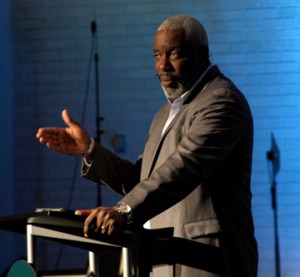
Thabiti_Anyabwile_blogThe mission of reconciliation can be seen in the Bible from the very beginning, said Washington, D.C., pastor Thabiti Anyabwile (right). Preaching from the book of Genesis, he urged his listeners to consider how they look at people different from themselves, in light of the fact that everyone is made in the image of God.

“Every person we have ever looked at, smiled at, greeted, encouraged, insulted, slandered, touched, is a person bearing the marks of divine likeness, the ‘imago dei.’ So, racial reconciliation must begin with our learning the habit of seeing each other as together made in the image of God, and therefore possessing inestimable, unfathomable dignity and worth and preciousness.”

But seeing other people is such a commonplace occurrence, Anyabwile continued, and then there’s the problem of sin. That’s why true reconciliation requires a constant renewing of the mind. How a Christian treats people of different ethnicities is such a key part of living out one’s faith that it ought to be a category of discipleship, the pastor said.

“That [racism has] moved so rapidly to be a despised thing is wonderful,” he said. “But along the way, I think many Christians have been so afraid of the label, so afraid of the discussion, and so afraid of the implications, that they don’t even want to have the conversation.”

Working out the reconciliation that Christ has achieved for us is one of the most underdeveloped areas in Christian discipleship in the U.S., he said. A believer can live his whole life without someone sitting down with them to explore their identity in Christ.

And so, Anyabwile said, “We’re weak when the Fergusons erupt around us, we’re weak when we watch Eric Garner choke to death on a city sidewalk. We feel incompetent when we see a Tamir Rice shot in Cleveland.

“We don’t know quite what to say or what to do, when the (Department of Justice) reports come out, whether it’s telling us that ‘hands up don’t shoot’ isn’t true, or whether it’s telling us that, man, this police department is shot through with racist practice….It immobilizes us, because we’re not discipled, because we don’t have this as a category in what it means to mature as a Christian, as a follower of Christ.”

Nashville, Tenn. | Racial reconciliation is the main topic of the Ethics and Religious Liberty Commission’s 2015 Leadership Summit, which starts today at 1 p.m. The Illinois Baptist is in Nashville covering the event, which today includes plenary sessions on:

  • Why racial reconciliation is a gospel issue
  • Ferguson, Eric Garner, and your community
  • Key issues in racial reconciliation: Poverty, fatherlessness, criminal justice and urban ministry

Tonight, ERLC President Russell Moore will interview civil rights leader John Perkins, and speakers Danny Akin and H.B. Charles will explore how racial reconciliation is shaped by the gospel and the Great Commission. The evening session will conclude with a panel discussion on the church and multi-ethnic ministry.

The Summit was originally scheduled to focus on pro-life issues, but unrest in Ferguson, Mo., and other U.S. cities caused ERLC leaders to change the topic. “Racism and injustice are not just social ills; they are sins against God,” Moore said last year.

“This summit will help equip us to tear down carnal divisions, to bring about peace, so that churches reflect the kingdom of God.”

LifeWay Research has found that while 86% of Protestant senior pastors have congregations with one predominant racial group, only 40% of American churchgoers believe their church needs to become more ethnically diverse.

Check back here for news from the Summit, and in the next issue of the Illinois Baptist.

Hobby_LobbyNEWS | The U.S. Supreme Court is expected to hand down its decision in Sebelius v. Hobby Lobby and Conestoga Wood Specialties sometime this week. The case has been closely watched by religious liberty advocates who believe the Court’s ruling will have significant impact on the freedom Americans have to practice their religious convictions.

At issue is the businesses’ refusal to cover abortion-inducing drugs for its employees, a measure required of for-profit companies by the Obama administration’s healthcare plan.

“The United States Supreme Court is deciding whether or not in this country there is the freedom to dissent, and the freedom to accommodate these conscientious objections in the governing of people’s lives and in the running of their businesses,” Russell Moore told Southern Baptist pastors and leaders meeting in Baltimore. The president of the Ethics and Religious Liberty Commission took part in a panel discussion about the case during the SBC’s annual meeting in June.

“It’s going to be a tremendously significant and important case for every single one of your churches and your ministries,” Moore said. “This will have everything to do with everything that your church does for the next 100 years.” In March, the ERLC issued a call to prayer for Hobby Lobby and the Supreme Court’s ruling.

Several institutions have won their fight against the health care mandate, including Colorado Christian University just this week. But Hobby Lobby and Conestoga Wood Specialties’ status as Christian-owned, for-profit businesses is what makes their case different.

The Hobby Lobby case sparked an online discussion about what makes a business “Christian.” See today’s Briefing for more.

NEWS | Meredith Flynn

Ask church leaders what is the single biggest threat to marriage right now, and most would probably give the same answer: the stunning wave of approval for same-sex marriage.

But a changing definition of marriage isn’t the only thing endangering the institution, said Baptist leaders at an April summit on sexuality and the Gospel. In fact, it may not even be at the top of the list.

Pornography has dulled the consciences of many Christians. Cultural trends have tended to devalue marriage at the expense of other arguably good things, like education, career and financial stability. And pastors may not feel the freedom or confidence to speak plainly about the issues affecting their congregations: sexual purity, marital fidelity, and what the Bible really says about all of it.

Faced with these threats to marriage, Andrew Walker of the Southern Baptist Ethics and Religious Liberty Commission said the church has a choice: “We can confront these changes, we can acknowledge them, we can work to combat them, or, sadly, we can conform to them.”

One thing the church can’t afford to do: nothing.

For today’s 20-somethings, marriage and family look very different than when their parents were making decisions about who to wed and how many kids to have. In 1960, 72% of American adults were married. In 1980, it was 62%. In 2012, it was just over 50%.

According to a 2013 study by the University of Virginia, the average age of first marriage now is historically
high – 27 for women and 29 for men. Waiting to marry has resulted in a lower divorce rate and better economic prospects for women; however, researchers also point to higher birth rates among unmarried women.

Almost half (48%) of first births are to unmarried women.

“What exists outside the church usually makes its way inside the church,” said Walker, the ERLC’s director of policy studies. In a breakout session at the Nashville summit hosted by the ERLC, he explored 11 threats to contemporary marriage, including:

The “soul mate” concept of marriage that emphasizes emotional and sexual fulfillment and partnership over biblical covenant and commitment.

Marriage as an aspiration. People marry later when they wait until they’re financially established, Walker said. “We need to mitigate against the [idea] that someone needs a Master’s degree and $75,000 in the bank” before they get married, he added.

– The rise of “professional marriages” where spouses have individual bank accounts and separate social lives.

Also on Walker’s list of external threats to marriage: divorce. Many would say it’s a threat inside the church too, although the statistics that place divorce rates the same or higher among Christians have been misreported, some researchers say. The more subtle danger may be Christians’ acceptance of the divorce culture.

In an interview last year with Christianity Today, ERLC President Russell Moore said divorce is one way Christians have surrendered to “the patterns of this age.”

“Evangelical Christians are as counter-cultural as we want to be, and it is clear that we are slow-train sexual revolutionaries, embracing the assumptions of the outside culture a few years behind everybody else,” Moore said. “This has had disastrous consequences.”

How these factors have marginalized marriage inside the church is supported largely by anecdotal evidence. The single adults in your congregation likely weren’t raised to focus on whom they would eventually marry. Marriage has been confined to “meeting the right person” for an entire generation (maybe more); it’s not something they can control. So young Christians focus instead on friendships, education and career. On top of all that, they’re haunted by the specter of divorce. Looking toward marriage seems strange to most of them, even limiting – and potentially disappointing.

David Prince is a Kentucky pastor who also spoke at the ERLC summit. He said that when he visits new parents in the hospital, he prays over their babies, and specifically for their future spouses. One grandfather in a hospital room expressed his disbelief that Prince was praying that way already, the pastor said.

The majority of Americans, and even more religious Americans, still have faith in the institution of marriage, according to research presented at the summit by sociologist Mark Regnerus. The question is whether they have enough faith to pursue it for themselves. In the absence of a “marriage culture,” wrote blogger Trevin Wax last year, Christians who marry early and stay married 40, 50 or 60 years will stand out. Which is good news for the church. “We’ll be ordinary oddballs,” Wax said. “So let’s not waste the opportunity.”

A healthier view
If negative influences on marriage and sexuality that exist outside the church have made their way inside, Scripture offers a better way forward. And it speaks to modern-day problems like pornography, said Southern Seminary professor Heath Lambert.

Likening porn to the “forbidden woman” in Proverbs 7, he told summit attenders there is a silent killer running rampant in churches. And it’s not growing acceptance of same-sex marriage.

“A greater threat to the church today is the Christian pastor, the Christian schoolteacher, the Christian Bible college and seminary student, who exalts sound theology, points to the Bible, and then retreats to the basement computer to indulge in an hour or three of internet pornography.”

Regnerus shared daunting numbers: When asked whether they had looked at porn on a given day, 11% of men said yes. Between 35 and 40% said they had within the last week, including 20-25% of Christian men between the ages of 18 and 39. And it’s not just men. In a reflection on biblical womanhood during the summit, Trillia Newbill said research from 2007 showed 13 million women clicked on pornographic web sites every month. Women represent one in three visitors to adult entertainment sites, she said.

“There is a stereotype and a really, really, really bad rumor that women don’t struggle with sexual sin,” said the ERLC’s consultant for women’s initiatives. “The sin that came into the world and corrupted all that was beautiful in the world, also corrupted us women.”

How can churches offer hope and the truth of the Gospel? By presenting marriage and sexuality in the same tone as Scripture, said Kevin Smith, who closed the conference with a message on biblical sexuality within marriage.

“…Certainly, let us avoid vulgarity and certainly let us avoid [language] that will remove the mystery of sexual intimacy between a husband and a wife,” the pastor and professor from Louisville, Ky., said.

“I’m kinda tired of preachers bragging about their hot wife.”

But Smith also warned church leaders not to let a sex-saturated society muzzle proclamations of biblical marriage and sexuality. Avoid the “flattening out” of sex that happens in our culture, which removes emotional, commitment and intellectual aspects of the one-flesh union of the Bible, Smith said.

“The one who is proclaiming the Word of God and speaking of sexuality in a biblical context, we’re trying to heighten the conversation. We’re not trying to make sex less dramatic, we’re trying to make sex more dramatic.”

And more biblical.

Meredith Flynn is managing editor of the Illinois Baptist newspaper. Read the IB online at http://ibonline.IBSA.org.

Russell Moore, president of the Ethics and Religious Liberty Commission, has used the phrase “convictional kindness” to describe how Christians ought to engage a vastly different culture than the one their parents and grandparents knew.

Russell Moore, president of the Ethics and Religious Liberty Commission, has used
the phrase “convictional kindness” to describe how Christians ought to engage a vastly different culture
than the one their parents and grandparents knew.


NEWS | Meredith Flynn

Southern Baptists’ generals in the culture war demonstrated their new strategy at an April meeting for church leaders. But the tactic, softer in decibels but not doctrine, was met by criticism from opponents using modern weaponry – social media.

“The way that we are going to be able to speak to the people in our culture…is not by more culture war posturing, but by a Christ-shaped counter-revolution,” said Russell Moore, president of the Southern Baptist Ethics and Religious Liberty Commission.

The conference on sexuality and the Gospel was the ERLC’s first major event since Moore assumed leadership from Richard Land, who served as the denomination’s main voice on issues such as abortion and first amendment rights.

The event came with a sort of confession: the culture war as we knew it is over.

“We’re all in agreement that the cultural war is over when it comes to homosexuality, certainly when it comes to gay marriage,” Florida pastor Jimmy Scroggins said at the ERLC’s summit. In his urban context of West Palm Beach, Scroggins said, “The question is what are we going to do in the church.”

Some might call this “post-culture war America.” Others might conclude that we’ve entered a new phase, culture cold war, with new weapons such as Twitter and a new battlefield, ironically, inside the church.

Embrace the strangeness
This new culture has been on the horizon for a while: Marriage rates across all demographic groups have fallen continuously since 1970, Andrew Walker of the ERLC noted during his summit breakout session. Cohabitation rates are up too: USA Today reported last year that for almost half of all women between ages 15 and 44, their “first union” was cohabitation instead of marriage.

Also on the rise: Approval for redefining marriage. A recent ABC News/Washington Post poll reported 59% of Americans approve of same-sex marriage.

Addressing sweeping social and cultural changes was one emphasis of the April 21-23 meeting in Nashville, but speakers also talked about how church leaders ought to interact with increasingly specific questions arising at their churches. Like what to do when a transgender person expresses repentance and belief in Christ. Or how to counsel college students when premarital sex is not only accepted, it’s expected on the first date.

A few days before the ERLC summit, Moore appeared on ABC’s “This Week” to discuss religion and politics with a panel of evangelical and conservative leaders. He talked about the falling away of nominal, in-name-only faith, and the increasing “strangeness” of Christianity. Moore told moderator Martha Raddatz, “It’s a different time, and that means…we speak in a different way.”

“We speak to people who don’t necessarily agree with us. There was a time in which we could assume that most Americans agreed with us on life, and on abortion, and on religious liberty and other issues. And we simply had to say, ‘We’re for the same things you’re for, join us.’

“It’s a different day. We have to speak to the rest of the culture and say, ‘Here’s why this is in your interest to value life, to value family, to value religious liberty.’”

During the Nashville meeting, social media provided plenty of evidence of the divide. The meeting was one of Twitter’s top trending topics on its first day. Feedback from attenders was positive, but others watching the summit online spoke out, often harshly, against what speakers said.

That Christian views are seen as strange isn’t surprising, Moore said on the ABC broadcast.

“Many people now when they hear about what evangelical Christians believe, their response is to say, ‘That sounds freakish to me, that sounds odd and that sounds strange. Well, of course it does. We believe that a previously dead man is now the ruler of the universe and offers forgiveness of sins to anyone who will repent and believe.”

Reclaim the strangeness of Christianity, he urged at the Nashville meeting, basing it on the death and resurrection of Jesus.

So, what should we say?
Throughout the summit, speakers stressed the supremacy of the Gospel and clarity of what the Bible teaches about sexuality. Christians shouldn’t apologize for it, said Andrew Walker. Preaching an almost-Gospel is no match for the sexual revolution, Moore said.

Or, as Southern Seminary’s Denny Burk put it, “We have to be grave about these things.”

Scripture calls Christians to speak the truth, but to speak it in love. “We have to reject ‘redneck theology’ in all of its forms,” Jimmy Scroggins said during a panel discussion on the Gospel and homosexuality. “Let’s stop telling ‘Adam and Steve’ jokes.” (God created Adam and Eve, not Adam and Steve…)

As the audience chuckled, Scroggins continued, “Let’s be compassionate because these are people that are in our community, these are people who are in our churches, these are people who have grown up in our youth groups, and these are people that we’re trying to win to Christ, and we want to care for them as a people created in God’s image.”

Speaking with “convictional kindness” has been a major part of Moore’s message in his first year as ERLC president. “I hope to speak with civility and with kindness and in dialogue with people with whom I disagree,” he told Christianity Today last year.

It’s a timely endeavor, especially when social norms run ever more contrary to the Gospel. J.D. Greear pastors The Summit Church in Raleigh-Durham, N.C. At a church that reaches a large number of college students, sexual ethics are a topic of constant conversation.

“Sex gets at the core of who we are. Its dysfunction and its damage is deep, but the Gospel goes deeper still,” Greear said. “Because where sin abounds, grace much more abounds, and the great brokenness of sex presents an even greater opportunity for the Gospel.”

The May 26 issue of the Illinois Baptist will examine in more detail how speakers at the summit addressed contemporary threats to biblical sexuality and marriage. The ERLC also will look more closely at “The Gospel, Homosexuality, and the Future of Marriage” at a conference scheduled for Oct. 27-29 in Nashville.

ERLC_Summit_logoNEWS | Meredith Flynn

Nashville, Tenn. | The first Leadership Summit hosted by the Southern Baptist Ethics and Religious Liberty Commission kicked off this afternoon at the SBC building in Nashville. The meeting of 180 church leaders is focused on how the Gospel applies to human sexuality, especially in a culture that’s changing fast.

“So many of the questions that pastors grapple with today deal with situations that would not even have been possible a generation ago,” ERLC President Russell Moore said when the summit was announced a few months ago. “As technology advances and the culture changes, the questions that we have to grapple with are often increasingly complex.”

The meeting’s first speaker, Heath Lambert, tackled one of those digital age issues with a keynote address on pornography. Lambert, executive director of the Association of Certified Biblical Counselors and a professor at Southern Seminary, said porn is a “silent killer” in churches.

“I think that pornography represents the greatest moral crisis in the history of the church,” Lambert said. It is “something that evangelicals can do in a dark room behind a shut door after they’ve railed against homosexual marriage and talked about conservative theology.”

Redefining marriage is a threat to the church, he added, but “a greater threat to the church today is the Christian pastor, the Christian schoolteacher, the Christian Bible college and seminary student, who exalts sound theology, who points to the Bible, and then retreats to the basement computer to indulge in an hour or three of internet pornography.”

Using Proverbs 7 as a backdrop, Lambert likened pornography to the Scripture passage’s “forbidden woman.” The Bible gives strategies for dealing with sexual temptation, and the church should too, he said. But the first call is to cling to the Gospel.

“I’m pleading with the church to have practical strategies…but those behaviors won’t be enough if we are not teaching people to draw near to Jesus Christ,” Lambert said.

He closed his message with three charges to church leaders concerning pornography: First, pursue accountability. 75% of pastors are accountable to no one for their internet activity, Lambert said.

Second, address your people. “If your job is to preach the whole counsel of God, here it is,” Lambert said. “You’ve got to talk about it. If we do not share this, if we overlook it, it’s folly. It’s foolishness.”

And third, awaken the world to the problem. “Evangelicals have tenderly and tenaciously taken up many causes…I want to ask that together we would begin to take up this cause, that we would begin to say, ‘Enough is enough.'”

Marriage, purity, human trafficking, and pastoral care for sexual sin are among the topics the Leadership Summit will explore through large-group sessions, breakouts and panel discussions. Check back here for updates, and watch it at live.erlc.com.

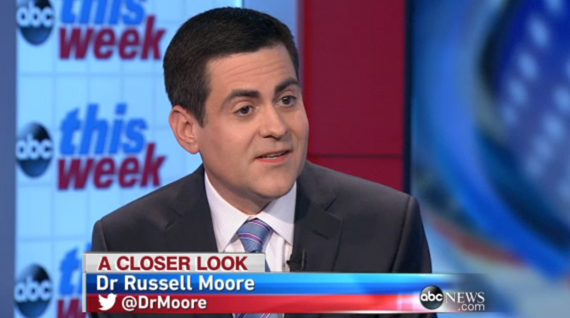
Russell Moore was joined on ABC's "The Week" by fellow panelists Franklin Graham, Ralph Reed and Cokie Roberts.

Russell Moore was joined on ABC’s “The Week” by fellow panelists Franklin Graham, Ralph Reed and Cokie Roberts. Photo from video on abcnews.go.com

NEWS | On Easter Sunday morning, ABC’s “This Week” featured a panel of guests discussing whether the influence of evangelicals is waning in the current culture. The group included Russell Moore, president of the Southern Baptist Ethics and Religious Liberty Commission, who said it is indeed a new day for Christians.

The percentage of people that are members of a church or synagogue has fallen from 70% in 1992 to 59% in 2013, said moderator Martha Raddatz, citing a Gallup statistic. She asked Moore if the numbers worry him, and what can be done about the decline.

“I’m not worried… because I think what we’re seeing is the collapse of a cultural, nominal form of Christianity,” Moore said. There was a time in America where in order to be a good person, to be seen as a good citizen, one had to nominally at least be a member of a church. Those days are over, and so we’re at a point now where Christianity is able to be authentic, and Christianity is able to be authentically strange.”

Moore pointed out that Christianity’s foundational beliefs are hard to grasp for the culture at large, but the disconnect isn’t unprecedented.

“Many people now when they hear about what Christians believe, what evangelical Christians believe, their response is to say, ‘That sounds freakish to me, that sounds odd and that sounds strange.’ Well, of course it does. We believe that a previously dead man is now the ruler of the universe and offers forgiveness of sins to anyone who will repent and believe.

“That’s the same sort of reaction that happened in the Greco-Roman empire when Christianity first emerged. So it offers an opportunity for the church to speak clearly, articulately, about what it is that we believe, to give a winsome and clear message about what the Gospel actually is.”

Raddatz asked Moore about his recent comment that “the illusion of a Moral Majority is no longer sustainable in this country.”

“Yes, it’s a different time,” Moore said on Sunday’s broadcast, “and that means that the way that we speak, we speak in a different way. We speak to people who don’t necessarily agree with us. There was a time in which we could assume that most Americans agreed with us on life, and on abortion, and on religious liberty and other issues. And we simply had to say, ‘We’re for the same things you’re for, join us.’

“It’s a different day. We have to speak to the rest of the culture and say, ‘Here’s why this is in your interest to value life, to value family, to value religious liberty.'”

The panel’s 10-minute conversation is available for viewing at the ABC News website.


Hobby_Lobby_prayerTHE BRIEFING | Meredith Flynn

The Southern Baptist Ethics and Religious Liberty Commission is calling Christians to pray for Hobby Lobby as the U.S. Supreme Court prepares to hear oral arguments this week in the government’s case against the craft retailer and another company, Conestoga Wood Specialties Corporation.

At issue is the businesses’ refusal to cover abortion-inducing drugs for its employees, a measure required of for-profit companies by the Obama administration’s healthcare plan.

“This case will set the tone for the next hundred years of church/state jurisprudence in this country,” ERLC President Russell Moore wrote in a blog post March 23.
“One of the reasons we oppose this sort of incursion into free exercise is that we want neither to be oppressed nor to oppress others,” Moore wrote. “We do not ask the government to bless our doctrinal convictions, or to impose them on others. We simply ask the government not to set itself up as lord of our consciences.”
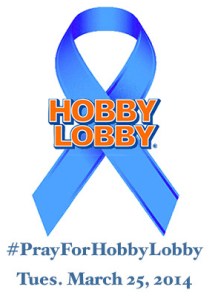
The ERLC has created a “Pray for Hobby Lobby” avatar for use on social media, and is asking Twitter users to post with the hashtag #PrayForHobbyLobby. Read the ERLC’s news release about the Hobby Lobby case here.
Other news:
Southern Baptist Convention First VP candidate named
North Carolina pastor Clint Pressley will be nominated for the office of first vice president at the Southern Baptist Convention’s annual meeting this June in Baltimore. Pressley pastors Charlotte’s Hickory Grove Baptist Church and currently is vice president of the SBC Pastor’s Conference.

“I love the Southern Baptist Convention,” Pressley told North Carolina’s Bibilical Recorder newspaper. “I’m thankful for the work of NAMB and IMB, and I want to keep supporting the convention. I want to see more younger guys getting excited about the work of our convention and how we do missions – whether it’s in North America or around the world.” Read the full story at BPNews.net.

Westboro pastor Fred Phelps dies
Fred Phelps, whose Kansas church made headlines for years with their incendiary protests, died March 19. LifeWay’s Ed Stetzer suggests how Christians should respond to Phelps’ death, including taking the opportunity for some self-examination.

“Let’s be careful to avoid our own self-deception,” Stetzer wrote on his blog, The Exchange. “The Phelps family, and the Westboro clan they started, are full of people that need Jesus. Let’s not get Pharisaical here – the Phelps family and the people they lead in worship of a false god are sinners, but so are we. The people who spew the hateful words of Phelps’s hateful god need the love of Jesus just like you and me. Pray for them to find peace in Jesus and love as he has loved.”

Former Haitian prisoner tells his storyA Baptist volunteer recounts his experience in a Haitian jail four years ago in this story on BPNews.net. “They were difficult and perplexing and complex days, but God ordained them,” Paul Thompson, pastor of Eastside Baptist Church in Twin Falls, Idaho, told BP. In 2010, he and nine other Baptist volunteers were detained and charged with kidnapping after trying to move children to safety in post-earthquake Haiti.

Barna: Who’s watching what at the movies
Sequels were big in 2013, according to data compiled by Barna Research, although the average American only saw 3.3 movies at the theater. The study also found 11% of people saw a movie in the last two years that made them think seriously about religion or spirituality. Read more at Barna.org.

Six Illinois volunteers, arriving in the Philippines this week, will help rebuild this school on Gibitngil Island.

Six Illinois volunteers, arriving in the Philippines this week, will help rebuild this school on Gibitngil Island. Photo is from the project’s Facebook page.

THE BRIEFING | Meredith Flynn

A team of six Illinois Disaster Relief volunteers will travel to the Philippines this week to help rebuild after last fall’s Typhoon Haiyan.

The group, composed of “blue cap” leaders from around the state, is part of a multi-week, multi-crew project to rebuild a school on Gibitngil Island. The team is the first from Illinois to join the long-term relief effort in the Philippines coordinated by Baptist Global Response. Keep up with their project here.

Other news:

Forum to focus on biblical sexuality
“The Gospel and Human Sexuality” is the theme of a Nashville summit planned for pastors and leaders this spring. The Southern Baptist Ethics and Religious Liberty Commission will host the April 21-23 meeting on marriage, family, purity, morality and culture.

“So many of the questions pastors grapple with today deal with situations that would not even have been possible a generation ago,” said ERLC President Russell Moore. “…We’ll talk about these questions, and how we can be faithful in ministry, Gospel-focused in engagement and Christ-shaped spiritual warriors in the ways we seek to wrestle with the principalities and powers of this age.” Read more at ERLC.com.

Blessed are the … athletic?
Just before the Super Bowl and Winter Olympics took over our TV screens, Americans weighed in on whether God rewards faithful athletes with health and success. Opinion is evenly split, according to the Public Religion Research Institute, with 48% saying yes and 47% disagreeing. But among white evangelicals, 62% believe God rewards faithful athletes. Read more at ChristianityToday.com.

Military’s religious climate questioned
The U.S. military has long been serious about protecting the religious freedom of its troops, said retired Gen. Doug Carver in submitted testimony before a House subcommittee last month. But Carver, who directs the North American Mission Board’s chaplaincy ministry, noted a climate within the military that could restrict religious liberty. Rep. Brad Wenstrup (R.-Ohio) summarized the prevailing concern: “There is a fine line between accommodation and respecting all religions and restricting religious freedom and that’s the line we are walking on here.”

Subcommittee chairman Joe Wilson (R.-S.C.) called for another hearing on the issue in the next 60 days. Read more at BPNews.net.

Bible-themed movies coming soon
2014 may well be the “Year of the Bible,” says culture writer Jonathan Merritt. At the movies, at least. Merritt lists five movies that will have the Bible front and center in the country’s consciousness, beginning with this month’s “Son of God.” Biblical biopics “Noah” and “Mary, Mother of Christ” are due late this year, along with “Exodus.” And although “Heaven is for Real” (April) isn’t based on the Bible, Merritt includes it on his list because “it will likely riff on popular Bible themes such as heaven, Jesus, and salvation.” Read more at JonathanMerritt.com.