Archives For November 30, 1999

O, Death

ib2newseditor —  April 10, 2017

Rolled away stone.

Several years ago, my father died on the first of April, just a few days before Easter. And so each year now, April and Easter roll in and bring me an emotional mixture of grief yet hope, sadness yet joy. At this time of year, I acutely feel both the promise of life, and the inevitability of death.

When I returned home from my dad’s funeral, the church I was serving as interim pastor sensitively asked if I would be ready to preach as soon as Easter Sunday. I assured them I wanted to. I believed, deeply, in resurrection and eternal life, and I was eager to declare that boldly from the pulpit, both for the congregation and for myself. I wanted to publicly join the Apostle Paul in defiantly asking death where its victory and sting are, now that Jesus has conquered it.

But I was also still feeling immersed in the reality and pain of my dad’s death, and my sermon outline showed it. My first three points were simple, and somber. Death is definite. Death is designed. Death is difficult. I preached those first three points through the misty eyes of fresh grief.

If I could get through this sermon, maybe, just maybe I’d find hope.

Of course, I was working my way to a fourth point, and a hope-filled conclusion. Yes, death is definite, and designed, and difficult. But death is also defeated! I knew that to be the ultimate truth, the ultimate promise, the ultimate miracle. Yet during those painful days, it was as if I needed to admit those first three points as much as I needed the assurance of the fourth.

I needed to acknowledge, in fact to proclaim, the inescapability of death. Everyone needs to understand that everyone dies. I also needed to place the providential plan of death squarely at God’s feet. Because of our sin, it is God’s good and merciful design that everyone dies. And I needed, from my own deeply personal experience that year, to acknowledge how terribly painful death is, especially for those who lose someone they dearly love. If we do not have a sound theology of death, we will not have a sound theology of eternal life.

I learned that year that death is like a terrible, dark canvass, but a necessary one on which the story of resurrection and life can be brightly and beautifully painted. Without the reality and severity of death, the promise of resurrection and new life means very little. It is the depth, and finality, and “no exceptions” nature of our mortality that makes resurrected life so supremely valuable.

In other words, I had never valued Jesus’ resurrection more profoundly than when my dad died. The true victory and joy of Sunday is for those who have experienced the loss and despair of Friday.

So if you are entering April or Easter this year with a fresh experience of death, don’t be afraid to feel that pain deeply, with a holy grief. Only through death could Jesus remove the penalty of our sin. Only through death to our old selves can we be raised to a new and abundant life. And only through the death of our earthly bodies can we receive our new heavenly bodies.

As I learned eleven years ago in a profound new way, Easter is of necessity a matter of both life, and death. But because of Jesus’ resurrection, we can stare death right in the face and ask where its victory and sting are. Death is simply a role player in the Easter story, a story that ends with the greatest victory in all of history—victory in Jesus.

Nate Adams is executive director of the Illinois Baptist State Association. Respond at IllinoisBaptist@IBSA.org.

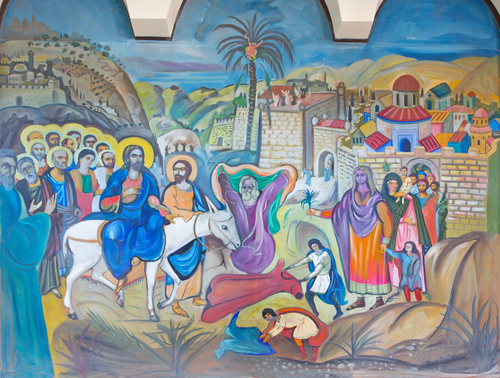
BETHLEHEM, ISRAEL - MARCH 6, 2015: The modern fresco of Palm Sun

The modern fresco of Palm Sunday in Syrian orthodox church by artist K. Veniadis (1987).

The crowd is often wrong. Popular opinion frequently misses the truth. And unfortunately, it seems that unrighteousness is usually trending.

From the earliest days of human history that has been so. The crowd was wrong in the days of Noah, as it was in the gathering at Babel. Godliness was often forsaken in the days of the prophets, and the dominant culture was usually wrong in the days of the early church.

But the crowds that gathered as Jesus entered Jerusalem on that first Palm Sunday got it gloriously right.

The crowds that gathered in the city just days later would call for the murder of Jesus. Many political and religious leaders would exult in the His crucifixion. But on that first Palm Sunday the gathered people welcomed the Messiah and Savior of the world.

Let’s note three ways the crowd got it right on that first Palm Sunday as we consider our response to Jesus on this Palm Sunday.

The crowd was right to give honor

The people got word that Jesus was entering the city and they immediately stepped forward to honor Him. He entered on a borrowed donkey which both fulfilled Old Testament prophecy and spoke to humility. People rushed to cushion each step by placing palm branches and even their own cloaks on the ground before Him.

We rightly honor Jesus by our care for the things of God. When we care more about the glory of the Lord than our own comfort, we honor Him. When we sacrifice our time and energy and possessions, we honor Him. When we look for ways to bless His work, we honor Him.

I pray you will honor the Lord with your life this Palm Sunday and Easter season. Honor Him by loving the things that matter. Honor Him with your sacrifice for the things that count. Honor Him with a bent knee and a giving heart. On Palm Sunday we remember all that Jesus is and all that He has done. And we honor that memory and that mission as we gather with the crowd.

The crowd was right to worship

The people began a spontaneous worship service as Jesus passed by on the first Palm Sunday. They sang out snatches of the Psalms. Their cries of “Hosanna” — a word of praise from the Hebrew word for “salvation” — rang out above the noise. They sensed the working of God to save mankind from sin and could not contain songs of loudest praise.

I hope you will worship the Lord joyfully this Palm Sunday and Easter season. He is worthy of all your praise. By His death, we can find life. By His work, we can find meaning and purpose in the work of our lives. By His resurrection, we have power over death and the grave. We have ample reason to praise our Messiah, Savior and Lord.

When you gather for worship on Sunday, remember who Jesus is and what He has done. And praise Him from the depth of your heart. Jesus told the skeptical Pharisees who hated this praise that the rocks would cry out if the people didn’t. We have a reason to sing and a reason to shout and Palm Sunday reminds us of this privilege. Let no stone be needed to take your place in worship. Praise His name fully and powerfully.

The crowd was right to proclaim

Matthew’s Gospel tells us the city was shaken by the crowd’s praise. People asked who it was that passed by. The crowd proclaimed, “This is the prophet Jesus from Nazareth in Galilee!” (Matthew 21:11).

We gather in worship on Palm Sunday and the Easter season to proclaim the message of Jesus. We proclaim the Gospel message that Jesus is God’s only begotten Son, that He died to pay the penalty for our sins, that He was buried but that He rose from the dead on the third day. We proclaim Christ as our Savior and as our King. We proclaim that He is the only hope for the world. We proclaim that He will return one day to claim His own and that those who repent of their sins and place their faith in Him will live for eternity with Him in heaven. This is our proclamation in song and sermon and life.

The crowd got it right on that first Palm Sunday. Let’s gather this week with other believers and all those who will hear and, together, honor and worship and proclaim the name of Jesus. There will be no need for stones to take our place.

— Doug Munton is pastor of First Baptist Church O’Fallon and first vice president of the Southern Baptist Convention. This column first appeared in Baptist Press.

We who handle holy things

Lisa Misner —  March 21, 2016

Jesus Christ crown of thorns and nail

Jesus wept. Standing in the cemetery with Martha and Mary, he didn’t pat the grieving sisters on the shoulder. He didn’t say, “I’ve got this.” Certainly he could have. Jesus knew that in a few moments he would order the great stone rolled away from the tomb and call a dead man from its greedy maw. He knew that this sign would portend his own resurrection and back up his statement: “I am the resurrection and the life.”

But when the sisters each said, “Lord if you had been here our brother wouldn’t have died,” it must have been like a knife under his ribs. He had delayed rushing to their brother’s deathbed on purpose so that the Father would be glorified. But in that moment, before the tomb, he grieved for the sisters and for his friend Lazarus. Jesus did not stand apart from their grief. He entered into it.

On a recent Wednesday, I faced this phenomenon myself: stand apart from the sorrow, or enter into it. First I visited with the family of a man who had learned two weeks earlier that he had only months to live. But the end came more quickly than that. On Saturday he was changing the brakes on his wife’s car; on Sunday he was in a coma. He believed in God, his wife said, but unlike her, he never accepted Jesus as his savior. She had carried this sad truth throughout their marriage. She had lived her faith before the man and witnessed to him many times. Many people had, and now it was too late.

An hour later I met with another man who had learned two weeks earlier that he had only months to live. He had questions about faith. He wanted answers about why Jesus had to die for everyone. But more important, he wanted to be certain of his own salvation. He wept over sin—his own—and we prayed for his salvation and assurance.

On the way home I thought about the contrasts between these two meetings. And I wondered when was the last time I saw someone weep over his own sin. It’s been a while. I’ve been there many times when people cried over the sins of others, and the impact of sin on the nation, but crying with the realization that their own sin is an offense to God? That their sin sent Jesus to the cross? It’s been a while. And stopped at a red light, I thought, How long since I cried over my own sins and my part in the sacrifice of Jesus?

We who handle holy things are like celebrity chefs who brag about their “asbestos fingers.” They’re so accustomed to grabbing hot pots without pot holders that their hands have become desensitized to the heat.

We stand so close the burning bush that it warms our toes but singes our eyebrows, and we hardly notice the difference. We climb the mountain like Moses to meet with God, and we approach the burning peak with such aplomb that the smoke and lightning don’t scare us. We reach out to prop up the house of God with unholy hands, hardly thinking that others who did so were struck dead.

And across a thousand Sundays in the course of our ministries, we offer up symbolic body and blood with little thought to the lambs whose throats were slit, whose lifeblood drained into bowls to sprinkle the altar, and whose bodies were burned in sacrifice for sins. “Without the shedding of blood there is no forgiveness for sin” is easier said over Welch’s than Red Cross. Strange as it sounds, in the rush to the Good News, it’s possible to skim past the realities of death. It’s possible to celebrate the Cross without mourning the blood dripping from God’s Ultimate Sacrifice. If we are not careful, all this handling of holy things becomes routine.

Even when we are careful.

Before we rush to the joys of Resurrection Sunday, let’s stop first at the reality of Crucifixion Friday. With sorrowful John and the weeping Marys at the foot of the Cross, let’s consider our own complicity, and enter in.

Eric Reed is editor of the Illinois Baptist newspaper.

Monochrome reality

Artist Andy Rains shows Christ’s humble beauty in simple black and white.

In our self-centered era, many people think the humble are losers and only the proud win. The Suffering Servant disagrees.

These aren’t humble times. So far, 2016 has produced as much bluster and blow as any year in memory. Not the meteorological kind, rather the political kind.

It is increasingly evident that ours is a land that no longer appreciates the humble man. In most every news report in this election cycle, humility as a value is trounced by pride, promises, and vainglory. Not the videogame Vainglory produced by Super Evil Megacorp (really, that’s the actual name of a game manufacturer); but the inordinate pride in one’s self and one’s accomplishments condemned in the Elizabethan English of the King James Version of the Bible as “vainglory” (Galatians 5:26, Philippians 2:3).

Prior to the 2008 election, a book was published that proposed “Jesus for President.” In it, the authors took a familiar concept from Charles Sheldon’s famous 1896 book “In His Steps” that first asked the question “What would Jesus do” and applied it to American politics: What would Jesus do—if he ran for president?

Probably lose. At least that would appear to be the answer in 2016.

Let’s face it: the humility platform would not prove popular today. The humility platform is not high and lifted up, it doesn’t have room for boasting. Its candidate doesn’t make empty promises. He doesn’t exalt himself, even though in the case of Jesus he rightfully could. He does nothing at the expense of others. And he’s interested in only One endorsement.

How could he possibly win here in Braggadocio?

Still, there is much the Humble One can tell the candidates—and the electorate.

A better example

Four passages in the book of Isaiah have been identified as the Servant Songs. The Ethiopian eunuch reading Scripture while sitting in a royal vehicle asked Philip, “Who is the prophet talking about?” He was reading from Isaiah:

“He was led like a lamb to the slaughter, and as a sheep before its shearers is silent, so he did not open his mouth. By oppression and judgment he was taken away. Yet who of his generation protested? For he was cut off from the land of the living…”  (Isa 53:7-8).

“Who is the prophet talking about, himself or someone else?” the servant to a queen asked Philip (Acts 8:34).

Definitely someone else.

He was talking about the Lord’s servant, the Suffering Servant. Jewish interpreters say the passage refers to the nation Israel, since in most of the book God speaks to Israel. But the verses describing an utterly humble servant and his sacrificial and redemptive work cannot be about a proud and unrepentant nation. They are clearly about the Messiah.

The Suffering Servant is Jesus.

In the Gospels, we see his humility in living tableau. He touches the unclean—lepers, lame, and blind people—and heals them as Isaiah predicted he would. He shows willing descent as he assumes the place of the lowest slave in the house and kneels to wash the feet of his followers. Then he stands with the condemned on the killing hill.

In Philippians, Paul sings a little song of the early church that puts Jesus’ humility into theological perspective.

“Who, being in very nature God, did not consider equality with God something to be used to his own advantage; rather, he made himself nothing by taking the very nature of a servant, being made in human likeness.

“And being found in appearance as a man, he humbled himself by becoming obedient to death—even death on a cross!” (Philippians 2:6-8).

Jesus’ humility was not only a matter of location but also of position. He let go of all the things God deserves in terms of dominion and stooped down to his own creation. He subjected himself to his own created beings, even though he knew beforehand they would murder him.

He never sought to justify his actions. He never came to his own defense. Neither did anyone else.

Was there ever a clearer picture of humility.

The mirror cracked

Today our concept of humility is corrupted. “Lord, it’s hard to be humble, when you’re perfect in every way,” songwriter Mac Davis wrote. Even our contemporary examples become more idols than icons as our culture converts them into celebrities.

Mother Teresa is rushed to sainthood so her musky humility sharpened in Calcutta ghettos can be perfumed for the ages. Pope Francis, hailed for his (relatively) simple lifestyle chides a woman in a parade line. “Don’t be selfish!” he snapped when she pulled him away from a handicapped man he was praying over. Our selfish generation demands something more grand from those who willingly would be lowly. Humility is not fashionable; it’s barely tolerated.

Could it be that Billy Graham sitting in a rocker on the porch of his Blue Ridge mountain cabin out of the glare of the Crusade spotlight is the last example of humility in our egotistical age?

The times are louder. The boasts are prouder. And the rhetoric of its claimants is so overblown that their platforms cannot support it. If only our national leaders could learn a few lessons from the Humble One. If only our countrymen would accept from their icons true servant leadership.

A humble servant is silent

“There is a time to speak,” the Preacher says in Ecclesiastes, “and a time to be silent.” The Suffering Servant is more often silent, so much so that silence has become one of his chief characteristics. When he speaks, it is to the glory of God and to the benefit of others; it is rarely if ever on his own behalf.

The word picture drawn by Isaiah is of a lamb about to be slaughtered. The lamb knows something is coming, from its perspective something bad. And yet he offers not a bleat in protest. If silence is consent, then the lamb is offering his tacit acceptance. Likewise, Christ before his accusers offers no defense of himself. His defense could rightly be that he is God and has done all to the glory of his Father. But he keeps his rebuttal to himself and leans in to his mission with the same humble spirit that has characterized his whole life on earth. The day of his exaltation will come, but there before Pilate, Herod, and the Jewish supreme court, it’s still about three days away.

Andrew Murray says, “Humility is perfect quietness of heart.” In this way, a humble servant stands in stark contrast to the leading figures of our time who exhibit little quietude.

In his little book Humility, Murray describes the inner working of this outward silence: “It is to expect nothing, to wonder at nothing that is done to me, to feel nothing done against me. It is to be at rest when nobody praises me, and when I am blamed or despised. It is to have a blessed home in the Lord, where I can go in and shut the door, and kneel to my Father in secret, and am at peace as in a deep sea of calmness, when all around and above is trouble.”

Oh, how we need that room, that door, that peace.

He is not vain

Isaiah’s prophetic description of the Messiah says there was nothing particularly attractive about him. Even before he was “marred,” “pierced” and “crushed” at Golgotha, the Servant was a plain man with “no beauty” and a king with “no majesty.” He is not a pretty flaxen-haired Jesus as painted in Sallman’s Head of Christ over grandma’s mantelpiece.

Our generation has bought the Kardashian concept of beauty that requires everyone in the public eye to be “carved out of cream cheese.” By this standard, Abraham Lincoln couldn’t get elected to office today. He was tall enough, but homely people don’t win elections. Nor would Cleveland, Taft, or Teddy Roosevelt. Too fat, bald, or bespectacled.

Appearance is not only about outward beauty. There is the vanity of money, stature, power, and position. The desire for reputation is a form of the vanity of fame. The proud person is concerned about the opinion others have of him. “Pride must die in you,” Murray warned, “or nothing of heaven can live in you.”

This is the dying to self Jesus called for, the laying down of his life.

“Men sometimes speak as if humility and meekness would rob us of what is noble and bold and manlike,” Murray said. The humble are rarely exalted in our times, nor do they win elections. But a wise generation doesn’t judge on outward appearances. To the extent it is possible they follow God’s standard when he sent Samuel to anoint lowly shepherd boy David to replace the high but corrupted Saul: He looked on the heart.

And what does he see there?

As a “man of sorrows,” the Suffering Servant is serious about serious things. Oh, sure, he can be great fun, but he is also sober minded. Jesus enjoys a good time in good company (remember the wedding at Cana), but he handles serious subject matter with the gravity deserved. He is “acquainted with grief.” One charged with so great a task as carrying our sorrows to the cross surely feels them deeply.

The same must be true of those who claim him as Lord: “Then Jesus told his disciples, “If anyone would come after me, let him deny himself and take up his cross and follow me” (Matt. 16:24).

“Humility, the place of entire dependence on God, is the first duty and the highest virtue of the creature, and the root of every virtue. And so pride, or the loss of this humility, is the root of every sin and evil,” Murray said.

For those who follow in the way of Christ, there is an inverse relationship between vanity and a quiet spirit. “Pride must die in you,” Murray warned, “or nothing of heaven can live in you.”

He serves needs over wants

The word “populist” has returned to the American vocabulary, driven largely by the large crowds showing up at campaign rallies. By definition, a populist candidate is concerned with the interests of common people. He seeks the involvement of ordinary folks in the political process and welcomes into the discourse issues drawn from ordinary lives. But by recent example, populism involves stirring up the desires of the people, then promising to fulfill them whether they are right (and righteous) or not.

A humble servant may be populist by its original definition. He is concerned about the people, but he doesn’t play to the crowd as is the current practice. At times the crowds were with Jesus; at times they were against him; but Jesus never played to the crowds. He never healed to curry favor. He did not feed the 5,000 to increase his poll numbers.

A humble servant doesn’t dispense treats to get public approval. Or health benefits or government subsidies or campaign promises. He accepts the hard job and does the hard work to its completion, even if that causes everyone to turn away.

The challenge for Americans today is to show some maturity by supporting a leader who will do what the nation needs, not necessarily what the people want. That may sound paternalistic, but isn’t God’s kingdom paternalistic? The Father is always doing what is best for his children, even when they don’t understand it or like it.

He lives with the end in mind 

A humble servant may live and work from a lower position, but that somehow gives him a higher perspective. Isaiah’s picture of the Suffering Servant is paradoxical: he is lowly but he will be exalted; he is oppressed, yet he is the strong arm of the Lord; he is wounded for the sake of our healing. And there’s this paradox concerning “the will of the Lord”—

Yet it was the will of the Lord to crush him; he has put him to grief; when his soul makes an offering for guilt, he shall see his offspring; he shall prolong his days; the will of the Lord shall prosper in his hand (Isaiah 53:10).

It was the will of God that the Suffering Servant be crushed, yet the will of God only prospers when this is done. Crushing and prospering would seem to be opposites. One destroys while the other creates. One shrinks and the other grows. One is an ending, but the other is unending.

And in all of this the humble Servant knows there is a higher purpose than his momentary affliction. The purpose in his dying is to make possible our living—forever. His offering is our ransom. His ending is our beginning. In it all he does not object, because the Servant knows that his grief will become our source of joy and our salvation.

There, between the Lord’s will that the Servant be crushed and the prospering of the Lord’s will in the Servant’s hand is the great promise: this lowly Servant will have offspring. That’s us, his children, his followers, his redeemed.

Isaiah, 700 years before hand, describes the centerpoint of history, the cross, where the crushing intent of the Lord’s will is met by the prosperous outcome of the Lord’s will in the salvation and multiplication of his progeny. This is only possible because the lowly Servant is willing to submit to the Lord’s will that he die and that he rise again, that we believing may be born again to new life.

Rising from that moment in history is the way for all who will follow the Suffering Servant. “Here is the path to the higher life: down, lower down!” Murray said. “Just as water always seeks and fills the lowest place, so the moment God finds men abased and empty, His glory and power flow in to exalt and to bless.”

Eric Reed is editor of the Illinois Baptist


HEARTLAND | Nate Adams

As Easter approaches each year, I frequently find myself returning to the music of “Jesus Christ Superstar.” Perhaps it’s because I was a teenager in the 1970’s, when Andrew Lloyd Webber’s groundbreaking rock opera was immensely popular. They say the music of our teen years can shape us for the rest of our lives, and certainly hearing these songs again brings back many memories and emotions.

Nate_Adams_April6But really more than the music, it has been Tim Rice’s lyrics that have stuck with me. To this day I can recite most of the words Rice penned over 40 years ago, including the powerful dialogue where Pilate angrily demands of Jesus, “Why do you not speak when I have your life in my hands? Why do you stay quiet? I don’t believe you understand!”

Jesus’ reply in the rock opera, though imaginary, is consistent with the Bible’s message. “You have nothing in your hands,” Jesus meekly replies. “Any power you have comes to you from far beyond. Everything is fixed, and you can’t change it.”

Those simple words powerfully convey the confidence and courage of Jesus as he went to the cross for us, and also the providence and sovereignty of God in securing our salvation. Each time I hear them, they make me want to cheer for God and His great victory on our behalf.

To their credit, Webber and Rice took moments like that from the passion week of Christ and, with some admitted license and imagination, placed them in the contemporary music and language of their day. The result was memorable, and therefore enduring.

And yet, as critics and Christians alike noted even during the height of its popularity, Jesus Christ Superstar has one obvious and major shortcoming. It concludes with the crucifixion.

Apologists for the rock opera observed that the ending was deliberately left to the faith or skepticism of the observer. Even Christians noted with appreciation that it at least served to place the name of Jesus on peoples’ lips, and the story of his life in their minds and hearts, in many cases for the first time.

But there was no resurrection. No Easter. No delivering the good news that death was not the end for Jesus and that it need not be the end for those who believe in him.

Yes, ultimately Jesus Christ Superstar sadly reminds us that it’s possible to stop the story too soon. It’s possible to focus so much on the various overtures to Easter that we don’t truly celebrate the finale.

It happens all around us. Immediately after Valentine’s Day, the candy and toy aisles at every store in town switch their ruby red treats and treasures over to the pastel, Easter versions. Clothing catalogs tell us that we need something new to wear. And florists and garden centers remind us that a properly decorated Easter requires lilies. All these traditions paint the days before Easter with an elaborate pageantry. Then the big day comes, and we are left to wonder whether all the preparation overshadowed Easter itself.

We can even do it in our churches. For weeks we can invest in preparing musicals, programs, decorations, and children’s activities designed to help us celebrate Easter. All these things are good. But they are not the finale. They are not the really big part of the story that must be celebrated and that must be told.

The title song from Jesus Christ Superstar is sung by, of all people, Judas, near the end of the rock opera. In it he asks Jesus, “Who are you? What have you sacrificed?” In our churches and in our conversations with others, we need to make sure to get to the part of the story that answers those questions with truth and faith and confidence. As important as what happened before Easter is, it’s what happens after Easter that makes all the difference.

Nate Adams is executive director of the Illinois Baptist State Association.
Layout 1“Father, … I commit my spirit!”
Read Luke 23:46-49, John 19:31-42

Here are some signs that Jesus’ work really worked: The earth shakes, as God’s own creation trembles at the mighty act just finished on a barren hill outside the city. The massive temple curtain separating the place of God’s holy presence from sinful people is ripped from top to bottom, signifying the Creator’s invitation to humanity to enter into restoration. And on the cross, Jesus makes his own great declaration of faith in the Father’s plan: I trust You.

How could Jesus say this?

No prisoner in solitary confinement was ever more alone than our Christ on the cross. It had to be that way.

faithOnly Jesus could serve as the sacrifice for our sins. Only Jesus could be our spotless lamb. Only Jesus could be the human qualified to pay the penalty for sin. Because he was sinless. And in this he was unique in all of the universe. In this he was alone.

All he had to hold to was the Father’s promise of life on the other side of the grave. Soon he would rest, his salvation work complete. Soon all heaven would celebrate.

PRAY Lord, because of Your great love and completed work on the Cross, into Your hands I, too, commit my Spirit.

The death of death

Meredith Flynn —  April 18, 2014

Charles_Lyons_blog_calloutCOMMENTARY | Charles Lyons

I wish you could meet Richard.* When our church moved into the hulking former Masonic Temple, squatting on a Kedzie Boulevard corner, the guy I would come to know as Richard hung out with a crowd of 20 guys in front of our building each evening.

This was their hood. This was their corner. Now, many years later, Richard has confessed with his mouth and believed in his heart the Lord Jesus.

He’s in my Grow Group that meets every Thursday night. The week after Easter we were bemoaning that Richard had to work the previous Sunday. He’s a security guard at a hospital, which has served this dangerous Humboldt Park neighborhood since the early 1900s.

He was recounting the hectic happenings at his ER security post on Resurrection morning.

“Yeah, we had two rape victims come in, then we had two other girls who were hit and run…” His hands were waving. “Then we had a shooting victim brought in.”

Right about here I interjected, “This is all Easter morning?”

“That’s right,” he affirmed, voice rising.

“Then the Monsters* (local gang whose turf surrounds the hospital) started gathering outside the ER door trying to get in to finish off the guy they shot but failed to kill. We had to put a call into CPD (Chicago Police Department) for some help. On top of that, two overdoses came in.”

While all that was going on, about a mile and a half north, Armitage Baptist was lifting praises to the resurrected Christ. We were declaring the good news that Jesus’ death, burial, and resurrection is victory over sin and death. He’s in the life-transforming business. That very morning, almost a score of sinners
confessed Jesus as Lord in our services.

Cities are centers of death. The wages of sin is death. Cities … more sinners … more sin … more wages of sin … more death. I can’t help but think of the crime, the plagues, the fires, the wars that have wreaked havoc on cities throughout history.

Even natural disasters are more dramatic and more death-dealing when they hit cities. Think of the tornado in Joplin, Hurricane Katrina in New Orleans and Biloxi, and Hurricane Sandy in Long Island.

Think of Jerusalem – ravaged, destroyed, blood soaks every square foot of its rocky soil. Several hundred years before Christ, the Babylonians decimated the city. Several decades after Jesus, the Romans brought great horror to the sacred city.

Jerusalem – The city. The city that is the center of the earth. The city central to God’s grand plan. On one dark Friday it is again the center of death. This death is the death of all deaths. Three days later death is conquered in a city, the city.

Could it be with all the devastation Satan has hurled at humanity in cities and through cities, that God chooses the city purposefully as the place where death will be conquered?

“O death, where is your sting, O grave where is your victory?” (1 Corinthians 15:55) The sting of death is sin and the power of sin is the law, but thanks
be to God who gives us the victory through our Lord, Jesus Christ.

Rosa,* new to our Grow Group, sat in stunned silence as Richard talked. Which, if you knew Rosa, was an awfully rare occasion. There had been a knock as our group assembled. The door was flung open. Richard entered the tiny living room seemingly filling it. Rosa told me later, “I recognized him right away! I don’t know if he recognized me, so I just introduced myself.

“Pastor, Pastor, he’s the guy who told my son that he was going to kill him!”

“When was this?” I asked.

“Over 15 years ago. Right out in front of church!”

It seems Rosa’s then-teenage son had some kind of run-in with Richard. Rosa had literally feared for her son’s life, taking precautions to avoid the big guy that ran the hood.

Not having seen him for years, she had the spiritually jolting, emotionally shocking experience of sitting that night studying the Word of God with the very man, now her brother in Christ, who had threatened the life of her son. And doesn’t God often take it up one more notch? Rosa’s son now works at the hospital because Richard helped him get the job!

Jesus is the death of death in the city.

Charles Lyons has pastored Armitage Baptist Church in Chicago since 1974. This column first appeared in the Baptist Bible Tribune.

Layout 1“It is finished!”
Read John 19:30, Hebrews 1:1-3

When its payment is completed, a bill is customarily stamped “paid in full.” No more payment is expected. The cancelled paperwork is proof that the debt is no longer held against the debtor. In New Testament times, the word written across the final invoice was tetelestai. This Greek word means “it is finished.”

Tetelestai (pronounced “tuh-TELL-uh-sty”) appears only twice in Scripture, in John 19:28 and 19:30. In the first verse, “Scripture” is described as tetelestai. Often translated as fulfilled or completed, it is finished. Jesus did everything the prophets said he would do. He left no job undone, no stone unturned.

finishedOnly two verses later in John’s account, Jesus himself declares his mission accomplished. After six hours on the cross, painfully pulling his body up to swallow every breath, it is almost impossible for Jesus to seize enough air to shout this news.

But he does. And everyone is stunned.

Tetelestai!

PRAY Lord, I am amazed by all you did to save me. Thank you for completing my redemption. Your work is finished, and I am paid for in full.

movie_filmstripCOMMENTARY | Meredith Flynn

Watching actors portray Jesus on film is a little like Goldilocks trying out chairs at the three bears’ house. This Jesus is too small (“Jesus Christ Superstar”). This one is too passive (“Son of God”). Or just too weird (“Godspell”).

Even when Jesus resembles the one you met in Sunday school, like in the 1965 epic “The Greatest Story Ever Told,” you still find yourself looking for the inconsistencies that prove this Jesus isn’t as satisfying as the one in the Bible.

And when his suffering is gut-wrenchingly authentic (“The Passion of the Christ”), you want to see this Jesus during the rest of his life, and not just the last few hours.

Movies can’t capture him, and they’re not the best way to connect with him. But there’s still a reason to watch. Jesus on film may be undersized compared to the real-life version, but the other humans in the movies are caught in brilliant living color.

Judas, Nicodemus, Barabbas and the others are fully life-sized, and watching them interact with the film version of Jesus is downright convicting.

See the shades of jealousy you’ve never noticed in the “Greatest Story” Judas, and his belief that he was actually doing what was right for his people. Or listen to him wail in “Superstar,” narrating the whole story in what he believes is the voice of reason.

Watch Nicodemus in “Son of God” draw close and then pull away, again and again, as he’s torn between this new gospel and what he’s always known.

Simon of Cyrene comes to life in “The Passion,” starting off skeptical and reluctant to help Jesus carry his cross, but defending him at the end of their long march. In the same movie, Mary Magdalene can’t turn away from the gruesome crucifixion scene, her current reality mixing with memories of how Jesus rescued her from the Pharisees.

Even in “Godspell,” the loopy 1975 musical, we watch the disciples have their world turned upside down as Jesus teaches them things that are the opposite of the status quo.

The filmmakers created some of the dialogue to fill in places Scripture doesn’t describe in detail, so we don’t know exactly what was said or felt. But Judas’ jealousy and Mary’s neediness and Nicodemus’ doubts are relatable all the same because we’ve been in their shoes.

There’s a young church in San Diego called Barabbas Road. The founding pastor picked the name because all redeemed Christians have walked Barabbas’ path, he said. In fact, one of their early promotional videos featured different church members each proclaiming, “I am Barabbas.”

These Jesus movies elicit the same reaction: I am Barabbas. I am Nicodemus. You are Peter. You are Simon of Cyrene. Watching Jesus interact with vividly human people like us is the most moving thing about all these motion pictures.

And as a bonus feature, these abridged versions of Jesus will drive many viewers back to Scripture for the full story.

Meredith Flynn is managing editor of the Illinois Baptist.

Layout 1“I thirst.”
Read John 19:28-29, Psalm 69:21,
Zechariah 12:10

Several times the Gospel writers say the events of the crucifixion happened to fulfill Scripture. Jesus sipped the sour wine. His bones were not broken, which would have sped up the dying process. His side was sliced open, and the water separated from the blood that spilled out showed he had died. Why was it necessary to fulfill the Scriptures?

Doubters might say that Jesus, sweet but deluded, had sacrificed himself unnecessarily. They might say there was no divine plan from before creation to redeem humanity from sin and death. They might say it was all miserable happenstance, a bad turn of events.

fulfilledBut as the pivotal point in all history, the crucifixion was no accident. And to prove it, the Author of the plan had it written down hundreds, even more than 1,000 years before it happened. Bible scholars point to over 300 Old Testament prophecies of the birth, life, death, and resurrection of the Messiah.

And for it all to be proven true for those of us who stand on the A.D. side of time, Scripture was fulfilled. Down to the last sop of vinegar. Down to the last spear point.

PRAY Lord, thank you for the details of the crucifixion proving Jesus’ humanity, the reality of his death, and your divine plan over it all.