Archives For November 30, 1999

Thom_Rainer_blog_calloutCOMMENTARY | Thom Rainer

Editor’s note: Thom Rainer is president and CEO of LifeWay Christian Resources. This article was originally published Feb. 12 at ThomRainer.com.

Many churches are busy, probably too busy. Church calendars fill quickly with a myriad of programs and activities. While no individual activity may be problematic, the presence of so many options can be.

An activity-driven church is a congregation whose corporate view is that busier equals better. More activities, from this perspective, mean a healthier church. The reality is that churches who base their health on their busyness already have several problems. Allow
me to elaborate on seven of those challenges:

1. Activity is not biblical purpose. Certainly some activities can move a congregation toward fulfilling her biblical purposes. But busyness per se should not be a goal of a healthy congregation.

2. Busyness can take us away from connecting with other believers and non-believers. It is sadly ironic that local churches are often a primary reason we do not connect on a regular basis with people in our community and in the world. We are too busy “doing church.”

3. An activity-driven church often is not strategic in its ministries. Leaders do not think about what is best; they often just think about what is next on the activity list.

4. A congregation that is too busy can hurt families. Sadly, some church members are so busy with their churches that they neglect their families. Our churches should be about strengthening families, not pulling them apart.

5. An activity-driven church often has no presence in the community. Christians should be Christ’s presence in the communities their churches serve. Some Christians are just too busy doing church activities to have an incarnational presence in the community.

6. Activity-driven churches tend to have “siloed” ministries. So the student ministry plans activities that conflict with the children’s ministries that conflict with the senior adult ministries, and so on. Instead of all the ministries and activities working together for a strategic purpose, they tend to work only for their particular areas.

7. Churches that focus on activities tend to practice poor stewardship. Many of the activities are not necessary. Some are redundant. Others are sacred cows. Ministry effectiveness can often be enhanced with less instead of more.

Many of our churches have traded effectiveness for busyness. Good use of the resources God has given us demands that we rethink all we are asking our members to do in our churches. We really need more simple churches. Now that’s a novel concept.

Pat_Pajak_blog_calloutCOMMENTARY | Pat Pajak

You might actually be tearing down the very thing you’re trying to build if you’re guilty of these teamwork killers:

1. Practicing the age-old adage: My way or the highway
When trying to build teamwork, don’t forget that everyone has an opinion. Oftentimes, the thoughts, ideas and suggestions that arise through team discussions can be helpful. Listen to and learn from your team, involve them in decision making, ask for their input, and embrace the reality that teamwork can often be better than “my way or the highway!”

2. Being all about the numbers
Make no mistake about it, numbers do matter and the bottom line is important, but it’s not the final measurement. The very best teamwork (strategies, goals, planning and effort) doesn’t always produce the expected results. Numbers become a problem when a leader puts so much focus on them that he or she forgets about the importance of the team – the people who are making those numbers happen. People matter more than numbers, and forgetting that fact destroys teamwork.

3. Talking without listening
If no one else can get a word in or share an opinion, there is no teamwork. A leader destroys the opportunity to build future leaders if he or she is always talking and never listening. If people are never heard, they will soon cease to share things that matter.

4. Changing things just for the sake of changing things
Change is good and sometimes necessary. But it must be based on a specific outcome. Any leader who takes this to another level by changing things just to let you know they’re in charge doesn’t really understand teamwork. Operating as a team requires a leader to explain why change is necessary, move carefully through the process, and be willing to admit that what the team is saying sometimes makes perfect sense. Failure to survey the impact, timing and necessity of change destroys teamwork. Get everyone on board before any change takes place.

5. Micro-managingThe quickest way to destroy a team is to micro-manage every decision, action and assignment. Team members know the difference between being given a responsibility, and being handed a predetermined to-do list. Leaders who care more about things being done exactly their way destroy the notion of teamwork. Are you really interested in building a team? Remember the word of Dr. John Maxwell: “People don’t care how much you know until they know how much you care.”

Pat Pajak leads IBSA’s church strengthening team.

Mark_Warnock_blog_calloutCOMMENTARY | Mark Warnock

I resigned in December from my church, First Baptist Columbia, to return to my home state of Florida. God has burdened me with the vast lostness of South Florida, and impressed upon me a duty to be closer to my aging parents. I’m moving down to join a church planting movement in South Florida, and to shine my little Gospel light in that darkness.

This move brings to a close 17 years of ministry in Illinois – six-and-a-half years in Chicagoland, and eleven years in the Metro East. I leave behind a host of people at my church and throughout the state that I love and respect. As I leave Illinois, I see both a lingering challenge and a great hope.

The primary challenge I see is the same one the church faces everywhere: selfishness. On a personal level, a church level, and a denominational level, we must fight constantly the Satanic gravity of our own selfishness that wants to make our lives all about us, our churches all about us, and our denomination all about us.  Jesus our Savior came not to be served, but to serve, and He calls us to deny ourselves, to take up our cross and to follow Him.

God formed a church to be a light to the world, for His glory. He has graciously allowed us to cooperate as a denomination to pool our efforts to fulfill the Great Commission, for His glory. So to the leaders in Illinois: Do not stop calling us outward, to the lost. Remember Luke 15, and the priority of God our Father: “…there is joy in the presence of God’s angels over one sinner who repents.”

This fight to keep our eyes outward is not in vain, because there are signs of hope everywhere. Here are three I see:

Planting churches. I learned during my time at Columbia that one key to a healthy church is a steady stream of new converts. Like families, which continue to exist only if new babies are regularly born into them, churches begin to die without new spiritual life, and denominations begin to die without new churches.

I’m encouraged that God is calling men and women to devote their lives to starting new churches, and that IBSA is giving great priority to new church starts all across the state. Even more, I’m encouraged that increasingly, established IBSA churches are beginning to discover the joy and adventure of partnering with, supporting and working alongside church plants for the advancement of the Gospel.

Thinking students. I began teaching high school students at IBSA’s Super Summer in the late 90s. Many of the students I had in the early years are now pastoring or leading in churches across our state. I have been consistently impressed with the quality of the students in Illinois. They are passionate about the Gospel, hungry to be taught, and eager to love God with their minds. If our churches fail to equip our students with a clear understanding of the Gospel and the intellectual tools to be apologists in a hostile culture, we are in deep, deep trouble. The good news is that when presented with the challenge, our students – our future leaders – consistently rise to it.

A saving God. The real reason I have hope for the Gospel in Illinois and in South Florida? God keeps saving people. In my Monday night men’s group in Columbia, God kept saving some of the most unlikely men. In my first Sunday at my new church in West Palm Beach, I met a woman who came to church without an invitation, just stirred by the Spirit, and not knowing why she was there. She came to faith that week.

Consider Jesus’ answer to the scribes in Mark 2:17 who asked why He was eating with unlikely dinner guests – sinners and tax collectors. “Those who are well don’t need a doctor, but the sick do need one. I didn’t come to call the righteous, but sinners.”

No one is as passionate as our God to save sinners like us.

So to my colleagues in the Gospel across Illinois: Thank you for 17 years of friendship and love. Don’t lose heart. Let your light shine in the darkness. Keep speaking of Jesus. Keep fighting the good fight. Keep holding out the Gospel, because our God is willing and mighty to save.

Mark Warnock formerly served as associate pastor of First Baptist, Columbia.

Part of solving the leadership puzzle is determining whether a particular role calls for a manager, visionary, intern, or seasoned leader.

Part of solving the leadership puzzle is determining whether a particular role calls for a manager, visionary, intern, or seasoned leader.

COMMENTARY | Carmen Halsey

Every church should be mindful that the recruitment of leaders is necessary. New leaders can bring new ideas, offer different perspectives and bring a fresh burst of energy, giving respite to an existing team. But the key phrase is can bring. Before you bring in new leaders, it’s crucial to know who and for what you are recruiting.

Your ministry’s leadership needs could include, but are not limited to:

1. Managers, capable of caring for the existing programs and maintaining a high level of performance

2. Visionaries, able to forecast future needs and develop present plans to meet them

3. Interns, willing to learn and desiring to hold positions in the future, but with little to no experience at present time

4. Seasoned leaders, possessing a transferrable skill set and core knowledge requiring minimal support or oversight

A common mistake is to promote an individual from within to an area of leadership assuming they will be effective. But just because someone performed well with one set of responsibilities does not guarantee desired performance in another. This error often repeats itself in an organization, costing precious resources like time, money, relationships and – most crucial but often unnoted – loss of self-esteem by the individual. We have a responsibility to individuals and to the organization to identify the right person for a particular leadership role.

Excerpted from the Spring 2014 issue of Resource magazine, online at http://resource.IBSA.org. Carmen Halsey is IBSA’s director of missions mobilization and Illinois WMU. A nurse by profession, she also has a Master’s degree in Organizational Leadership and has served in numerous leadership roles in her field and in church life.

Nate_Adams_blog_calloutCOMMENTARY | Nate Adams

The Christmas and New Year holidays have passed, again. The decorations are mostly put away. The gifts have been placed into use, or into storage, or quietly returned. The various stresses of the season now finally seem to be subsiding, only to be replaced with something new – the stresses of returning to our regular routines.

One of the Christmas messages I heard last month focused on the shepherds. Before telling the story of how the angels came to announce Jesus’ birth, and how the shepherds left immediately for Bethlehem, the pastor went into some detail on how miserable the life of a shepherd was during that day. Their work was hard, and long, and dirty. They were poor. They had no status in society, no education, no real prospects. They were not only physically unclean, they were also considered spiritually unclean, at least by religious people. They had little hope.

As the pastor spoke, I began to think about how hard and thankless and frustrating work can be, and the drudgery of life’s routines. None of us have it as rough as first century shepherds. But I started thinking about the stacks of papers I had brought home from the office, and had not yet touched. I thought about my job’s most challenging problems, projects, and people, all of which would be waiting for me after the holidays.

Yes, leaving my own field of work for a break had actually sounded pretty good to me just prior to Christmas. The question was, where would I find my enthusiasm for returning to that field? Where do any of us find new hope and purpose for our work at the start of a new year, or a new week, or a new day?

We find it the same place the shepherds did. We find it in the presence of our King.  We intentionally pull away from our work, both its importance and fulfillment, and also its occasional drudgery and hopelessness. And we worship. We run to Jesus, and we realize again that He is our hope, that He is our strength, that He is our reason for living and that He gives purpose to our work.

Whatever our life’s work may be, if we do it merely for a paycheck, or for status or success, or to try and give our lives meaning, we will constantly feel like hopeless shepherds. But look at how these shepherds returned to their fields after worshiping the Christ child! They were enthusiastic, they had hope, and they were eager to tell everyone about the Immanuel who had come and made all the difference in their lives.

Especially if you are a pastor or busy church leader, you may have allowed the holidays to come and go this year without pulling away for some genuine, personal, renewing worship time. If so, let me urge you to do that before returning to your ministry field’s routines for 2014. Gaze at Christ as if for the first time, and remind yourself what your life, and His, and your work, and His, are really all about.

In fact, throughout the year, let’s let the shepherds remind us that we can always return to the fields of our work and our ministries different, with renewed strength and purpose, after experiencing true, heartfelt worship. It’s true once in a lifetime, when we meet Christ. It’s true once a year, when we pull away for the holidays and then start a new year. It’s true every week, when we remember the Sabbath day, and keep it holy. It can even be true every day that we go to work, if we return to that same old field with a fresh view of the King.

Nate Adams is executive director of the Illinois Baptist State Association.

IBSA's Mark Emerson (left) and Harold Booze from Woodland Baptist in Peoria (right) stand with a village chief in West Africa.

IBSA’s Mark Emerson (left) and Harold Booze from Woodland Baptist in Peoria (right), with a village chief in West Africa.

COMMENTARY | Mark Emerson

My wife recently downloaded and played for me Scott Wesley Brown’s classic song “Please Don’t Send Me To Africa.” It brought back memories of college chapel services and the annual mission challenge to take the Gospel to the ends of the earth. Tammie played the song for me because as I write this, I’m getting ready to join four Illinois Baptist pastors on a mission trip to the very continent Scott Wesley Brown was praying God wouldn’t send him.

Among missiologists there is a growing debate on the effectiveness of such short-term trips. Should we really go to Africa? Here are a few insights God has laid on my heart.

First, I’m going to Africa because God commanded me to go. Some would say there really doesn’t need to be another point. God has said it and that settles it. When the Lord shared that we should “go into all the world and take the Gospel to every creature,” He wasn’t directing the challenge only to a small group of disciples at that particular time. He was including you and me. God was declaring that we are the instruments He has chosen to take the Gospel to the world.

The second reason I’m going is because there are people who need the Gospel. In Africa our team will visit UUPG’s – “Unreached, Unengaged People Groups.” These groups are less than 2% Christian and do not have an indigenous church planting strategy. Simply put, there are few believers and no churches. I have never been to a place where the Gospel hasn’t been. The privilege of being able to share the story of Jesus around the village fire to those who will hear it for the first time has captured my heart.

And finally, I’m going to Africa because it may help others to go! Many groups are unreached in our world because it is hard to get the Gospel to them. I have led numerous groups to fairly easy locations, many have gone, but we followed multitudes that had already been there.

Going to West Africa is hard. Inoculations are expensive; airfare is expensive, travel conditions are difficult, living conditions are outside our comfort zones. But millions are dying without Christ. If I go, maybe someone would be willing to go with me, or better yet, see going as not so difficult. Pastor Kevin Carrothers from Rochester First Baptist Church is going with me in hopes of helping volunteers in Capital City Association engage an unreached people group. He is going so others can go.

I may have returned by the time you read this article. If so, I would love to share with you how God opened doors and used our team to share the Gospel. I would also love to share with you how your gifts through the Cooperative Program have provided full-time IMB missionaries who are working on your behalf to take the Gospel to the ends of the earth. I will get to work alongside several of our missionaries during this trip. They are anxiously awaiting the opportunity of working alongside you in Africa and all over the world. Consider going!

Mark Emerson is IBSA’s associate executive director of missions.

Study kits are great tools, but they don’t make disciples

COMMENTARY | Heath Tibbetts

Discipleship doesn’t come in a box. Lessons come in boxes, neatly packageHeath_Tibbettsd with DVDs and participant guides. And for years, discipleship to me was the newest lessons from great teachers. It was all I had ever known, until God called me to a church outside the Bible Belt.

Our Southern Baptist church in Pennsylvania was mainly comprised of former Catholics, Methodists, or unchurched people. Many in our congregation
came from a background where they had never been encouraged to read the Bible. One former Catholic who joined told me, “Our priest said if we ever needed to know something from Scripture, he’d tell us.” It became quickly apparent that doing discipleship the same old way wasn’t going to work.

And then I began to ask myself a tougher question: Did it ever work?

Much of our discipleship today fails because of a lack of biblical literacy. We have assumed for so long that those within our congregations are having a personal devotional time of some sort because they’re Christians. The reality is that many lack this important time with the Lord, not because they don’t love God, but because they were never discipled on how to do it.

So we scrapped our random discipleship efforts in Pennsylvania. We canceled all the classes, not because the subjects or teachers were bad, but because there was no fruit. Our pastoral staff and wives established discipleship groups. We didn’t promote them in the bulletin, but as individual leaders we identified potential future disciple makers. We established these as regular groups, meeting at least on a monthly basis. We prayed together, ate  together, and studied the Bible together. As group leaders, we did this to make disciples who would make disciples.

When God called our family to northern Illinois this year, I had the opportunity to step back and look at my group. Corey had been silent and plagued with guilt over his lack of depth as a believer. He’s now the leader of the group, and a new deacon in the church. Matt was becoming serious about studying the Bible, but often unwilling to commit. He’s now leading the youth ministry since my departure and learning to be a doer. And after two years, another man finally left the comfort of those friends to invest in a new group, where he will pass along the lessons of personal discipleship he learned.

Jesus’ earthly ministry over a three-year stretch was marked by twelve disciples. That ministry would barely register a blip on the radar of many church leaders today because of its humble beginnings. But as a result of Jesus’ personal investment in those men, churches were started, the Gospel spread, and many were saved. Jesus gave us a simple model: love them then lead them. This is the lesson I am now living out.

Here at First Baptist Church in Machesney Park, Ill., there are many dreams I have for our church. I dream of a church that is debt-free. I dream of a church that is focused outside of our walls. I dream of a church where our people live in a passionate relationship with their Savior. And all those dreams are tied to personal discipleship.

Disciples will give, disciples will go, and disciples will grow. But for these dreams to become reality, I must set the example as pastor. So I will invest in the lives of our people, finding those who can be grown not only as disciples, but disciple makers. It will grow our First family closer to God and each other.

Christ called us in Matthew 28:19 to “Go therefore and make disciples.” Andy Stanley and Beth Moore are great teachers, but they can’t make disciples for you. Discipleship requires personal investment that a box cannot provide. I challenge you to examine discipleship in your church. How can you personally invest in the lives of your church family such that you will make disciples who make disciples?

Heath Tibbetts is pastor of FBC Machesney Park, Ill.

Be it (still) resolved

Meredith Flynn —  January 1, 2014

Scott_Kelly_blogCOMMENTARY | Scott Kelly

At this time of year, it’s likely that someone may ask us this question: “Do you have any New Year’s resolutions?” And when asked, we usually answer: “Lose weight,” or “Read the Bible more,” or something like that. Our culture’s common thinking on resolutions tends to be individualized thinking about our own personal goals. That’s normal, right?

Not if you’re an Illinois Baptist. Our family of churches makes resolutions together. We make these resolutions not as individuals, but as a gathering of Christians from hundreds of Illinois Baptist churches. And we make these large-group resolutions at a strange time, in early-to-middle November, not on January 1. These resolutions are part of our Annual Meeting every year.

My dear Illinois Baptist family, now that the New Year has come, I must gently ask: Do we even remember our resolutions from our annual meeting this past November? The messengers from our churches enthusiastically approved resolutions about marriage, religious freedom, human trafficking, and state-sponsored gambling. As we gather in our churches for our first prayer meetings of 2014, let’s remember our resolutions and keep praying about these things that we were so resolved about on those days in November.

I left our annual meeting very encouraged by what God is doing through our Great Commission work in Illinois. As I boarded the last Amtrak train out of Springfield a few hours after our last meeting session had ended, I was still affected by the last-minute resolution that one of our brothers proposed regarding repentance and evangelism.

The wording of the resolution was both convicting and inspiring – and repentant. We resolved we should “repent of our unfaithfulness to God and beg for His mercy, grace and forgiveness because at times we have all failed to faithfully and regularly share the Gospel.”

Furthermore, we said, “All members of Illinois Baptist State Association churches are encouraged to regularly pray for God to give His people the ability to speak HIS message with boldness and clarity by the power of the Holy Spirit, and regularly pray for all to receive Jesus Christ as their Lord and Savior.”

Illinois Baptists, let’s keep repenting and sharing the Gospel in 2014, so that we may truly grow as churches together advancing the Gospel.

And may God receive all the glory!

Scott Kelly is pastor at Evanston Baptist Church and director of the Baptist Collegiate Ministry at Northwestern University.

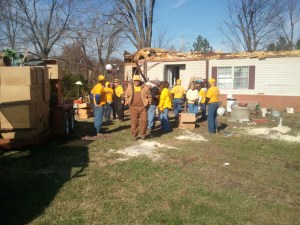
Disaster Relief volunteers served across the state after several tornadoes Nov. 17, including one in Brookport in southern Illinois.

Disaster Relief volunteers served across the state after several tornadoes Nov. 17, including one in Brookport in southern Illinois.

COMMENTARY | Eric Reed

When Time magazine announced the new pope as its person of the year, we were reminded that sometimes the publication has not chosen an individual, or even a person.

Time named “the computer” as its entity of the year in 1982, and in 2011, following the Occupy movement and the “Arab spring” uprisings in the Middle East, the “honor” went to “the protester.”

So it’s not surprising that the village of Sturgis, South Dakota, chose not a single person to receive its annual Volunteer of the Year award, but a group. And that group is Southern Baptist Disaster Relief Volunteers.

When Sturgis was hit with a winter storm in October, SBDR sent 110 relief workers in five teams to help them dig out. About 50 of those volunteers were from Illinois.

The town council noted in their announcement last week that many of the people receiving assistance were elderly or disabled, and the time given amounted to 576 days of work. Sturgis is grateful.

So are many others.

“Thank God for you all showing up to Mary Lou’s house in Rapid City, SD, to help with all the trees and branches due to the snow storm,” one couple who look after their elderly neighbor wrote to the Illinois team that aided them. “We are praising God and thanking Him for each one of you who made it all possible to come out to South Dakota and serve God.”

And when Rex Alexander, IBSA’s DR mobilization director, summed up the recent response to tornadoes in Illinois, he said there were more volunteers and offers of assistance than he had ever seen. Just before Christmas, 250 relief workers finished up their service in Washington and other communities laid waste by twisters in mid-November.

A new NAMB video shows Illinois residents picking through the remnants of their homes, weeping not so much at their loss, but in gratitude for the aid of strangers in yellow shirts.

“It’s raining, it’s cold, it’s nasty,” said a tearful Melissa Helfin outside her home. “And all these people – they’re here with chainsaws and pulling limbs and – it’s amazing…. I don’t know what we would have done, honestly. And it’s such a blessing.”

If we offered a “Person of the Year” award, it would be to the whole group who share Jesus Christ with a Bible in one hand and a spatula, mop, or chainsaw in the other.

COMMENTARY | Meredith Flynn

For something that we talked about for so long, the debate over same-sex marriage seemed to end so quickly. Tuesday’s vote in the Illinois House was preceded by two hours of debate, sure, but the feeling inside the Capitol was that this decision was a foregone conclusion.

The legislation – officially titled Senate Bill 10 – passed narrowly through the House and zipped back through the Senate and onto to Gov. Pat Quinn’s desk, where presumably it will be signed soon. If all goes according to the bill, same-sex marriage is legal in Illinois effective June 1, 2014.

Supporters of the bill stood in line outside the House gallery, hoping to get inside before the vote. As discussion dragged on inside the chamber, they huddled around iPads and cell phones, listening to a live stream of the debate. Eventually, they struck up conversations about what a yes vote would mean.

“It’s a no-brainer,” a young woman in an ILove T-shirt told me. She was polite and hopeful about the day, probably college-age. We chatted for a few minutes about what we thought about the issue, and I told her church leaders are most concerned about redefining something originally defined by God.

“But not everyone believes in God,” she said. For her, religion and the matter at hand were completely separate. And after five or ten minutes, I realized I didn’t have answers to counter her argument.

Before the vote, we heard that people on the pro side of the same-sex marriage won’t be persuaded by debate based on the Bible. In other words, our defense of marriage is rightly grounded in biblical truth, but our arguments need oomph – sociological, philosophical and yes, theological, oomph.

How true that is now that we’re facing a new normal in Illinois. As I continued to think about what I could have said in that line, I realized this is a new day for Christians too. We have to pray harder for our culture, study God’s Word more faithfully, and be more diligent in our thinking. Unlike my friend in line, this has to be a “brainer” for us.

Above all, we have to be more loving. This months-long debate has been divisive. Relationships are frayed between conservative Christians and those who advocated a new definition of marriage. We have to love intentionally in the days ahead. We’ll do that by thinking deeply and compassionately, and with discipline. And letting our words so follow.

Meredith Flynn is managing editor of the Illinois Baptist newspaper.