Archives For November 30, 1999

The pipeline

nateadamsibsa —  August 10, 2015

Nate_Adams_August10COMMENTARY | Nate Adams

Recently Beth and I had the opportunity to travel to Alaska for our 30th anniversary, and to see for the first time the famous Alaska Pipeline. It is truly a modern marvel, transporting millions of barrels of oil each week over 800 miles from the north slope of Alaska to its northernmost ice-free port in Valdez. Since the pipeline opened in 1977, more than 17 billion barrels of oil have flowed through it, along a route that travels both underground and over the permafrost, in climates that can vary from -80 to +95 degrees Fahrenheit.

The amazing length, cost, and complexity of the pipeline is a testimony to the value of the oil it carries. At $8 billion, it was the largest privately funded construction project ever at the time, and took 70,000 workers and more than three years to build. But it has paid for itself many times over.

Here in Illinois, Baptist churches are working together to build a different kind of pipeline, one designed to carry something of far greater spiritual value than oil. We are seeking to build a leadership pipeline, one that can deliver church planters and tomorrow’s church leaders, both to current churches, and to the under-churched regions of our state.

This summer we laid some major new sections of that pipeline. For the second year, IBSA hosted “ChicaGO Week” at Judson University in Elgin, a mission week experience designed to connect student groups with church planters in Chicagoland. We were delighted to see participation triple over the previous year, as 181 students and leaders from 14 churches invested a week of their lives in numerous neighborhoods where we are seeking to plant new churches.

Earlier in the summer, we laid yet another track of leadership pipeline through IBSA’s Summer Worship University, hosted by Hannibal-LaGrange University. About 130 students and leaders invested a week learning music and worship leadership skills, and then more than 50 of them went on tour to put those skills into practice through the All State Youth Choir.

Super Summer for student leaders at Greenville College, kids camps at Lake Sallateeska and Streator Baptist Camps, and many other leadership development efforts throughout the year are designed to prepare tomorrow’s leaders, and guide them through childhood and adolescence and internships into tomorrow’s—and today’s—church leadership roles. In fact I frequently meet young adults serving in IBSA churches who say they got their start in church leadership through an IBSA leadership development event for students.

A church leadership pipeline is something that we all have to work together to build, in multiple different ways, whether we’re preparing leaders for our own church, or for a sister church somewhere. If we all work at it together, the value of the leaders the pipeline eventually delivers is well worth the cost.

The last day of the ChicaGO Week student camp happened to fall on July 31, which was also my mother’s 85th birthday. So that morning I showed a picture of her to the almost 200 students, interns, youth leaders, and church planting catalysts, and reminded them that missionaries like my mom and dad had invested their lives for decades in the work those young leaders were just now being challenged to continue. I wanted them to see where the leadership pipeline was leading.

After the group joined me in singing “Happy Birthday” on video to my mom, they loaded up in their respective vehicles. But as they drove away, I told myself that they were not just headed home. They are now on a long but important journey, down a pipeline that will one day deliver them to the church of tomorrow, as its leaders.

Nate Adams is executive director of the Illinois Baptist State Association.

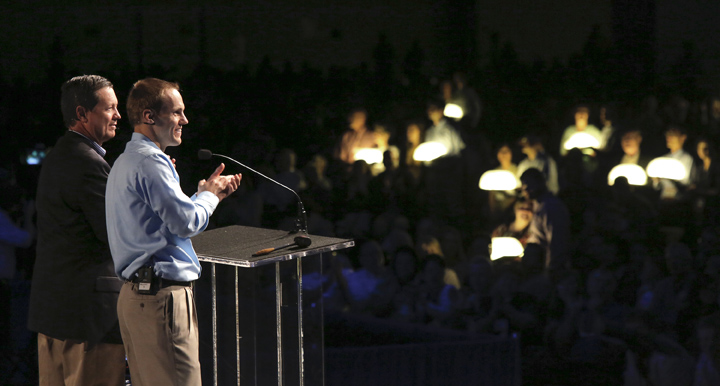
Kevin Ezell, left, president of the North American Mission Board, and David Platt, president of the International Mission Board end a joint Church and Mission Sending Celebration by recognizing missionaries with a standing ovation at the June 17 Southern Baptist Convention annual meeting at the Greater Columbus Convention Center in Columbus, Ohio. Photo by John Swain/NAMB

Kevin Ezell, left, president of the North American Mission Board, and David Platt, president of the International Mission Board end a joint Church and Mission Sending Celebration by recognizing missionaries with a standing ovation at the June 17 Southern Baptist Convention annual meeting at the Greater Columbus Convention Center in Columbus, Ohio. Photo by John Swain/NAMB

Columbus, Ohio | Meredith Flynn

A missionary “Sending Celebration” during the Southern Baptist Convention last week signaled a new, urgent day for SBC missions in North America and around the world. The vastness of lostness, said the leaders of the denomination’s mission boards, requires new thinking about getting missionaries on the field—and supporting them while they’re there.

That could mean sending out missionaries—students, retirees, and professionals— who are financially self-supported. Baptists who traditionally have focused on giving from the pew in order to support missionaries are now being called to go to the nations too.

The celebration in Columbus, Ohio, marked a shift from 20 years ago, when the commissioning might have featured flags of the world and missionaries in brightly colored international dress processing into the auditorium to “We’ve a Story to Tell the Nations.” But in Ohio, photos of the missionaries and families flashed up on large screens in the convention hall, with their home state, sending church, and a brief snapshot of the region where they’ll serve.

Across the room, the missionaries stood as their slides played, illuminated only by book-shaped lights fanned out in front of them.

The low-key, somber service hinted at the desperate spiritual need the missionaries will encounter here and abroad. In the Northeast U.S., said International Mission Board President David Platt, 82% of people don’t know Christ. In the western U.S., it’s 87%, and in Canada, 90%.

Those numbers are small compared to India, where 1 billion people are spiritually lost. Platt and Kevin Ezell, president of the North American Mission Board, focused on the role of the local church during the sending celebration, urging congregations to consider their responsibility to take the gospel to the nations.

Platt also pointed to the possibility of new strategies for supporting missionaries on the field. In 2009, he said during his report prior to the celebration, the IMB had 5,600 missionaries serving around the world. The number is 4,700 now, and headed toward 4,200, due to the Board’s inability to financially support them.

“We are evaluating all of our structures and systems to discern how we can more efficiently and effectively use the resources Southern Baptists have entrusted to us,” he said. But we’ll always be limited, he added, as long as full financially supported missionaries are the only way we think about getting the gospel to the nations.

Throughout the IMB’s history, the Board has sent about 25,000 missionaries to serve around the world. “Which is awesome, but the reality is we need 25,000 now,” Platt said.

After a year in which the IMB operated $21 million in the red, a new plan is needed to send more people to more places and people groups. And everyday Christians play a key role in that plan, Platt said, painting a picture of students and retirees and professionals forming a network of support around missionaries and church planters around the world. Regular people with regular jobs, leveraging those jobs to go overseas.

“What if God has designed the globalization of today’s marketplace to open up opportunities for the spread of his gospel?” Platt asked.

The time is now, he urged during his final challenge to the audience in Columbus. “Not one of us is guaranteed today, much less tomorrow. So, brothers and sisters, let’s make it count. Let’s make our lives and our churches and this convention of churches count.”

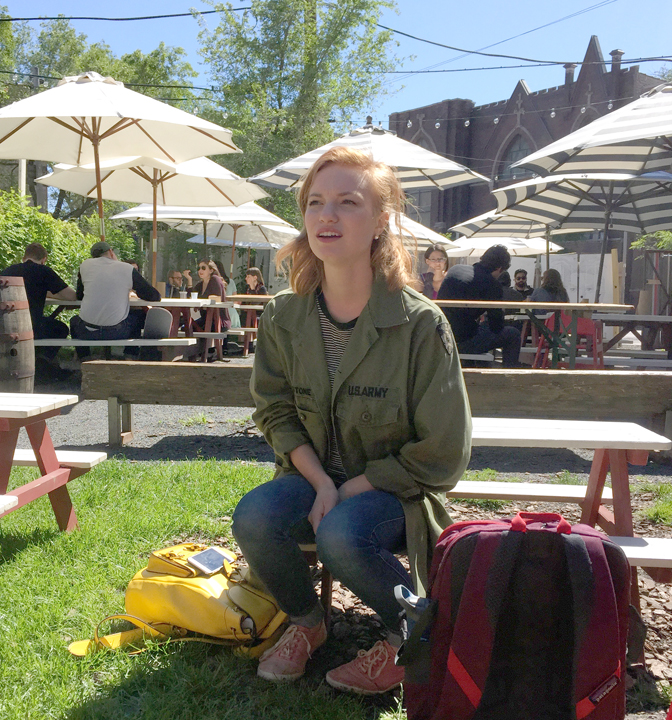
One of the first stops for Cassidy Winters and three other Transplant student mobilizers was an orientation session in the courtyard of a Chicago pie shop.

One of the first stops for Cassidy Winters and three other Transplant student mobilizers was an orientation session in the courtyard of a Chicago pie shop. Photo by Charles Campbell

HEARTLAND | Two groups of interns will work in Chicago this summer to assist church planters already on the ground, and to help outline the demographics of other neighborhoods in need of new churches.

Transplant, a summer initiative for students sponsored by IBSA, placed four “mobilizers” in various parts of Chicagoland in June, each paired with a church planter reaching out to people in the city or suburbs. Cassidy Winters said the mobilizers’ goal is to give their planters “more arms” to reach out in the community.

The college freshman from Edwardsville is serving alongside Dave and Kirsten Andreson, who are planting Resurrection City Church in Avondale on the city’s North Side. This is Winters’ second summer in Chicago. Last year, she admits, she didn’t know much about church planting. Shortly after her arrival, she remembers texting her mother something along the lines of, “I’m starting a church, Mom!”

This summer, Winters is helping the Andresons as they plant a church in a community of 40,000—and little evangelical presence. Growing up in her Christian home, Winters said, she “kind of got stuck in a Christian bubble…just not ever thinking about people who don’t love Jesus.” But in Chicago, there is a lot of hurt, and a lot of love is needed. Winters is helping the Andresons identify the projects they’ll tackle during ChicaGO Week, when teens from around the state come to Chicago for a week-long church planting practicum.

Cody Wilson is another student serving in the city this summer, along with a group a mobilizers recruited by the North American Mission Board for the Generation Send program. Instead of spending most of their time working with existing church plants, Gen Send-ers will develop a prospectus for a future planter who will start something new in a specific community.

Wilson, a student at Middle Tennessee State University, is serving in the Lakeview neighborhood and looking for what he calls “third spaces.” These are the coffeeshops, gyms, and arts programs where people hang out, and where a church planter might go to build relationships.

He had met a lot of people after just over two weeks in the city. “But it’s still obvious that in one of the busiest cities in the world…people are incredibly lonely and have very high walls and don’t let people in.”

In mid-June, team members joined Wilson, Winters and their fellow mobilizers to help further develop their prospectuses and projects. Their teams bring the total number of college students serving in Chicagoland through IBSA and NAMB to around 55 for the summer.

Look for more updates from Transplant and Generation Send interns, and a full report from ChicaGO Week, in the July and August issues of the Illinois Baptist.

Editor’s note: March 1-8 is the Week of Prayer for the Annie Armstrong Easter Offering, which supports Southern Baptist missionaries all over North America. View more videos like the one below at anniearmstrong.com.

MISSIONS | As a traveling musical evangelist, Mark Lashey longed for a church in his Delaware city like the ones he visited around the country. Turns out the church Middletown, Delaware, needed was one he would start.

“I never had considered myself, or desired to be, a pastor or to plant a church,” Lashey says in a video for the 2015 Annie Armstrong Easter Offering. “But we unknowingly were really kind of tilling the soil for a church plant for 10 years, as we built relationships with people, our neighbors, our friends.

“And still feeling incapable and unqualified and all those different things, felt like we had to do something. So we started a Bible study in our home.” The Bible study grew into LifeHouse Church, which launched in 2012 and has seen 150-200 people baptized.

https://vimeo.com/113545138

-Story and video from the North American Mission Board


THE BRIEFING | Meredith Flynn

The Washington florist found to be in violation of her state’s non-discrimination law rejected a settlement that could have mitigated some of the damage to her financial well-being, The Christian Post reports.

The_BriefingWhen Baronelle Stutzman refused to provide florist services for a same-sex wedding, Washington Attorney General Bob Ferguson filed suit against her. Following the Feb. 18 verdict, Ferguson offered to let Stutzman pay $2,001 in penalties and fees, as long as she committed “not to discriminate in the future.” Stutzman said no.

“Washington’s constitution guarantees us ‘freedom of conscience in all matters of religious sentiment.’ I cannot sell that precious freedom,” she wrote in a letter. “You are asking me to walk in the way of a well-known betrayer, one who sold something of infinite worth for 30 pieces of silver. That is something I will not do.”


Controversial author and former pastor Rob Bell told Oprah Winfrey that church culture is turning toward acceptance of same-sex marriage. “Lots of people are already there,” he said on the Feb. 15 episode of Winfrey’s “Super Soul Sunday.”

“We think it’s inevitable and we’re moments away from the church accepting it.”


Messengers to the Southern Baptist Convention’s annual meeting this June will vote on a key change to the ministry statement of the North American Mission Board. If approved, according to Baptist Press, NAMB personnel could provide assistance to the International Mission Board in planting churches overseas.


“War Room” is the newest movie from the Georgia brothers who created “Facing the Giants,” “Fireproof,” and “Courageous.”

“This film is about the power of prayer, and the necessity of prayer in our lives,” Alex Kendrick says in a video on warroomthemovie.com. He and his brother, Stephen, produced their earlier films with Sherwood Pictures, based in their Baptist church. “War Room” will be distributed by Worldwide Distribution for Sony Pictures, Baptist Press reported. Bible teachers Priscilla Shirer and Beth Moore both appear in the film.

When God calls, you go

Meredith Flynn —  February 16, 2015

HEARTLAND | “I think for most people when God really calls you out in faith to something deep, you know in your soul it’s going to cost you everything,” says church planter Nathan Brown.

“But when God calls you on his mission, you go because you love him.”

Brown came to Illinois from California to plant Real Church Chicago. Hear more about the challenging call to start a new work in the city in this video clip:

The Chicago vortex

nateadamsibsa —  January 12, 2015

HEARTLAND | Nate Adams

It’s January, and another “polar vortex” appears to be descending upon our heartland homes. Just a few days ago the temperature outside was flirting with 50 degrees. But then yesterday was barely above freezing, and as I write now it’s 16 degrees, heading for a low of 6 tonight, with wind chill temperatures that will require those dreadful minus signs in front of them.

Nate_Adams_Jan12So instead I’m choosing to think about next summer, and I encourage you to do so too. Now, in the dead of winter, is a perfect time to start planning a summer missions experience.

Your church may already have a plan for sending one or more groups on mission trips outside your own community this year. Many churches in Illinois have adopted an Acts 1:8 strategy, and are seeking to send mission groups to serve nearby in their local association, as well as elsewhere in Illinois, North America and internationally. These are modern day equivalents of the “Jerusalem, Judea, Samaria, and the Ends of the Earth” mission fields that Jesus spoke of in His last words on earth.

If your church doesn’t yet have a mission trip planned for this summer, and especially if you have teenagers in your church, let me suggest one option where most of the planning has already been done for you. It’s called ChicaGO 2015, and it will be hosted July 26-31 on the campus of Judson University in Elgin. You can find more detailed information on the IBSA website, or by calling or
e-mailing Rachel Carter (217-391-3101 or RachelCarter@IBSA.org). Even if you only have two or three who can go, they will be quickly welcomed into the larger group.

During ChicaGO 2015, your group will be housed on the Judson campus there in Elgin, but during the days you will explore one or more of Chicago’s 77 neighborhoods or diverse suburbs. Morning training sessions and evening worship experiences will allow you to meet some of the dynamic church planting missionaries that are seeking to advance the gospel in our nation’s third largest mission field. And during the day you will work right alongside them, and alongside other students and adults from Illinois churches that share your heart for advancing the gospel there.

Wherever you live in Illinois, ChicaGO 2015 is relatively nearby, and affordable. Planning and preparations for the week, such as meals and work projects, will have been done by IBSA before you get there. Participants can be both students and adults, and the environment is one that’s safe, and yet that will open your group’s eyes to the vast and diverse lostness that is Chicago.

You see, Chicago itself is a vortex, and not just in the winter. A vortex is defined either as a “whirling mass,” or simply as “something overwhelming.” That’s why, when the frigid air from the Arctic Circle whirls its way down into Illinois, we feel the overwhelming
brutality of its icy grip. But there is also a whirling mass of people in Chicago that are in the icy grip of lostness. Many have never heard the true gospel in a way they can understand, or from people that care enough to meet them where they are.

That’s why now, this winter, right in the middle of our polar vortex, is an ideal time to plan a summer mission trip. Perhaps you will join our church planters and me in the Chicago vortex next July. Or perhaps your church has identified a different vortex of lostness or two to enter. Last year more than 26,000 Illinois Baptists did. It warms my heart just to think about it.

Nate Adams is executive director of the Illinois Baptist State Association.
The Mission Illinois Offering and Week of Prayer, marked this week in churches across the state, focuses on ministry to kids and families. The crucial “4-14 window” is the best opportunity for churches to effectively share the gospel with the next generation. Use this daily devotion guide, and go to http://www.IBSA.org/mio for videos, stories, mission study teaching plans, and ideas for prayer and worship.

oneDay 1: Scott Kelly, Pastor, Campus Minister
A century-old house in Evanston, Ill., is a home base for ministry to students at Northwestern University. Scott and Megan Kelly and their three kids open their home on a regular basis to students who come for parties, prayer meetings, or just dinner. “The students I meet are open to speaking with me about Jesus and what the Bible says, as we meet in the dorm or over Dunkin coffee at the student center,” said Scott, who also pastors Evanston Baptist Church. “But the best conversations I have with students are when they are around my family.” Pray for Pastor Scott as he leads his church and the campus ministry at Northwestern University.

twoDay 2: Tim Sadler, IBSA Evangelism Director
IBSA churches baptized just over 5,000 people last year, but more than 400 of our churches baptized no one. Tim says, “Generous giving through the Mission Illinois Offering allows me to assist churches taking the Gospel to their mission fields. I can provide resources such as Gospel tracts and training to churches who want to reach their communities for Christ. It allows me to do customized training and strategy development for IBSA churches.” Pray for Tim and for renewed evangelism in IBSA’s 1,000 member churches.

threeDay 3: Chet Cantrell, Christian Activity Center Director
Every day after school at the Christian Activity Center, kids in East St. Louis get a healthy snack and help with their homework. They learn Bible stories and songs, play in the gym, and spend time in the computer lab. It’s a world far removed from how this street—known as a center of prostitution—used to operate. “In the early days our mission was to keep our kids alive,” said Chet Cantrell, who directs the CAC, “but our mandate was bigger than that. We want to help them thrive, so they can be what God intends them to be.Pray for Chet, the ministry team at the Christian Activity Center in East St. Louis, and the hundreds of young lives they touch each year.

fourDay 4: Carmen Halsey, Mission Mobilization Director
There are 13 million people in Illinois, and at least 8 million of them do not know Christ. Carmen sees tremendous opportunity for the Gospel. “Our lives begin to make sense when we realize that they are a platform for God’s word to be demonstrated to others. Illinois Baptist Women are embedded into society all across our state. With our resources, we are developing women to recognize and seize everyday opportunities to share the gospel.” Pray for Carmen and Illinois Baptist Women who are mobilized to share Christ. Pray for spiritual awakening in Illinois.

fiveDay 5: Brad Pittman, Church Planter
Davis Junction in Northwest Illinois was a community of more than 3,000 people, but only one church. Until recently. In this town 15 miles south of Rockford, Brad Pittman and his family are planting Grace Fellowship Church. It’s the third location for a multi-site church that started in Ashton and also meets in Amboy.

Brad was a member of the Ashton location for 13 years before joining the staff with pastors Jeremy Horton and Brian McWethy. “We want to be an Acts 1:8 church that not only plants here locally,” he said, “but we’re going into our state, that we’re going into our nation, we’re also going into our world.” Pray for The Pittman family and all church planters in Illinois. Pray for the 322 places and people groups where new churches are needed.

sixDay 6: Chase Abner, Collegiate Evangelism Strategist
“God changed my life through a college ministry supported by IBSA,” Chase says. His salvation as a young adult at SIU Carbondale urges him forward. “Generous giving by Illinois Baptists helps me to assist churches as they reach out to students on campuses across Illinois. These campuses are home to nearly one million students. Before they leave school, we must share Christ with them.” Pray for Chase and the campus ministries he helps start and facilitate.

sevenDay 7: John Mattingly, Church Planting Catalyst
24 new churches were started in Illinois last year. And 13 are in progress in the northwestern region. “Our new church plants in northwest Illinois are building relationships that help bridge the gap of misunderstanding of who Southern Baptists are in the North,” John says. “They are also enjoying a harvest of souls that is due to the on-going relationships between planters and our established rural churches. It is a testimony of the power behind steady giving and praying.” Pray for new ministries to reach the 4 million people who live in non-urban settings in Illinois.

eightDay 8: Rex Alexander, Disaster Relief Coordinator
Rex is one of 85 IBSA missionaries, ministry staff, and church planters. This offering makes it possible for all the team to represent Christ wherever and whenever needed. “We provide opportunities for Disaster Relief workers to bring help, healing, and hope to victims of natural disasters in Illinois and North America,” Rex says. “God uses their skills, and the additional training IBSA provides, to help people physically and spiritually as they attempt to rebuild their lives.” Pray for all the IBSA team, including staff and volunteers. Pray that we will reach the $475,000 goal to keep them serving on our Illinois mission field.

THE BRIEFING | Meredith Flynn

New International Mission Board President David Platt said his head was “still kind of spinning” the morning after his Aug. 27 election by IMB trustees. “It’s good, though,” he told IMB global correspondent Erich Bridges. Their interview touched on mobilizing the next generation of missionaries, and the value of traditional Christian institutions in penetrating spiritual lostness.

“That’s the beauty in what God has created, even in the Southern Baptist Convention on a large scale – 40,000-plus churches working together, and the IMB keeping that coalition focused on reaching unreached peoples with the Gospel. The key is [building] strategies and structures and systems that help fuel a movement, that don’t inhibit the movement or cause churches to abdicate their responsibility in mission.”

Chicagoland pastors, planters share ministry challenges with SBC leaders
Frank Page
, president of the Southern Baptist Convention’s Executive Committee, was in Chicago last month for two “listening sessions” with leaders where the discussions touched on church size, diversity, church planting, and the challenges of urban ministry. Read the story from the Illinois Baptist here.

Seminary eyes new campus, new name
Golden Gate Baptist Theological Seminary has signed a purchase agreement for its new campus in southern California, President Jeff Iorg announced in August. The school, currently located in Mill Valley near San Francisco, plans to relocate to the 153,000-sq.-foot building and adjoining property in Ontario, Ca., by June 2016.

Iorg also said the seminary will request that the Southern Baptist Convention approve a new name—Gateway Seminary of the Southern Baptist Convention. “The new name connects to our heritage, frees us from geographic designations, allows for developing a more global identity, and acknowledges our Baptist distinctive.”

Pastors call Driscoll to step down
Nine pastors at Mars Hills Church have called for Pastor Mark Driscoll to step down from ministry for a year in the wake of charges of verbal abuse and ungodly leadership. A 4,000-word letter from the pastors was circulated two days before Driscoll announced he would take a six-week leave of absence while the charges were investigated, Christianity Today reported.

In reponse to the letter, which was leaked online, a newly formed Board of Elders for Mars Hill responded with their own message to Mars Hill members, asking them not to “react in fear or anxiety” or “pronounce judgment before the time.” Read more at ChristianityToday.com.

Barna studies Christians and public schools
New research from Barna found 95% of Protestant pastors believe Christians should be involved in helping public schools, and more than 8-in-10 church-going Christians agree. While 65% of people who regularly volunteer at public schools are church attenders, Barna said, there are some factors holding Christians back. 44% say they don’t have children in public school, 18% don’t think public schools want religious people to help, and 17% are unsure how to help.

Church planter Scott Venable (second from right) shares about the process of starting Mosaic Church in Wicker Park, during a listening session hosted by SBC Executive Committee President Frank Page.

Church planter Scott Venable (second from right) shares about the process of starting
Mosaic Church in Wicker Park, during a listening session hosted by SBC Executive Committee
President Frank Page (photo below).


NEWS | Frank Page
is president of the Southern Baptist Convention’s Executive Committee, but he also carries the title CEO, which he has often said means “chief encouraging officer.” Operating in that role, Page joined pastors and church planters in northern Illinois for two “listening sessions” in August.

Throughout the year, Page has met with leaders in several states. In Chicagoland, he and members of his staff hosted church planters at a luncheon in Edgewater to discuss specific ministry challenges related to planting in the city. They also were at Broadview Missionary Baptist Church for a session with more than 50 leaders.

“I think the key is building relationships and building trust,” Page told SBC Life about the listening sessions. “It’s time to build some momentum on correct relationships.”

Broadview Pastor Marvin Parker said he was impressed Page “is taking the time to go around the country, to hear what SBC pastors are talking about.” In the Chicago sessions, Page and leaders addressed several issues:

Page_blogChurch size and diversity. Page previously has called small churches the “backbone” of the convention. In the session at Broadview, he told leaders that a large majority of Southern Baptist churches run 100 people or less, said Pastor Don Sharp. “And to me, that’s a story that needs to be told over and over and over again,” said Sharp, pastor of Faith Tabernacle Baptist Church in Chicago.

“…We hear these stories of people coming in places and [the] membership’s quadrupled and the baptisms are off the board, so to speak, but it doesn’t speak to many of us” pastors of small churches, Sharp said. Faced with the comparisons, leaders can fall into fear that they’re the reason their church doesn’t measure up.

“If nothing else, I came out of that meeting with a sense of, ‘Keep doing what you’re doing, and leave room for God to do the rest.’”

The group also discussed diversity in the SBC, and the need for more ethnic groups to be represented in convention leadership, Sharp said. He paraphrased Page’s words: “The election of Fred Luter (as the SBC’s first African American president) should not be an anomaly…it shouldn’t take another 30 or 40 years for something like that to happen again.”

Cooperative Program education. The CP is Southern Baptists’ main method of supporting missions around the world, but it doesn’t have a Lottie Moon or Annie Armstrong to help promote it. “One of the keys for the future is to somehow put a face on the Cooperative Program,” said IBSA’s Dennis Conner during the Edgewater meeting of church planters. “We are deep into a cultural shift where people want to know the people they support.”

That challenge is something his team deals with every day, Page said, asking for ideas. The planters suggested using social media or daily news briefs to connect Southern Baptists with missionaries they support through the Cooperative Program.

The Executive Committee’s Ashley Clayton suggested a more foundational plan to help communicate the importance of CP giving in the next generation. “Perfunctory” support for CP has been tailing off for several decades even among older Baptists, Clayton said. There’s a need to elevate again Baptists’ core values, like international missions, reaching unreached people groups, planting churches, and theological education.

“These are core values, that when you say it in a room full of pastors, they nod their heads, they’re in agreement, they go, ‘Yeah, I’ll support that.’”

The Chicago challenge. Also in Edgewater, Page heard from Chicagoland church planters about how long it often takes to grow a church. Michael Allen, city coordinator for Send North America: Chicago, said he tells planters, “When you come to Chicago to plant a church, buy a cemetery plot.”

“In other words, don’t come to Chicago thinking I’m going to try this church planting thing and see if it works out….Many [church planters] who start do not last, and I think primarily they didn’t realize just how hard the ground is, and how much gumption you have to have.”

Page told the leaders around the lunch table that he understands the role of a sponsoring church pastor, but hasn’t had personal experience as a church planter. “I don’t even pretend to understand what you might be going through,” he said.

“I will tell you that what I hear, what I’ve seen in the past four to five years, is that things are changing across our nation….Even in the deep south, we’re seeing an encroaching lostness in some areas that is profoundly more than what you might think.”

The planters and Page discussed the temptation church planters have to move to a new place with the hope of winning the city, but without really understanding its culture and context.

Page said he was praying for “an indigenous move of God, that native Chicagoans will be able to reach the city for Christ, in addition to those that God does bring in from the outside that has called, and equipped, and [that] have the staying power to get it done.”