Archives For November 30, 1999

Called to battle for souls

Lisa Misner —  December 10, 2015

Rankin exhorts planters in prayer, spiritual warfare

“There is no greater specialty than someone called and gifted by God” to bring the gospel of Jesus Christ to those who are lost, said former International Mission Board President Jerry Rankin at a recent gathering of church planters in St. Louis.

The acoustics inside Apostles Church were breathtaking as church planters began the day with worship.

The acoustics inside Apostles Church were breathtaking as church planters began the day with worship.

During two sessions on prayer and spiritual warfare, Rankin addressed planters at a quarterly PlantMidwest meeting—recognizing them for the level of sacrifice and dedication their work requires, reminding them of the spiritual target on their backs because of their calling, and equipping them with ways to combat the enemy’s attacks.

Rankin shared experiences from his years as a missionary, pastor, and organizational leader, including his family’s time in Indonesia, when he grew frustrated because people weren’t responding to the gospel as he had envisioned.

But reminded of 2 Corinthians 4:4, “In their case the god of this world has blinded the minds of the unbelievers, to keep them from seeing the light of the gospel of the glory of Christ, who is the image of God,” Rankin said he began realizing mission work is not just a matter of strategy or learning how to present Christianity cross-culturally. It’s about engaging in spiritual warfare with an enemy who has people and nations in bondage to darkness and sin. He quoted 1 John 5:19, “We are from God but the whole world lies in the power of the evil one.”

He urged planters to recognize the essence of their evangelistic calling—being conduits through which God can lead people from darkness to light. But “Satan is an adversary,” Rankin continued. “He is absolutely opposed to the church growing…He is opposed to missionaries going out to take the gospel to closed countries and nations and unreached people groups. He is adamantly opposed to the individual Christian discovering the victorious Christian life.

“And he is most of all opposed to anyone who would presume to take charge of reaching those nations and people with the gospel of Jesus Christ.”

Rankin outlined four strategies the devil typically employs to prevent people from a relationship with the Heavenly Father: he keeps places and countries closed through restrictive government policies, he keeps people groups hidden and neglected from a believer’s sight, and he deters Kingdom advancement through persecution.

Fourthly and most effective of all, Rankin said, “[He] creates indifference among Christians toward a lost world and our mission task.” Satan causes churches to become ingrown and self-centered, believing that missions is optional.

Just being aware of this spiritual warfare, though, is a huge part of claiming the victory in Christ, he said. “We are to engage the battle and put Satan on the run…We, in the power of our Lord, are to stand in the victory…And prayer is connecting to the one who provides that power, that authority.”

Boiled down, the nature of spiritual warfare is simple, said Rankin. God’s purpose through his people is to be glorified. Satan’s purpose is to deprive God of being glorified in the nations.

And the most effective way to combat the enemy’s lies and schemes is through prayer, the former president explained. Not just bringing God our list of wants and needs, but forming a deep, intimate relationship with him. Because Satan trembles in the presence of the Almighty Creator.

Satan is a defeated foe, Rankin exclaimed, so don’t let his deceit lead you astray discouraged and defeated. “You have the victory in Jesus Christ!”

Morgan Jackson is an intern at the Illinois Baptist.

New church plants double in 2015

Edgar and Sonia Rodriguez, potential Chicago church planters

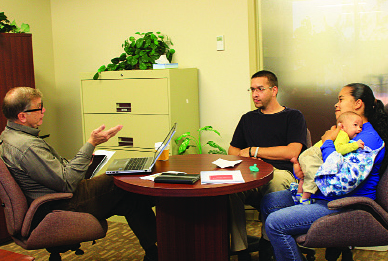
IBSA’s northwest church planting director, John Mattingly, talks with Edgar and Sonia Rodriguez, potential Chicago church planters.

Illinois Baptist church planters started 20 new congregations in 2015, an increase of 10 from last year’s number.

“We are very grateful to the Lord for the increased harvest of new churches this year,” said Van Kicklighter, associate executive director for IBSA’s Church Planting team. “At the same time, we feel the burden of knowing that 20 new church plants doesn’t begin to impact the huge number of people in Illinois who need to hear the gospel message.”

In October, Kicklighter and his team welcomed a group of potential church planters for an assessment event that will help determine their next steps in the planting process. Edgar Rodriguez, a candidate from Illinois, said the state’s diversity draws would-be planters.

“Not just in Chicago, but in [all of] Illinois…Individuals are coming in from all over the world, so I think it’s good ground for the gospel and leaders from various places in the world to be trained up and eventually be sent out.”

Thomas Clark wants to plant a new church in Chicago. “This is a place where souls are needing to be saved,” he said, noting that Christ’s blood can have an impact there. “There’s a lot of blood being shed in Chicago, but with the right blood, we can make a difference.”

Tim Swigart

Tim Swigart, who wants to plant churches in NW IL, preaches to a number of IBSA representatives.

New churches are needed outside Chicagoland too. Tim Swigart and his wife are Midwest natives and self-described “farm kids.” They’re exploring planting possibilities in Northwest Illinois, the state’s most unchurched region.

“The motif of ‘planting’ is an apt one in understanding why some years produce a large harvest of new churches and other years a smaller harvest,” Kicklighter said. “As in the parable of the sower, some seed falls on good soil while other seed falls on hard and rocky soil.

“We are seeking to increase the number of people and churches who are sowing in the mission fields of Illinois and the amount of gospel seed that is sown.”

Bryan Coble and his wife, Marci, are two potential “sowers” from Missouri. At the assessment event, Bryan said planters are drawn to Illinois not just to plant churches, but to “make disciples that will plant churches themselves.”

Local churches are key to more church plants, Kicklighter said. IBSA’s Church Planting team has implemented a pray-partner-plant strategy to engage more congregations in the planting process.

“This year the Lord has blessed our sowing and gave us an increased harvest,” Kicklighter said. “Some of this is a reflection of the work of our staff and some is the result of more praying, partnering, and planting churches.”

Nathan CarterCOMMENTARY | You are probably familiar with the term “multi-site” by now. Maybe your church has already gone to the model, or is considering it. Very simply put, multi-site refers to the concept of one church that meets in multiple locations. Twenty-five years ago, there were fewer than 25 such multi-site churches in North America. Today there are over 5,000! It is a relatively recent phenomenon, yet an increasingly popular strategy for reaching more people with the gospel.

Opening up another campus allows for growth that is usually quicker and more cost-effective than building bigger or sending people out to start something new. It is in many ways simpler and more streamlined. You don’t have to reinvent the wheel, but can keep the same name, logo, website, 501(c)3 status, support staff, etc. Resources can be shared more readily. You can be more certain that your own “DNA” is being replicated.

I understand the appeal and practical benefits. There are many Baptists whom I respect that have gladly joined the multi-site movement, motivated by a genuine desire to penetrate lostness. But I’ve always had a lingering doubt about whether this method is entirely consistent with our Baptist principles, particularly that of local church autonomy.

Now you may be wondering why I don’t pose the question as, “Is it biblical to be multi-site?” It is because I don’t have space to make a full argument from Scripture. I am assuming that we are all Baptists here. And I am assuming that we are Baptists because we believe it is biblical. We are solidly convinced the Bible teaches that baptism is to be administered to believers only. And we believe that “a New Testament church of the Lord Jesus Christ is an autonomous local congregation of baptized believers” (The Baptist Faith & Message 2000, Article VI). Our views about credobaptism and congregational ecclesiology are the principal reasons why we are Baptist, and not Methodist or Presbyterian.

But while they may remain firm on the practice of baptism, Baptist practitioners of the multi-site model appear willing to compromise the autonomy of the local assembly. Each distinct location is not allowed the responsibility to receive and dismiss its own pastors and members. There is limited leeway given to determine the best programs and strategies for evangelism and discipleship. In many ways, the satellite congregations are bound by the decisions coming out of central headquarters.

When it comes to organizational structure and leadership in a multi-site operation, there may be one single pastor over all the campuses, in which case you have a hierarchy. How is this different than having a bishop? Or there might be a representative group of elders overseeing all the campuses, in which case you then have a presbytery. It seems to me that while the language may be “one church in multiple locations,” what you really have is a small denomination.

There are potential dangers in any system, but with multi-site, the pull towards empire-building and a cult of personality is extremely strong. There is also a temptation to trust in a franchise brand instead of the power of the Word and Spirit.

I can see how in true revival circumstances where massive amounts of people are being converted at once, a temporary multi-site solution might be needed. But I would rather see this as church planting in slow motion.

What all this means is that the task of pastors is not just to do the work of an evangelist (2 Tim. 4:5), but also to commit what we know to faithful men who will be able to teach others also (2 Tim. 2:2). We must be committed to raising up leaders from within our churches who could do what we do and be released from our authority to start other churches as the need arises. Hopefully these churches would retain a similarity and organic connection, without control or formal structural unity.

A growing number of like-minded yet independent congregations freely choosing to associate and cooperate together in mission…that sounds more Baptist (and biblical) to me.

Nathan Carter is pastor of Immanuel Baptist Church in Chicago. This article first appeared in the Illinois Baptist. Read the latest issue online.

Chicago, IllinoisCOMMENTARY | While many college students were using summer break to relax and catch up on some much-needed sleep, one group of undergrads dedicated their downtime to proclaiming the name of Jesus throughout the city of Chicago, one of our country’s biggest mission fields.

The North American Mission Board started a program a few years ago called Generation Send. They identified 32 cities in great need of laborers and then sent students out to work in them. This past summer almost 400 youth showed 16 of these cities the love of Christ as they learned what it meant to live a life on mission in an urban context.

Students from Georgia, Texas, Louisiana, and Tennessee were excited to come and serve in the unique and diverse community of Chicago. They arrived at the beginning of the summer with few expectations for the coming months but to see Christ glorified.

Chicago contains 77 neighborhoods filled with people from across the world. It is the third largest city in the U.S., but less than 10 percent of the population is involved with an evangelical church. They are in desperate need of the gospel and for people to come and serve in the name of Christ.

Two of the student leaders through Generation Send, known as mobilizers, were returning to Chicago for the second summer in a row. They had become extremely burdened for the city and wanted to continue sharing that passion with others. Looking beyond all the glitz and the glamour, Chicago is still a place where people have real needs and individuals are desperately lacking gospel truth. Realizing this firsthand has a way of leaving an imprint on one’s heart.

Four mobilizers led teams of 3-10 people in four of the 77 Chicago neighborhoods. Students engaged business owners, college students, young professionals, different ethnic groups, families, and many others for the gospel.

Every week a Generation Send student would encounter someone who needed to hear God’s truth. And many times they were receptive to it. Less than halfway through the summer, students couldn’t bear the thought of going home and leaving these people behind.

In July when it was time to say goodbye, one team had the privilege of leaving Bibles with a Muslim family who owned a restaurant that they visited several times a week. Another team came alongside a church planter and his family and helped them prepare for their first Sunday preview service. In a matter of only six weeks, these students from Georgia, Texas, Louisiana, and Tennessee were completely broken for this place that desperately needs Jesus.

One mobilizer has now made the commitment to move to Chicago. In September she will move from her quiet, small town in Louisiana to the chaos of the Windy City, all to further the gospel. Another student is also praying about becoming a church planter there in the coming years. Many others have already committed to bringing teams back next summer and will continue to pray for Chicago throughout the year.

All throughout scripture we see God’s people burdened for cities that were in need of Him. In the book of Nehemiah we encounter a man who asked his King to return to Jerusalem, a city he once called home. He was so burdened for the people of Israel and for the city of Jerusalem that he wanted to make new again what was destroyed. The task was not easy and the burden was not light, but he was determined to obey and honor what God had called him to do.

This theme of being burdened for God’s cities continues today. God is calling his people back into the cities so that the gospel may go forth. Cities are considered the heart of our country and we need the people who live in them to have repentant hearts and put their faith in Jesus Christ. Please pray for Chicago and for students preparing to join the mission field there.

And he said to them, “The harvest is plentiful, but the laborers are few. Therefore pray earnestly to the Lord of the harvest to send out laborers into his harvest” Luke 10:2 (ESV).

Carrie Campbell is a teacher in Beardstown. She has served as coordinator for NAMB’s Generation Send summer missions program in Chicago for two years.

This is the Week of Prayer for the Mission Illinois Offering. Pray for our missionaries and that we will reach the $475,000 statewide offering goal.

Giving to the Mission Illinois Offering aids in the continued health and strength of local churches right here in our own state.

This offering supports the salaries of church planters, missionaries, and leadership trainers. It supports campus ministries and reaching the thousands of Illinois college students. It provides ministry supplies, equipping for church leaders, and the mobilization of mission volunteers. But overall, it supports the goal of living out the Great Commission and carrying the gospel to those in Illinois who are lost.

Pray: As Illinois Baptist churches collect the offering this week, pray that hearts will be moved to give.

Pray that God will prompt people to be generous with their resources and that each congregation will reach its goal. Pray that the overall state goal will also be exceeded. And pray about your own financial commitment, that God will reveal how he is calling you personally to support state missions through the Mission Illinois Offering.

Take time to pray today

Mission Illinois Offering: The Week of Prayer

Learn more about the Mission Illinois Offering at IBSA.org/mio. #mio2015

This is the Week of Prayer for the Mission Illinois Offering. Pray for our missionaries and that we will reach the $475,000 statewide offering goal.

Nearly one out of every seven Illinois residents is an immigrant to the United States. Nowhere is cultural diversity more evident than in Chicagoland: 53% Anglo, 22% Hispanic, 18% African American and 7% Asian/ Pacific Islander.

The metro area is also home to a large number of second-generation churches and church plants—congregations reaching out to the children of immigrants.

Pray: For John Yi, an IBSA church planting catalyst in Chicago, as he works with second generation churches who are doing the challenging work of sharing the gospel across cultural boundaries.

Pray also for church planters working to start congregations to reach the state’s numerous people groups, from Effingham, where Tony Munoz helps start new churches among the Hispanic population, to Chicagoland, where planters including Eric Aidoo (Bolingbrook), Cody Lorance (Aurora) and Zhenjun Wang (Clarendon Hills) seek to reach West Africans and East Asians.

Take time to pray today

Mission Illinois Offering – Real Church, Real Faith

Learn more about the Mission Illinois Offering at IBSA.org/mio. #mio2015

This is the Week of Prayer for the Mission Illinois Offering. Pray for our missionaries and that we will reach the $475,000 statewide offering goal.

The spiritual need is great in Metro Chicago, home to 10 million people and only one Southern Baptist church for every 35,105 residents. Let the church-to-people ratio prompt you to pray fervently and frequently for those in the city and suburbs who have never experienced God’s love and the saving power of Jesus Christ.

Pray: Ask God to guide IBSA staff members who are facilitating church planting in Chicagoland: Dennis Conner, Tim Bailey, Edward Jones, and Jorge Melendez. Pray specifically that the seeds planted during this summer’s ChicaGO Week would continue to grow, and that leaders in the city would find favor with their neighbors, schools, and local officials.

Take time to pray today

Mission Illinois Offering – Chicago: Christ is Needed Here


Learn more about the Mission Illinois Offering at IBSA.org/mio. #mio2015

This is the Week of Prayer for the Mission Illinois Offering. Pray for our missionaries and that we will reach the $475,000 statewide offering goal.

Our Illinois mission field is broad, diverse, exciting…and sometimes daunting. The state is a temporary home to 925,000 college students, some who have never heard the gospel. Pray for campus ministers and their volunteer teams as they work to make a difference in the lives of students.

Pray: For Chet Cantrell as he influences elementary and high school students at the Christian Activity Center in East St. Louis, where more than 50% of households are below the poverty level and the CAC’s after-school program serves as a safe haven for hundreds of kids.

IBSA staff members help churches realize their missions potential, even when it takes them outside the state. Remember Carmen Halsey as she works with congregations on women’s ministry and missions, and Bob Elmore as he facilitates short-term mission trips to countries like Haiti, Jamaica and Guatemala.

Take time to pray today


Mission Illinois Offering – Our Big Mission Field


Learn more about the Mission Illinois Offering at IBSA.org/mio. #mio2015

Mission Illinois OfferingA pastor recently wrote to IBSA Executive Director Nate Adams to ask a couple of questions about the state missions offering. The questions were excellent and so were the answers. We think they may help you as you explain to your congregation why we support the Mission Illinois Offering.

1. If you were here at our church during the Mission Illinois Offering season, what one thing would you tell us about MIO?

100% of the Mission Illinois Offering stays here in Illinois to focus on the evangelistic strengthening and starting of churches here in our home state. Right now there are around 80 new churches in Illinois in some stage of getting started, with about 25 new churches being planted each year.

Your Mission Illinois Offering allows us to nurture and help establish these churches, along with more than 750 existing churches whose leaders our staff helps train and strengthen each year, in areas ranging from evangelism and discipleship to Vacation Bible School, Worship & Technology, children’s ministry, and leadership development.

We also help churches navigate transitions and challenges, such as finding new pastors and addressing legal and financial challenges. As a result, together those churches baptize almost 5,000 new believers each year.

2. What makes the Mission Illinois Offering unique from Cooperative Program giving to the Illinois Baptist State Association? What special thing does it do?

The Mission Illinois Offering really supports all that we do as cooperating Illinois Baptists, as does the Cooperative Program. But with funding from the North American Mission Board shifting almost exclusively to church planting in the major cities, the MIO enables us to continue supporting ministries in Illinois that NAMB has moved away from.

For example, the Christian Activity Center in East St. Louis, collegiate ministry on 30 college campuses in Illinois, Women’s Ministry and Missions, including Illinois WMU, and Missions Mobilization staff that plan and assist Illinois Baptists in multiple mission trips and experiences each year.

The Mission Illinois Offering helps us focus on missions and ministries that are unique and important to Illinois Baptists, even if those are not priorities of the national SBC entities.

The Week of Prayer for the Mission Illinois Offering is Sept. 13-20. Resources are available at IBSA.org/mio.

Why Mission Illinois?

Lisa Misner —  September 7, 2015

COMMENTARY | As a state association of almost a thousand churches, we challenge one another every year to give a special offering in support of the Great Commission task we share here in Illinois. While September is the focused time for emphasizing the Mission Illinois Offering, churches or individuals can give at any time during the year.

But if you’re like me, someone appeals to you every month, perhaps every day, to give to a different need or cause. How do you decide what to prioritize in your giving? What deserves your most loyal and generous support? Let me share what I try to communicate consistently about why I give generously to the Mission Illinois Offering, and why I urge others to do the same.

  • First, I want my giving to be focused on delivering the Gospel.
  • Second, I want my giving to prioritize the work of local churches.
  • Third, I want my giving to partner with those who believe and teach Baptist doctrine.
  • Fourth, I want my giving to be entrusted to people and organizations that are both effective and accountable.

Nate Adams

Frankly, the Mission Illinois Offering gives me one of the best, most trustworthy channels available for meeting all four of those criteria. Here’s why I prioritize it in my own personal stewardship:

The MIO is focused on delivering the Gospel. Each year, more than 300 IBSA churches receive customized training in evangelism, and many others receive resources or financial assistance with evangelistic events. In addition, more than 80 evangelistic church plants are currently underway in Illinois, about 25 being started each year, each one pressing the Gospel into urban neighborhoods or unreached communities and seeing new people come to faith in Christ. Our shared missionary efforts on college campuses or through urban ministries like the Christian Activity Center all deliver the Gospel as their top priority.

The MIO prioritizes the work of local churches. There are many good parachurch organizations and charities that are doing many good things, and I personally support some of those. But I believe that God’s primary, enduring channel for delivering the Gospel and making disciples is the body of Christ expressed in local, New Testament churches. The MIO helps deliver direct assistance and encouragement to local churches through training, consultation, conflict resolution, and countless other resources designed to strengthen local churches into greater effectiveness.

The MIO partners with those who believe and teach Baptist doctrine. In addition to parachurch groups, I believe there are many other churches, especially evangelicals, who are also advancing the Gospel and making disciples. If resources were unlimited, I would probably support them all!  But I want to reserve my most generous missions giving for the efforts of missionaries and church planters and pastors and churches who understand and teach the Bible and at least its broad doctrines consistently with Southern Baptists around the world and across the generations.

And finally, the MIO is entrusted to those who are both effective and accountable. Every year Illinois Baptist churches elect boards and committees that oversee the work of IBSA. Devoted staff members are employed to work hard at the above priorities, and to deliver detailed, public reports of the results, the finances, and the continued needs of our cooperative work advancing the Gospel. I can always know how my MIO dollar is invested and what results it is producing.

Illinois is a flat state geographically, but the task of advancing the Gospel and establishing effective Baptist churches here is often a steep, uphill climb. It’s only possible through the sacrificial, cooperative giving of Baptist people in Baptist churches. I hope the above answers to the question, “Why Mission Illinois?” will give you the same strong motivation I have again this year to give generously through the Mission Illinois Offering.

(If your church does not collect a formal Mission Illinois Offering, you can still contribute directly by going to www.ibsa.org and clicking on the “donate” tab. Or mail your gift labeled “MIO” directly to IBSA at 3085 Stevenson Dr., Springfield, IL 62703.)

Nate Adams is executive director of the Illinois Baptist State Association. Respond to his column at IllinoisBaptist@IBSA.org.