The Briefing

IBDR flood response teams activated
The heavy rains that fell in late April and early May leaving behind several inches rain have caused major flooding in Southern Illinois and the St. Louis Metro area. Illinois Baptist Disaster Relief (IBDR) has been monitoring the situation and called assessors. Now, multiple IBDR flood response teams are on the ground in Williamson and Franklin Counties in Illinois.

Samford U considers pro-LGBT student group
A recommendation by Samford University’s faculty to approve a pro-homosexual student group could have “serious implications … for the relationship” between the university and the Alabama Baptist State Convention, according to a joint statement by the convention’s president and the executive director of its State Board of Missions.

Americans view of morality studied
Most older Americans say right and wrong never change. Younger Americans — not so much, according to a new study released May 9. The study by LifeWay Research found a significant generation gap in how Americans view morality. More than 6 in 10 of those older than 45 say right and wrong do not change. For those 35 and younger, fewer than 4 in 10 make that claim.

Religious liberty order doesn’t answer evangelicals’ prayers
In his biggest religious liberty push since taking office, President Donald Trump officially laid out in an executive order some of the protections he has promised faithful supporters for months. The move came on the same day that evangelical leaders gathered in Washington for the annual National Day of Prayer. One problem: This is not the executive order many evangelicals had been praying for.

Army secretary nominee bows out over marriage views
President Donald Trump’s nominee to be secretary of the Army has withdrawn from consideration amid criticism of his positions on marriage and gender. Mark Green, a state senator from Tennessee, said in a statement that false and misleading attacks against him made his nomination a distraction.

Sources: Illinois Baptist, Florida Baptist Witness, Baptist Press, Christianity Today, World Magazine

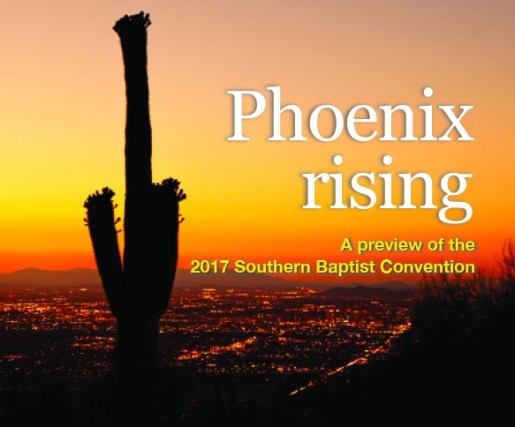
Phoenix rising

When Baptists gather in Phoenix next month, they’ll address the challenges of taking the gospel to a world that seems less inclined to hear the message, and doing so with fewer resources to get the job done.

Messengers to the Southern Baptist Convention June 13-14 will also meet against a very different political backdrop than a year ago, and could contend with the fallout of recent debate fueled by a raucous and divisive U.S. presidential election.

Or not.

Recent calls for Convention-wide unity—and similar statements by SBC leaders—could rule the day in Phoenix, where Baptists will focus on prayer, evangelism, and financial stewardship, said SBC President Steve Gaines.

“I believe Southern Baptists can be used of God to spark a mighty movement of prayer, evangelism, and discipleship across our nation and around the world,” said Gaines, pastor of Bellevue Baptist Church in metro Memphis, Tenn., in announcing the meeting’s theme. “Pray! For such a time as this” is based on Luke 18:1 and Esther 4:14.

“If we will pray and abandon ourselves to the Lord, he will use us exponentially to take the gospel to people,” Gaines said.
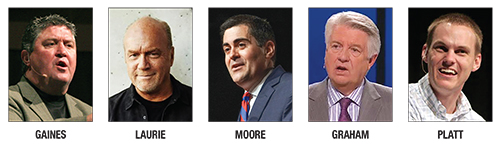
SBC personalities

Similar to the previous few annual meetings, Gaines said the 2017 gathering will include seasons of prayer, as well as a personal evangelism emphasis on Tuesday evening led by Greg Laurie.

The California evangelist also will lead a Harvest Crusade Sunday, June 11, as part of the annual Crossover evangelistic effort that precedes the Southern Baptist Convention (see Nate Adams’s column on page 2 for more information). Organizers say the event at University of Phoenix Stadium, which holds 65,000 people, promises to be the largest single gospel presentation in Arizona history.

Focus on stewardship
Following the example of previous annual meetings, the gathering in Phoenix will include a panel discussion with SBC leaders. This year’s topic: financial stewardship.

Gaines told Baptist Press Southern Baptist churches cannot give more to SBC missions and ministries than church members give through their local congregations.

“The solution for increased funding for world missions begins in the heart of every individual believer in Christ,” he said. “Southern Baptists need to get our financial houses in order.

The Cooperative Program—Southern Baptists’ unified giving channel for supporting missions and ministry around the world—is likely to be a topic of conversation in Phoenix as well. In February, Prestonwood Baptist Church in Plano, Texas, pastored by former SBC President Jack Graham, announced they would temporarily escrow their CP giving because of positions taken by the Ethics and Religious Liberty Commission.

ERLC President Russell Moore, a vocal critic of now-President Donald Trump during the campaign, has apologized for comments that seemed directed at all evangelicals who supported Trump, and the ERLC’s executive board released a statement in April pledging their support for Moore. The statement also called for unity in the SBC despite differences, a sentiment echoed by Gaines.

“I believe all of us who are recipients of grace and forgiveness should grant him the same forgiveness that we desire from the Lord,” Gaines said after Moore and the ERLC executive board released the statement. “It is high time that we put all of this behind us….It is time to move ahead and work together to double our efforts to take the gospel to our nation and the nations.”

If the recent controversy surrounding the ERLC does make an appearance at the SBC, it could be in the form of a motion from the floor, or during the Q&A time following Moore’s report, which is the final item on the meeting schedule. International Mission Board President David Platt could also face questions about the IMB’s support of a Muslim group’s fight to build a mosque in New Jersey. (Like the ERLC, the IMB also signed on to a friend of the court brief in support of the group.)

In February, Platt apologized for how “distracting and divisive” the brief was, and pledged that in the future, the IMB “will have a process in place to keep us focused on our primary mission.” Still, the mosque debate could spark a religious liberty conversation in Phoenix, as could President Trump’s controversial travel ban for people from some majority Muslim countries into the U.S.

Online pre-registration for the Phoenix meeting is now open at sbcannualmeeting/sbc17. Messengers and guests are required to be registered and properly badged in order to enter the general sessions June 13-14.

For more information about the Southern Baptist Convention’s June meeting in Phoenix, go to sbcannualmeeting.net.

– With info from Baptist Press

Trump-religious-liberty-EO

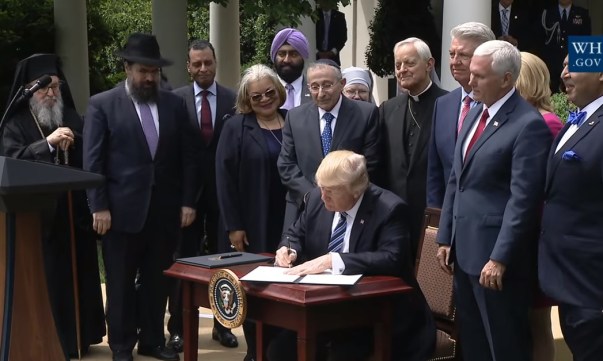
President Donald Trump signed an executive order to protect faith beliefs and practice in a ceremony May 4. Screen capture from WhiteHouse.gov. Courtesy Baptist Press

On May 4 – The National Day of Prayer – President Donald Trump, signed an executive order promising to provide churches, non-profit organizations, and Christian-owned business greater religious liberty. Reaction among Christians, especially evangelicals has been mixed. Here’s a round-up of some of those reactions:

Baptists cautious on Trump executive order
Russell Moore, president of the Southern Baptist Ethics & Religious Liberty Commission, said, “After years of open hostility toward religious institutions and conscience from the previous administration, this executive order is a welcome change in direction toward people of faith from the White House. Not only that, but many federal agencies are working already to ensure that the executive and administrative violations of religious freedom from the Obama administration are being rolled back.” Read more from Moore and other Southern Baptists.

Concern Trump’s order doesn’t address key issues
Some evangelical voices, like Ryan Anderson of the Heritage Foundation; David French, a lawyer and writer at National Review; and Gregory Baylor with Alliance Defending Freedom had critical words for the president’s religious liberty executive order. They called the order woefully inadequate, weak, and a promise unfulfilled.

What Trump understands about religious liberty in America
There is a war on religious liberty in America – and this war is targeting people of the Christian faith. An Army of militant atheists and LGBT activists are hell-bent on eradicating Christianity from the public marketplace and punishing Christians who follow the teachings of Christ. That’s why President Trump signed an executive order on religious liberty Thursday in the Rose Garden – to protect Americans who have been targeted by a politically correct lynch mob.

Reaction mixed on order targeting birth control, churches, politics
Trump’s executive order targeted the Johnson Amendment, a provision of tax law which prohibits churches from getting directly involved in political campaigns. But it stopped short of his vow to “totally destroy” the amendment, instead instructing the Internal Revenue Service to enforce the law consistent with how it’s done so in the past — allowing speech on political and moral issues as long as it doesn’t advocate the election or defeat of a particular candidate.

Analysis: Trump order unlikely to alter sermonizing
Many Americans want religious leaders to be clear about their values and how those values impact every aspect of life, including politics. And they want churches to be free to practice their faith, which includes discussing politics without any government intervention. But few want their preacher’s advice on which candidate to vote for.

Sources: Baptist Press, World Magazine, Fox News, USA Today, Baptist Press

Michael Allen

In a complete revamp from any year in memory, the 2017 Southern Baptist Pastors’ Conference features pastors of average-sized SBC churches who will preach through one book of the Bible—Paul’s letter to the Philippians.

Michael Allen, pastor of Uptown Baptist Church in Chicago and a former president of IBSA’s Pastors’ Conference, is one of 12 pastors who will take the stage in Phoenix June 11-12. The group also includes David Choi, pastor of Chicago’s Church of the Beloved.

Allen spoke with the Illinois Baptist about his upcoming message and what pastors like him contribute to the SBC family:

Q: What passage will you preach in Phoenix?

A: I’ll be preaching Philippians 3:17-21. This passage gives us a reminder of our citizenship in heaven, and helps the church distinguish itself from the world in how we think, act, and live. And then it also reminds us that it is the resurrection power of Christ that changes us both inside and out.

Q: What do you think is unique about what smaller or average-sized churches (and their pastors) add to SBC life?

A: The conference choice of pastors who lead small and medium-sized churches helps the conference attendees better identify and relate to guys just like them. We know that most churches in America, regardless of denomination, are small (less than 100). It also highlights the fact that pastors of smaller churches can effectively handle the Word of God, even in big venues. The Scriptures remind us not to “despise small beginnings” (Zech. 4:10).

Q: The conference this year also is focused on diversity. In your opinion, what is the value of hearing from pastors of different ethnicities and backgrounds?

A: We all have a unique cultural background which colors how we see and experience life. Culture also is a lens through which we see and interpret God’s Word and God himself. So hearing from ethnically diverse preachers in our convention enriches us all, because God made us different and his intentions are that we learn from and complement each other.

Q: You represent both the Midwest and one of the country’s largest cities. What about your ministry experience in Chicago do you want the larger SBC family to hear and understand?

A: The SBC family needs to understand that the world continues to move into ever-growing metropolitan cities, making them more and more diverse—ethnically, socio-economically, religiously, and every other measurement of diversity. Therefore, we have a great opportunity to win the world to Christ without ever boarding a plane.

At the same time [increasing diversity] makes ministry more complex, and more resources are needed to do ministry here. Whatever strategy the International Mission Board is using to reach the world for Christ can and should be prayerfully considered to be employed in America’s rich and diverse urban centers. IMB and the North American Mission Board ought to continue to seek ways they can collaborate with each other for the glory of God in the salvation of souls.

The primary group of preachers at the Pastors’ Conference will be joined by four pastors who will give testimonies of how their lives and ministries have benefited from smaller membership churches:

  • SBC President Steve Gaines, pastor of Bellevue Baptist Church, Memphis
  • J.D. Greear, pastor of The Summit Church, Raleigh-Durham, N.C.
  • Johnny Hunt, pastor of First Baptist Church, Woodstock, Ga., and former SBC president
  • Fred Luter, pastor of Franklin Avenue Baptist Church, New Orleans, and former SBC president

For more information on the Pastors’ Conference, including a full schedule, go to sbcannualmeeting.net.

The Briefing

Christian nation no more?
Most Americans do not believe America is a Christian nation today, even if many say it was in the past. About one-third (35%) of the American public believes the U.S. was a Christian nation in the past and is still a Christian nation today; close to half (45%) say the U.S. was once a Christian nation but no longer remains so; and 14% say the U.S. has never been a Christian nation.

SWBTS apologizes for photo
Paige Patterson, the president of Southwestern Baptist Theological Seminary, apologized for a photo of white professors posing as rappers that appeared on Twitter and was instantly deemed racist. The photo featured senior School of Preaching faculty members gesturing and wearing bandannas and chains and was labeled “Notorious S.O.P.” One of them appears to hold a handgun.

Cedarville’s Philippians 4:8 rule
This spring, Cedarville University enacted new curriculum guidelines inspired by Philippians 4:8 and aimed at purifying coursework of erotic and graphic content. The university has spelled out new guidelines officially barring any materials that “may be considered ‘adult’ in nature, that represent immorality, or that may be a stumbling block to students.”

Religious freedom dying in Russia
Russia’s nationwide outlaw of Jehovah’s Witnesses will likely ricochet and strike other religions outside of Russian Orthodoxy there, said Donald Ossewaarde, an independent Baptist missionary forced to shut down his church in that country. He has exhausted his appeals on an August 2016 conviction of operating a church without a permit under the 2016 anti-religion Yarovaya Law. Ossewaarde, who is making plans to return May 8 to his home in Elgin, Ill., said every religion outside Russian Orthodoxy is considered a cult.

Students: Biblical views on sex ‘unChrist-like’
A student club at Seattle Pacific University recently protested against the Christian university because it adheres to biblical views on human sexuality and gender identity.  The club, called SPU Haven, which advocates for gay students, claims that the university’s “Statement on Human Sexuality” is “unethical, unscientific and unChrist-like,” according to College Fix.

Sources: Facts and Trends, Religion News, Christianity Today, Baptist Press, The Christian Post

Nate Adams IBSA exterior

Nate Adams

In just a few weeks, thousands of church messengers will gather in Phoenix for the annual Southern Baptist Convention and its many related events and opportunities. Last year’s St. Louis convention drew 533 messengers from Illinois, our state’s largest representation since 2002. Only host state Missouri and nearby Tennessee sent more messengers, and I believe Illinois Baptists’ strong showing gave us a stronger than usual voice in the national convention.

It would be great to have as many Illinois messengers as possible in Phoenix, but if history is any indicator, distance and travel expense will reduce our numbers significantly. Even if you can’t travel that far west this year, let me share a couple of ways you can stay engaged with the larger SBC from right here in Illinois.

First, the convention itself and some related events will be live streamed via the Internet, providing a front row seat from your computer screen. Our IBSA communications staff will also be there, uploading the latest happenings to IBSA.org and giving you an Illinois perspective on news coming out of the convention.

You and your church can also participate in the evangelistic efforts that surround this year’s Southern Baptist Convention, and in a way that reaches out not only to Phoenix, but to your community as well. This year the SBC is partnering with evangelist Greg Laurie to bring the Harvest America Crusade to the University of Phoenix Stadium on Sunday evening, June 11.

In Phoenix or from Illinois, you can help share the gospel with half a million people.

While an estimated 65,000 people will gather in the stadium that night, the Harvest Crusade hopes to invite as many as 500,000 viewers through multiple simulcast locations, such as our churches and homes right here in Illinois. In a similar Harvest America Crusade in Texas last year, more than 24,000 people made professions of faith in Christ, many of them at the remote simulcast sites.

Might this Harvest America Crusade be something that your church would consider hosting on June 11, as a way of inviting your community to hear the gospel message, and participate in potentially one of the largest evangelistic events in American history? Or perhaps you would consider hosting a small group in your home, and using it as a conversation starter with friends for whom you have been praying.

Pat Pajak, IBSA’s associate executive director of evangelism, is already in communication with dozens of pastors and evangelism leaders across Illinois, asking them to consider hosting a simulcast location. If you would like information on being a host site on June 11, you can contact Pat directly at PatPajak@IBSA.org or (217) 391-3129.

It’s amazing to me that technology and a little planning and cooperation among Christians and churches can make it possible for a half million people to hear the gospel message at the same time. It also reminds me that we could do so much more to spread the good news about Jesus if we would leverage these same things more consistently in our churches.

For example, does your church have young people that could help you use social media more effectively in reaching your community, and beyond? Are there tech-savvy folks sitting in the back rows of your auditorium that could be invited to the front rows of service?

We can stay here in Illinois and yet engage the larger Baptist family as it gathers in Phoenix. We can stay in our churches or homes and yet be part of sharing the gospel with a half million people at once. And we can stay at our computer screens and help our church reach people in new ways through technology. Aren’t these amazing days, when God has given us the ability to go, even when we stay?

Nate Adams is executive director of the Illinois Baptist State Association. Respond at IllinoisBaptist@IBSA.org.

Exterior of a building with Education engraved in stone

I hadn’t intended college to be a particularly eye-opening experience. I was excited about my newfound freedom and interesting classes and those deep friendships everyone always talked about, but I was going someplace where I thought all those things would happen in the context of familiarity. My Southern Baptist college had felt like home during my first on-campus visit—that was what drew me there in the first place.

But at the start of my second semester, I sat with my Bible on the roof of the gymnasium (where the serious scholars went to study all night), wondering whether the loneliness and uncertainty I felt meant I had made the wrong decision in coming to a place six hours from home. Those good college things—the classes and the friends and the football games and the freedom—had all happened. But instead of feeling fulfilled, I was left with a bigger question, one that I now know most people that age, particularly younger Christians, probably face at one time or another: Who am I going to be?

I met people my own age who pushed me to a deeper investigation of what it means to be a Christian, no matter what job I would eventually choose.

A few years later when I graduated, I was glad I had been at that small college six hours from home as I tried to answer that big question. Because it was there that I found people with the knowledge, experience, and empathy to help young people navigate that tricky territory between the familiar and the future. Here are three things I still value about my Christian college experience:

1. A deeper faith identity. Raised in a minister’s home, I thought I had Christianity figured out (and, at 18, probably most everything else too). That’s why it was surprising, then convicting, to find other people my age who knew much more and felt much more about the call of Jesus on their lives than I did. And these weren’t just the kids that had committed to career ministry or missions—these were everyday students studying to be dentists, attorneys, and counselors. But they seemed to understand that the responsibility of a Christian to be, well, a Christian, extended far beyond one’s future vocation. They lived their faith in a way I wanted to, and their example pushed me to a deeper investigation of what it meant to be actually be a believer in Christ, no matter what job I would eventually choose.

2. Challenging, trustworthy professors. My first class on my first day of college was Old Testament Survey, taught by a young professor who would present four or five different theories about a difficult text and then say something like: “That’s what some people think. Here’s what I think.” Usually, his opinion was similar to one that he had presented. But by giving us the breadth of knowledge on a particular topic, he showed us young Bible scholars that it’s OK to wrestle with Scripture. At the same time, his daily, trustworthy counsel through the Bible gave us an anchor to come back to amid the multiple interpretations offered by the outside world.

3. Unrequired opportunities. Like many high school youth group kids, I started going to church because my parents drove me there, and I kept going because I had always gone. But in college, I didn’t have to be anywhere. Tuesday night Bible study wasn’t a necessity; neither was a Saturday mission project in our neighboring city. Learning to commit to things that weren’t required drove me to deeper discipline about how I spent my energy and time. The ministry activities that are most valuable, I learned in college, are the ones that root themselves in your mind and heart so that you are compelled to take part, even if no one would miss you if you weren’t there.

After I graduated, I moved to the Midwest to attend graduate school at a large state university. It was certainly different than where I had been. And that’s one more reason I’m grateful for my college experience: The foundation that God, through wise professors and leaders, had begun to lay for me carried me through the challenges of a truly unfamiliar place. And has continued to do so, all these years later.

– Meredith Flynn

The Briefing

W.V. Bible class faces legal challenge
For decades Mercer County’s public schools have offered a weekly Bible class during the school day — 30 minutes at the elementary level and 45 minutes in middle school. The program is not mandatory, but almost every child in the district attends. And there is widespread support for the classes: Parents and community members help raise nearly $500,000 a year to pay for the Bible in the Schools program. Now, two county residents with school-age children argue in a lawsuit that the program violates the establishment clause of the First Amendment and the West Virginia constitution.

Baptist Baylor picks first female president
Linda Livingstone succeeds Baylor University’s first non-Baptist president, Kenneth Starr, who was fired last year over the Texas institution’s bungled response to ongoing reports of rape on campus. Livingstone, a former faculty member of Baylor and Pepperdine University, leaves her position as business school dean at George Washington University to become the Waco school’s first female president in its 172-year history.

Porn deemed public health crisis in 5 states
At least five states have officially declared pornography a public health crisis or harmful to the public, and at least one other is considering a similar measure, according to bill updates filed on state legislature websites.

Saudi Arabia elected to UN women’s rights commission
Saudi Arabia was elected to the United Nations Commission on the Status of Women. The addition of the Gulf nation was first flagged by UN Watch, a nongovernmental body that monitors the United Nations. The Commission on the Status of Women’s executive director slammed the election. “Electing Saudi Arabia to protect women’s rights is like making an arsonist into the town fire chief,” Hillel Neuer said.

‘John 3:16’ NFL suicide mystery
It wasn’t a suicide note that former NFL star Aaron Hernandez left in his prison cell when he reportedly hanged himself. Instead, the Massachusetts corrections officers who discovered his body Wednesday morning saw “John 3:16” written across Hernandez’s forehead in red ink. A Bible in the cell lay open to the same verse.

Sources: Washington Post, Christianity Today, Baptist Press, The Hill, STL Today

Exterior of Modern Church with Large Cross

A bill in the Illinois Senate that would have required pastors to take state-regulated classes in child protection raises important questions: Shouldn’t pastors do all they can to protect children, one colleague asked. Yes, obviously, but at what risk to religious communities’ First Amendment rights?

And, as important is this question: Why aren’t clergy engaging in stronger self-policing using a mechanism most already have in place, the ministerial code of ethics?

Sen. Melinda Bush of Lake County withdrew the bill last week, after objections from pastors on First Amendment grounds: If the state requires pastors to receive certification in this well-intended and altruistic concern, then what’s next? There aren’t many steps from this bill to government licensure of clergy and churches. “Won’t somebody please think of the children!” isn’t a sufficient argument to allow government regulation of pastoral work.

And, there’s a better way.

As a seminary student, I was required to write for myself a ministerial code of ethics. I studied a dozen examples and came up with a list of biblical and ethical ways for dealing with people, issues, and sticky situations.

A year or two later, I was the grader for that class, and I read scores of codes of ethics submitted by students. Most of these aspiring pastors took the assignment seriously, considering how they should handle counseling and confidentiality, reporting of abuse or neglect, the pastor’s relationship to the law and enforcement agencies. Some addressed euthanasia, and a few spoke to sexual identity and relationship issues just entering public discourse at the time.

Some of these students laid a good foundation for engaging and regulating their future work, so when hard questions arose, they already had biblical ways of processing the issues not based on emotion and reaction.

A good ministerial code of ethics guides pastors in their ministry to children and families in jeopardy. It requires that pastors stay up-to-date on the issues and the law. Through such personally adopted codes, pastors police themselves. They may join in voluntary association with other clergy in their enforcement.

Our Baptist polity—respecting the autonomy of the local church—doesn’t allow the denomination to enforce rules on pastors. Neither does the U. S. Constitution. That’s why we must take responsibility to govern ourselves.

For the sake of the children.

– Eric Reed

Judge Neil Gorsuch

Supreme Court Justice Neil Gorsuch

New Supreme Court Justice Neil Gorsuch continued his first week on the bench with what many Court watchers have said could be the most important case of this term. The justices heard oral arguments April 19 on “the Playground Case,” which involves a church-owned preschool’s fight to participate in a state grant program.

Trinity Lutheran Church in Columbia, Mo., sued the state after its preschool was denied participation in a program that funds safer recreation spaces for kids. (Trinity’s playground is gravel, but operators wanted to replace it with a rubberized surface made from recycled tires.)

The preschool was denied funding, even though it ranked fifth out of 44 applicants, and 14 of those applicants received grants the year the school applied, USA Today reported. At issue is a Missouri provision that prohibits religious institutions from receiving public money.

But multiple media outlets reported that opening arguments before the Supreme Court favored the Missouri church, with even some liberal-leaning justices appearing to side with the preschool’s right to participate in the program.

According to USA Today, concerns raised by Justices Elena Kagan and Stephen Breyer during the oral arguments could result in a 7-2 decision (should conservatives John Roberts, Anthony Kennedy, Clarence Thomas, Samuel Alito, and Neil Gorsuch move in the expected direction). However, the newspaper reported, the Court will perhaps rule “on narrow grounds, so as not to set a broad, nationwide precedent on public funding for religious institutions.”

It’s also possible that the Court could rule the case moot, since Missouri Governor Eric Greitens recently instructed the state’s Department of Natural Resources to allow churches to apply for and receive funding from state grant programs.

Prior to Tuesday’s arguments, the case was thought to be an issue on which Gorsuch would help shift the Court toward the school’s side. The former appellate judge previously ruled in favor of Hobby Lobby in the company’s fight over the Affordable Care Act’s requirement that corporations cover birth control—including drugs such as Plan B and Ella—in their employee health care plans.

The Playground Case has been in a holding pattern for more than a year since the death of Justice Antonin Scalia, and a subsequent Senate hold on former President Barack Obama’s Supreme Court nominee, left the Court with only eight justices.