Archives For November 30, 1999

“To God be the Glory! Great things He has done! Thank you, I love you.” – SBC President Fred Luter on his election.

“To God be the Glory! Great things He has done! Thank you, I love you.” – SBC President Fred Luter on his election.

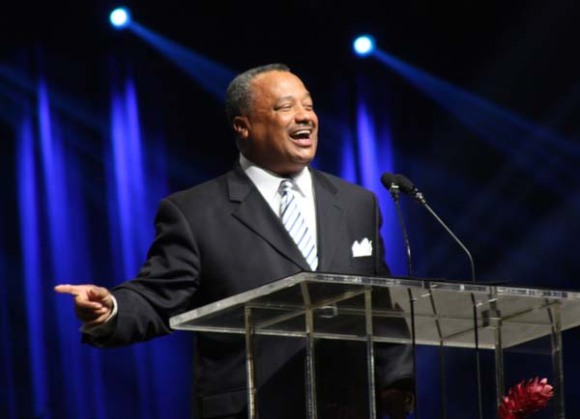
The face of the Southern Baptist Convention has changed. He’s African American, the first minority president in the denomination’s 167-year history. More important, given the challenges before him, he’s smiling. 

 Fred Luter was elected by acclamation at the annual meeting in New Orleans on June 19. He ran for the presidency of the 16-million member convention unopposed.

The denomination that was born out of a break between slave-owning Baptists in the South and northern abolitionists finished the repudiation of racism begun 16 years earlier by naming the New Orleans native, a pastor known for fiery preaching, effective leadership, and a winsome ability to work across cultural lines, as its first black president. 

“God has given me a gift in building bridges through the years, and my prayer is that, someway, somehow, I can get groups on this end [and] groups on this end…and meet together,” Luter said after his election. His diplomatic strategy, joy. 

“I love to laugh,” he told a reporter. “I love to have a good time.”

This joy in the face of adversity has seen Luter through difficult tasks before, including rebuilding Franklin Avenue Baptist Church, a large congregation decimated by Hurricane Katrina in 2005. “If anybody has joy, if anybody has peace and happiness, it should be us,” he said, referring to Christians. 

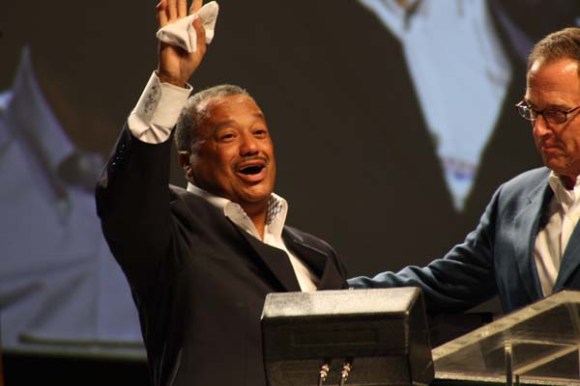
Because no other candidate ran against Luter, the convention recording secretary came to the microphone to cast the official ballot of the entire convention for Luter, but outgoing president Bryant Wright welcomed messengers to participate in the historic moment by raising their own ballots.

They did. 

And approximately 8,000 people stood to their feet for several minutes of clapping and cheering and, for many, weeping “That was such a wonderful and historic moment …. I was moved to tears of joy as were the African-American pastors I was sitting with,” said Michael Allen, pastor of Uptown Baptist Church in Chicago.   

As Bryant brought Luter to the platform on a wave of adulation, it was evident this was everyone’s decision. Now the question looms, can Luter ride this wave to bring lasting change in the denomination that faces declining membership and offerings, and the need for broader appeal in an increasingly diverse American culture. 

“I think he’ll do a great job, and I think he’ll work at trying to build up the Kingdom of God through the Southern Baptist Convention,” said Marvin Parker, pastor of Broadview Missionary Baptist Church, a large mostly African-American congregation in metro Chicago. “I expect there to be a greater outreach winning souls for Christ, I really expect a great increase because I think he’ll attract more folks with his style of preaching and all.” 

Other actions 

The 2012 convention was historic for reasons other than the barrier-breaking election. One issue that threatened to divide the convention in recent months was the prospect of a name change. 

Messengers approved “Great Commission Baptists” as a descriptor name that can be used in place of “Southern Baptists,” an adjustment many in the north and west see as necessary for effective ministry. The issue was debated on the convention floor until it passed by a narrow majority, 52.78 percent.

Chairman of the name change task force Jimmy Draper presented the recommendation to the convention. Draper told the Illinois Baptist the motivation for the informal change is “missional.” 

“We’re not going to be more evangelistic just because we have a new descriptor. But who among us could be against focusing on the Great Commission?” Draper said. “It’s something that would point us in the right direction, and would always be descriptive of who we are as Southern Baptists. We are, without apology, a Great Commission people.”

The annual meeting wasn’t the forum for debate on Reformed theology that some thought it might be, but messengers did engage in deep discussions about how people come to a saving relationship with Jesus. Alabama pastor David Platt told the stories of two active members of his church who realized they had never come to true faith in Christ. He pleaded with Southern Baptists to reexamine their understanding of repentance and belief.

“They represent a pandemic problem across contemporary Christianity, and some of you have the same story. You made a decision, prayed a prayer, signed a card, got baptized, you thought you were a Christian, you were told you were a Christian, and now you know that you were not. You were deceived.”

Platt sparked conversation about the “sinner’s prayer” months before the convention, in a YouTube video that resulted in a resolution establishing the sinner’s prayer as a biblical expression of repentance and faith. That resolution, along with another that addressed pre-convention debate between Calvinists and non-Calvinists, was recommended by the SBC Resolutions Committee to emphasize cooperation said Chairman Jimmy Scroggins. 

“Southern Baptists are going to have to agree on the essentials. We’re going to have to disagree on certain things, but what we really want to do is lock arms and fight the darkness.”

Other resolutions included statements on same-sex marriage (affirming traditional marriage while discouraging hurtful language in dealing with homosexual issues) and religious freedom (including repudiation of requirements by the Obama health care act requiring religious institutions to provide contraception and other services contrary to their beliefs as part of their employees’ insurance benefits). 

Reports by the SBC’s six seminary presidents, the heads of the International Mission Board, North American Mission Board, LifeWay, GuideStone, and the Executive Committee of the SBC were received without objection and with few questions from the messengers.

(Editor’s note: New Orleans in Rear View. Now that we’re back home, our Illinois Baptist news team reflects on the question: What is the lasting value of the 2012 SBC?)

 Posted by Meredith Flynn

David Platt, pastor of The Church at Brook Hills in Birmingham, Ala., delivers a Pastors' Conference message in New Orleans on true repentance and salvation.

David Platt, pastor of The Church at Brook Hills in Birmingham, Ala., delivers a Pastors’ Conference message in New Orleans on true repentance and salvation.

Before the convention, many (especially us press types) were buzzing about how a growing debate over Reformed theology might come up from the floor. The answer: It didn’t really pan out like we thought it might, at least in terms of a heated debate.

Instead, Pastors’ Conference speakers and panelists at some of the surrounding meetings encouraged Southern Baptists to work together, even if it means crossing theological lines. And some, most notably Alabama pastor David Platt, spoke passionately about the bigger fish we have to fry.

During his message Monday afternoon, Platt referenced a YouTube video from a message he preached at an inter-denominational conference earlier this summer. On the widely-watched video, Platt said the sinner’s prayer is a “superstitious” prayer that never appears in Scripture, and called into question some traditional evangelism methods.

In his message at the Pastors’ Conference, Platt admitted that as a young pastor, he would be wise to watch his words. But then he stayed true to what he said briefly in the video, pleading with Southern Baptists to preach the true Gospel, full of the messages of repentance, belief, discipleship, and global mission.

Two days later, after some debate on the convention floor, messengers approved a resolution upholding the “sinner’s prayer” as a biblical means to salvation.

How we lead people toward a saving knowledge of Christ, and where we find the conviction of our own salvation, is the most important conversation we can have, in my view. I’m grateful for the discussion, and look forward to watching and listening as God moves us closer to His heart for people.

(Editor’s note: New Orleans in Rear View. Now that we’re back home, our Illinois Baptist news team reflects on the question: What is the lasting value of the 2012 SBC?)

Posted by Eric Reed

Parents watch the convention proceedings from the "stroller section," a cordoned-off area for families with young children.

Parents watch the convention proceedings from the “stroller section,” a cordoned-off area for families with young children.

Descending the escalator on the final day of the convention, I watched on the floor below me as a four-year-old had a meltdown. He wasn’t alone. His sister, a couple of years younger, perched in a carrier seat atop a stroller, teared up, and eventually wailed.

I felt the same way. We were all tired. The only difference between us was, I couldn’t get away with a meltdown.

Landing at the foot of the two-story escalator, I was suddenly in a sea of small children. “Don’t run!” the father of one said futilely. “There are grown-ups here.”

Really?

Not as many grown-ups as children, it seemed at times. This was a convention of young people. Once the domain of people with hair in various shades of gray and blue, this gathering was marked by a large percentage of young adults, many of whom bought their families. (There were strollers everywhere, even a “stroller section” roped off near the platform.) And their presence was felt in all the proceedings of the convention.

Perhaps the Pastors Conference foreshadowed a shift we should notice. Opening on Fathers Day, the line-up included sons introducing their better-known fathers as conference speakers. “Dad’s gonna bring the heat!” one son said before his father preached. But in one notable reversal, it was the father, a former convention president, who introduced his up-and-coming son. There was a changing of the guard, it seemed.

The most challenging and emotionally gripping moments among the pre-meeting sermons came from the youngest preacher, in his early 30s.

The debate over use of “the sinner’s prayer” started with young people, as an older generation’s tried and accepted method is challenged. 

And it is young people who raised debate over Reformed theology and Calvinism. A young pastor (age 40, son of a past SBC president) drafted a response and coined the phrase “Traditionalists” to describe his (and many elders’) Southern Baptist theology.

Many messengers speaking from the floor mics during the business sessions were younger pastors. 

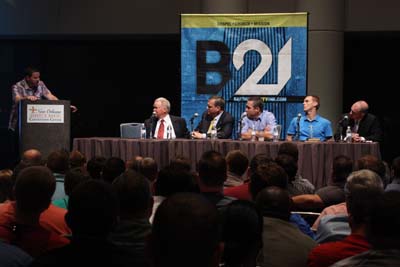
This emergence of young people in SBC life was clearest at the Baptist 21 panel discussion (and turkey po-boy lunch). “21” in the name refers to 21st century, but it might have characterized their age. Fully half the people in the SRO crowd of nearly 1,000 were in their 20s and 30s.

For watching the panel discussion, the Conservative Resurgence of the 1980s was ancient history. Like WW2. Many of them were not born at the time today’s senior convention leaders stopped what they described as a left-leaning drift and returned the denomination to biblical inerrancy. For these young people, Judge Paul Pressler and Dr. Paige Patterson are historical figures to be honored (which they were at the luncheon).

For a few minutes in New Orleans, the convention’s past met its future. And it was clear in that moment that this is not your grandfather’s SBC.

Or even your father’s.

It belongs to the kids.

Posted by Eric Reed

(New Orleans) — As we come down to the wire on this annual meeting of the Southern Baptist Convention, I am reminded of my friend Martha who told her husband every year as he left to attend the convention, “Bring home a copy of the resolutions!” For her, the essence of Southern Baptist life is not so much in the election of officers or agency reports; it’s in the annual statements messengers make on the clarification of our beliefs, and the intersection of our faith with contemporary culture.

Sometimes it’s from the resolutions that mainstream media find statements that are perceived as critical of the culture, politics, and secular leadership. But it is also in these resolutions what we affirm our faith and the value of biblical principles and lifestyles in transforming our culture by godly standards.

This year, in the waning moments of the 2012 convention, we are affirming the doctrine of salvation, the doctrine of inerrancy, religious liberty—with attention to issues involving mandated health care and same-sex marriage, the value of human needs ministry, and the contributions of African Americans to Baptist history.

A lot of people went home early.

The hall was not full when these resolutions were debated and adopted. But they are worth our time and attention—because it’s often in these areas that our faith is lived out.

When Baptist Press publishes the resolutions, take time to read them.

And “bring them home.” 

Paige Patterson, Al Mohler, J.D. Greear, David Platt and Danny Akin served as panelists during Baptist 21's luncheon for young leaders in New Orleans.

Paige Patterson, Al Mohler, J.D. Greear, David Platt and Danny Akin served as panelists during Baptist 21’s luncheon for young leaders in New Orleans.

At Tuesday’s Baptist 21 luncheon, hundreds of young people balanced turkey sandwiches and chocolate chip cookies on their laps as six Southern Baptist leaders reminded them of the price that was paid for the theological stability they enjoy today.

Paige Patterson, Al Mohler, Fred Luter, Danny Akin, J.D. Greear and David Platt weighed in during a panel discussion of the Conservative Resurgence (Southern Baptists’ return to orthodox doctrine beginning in the late 1970s) and the future of the SBC. As conversation continues to simmer over the surge of Reformed theology in the SBC, the panelists, who themselves represent a variety of theological perspectives, urged their listeners to hold fast to the inerrancy of Scripture.

“What was gained can be so quickly lost,” Mohler said. “It was excruciating, it was difficult, it was a near-fought thing, in the sense that it could have gone in the other direction. There was a victory that created a precious opportunity that’s a stewardship that we know can be lost at any time…

Every single year that passes is going to be more difficult, in terms of our cultural context. There are going to be issues we don’t even know to imagine today that your generation is going to have to imagine. It’s going to require the full wealth of conviction; if you do not nail your ministry to the foundational truth of the inerrancy of God’s word, you will – it’s not a question of if, it’s a question of when – you will go off the tracks.

It is essential from the very beginning to say, ‘This is where I’m going to stand, this is where I’m going to go in my ministry. This is a non-negotiable and quite frankly, I want the world to know it.”

Newly elected SBC President Fred Luter

Pastor Fred Luter balances serious subjects with joyful repartee while preaching at the Pastors’ Conference on the eve of his election as SBC President.

Posted by Eric Reed

A newspaper profile of Fred Luter pointed out the ways he will be a new face for Southern Baptists. Beyond race, Luter will bring a smile as the chief representative of the denomination, something that is lacking in our history of leadership by serious, white middle-age pastors, the report said.

Not that Luter isn’t serious. He is very serious about the traditional values of Southern Baptists, both theologically and culturally. His sermon that closed the Pastors Conference on the eve of his election as theconvention’s first African American president was a fiery litany of the ills of times—broken homes, crime, racism, abortion, homosexual lifestyles—and the hope, the only hope we have in the gospel of Jesus Christ. But this energetic dance of oratory was punctuated by self-effacing confessions of personal sin and redemption, and joyous grins attesting the effects of Christ in his life.

Fred Luter is serious about the joy of his salvation.

“I love to laugh,” he told the reporter. “I love to have a good time.” And those who hear Pastor Luter preach know it’s true. “If anybody has joy, if anybody has peace and happiness, it should be us,” he said.

If the perception persists that “Baptists don’t have any fun, that we don’t laugh—we don’t have any joy, I would love to change that perception,” Luter said.
Luter is equally serious about making the fuller ethnic representation a fact of life in all areas of Southern Baptist life.

“If we stop appointing African Americans or Asians or Hispanics to leadership roles in this convention after my term is over, we failed. We absolutely failed,” Luter said at a news conference after his historic election.

Luter summarized his election as “a genuine, authentic move by this convention that says our doors are open, and the only way they can see that is not just putting up an African American president, but seeing other ethnic groups inother areas of this convention. Time will tell and I’ll be a cheerleader promoting that.”

Luter and others described his election, at a national convention held in his own hometown of New Orleans, as providential. After a lengthy season of prayer, Luter and his wife agreed to put his name forward as a candidate in January. No other candidates emerged, and Luter was elected unopposed on the first day of the annual meeting.

Messengers stood and applauded for several moments as the convention’s vote was cast for the lone candidate, cheering and whooping and waving their ballots in the air. Some wept at the election of the African American pastor, seen by many as a fitting sign of repentance of the denomination’s birth in a time of slavery.

“There will be some pitfalls,” Luter said of his service as SBC president, “but I hope I will learn from them and study more on things I anticipate being asked.” Already Luter has faced the national media, answering questions about the role of race in the mostly white denomination. Luter said he hopes to be known as a man of God who “loves being part of this convention.”

And he smiles when he says it.

The name “Southern Baptist Convention” tells who we are, but it doesn’t tell what we do. The descriptor “Great Commission Baptists” tells what we should be doing.

Messenger on the floor of the convention speaking for adoption of informal “descriptor” name for optional use by churches. Name was adopted by 52% vote.

From the floor: Name Change

(New Orleans) — While debate continues over a resolution affirming “the sinner’s prayer,” and we wait to see if a fuller debate will develop over Reformed versus “Traditional” Southern Baptist Theology, what might be considered a less important vote by the convention—for second vice-president—may better signal how messengers really feel about the simmering theological arguments.

Messengers elected a pastor who was positioned as a unity candidate over the author of the statement on “traditional” Southern Baptist Theology by 20 percentage points.

Dave Miller is an Iowa pastor whose nominator described him as a man who could unite Southern Baptists, someone serving in a small church in a frontier territory of SBC work whose voice needs to be heard at the denominational table. He won in a run-off by 59.5% to 39.5%, defeating Eric Hankins, the Mississippi pastor who drafted a defense of Southern Baptist theology against inroads by Reformed theologians.

In an earlier round, messengers eliminated a third candidate, Brad Atkins, a pastor from South Carolina. 

Posted by Eric Reed

(New Orleans) — The outcome of Tuesday’s ballot on adopting the optional use of ‘Great Commission Baptists’ in addition to the official name Southern Baptist Convention was announced this morning– it was approved by a 52.48% vote.

The announcement of the tally was delayed yesterday, after a hand vote was too close to call and a ballot vote was required. Messengers debated the “name change” which would allow churches and SBC entities to use the descriptor, without changing the official name of the SBC.

The narrow margin of the vote reflects both strong opinions and ambivalence over the change, which would lessen the regional nature of the convention’a name. Floor debate included memorable comments from advocates. One church planter who was on the committee that recommended the name change said, “This motion helps church planters outside the south build a bridge to share Jesus.”

Another advocate, Micah Freeze of St. Joseph, MIssouri, said, “We are an incredibility diverse people. As we polled those Southern Baptists who live in the frontier areas, they said to us with strong voice that this would help them advance the gospel. For those who live in the hard areas, to push back the darkness, I don’t see how we can say no to them.”

But Gary Honeycutt of Arkansas countered, “I don’t care what you call your church, I care what you call the convention.”

Ted Traylor, pastor of Olive Baptist Church in Pensacola, Florida, observed this morning, “I’m note sure we’re going to help ourselves by having a name and a half. We may just cause confusion….If Gateway Seminary wants to use the name, and it will help them, that’s good. But in New Orleans, being Southern Baptist is a good thing—especially after Hurricane Katrina. And in New York, after 9/11.”

The use of the description “Great Commission Baptists” will be a the discretion of local churches.


When you know Christ as a Christian you have been given much, therefore love much. …We have all been forgiven much, therefore love much….To be forgiven so much and love so little is the greatest sin of all.

David Uth, pastor of FBC Orlando, preaching the Convention Sermon at the SBC in New Orleans

From the Platform: Preaching Love