Archives For November 30, 1999

News of interest to Illinois Baptists

Proud moment

ib2newseditor —  September 1, 2016

Sandy Wisdom-Martin elected to lead National WMU
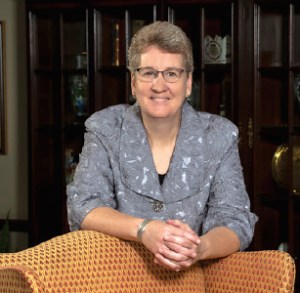
Sandy_Wisdom-MartinThe news spread quickly among Illinois Southern Baptists that one of their own was named to serve as executive director/treasurer of Woman’s Missionary Union.

Sandy Wisdom-Martin, an Illinois native who grew up near the small town of Marissa, was unanimously elected by the WMU executive board at a special-called meeting July 29-30 in Birmingham, Ala. She directed women’s missions and ministries for IBSA from 2001 until 2010, when she moved south to serve as executive director of WMU of Texas.

“Many of us here in Illinois are ‘busting our buttons’ with pride and gratitude for Sandy’s selection, because we consider her one of our own,” said IBSA Executive Director Nate Adams.

The Illinois Baptist paper is not large enough for me to list the ways or the people who have impacted my life. I take with me to Birmingham a priceless heritage passed down to me by faithful Christ-followers.

“People eagerly hear her, respond to her, and follow her because of her personal integrity and character, and because she clearly follows the Lord’s leadership in her own life.”

Wisdom-Martin was highly involved in Illinois WMU as a student, serving on the state Acteens panel and several Acteens Activator mission teams. She also was the first recipient of the Darla Lovell Scholarship from Illinois WMU while studying at The Southern Baptist Theological Seminary in Louisville, Ky.

While at IBSA, she served as president of Mississippi River Ministries and led the first international WMU Habitat for Humanity team, which traveled to Ghana to build houses.

“I am thrilled beyond words in Sandy’s selection as Executive Director of WMU,” said Evelyn Tully, who directed Illinois WMU prior to Wisdom-Martin. “Her missions commitment, her ministry lifestyle, and her exemplary relationships have uniquely prepared her for this tremendous responsibility.

“I know Illinois missions-minded women will be her strong prayer supporters.”

The Illinois Baptist interviewed Wisdom-Martin via e-mail shortly after her election:

Illinois Baptist: Congratulations! We’re so excited one of our own is on her way to Birmingham!

Sandy Wisdom-Martin: Thank you. That means a great deal to me.

IB: Let’s start with the name and role of your organization. What does “woman’s” and “auxiliary” mean in the 21st century?

SWM: Our leaders have all said in different ways, “We are not a women’s organization, we are a missions organization.” My first full-time ministry supervisor, Julia Ketner at the Arkansas Baptist State Convention, said, “We shout missions and whisper WMU.”

We are not about perpetuating an organization. We are about making Christ known in the world. If we focus on who we are, we will fail. If we focus on Christ and the mission he has given us, we cannot fail.

IB: What will you take from your Illinois/IBSA experience to Birmingham?

SWM: I am a product of Illinois Southern Baptists. The daughter of a coal miner and foundry worker. The first Illinois Southern Baptists I knew were my Christian parents who worked hard and served well. I learned lessons too numerous to mention. The members of Clarmin Baptist Church poured their lives into mine giving me every advantage possible as a young Christ-follower.

A new pastor’s wife introduced our church to Acteens and I discovered what God was doing in the world. State missions camps and events, as well as Acteens Activator teams, sealed my heart for missions. Then came the opportunity to rub shoulders with heroes of the faith who served with the Illinois Baptist State Association. In college, the Nine Mile Baptist Associational WMU council invited me to join their team. They let me teach conferences. I was awful. They loved me anyway. Baptist Student Union at SIU-Carbondale became one of the most important discipling influences of my life.

And that’s only the beginning. The Illinois Baptist paper is not large enough for me to list the ways or the people who have impacted my life. I take with me to Birmingham a priceless heritage passed down to me by faithful Christ-followers.

IB: How will you make WMU relevant for a new generation of women?

SWM: We have challenges to be sure. The future will demand higher visibility and more options. I find that when people understand what we really do, they value us.

As WMU, we have these six objectives: pray for missions, engage in mission action and personal witnessing, learn about missions, support missions, develop spiritually toward a missions lifestyle, and participate in the work of the church and denomination. While we want people engaged in all six objectives, ministries seem to be the way to capture people’s heart for missions initially.

So, in Texas, we began doing things like building houses in partnership with local associations. We converted an old bus to a rolling WorldCrafts store and have sold more than $100,000 in WorldCrafts products while teaching shoppers about fair trade and missionaries who work with artisans. We have a truck and generator being converted into a “Suds of Love” laundry unit.

Once we get people involved initially, we invite them to go deeper in missional living. We strive to engage missional disciples for life.

IB: It seems like a lot of churches have moved away from missions education programs like Girls in Action and Royal Ambassadors. Do you think people need to be reminded (or taught for the first time) why missions education is important?

SWM: I think the experience of 2015 should be enough to remind people of the importance of missions education. Between 600-800 international missionaries were brought home (because of budgetary shortfalls at the International Mission Board). When people know about the needs of the field, they respond by praying and by giving. When they don’t know, the reverse happens.

I think we have moved away from missions education because we have moved away from the Great Commission. We are failing at the one thing Jesus told us to do which is “make disciples.” Making disciples is a lifelong process.

I am who at I am today because Illinois Southern Baptists began pouring their lives into mine and discipling me through local church missions education, missions education camps, associational missions, campus ministry and statewide missions activities. I grew up passionate about the Cooperative Program because that was what I was taught. We lived and breathed missions in my small country church. It was not an option. It was part of the DNA of our congregation.

IB: People today are awfully busy. How can WMU leaders find time on the church schedule for missions education?

SWM: We live in a wonderful age where resources are readily available and creativity abounds. There are countless ways to engage in missions education and involvement.

WMU provides premier missions resources. I think the problem is not with church schedules or other issues. I think the primary problem is that we have forgotten our “why.”

Our identity is with Christ. We believe Christ gave his all for us. We follow his teachings and his example. We do it all for the sake of Christ. We believe we are people made in the image of God with infinite worth because we are his creation. We know we are broken people in need of restoration and healing. Through Christ’s forgiveness, mercy, and grace, our lives are being made new. We are passionate about telling his story and how it has changed us. We want every culture to know his story and be changed by it as well. We give our lives to that pursuit. That is why we do what we do.

IB: What does partnering with the International Mission Board look like now, with a new leadership team and reduced missionary force from funding challenges?

SWM: I’m looking forward to discussions with both IMB and NAMB (North American Mission Board) when I get settled, but believe our partnership will focus on reaching the nations for Christ as it always has. WMU actively promotes the Lottie Moon Christmas Offering and Week of Prayer for International Missions, encourages members to pray for missionaries daily through the missionary prayer calendar, coordinates stateside housing, provides water filters through Pure Water, Pure Love, and so much more.

IB: What is WMU’s main point of connection with NAMB, given its church planting focus?

SWM: Through our partnership with NAMB, we help participants live out the six objectives we discussed earlier. We count it a joy to be able to tell the stories of all our missionaries, as well as support their work through extensive promotion of the Annie Armstrong Easter Offering and Week of Prayer. We also support NAMB missionaries through Christmas in August, scholarships for MKs (missionary kids), and more. When it is possible, we continue to invest our lives in their ministries through hands-on involvement.

IB: How do you make missions cool in a world without borders? What is the compulsion to “Go…” when “all the world” seems so close these days?

SWM: For more than 125 years, the name of our organization has been said incorrectly in many venues. We are named Woman’s Missionary Union because it is the individual woman who understands and responds to God’s call on her life.

That is how we make missions cool. We help each individual understand their own giftedness and God’s call on their life to make disciples. It’s not about what you do. It’s about who you are in Christ. You were created in the image of God for His purpose and glory. We are here to help nurture that call.

Disaster_Relief_logo_ILSix teams of Illinois Baptist Disaster Relief volunteers are scheduled to go to flood-ravaged southern Louisiana over the next month. The first team, from Harrisburg First Baptist Church in Saline Baptist Association, will serve from August 28-September 3. It will include flood recovery and chaplaincy volunteers.

According to Baptist Press, over 65,000 homes and 60 churches in southern Louisiana have been affected by the recent flooding. IBSA is offering a one-day Disaster Relief Training event Saturday, August 27 at Living Faith Baptist Church in Sherman. Potential volunteers will have the opportunity to train in flood recovery or food preparation. To learn how you can participate, visit IBSA.org.

Dwayne Doyle, State Disaster Relief Coordinator, shared, “Disaster Relief teams will be traveling through flood zones with recovery trailers and heavy equipment. Please pray for their safety. Pray for open doors in affected communities as volunteers offer physical assistance and spiritual comfort. Our chaplains often report salvation decisions from their work sites as people suffering after disaster turn to Christ.”

Doyle said he has received phone calls and e-mails asking, “if we will be accepting practical supplies like buckets, mops, and the such for the response. At this point, we will not be receiving practical supplies like these, but are needing funds to help mobilize our many volunteers and equipment. Your sacrificial giving helps Illinois Disaster Relief meet the many needs of those who are suffering.”

Illinois Baptist Disaster Relief is funded through individual and church donations. When you give, 100% of your offering will assist storm victims as disaster relief volunteers assist in recovery efforts. Ask your pastor to take up a special offering for Illinois Disaster Relief this Sunday. You may also give individually by mail or online. Mail a check payable to Illinois Disaster Relief to: Illinois Baptist State Association, P.O. Box 19247, Springfield, IL 62703.

Denham-Springs,-La.-from-blackhawk

The city of Denham Springs is among the hardest-hit in flooding across south Louisiana. Baptist Press/Governor’s Office of Homeland Security and Emergency Preparedness

This isn’t Illinois Disaster Relief volunteers first time to serve in the state this year. Volunteers participated in Louisiana flood recovery efforts in March and April. It was during that call-out that volunteer Don Fulkerson, a member of First Baptist Church of Galatia, IL., died of a heart attack while serving flood victims in Leesville, LA. His team returned to Louisiana to finish the work it began later in the spring.

IBSA has over 1,600 trained volunteers who serve as part of the Southern Baptist Convention’s Disaster Relief ministry, the third largest relief agency in the United States. Disaster Relief often responds to natural disasters by providing feeding stations, mobile kitchens, child care and chaplains. In the case of flooding, volunteers in their signature yellow shirts help homeowners with “mudout,” clearing flooded properties of debris and contaminated building materials, so they can begin rebuilding and recovery.

If you are already a trained volunteer and want to go to Louisiana, contact one of the team leaders below.

Team Leader: Joe Jackson – Region 6
Date: August 28-September 3, 2016
Location: Southern Louisiana
Needed: Mud-out/Flood Recovery and Chaplaincy
Contact: joeluj@frontier.com

Team Leader: Don Kragness – Region 4
Date: September 4-12, 2016
Location: Southern Louisiana
Needed: Mud-out/Flood Recovery and Chaplaincy
Contact: donjank1@gmail.com

Team Leader: Dennis Felix – Region 4
Date: September 4-12, 2016
Location: Southern Louisiana
Needed: Mud-out/Flood Recovery and Chaplaincy
Contact: crossconnect2u@hotmail.com

Team Leader: Don Ile – Region 3
Date: September 11-18, 2016
Location: Southern Louisiana
Needed: Mud-out/Flood Recovery and Chaplaincy
Contact: donruthsawdust@gmail.com

Team Leader: Butch Porter – Region 6
Date: September 14-21, 2016
Location: Southern Louisiana
Needed: Mud-out/Flood Recovery and Chaplaincy
Contact: bp.dp@hotmail.com

Team Leader: David Howard – Region 2
Date: September 17-24, 2016
Location: Southern Louisiana
Needed: Mud-out/Flood Recovery and Chaplaincy
Contact: david@capcity.org

Media contact:
Lisa Sergent, IBSA Director of Communications
(217) 391-3119
LisaSergent@IBSA.org
Springfield, IL

Save

Ready for Rio

ib2newseditor —  August 5, 2016

Rio_2016_crop.jpgWith the Olympic Games set to kick off Aug. 5, Southern Baptist volunteers will be in South America to share the gospel both with local residents and with the thousands of visitors from across the globe.

“There exists no greater opportunity to reach people from over 200 nations in 30 days than the Olympic Games,” said John Crocker, a missions pastor from Alabama who is leading a mission team to Rio. Crocker’s team will engage Rio residents with the gospel through evangelistic block parties and Olympic pin trading.

“There is an openness by people to talk with one another and to talk about spiritual things,” said Sid Hopkins a retired director of missions from Georgia who ministers at the Games by distributing pins made especially for the Olympics that tell the story of Jesus.

“We have seen many people who come to the Olympic Games open to listen to the gospel because the atmosphere created is one of friendship on a global level. Ministry during the Olympics is simply electric.”

Pre-event publicity for the Olympics has been largely negative, due to concerns over the Zika virus, Brazil’s economic struggles, the fitness of Rio’s water supply, the Russian doping scandal, and other issues. But Brazil’s hosting of the 2014 World Cup proved to be successful, and Olympic organizers are banking on a repeat of that success in Rio.

Journalist Tim Ellsworth, former editor of the Illinois Baptist, will cover the Games for Baptist Press, focusing largely on Christian athletes who are competing, including diver David Boudia. He won gold in the 10-meter platform competition in 2012 and is looking to add to his medal count in both that event and the men’s 10-meter synchro competition with his partner Steele Johnson. Both men gave strong testimonies of their faith in Christ following the Olympic trials this summer.

“This is not what my identity is going to be in the rest of my life,” Johnson said. “Yeah, I’m Steele Johnson the Olympian, but at the same time, I’m here to love and serve Christ. My identity is rooted in Christ and not in the flips we’re doing.”

The Illinois Baptist blog, iB2news.org, will have more stories from Rio during the Olympic Games.

– From Baptist Press

Election 2016For nearly a year, evangelicals, including many high profile leaders, have been debating who to support in the 2016 U.S. Presidential election. Many have even joined the the #NeverTrump moment. But that may be changing.

A new poll released by Pew Research Center shows four-fifths of white evangelicals say they have decided to vote for the presumptive Republican nominee Donald Trump in the general election. According to Pew, 78% of white evangelicals now support the candidate. Just 17% support Hilary Clinton, the presumptive Democrat nominee, while 5% are undecided.

Support for Trump among white evangelicals is even higher than as it was for Republican Mitt Romney (71%) in 2012.

The New York Times quoted J. Tobin Grant, a professor of political science at Southern Illinois University-Carbondale, on the difference. “Trump is not a true believer in any sense, both religiously and on the issues, but he’s speaking to them,” said Tobin. “He’s actively courting them, and that’s what the activists want. They want to have a seat at the table, and they felt they didn’t have that with Romney.”

White evangelical Protestant voters make up one-fifth of the the nation’s registered voters, with one-third stating they are or at least lean Republican. Evangelicals are rivaled by religious “nones,” voters who have no religious preference or are atheist, who also make up one-fifth of registered voters. More than a quarter of the nones say they are or lean Democrat.

Writing for Religion News Service, Mark Silk touted the “big news” from the Pew poll as “the disappearance of the God gap.” In 2012, “respondents who said they attended worship at least once a week preferred Romney to Obama by 15 points, 55% to 40%. This year, the margin is just four points: 49% for Trump to 45% for Clinton.”

Silk also noted, “In 2012, less frequent attending white evangelicals preferred Romney to Obama by 29 points (62-33). This year the margin for the Republican has doubled to 57 points (76-19) — almost the same as the margin among frequent attending white evangelicals.”

Pew found voters in general are not pleased with their choices for president – “42% of voters said it would be difficult to choose between Trump and Clinton because ‘neither one’ would make a good president.”

Black Protestant voters overwhelmingly say they support Clinton – 89% to 8% for Trump. Just four percent say they are undecided. Hispanic Catholics support Clinton (77%) over Trump (16%).

The survey also measured voter motivation. Pew discovered “the desire to defeat Clinton was the prime reason evangelicals supported Trump. Of the 78% of white evangelicals who said they would vote for Trump, 45% said their decision was ‘mainly a vote against Clinton,’ while only 30% said it was ‘mainly a vote for Trump.’”

In addition, the survey found nearly half (46%) of white evangelical voters believe it it is now more difficult to be a Christian in the United States. This compares to just 18% of Catholics who believe it is now more difficult to be a Catholic in today’s society.

The survey also comes on the heels of Trump’s meeting last month with nearly 1,000 evangelicals, including many Southern Baptists. At least eight Southern Baptists now serve on Trump’s evangelical advisory panel.

The Republican National Convention takes place next week, July 18- 21, in Cleveland, Ohio. The Democrat National Convention follows July 25–28 in Philadelphia, Pennsylvania.

– Lisa Sergent

Race panel

Resolution urges no more use of Confederate battle flag

The Southern Baptist Convention rejected use of an iconic Southern emblem, the Confederate battle flag still commonly seen in the South, because it is for many representative of slavery and ongoing racism against African Americans. The resolution states: “We call our brothers and sisters in Christ to discontinue the display of the Confederate battle flag as a sign of solidarity of the whole Body of Christ, including our African-American brothers and sisters.”

Its passage by a considerable majority was met with enthusiastic applause.

The vote came after an impassioned plea by Georgia pastor and former SBC President James Merritt, himself the descendant of two Confederate war veterans.

“Make no mistake, this is a seminal moment in our convention,” said Merritt. “I believe God has brought the SBC to both the kingdom and our culture for such a time as this. What we do today with this issue will reverberate in this nation, not just today, but I believe a hundred years from now. This is not a matter of political correctness, it is a matter of spiritual conviction and biblical compassion.”

Merritt proposed an amendment which strengthened the resolution, and removed a phrase some had used about “honor(ing) their loved one’s valor.” He substituted language to “discontinue the display of the Confederate battle flag as a sign of solidarity of the whole Body of Christ, including our African-American brothers and sisters.”

The amendment passed. While not all messengers who spoke supported the resolution, the will of the Convention was clear: Southern Baptists have broken with the racism of their past. After statements in 1995 and the election of an African American president in 2013, some expressed hope the sins of the past are repudiated as well as the flag.

SBC President Ronnie Floyd chose the St. Louis convention, just a few miles from Ferguson, Missouri, as the place to discuss racial reconciliation. Convention week began with outreach ministry in Ferguson, site of riots in 2014 following the police shooting of a black teenager.

Floyd told convention messengers, “America is…experiencing a racial crisis. Any form of racism defies the dignity of human life. Regardless of the color of human skin, God has put his imprint on each of us…Racism is a major sin and stronghold in America.”

Floyd staged a panel discussion, a rarity in SBC business sessions, called “A National Conversation on Racial Unity in America,” with 10 leaders.

“I am absolutely, totally convinced that the problem in America can be put totally at the doorsteps of our churches,” said Jerry Young, president of a mostly African American denomination, the National Baptist Convention.

Young noted Christ told his disciples to be the salt and light of the world, and he said Christians are failing in the task. “I challenge you to know that the problem in America is a problem with the church being what God called it to be….Here’s what needs to happen in America: Somebody needs to pass the salt and turn on the lights.”

The panel discussed the killing of nine people at Emanuel AME Church in Charleston, South Carolina last year. “That racially motivated murder hurt all of us,” said Marshall Blalock, pastor of the mostly white First Baptist Church in Charleston. “The white community for the first time began to understand.”

Blalock noted, “The killer was a terrorist, he wanted to create fear and cause hopelessness. But he went to church where there is no room for fear, or hate, or hopelessness…Only the gospel can eliminate racism.”

Kenny Petty, pastor of the Gate Church in St. Louis, said incidents such as the Charleston church shooting and police shooting of Michael Brown in Ferguson, Mo., exposed an infection. “That wound opened up and it reeked.” Since the shooting, “there has been some healing (in Ferguson), but we’ve got a long way to go. We found out that infection didn’t just stop with the culture, it went on to the doorstep of the church.”

“What we need is the mind of Christ,” Young said. “If we want to change racism in our churches and America we’re going to have to change our attitude through Christ.”

President of the SBC’s Ethics and Religious Liberty Commission Russell Moore called the convention’s action “an extraordinary moment.”

“We watched a denomination founded by slaveholders vote to repudiate the display of the Confederate battle flag in solidarity with our African American brothers and sisters in Christ,” Moore said.

– Lisa Sergent

Editor’s note: Doug Munton, pastor of First Baptist Church in O’Fallon, will be nominated for First Vice President of the Southern Baptist Convention when the SBC’s annual meeting convenes in St. Louis June 14.

Dr. Doug Munton, Senior Pastor of First Baptist Church of O’Fallon, Illinois

Dr. Doug Munton, Senior Pastor of First Baptist Church of O’Fallon, Illinois

Illinois Baptist: What lessons from your ministry in the Midwest do you think Southern Baptist pastors would benefit from, especially in transforming the prevailing culture?

Doug Munton: The power of the Holy Spirit is not limited geographically. We have found that loving God and loving people really matters. A church that is true to the Bible and that teaches that truth clearly, powerfully, and relevantly can impact the culture.

We have found that God can do things that some say can’t be done—“You can’t grow a church in the Midwest. You can’t reach old and young people. You can’t cross racial barriers.” These things are not too great for God and he is at work doing those things in churches across the Midwest.

IB: It appears that the SBC is fragmenting along lines of theology and philosophy of missions. Are you concerned about that?

Doug: I am concerned about our fragmentation. We can overcome differing views of soteriology, worship styles and other issues through love and respect. Unity in our fellowship can be a powerful tool for our mission.

I do hope we will be careful not to throw away the Cooperative Program and our cooperative mission approach. We can find ways to be more effective in our mission. But the Cooperative Program can be a great blessing to our mission work together. I want to encourage that cooperation.

IB: Are you concerned about the future of the Cooperative Program?

Doug: The effectiveness of the CP should not be taken lightly. It is why we have been able to send so many to the mission field in days gone by. It is a blessing to our seminarians. And, in Illinois, it has allowed us to cooperate together to do so much more than we could do separately here, nationally, and internationally.

IB: What about being a Southern Baptist in today’s culture challenges you and excites you?

Doug: These are the best of times, these are the worst of times. (I should use that line as the opening of a novel!) We are weaker in evangelism than ever in my lifetime. We have sent missionaries home from the IMB for lack of funds for the first time ever. But we also have young people who will sacrifice all for the cause of Christ. We are making strides in racial unity that give me encouragement for our future. And, our call for spiritual awakening is exactly what is needed at this time.

Perhaps we will see God move in our day as never before. May it be so and may our fellowship of churches seek God and his direction more fully than ever.

Munton is presently unopposed for First Vice President. The election will be held on Tuesday afternoon, June 14.

Governor Rauner crop

Illinois Governor Bruce Rauner

Religion and faith were on display at the Illinois Governor’s Prayer Breakfast as around 200 Christians, Jews, Muslims, Sikhs, Hindus, and others gathered at the Executive Mansion in Springfield May 26.

Yet, even in this setting with representatives of several religions, Jesus was lifted up. The gospel was clearly presented in song through the harmonies of The Gibson Girls, Scripture readings from Isaiah 2:1-4 and John 17, and prayer.

At the event, Governor Bruce Rauner asked attendees to pray for the state government. “I hope you will join us and people all around the state of Illinois in prayer. Keep us in your prayers. We need prayers for inspiration and to have good judgment.”

He also shared from his own personal faith background. His father is Catholic, while his mother is Swedish Lutheran. Rauner said he was baptized and confirmed in the Episcopalian Church and his wife is Jewish. “We have interesting conversations around the dinner table,” he joked.

But Rauner said he was inspired by his grandparents’ faith and the lessons they taught him: “Do unto others as you would have them do unto you,” from Luke 6:31 and “For whom much is given, much shall be required,” from Luke 12:48. He spoke of the responsibility he felt after earning his own wealth, and said it was their examples that lead him to set up a charitable foundation to give to causes as well as to serve.

The governor shared about the importance of continuing the tradition of the breakfast, which some feared would not take place this year. In early May, a member of the organization that normally hosts the event, told media the breakfast would not be held due to state budget problems. Upon hearing the news, the Rauner expressed his disappointment and his office sought sponsors to host the event. Three organizations — the Abundant Faith Christian Center, the One Nation Under God Foundation, and the Illinois Executive Mansion Association — stepped up to sponsor the event, held every year since 1963. No government dollars were used to pay for this years event.

Bob Vanden Bosch, chairman of the One Nation Under God Foundation, told the Springfield State-Journal Register last week, “For us, this is a faith initiative. It’s not something that’s political. … I believe that prayer could be used by the state of Illinois right now.”

The event did include a reading from the Koran, but the overall tone of the event was Judeo-Christian.

Illinois Southern Baptists were represented at the event by two of the Illinois Baptist newspaper’s editors, Eric Reed and Lisa Sergent.

Dr. Doug Munton, Senior Pastor of First Baptist Church of O’Fallon, Illinois

Doug Munton

Doug Munton, expected Southern Baptist Convention First Vice President nominee, is a featured guest on SBC This Week’s May 20 podcast. You can listen to the interview and learn more about his vision for the SBC and the Cooperative Program at sbcthisweek.com.

Munton, senior pastor of First Baptist Church, O’Fallon, Ill., announced April 26 he will be nominated for First Vice President of the Southern Baptist Convention.

The nomination will be made by John Marshall, pastor of Second Baptist Church, Springfield, Mo., during the SBC’s annual meeting in St. Louis June 14-15.

Munton, 56, has pastored FBC O’Fallon for more than 20 years, during which time the church has grown from 550 to over 1,600 people in average attendance and has baptized about 2,000 people. In the 2014-15 reporting year, the church gave just over 8% of budget receipts through the Cooperative Program—Southern Baptists unified method of supporting missions and ministry.

He served as president of the Illinois Baptist State Association for two years, and is currently on the SBC’s Committee on Committees. His wife, Vickie, is the president of the Ministers’ Wives Conference this year at the Southern Baptist Convention in St. Louis. The Muntons have four adult children and will soon have their seventh grandchild.

The Illinois Baptist editors asked the SBC Presidential candidates this question: What are the three greatest challenges facing the SBC? Here are their replies:

David CrosbyDavid Crosby
First Baptist Church, New Orleans

1. We must get out of our buildings and into our communities. We are plagued with the mentality that people “go to church.” This says that “church” is a location somewhere. We need the reverse: “Churches go to people.”

I want us to expand the presence of our churches in their communities. I will seek to foster strategies of compassion ministries that keep us in touch with neighbors in need and open wide the doors of loving witness. These ministries break down racial and class barriers and help our churches look more like our communities and more like heaven. This is our future.

2. We must bring a message of hope to our churches and our culture. The primary metaphor for being in the world as believers is not warfare. It is light. Anyone in darkness is thrilled to see a glimmer of light. Our warfare mentality has had the unintended effect of stealing hope from our hearts and our message. An angry and fearful posture in the world is unwise, unfounded, and unchristian. Losing the culture wars is no loss at all compared to losing the message of a living hope.

My daily reality is the hardscrabble world of urban New Orleans. I will lead the SBC from the perspective of this highly diverse and difficult mission field where God’s people shine like stars and loving engagement brings true hope.

3. We must be cooperative. Southern Baptists are distinguished from other groups in that they actually do mission together, not just independently. Cooperation, we believe, is biblical and is a superior strategy for accomplishing the world mission of the church.

The spirit of cooperation has waned, but the need for it has not.

As SBC President, I will not talk or act as if a return to the society method of supporting our cooperative work is progress. I will cultivate and promote a cooperative spirit. I will demonstrate cooperation by continuing to give a substantial percentage of the undesignated receipts of my church to our unified giving plan.


Steve GainesSteve Gaines
Bellevue Baptist Church, Memphis

Three of our greatest challenges in the SBC are: spiritual awakening, soul winning, and stewardship.

Regarding the second challenge, the SBC is in a 15-year downward trajectory in baptisms, the longest in SBC history. In 2014 we baptized 100,000 fewer people than in 1999. Regarding the third challenge, we recently called 1,000+ IMB missionaries home due to financial deficits.

In my opinion, the first challenge, our need for spiritual awakening, is the most important. If prioritized, it can solve the other two.

The SBC needs fresh wind and fire from heaven. That will only come when a spirit of prayer and repentance captivates our pastors, lay leaders, church members, associations, state conventions, and SBC entities.

I will seek to lead our SBC to prioritize passionate prayer in each person’s personal life, and encourage the development of specific prayer strategies for pastors, church members and all who serve in our SBC agencies. Without spiritual awakening, the SBC will continue to decline. God can do more in revival in one hour than we can do in years without it.

Both the early church (cf. Acts 2:1f) and missions (cf. Acts 13:1f) were birthed in prayer meetings. Prayer and revival caused the early church to win multitudes to faith in Jesus. Prayer and revival also made the early believers strong financial stewards who gave generously. When we pray, we will evangelize and make disciples. God will also activate his angelic army to defeat our enemy, the devil, and thus advance his kingdom in our churches, Convention and culture.

If chosen to lead the SBC, I will give myself wholeheartedly to help the SBC experience spiritual awakening to bring glory to God through souls being saved, people being discipled, financial resources being made available, and more missionaries being sent out to the ends of the earth.


JD GreearJ.D. Greear
The Summit Church, Raleigh-Durham

First and foremost, we need a continued re-awakening to the gospel. Historically, revival has begun not with lost people getting saved, but with the church getting “re-converted” to the gospel, which then leads to massive evangelism. I know we feel like we live in a dark age, but if we look at the last four awakenings in the Western world, we see that the conditions in our country are riper for revival now than at any other point since the Great Awakening.

The time is right. The harvest is ready. So we need to boldly ask God for what we know he wants to give us. And our entities need to respond accordingly. The Convention doesn’t exist for sake of the entities or the state conventions. It exists for the Great Commission. We must constantly re-evaluate everything we do in light of that.

Second, we need to bring a new generation of Southern Baptists to the table to partner with older generations in the cooperative missions of the SBC. There is a new wave of excitement about the SBC, but many newer generations of churches are still sitting on the sidelines. We need to take personal responsibility for the entities of the SBC and step up to own the mission. We must join with a faithful older generation to sacrificially give, support, and serve in these entities, boards, and institutions.

Third, we need to see diversification in the leadership of the SBC. About one in five churches in the SBC now is predominantly non-Anglo (praise God!), and we want to see our brothers and sisters from these non-Anglo backgrounds join us in leadership. I believe we are at a kairos moment in this. We should strive to see SBC leadership reflect the diversity of the SBC—culturally and racially, including younger and older, more traditional and more modern. We are united by The Baptist Faith and Message (2000) and our passion for the Great Commission. I believe that our greatest days are yet ahead!

Dr. Doug Munton, Senior Pastor of First Baptist Church of O’Fallon, Illinois

Dr. Doug Munton, Senior Pastor of First Baptist Church of O’Fallon, Illinois

Doug Munton, pastor of First Baptist Church, O’Fallon, Ill., announced April 26 he will be nominated for First Vice President of the Southern Baptist Convention.

Media release — Illinois Pastor Doug Munton to be Nominated for First Vice President of the Southern Baptist Convention 

“I am excited to hear that Doug will be nominated for this national role, after experiencing his strong leadership here in Illinois as our state convention president and as longtime pastor of one of our leading churches,” said Illinois Baptist State Association Executive Director Nate Adams. “Doug has all the qualities I would hope for in SBC leadership. He is a conservative, cooperative, humble, thoughtful, missions-hearted pastor who will lead both as statesman and by personal example.”

The nomination will be made by John Marshall, pastor of Second Baptist Church, Springfield, Mo., during the SBC’s annual meeting in St. Louis June 14-15.

Munton, 56, has pastored FBC O’Fallon for more than 20 years, during which time the church has grown from 550 to over 1,600 people in average attendance and has baptized about 2,000 people. In the 2014-15 reporting year, the church gave just over 8% of budget receipts through the Cooperative Program—Southern Baptists unified method of supporting missions and ministry.

He served as president of the Illinois Baptist State Association for two years, and is currently on the SBC’s Committee on Committees. His wife, Vickie, is the president of the Ministers’ Wives Conference this year at the Southern Baptist Convention in St. Louis. The Muntons have four adult children and will soon have their seventh grandchild.

Asked about his reasons for allowing his name to be submitted in nomination, Munton said, “I want to see a continued move in our Convention towards racial diversity and unity. I want to encourage our churches to participate in missions through support of the Cooperative Program. I hope to encourage prayer for a spiritual awakening in our convention and nation.”

The 2016 Southern Baptist Convention will be held at the America’s Center in St. Louis June 14-15. The election for First Vice President is slated for the Wednesday afternoon business session.

Statements from and about Doug Munton, Senior Pastor of First Baptist Church of O’Fallon, Illinois