Archives For November 30, 1999

News of interest to Illinois Baptists

When Bob Elmore described what our team would be doing this week in Haiti, he was careful to remind us we wouldn’t be building houses. Rather, Bob said, we’re here to help local workers build houses. And to remember that the “bosses” and their helpers know a lot more about what works in Haiti than we do.

It has to be a bit of a burden, taking on 19 American volunteers, many who have little to no construction experience. But the Haitians we worked with today greeted us with smiles every time we saw them, patiently reminded us how to say “what is your name” in Creole (more than a few times), and took us under their wing on two hot, dusty construction sites that will hold new cinder block homes in just a few days. They’re sacrificing to partner with us.

They’re also teaching us the basics of Haitian construction, from sifting dirt to be used as mortar, to creating an assembly line to get cinder blocks where they need to go.

And in return, hopefully we’re loving them well, even knowing many of us may not come back to Haiti, at least for a while. Our sacrifice is forgetting the heat long enough to loop both arms around kids when they want to walk down the street with you. (Five wide: you in the middle, one kid under each arm, and two more holding your hands).

Our sacrifice is having the courage to love them well, as one group member said during tonight’s devotion time. “It’s easy not to fall in love,” Emily Ebert said, not because the people aren’t lovable, but because it would be easier to hang back, build what we need to build, and leave on Sunday. It’s harder to start an awkward conversation in a foreign language, knowing we’re going to look like we don’t know what we’re doing.

Bob told us tonight that on his first trip to Haiti a few years ago, he focused on the work to be done and didn’t really meet many people. But on several subsequent trips, he decided the relationships were more important. Today, as we stood on the bank of the Grise River (named for its gray color), one of Bob’s Haitian friends – Phillip- told him, “You are from Haiti now.”

20130722-202455.jpgBob Elmore (in yellow) gives instructions at the beginning of the team’s first work day in Haiti.

20130722-202658.jpgPastor Estaphat of Gosen Church leads the volunteers in singing before they start their work. His church building was built in November by volunteers led by Bob Elmore.

20130722-203205.jpgBigarade is dotted with houses built by Baptist Global Response after the 2010 earthquake. Southern Baptist missionary Sam Yorke was instrumental in the building of those homes, so the locals call the community “the city of Sam” and “Sam village.”

20130722-203541.jpgThe volunteers are magnets for friendly kids.

20130722-203840.jpgCourtney Fallon gets the beauty shop treatment on the work site.

20130722-203716.jpgTad Arndt and Cara Atienza shovel and sift to make mortar for the homes under construction.

“May the God of hope…”

Romans 15:13 begins with a promise that our God is a God of hope, and that something else is coming. He’s going to do something, He’s going to work.

This week in Port-au-Prince, Haiti, a group of 19 volunteers from Illinois waits in expectation that God will work. But their waiting isn’t passive; they won’t be killing time. Instead, they plan to build two houses and visit families on behalf of local churches.

They arrived Sunday morning at New Life Children’s Home, their home this week, wearing bright yellow T-shirts  proclaiming Romans 15:13 in Haitian Creole. The team spent most of the day getting used to the Haitian heat and meeting the kids who live at New Life, which, in addition to the guest house, also operates an orphanage.

Check this blog throughout the week for more from the group, and how they’re living out Romans 15:13 here  in Haiti.

The team traveled to the children's home in. Yellow school bus, after an overnight layover in Miami.

The team traveled to the children’s home in. Yellow school bus, after an overnight layover in Miami.

One worker at New Life calls it "an oasis in the chaos." The compound has bright buildings, quaint guest accommodations, and is also home to a long-established orphanage.

One worker at New Life calls it “an oasis in the chaos.” The compound has bright buildings, quaint guest accommodations, and is also home to a long-established orphanage.

Abby Fleischer of Cross Church in Carlingille colors with a young boy at New Life.

Abby Fleischer of Cross Church in Carlinville colors with a young boy at New Life.

pull quote_LUTERHard questions remain for nation still affected by racial tensions

COMMENTARY | From Baptist Press

After a jury found George Zimmerman not guilty in the death of teenager Trayvon Martin, Southern Baptist leaders called for active love and respect for justice. They also acknowledged very real questions raised by the case, including the validity of state laws like Florida’s “stand your ground” statute, and the prevalence of racial tension and discrimination in the United States.

Zimmerman, a 29-year-old neighborhood watch volunteer, shot and killed Martin, 17, last February in Sanford, Fla. The case ignited a firestorm of controversy about race and gun laws across the country.

Churches had the trial on their minds as they met Sunday, July 13, after the not-guilty verdict was announced Saturday evening. Kevin Cosby, pastor of St. Stephen Church in Louisville, Ky., tweeted: “The black community is engulfed in grief. Service today was like attending a funeral. Despair!”

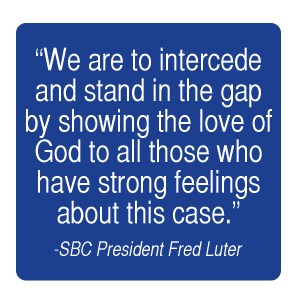
This is a perfect time for the church to be a “healing balm” for the country, Southern Baptist Convention President Fred Luter said. “Some people are upset, angry and frustrated, while others are in full support of the verdict, so where does the church fit in?” Luter asked in comments to Baptist Press.

“The church should be there to pray for both families, the city of Sanford, and our nation. We are to intercede and stand in the gap by showing the love of God to all those who have strong feelings about this case.”

Amidst the call to love and to pray, leaders also urged Christians to stand for what’s right. “This is our season as the body of Christ to heed the call of the minor prophet Micah to do justice, love mercy and walk humbly with God (Micah 6:8),” said Philadelphia pastor K. Marshall Williams, chairman of the African American Advisory Council of the SBC Executive Committee.

“The world needs to see God’s people of all races stand up not just on issues of morality but issues of race and social justice…”

Some leaders voiced questions about laws that enable discrimination against particular ethnic groups. San Diego pastor A.B. Vines noted while Zimmerman used Florida’s “stand your ground” law as a successful defense, Jacksonville mother Marissa Alexander was sentenced last year to 20 years in prison for firing a gun in the air – even though she injured no one – because of a state law that predetermines the sentence for firing a gun in public.

Alexander had secured a restraining order against a husband based on physical abuse. Comparing her case to Zimmerman’s, Vines said, “…Those are the issues I think Southern Baptists need to address … the disparity of the law and how certain laws affect certain ethnic groups differently than other ethnic groups.”

Russell Moore, president of the SBC Ethics and Religious Liberty Commission, also referenced a disparity in the justice various ethnic groups receive.

“This…ought to remind us of the blighted history of our country, when it comes to racial injustice. Despite all the progress we’ve made, we live in a culture where too often African American persons are suspected of a crime just for existing.”

Kevin Smith, an assistant professor at The Southern Baptist Theological Seminary in Louisville, Ky., referenced that hard truth in a tweet the day after the verdict: “Revisiting ‘the talk’ with my rising senior (UK honor student) about where he hangs out – unique duty to parents of black males.”

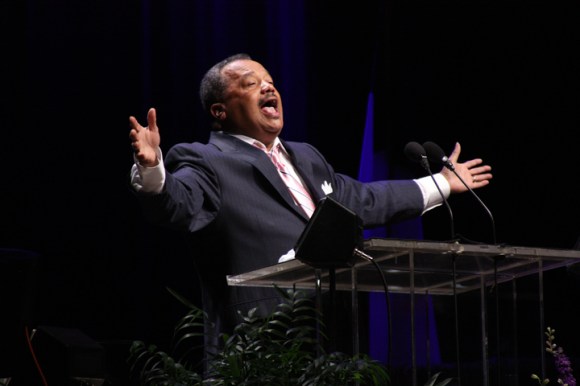
“Elizabeth, you can now exhale, my girl.” Fred Luter adjourned the 2013 Southern Baptist Convention with a smile, a word to his wife, and probably a sigh of relief. His first convention as president brought little controversy – a half-hour discussion on a Boy Scouts resolution was the most buzz-worthy topic. And, while fewer in number than in previous years, Baptists gathered at the George R. Brown Convention Center were focused on reversing the denomination’s decline, with a focus on true revival.

“Lord, send a revival, and let it begin with me,” Luter said in his last words to messengers.

Unofficial numbers show 5,103 messengers registered in Houston. Despite the low-key tone, trends emerged that could chart a new course for the SBC:

-Events targeted toward young leaders were well attended, allaying fears – for now – that the next generation is unengaged and uninterested.

-Under the leadership of new Ethics and Religious Liberty Commission President Russell Moore, Southern Baptists’ policy agency could be marked by an emphasis on “convictional kindness.”

-The convention’s declining baptism and membership numbers are very real indicators of decline, but for the most part, the meeting kept a hopeful tone, buoyed largely by Luter’s good-natured approach to his time at the podium. Re-elected to a second term, he will play a key role in reigniting Baptists’ passion and commitment to cooperate together, as the convention looks toward the 2014 Annual Meeting in Baltimore.

The June 17 issue of the Illinois Baptist will cover all this and more – read it online this Friday and ibonline.IBSA.org. And thanks for following along these past few days. As they say in Texas (we think), So long, pardner!

Fred Luter and his wife, Elizabeth, are recognized by convention messengers Wednesday afternoon. Luter was elected to a second term as SBC President in Houston this week.

Fred Luter and his wife, Elizabeth, are recognized by convention messengers Wednesday afternoon. Luter was elected to a second term as SBC President in Houston this week.

BREAKING_NEWSHOUSTON | Messengers to the 2013 Southern Baptist Convention approved a resolution this morning calling for Boy Scouts of America (BSA) to “remove from executive and board leadership those individuals who, earlier this year, sought to change both the membership and leadership policy of Scouts.”

The resolution doesn’t prescribe any specific action as related to continuing or discontinuing fellowship with Boy Scouts, but does “affirm the right of all families and churches prayerfully to assess their continued relationship with the BSA.”

A messenger from Florida moved that the Resolutions Committee strike a reference to churches who choose to remain in fellowship with Boy Scouts. The amendment was defeated. Debate on the issue last around a half hour, requiring the committee to move the second half of their report to the afternoon session. On the docket: resolutions on the Cooperative Program, WMU, prayer for the President, religious freedom, age discrimination in healthcare rationing, and America’s growing prison population.

This morning, messengers also approved resolutions for:

-Appreciation for the 2013 annual meeting

-Recognition of the Bill Graham Evangelistic Team

-Support for safe and healthy children’s ministries, and to protect children against sexual abuse, and

-Commitment to minister to people who struggle with mental health concerns

HOUSTON | The first official day of the Southern Baptist Convention’s Annual Meeting in Houston started with a joke from President Fred Luter (he pretended to bobble the historic gavel used to call the meeting to order). Luter kept the tone light throughout most of the day, but ended with a rousing president’s message that urged Southern Baptists to reach more people with the Gospel. Here, the day’s highlights in pictures:

Danny Akin, president of Southeastern Seminary, was part of a panel at the "Marriage on the Line" breakfast hosted by the Ethics and Religious Liberty Commission. The meeting covered issues like same-sex marriage, religious freedom for churches, and recent Boy Scouts policy changes.

Danny Akin, president of Southeastern Seminary, was part of a panel at the “Marriage on the Line” breakfast hosted by the Ethics and Religious Liberty Commission. The meeting covered issues like same-sex marriage, religious freedom for churches, and recent Boy Scouts policy changes.

Reflecting his desire for greater ethnic representation in the Southern Baptist Convention, Executive Committee President Frank Page prays with African American and Asian leaders during his report.

Reflecting his desire for greater ethnic representation in the Southern Baptist Convention, Executive Committee President Frank Page prays with African American and Asian leaders during his report.

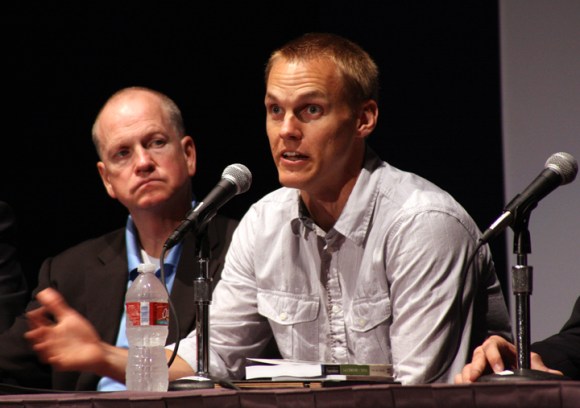
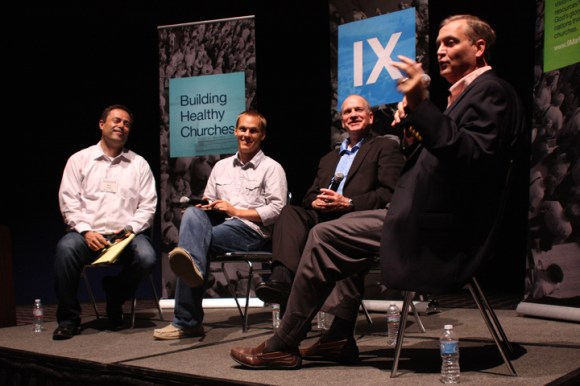
At the Baptist 21 luncheon and panel, the discussion turned to issues that put the church at odds with the larger culture. Alabama pastor David Platt told the audience, "We can't pick and choose when we believe the Gospel, which social issues we're going to apply the Gospel to, and which we're not."

At the Baptist 21 luncheon and panel, the discussion turned to issues that put the church at odds with the larger culture. Alabama pastor David Platt told the audience, “We can’t pick and choose when we believe the Gospel, which social issues we’re going to apply the Gospel to, and which we’re not.”

Richard Land, who served as president of the Ethics and Religious Liberty Commission for 25 years, delivered his final report Tuesday as the entity's leader.

Richard Land, who served as president of the Ethics and Religious Liberty Commission for 25 years, delivered his final report Tuesday as the entity’s leader.

New ERLC President Russell Moore answers questions at a press conference.

Russell Moore answered questions at a press conference before his first presentation as president of the Ethics and Religious Liberty Commission.

Frank Page (left) stood with the advisory team he appointed to study theological differences within the convention. The group's work was "an attempt to start talking to each other, rather than about each other and at each other," Page said.

Frank Page (left) stood with the advisory team he appointed to study theological differences within the convention. The group’s work was “an attempt to start talking to each other, rather than about each other and at each other,” Page said.

Fred Luter laughs as Virginia pastor Mark Croston nominates him for a second term as SBC President. Luter, pastor of Franklin Avenue Baptist Church in New Orleans, was unopposed.

Fred Luter laughs as Virginia pastor Mark Croston nominates him for a second term as SBC President. Luter, pastor of Franklin Avenue Baptist Church in New Orleans, was unopposed.

Adam Cruse, pastor of First Baptist Church, Mt. Carmel, Ill., closes Tuesday afternoon's session in prayer.

Adam Cruse, pastor of First Baptist Church, Mt. Carmel, Ill., closes Tuesday afternoon’s session in prayer.

Charles Billingsley, worship leader at Thomas Road Baptist Church in Lynchburg, Va., leads convention messengers in worship with help from the choir from Houston's Second Baptist Church.

Charles Billingsley, worship leader at Thomas Road Baptist Church in Lynchburg, Va., leads convention messengers in worship with help from the choir from Houston’s Second Baptist Church.

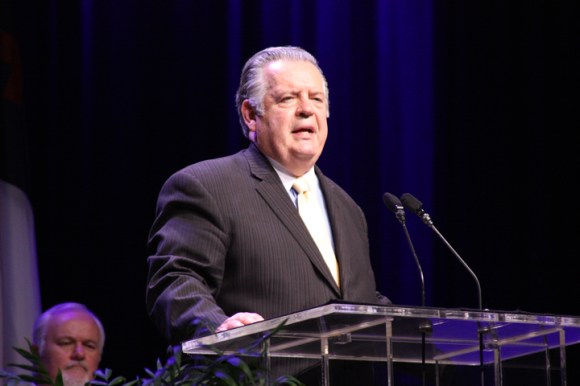
"We need to understand that we're in this together," Luter said in his president's address. "It's not about your church and my church. It's not about your ministry and my ministry. If's not about your kingdom and my kingdom. It's about all of us as Southern Baptists working together."

“We need to understand that we’re in this together,” Luter said in his president’s address. “It’s not about your church and my church. It’s not about your ministry and my ministry. If’s not about your kingdom and my kingdom. It’s about all of us as Southern Baptists working together.”

Mark Dever, pastor of Capitol Hill Baptist Church in Washington, D.C., hosted a 9Marks at 9 session on "the current state of the SBC."

Mark Dever, pastor of Capitol Hill Baptist Church in Washington, D.C., hosted a 9Marks at 9 session on “the current state of the SBC.”

Al Mohler, president of Southern Seminary, explains the Conservative Resurgence of the 1970s and 80s to young leaders gathered for 9Marks at 9.

Al Mohler, president of Southern Seminary, explains the Conservative Resurgence of the 1970s and 80s to young leaders gathered for 9Marks at 9.

Brothers and sisters, I’ve said it before and I’ll say it again at this convention: Nothing, nothing, absolutely nothing can be politically right if it’s biblically wrong.

Fred Luter, preaching his president’s message at the Southern Baptist Convention

Russell Moore (right), the new president of the Ethics and Religious Liberty Commission explains that the ERLC will support principles, rather than specific legislation. President Emeritus Richard Land (left) led the commission for 25 years.

Russell Moore (right), the new president of the Ethics and Religious Liberty Commission explains that the ERLC will support principles, rather than specific legislation. President Emeritus Richard Land (left) led the commission for 25 years.

HOUSTON | Richard Land, President of the Southern Baptist Ethics and Religious Liberty Commission for the past 25 years, turned over the organization’s leadership reigns to new president Russell Moore during the ERLC’s report Tuesday afternoon.

The two men only stood together for a moment, to tag-team answer a question about the ERLC’s stance on immigration reform.

Land’s contribution to the ERLC and to Southern Baptist history was celebrated in a video that showed a lighter side of the long-time culture warrior. Footage of Land telling humorous stories from his past was intercut with words of appreciation from SBC leaders like Al Mohler and Paige Patterson, and from conservative stalwarts on Capitol Hill. Land received a standing ovation from the audience in Houston.

Then, Moore took to the podium. Repeating a phrase he used at Tuesday morning’s “Marriage on the Line” breakfast hosted by the ERLC, he committed to lead churches to act with “convictional kindess” in a world that presents questions that wouldn’t have been asked a generation ago. And referencing Ephesians 6, he urged Southern Baptists to remember who the true enemies are.

“We oppose demons. We don’t demonize opponents.”

He also tried to put in perspective Christians’ ideological differences with the culture.

“We have no reason to be fearful or sullen or mean. We’re not the losers of history,” Moore said.

“Since Jesus is marching onward and since the gates of hell cannot hold Him back, why on earth would we be panicked over the Supreme Court?”


What the Conservative Resurgence bought for us as a denomination was a second chance to be theological, rather than dead.

Al Mohler, speaking at the B21 panel discussion in Houston

For the Supreme Court to attempt to define marriage, when marriage is already clearly defined in the first chapters of Genesis forever and ever, is unbridled chutzpah. They have no business even attempting it.

Paige Patterson, at the “Marriage on the Line” breakfast hosted by the Ethics and Religious Liberty Commission