Archives For November 30, 1999

Redunda_Noble_blog_calloutHEARTLAND | Redunda Noble

Our church recently completed a study based on Thom Rainer’s eye-opening book “I Am a Church Member.” In the book, Rainer shared practical insight for developing the right attitude about the part we play as members of the Body of Christ. I breezed through the first few chapters with an air of superiority. As the wife of a pastor for more than 15 years, I was completely proud of myself for being a “model” church member. After all, I was already obeying most of the principles articulated in the book. I kept thinking, “It sure would be great if ‘brother and sister so-and-so’ read this book.” (Be honest. You know you have thought this too!)

I gleefully stood on my pedestal — until I got to chapter four.

The title, “I Will Pray for My Church Leaders,” hit me on the head like a ton of bricks, knocking me off my pedestal and down to my knees.

The moment I read the title, it struck me that I was the one who needed this book. I was not spending quality time daily in prayer for my pastor (who is my husband) and the other leaders of our church. (Bear with me while I confess.) I prayed daily like most Christians. I prayed for my family, my health, my needs, my wants, my desires, my struggles … my, my, my. My. All about Me! Oh My! How selfish I was in my prayers! Nowhere in my prayers did I petition the Lord specifically for the needs of my pastor and leaders.

We mistakenly think our pastor doesn’t need our prayers because when we see him, he is in the pulpit, often wearing a tailored suit and always a smile. We never want to think that our pastors and leaders might be struggling and desperately need our prayers.

Rainer challenges us to pray five minutes a day for our pastor. Only FIVE minutes. Who doesn’t have five minutes, right?

Jesus is the Son of God; yet he understood the importance of prayer in ministry. In Luke 6:12, the Bible records Jesus going to a mountain to pray. He stayed there and prayed ALL NIGHT. As Christians, we should follow Jesus’ example by spending ample time in prayer. While most of us understand we should pray, we have difficulty finding the time to pray. After looking at my own prayer life, I found that I struggled in three areas:

Prioritize prayer
How often do we get up in the morning, get dressed, eat breakfast and rush out the door, certain that we will have time to pray later? But later never comes. By 10:30 p.m., I was exhausted from the busyness of the day, managing to whisper only a few words to the Lord before drifting off to sleep. To prioritize prayer, I had to prioritize my morning and designate a specific time to pray.

Learn what your pastor’s needs are. Pray for his needs the way you pray for your own. It does not matter when you pray as long as you do pray. Put a daily reminder in your smartphone and take the time to pray for your pastor.

Persevere in prayer
You will find that when you decide to pray regularly for your pastor and the leaders in your church, many things will challenge your commitment. You may choose to start with prayer early in the morning, but on the day you begin, the baby wakes up crying at the same time. You may decide to pray on your lunch break at work, but find that other employees constantly interrupt. You may plan to pray in the evening, but your child’s teacher sends extra homework that requires your help. Whatever the challenge, recognize that prayer honors God. Don’t give up. Although you may struggle in the beginning to pray, what joy you will find when you persist.

Prayer is a privilege
What is your attitude toward prayer? Do you see prayer as just another chore added to your to-do list? Attitudes are important to God. View prayer as a privilege. See it as your opportunity to spend time with the One who loves you most. Ask God to give you a desire to pray.

I have struggled to be consistent. But I find that as I continue to pray, my love for the Lord, His church, and my spiritual leaders grows deeper. I hope you find this to be your experience as well.

Redunda Noble leads a women’s Bible study, sings at church and serves alongside husband James Noble, pastor of Grace Fellowship Baptist Church in Memphis, Tenn. This Baptist Press column is part of the call to prayer issued by Frank S. Page, president of the Southern Baptist Convention Executive Committee, to pray for revival and spiritual awakening for churches, the nation and the world.

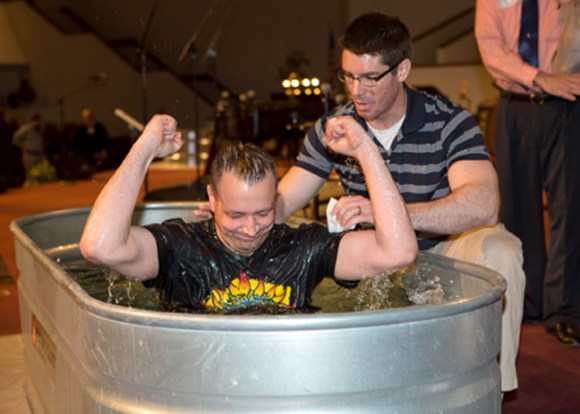
After being baptized in a horse trough, David Vittetoe celebrates as John Howard, minister to students, assists. The troughs gave the church three locations to baptize the 103 people who came forward.

After being baptized in a horse trough, David Vittetoe celebrates as John Howard, FBC O’Fallon minister to students, assists. The troughs gave the church three locations to baptize the 103 people who came forward.


HEARTLAND | Lisa Sergent

Over a single weekend, more people were baptized at First Baptist, O’Fallon, than in all of 2013. The church’s crusade March 29-30 resulted in 103 baptisms, 17 salvation decisions, and 15 rededications.

Tom Dawson, FBC’s minister of adult education who helped organize the crusade, described it as “a wonderful event.” He called Texas evangelist Ronnie Hill “electric. He brought God’s Word straight to peoples’ hearts.”

Dawson said the church did “quite a bit of preparation” in the month before the crusade. Prayer, training, and logistics were key. Groups spent time praying for Hill and for those who would come and make decisions. Church members were trained to be “encouragers,” or counselors, to talk with people as they came forward.

Carol Cluff, adult ministries specialist, said the encouragers were trained a few days in advance of the crusade. “We wanted to make sure every person who stepped forward had someone to come with them, to talk with them about what prompted them to come forward, and to make sure they fully understood the commitment they were making.”

She noted many of those who were baptized had come to understand they had been “baptized out of order. Several people realized they had been baptized as a baby or even as a child without knowing Christ and wanted to be baptized now as believers in Jesus. Others had accepted Christ at youth events some time ago, but not taken that step.”

Sarah Schultz rejoices with Skip Leininger, associate pastor of FBC O’Fallon, after being baptized at the church’s March 29-30 crusade.

Sarah Schultz rejoices with Skip Leininger, associate pastor of FBC O’Fallon, after being baptized at the church’s March 29-30 crusade.

Hill urged the church to be ready to baptize people in each session and not make them wait until a later date. In anticipation of a large number of baptisms, the church made sure to have plenty of T-shirts, shorts and towels on hand. Plus, they placed two horse troughs filled with water on either side of the platform giving them three locations, including the baptistery, to baptize people in a single service.

“We were ready to baptize people on the spot,” Dawson said.

First Baptist has made follow-up a priority, stressing the importance of continued discipleship. In a series of follow-up actions, encouragers are keeping in touch with those they counseled and are connecting them with small groups within the church. As part of the effort, Senior Pastor Doug Munton is leading a special sermon series covering the Good News and the importance of baptism along with why Christians should share their faith and be fishers of men.

Munton is pleased with the crusade’s outcome. “We had a great crusade,” he shared. “The Gospel was preached clearly and the response was great. Many people trusted Christ as Savior and that never gets old to me. And, it was such a privilege to see more than 100 people follow the Lord in believer’s baptism.”

Leininger prepares to baptize Sonja Conrad.

Leininger prepares to baptize Sonja Conrad.

Dawson said church members are excited. The momentum continued into Easter as the church had its largest Easter Sunday worship attendance – 2,569 people.

“The crusade was wonderful,” said Cluff. “It lit us on fire.”

Erich_Bridges_blog_calloutHEARTLAND | Erich Bridges

She wants desperately to return to the hurting people she loves.

Laura Miles* is a missionary on hold. At least, she sometimes feels that way.

Miles spent two terms overseas with her husband, in places where the people she served are experiencing hard times and the threat of worse. It tears her up inside to watch from a distance their suffering. But for now she’s back home, where she and her husband minister to young adults in a local church.

“We really felt like it was a lifetime calling,” Miles said of the first stint abroad. “We went over and just loved the people, loved the ministry. We have a definite heart for Muslims. We felt like we really connected, but about halfway through the Lord was telling us we needed to go back and [prepare] for long-term career ministry.”

They thought God would lead them back to the same place, “but it wasn’t long after leaving that we felt that door kind of shut,” Miles said. “We prayed and prayed. We were very impatient with the Lord. We wanted to know where and what was next. We realized we weren’t trusting in Him, so we committed to resting in serving where we were until He revealed the next location.”

When the time was right, they went to a different country and ministered there for three years. “We left everything, sold everything, and we thought it was going to be long-term,” she recalled.

Once again, however, they sensed the Lord drawing them home — this time to reach out to American millennials searching for God’s purpose for their lives. Young women who look to Miles for guidance and inspiration confirm that she’s doing a pretty good job.

Still, a hurting, darkness-enveloped world calls to her.

“Honestly, my heart is on the field somewhere,” she admitted. “So I’m trying to seek out, ‘Lord, who do You want me to be right now while I’m here? Whenever You want to send me back somewhere, I’m ready.’ But until then, it’s about trying to be faithful where you’re at, with whom you’re given.”

The missionary call of God is as clear as glass. He called Abraham to leave his home for a place yet to be revealed (Genesis 12). Abraham obeyed, setting in motion a divine plan that would bless all nations. Jesus called His followers to make disciples among all peoples (Matthew 28:19-20), a command to His church that still stands. The New Testament refers 195 times to a “calling.”

But God’s specific calling to individuals is more mysterious. It arrives in His time, not ours. It might be dramatic or quiet. It might come gradually or in a single, powerful moment. It is personal, tailored to one’s gifts and experiences. It might involve traditional avenues of mission service, or using your professional skills to share the Gospel in the secular marketplace.

“God’s call involves a personal response to the witness of the Holy Spirit within us,” according to “Exploring your Personal Call,” an IMB document shared with potential missionary candidates. “In this sense, the call of God is inward, personal and even secret. People accurately say, ‘God has laid this on my heart.’ There is a sense of ‘oughtness’ or divine compulsion toward a task or occupation. This kind of conviction led Isaiah to utter [in Isaiah 6:8] the memorable words, ‘Here am I. Send me!'”

“This inward call can come in a variety of ways: through reading Scripture, through concentrated prayer, through special events or a special person, or through life’s experiences,” the IMB document reads. “However this personal call comes, it must be followed by a commitment to do that which God intends.”

Obedience, then, is the key. God calls us first to Him, not to a place or a people. Location comes later, and it may change. Abraham didn’t know where he was going; he only knew the One who was calling.

“No one, in other words, has a call to a particular place,” writes author and speaker Joan Chittister. “The call of God is to the will of God.”

Day by day, Laura Miles is learning that truth. What about you?

*Name changed. Erich Bridges is an International Mission Board global correspondent. He blogs at Worldview Conversation.

Layout 1“Father, … I commit my spirit!”
Read Luke 23:46-49, John 19:31-42

Here are some signs that Jesus’ work really worked: The earth shakes, as God’s own creation trembles at the mighty act just finished on a barren hill outside the city. The massive temple curtain separating the place of God’s holy presence from sinful people is ripped from top to bottom, signifying the Creator’s invitation to humanity to enter into restoration. And on the cross, Jesus makes his own great declaration of faith in the Father’s plan: I trust You.

How could Jesus say this?

No prisoner in solitary confinement was ever more alone than our Christ on the cross. It had to be that way.

faithOnly Jesus could serve as the sacrifice for our sins. Only Jesus could be our spotless lamb. Only Jesus could be the human qualified to pay the penalty for sin. Because he was sinless. And in this he was unique in all of the universe. In this he was alone.

All he had to hold to was the Father’s promise of life on the other side of the grave. Soon he would rest, his salvation work complete. Soon all heaven would celebrate.

PRAY Lord, because of Your great love and completed work on the Cross, into Your hands I, too, commit my Spirit.

Layout 1“It is finished!”
Read John 19:30, Hebrews 1:1-3

When its payment is completed, a bill is customarily stamped “paid in full.” No more payment is expected. The cancelled paperwork is proof that the debt is no longer held against the debtor. In New Testament times, the word written across the final invoice was tetelestai. This Greek word means “it is finished.”

Tetelestai (pronounced “tuh-TELL-uh-sty”) appears only twice in Scripture, in John 19:28 and 19:30. In the first verse, “Scripture” is described as tetelestai. Often translated as fulfilled or completed, it is finished. Jesus did everything the prophets said he would do. He left no job undone, no stone unturned.

finishedOnly two verses later in John’s account, Jesus himself declares his mission accomplished. After six hours on the cross, painfully pulling his body up to swallow every breath, it is almost impossible for Jesus to seize enough air to shout this news.

But he does. And everyone is stunned.

Tetelestai!

PRAY Lord, I am amazed by all you did to save me. Thank you for completing my redemption. Your work is finished, and I am paid for in full.

Layout 1“I thirst.”
Read John 19:28-29, Psalm 69:21,
Zechariah 12:10

Several times the Gospel writers say the events of the crucifixion happened to fulfill Scripture. Jesus sipped the sour wine. His bones were not broken, which would have sped up the dying process. His side was sliced open, and the water separated from the blood that spilled out showed he had died. Why was it necessary to fulfill the Scriptures?

Doubters might say that Jesus, sweet but deluded, had sacrificed himself unnecessarily. They might say there was no divine plan from before creation to redeem humanity from sin and death. They might say it was all miserable happenstance, a bad turn of events.

fulfilledBut as the pivotal point in all history, the crucifixion was no accident. And to prove it, the Author of the plan had it written down hundreds, even more than 1,000 years before it happened. Bible scholars point to over 300 Old Testament prophecies of the birth, life, death, and resurrection of the Messiah.

And for it all to be proven true for those of us who stand on the A.D. side of time, Scripture was fulfilled. Down to the last sop of vinegar. Down to the last spear point.

PRAY Lord, thank you for the details of the crucifixion proving Jesus’ humanity, the reality of his death, and your divine plan over it all.

Layout 1“Why have you forsaken me?”
Read Matthew 27:45-49, Psalm 22

The crowd on Golgotha thinks Jesus is calling on Elijah for rescue, but he isn’t. He’s calling on Elohim. With the opening to Psalm 22, he invokes the entire prophetic psalm. It’s a word picture written a thousand years earlier showing the Messiah, abandoned to die.

How can someone who lives in constant contact with two others ever be alone? That has never happened before. The Trinity is the perfect picture of community: three persons enjoying complete unity, holy boon companions always in agreement.

forsakenBut for three hours Jesus feels nothing but the weight of our sin, and the one who knew no sin becomes sin for us. It’s so revolting that the Father who ordained it can have nothing to do with it. And Jesus, for the first time in all eternity, is alone.

Standing beneath the cross, disciple John and mother Mary witness in the skies what’s happening within Jesus Himself. The sky grows dark. The sun is blotted out. And rain falls on them all, the tears of heaven, as Jesus cries, Why have you left me?

PRAY Lord, when I feel alone, remind me that you know how it feels. And because You bore my sins, I need never be separated from God anymore.

Layout 1“Woman, behold your son.”
Read John 19:25-27

Jesus’ most tender word from the cross is to Mary; perhaps his most challenging is to John. Behold. To both of them he says “behold,” a command meaning to look, see, and understand.

“Behold your son…behold your mother.” Behold my provision; behold your responsibility.

To Mary, Jesus is affirming his love for her. As the eldest son in the family, it is Jesus’ duty to provide for his mother in his earthly father’s absence. He entrusts her care to his dearest friend on earth, his beloved follower John.

familyTo John, what an awesome responsibility this must be, that his friend, teacher, and Lord would give to him this duty as if Mary were his very own mother. If he never knew it before, John must realize it now: he really is one of the family. Jesus’ family.

Behold. Could there be any greater statement of the love of God than to be made part of the family?

PRAY Lord, when I behold you, help me to understand that you are the Son, and you have welcomed me into your family.

Layout 1“Today … in paradise.”
Read Luke 23:39-43

One thief spits curses and ridicule. The other pleads, Remember me. Both deserve death for their crimes. The law said so. The judge said so. The hammer said so. The executioner agreed. But their reactions to their punishment are exactly opposite. Why?

One gives up hope, even when hope is right before him. The other holds onto hope, not because he can see it, but because it’s the only thing he has left.

futureOne man believes in death there is no future. The other believes in the future there is no death. And in response to his faith, Jesus holds before the believing thief the promise of paradise.

What a contrast to the utter degradation of the executioner’s hill beside the smoking city garbage dump: Paradise. Eternity. Joy. A never-ending future in the presence of a loving God.

PRAY Lord, help me remember there is a future and a hope as I face death, even though I deserve it.

Layout 1To prepare for celebration of the Resurrection, we must first witness the agony of the cross. Crucifixion is a most torturous form of execution. It may last several hours or several days. The body’s systems shut down and the condemned man’s lungs fill with fluid. In effect, he drowns. As he pulls against the spikes in his flesh, trying to lift his body just enough to gulp another breath, Jesus uses his last energies to make seven bold declarations.

Standing at the foot of the cross with his most devoted follower, John, and his mother, Mary, we watch as Jesus pours out his life. We listen for clues to his future – and ours – as the Lord of all creation bows to his Father’s will on our behalf.

Use these devotionals once a day during Holy Week, or as an hour’s contemplation on Good Friday.

“Father forgive them,”
Read John 19:17-24, Luke 23:32-34

forgivenIt’s brazen. The soldiers who beat Jesus then stripped him and nailed him to the beam. They raised the cross and let it drop into the hole that held it up, letting Jesus’ full weight pull against the severed flesh where the great nails affixed him. Now they have the nerve, stooping to the ground before that very cross, to gamble for the only nice thing Jesus had on earth, his seamless robe.

And yet, their brazen offense, to kill a man and rob him of his clothes as payment, is not the most heinous crime Jesus suffered that day. He had laid on his back all the sins of all people of all time. And still, he says, Forgive them.

Who else could offer such a word? Only the one who is offended has the right to forgive the offender. Only he could extend grace to the one who sins against him. Jesus’ desire is always that we accept his forgiveness and live in his grace.

PRAY Lord, I, too, am responsible for your death. Help me to live in gratitude for your forgiveness.