Archives For November 30, 1999

The Chicago vortex

nateadamsibsa —  January 12, 2015

HEARTLAND | Nate Adams

It’s January, and another “polar vortex” appears to be descending upon our heartland homes. Just a few days ago the temperature outside was flirting with 50 degrees. But then yesterday was barely above freezing, and as I write now it’s 16 degrees, heading for a low of 6 tonight, with wind chill temperatures that will require those dreadful minus signs in front of them.

Nate_Adams_Jan12So instead I’m choosing to think about next summer, and I encourage you to do so too. Now, in the dead of winter, is a perfect time to start planning a summer missions experience.

Your church may already have a plan for sending one or more groups on mission trips outside your own community this year. Many churches in Illinois have adopted an Acts 1:8 strategy, and are seeking to send mission groups to serve nearby in their local association, as well as elsewhere in Illinois, North America and internationally. These are modern day equivalents of the “Jerusalem, Judea, Samaria, and the Ends of the Earth” mission fields that Jesus spoke of in His last words on earth.

If your church doesn’t yet have a mission trip planned for this summer, and especially if you have teenagers in your church, let me suggest one option where most of the planning has already been done for you. It’s called ChicaGO 2015, and it will be hosted July 26-31 on the campus of Judson University in Elgin. You can find more detailed information on the IBSA website, or by calling or
e-mailing Rachel Carter (217-391-3101 or RachelCarter@IBSA.org). Even if you only have two or three who can go, they will be quickly welcomed into the larger group.

During ChicaGO 2015, your group will be housed on the Judson campus there in Elgin, but during the days you will explore one or more of Chicago’s 77 neighborhoods or diverse suburbs. Morning training sessions and evening worship experiences will allow you to meet some of the dynamic church planting missionaries that are seeking to advance the gospel in our nation’s third largest mission field. And during the day you will work right alongside them, and alongside other students and adults from Illinois churches that share your heart for advancing the gospel there.

Wherever you live in Illinois, ChicaGO 2015 is relatively nearby, and affordable. Planning and preparations for the week, such as meals and work projects, will have been done by IBSA before you get there. Participants can be both students and adults, and the environment is one that’s safe, and yet that will open your group’s eyes to the vast and diverse lostness that is Chicago.

You see, Chicago itself is a vortex, and not just in the winter. A vortex is defined either as a “whirling mass,” or simply as “something overwhelming.” That’s why, when the frigid air from the Arctic Circle whirls its way down into Illinois, we feel the overwhelming
brutality of its icy grip. But there is also a whirling mass of people in Chicago that are in the icy grip of lostness. Many have never heard the true gospel in a way they can understand, or from people that care enough to meet them where they are.

That’s why now, this winter, right in the middle of our polar vortex, is an ideal time to plan a summer mission trip. Perhaps you will join our church planters and me in the Chicago vortex next July. Or perhaps your church has identified a different vortex of lostness or two to enter. Last year more than 26,000 Illinois Baptists did. It warms my heart just to think about it.

Nate Adams is executive director of the Illinois Baptist State Association.

My best prayerwalking technique came from second graders.

PRAYER | Cheryl Dorsey

Editor’s note: This is the fourth and final post in a series on prayer and spiritual awakening. Read the previous posts: 2015: The Year of Prayer, Revise us, O Lord, and 15 prayer requests for your city.

One of my most profound prayerwalks took place with a pair of 7-year-olds. On that particular Saturday at our church, everyone had already paired up for the half-hour walk through our community of 500 homes. Leaving me with my son, Joseph, and a friend’s grandson, Antoine.

On school days, waking Joseph up was an ordeal. But on prayerwalking Saturdays, he beat me at getting up and ready to head to church. Amazing! We use the simple strategy – walking the neighborhoods around our church in two’s and three’s – to identify needs in our community and pray on the spot for people we encounter, that they might come to know Christ.

Joseph, Antoine and I began to walk three blocks around the church. I launched into a powerful prayer: “Lord, let your salvation come to this house! Send your power, Father. Change hearts, O God!” When I paused to allow the babies to get a word in edgewise, I heard this:

“Lord, help this little boy to help his mommy clean the front yard.”

And another saying, “Jesus, please give the little boy in this house a new Big Wheel because his is broken.”

And then, “Jesus, help them get these beer bottles out of the yard. They shouldn’t be drinking, Lord! Help them to stop.”

Even though I was towering over my prayerwalking partners, I felt seven inches tall.

That morning, the Holy Spirit taught me what prayerwalking is all about. He used Joseph and Antoine to teach me again what it means to pray “on site with insight,” which is how we encourage all our prayerwalking teams. Here’s what it looks like for us:

Each session starts with a 15-minute meeting at the church. This is when we distribute prayer guides, go over prayerwalking basics, and point everyone to a focal Scripture that will set the stage for the next hour.

We send pray-ers out from the church in two’s and three’s, instructing them to go as far as they can and be back in half an hour. As they go, we urge them to pray “on site with insight.” That’s God’s insight and not their own.

Prayerwalkers pray as they’re prompted by the things they encounter. Every street is different. Our prayers should feel conversational, low-key, but powered from on high. If folks across or down the street can hear us, we’re doing it wrong.

Each person in the groups takes a turn praying in short paragraphs, not soliloquies. I like it to making a prayer quilt – everyone brings a piece. If we encounter people along the way, we introduce ourselves and ask if they have any prayer needs. If they say yes, we ask permission to pray for them right there. Or, we take the names and requests back to the church to add to our prayer list for the week.

During our walk, we may pray, quote Scripture, or sing, all as the Spirit prompts the pray-ers. Once everyone is back at the church, we take 15-20 minutes to recap the experience. This is very powerful! Prayerwalking teams share what they encountered and how the Lord had them praying, as well as names they’re adding to the prayer list. As the teams report, a scribe records the headlines on a flip chart, chalkboard, or poster.

The Lord reveals his awesomeness as our teams often see a theme emerge. Even though they prayed on different streets, they see how God loves the community, and works in us through the Holy Spirit to “pray things out” over our neighbors. The prayerwalkers recognize that God has a plan, that they can hear his voice, and that he can use them to bless his people.

That first day I prayerwalked with Joseph and Antoine, I witnessed our youngest pray-ers interceding from their perspective. They prayed for the practical and immediate needs of the house we were passing by, and they hit some spiritual pay dirt. From that point on, they were my favorite prayerwalking partners that summer. I mention them often when I teach, saying kids pray differently because they see things from a different level.

They blessed me, and showed me that children have a place in our prayerwalking ministry. You don’t need to pontificate, just walk, see and pray.

Cheryl Dorsey is a prayer coordinator and pastor’s wife at Beacon Hill Missionary Baptist Church in Chicago Heights. She also serves as prayer leader for Chicago Metro Baptist Association. This column first appeared in the Spring 2015 issue of Resource magazine, online at http://resource.IBSA.org.

HEARTLAND | Charles Lyons

Editor’s note: This is the third post in a series on prayer and spiritual awakening. Read “2015: The Year of Prayer,” and “Revise us, O Lord,” at ib2news.org.

A mid-1800’s revival that started with a small prayer meeting in New York City resulted in thousands upon thousands of people trusting in Christ. We need such a movement today, perhaps using several ideas from this list. Use personally, or with family devotions. Share it with your church prayer group of Bible study group. Share on Facebook.

City HallLead your church to pray for one item each Sunday for 15 Sundays. Use each one for a church prayer focus for a week each.

“Seek the welfare of the city where I have sent you into exile and beseech the Lord on its behalf. For in its welfare you will also have welfare.” (Jeremiah 29:7)

1. Invite the Holy Spirit to teach you to pray as He helps you to pray.

2. Pray for your pastor – his spiritual health, his marriage, his family, his vision, wisdom, and spiritual power. Ask God to enhance his ability to lead your church to reach your city or town.

3. Pray for your church family to enthusiastically engage in serving your community.

4. Pray the same for the pastors in your city.

5. Pray for the newest church you know and the oldest church.

6. Pray that your church family will impact your city or town in 2015 as never before.

7. Pray for your mayor – a sense of accountability to God, humble acknowledgement of need for wisdom, relationship to God, and desire for righteousness and integrity.

8. Pray the same for your police chief.

9. Pray the same for your fire chief.

10. Pray the same for your city council or your local elected official.

11. Pray the same for your superintendent of schools.

12. Pray for the schools closest to you, the high school and its principal, the grade school and its principal.

13. Pray for those who work in the healthcare system in your community – administrators, doctors, nurses, technicians.

14. Pray for your closest neighbors or friends to be saved and be fully devoted disciples of Jesus Christ.

15. Pray for a merchant or clerk you interact with on a regular basis.

Part 1

Part 2

Charles Lyons pastors Armitage Baptist Church in Chicago.

PRAYER | Phil Miglioratti

Editor’s note: This is the second in a series of posts on prayer and spiritual awakening. Read the first, “2015: The Year of Prayer,” here.

Read the headlines in Christianity Today and you’ll being praying for a revival. Read Time magazine and you’ll plead with heaven for a spiritual awakening.

From the church, we have reports of plummeting Sunday attendance: Polls once claiming 40% or more are now reporting a more accurate 17%. And the statistics about disappearing youth are even more appalling.

Plant in dried cracked mudAnd in the culture: States are redefining marriage. Economic collapse is rooted in a corrupt banking system. And for more examples of why we are desperate for a spiritual awakening, we need only to watch the evening news.

The Church needs to be revived. Not merely your congregation, but the Church across North America. A revival that spills out of our sanctuaries and brings spiritual awakening to the tributaries that feed and fuel our culture. Education. Business. Media. Family. Health Care. Entertainment.

But have we considered this: What if God is responding to our prayers for a revival and our pleas for an awakening, but we are failing to notice?

What if God is answering our calls for reviving the Church by His work of revising the Church? Could the revising work of the Holy Spirit be a preparing of the Church for some kind of non-traditional impact on our culture? Should we be looking for new ways the Church is influencing communities with God’s good news?

Since the 1980’s leaders have commented on how several trends have brought correction and health to the Church.

  • Worship has become, well, worship. We are learning to sing songs as an expression of praise and petition rather than as performance or for our entertainment.
  • In many congregations, prayer has matured from reciting lists of sick members to listening to the Spirit; from me, myself, and I, to the least, the lonely, and the lost.
  • Church planting has become a top priority in a growing number of evangelical denominations. The churches my daughters take my grandkids to are new and vibrant, unhindered by traditions and systems designed for 19th century cultures.
  • Cities are no longer merely zip codes. God has raised up “city reachers,” leaders with a citywide vision who call the Body of Christ in a community or city to serve better together in collaborative evangelism. The “100 Cities Invitation” hopes to catalyze acts of kindness and justice to demonstrate the Good News in 100 cities in 2016.
  • That same year, RESET, a new initiative led by under-35 leaders, will call young people to the National Mall in Washington, D.C. for repentance and revival. Could spiritual awakening of their generation be far behind?

In all this, I see God answering our pleas for revival by revising the Church in a Romans 12:2 way. Our methodologies are being transformed by the Holy Spirit’s renewing of our minds. We are rethinking the need to reconnect evangelism and discipleship. Even very small congregations realize they need to get our of their seats and into the streets with the prayer-care-share lifestyle of Christ-followers. We read more and more of a new generation of leaders who bring good news in very different ways that relate to our radically changed culture.

I see signs that God is responding to our “revive us again” supplication and the seeds He is planting for spiritual awakening. What signs do you see?

Part 1

Part 3

Phil Miglioratti heads the National Pastors’ Prayer Network and serves as IBSA’s prayer ministries consultant. This column first appeared in the Spring 2015 issue of Resource magazine, online at http://resource.IBSA.org.

HEARTLAND | Eric Reed

O Lord, my God, when I in awesome wonder consider all the works Thy hands have made in 2014…

365 days marked by evening and morning, 365 sunsets and sunrises, as 143,341,000 people were born onto this planet and 56,759,000 departed, all receiving 1,640 minutes each day and blessings beyond number, I say

Thank you, Lord, for saving my soul; thank you, Lord, for making me one of the billions you have saved by grace through faith. I was sinking deep in sin, far from your holy standard, and yet you made a Way for me—for us—to be rescued.

And His Name is Jesus.

Dear Lord and Father of mankind, forgive our foolish use of time and grant that we may more wisely employ our moments and our days to share your peace with a world that has suffered its absence this year: the death-march of ISIS and the persecution of Christians in the Middle East, the kidnapped girls and the lost boys; the fear in Ferguson, and the failure of our social contract. We are grateful for God’s peace in our hearts, even as we realize the fragility of peace in our streets.

Sixty years after D-Day, bless the Greatest Generation who secured our freedom, and guard the young soldiers whose service today has redefined sacrifice.

calendar 2014.In this, the year of Ebola, we pray: Eternal Father, strong to save, whose arm hath bound the deadly wave with wonder drugs and rescue teams, hazmat suits and quarantines. For healthcare, though at times it’s costly, sparing lives that once would lost be; for ribbons pink and yellow wristbands and friends who live strong when faced with cancer. (And their hats.)

O God, our help in ages past, our hope for the year to come, we’re grateful for a stronger economy, steadier jobs, and the roof overhead. Our kids are warm and safely tucked in; thank you for the joy of children (those here now and those a’comin’).

For our Baptist family on bended knee lifting lost ones up to Thee; for our dear church, where would we be without your Body on earth that meets just down the street and comes over for small group?

For faithful friends and faithful givers, co-laborers in Christ who become brothers and sisters, the cloud of witnesses in heavenly places who cheer us on as we run our races.

Our Father, who art in Heaven, hallowed is all you made and we marvel still at your inscrutable creation…yet little things cheer our hearts and make us sing “Happy” songs. I love breakfast (oh it’s so good!), foods I eat and foods I should. Coffee hot and iced tea sweet, mittened-hands and sock-warmed feet; feeling glad when winter comes and gladder still when winter goes.

Clinging to the hope of spring, there are 10,000 reasons for my heart to sing…Bless the Lord, O my soul, O my soul…because whatever comes in 2015,
“I am persuaded that neither death, nor life, nor angels, nor principalities, nor powers, nor things present, nor things to come, nor height, nor depth, nor any other creature, shall be able to separate us from the love of God, which is in Christ Jesus our Lord” (Romans 8:38-39).

Eric Reed is editor of the Illinois Baptist and IBSA’s associate executive director for the church communications team. This column was written in the style of the late Joan Beck, Chicago Tribune columnist, whose annual “thanks” essays inspired readers for 30 years.

Danielle and Jonathan Spangenberg portray Mary and Joseph at Living Faith Baptist Church’s living nativity scene Dec. 6.

Danielle and Jonathan Spangenberg portray Mary and Joseph at Living Faith
Baptist’s living nativity scene Dec. 6.

HEARTLAND | Meredith Flynn

“Start tending the sheep!” The warning is issued from a pint-sized shepherd on this chilly Saturday night in the parking lot of Living Faith Baptist Church.

The shepherds are a middle stop of the church’s drive-through nativity experience, and these kids in belted tunics have been waiting for the first car to arrive at their scene. Inside the cars, families listen to a CD of the Christmas story they received as they drove in; each track corresponds to a different scene. Outside, the shepherds act it out, tending their sheep like any other day, until a heavenly host appears above them.

“Christmas seems to be the most hectic time, the most stressful time of year,” says Pastor Adam Cruse. “And so, really, we want to bring it back to what is Christmas truly all about? The simple message of Christmas is about a savior who came into the world, and so we just wanted people to come back to the focus of it all.”

Living Faith planned to do the nativity last year, but were snowed out, making this year the “second annual attempt,” according to associate pastor Daniel Waters. A few minutes before this year’s performance is set to start at 5:30, cars begin lining up at the edge of the parking lot. Turning off their lights, they drive single-file past several scenes: Mary and Joseph hearing individually from angels; the couple with their new baby and the manger, shepherds tending their flocks; and wise men from the east visiting the family.

The last two scenes don’t feature any actors. In the corner of the parking lot stand three empty crosses, the middle one slightly larger with a white cloth wrapped around it. Next to the crosses, a small trailer has been fashioned into an empty tomb.

“We didn’t want to just focus on the Christmas scene, because it’s very easy to forget what Christ did and why he came,” Cruse said. “He came to die on the cross and then to come out of the grave, so we wanted to depict those scenes as well.”

Nate_Adams_Dec15HEARTLAND | Nate Adams

Have you ever found yourself heading into the Christmas season feeling blue? I have. In fact, this was one of those years.

I couldn’t put my finger on exactly why I felt down, other than the fact that several things haven’t turned out the way I would have hoped this year. It appears some of the key measurements we set for our work at IBSA are not going to be met. In arenas outside IBSA that I care about, several decisions were made this year that were very different than what I thought best. Several people disappointed me. Even as I looked around for things I could call personal successes, well, I just couldn’t think of many.

The second factor that contributed to my blueness was just the sheer volume of work and challenges that seemed to still lay before me. After working so hard and seeing so little of the success I was looking for, it was hard to find the energy to dig in again.

In my blueness, I turned to music for some encouragement and reassurance. I found on my iPhone a playlist of 13 songs titled “Colorado Renewal 2013” that I had made two summers ago, during some personal retreat time. The first song, “Disappear,” by Bebo Norman, quickly gave expression to what I was feeling:

On a day like this I want to crawl beneath a rock
A million miles from the world
, the noise, the commotion – that never seems to stop.
And on a day like this
I want to run away from the routine
Run away from the daily grind
that can suck the life, right out of me.
I only know one place I can run to…

A place to run to is what I was looking for. And the song didn’t disappoint.

I want to hide in You, the way, the life, the truth so I can disappear
And love is all there is to see coming out of me
, and You become clear as I disappear.

For the next few minutes, I ran to Jesus, and disappeared there. I found sweet relief in the reality that Jesus’ completed work on the cross is all I need. I don’t have to earn or deserve anything more. Hidden in Him, everything returns to its proper perspective.

Then, just as the words of the first verse helped me express my discouragement, the words of the second verse helped me set a new direction, and a new motivation for the future.

I don’t want to care about earthly things
Be caught up in all the lies that trick my eyes
, they say it’s all about me
I’m so tired of it being about me.

As I looked back on the things that were making me blue at Christmas time, I realized they really were all about me, and what I could accomplish or control, what I could perhaps call success. And I realized that somehow I had indeed been deceived into thinking that my work, my successes, or even my ministry were the sources of my joy.

I recently watched a documentary about Bing Crosby that credited his classic “White Christmas” with being the song that first secularized Christmas. Until then, most Christmastime songs were sacred, Christ-centered. But after White Christmas, lots of writers and composers began creating sentimental Christmas songs with someone or something other than Christ as their focus. Of course one of those was Elvis Presley’s now famous lament, that it will be a “Blue Christmas without you.”

A Christmas season that depends on successes, or other people, or anything other than Jesus is bound to be blue. Maybe that’s one reason the shepherds fled their work and their despair and their longing and “came with haste” to the manger. That’s exactly where I want to run to and disappear this Christmas.

Nate Adams is executive director of the Illinois Baptist State Association.

Why my family puts a shoebox under the Christmas tree

HEARTLAND | Serena Butler

UNCLE BENNY – The Butler family remembers the best reason to celebrate Christmas.

UNCLE BENNY – The Butler family remembers the best reason to celebrate Christmas.

Where do babies come from? It’s a question children have been asking through the ages and one that parents have found some creative ways of answering. My family has a unique explanation for a baby’s arrival to its new family.

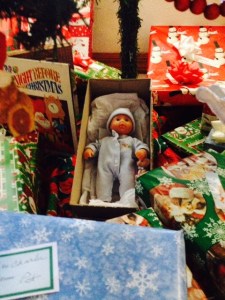
When my dad, Charles, was about two years old, his mother was expecting a baby. The day came for the birth, and the doctor was summoned to the farmhouse in northern Florida. My grandfather took my dad and his older sister out into the fields to take a walk so that they would not be in the house during the delivery. A little while later, when they returned home, my newborn Uncle Benny was there. Because the family did not have a cradle for the baby, Uncle Benny was placed in a shoebox. So, if you were to ask little Charles Butler where babies come from, he would tell you that the doctor brings them in a shoebox.

Seventy-five years ago, Benjamin Harrison Butler was born and placed in a box. Two thousand years ago, another baby was born and placed in a box. Benny was a gift to his family. Jesus was a gift to the world.

This is the time of year when Christians remember the gift of the Christ-child. We hang lights, put up trees, and buy gifts for one another. We plan special worship services and send cards to family and friends. But we must remember that Christmas would not exist if it weren’t for the crucifixion and resurrection. The birth means nothing without the death. For this is the gospel, that Jesus died for our sins and rose from the dead, conquering the power of sin in our lives.

Grace, mercy, forgiveness, and new life are the true gifts given through Christ. But we celebrate the gift at its beginning, the birth.

2 Corinthians 5:17-18 says, “The old life is gone; a new life has begun! And all of this is a gift from God, who brought us back to himself through Christ. And God has given us this task of reconciling people to him.” When we accept the gift, our life is changed forever. In fact we are given a new life. And this new life is a gift from God.

We know that. We have heard it through numerous sermons and devotions. We know it through our own life experiences. But how often do we ignore the next part? Once we have received the gift of salvation, we then are given the responsibility of passing that gift on to others. The verse tells us that we have been “given the task of reconciling people to him.” That means sharing the gospel.

Christmas shopping season is upon us. We will visit malls and shop online. Some of us will spend hours making gifts to be given to loved ones. But the clothes we give will be outgrown or wear out. The toys will break or be cast aside. The electronics will become outdated.

Jesus is the one gift that will never fade away. It is truly the best gift anyone could receive. Paul describes it this way: “Thank God for this gift too wonderful for words!” (2 Corinthians 9:15)

A few years ago, my dad told the story of Uncle Benny’s birth to his Sunday school class. He also related it to the birth of Christ and how he was placed in a box. A few weeks later the class gave my dad a present. It was a baby doll in a shoebox to represent both Uncle Benny and the baby Jesus.

Now, if you were to visit the Butler home at Christmas and look under the tree, you would see a baby doll, dressed in blue, in a shoebox. He is named Uncle Benny, but he is a reminder to our family that the greatest gift of all is Jesus, a baby who was born and placed in a box. It is also a reminder that the baby should not stay with us, but we should be giving Jesus to others.

So, as you look for that perfect gift this Christmas, don’t overlook the gift you already possess. Jesus is the gift that is always the right size, won’t wear out or go out of style, and will be exactly what they were wishing for.

Serena Butler is Upper Midwest regional manager for Operation Christmas Child. She formerly served as IBSA’s director of missions awareness and Illinois WMU.

HEARTLAND | Nate Adams

Recently Chicagoland church planter Dave Andreson was addressing a group of mostly college students on the subject of how to pray for your community. I was there primarily because our son Noah was hosting the meeting at his church, Calvary Baptist in Elgin.

Nate_Adams_blog_callout_Dec1Most of the students were from Judson University there in Elgin, where IBSA is developing a church planting partnership. Dave spoke pointedly to them. “If you’re not currently praying for your community, let me tell you why that probably is,” he said. “It’s because you haven’t really taken ownership of this community. You think of your community as the place that you’re from, or where your family lives. You figure you’re just here for a few years, going to school, so why bother? In the meantime, many of the people you will meet here desperately need to know Jesus Christ.”

I winced with conviction at the truth of Dave’s observation, and not just for college students. Sadly, I’ve known people who seem to have the mindset that their situation is temporary, and as a result they seem to be just biding their time spiritually.

“Oh we just came here for Bill’s job, but we’ll be going back home eventually,” they sometimes say. And yet when asked how long they’ve lived there, the answer is often twenty or thirty years.

Or, “When our kids are older and life slows down some, we may have more time to do missions or help with outreach.” Especially in today’s ever-changing and mobile society, we cannot wait until our situations are more “permanent” to take ownership of our communities. That day may never come.

Dave went on to speak of the passion that Jesus had for a city, and for a crowd, and for a man named Zacchaeus. He urged us to be like Jesus and see our city, and our crowds, and the God-created individuals around us with spiritual eyes. And he invited us to pray with him for Avondale, the Chicago neighborhood that he has now made his home, and where he is seeking to plant a new church. Avondale is a community of only two square miles, yet 40,000 people live there. It has no Baptist church, and little if any evangelical witness.

Dave challenged us all that night to take ownership of our communities, wherever we find ourselves, and to do it now. We can’t wait for more permanent or ideal circumstances. People need prayer, and relationship, and the Gospel message.

His challenge reminded me of a time that our family ate at a fast food restaurant, when our boys were still little. Though the employees were working hard, the dinner rush had overwhelmed them and more than half of the tables were a mess while the trashcans overflowed. So as we left, I asked our boys to help me clear the rest of the tables in the restaurant, in addition to our own. “But Dad, we don’t work here!” one of them cried. And yet because I asked them to, they helped me take responsibility for other people’s messes, there in our temporary community.

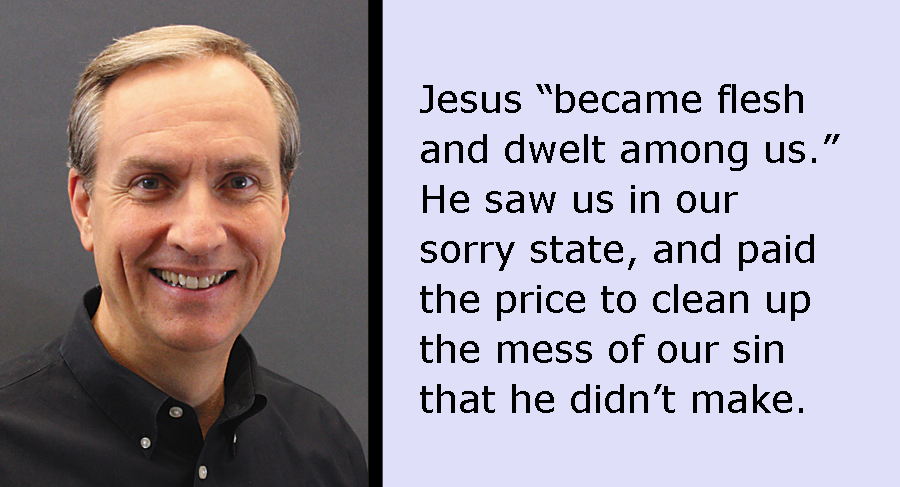
As we enter another Christmas season and begin reflecting on the birth of Christ, let us remember that Jesus willingly entered our world and made it His home. He “became flesh and dwelt among us.” He saw us in our sorry state, and paid the price to clean up the mess of our sin that he didn’t make.

So let’s enter in and spiritually invest in our own communities, even now. Let’s take ownership of where we live, even if it doesn’t feel permanent, or even if it’s in a difficult place like the Avondale neighborhood of Chicago. Our community, wherever it is, is our mission field. Home is here, and the time is now.

Nate Adams is executive director of the Illinois Baptist State Association.

HEARTLAND | Eric Reed

The world has gotten scarier in recent months. If the ongoing threat from Al Qaida, government-sponsored terror in Syria, escalating conflict in Israel, and the persecution of Christians across the Middle East were not enough, now there’s the march of ISIS, a vast, mobile, and unpredictable kind of terror that produces beheadings on our TV screens and a surge in troop deployment.

We might soothe ourselves by saying, “That’s far away—over there,” if not for Ferguson, Missouri. The scenes of protests following the shooting death of a teenager by a city policeman are still fresh, and the threat of deadly riots pending the outcome of a grand jury investigation of the policeman’s actions is even scarier. Our Illinois friends who live in metro St. Louis television market have been subjected to four months of daily news coverage predicting trouble. Teachers, pastors, and church leaders have all been advised what to do if protests again turn violent.

Eric_Reed_Nov24And don’t forget Ebola. For people all over the world, these are scary days. But into such frightening times, God often sends a message: fear not.

The Lord assures Joshua as he assumes command after Moses, “Haven’t I commanded you: be strong and courageous? Do not be afraid or discouraged, for the Lord your God is with you wherever you go” (Joshua 1:9).

Gideon, ordered to save Israel from the Midianites, is fearful until he hears from God himself: “But the Lord said to him, ‘Peace to you. Don’t be afraid, for you will not die’ (Judges 6:23).

From Lamentations, the prayer of all Israel: “You come near when I call on You;
You say: ‘Do not be afraid.’” (Lam. 3:57).

And most famously, the head of a night-sky army tells a little band of shepherds outside Bethlehem, “Fear not, for behold…” In their declaration there’s a reason for steely nerve: A savior, a rescuer has been born.

When God sends the message to be brave and courageous, he often couples it with an assurance of his own presence. “Do not fear, for I am with you; do not be afraid, for I am your God. I will strengthen you; I will help you; I will hold on to you with My righteous right hand” (Isaiah 41:10).

In Isaiah’s question, “Who has believed what we have heard?
And who has the arm of the Lord been revealed to?” (53:1), the prophet is referring to the coming Messiah. God’s strong right arm is Jesus himself. That’s who will defend us. That’s who will protect us.

“Fear not” is not an idle command; God backs up what he says. “For behold” is an invitation to look and see that His promise is ready to be tested and fully verified.

Jesus, walking on water, tells the disciples: “‘Have courage! It is I. Don’t be afraid.’

‘Lord, if it’s You,’ Peter answered Him, ‘command me to come to You on the water.’

‘Come!’ He said” (Matt 14:27-29).

Fear not, Peter, the Lord’s strong arm will hold you up, even on the roiling sea. With such an all-powerful guard alongside, there is no reason to be afraid.

Kizzie Davis, owner of the Ferguson Burger Bar, told KMOX radio last week she refused to board up her new business, as other owners were doing ahead of the grand jury’s report. The mom-and-pop hamburger shop opened one day before the death of Michael Brown and survived the first protests. “We had no issues at that time,” Davis told the reporter. “Prayerfully, we won’t have any issues if unrest occurs this time.”

Customers commended her brave stance. “Cool management. They fear no one, but God,” one posted at the restaurant’s website. (And the turkey burger topped with a fried egg got five stars.)

Davis reminds us all that we can’t live in fear, even in fearful times. And if we follow her example, we too will stay open, keep cooking, and pray.

Eric Reed is editor of the Illinois Baptist and associate executive director for IBSA’s Church Communications Team.