Archives For November 30, 1999

Thanksgiving 2016 FB Twitter.jpg

Give thanks Autumn conceptual creative illustration

(Editor’s Note: Chicago Tribune columnist Joan Beck annually penned a list of things for which she was grateful, letting lines from a few famous hymns to guide her prayer. With appreciation, we borrow her literary form for our own version again this year.) 

As we gather together to count the Lord’s blessings, 396 years after the first Thanksgiving day, we are thankful once again that our forefathers brought forth on this continent a new nation… that survives even today, twelve score years later,

still committed as one nation, despite our divisions,
still committed to the proposition that all people are created equal,
still committed to pursuit of life, the cardinal freedoms, and happiness.

Our fathers’ God, to Thee, Author of Liberty, we are grateful—
For the rule of law and peaceful transfer of power,
for the right to vote, and whether we win or lose, we’re still one nation under God;
That truth, justice, and the American way, mystifying it at times may be
Is God’s gift, this noble attempt to govern well through liberty.

O Lord My God, when we in awesome wonder consider—
this year’s progress with cancer drugs, loyal dogs and healing hugs;
children raised with tender care, troops come home in answered prayer,
dear souls saved by God above…this is amazing grace, unfailing love.

O God, our help in ages past, our hope for years to come;
Wins we never dreamed came true, this was the year for champions:
Gymnasts, Phelps, and medals gold, victory laps and stories told
Of dedication’s sure reward, winners crowned and loss consoled;
Several million voices raised, the whole state rings with the praise;
Holy cow! a chant sublime, Go, Cubs, Go! It’s about time.

Count your blessings, name them one by one…
the bills were paid, the taxes too, the floors were sound, the roof was sure;
with many homeless, we were “homed,” many hungry, we were fed.

So thank you, Lord, for my three squares, Pease’s candy, deep-dish pizza,
Horseshoes, cornbread, and Cracker Barrel.
Forgive the irony, but thank you, too, for insulin and athletic shoes,
which we’ll use next year.

Surely, there are 10,000 reasons for my heart to say…Bless the Lord, O my soul, and forget not all his benefits.

In Christ alone my hope is found…and in a year of uncertainty, we have learned again the meaning of sovereignty, that God’s in charge whatever man plans, when the world’s unsafe we rest in Your hands. At day’s end with the lights turned out, we hold this blessed assurance close, that neither death, nor life, nor angels, nor principalities, nor powers, nor things present, nor things to come, nor height, nor depth, nor any other creature, shall be able to separate us from the love of God, which is in Christ Jesus our Lord.

Eric Reed is editor of the Illinois Baptist.

Go Church Go!

ib2newseditor —  November 14, 2016

People in the form of  church.First let me say I how much I appreciate my many friends who are St. Louis Cardinals and Chicago White Sox fans, even those who seemed to suddenly become Cleveland Indians fans just prior to the 2016 World Series. I try not to be an annoying or gloating Cubs fan, though some might say that simply writing about the Cubs here makes me so.

But it’s not really the now-world-champion Cubs team or organization that I want to draw on for inspiration with these thoughts. Rather, it’s the persevering, always hopeful, and now victorious Cubs fans. Though I grew up a Cardinals fan like many in southern Illinois, five things have always drawn me to Cubs fans, and made me one of them.

Worldwide – The WGN cable network is probably most responsible for giving the Cubs a more than regional fan base. When wearing a Cubs logo, I have found other fans all around the country, and even around the world.

Wrigley – You just can’t deny the old world charm of the historic yet modernized stadium that the Cubs call their friendly confines. For true baseball fans, it’s one of the most inviting places in the world.

Waiters – As almost everyone now knows, Cubs fans had not seen a World Series championship since 1908. As the Series approached, numerous writers listed things that are more current than a Cubs championship, including the toaster and sliced bread itself. True, faithful Cubs fans are by definition those who patiently wait.

Winsome – While I’m sure we all know an abrasive Cubs fan or two, the overwhelming majority of Cubs fans I’ve known are friendly, hopeful, optimistic, and deeply loyal. Even though “lovable losers” is a label that’s practically become part of the official Cubs brand, you can’t get a rise out of a Cubs fan with that kind of insult. After all, until this year, what defense was there to that label? Cubs fans just smile, and winsomely recite their equally well-known mantra: “Wait ‘til next year.”

Winners – And finally, this year, we can add a new capital W that could only have been used in small case a few times over the past 108 years. This year, Cubs fans are winners. Their perseverance finally paid off. Next year has finally come. And in a demonstration of support and celebration that has now been labeled the largest gathering in American history, and seventh largest in world history, more than five million fans flooded the streets and parks of Chicago to relabel their lovable losers—beloved winners.

Now, how do I rationalize writing about baseball here? Well, almost any time I am moved or inspired by something in secular culture, I find it’s because I see in that event a reflection of something larger in God’s Kingdom, or God’s character, or God’s people. In this case, I think I find Cubs fans so inspiring (admittedly, some Cubs players are not) because I see in them a faint reflection of the same qualities I see in faithful Christians, and churches.

Throughout much of the world, including our own nation and state, faithful Christians are not seen as current winners. But, at least when we’re at our best, we are seen as winsome people who are patiently waiting for our victorious Lord Jesus to return. We are seeking to take our love and loyalty and gospel message worldwide. And yet we seek to make each local gathering place as inviting and friendly as the confines of Wrigley Field.

There will be a day when the five million that gathered to celebrate in Chicago will be a pale comparison to the tribes, tongues, and nations that will gather at the feet of Jesus, to worship him forever. But for now, a long-suffering group known as Cubs fans have reminded me of a more important group of people whose patient, faithful, hopeful perseverance will eventually be rewarded by victory. Go Church Go.

Nate Adams is executive director of the Illinois Baptist State Association. Respond at IllinoisBaptist@IBSA.org.

The Faith Frontier

ib2newseditor —  October 24, 2016

Illinois has come a long way, but we still have a way to go

Illinois IL State United States of America 3d Animated State Map

When Illinois became a state in 1818, fewer than 100 people lived in Chicago, and less than that at Calhoun. The hubs of activity were places such as Kaskaskia, on the banks of the Mississippi River. The town swelled to 7,000 when it became the first state capital for one year. Then bustling Vandalia was the capital for 20 years, until Abraham Lincoln and a few others had the capital moved to Calhoun in 1839. Calhoun had been renamed after Springfield, Massachusetts, a center of trade, creativity, and innovation. They had high hopes for their new Springfield—and for all of Illinois.

Catholic priests came to the area early, following French trappers and traders into St. Louis and later Chicago, building a few churches and converting a few Native Americans. The trappers were largely unconverted. Baptists and some Methodists were on scene by 1781, starting the first Protestant congregation in Illinois and building a Baptist meeting house at New Design, across from St. Louis on the river.

Illinois was a frontier state 200 years ago. Today, in many ways, it still is.

Almost 13 million people live in Illinois. But in terms of faith, the state is wild and untamed. At least 8 million residents do not know Jesus Christ. As the population grows, the percentage who identify with any religion at all continues to decline.

The state’s population hubs are our largest mission fields, especially metro Chicago and metro East St. Louis. Our cities are teeming centers of commerce and education, with growing populations of immigrant peoples.

The last census showed Hispanic and Asian populations are the fastest growing ethnic groups in the state. In fact, the Hispanic population grew in all but one of Illinois’ 102 counties.

In Illinois, nine people groups are unreached with the gospel because of language and cultural barriers, but literally millions of English-speaking and culturally mainstream people have never heard the message of salvation in a way they have understood and believed.

On our college campuses, for example, almost 900,000 students represent a mission field with enormous potential, and historically the lowest percentage of believers among young adults ever.

The cultural withdrawal from the Christian faith is felt all across Illinois—in cities and university settings, in small towns and crossroads communities. The northwest quadrant of Illinois is one of the least-Christian areas in the nation. And scattered across the state, there are nine counties that have no Southern Baptist congregation, 12 counties have only one, and many more have minimal evangelical presence.

In 40% of Illinois counties, less than 1% of the population identifies as Southern Baptist.

By faithful, regular, systematic giving to missions through the Cooperative Program, Baptists together serve as missions pioneers, in our frontier territory in Illinois and around the world, wherever the gospel is needed.

With the IBSA Annual Meeting just weeks away, pastors and church members who plan to serve as messengers at the Nov. 2-3 meeting are encouraged to make preparations now. See the checklist below for a step-by-step plan of how to get ready for Chicago.

The meeting at Broadview Missionary Baptist Church is preceded by the annual IBSA Pastors’ Conference, which begins Tuesday, Nov. 1 at 1 p.m. and will feature preachers H.B. Charles, Fred Luter, Scott Nichols, and Jonathan Peters. The Pastors’ Conference also will include breakout sessions on cross-culture ministry and evangelism.

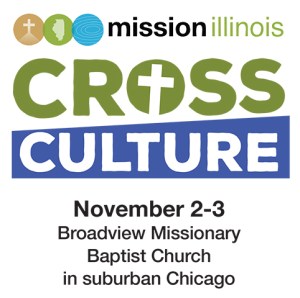
“Cross-Culture” is the theme of the Annual Meeting, which begins at 1:15 p.m. on Wednesday, Nov. 2. Jeff Iorg, president of Gateway Seminary of the Southern Baptist Convention, will help interpret the meeting’s theme throughout the sessions, and will join IBSA Executive Director Nate Adams and other guests for Mission Illinois: “Cross-
Culture” on Wednesday evening.

The meeting also will feature preaching by Kevin Carrothers, IBSA president and pastor of Rochester First Baptist Church, and Adron Robinson, IBSA vice president and pastor of Hillcrest Baptist Church in Country Club Hills.

Meeting attenders will have an opportunity to see Chicago missions and ministry sites on vision tours planned for Nov. 1 and Nov. 3. Space is limited; go to IBSA
annualmeeting.org to sign up and choose your route (Northside, Southside, Westside, Suburban, or a Chicago sampling).

IBSA also will offer dine-in meal opportunities during the Pastors’ Conference and Annual Meeting. See details below and order meal tickets at IBSAannualmeeting.org/meal-tickets.

Check the website, IBSAannualmeeting.org, for all other meeting details, including information about travel, parking, and hotel accommodations. And take note of the other meetings also scheduled Nov. 1-3:

Young Leaders Network
When: Tuesday, Nov. 1, 9:30 p.m.
Where: Broadview Baptist Church
Menu: Wings ‘n things

Pastors’ Wives Luncheon
When: Wednesday, Nov. 2, 9 a.m. to noon
(Coffee fellowship begins at 8:30 a.m.)
Where: Broadview Fellowship Hall
Cost: $15; send check made out to IBSA Pastors Wives to Stevi Smith, 1302 W. Robinson St., Harrisburg, IL 62946
RSVP: Pre-registration is not required, but strongly recommended by Monday, Oct. 24. E-mail Lindsay McDonald at lmcdonald_31@hotmail.com.

Church Planters Breakfast
When: Thursday, Nov. 3, 7 a.m.
Where: Broadview Fellowship Hall
Cost: This is a free breakfast for planters and spouses, but pre-registration is appreciated.
RSVP: RachelCarter@IBSA.org, (217) 391-3101

Directors of Missions/Moderators Breakfast
When: Thursday, Nov. 3, 7 a.m.
Where: Broadview Fellowship Hall
RSVP: If you have received an invitation, please RSVP to LindaDarden@IBSA.org or (217) 391-3137.

annual-mtg-checklist


A popular hotel chain is running a television commercial that cleverly depicts several groups of people trying to decide whether or not to attend a wedding. One is a group of bridesmaids, who clearly aren’t thrilled about the turquoise dresses the bride has chosen. Another group is former boyfriends of the bride, wondering why on earth they all got invited. And one sad lady simply doesn’t want to see Uncle Joe dance in public again. I think it might be Uncle Joe’s wife.

The musical background for the commercial is a rock song from the 1980’s. Over and over that song chants the simple question, “Should I stay, or should I go?”

Because Chicago is our state’s largest and most diverse mission field, we all need to get more familiar with, and comfortable in, this world class city.

As the November 2-3 IBSA Annual Meeting approaches, I imagine there are Illinois Baptists asking themselves that same question. For the first time in several years, the meeting is being hosted near Chicago, at Broadview Missionary Baptist Church. The drive will be quite a distance for those in other parts of the state, just as last year’s location in Marion was a long drive for northern churches.

And of course some will not want to brave the congestion and the traffic. In fact, I don’t know any Chicagoland natives who look forward to that part.

The message of the hotel chain’s commercial is that their comfortable, affordable hotels give even reluctant travelers reasons to go, rather than stay home. So let me suggest some reasons to go to the IBSA Annual Meeting this year.

We need to see and care about and partner with its churches.

First, the challenging theme of this year’s gathering is “Cross Culture.” The program will intentionally showcase the diversity of Illinois Baptists and also point to multiple cultures in our state that desperately need the gospel. There’s no better place in Illinois to receive the challenge to “cross culture” than in Chicago.

Second, because Chicago is our state’s largest and most diverse mission field, we all need to get more familiar with, and comfortable in, this world class city. We need more practice going there. We need to better understand its neighborhoods, its problems, its needs, and its people. We need to see and care about and partner with its churches.

Third, a lot of advance preparation has already gone in to making your stay in Chicagoland as easy as possible. Broadview is a wonderful, generous church, with lots of parking and lots of practice hosting large events. Catered meals have been arranged on site at the church to make the dinner hour easier and more convenient. Nearby hotels have provided very reasonable rates that include breakfast. And Broadview’s near west suburban location makes it a wonderful home base for seeing more of the city, either on your own or as part of two pre-planned vision tours.

Should you stay or should you go?

I could go on and on, but let me cite just one more reason, one that really applies to every Annual Meeting, regardless of location. It’s just very, very good for our Baptist family in Illinois to be together. Throughout the year, we as pastors and leaders and devoted church members work hard in our various local contexts to fulfill the Great Commandment and the Great Commission of Jesus. As the year draws to a close, it is good for us to assemble, and network, and be inspired, and remember that we are not alone in this mission.

Should you stay or should you go? If at all possible, you should go. It may surprise you what the Lord has done across our state over the past year. And it may surprise you how he and the fellowship of your brothers and sisters in Christ will inspire you for the year to come. I look forward to seeing you there.

For more information about the IBSA Annual Meeting and Pastors’ Conference, visit www.IBSAAnnualMeeting.org.

Nate Adams is executive director of the Illinois Baptist State Association. Respond at IllinoisBaptist@IBSA.org.

Come to Chicago

ib2newseditor —  October 3, 2016

Annual Meeting to focus on reaching across cultures—and opportunities in Illinois

am_2016_logoWhen the lawyer—trying to get out of his moral obligation—said, “Who is my neighbor?”, Jesus’ response produced an even greater responsibility: be willing to cross cultures in order to help another.

The requirements of love in the story he told of the good Samaritan might seem excessive if Jesus himself had not already fulfilled them. The priest in the parable refused to cross the road to aid a dying man, yet Jesus chose to cross the border into forbidden territory to help an immoral woman.

For a faithful Jewish man, this was not one, but three violations of custom and law.

“Now he had to go through Samaria,” the apostle John records (John 4:4). Had to? In what way?

Good Jews avoided Samaria. They took the long way around on a trip from Judea to Galilee just to avoid their despised half-cousins the Samaritans. But Jesus felt some compulsion to travel through the forbidden region. It was there in the town of Sychar that Jesus met and spoke to the woman who was rejected by the rest of the town because of her bad behavior. First he asked her for a drink of water, then he offered her living water.

What compelled Jesus to go through Samaria?

The easy answer is love, but love is not always easy.

It’s not just ethnicity
The IBSA Annual Meeting in November will focus on cross-cultural ministry. Sharing the gospel across cultures to people of all languages, ethnicities, nationalities, and people groups is our high calling. But no one ever said it would be easy.

What better place to do this work of reconciliation than Illinois?

We live in a multi-cultural world. As the missiologists often tell us, the world is at our doorstep. Every race, religion, and people group is represented in America—and most of them, too, in Illinois. From the first beep of Telstar and the first flickering satellite images from another hemisphere, the world in our lifetimes has become a relatively small place. Figuratively speaking, and often literally, we live elbow to elbow with people very different from ourselves. The melting pot of America has become a stew bowl of people and beliefs, not mixing so much as existing side by side, sometimes peaceably, sometimes not.

If 2016 has taught us anything it is that bringing cultures together is complicated.

Misunderstanding is probable, real understanding is not. (Watch any newscast for examples.) But the Bible has taught us that bringing cultures together—in Christ—is the goal.

“There is neither Jew not Greek, slave nor free, male nor female, for you are all one in Christ Jesus” (Galatians 3:28). And Jesus himself accomplished this, “who has made the two one and has destroyed the barrier, the dividing wall of hostility” (Ephesians 2:14).

What better place to do this work of reconciliation than Illinois?

With 13 million residents and at least 8 million of them without a faith relationship with Jesus Christ, the call to be reconcilers and gospel ambassadors rings loud. But it is often drowned out by clashes of race and place, divergent views on social justice, and the widening economic divide. Add growing political arguments in an atmosphere of distrust, and we might say the task of spiritual reconciliation is as challenging in the 21st century as it was in the first. The main difference between then and now, between Samaritans and Illinoisans, is sheer volume.

Which was a neighbor to the man in need? “The one who had mercy on him.”

In Illinois our cultural divides are not only ethnic. There is the upstate-downstate dichotomy, Chicago versus everything south of I-80, Northside versus Southside, city verses suburbs, the political tug-of-war between red and blue, between Springfield and the rest of the state. And if we Christians aren’t careful, the prevailing social and political prejudices spill over into our attitudes—and even into our churches.

And one more observation: crossing cultures is not only reaching across barriers to other ethnicities and language groups. It’s also reaching out to people who hold different views on sexual and moral issues, those in lifestyles that Christ-followers believe are unbiblical. It means reaching across the back fence to neighbors who look and sound a lot like us, but whose lost condition characterizes their whole lives. For people who live in a Christian culture and try to behave in Christly ways, embracing anyone outside the church is a cross-cultural experience.

But that is our calling.

9-12-16-ib-facesWelcome to Samaria
When Jesus was telling the lawyer about eternal life, how a changed life produces love for one’s neighbors, he chose to make a Samaritan the hero of the story. “Samaritan” was virtually a curse word when it described the woman at the well. “Samaritan woman” was doubly offensive. The disciples were stunned to find Jesus talking to such an outcast, but none dared confront him on it.

Neither did anyone object when Jesus said it was a Samaritan that helped a Jewish man who had been robbed and beaten and left half dead. But they were surely surprised that the Samaritan was commended for his actions rather than the priest and the Levite who crossed the road to avoid the bloody, unclean wretch, and thereby kept the law. The invective “Samaritan” was redeemed and the merciful man made a model. The Good Samaritan.

What compelled the Samaritan to help a hurting man, likely an enemy of his people, a Jew? Love is the ready response, but Jesus pointed to mercy: that holy mixture of God’s grace motivated by unfailing love, extended to mankind.

Which was a neighbor to the man in need? “The one who had mercy on him.”

The 2016 Annual Meeting in suburban Chicago offers opportunity to see Illinois—our great mission field—with fresh eyes. This vast state with its world-class cities and fruitful, abundant plains calls for multiple approaches to ministry. One size doesn’t fit all our mission fields, but one calling does: Go.

– Eric Reed is editor of the Illinois Baptist


Bringing down walls

ib2newseditor —  September 26, 2016

Four pastors discuss what it means to be ‘one in Christ’ today

Jesus issues a clear directive in Acts 1:8 to take the gospel to the ends of the earth. His command seems simple enough: Go and tell everyone about me. But when the ends of the earth move in next door, differences in language, religion, customs, and culture can quickly build walls between people who have the gospel and people who need to hear it.

The 2016 IBSA Annual Meeting will explore issues surrounding cross-cultural ministry, including real-life stories of pastors and churches who have sacrificed their own cultural comfort for the sake of the gospel.

The Illinois Baptist sat down with four such leaders for a special roundtable discussion about the cultural idols we all have, why the church seems to be last to change, and how to be a good neighbor. The following interview was edited for space.

9-12-16-ib-panel-photo

Around the table: (left to right)
– Kevin Carrothers, pastor of Rochester First Baptist Church and president of IBSA
– Marvin Del Rios, pastor of Iglesia Bautista Erie in Chicago and a leader in the movement to reach second- and third-generation Hispanic peoples
– John Yi, IBSA’s second-generation church planting catalyst in Chicago, founder of a community ministry in Maywood, and a leader  at Bethel SBC, a church plant in Mt. Prospect
– Adron Robinson, pastor of Hillcrest Baptist Church in Country Club Hills and vice president of IBSA

Illinois Baptist: Let’s start by defining the big topic. When we talk about ministering cross-culturally for the sake of the gospel, what does that mean to you?

Adron Robinson: In Ephesians 2, when Paul says that we are all one body of Christ, he is telling believers that we are all one new culture, and it is about tearing down our cultural idols in order to be that body of Christ.
We all have inherent cultural idols. We all come from culture and we all come with that assumption that the way we grew up is the way everybody should grow up. The gospel shows us that there is a new normal.

Marvin Del Rios: I go to the book of Acts, chapter 6, what we see between the Hellenistic Jews and the Hebrews. That is something we are living within the Hispanic and Latino churches right now. Unfortunately, the first generation can get stuck in a certain way of preaching, a certain way of leading worship, a certain way of doing church. What is happening is that there is an exodus of the second and third generations from the church. My thing with cross-cultural ministry is that even though I am called to go and preach to the nations, I have a burning desire to go and reach my second- and third-generation Latino culture.

IB: Do you as pastors feel the pressure to lead in that way, to help your churches to move beyond those inherent cultural biases?

Kevin Carrothers: I will certainly agree that that is our responsibility. I was talking to Pastor Adron earlier about Jeremiah 29 and how God spoke through Jeremiah about the exile. The verse that sticks out in my mind is Jeremiah 29:7. It says, “Seek the welfare of the city I have deported you to; pray to the Lord on its behalf for when it has prosperity, you will prosper.”

Sometimes we feel like we are living in exile wherever we are. But we are called to wherever we are. God has planted us there, and we need to have transformational ministry in our communities. That does mean crossing all kinds of cultural divides.

Robinson: The other side of that, of God telling them to seek the welfare of the city, is them overcoming their nationalism.

Carrothers: That’s right.

Robinson: For them, Jerusalem was the pinnacle. God says, “Well, now you are in Babylon and you are to make Babylon a better place. You have been planted there sovereignly for a purpose.” Part of that is laying down our love for our old culture and doing what God has called us to do in a new context.

IB: We know that communities change over the years—your churches have experienced those shifting demographics in their neighborhoods. How does community change affect a church’s ability to reach across cultures?

Robinson: Hillcrest started as an Anglo church in an Anglo community. As the community transitioned to a more blended community, the church is always the last thing to change. The community was predominately African-American and the church was still predominately Anglo. They become known in the community as “that” church, not “our” church.

When they called me as pastor, the first thing we started to do is to try to reach our neighbors. Our first priority was to get out and meet the community and build relationships so that we could have conversations about faith going forward. We connected with a high school across the street. We connected with City Hall. We started to look for ways to be incarnational. How can we take the gospel out to other places?

IB: You mentioned the church is always the last thing to change. Do you think that’s true of most churches?

Robinson: Yes, I think that’s most churches. I think we downplay how big of an idol comfort really is to us. As communities transition, churches can easily fall into the “us versus them” mentality. This is our church, we have always been here. Yeah, but the purpose of the church is to reach the community with the gospel. So if the neighborhood changes, you have new neighbors to reach.

Del Rios: We don’t change fast enough and then when we do decide to change, we are already five to ten years behind. Then we are doing the catch-up game, and I think that’s where we as leaders get tired. We feel like we are in the hamster wheel running around doing nothing.

Yi: I think the big secret that we need to bring out into the open is that every church is “that” church, it’s just a matter of which “that” you are going to be. I still remember when you talked about a church, it was, “That’s the Catholic church, that’s the Baptist church, that’s a Methodist church.” But it’s not like that anymore. I think that churches can be more proactive about helping the community define what they are.

Working around church planters, one of the things we see is leaders being very proactive about what they want their church to be known as, what their niche is. Of course, in churches, we are not supposed to be public relations people, but I think we do have to be concerned, not just with what do the people outside the church think of us, but also what do our own members think of us. What kind of church are we? I think there is a lot we can do to help shape that. We do not have millions of dollars to create that public image, but we do have a currency and that’s the way we do our ministry. The way we engage our neighbors.

Robinson: I think John touched on something important: Every church is going to be that something. People are going to say that’s the church that does this or that church does that. You need to get out front in defining what your church is going to be known for. John 13:35 comes to mind. “By this all people will know that you are my disciples, if you have love for one another.”

Carrothers: Probably where our church has struggled the most is that we have to give away without expecting anything in return. We have done a fall festival for nine years, but it hasn’t brought a single member into the church. People have asked me why we keep doing this if we are not seeing people come into the church. My response is, if you can come up with something else where we can speak into 300-500 people’s lives in our community, then I’m all ears. Well, nobody has taken me up on that yet because we are speaking to 80 people on Sunday morning.

IB: Is expecting something in return one of those cultural idols we talked about?

Robinson: The corporate model, which is an idol from the world. One of the budget shifts Hillcrest made as far as reaching the community was to stop doing events for how much we can get back. We are doing whatever it is to extend the gospel to our community, which means that we are going to have to spend some money and sacrifice in order to reach our neighbors with the love of Christ. It’s not all going to come right back. You’re not going to have an event today and 50 new neighbors come in next week.

Yi: If you can get your congregation to think that way, that the church really is a non-profit organization, that we are not doing ministry for profit, that’s a success too. Just getting that shift in thinking.

Robinson: Getting the membership to embrace discipleship.

Carrothers: Absolutely. That’s a kingdom value.

Del Rios: We established a Halloween outreach at the church three years ago. We open the doors and the kids come in with their families. We have a little table for kids’ activities, something very simple, and they get candy and they can leave. Then, as they are leaving, the parents are there and we have adults there to have simple conversations. Some lead to gospel conversations.

Now, how many have joined the church out of the last three or four years during that process? None. But this Saturday there was a block party in our neighborhood and I went to visit and just talk to a couple of folks I know. The people I talked to introduced me to other folks, and the other folks said, “You’re the church with the Halloween stuff going on. You’re the church that gave us hot chocolate and that Spanish coffee that was delicious.” Yes, we are the church. Are they coming in? They are not, but they associate us with the church on Halloween that had the great Spanish coffee and they came in and they listened to a gospel conversation. Not a Bible-banging conversation, but a gospel conversation.

Carrothers: Isn’t it interesting that one of the things Paul talks about in Romans 12 is hospitality?

Del Rios: Yes.

Carrothers: Isn’t the heart of hospitality giving away without expecting anything in return?

Robinson: In Acts 2, we see the church breaking bread together going house to house. It’s relationships when you read the Gospels. Jesus shares his life with 12 people. He teaches them by example what it looks like to have a relationship with God and they go out and spread the gospel with more people. They are living together, eating together, hanging out together all day long. Our churches are so “Sunday meeting, Wednesday meeting.” See you next Sunday, see you next Wednesday. We started to incorporate intentional hospitality to the life of the church.

Watch for Part 2 on this blog Thursday, September 29, 2016

– Meredith Flynn, editorial contributor

Great Partners

ib2newseditor —  September 19, 2016

Recently my wife, Beth, left town for a few days to visit our sons in the Chicago area and to attend a bridal shower for our soon-to-be daughter-in-law Alyssa. I had a couple of local commitments, and so I agreed to take care of the home front while she was gone. I thought to myself, “This won’t be that hard. I’ll just do all the things she normally does, plus my stuff. There should be plenty of time left over to relax as well.”

How wrong I was. After a few days of preparing my own meals, doing the laundry, tending to the dog, and a dozen other surprisingly time-consuming duties, I realized the lawn needed mowing. Now before you judge me, let me point out that my wife says she likes to mow the lawn. She loves being outside, considers it good exercise, says it gives her a sense of accomplishment, and even uses it as prayer time. So I let her mow.

Our missionaries and staff couldn’t do what we do without the partnership of IBSA churches and the generous gifts of Illinois Baptists, especially through the Mission Illinois Offering.

Beth chose to be absent, however, on one of the hottest and most humid Saturdays of the summer. On top of that, our self-propelling mower recently stopped self-propelling. Its handle is held together by little plastic ties. And at least two of its wheels wobble badly. As I forced it up the hills and around the curves of our yard, I seemed to remember Beth saying something about perhaps needing a new one.

During the many times I stopped to wipe the perspiration off my brow and out of my eyes, I found myself thinking how much I missed not just my wife, but my life partner. I pictured trying to do both of our jobs all the time, plus parenting and serving in the church, and all the other responsibilities that we share. And I realized again that I can only do what I do because of what she does.

The following Sunday I was scheduled to speak at one of our state’s most generous missions-giving churches, though they are far from the largest. In 2015, this faithful church gave by far the state’s largest Mission Illinois Offering.

They are between pastors right now, and I had already planned to try and encourage them from Philippians 1, where Paul says, “I thank my God every time I remember you. In all my prayers for all of you I always pray with joy, because of your partnership in the gospel from the first day until now.”

As I introduced the text, I found myself telling them about the unsustainable few days I had just spent without my wife. I told them those days had really made me appreciate the value of a good partner. And then I thanked them sincerely, from my heart, for their partnership in the gospel, not just this year, but for so many years.

Without the partnership of local IBSA churches, we could not have planted 23 new congregations last year, or delivered 20,000 trainings to pastors and church leaders, or mobilized more than 24,000 missions volunteers.

Across the state this month, hundreds of IBSA churches will receive the Mission Illinois Offering, focused on reaching more than 8 million lost people here in our state. Some offerings will total a few hundred dollars, and some several thousand. But together, they help form a powerful partnership in the gospel that gives my prayers joy as well.

Beth is back, and this week we bought a new lawnmower. It’s one small way I can thank my wife for being a great partner. Our missionaries and staff couldn’t do what we do without the partnership of IBSA churches and the generous gifts of Illinois Baptists, especially through the Mission Illinois Offering. Thanks for being great partners.

Nate Adams is executive director of the Illinois Baptist State Association. Respond at IllinoisBaptist@IBSA.org.

Mission Illinois Offering Devotion Day 3

MIO-box-smallThis spring seven Illinois women set aside their daily responsibilities for a week and said “yes” to a call to South Asia. There they worked with Muslim women. Team member Lindsay McDonald said it was a very dark and oppressed place, “but I think in the darkness, we were also allowed to see hope.” Even in a place of persecution, women raised their hands wanting to become followers of Christ.

“We went expecting to see certain things and then God delivers the unexpected!” said Carmen Halsey.

IBSA aids churches in sending more than 22,000 people each year to serve on mission teams, in their communities and around the world.

Pray for IBSA’s Carmen Halsey and Dwayne Doyle and the teams they help train. And pray for your church’s involvement in missions.

Learn more about the Mission Illinois Offering

Watch Lindsay McDonald’s story, “Mobilizing volunteers worldwide.”