Archives For November 30, 1999

Close-up of father and son fixing bike

There is a tape that plays in my head. I don’t turn it on, it just plays. I found it playing deep in the recesses of my mind when I disciplined my children or taught them to play ball or how to hammer a nail. It plays involuntarily still when I show my grandchildren how to cast a fishing line or how to play well with their siblings.

It goes like this: “How did my Dad do it?”

This intimidates me a bit because I know my children—and yours—have a tape playing in their own minds. This intimidation only deepens when I consider the common description of God as a father. When our children go to church they learn the lesson that God is their heavenly Father, and they can’t help but see that through the lens of their own earthly dad.

At our best, we will be imperfect fathers. We will always be imperfect models because we are imperfect people. But God uses fatherhood as a description of himself. We are, for good or for bad, examples from which our kids learn about God. We are, for good or for bad, examples from which our kids learn how to do life.

Here are some suggestions about how dads can get this right—imperfect, but right:

1. Show your children how to love their families. Dads, make sure your children know you love them. Let them know you love them when they succeed and let them know you love them when they fail. Be certain they know that your love is unconditional. That you love them whether they do right or wrong. That you love them even when you discipline them. That you discipline them because you love them.

Proverbs 3:12 says, “The Lord disciplines the one he loves, just as a father disciplines the son in whom he delights.” Unconditional love is a powerful force in the life of a child.

And, make sure they know you love their mother. Teach them by your actions how a man is to treat his wife. Live out Ephesians 5:25, “Husbands, love your wives, just as Christ loved the church and gave himself for her.” Show by your love and sacrifice that you treasure your wife so they can see a healthy model.

2. Show your children how to love the church and the things of God. I am very blessed that my father took me to church. He cared so much about my spiritual development that he took me to church Sunday by Sunday. Note that he didn’t just send me to learn from others. He took me and thereby taught me to value this institution formed by the Lord. By the way, he didn’t give me a choice about attending church any more than he let me choose whether to skip school or to stay up all night long or to eat only ice cream.

Show your kids that the things of God are important. Help them see that church is God’s idea, the Bible is God’s Word, and prayer is talking to God. Let them see this by how you spend your time and your money. Let them see this by what you talk about and what you do.

3. Show your children how to love Jesus and to follow him closely. Faith is about more than going to church or being moral. Ultimately, it is about a personal relationship with God the Father through his Son, Jesus Christ. Let your children know by your words and your actions that Jesus is your Savior, your Lord, and the center of your life. Tell them about when you trusted Christ. Talk to them about what God is doing in your life currently. Let them know the primacy of your devotional life—that Dad reads his Bible and spends time with the Lord in prayer.

You are going to get some things wrong in parenting. But don’t get this one wrong. Let your children know that you love Jesus more than them and that this love makes you love them more than you ever could otherwise. Let them know that your commitment to Jesus not only gives you a home in heaven one day, but it makes your home better in this day.

Dads, there is one more gift to give to your children. Help them hear an even better tape that needs to play in their minds than “What would Dad do?” This tape has to be played consciously and intentionally. It goes like this: “What does my Heavenly Father want?”

Dads, you can let them see some of the answer to that question in your life.

Doug Munton is first vice president of the Southern Baptist Convention and senior pastor of First Baptist Church in O’Fallon, Ill. His latest book is titled “30 Days to Acts.”

For the joy

Decatur | Deana Moore didn’t mind the less than stellar running conditions that greeted her early on Saturday morning, April 28. Instead of derailing her from participating in a planned 5K race, the rain and unseasonably cool temperatures helped her enjoy nature and the people she ran with in the event, which is held along with IBSA’s Priority Women’s Conference.

“It was quite an accomplishment for me too, because I was able to run the whole thing without walking or stopping,” said Moore, a member of Tabernacle Baptist Church in Decatur. Running alongside her were several other women who participated in a spring “Run for God” Bible study that met on Wednesday evenings at Tabernacle.

The 5K in Decatur was a “graduation race” for the class led by Leigh Johnson, a veteran runner and the wife of Tabernacle Pastor Randy Johnson. Run for God is a curriculum created in 2010 by Georgia runner Mitchell Hollis that combines the physical and the spiritual in a 12-week study that also includes group runs.

At Tabernacle, Johnson’s group ran outside on Wednesday evenings when they could, and inside when the weather didn’t permit it. The building’s upstairs loop was their track, she said, as the group carefully dodged around children from the church’s Awana program.

“They were very gracious to kind of bob and weave with us,” Johnson said. The run also took the class through the balcony around the sanctuary, where they heard the worship band practicing for Sunday’s worship service.

The music could well have served as a reminder for the group’s ultimate purpose—to grow closer to God while doing something he has equipped them to do. “Being able to physically do those things—[to] build up to running like we did—I know that wasn’t me,” Moore said after her recent 5K. “I know that it was all God helping me to do that.”

Unhindered

Rainy weather didn’t keep runners from participating in the Priority Women’s Conference 5K race April 28
in Decatur.

One class for all levels
Leigh Johnson first heard about Run for God during last year’s Priority conference. IBSA’s Carmen Halsey, director of women’s missions and ministry, introduced the curriculum at the annual 5K race and offered to partner with churches who wanted to use it as an evangelistic outreach.

Johnson went home and looked up the program. “I was all over it,” she said.

Each week of the study focuses on a devotional piece and correlating Scripture passages, along with an educational component about running.

One week, the lesson focused on Jesus feeding the 5,000. He recognized the physical hunger in front of him, but also an even deeper need—the spiritual hunger of the people. Johnson’s group talked about how the things people do—going to church, reading books, listening to sermons in the car—are good and valuable. But they’re snack-like compared to the sustaining nourishment of a relationship with Jesus that includes personal quiet time, reading, praying, and searching.

Greeting

Members of Leigh Johnson’s Run for God Bible study group were among the runners, and she greeted them at the finish line.

Before their Wednesday evening runs together, the women discussed the Scripture passages provided with each week’s lesson. Johnson brought in local experts—including a physical trainer and a representative from a running shoe store—to help teach the group about the proper way to run.

Johnson said the study was beneficial to people at all stages of physical fitness, and spiritual development.

“I think it’s beautiful in that sense, that it could be for anyone,” she said. “For the runner, the non-runner, the person that’s been a Christian for years, a non-Christian, or a baby Christian that’s just accepted the Lord.”

One woman in the class was brought back into the hope of a relationship with Christ, after feeling like her connection with him had been broken. Another rediscovered the joy of personal devotional times with God.

Deana Moore said the week the class was challenged to share their own stories was particularly effective for her. “It made me think about my own testimony: if I’m called to give it, am I prepared for that?”

Since the 12-week class ended, Moore has also already signed up for two more 5K races, and is involving her teenage daughters in running with her.

Johnson, a self-described uncomfortable public speaker, discovered the encouragement of her group—and strength from God—could help her do something she didn’t previously think was possible. After she made a Facebook promotional video for the class and flyers were printed about the upcoming study, she realized, “I’m really going to have to do this,” Johnson said.

But with “deep breath after deep breath and prayer and prayer,” she moved forward, leaning on Scripture verses like Philippians 4:13 and Joshua 1:9, whick is a key verse for Run for God. Johnson said she’s “blown away” that God would use something she’s comfortable doing—running—to help her with something she’s less comfortable with—leading in a public setting.

At the Priority 5K in Decatur, she had to take on a completely different role after injuring her foot just before the race. Rather than running with her group, she had to take a step back and cheer them on at the finish line. Johnson stood in the rain under a large umbrella, greeting her friends as they completed the run and handing out finisher’s medals.

Had she run herself, she said, she might have forgotten what the day was supposed to be about. Instead, she ran a different race that Saturday, one that, judging by the hugs she gave and received, was every bit as vital.

For more information about women’s ministry and missions opportunities across Illinois, go to IBSA.org/women or contact Carmen Halsey at (217) 391-3143 or CarmenHalsey@IBSA.org.

–Meredith Flynn

SBC candidates

The slate of nominees for Southern Baptist Convention offices to be elected in Phoenix represent a push toward greater diversity in SBC leadership.

Walter Strickland, special advisor to the president for diversity at Southeastern Baptist Theological Seminary, will be nominated for the role of first vice president (currently filled by Illinois pastor Doug Munton). Strickland also teaches theology and operates a consulting agency to assist churches and organizations with diversity-related issues.

“As our nation and our convention become more diverse, it is imperative that our leadership reflect the diversity that marks the Kingdom of God and Heaven itself,” said Georgia pastor James Merritt, who will nominate Strickland. “Beyond that we need people in leadership that reflect the best of Southern Baptists theologically, spiritually, and personally.

“Walter Strickland meets both of these needs perfectly and I am excited about nominating him for the position of first vice president at our upcoming annual meeting in Phoenix.”

Also to be nominated in Phoenix is Jose Abella, pastor of Providence Road Baptist Church in Miami, Florida. Abella, one of the preachers at this year’s SBC Pastors’ Conference, planted the bilingual congregation in 2010.

“Jose is a loving picture of what Southern Baptists are working to become,” said Georgia pastor Michael Lewis in a news release about the nomination, “effective in an urban context, multiplying churches, reaching different generations, ethnicities and socioeconomic groups, all while being faithful to Scripture.”

A third SBC leader, John Yeats, will be nominated for office in Phoenix. Yeats is executive director of the Missouri Baptist Convention and will be nominated for his 21st term as SBC recording secretary.

First elected to the post in 1997, Yeats designed the process currently used to get information from the convention floor to the platform at the Committee on Order of Business, Baptist Press reported.

Yeats said he and his wife, Sharon, who serves beside him on the convention platform “are deeply honored by Southern Baptists to serve our Lord in this role.”

Steve GainesSteve Gaines, pastor of the Memphis-area Bellevue Baptist Church, will be nominated for a second one-year term as SBC president by his son Grant Gaines, pastor of Calvary Baptist Church in Jackson, Tenn. Gaines was elected last year after North Carolina pastor J.D. Greear pulled out of the race before a second run-off election.


For more information about the Southern Baptist Convention in Phoenix, go to sbcannualmeeting.net.

– From Baptist Press reports

Phoenix map 2

People everywhere need the Lord, says IBSA’s Dennis Conner

In its first two years of production, “The Beverly Hillbillies,” topped the TV ratings in the U.S. It was so popular in those early years that nearly 40% of households that were watching television were watching the Clampetts. That’s a larger percentage of viewers than Game 7 of the Cub’s World Series Championship victory.

The basis for all the humor on the show was the fact that the principal characters were out of place. The family from deep in the hills of the Ozark Mountains discovers oil on their land and moves into a posh mansion in Beverly Hills. Hilarous hijinks ensue.

While not quite that extreme, a move from a small town in northeastern North Carolina to the western suburbs of Phoenix 11 years ago was a similar learning experience for my wife and me. Here are just a few of the things we learned:

People are open to the gospel. True, church attendance has declined substantially in the little more than half century of my lifetime. Yet, while people may not be going to a church gathering to hear the gospel, they are willing to hear it, discuss it, consider it, embrace it, or reject it in a park, a coffee shop, a work place, a restaurant, a classroom, a condo building, and a myriad of other places.

When we were planting Crosspointe, the Church at Tartesso, Arizona, most of the gospel conversations I had with those who became believers (and those who didn’t) were in one of the parks in our community.

In the three years I’ve lived in Chicago, I’ve learned people are open to the gospel here as well. And while I haven’t lived in the other cities, towns, villages, or farm communities that make up the varied mission field of Illinois, I’m confident that every place in our state has people who are open to the gospel, even if they might reject an initial invitation to church.

The fruit of the Spirit is effective in opening doors of opportunity for evangelism. When our lives are characterized by love, joy, peace, patience, kindness, goodness, faithfulness, gentleness, and self-control, we will never lack opportunities to talk about what produces those qualities in us.

Unbelieving people recognize the difference in us. They are drawn to the fruit of the Spirit. They will ask questions. Often, their desire to learn will be expressed in invitations to family or social events that welcome us into their lives and networks of relationships.

Effective evangelism often starts with open ears, eyes, and minds. Taking time to get to know someone is an expression of the value we place on them. Asking questions about a person’s education, family, work, or interests demonstrates a desire to know them. If that desire is genuine, it will communicate our value of others as human beings. Simply demonstrating care and concern for others earns us relational credibility and opportunities for relational influence. As Jesus-followers, our influence will lead others to go with us as we follow after him.

New people bring new opportunities for the gospel. Moving to a new place will often open people up to new relationships and new experiences. While planting a church in a brand-new planned community in Arizona, we hosted numerous community events that were intended to serve the community and gather new neighbors together.

Bringing people together at the common ground of a park or a school gave them an opportunity to get to know each other. Being a part of those networks of relationships gave the people of Crosspointe an opportunity to share the gospel with new friends.

People who are new to Chicago will often be ready to meet new people. A monthly weekend brunch for newcomers could be an effective tool in a condo building. While small towns in rural Illinois may not see as many new people as Chicago, the new people who do arrive are often even more open to new relationships because the established social networks can be hard to penetrate.

In just a few weeks, Illinois Baptists will have an opportunity to spend several days in Phoenix for the Southern Baptist Convention. Take some time to step away from the familiar crowd from Illinois. Engage some locals in conversation. If you encounter someone who is not a Phoenix native, ask them about how different it is for them. Their answer may just make you more aware of the people in your own town who need to hear and respond to the gospel.

Dennis Conner is IBSA’s director of church planting in northeast Illinois.

Nate Adams IBSA exterior

Former editor Dennis Dawson used to write a column in the Illinois Baptist titled, “Is This a Great State or What?” During those days, I remember many IBSA staff members who would return from a far corner of the state and parody that column’s title by asking, “Is this a great BIG state, or what?”

Illinois is almost 400 miles long from its northern border to its southern tip, and more than 200 miles at its widest point from east to west. Believe me, I know. On a given Sunday, it’s possible for me to drive three and a half hours to a church in southern Illinois, or four or more to a church north of Chicago, even from our central location in Springfield. But when it comes to traveling our great state, I have two secret weapons, or perhaps I should call them secret blessings. I have a mom who lives in the Chicago suburbs, and a mother-in-law who lives in the heart of southern Illinois.

Though both have been widowed for several years, and both are well into their 80’s, these two dear moms still maintain their own homes and are very active in their churches. And they still put a pretty good meal on the table. So when my travel takes me in their direction, my wife or I often call in advance and ask, “Is the Bed & Breakfast available this weekend?”

A word of thanks to faithful mothers for good food and, even better, spiritual refreshment.

Of course, these are our moms, not innkeepers. I would never want to presume upon their hospitality, and I’m sensitive to the fact that I’m sometimes passing through their homes quickly, with little more time than for a bed and breakfast. Yet each time I have apologized for that, our moms have both assured me that they are always glad for whatever time we have together.

Over the years, I have learned that there is more to a bed than sleep, and
more to breakfast than eating. When you’re at Mom’s house, the smells are
familiar. The sounds are familiar. The pictures on the walls and the knickknacks on the shelves are familiar. It’s home.

When you sit around the kitchen table at Mom’s house, you relax and ease up a little. You help yourself from the fridge. You change a light bulb or two, so she won’t have to. You eat, but more than that, you fellowship.

In other words, the blessing that these two moms are to me and my often extensive travel goes far beyond the hours of sleep saved. It even goes beyond the dollar they save the IBSA budget, which I’m sure would be thousands and thousands over the past few years. They refresh me. They refresh my wife and allow us to travel together more. They give me home away from home.

So as Mother’s Day passes this year, and since they both read the Illinois Baptist faithfully, I want to use this brief space to say thank you to two faithful moms, Romelia Adams and Georgianna Schultz. Perhaps in doing so I am helping other pastors or church leaders say thank you to their moms too, for all the ways that they support our ministries, from nearby or afar.

I recall my dad once saying that when his mother passed, he physically felt the absence of her prayers. I don’t know how that works exactly, but I do know that there is something extremely valuable in the support of a mother. I see it in our two moms, and I see it in my wife, not just for me, but especially for our children, and their spiritual lives.

So I will keep cherishing the times when I can pick up the phone and ask, “Is the Bed & Breakfast available?” So far it has been every time.

Nate Adams is executive director of the Illinois Baptist State Association. Respond at IllinoisBaptist@IBSA.org.

Blue ribbonNate Adams’s Illinois Baptist column was awarded first place by the Evangelical Press Association.

Welcome to our mission field

Elizabeth Young

Elizabeth Young

For the third time in 14 years, Arizona Southern Baptists will welcome the larger Southern Baptist family to Phoenix in June.

When Phoenix was chosen to host the Southern Baptist Convention’s annual meeting the first time in 2003, we were more than a little surprised, given our reputation for high summertime temperatures. But with Baptists’ repeated visits, we figured the word must have gotten out that, given our low humidity, our average 102-106 degree June temperature isn’t as bad as “back home” for a lot of folks.

We’re delighted when the family comes to town. We hope, for many, it’s a reminder that Southern Baptist work does exist outside of the Deep South and west of the Continental Divide. Illinois Baptists may feel the same way about recognition of Southern Baptists north of the Mason-Dixon Line.

While we want to offer a warm welcome to the family, we sincerely pray that our guests will remember they are on a mission field. We pray for a quiet, peaceful annual meeting so that we don’t have to explain to our lost neighbors why feuding Baptists, or Baptists engaged in culture wars, made the local news. When you’re up to your eyeballs in lost people, it puts a different perspective on priorities of concern.

Illinois Baptists probably understand this, too. Although we have some differences, we seem to have a lot in common.

You have more people—almost 13 million to our 6.9 million—but we have more land—nearly 114,000 square miles to your almost 58,000. You have more churches—nearly 1,000 to our about 450—but we have similar church-to-population ratios—one church for every 13,000 people in Illinois and one for every 15,000 in Arizona.

Both of our states have one large metropolitan area that encompasses two-thirds or more of the state’s population. And whether it’s Chicagoland or greater Phoenix, also known as the Valley of the Sun, the city is a massive sea of people who don’t know Jesus as savior.

Whether on not you make the trek to the Grand Canyon State this summer, our message to you is the same. We’re drawing from Paul’s Macedonian Call in Acts 16:9 and inviting you to “Come over…and help us.”

Consider what God is calling you to do:
• Pray for God’s work in our vast state.
• Partner with an Arizona church.
• Plant a church in Arizona.

May God give all of us a “Macedonian” vision for Arizona—and beyond!

Elizabeth Young is director of communications for the Arizona Southern Baptist Convention and the editor of Portraits magazine.

Phoenix rising

When Baptists gather in Phoenix next month, they’ll address the challenges of taking the gospel to a world that seems less inclined to hear the message, and doing so with fewer resources to get the job done.

Messengers to the Southern Baptist Convention June 13-14 will also meet against a very different political backdrop than a year ago, and could contend with the fallout of recent debate fueled by a raucous and divisive U.S. presidential election.

Or not.

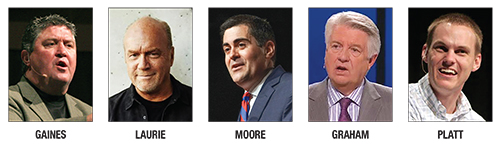
Recent calls for Convention-wide unity—and similar statements by SBC leaders—could rule the day in Phoenix, where Baptists will focus on prayer, evangelism, and financial stewardship, said SBC President Steve Gaines.

“I believe Southern Baptists can be used of God to spark a mighty movement of prayer, evangelism, and discipleship across our nation and around the world,” said Gaines, pastor of Bellevue Baptist Church in metro Memphis, Tenn., in announcing the meeting’s theme. “Pray! For such a time as this” is based on Luke 18:1 and Esther 4:14.

“If we will pray and abandon ourselves to the Lord, he will use us exponentially to take the gospel to people,” Gaines said.

SBC personalities

Similar to the previous few annual meetings, Gaines said the 2017 gathering will include seasons of prayer, as well as a personal evangelism emphasis on Tuesday evening led by Greg Laurie.

The California evangelist also will lead a Harvest Crusade Sunday, June 11, as part of the annual Crossover evangelistic effort that precedes the Southern Baptist Convention (see Nate Adams’s column on page 2 for more information). Organizers say the event at University of Phoenix Stadium, which holds 65,000 people, promises to be the largest single gospel presentation in Arizona history.

Focus on stewardship
Following the example of previous annual meetings, the gathering in Phoenix will include a panel discussion with SBC leaders. This year’s topic: financial stewardship.

Gaines told Baptist Press Southern Baptist churches cannot give more to SBC missions and ministries than church members give through their local congregations.

“The solution for increased funding for world missions begins in the heart of every individual believer in Christ,” he said. “Southern Baptists need to get our financial houses in order.

The Cooperative Program—Southern Baptists’ unified giving channel for supporting missions and ministry around the world—is likely to be a topic of conversation in Phoenix as well. In February, Prestonwood Baptist Church in Plano, Texas, pastored by former SBC President Jack Graham, announced they would temporarily escrow their CP giving because of positions taken by the Ethics and Religious Liberty Commission.

ERLC President Russell Moore, a vocal critic of now-President Donald Trump during the campaign, has apologized for comments that seemed directed at all evangelicals who supported Trump, and the ERLC’s executive board released a statement in April pledging their support for Moore. The statement also called for unity in the SBC despite differences, a sentiment echoed by Gaines.

“I believe all of us who are recipients of grace and forgiveness should grant him the same forgiveness that we desire from the Lord,” Gaines said after Moore and the ERLC executive board released the statement. “It is high time that we put all of this behind us….It is time to move ahead and work together to double our efforts to take the gospel to our nation and the nations.”

If the recent controversy surrounding the ERLC does make an appearance at the SBC, it could be in the form of a motion from the floor, or during the Q&A time following Moore’s report, which is the final item on the meeting schedule. International Mission Board President David Platt could also face questions about the IMB’s support of a Muslim group’s fight to build a mosque in New Jersey. (Like the ERLC, the IMB also signed on to a friend of the court brief in support of the group.)

In February, Platt apologized for how “distracting and divisive” the brief was, and pledged that in the future, the IMB “will have a process in place to keep us focused on our primary mission.” Still, the mosque debate could spark a religious liberty conversation in Phoenix, as could President Trump’s controversial travel ban for people from some majority Muslim countries into the U.S.

Online pre-registration for the Phoenix meeting is now open at sbcannualmeeting/sbc17. Messengers and guests are required to be registered and properly badged in order to enter the general sessions June 13-14.

For more information about the Southern Baptist Convention’s June meeting in Phoenix, go to sbcannualmeeting.net.

– With info from Baptist Press

Nate Adams IBSA exterior

Nate Adams

In just a few weeks, thousands of church messengers will gather in Phoenix for the annual Southern Baptist Convention and its many related events and opportunities. Last year’s St. Louis convention drew 533 messengers from Illinois, our state’s largest representation since 2002. Only host state Missouri and nearby Tennessee sent more messengers, and I believe Illinois Baptists’ strong showing gave us a stronger than usual voice in the national convention.

It would be great to have as many Illinois messengers as possible in Phoenix, but if history is any indicator, distance and travel expense will reduce our numbers significantly. Even if you can’t travel that far west this year, let me share a couple of ways you can stay engaged with the larger SBC from right here in Illinois.

First, the convention itself and some related events will be live streamed via the Internet, providing a front row seat from your computer screen. Our IBSA communications staff will also be there, uploading the latest happenings to IBSA.org and giving you an Illinois perspective on news coming out of the convention.

You and your church can also participate in the evangelistic efforts that surround this year’s Southern Baptist Convention, and in a way that reaches out not only to Phoenix, but to your community as well. This year the SBC is partnering with evangelist Greg Laurie to bring the Harvest America Crusade to the University of Phoenix Stadium on Sunday evening, June 11.

In Phoenix or from Illinois, you can help share the gospel with half a million people.

While an estimated 65,000 people will gather in the stadium that night, the Harvest Crusade hopes to invite as many as 500,000 viewers through multiple simulcast locations, such as our churches and homes right here in Illinois. In a similar Harvest America Crusade in Texas last year, more than 24,000 people made professions of faith in Christ, many of them at the remote simulcast sites.

Might this Harvest America Crusade be something that your church would consider hosting on June 11, as a way of inviting your community to hear the gospel message, and participate in potentially one of the largest evangelistic events in American history? Or perhaps you would consider hosting a small group in your home, and using it as a conversation starter with friends for whom you have been praying.

Pat Pajak, IBSA’s associate executive director of evangelism, is already in communication with dozens of pastors and evangelism leaders across Illinois, asking them to consider hosting a simulcast location. If you would like information on being a host site on June 11, you can contact Pat directly at PatPajak@IBSA.org or (217) 391-3129.

It’s amazing to me that technology and a little planning and cooperation among Christians and churches can make it possible for a half million people to hear the gospel message at the same time. It also reminds me that we could do so much more to spread the good news about Jesus if we would leverage these same things more consistently in our churches.

For example, does your church have young people that could help you use social media more effectively in reaching your community, and beyond? Are there tech-savvy folks sitting in the back rows of your auditorium that could be invited to the front rows of service?

We can stay here in Illinois and yet engage the larger Baptist family as it gathers in Phoenix. We can stay in our churches or homes and yet be part of sharing the gospel with a half million people at once. And we can stay at our computer screens and help our church reach people in new ways through technology. Aren’t these amazing days, when God has given us the ability to go, even when we stay?

Nate Adams is executive director of the Illinois Baptist State Association. Respond at IllinoisBaptist@IBSA.org.

Exterior of Modern Church with Large Cross

A bill in the Illinois Senate that would have required pastors to take state-regulated classes in child protection raises important questions: Shouldn’t pastors do all they can to protect children, one colleague asked. Yes, obviously, but at what risk to religious communities’ First Amendment rights?

And, as important is this question: Why aren’t clergy engaging in stronger self-policing using a mechanism most already have in place, the ministerial code of ethics?

Sen. Melinda Bush of Lake County withdrew the bill last week, after objections from pastors on First Amendment grounds: If the state requires pastors to receive certification in this well-intended and altruistic concern, then what’s next? There aren’t many steps from this bill to government licensure of clergy and churches. “Won’t somebody please think of the children!” isn’t a sufficient argument to allow government regulation of pastoral work.

And, there’s a better way.

As a seminary student, I was required to write for myself a ministerial code of ethics. I studied a dozen examples and came up with a list of biblical and ethical ways for dealing with people, issues, and sticky situations.

A year or two later, I was the grader for that class, and I read scores of codes of ethics submitted by students. Most of these aspiring pastors took the assignment seriously, considering how they should handle counseling and confidentiality, reporting of abuse or neglect, the pastor’s relationship to the law and enforcement agencies. Some addressed euthanasia, and a few spoke to sexual identity and relationship issues just entering public discourse at the time.

Some of these students laid a good foundation for engaging and regulating their future work, so when hard questions arose, they already had biblical ways of processing the issues not based on emotion and reaction.

A good ministerial code of ethics guides pastors in their ministry to children and families in jeopardy. It requires that pastors stay up-to-date on the issues and the law. Through such personally adopted codes, pastors police themselves. They may join in voluntary association with other clergy in their enforcement.

Our Baptist polity—respecting the autonomy of the local church—doesn’t allow the denomination to enforce rules on pastors. Neither does the U. S. Constitution. That’s why we must take responsibility to govern ourselves.

For the sake of the children.

– Eric Reed

The surrendered life

ib2newseditor —  April 17, 2017

Surrendered life

Martyn Lloyd-Jones was one of the greatest preachers of the twentieth century. He pastored the Westminster Chapel in the heart of London for nearly three decades, and by the end of his ministry he was one of the most influential ministers on earth. But before Lloyd-Jones was a great preacher, he was an accomplished physician. After earning his medical degree, he came under the tutelage of Lord Horder, caregiver to His Majesty, King George V, and enjoyed one of the most promising medical careers in all of England.

In considering God’s call to ministry, Lloyd-Jones wrestled with his “physician’s dilemma”—giving up medicine to pursue preaching. Ultimately, it was a war of desire, and his desire for ministry won out:

“We spend most of our time rendering people fit to go back to their sin! I want to heal souls. If a man has a diseased body and his soul is all right, he is all right to the end; but a man with a healthy body and distressed soul is all right for sixty years or so and then he has to face eternity in Hell.”

From his book, “Discerning Your Call to Ministry,” Midwestern Baptist Theological Seminary President Jason K. Allen offers insight on ministry, calling, and Christian education.

Are you willing to surrender?
A generation ago, “surrendering to ministry” was a common phrase in evangelical churches. It was certainly common in my childhood church. Most every sermon ended with an invitation to surrender to ministry. This immediately followed our pastor’s appeal to follow Christ, be baptized, or join the church.

Like Moses at the burning bush, you can persist in your excuses, or surrender to the call of God on your life.

As a boy, the phrase “surrender to ministry” both mystified and unnerved me. It sounded as though one was embracing an unwanted life, a call to a distant land for an undesired work. It seemed like a call one intuitively resisted—as long as possible—until finally buckling under the Spirit’s pressure and embarking on a life of ministry that, albeit noble, would be marked by sacrifice and hardship.

In hindsight, I do not think that is what my pastor meant, nor do I think that is what the New Testament implies. As I found in my own life, surrendering to ministry is not caving to an unwanted vocation; it is embracing what becomes increasingly irresistible: gospel ministry.

In other words, if by surrendering to ministry we mean engaging in an undesirable work, then jettison that phrase now. But if we mean surrendering to minister as unto the Lord and self-consciously choosing to forgo other life opportunities, conveniences, and ambitions, then surrendering to ministry is a good, healthy phrase. In fact, I am convinced “surrendering to ministry” is a phrase the church needs to recover and ministry-posture the church needs to cultivate. Every faithful ministry begins with a surrendered life, and that submissiveness shapes every aspect of one’s ministry, including why, where, and what one preaches.

What surrender entails
Surrendering to ministry rightly establishes the pastor’s motivation. After all, the pastor’s incentive should not be material gain, the applause of men, or any other earthly enticement. Rather, the preacher should, like the apostle Paul, know in his heart, “If I preach the gospel, I have nothing to boast of, for I am under compulsion; for woe is me if I do not preach the gospel” (1 Cor. 9:16).

To surrender to preach the ministry is to be so gripped by God’s call, and so moved for His glory, that one shares Jeremiah’s burden: “If I say, ‘I will not remember Him or speak anymore in His name,’ then in my heart it becomes like a burning fire shut up in my bones; and I am weary of holding it in, and I cannot endure it” (Jer. 20:9).

The urgency with which one preaches may ebb and flow based on a multitude of factors, including the receptivity of the congregation, the preacher’s spirituality vitality, and the tenor of the text itself. But, for the man rightly surrendered to ministry, the “why” of the ministry is settled—it is for Christ and His glory.

Additionally, surrendering to ministry includes a determination to follow God’s call wherever it may lead. This may include a willingness to leave family and friends, go to a distant place, and undertake a new work. After all, Jesus reflected, “Foxes have holes, and the birds of the air have nests, but the Son of Man has nowhere to lay his head” (Matt. 8:20).

Too many ministers are perfectly willing to follow God’s call as long as it does not lead out of their hometown. Such kingdom restrictiveness is alien to the New Testament and stymies one’s availability to be used by God. Practically speaking, you can know if you are limiting God’s call if you’ve already placed—perhaps even unconsciously—limits on where you are willing to serve Christ.

A willingness to go wherever includes a willingness to minister to whomever. There are churches across the land poised for anything but numerical success. Challenging demographics, an unreceptive audience, or a dilapidated neighborhood might make God’s call unattractive, but if it is God’s call, it is a glorious one—regardless of the zip code. After all, struggling churches and dying communities need ministers, too. God typically calls more to a people than a place. If God calls you to minister to a church in a challenging area, are you willing to go?

Don’t settle for the path of least resistance or the best payout. Seek God’s will and surrender to it.

Surrendering to ministry also means operating under the authority of God’s Word. Most especially, this relates to the act of preaching itself. The role of the preacher is not to cobble together anecdotes with human insights and then sprinkle in a couple of Bible verses to produce a “homily.” The faithful preacher tunes his ear to the Spirit of God, not the critic’s grumble. His finger is on the text, not in the air, gauging the wind. His voice is given to preaching the Word, not peddling shallow sermons for shallow people.

Too many pastors are textual acrobats, contorting their preaching to avoid Scripture’s sharper edges. Such preachers have become adept at explaining away difficult texts and dodging confrontational verses. From the earliest days of ministry you’ll have to guard your heart from pleasing anyone other than the Lord. Fearing combative personalities, overreacting to legitimate criticism, or stubbornly desiring man’s approval can all compromise your message and disorient you from paramount loyalty: loyalty to the One who called you—God Himself.

Two stories of surrender
The Bible offers no better case study of surrendering to ministry than the Old Testament prophet Jonah. God called Jonah to go to Nineveh, and preach repentance so the people there might be saved. It’s crystal clear that God was concerned about the why, where, and what of Jonah’s message.

Tragically, Jonah resisted God’s call in spectacular fashion. When God called Jonah, he was in Israel. God instructed him to go to Nineveh, which was about 550 miles east of Jerusalem in what is now modern-day Iraq, but Jonah did the exact opposite. He struck out for Tarshish, located in modern-day Spain, some 2,000 miles in the opposite direction!

Why did Jonah resist God’s call to preach repentance to the Ninevites? The Ninevites were the sworn enemies of the Israelites. The last thing Jonah wanted was to see the Ninevites repent and escape God’s impending judgement. In fact, Jonah actually confessed that he fled to Tarshish because he knew God was “gracious and compassionate, slow to anger and abundant in loving kindness, and one who relents concerning calamity” (Jonah 4:2).

God’s ministers are not spiritual free agents. We are not ecclesiastical entrepreneurs who strike out on our own and minister in accordance with our own desires. As Jonah’s sin was running from God’s appointed place of ministry, a more common twenty-first-century sin might be running to a preferred place of ministry.

On the contrary, aspire to be like John Piper, who went to Bethlehem Baptist Church in 1980 despite a small, aging congregation in dilapidated facilities located in a transitional neighborhood. He sensed God’s call, followed it, and has been used by God like few others in our generation.

A number of years ago I faced a similarly challenging decision. A church reached out to me about helping them through a season of challenge and transition. I felt God’s leading to serve the church, but several friends sought to dissuade me. I vividly recall one friend telling me, “Stay away. That church will ruin your resume. It’s a troubled congregation in a troubled part of town. Billy Graham couldn’t grow that church. You’ll have plenty of great opportunities in the years ahead. Don’t settle for anything less than God’s best for you.”

Though well intended, that counsel was altogether unhelpful and disorienting. For a while it confused me, until I remembered that God’s will for my life is God’s best for my life. By enlarging my circle of wise counselors, reflecting on the church’s needs, and my wife and I seeking the Lord and gaining His peace, it became clear that God was indeed calling us to that church.

The bottom line is, if you had a million lives to live you could not improve upon the life God has called you to live and the ministry to which He has called you. Don’t settle for second best by choosing the path of least resistance or the ministry that promises the best payout. Seek God’s will and surrender to it.

These days the phrase “surrendering to ministry” seems a vestige of the previous generation of church life. This is more than unfortunate; it is unhealthy, and the church is the big loser.

Surrendering to ministry means you’re willing to go to anyone, anywhere, anytime. But don’t be confused; as you surrender you will enter more fully into God’s joy and blessing. A surrendered life is integral to a healthy ministry.

– Reprinted by permission