Archives For November 30, 1999

Can it happen here?

ib2newseditor —  November 18, 2017

church pews

The 26 lives taken in an act of evil at a Sunday morning church service on Nov. 5 at Sutherland Springs, Texas shocked the nation. It was the largest mass shooting at a church in the history of the United States, but sadly, not the first. And it happened at a Southern Baptist Church, one named First Baptist, like so many around the country.

Still, many believe it won’t happen “here.”

It could and it already has. In March 2009 Pastor Fred Winters was shot and killed while preaching from the pulpit at First Baptist Church Maryville.

The Illinois Baptist interviewed Rich Cochran, director of leadership development at IBSA, who was minister of education and children at FBC Maryville that tragic Sunday morning.

“We ignore reality because we don’t want to face it and don’t know what to do,” he said. “We’d rather keep our heads in the sand.”

Cochran was just getting ready to enter the sanctuary when the shots rang out. The church had a security plan, but the gunman who was also armed with a knife and stabbed two church members who tried to restrain him, still managed to fire four shots before he could be subdued. The killer, who had no known connection to Winters or the church, was later found not guilty by reason of insanity.

Remembering that morning, Cochran said, “I don’t think there was a whole lot of second guessing. We had a plan and [after] we created a more detailed plan. There was a tornado threat that day and that was the plan that had been reviewed that morning.”

The repercussions are lasting, taking an emotional toll on the staff and congregation. “There are still dreams about and emotions from what happened,” he shared.

Cochran referenced Tom Hufty’s message at the IBSA Annual Meeting on Nov. 8., when Hufty said he “still runs into people with strong hurts that don’t go away.” Hufty took Winters place as pastor of FBC Maryville.

Hufty noted the different emotional responses that occurred within the congregation. According to Hufty, some said, “I can’t come back to that place. Others closed ranks — we’ve got to stick together we can’t let Satan win. And others needed a new start.”

When asked what advice he would give to pastors and staff thinking about putting a church safety plan together, Cochran said it’s important that pastors and staff process and walk through mentally and verbally would what they do were such a thing to happen.

“Review your risk, take an assessment, know where your vulnerabilities are, minimize those vulnerabilities, live out your mission,” those are the key things they can do.

He also noted, “It’s important congregations be extremely friendly, engaging everyone. Then, you can notice when something isn’t right. Then, it doesn’t seem like you have the National Guard in your lobby. The best way, is to train people to be nice and to welcome everyone.”

There is a danger in letting fear take hold he cautioned. “If we pat our heads and build mega-forts around ourselves we do a disservice to missionaries. If we protect ourselves so much it disrupts our mission we’re out of whack. There is a constant tension.”

Prayer does play a role. “We need to pray, yes, we need to prepare,” he nodded. “Yes, we need to live by faith. We live in a world where evil is present. Even Jesus said there would be troubles.”

In the simplest of terms Cochran urged, “Prepare, prepare, prepare. Then you have to walk by faith. We’re called to illuminate the darkness.”

– Lisa Misner Sergent

Thnaksgiving Blessing Celebrating Grateful Meal Concept

(Editor’s note: For thirty years, Chicago Tribune columnist Joan Beck annually penned a wonderful essay of thanks. It was part song, part poetry, and a lovely grocery list of God’s blessings in the year nearly passed. Beck died in 1998. Here we offer our own humble version, with thanks for her example of gratitude.)

As we gather together to ask the Lord’s blessings,
396 years after the first Thanksgiving Day,
we are grateful, dear God
For pilgrim fathers and mothers
who survived privation and dismay,
only to see your rich blessings
on the other side of suffering.
Their spiritual journey reached fulfillment on these shores;
Brave Pilgrims in a fearful new world,
Found welcome and home.

Now thank we all our God—
For that signal year 1517,
When an agitated priest sounded a protest,
Nailing his complaints to the church house door.
The echo of his hammer rings today.
We are grateful inheritors of the Reformation,
Expiation, Propitiation
Justification, Sanctification;
that the just shall live by faith alone;
For grace that grants to us salvation
offered freely but in Christ alone
my hope is found,
He is my light, my strength, my song.

Here we are, five centuries past, and the Protest lives.
The freedoms won by our spiritual ancestors are still protected;
We are grateful for the Constitution that lets us worship freely—
even though our theology differs,
And to speak freely—even when others object.

O God, our help in ages past, our help for years to come…
For responders first on scene in crisis and storm,
That in their service we see the Ultimate Rescuer.
For those who come in the second wave;
“Yellow Shirts” and the Relief they bring,
the love they extend for the One who gave
his very life the dying to save,
and for standing for us all, we sing,
You’re a good, good father
It’s who you are, it’s who you are,
it’s who you are.

Give thanks with a grateful heart…
For text and Skype and e-mail too—
(I may never have said that before)—
because it keeps our loved ones close
though they live on distant shore.
For faithful companions for life’s journey
and a church that proves they’re truly family
in our time of need,
and for man’s best friend
who loves us steadily to the end
(not only because we feed them)
thank you.

For summer tomatoes and cornbread dressing,
Folded hands and children’s blessing,
The Spirit’s whisper in times distressing;
For “miracle drugs” and miracles real,
For doctors, nurses, and the God who heals,
for the will to get up and the desire to soldier on,
for endurance and insurance and the blessed assurance
that neither death, nor life, nor angels, nor principalities, nor powers, nor things present, nor things to come, nor height, nor depth, nor any other creature, shall be able to separate us from the love of God, which is in Christ Jesus our Lord.
Amen.

Eric Reed is editor of Illinois Baptist media

Andreson-Ponce

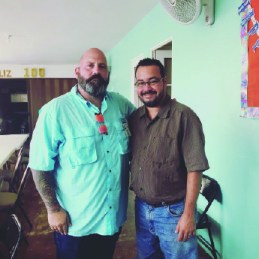
Chicago pastor Dave Andreson (left) met Puerto Rican church planters while serving on the island in October, including Jose Ponce, pastor of Iglesia Bautista Resurrección in Isabela.

Arecibo, Puerto Rico | In October, Southern Baptist volunteers began relief efforts in Puerto Rico after the U.S. territory sustained devastating damage from the one-two punch of Hurricanes Irma and Maria.

The volunteers are working through Southern Baptist Disaster Relief and the North American Mission Board’s (NAMB) Send Relief initiative, but their work is unlike other Disaster Relief projects.

“The circumstance is so unusual that we have to take the full responsibility of this response on our own,” said David Melber, president of Send Relief. “That means buying and shipping the food, renting warehouse space, sending the kitchen equipment, and then providing the volunteers to do the cooking. We are forging our entire response by ourselves.”

Chicago church planter Dave Andreson spent a week in Puerto Rico as a trained Disaster Relief chaplain. Andreson, a U.S. Army veteran, couldn’t shake the growing burden he felt for the island. “I had to get there,” said the pastor of Resurrection City Church in Chicago’s Avondale neighborhood.

While plans to send volunteers to Puerto Rico were on hold immediately after the storms, Andreson attended a two-day Disaster Relief training at Lake Sallateeska Baptist Camp in southern Illinois. One week later, with Baptist volunteers able to get into Puerto Rico, Andreson boarded a flight from Chicago to San Juan.

McKnight

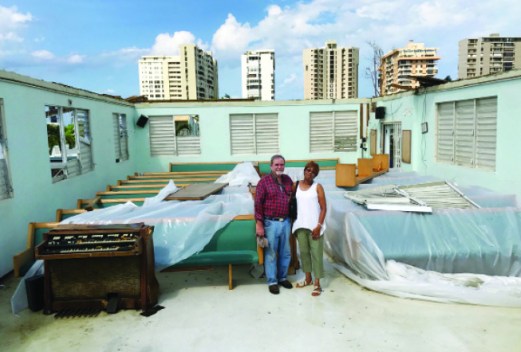
Pastor George McKnight and his wife, Debbie, pause for a photo at Green Island Baptist Church in Puerto Rico, which lost its roof and was flooded during Hurricane Maria’s sweeping destruction.

He served with a Disaster Relief team from Virginia in Arecibo, a city 50 miles west of San Juan in northern Puerto Rico. The team stayed at First Baptist Church there and spent their days cleaning out homes and removing downed trees. Andreson said the teams are working under the leadership of local pastors who understand the people and needs in their communities.

Since the hurricanes, Andreson said, many people are leaving Puerto Rico. Their workplaces are still without power, most schools are still closed, and if you have running water, it’s not safe to drink. FBC Aricebo has already lost about 40 people. One church planter Andreson talked to is worried his young congregation won’t survive.

But the Chicago pastor said he believes Puerto Rico is primed for the gospel. “Physical suffering makes us aware of physical need, and those physical needs always open the door by which the word of God, the gospel proclaimed, makes us aware of our spiritual need,” Andreson said.

“This is a horrible thing that happened, but it’s a good gift from God by which the gospel will go forward. Now more than ever, the church in Puerto Rico, the church of Jesus Christ, has an opportunity to shine the light of Christ.”

The punishing hurricane season has left its mark in other parts of the U.S., including Florida and in Texas, where Illinois teams have served in the aftermath of Hurricane Harvey. For more information about Illinois Baptist Disaster Relief opportunities and training, go to IBSA.org/dr. To learn more about opportunities in Puerto Rico through Send Relief, go to sendrelief.net.

– Meredith Flynn, with reporting from NAMB

Counting to 200

ib2newseditor —  November 6, 2017

illinois coat of arms

Illinois became a state on December 3, 1818. And so soon, those who pay attention to such things will begin the one-year countdown to our state’s bicentennial.

Because Illinois is our state mission field, the “Judea” in our churches’ Acts 1:8 missions responsibility, IBSA will be joining the bicentennial celebration with a countdown of our own. Launching at the 2017 IBSA Annual Meeting, and continuing through next year’s Annual Meeting, we are challenging IBSA churches to consider “counting to 200” in four very special ways.

First, we have identified 200 places or people groups in Illinois where a new church is desperately needed. We are inviting churches to adopt one or more of those 200 by praying, or partnering with resources or volunteers, or actually sponsoring the plant as the mother church.

Second, we are praying for at least 200 churches that will seek to become more frequently baptizing churches, by setting annual baptism goals and equipping their members to intentionally have gospel conversations and participate in evangelistic events and mission trips. We are praying for churches that will set their sights on baptizing at least once a month, or more than their previous three-year average.

Third, we are praying for at least 200 churches that will commit a percentage of their annual budgets to Cooperative Program missions, and then seek to increase that percentage annually toward 10% or more.

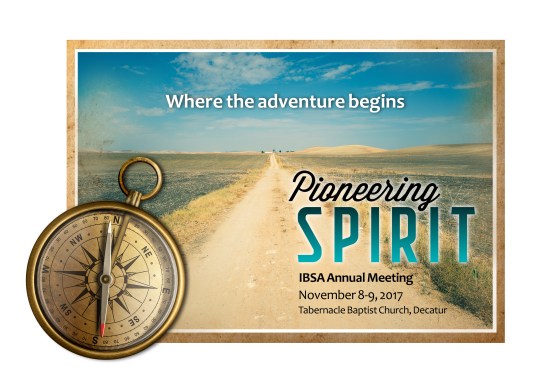
Potential for true mission advance is through churches that embrace pioneering spirit commitments.

And finally, we are praying for at least 200 churches that will commit to intentional leadership development processes—not only for the pastor and current leaders, but also for future pastors, planters, and missionaries.

Of course, some churches are fulfilling one or more of these challenges already. But for the overwhelming majority of IBSA churches, these challenges will be a major stretch. In fact, as our 2017 Annual Meeting theme suggests, moving beyond our status quo into these types of commitments will take a true “pioneering spirit.” It’s the kind of spirit that brought Baptist pioneers to Illinois more than 200 years ago.

That’s why we at IBSA are asking churches to register their “pioneering spirit” commitments, either now or in the coming months. Not only do we want to celebrate those commitments between the 2017 and 2018 IBSA Annual Meetings, but we also want to give those churches our focused, priority attention as an IBSA staff.

Certainly we will continue to be responsive to the requests and needs of all IBSA churches, and to provide services, resources, consultations, and events throughout the busy year. But we believe that the greatest potential for true mission advance in Illinois will be through churches that embrace these pioneering spirit commitments, and we want to come alongside them in special ways, and give them our priority assistance. We also want to network these churches together, so that they can benefit from one another’s experiences and ministry strategies.

The second verse of our Illinois state song begins, “Eighteen-eighteen saw your founding, Illinois, Illinois, and your progress is unbounding, Illinois, Illinois.” It goes on to remind us of the origin of that unbounding progress. “Pioneers once cleared the lands where great industries now stand. World renown you do command, Illinois, Illinois.”

When you see things like great industries and world renown, it’s usually because a few pioneers paved the way for them. And if we are to see great churches and world impact coming from Illinois Baptists, it will be because a few pioneers sacrificially pave the way. Will your church be one of those first 200 that brings a much-needed pioneering spirit to our state’s bicentennial, and to our mission of seeking and saving the lost here in Illinois?

Nate Adams is executive director of the Illinois Baptist State Association. Respond at IllinoisBaptist@IBSA.org. Read more at IBSA.org/pioneering.

The road ahead

ib2newseditor —  October 30, 2017

A tough but exciting journey awaits us

Postcard art w adventure inserted

If we were to drive west from Illinois, whether along Interstate 70 from St. Louis, 72 from Springfield, or 80 from Chicago, the experience would be largely the same. We would continue in a long, straight line for a very long time, rolling over a few hills and rivers in Missouri or Iowa before settling into the even longer, even straighter, seemingly eternal plains of Kansas or Nebraska and eastern Colorado. Then we would see the mountains.

Imagine what early pioneers must have thought when the amazing barrier of the Rocky Mountains first appeared on the horizon. No doubt many of them turned south or north for a while, hoping to find a way around. They knew the experience, equipment, and skills that had carried them across the slowly elevating plains would not take them over those mountains. They would need to find a pass, a way through. And even that journey would be like none they had faced before.

As we Southern Baptists in Illinois now approach our state’s bicentennial year, our journey is much the same. We have been on a long, flat path for years—in number of churches, in baptisms, in church plants, in giving, and in most measures of church involvement and growth. That’s not a criticism. It’s just a description of our recent journey.

Along the way, hardly noticeable until just recently, the altitude has gradually increased and the climb has grown steeper. So many cultural dynamics have grown counter to Christian faith, and perhaps especially to Baptist faith. We too can turn to the left or to the right for a while. But to truly advance from the plains of our status quo up into the mountains our mission now faces, I believe we must dig deep and find a new, pioneering spirit.

Go to new places
In Illinois Baptist mission life, going new places means taking the gospel to the counties and cities and communities where Baptist or even evangelical churches don’t yet exist or have a strong presence. It means church planting.

IBSA churches have numbered right around 1,000 for decades, even while planting around 20 new churches a year. With those one thousand churches baptizing between four and five new believers each, we reach about 4,000 to 5,000 people per year. Yet Illinois has 13 million people, and at least 8 million of them don’t claim to have a personal relationship with Jesus Christ. And most of them do not live near our existing churches. To leave the flatland of our status quo and reach the lost people of Illinois, we must increase and accelerate the number of new churches being started. We must place a gospel witness near them.

Pioneering Spirit Challenge #1: Will your church adopt at least one of the 200 places where a new church is needed? Your commitment can be to pray, or to partner with others to get that church started, or to be the primary planting church. Will you pray, partner, or plant?

Engage new people
Establishing healthy, new churches in the places where they are needed is one important commitment of a pioneering spirit. The first Baptists arrived in Illinois during a time when it was extremely difficult and even dangerous just to survive and eke out a living. Yet they considered it a priority to share the gospel and to start new Baptist churches. Four of those churches that were in existence when Illinois became a state in 1818 are still serving their communities today!

But being blessed—and burdened—with a pioneering spirit also leads churches, both new and established, to intentionally and consistently engage new people with the gospel message. With a sense of urgency, they will evangelize.

Sadly, it’s possible even for a well-intentioned church to lose its passion for evangelism, and become more of a church of settlers than a church of pioneers. They worship, and study, and fellowship, and even serve one another and the community. But very little energy goes into seeking and saving the lost.

Consider this: The almost 1,000 IBSA churches baptized about 4,000 people last year, four per church on average. But over 300 churches reported no baptisms at all. The remaining churches that reported baptisms averaged seven each. If non-baptizing churches simply reached the same number of people with the gospel that baptizing churches did, 7,000 people would come to know Christ next year. And just imagine what would happen if the churches already baptizing seven or more started baptizing monthly!

By intentionally shifting their focus toward evangelism, churches that have settled can become pioneering churches again.

Pioneering Spirit Challenge #2: Will your church commit to turning itself inside out into your community, training its members to intentionally have gospel conversations and evangelistic events, and asking God to increase the number of baptisms you see each year? Will you do whatever it takes to become a more frequently baptizing church?

Make new sacrifices
Going to new places and engaging new people is costly. It’s one reason so many stay where they are—and settle. Many early pioneers packed literally everything they owned into a wagon, and some sacrificed it all to get to their destination. A pioneering spirit sees the value of moving toward those new places and new people, and is willing to give sacrificially to make it happen.

Going to a new place of mission effectiveness here in Illinois will be costly too, especially if God inspires more churches and raises up more leaders, planters, and missionaries to go to new places and engage many new people. Fortunately, we as Illinois Baptists have a wonderful, reliable, tested vehicle in which to entrust our sacrifices. The Cooperative Program (some call it CP Missions) prioritizes missions in Illinois by investing 56.5% of its gifts here, while also sending 43.5% to be combined with others’ gifts and take the gospel throughout North America and the world.

Today the average IBSA church gives about 7% of its undesignated offerings to local and worldwide missions through the Cooperative Program. As with baptisms, that average is the result of some churches sacrificing far more, and some sacrificing far less. At one time, 10% was the accepted norm for Cooperative Program missions, and at one time IBSA churches averaged giving 11% rather than 7%. Simply stated, a return to that 10% standard could result in over $3 million more to missions next year.

Pioneering Spirit Challenge #3: Will your church commit to a new level of sacrificial missions giving through the Cooperative Program? Will you challenge your members to faithful tithing and life stewardship, so that generous giving transforms their own lives, as well as others’?

Develop new leaders
A pioneering spirit must be multi-generational. Very few destinations that require true, pioneering effort can be fully attained in one lifetime. Our parents’ generation brought us this far into our Baptist missionary journey in Illinois, and now we lead and will go a little farther before entrusting the journey to our children. That’s why a pioneering spirit must invest in the development of new leaders, even as it sacrifices and gives its all now.

It seems that churches used to have more systematic ways of developing new leaders. Sunday nights were invested in church leadership training programs. Wednesday nights were often invested in missions education programs that developed boys and girls, and young men and women, for tomorrow’s missionary and church leadership roles.

We should be grateful for churches that still develop tomorrow’s leaders in this way, while not necessarily wishing the same programs or methods on others. But today, more than ever, we must ask ourselves with a new seriousness, “How are we systematically and intentionally developing leaders for tomorrow’s churches?”

Pioneering Spirit Challenge #4: Will your church commit to the intentional developing of younger leaders who will be tomorrow’s pastors, and church planters, and missionaries? Will you join with other Baptist partners like IBSA who can help you develop these young leaders for tomorrow’s church?

Facing our mountains
Last summer I traveled to Loveland, Colorado, in part to scout out Long’s Peak, a 14,259-foot mountain that will hopefully, next year, be the thirty-first and most difficult “fourteener” I climb. As I headed west from the Interstate and flatlands of Loveland, I could not immediately see the pass up into the mountains. But soon I noticed that the road was following a stream, and then a mighty, rushing river. There was barely room for a road in some places, but the water had cut enough of a path through the rock that we could now follow it up to previously impossible heights. We eagerly forged ahead.

To leave the flat trends of our recent journey as Illinois Baptists may seem impossible at first. Our 200-year-old mission field is more lost now than ever. And developing new leaders while making new sacrifices to engage new people in new places with the gospel—well, that’s no easy path. But I believe the living water of God’s own Spirit has already made a way for us. If we are filled with his Pioneering Spirit and will follow him forward by faith, even into difficult places, I believe God has new heights planned for us here in Illinois.

Nate Adams is executive director of the Illinois Baptist State Association. The challenges outlined here will be presented in the Annual Meeting.

Check up Pastors ConferenceThe 2017 IBSA Pastors’ Conference will kick off Nov. 7 at Tabernacle Baptist Church in Decatur with a focus on the spiritual health of leaders, their families, and their churches. The conference, held prior to the IBSA Annual Meeting, is based on the qualities the Apostle Paul set out for church leadership in Titus 1:5-9.

The theme for the conference, “Time for a Check-Up,” is something pastors are familiar with when it comes to their congregations, said Brian Smith, pastor of Second Baptist Church in Granite City and president of this year’s Pastors’ Conference. Pastors provide spiritual check-ups for their people every week through preaching and teaching, but who’s doing the same for the pastor?

“That is what this conference is for, to provide pastors and staff with a spiritual health check-up and scriptural prescriptions for better spiritual health for them and ultimately their families and churches,” Smith said.

Southern Baptist Convention President Steve Gaines is among the preachers who will fill the pulpit at Tabernacle Nov. 7-8. Joining him are Ed Stetzer, who holds the Billy Graham Chair of Church, Mission, and Evangelism at Wheaton College and serves as executive director of the Billy Graham Center for Evangelism; Curtis Gilbert, lead pastor of the Belleville campus of The Journey; and Joe Valenti, associate pastor of youth and missions at Cuyahoga Valley Church in Broadview Heights, Ohio.

The Pastors’ Conference also will include breakout sessions led by the speakers and other Illinois leaders:

  • Valenti will lead a session on healthy churches reaching UPG’s (unreached people groups), and also a breakout on healthy youth ministry.
  • Gilbert will lead pastors in developing healthy church elders and building a healthy multi-site ministry.
  • Rayden Hollis, pastor of Red Hill Church in Edwardsville, will lead a session on healing from an unhealthy ministry, and also will facilitate a church planting round table discussion.
  • A trio of IBSA staff members will also lead breakout sessions, which will be offered at both breakout times on Tuesday. Pat Pajak, associate executive director of evangelism, will encourage pastors with ways to make their churches more evangelistic; Mark Emerson, associate executive director of the Church Resources Team, will speak on healthy small groups and Sunday school; and Steve Hamrick, director of worship ministries, will lead a session on developing and leading healthy worship teams.
  • On Wednesday morning at 8:30, Gaines will speak to Pastors’ Conference attenders and participate in a Q&A session.

A pizza dinner will be offered onsite Tuesday evening for $10 per person. To purchase dinner tickets and for more Pastors’ Conference info, go to IBSAannualmeeting.org.

Family gatherings

ib2newseditor —  October 16, 2017

Postcard art

Not long ago, the pastor of an already growing church contacted me about “becoming Southern Baptist.” His church was starting to think about planting another church or campus, and had heard about the partnership and resources available through our North American Mission Board.

As I began explaining Southern Baptist polity and structure to him, I realized that those of us who “became” Southern Baptist when our parents enrolled us in the church nursery may sometimes take for granted the way our largest Protestant denomination in America operates and cooperates. In fact, many laypeople in our churches today might have trouble answering this pastor’s question.

Later I wished I had explained Southern Baptist life to him the way I truly think about it—like a family. A local church is like the immediate family you live with every day. You do life with them and know them intimately, in good times and bad, for better and worse.

A local Baptist association is like your family that lives nearby. You might see them every week, or maybe once a month, perhaps for dinner or to help with a project. They would help you move, or loan you their truck, or pick up your kids or grandkids in an emergency. They are your first line of support, and your first line of defense. You trust them, and you count on them, because they’re family, even if they don’t live at your house all the time.

Illinois Baptists will celebrate their annual ‘family reunion’ Nov. 7-9.

A state Baptist Association or Convention is like a more extended family. The distance between family members keeps you from seeing everyone in person very often. But you talk by phone, and you’re Facebook friends, and you’re aware of what each other is doing. When you’re in their town, you visit them. When their kids graduate or get married, or have a big life event, you’re there. And they’re there for you too.

When you are together with extended family, it’s still clear you’re related. The subtle family resemblances are there. Behaviors and preferences may be diverse, but values are largely the same. You know the same folklore. You celebrate the same heritage. You would still do anything for each other, even if Uncle Bill irritates you a little. You would never want to leave or lose this family, even if you’re grateful to get back in the car and go home.

Then there’s the national Southern Baptist Convention, which I might compare to a nationwide family reunion. I attended one of those once, for the Cunningham line of my family, which has gathered every Father’s Day weekend for decades in western Kentucky. We loved going, and met people we had never met before, and it didn’t take long to discover common threads, and certainly common values. I hope to go again someday. And if you ask me, “Are you a Cunningham?” I will proudly say yes, and eagerly help anyone from that family.

I know lots and lots of pastors and church members who have never been to a national Southern Baptist Convention, but who faithfully give to Southern Baptist missions, and who faithfully believe The Baptist Faith and Message. It’s a wonderful, diverse, large family.

And so, with a newfound warmth and enthusiasm for family, I invite you to come to Tabernacle Baptist Church in Decatur this November 7-9 for the IBSA Pastors’ Conference and IBSA Annual Meeting. In fact, bring someone with you who hasn’t been to this extended family gathering in a while. You won’t know everyone, but everyone you meet will be family. They believe what you believe, and they work together at doing the things you know are most important. And at least most of us would do anything for you.

Nate Adams is executive director of the Illinois Baptist State Association. Respond at IllinoisBaptist@IBSA.org.

Family blocks

The word “family” conjures up feelings of warmth, sentimentality, peace, and tranquility—the kinds of things we put on Christmas cards, said Russell Moore, president of the Ethics and Religious Liberty Commission.

Often, though, our families aren’t really like that. We’re not lying, Moore said, but there are so many things we leave unsaid. Those things—the challenges of parenting, the hard conversations, the fears that children won’t turn out like we want them to—were at the heart of the ERLC’s conference on “Christ-Centered Parenting in a Complex World.”

The podium at the Aug. 24-26 meeting was filled by family experts, church leaders, storytellers, and even a U.S. Senator (Ben Sasse of Nebraska). But the audience looked a lot like real parents. Strollers lined the walls of the auditorium as parents and children listened together. One speaker in a breakout for moms tweeted that it was highly appropriate to hear several crying babies in the session.

Over three days at Nashville’s Opryland Hotel, conference speakers drew on their experiences ministering and equipping families—and raising their own—to guide parents toward a gospel-centered view of the family. Along the way, they touched on some specific issues of our day—gender identity, racial division, sexuality, pornography, and the overwhelming influence of technology.

They also called Christian parents to an ideal that grows more and more radical as the culture around them changes. “Those who grow to know and serve God with everything they have do not blend in,” said author and speaker Jen Wilkin. “The goal of a Christian parent is to prepare their child to live in a world that is not their home.”

In his opening address, Moore said the unspoken challenges of parenting are part of the reason it can be so difficult. “…In our culture, parenting so often is about winning and displaying.” If something goes wrong in our family, he continued, we worry people are going to think something’s wrong with us. He quoted a friend who said he knew parenting would be humbling, but had no idea it would also be humiliating.

“Parenting matters. The stakes are high. That’s why it’s hard.”

– Russell Moore, president, Ethics and Religious Liberty Commission

The antidote to drowning in all the potential failures? A Christ-centered perspective, one that acknowledges parents are called to follow Christ’s example and take up a cross, Moore said.

“Parenting is a unique mixture of joy and terror, beauty and brokenness, happiness and disaster. Nothing is easier than loving your children, and nothing is harder than loving your children. We as Christians ought to be people who understand that dynamic.”

Alien children
It’s easy to blame kids for peer pressure—for exerting it on one another and for feeling it themselves. But it’s generally not children who fall victim to it, said Jen Wilkin. It’s parents who feel a strong pull to soothe their own memories of not fitting in by helping their kids fit in.

But Christian parents need to be looking instead for opportunities to help their children get comfortable with being different—even “alien” in our culture, Wilkin said. She gave five areas where Christian families and kids will look different, beginning with their activities.

“We have to be running these things through a different filter than other people,” she said. A filter that places a higher priority on the dynamic at home than allowing children to run themselves—and their parents—into the ground with an ever-increasing list of activities.

She read Deuteronomy 6:6-7: “And these words that I command you today shall be on your heart. You shall teach them diligently to your children, and shall talk of them when you sit in your house, and when you walk by the way, and when you lie down, and when you rise.”

“The author of Deuteronomy seems to think that there will actually be times when we sit in our house­—together,” Wilkin said. “Seems to think there will be times where we walk by the way­—together. When we lie down­—together, and when we rise up­—together.
“This passage assumes a natural rhythm of the home that is bringing the family together, versus spreading the family out.”

Jim Kerr is pastor of First Baptist Church in Fairview Heights. Wilkin’s talk on family activities resonated with him because he sees families in his church struggling to balance all the things they think they have to do. Churches can fall victim to the same kind of thinking, he said.

“The guilt of doing ministry sometimes overrides the benefit of the right amount of ministry and the right amount of time,” Kerr said. “Because we just wear ourselves out.” That’s why his church plans intentional seasons of break in certain activities and ministries, he said, “realizing that there’s so much going with our families and our children, we’re going to wear ourselves out from doing, while not really gaining the purposes we need.”

Wilkin talked about four other areas in which Christian families should be alien and strange: speech, possessions, entertainment, and friends. Look for more on counter-cultural families and how parents in Illinois are raising “alien” children in upcoming issues of the Illinois Baptist.

The role of the church
At least two speakers in Nashville quoted a study that found children are more likely to stick to their faith after high school if they’ve been invested in by adults other than their parents. Christ-centered parenting can’t be done in a vacuum. It calls parents to rely on others in their faith community, Russell Moore said. Christians are to bear one another’s burdens, including in parenting, he said.

“That is what is so dangerous about the church turning, in many cases, into silos filled with individual minivans full of families, coming to receive instruction and then to return home to their self-contained units.” Even more so in our rootless, hyper-mobile culture, Moore said, where children don’t see their extended families often and mothers and fathers fight feelings of isolation, parenting can be a lonely endeavor.

“We need each other, and we cannot be godly parents to our children if we are not brothers and sisters to each other.”

Moore recalled a woman who approached him after he preached at her church and leaned close to whisper a prayer request for her daughter, who was away at college and had decided she was an atheist. When Moore asked why she was whispering, she said, “I don’t want anybody to think, ‘There’s that lady with the atheist daughter.’”

Something’s terribly wrong with that picture, Moore said. “Here we are when every family in Scripture has prodigals, including God the Father. And we are scared to cry out to one another and say, ‘I feel like in my parenting I am drowning and I need help.’ That is what the church is for.”

If parenting in community means bearing one another’s burdens, it also involves having the courage to turn children loose to engage in God’s mission. In fact, that should be the goal of parenting, said North Carolina pastor J.D. Greear. Children are designed by God to be arrows, Greear said, referencing Psalm 127, not accessories.

Quoting family ministry expert Reggie Joiner, Greear said in our safety-obsessed culture, we forget the ultimate goal of parenting is to let go.

“The ultimate mission of the family is not to protect your children from all harm, but to mobilize them for the mission of God,” said Greear, pastor of The Summit Church in Raleigh-Durham.

And as they go, they’re sure to look different, having been shaped in a community in which the goal of the family is to glorify God and, through their example, to bring others to a saving knowledge of Christ.

“As Christian parents, the most hopeful thing we can do is lift up our own eyes and train the eyes of our children to behold our Savior, alien and strange,” Wilkin said. “He is coming on the clouds, and when he comes, may he find the family of God, and your family and my family, desperately hoping and yearning to look like him.”

For more from the ERLC’s National Conference on Christ-Centered Parenting in a Complex World, see upcoming issues of the Illinois Baptist, or go to ERLC.com to view conference sessions.

-Meredith Flynn, managing editor, Illinois Baptist


Somebody’s prayin’

ib2newseditor —  October 2, 2017

Pray button

After my dad’s mother died, I remember him saying that he physically felt the absence of her prayers. Dad had, in some ways, a challenging personality for pastoring. He was introverted, in many ways non-assertive, a quiet thinker and reader who scripted his sermons by hand so that he could deliver them effectively.

So, if you only knew my dad personally, you may have been surprised when you first saw him step into the pulpit, or witnessed him in some other pastoral role. He was wise, articulate, bold, insightful, truly helpful. As a pastor, he was supernaturally equipped for the role to which God had called him, in a way that eclipsed his natural limitations. And I believe this was supernaturally sustained by the devoted prayers of people who supported him over the years, his mother and my mother chief among them.

Our pastors need our sincere and earnest prayer. They need us to intercede spiritually for them, every bit as much as they need us to support them in leading the ministries of our church. Not all pastors face the same challenges that my dad did, but all of them face their own unique struggles and obstacles. If it is primarily those closest to them that sustain them in prayer, just think what could happen with an entire church earnestly praying.

Pastors need our sincere and earnest intercession.

October is Pastor Appreciation Month. If this is not already your practice, let me encourage you to take the month of October to pray for your pastor, and perhaps other pastors you know, daily. At the IBSA.org website, there will be a daily prayer guide to assist you in that discipline.

You will not be alone. Throughout October, our IBSA staff will be praying for every IBSA church pastor, by name. We are also asking for specific prayer requests by e-mail, and personally calling more than 300 pastors for whom we don’t have a current e-mail address, to ask them how we can pray.

I hope many pastors will share specific prayer needs, perhaps some that are difficult to share with church members, and will allow us to pray for them personally in this way. For those from whom we don’t receive specific requests, we will simply use the prayer guide to pray for each pastor.

Many churches give gifts and other expressions of love to their pastors during October. Prayer, especially consistent, daily prayer, is one of the greatest appreciation gifts you can give. When something “appreciates,” it increases in value. And I believe that the sincere, consistent prayers of a congregation will “increase the value” of a pastor more than anything else. And by the way, that’s true even when you may personally struggle with your pastor!

In a recent IBSA chapel, we were talking about praying for pastors. Our state worship director, Steve Hamrick, shared about his dad, also a pastor, who prayed for him daily throughout his ministry. When his dad passed away a few years ago, his father-in-law noted at the funeral how special that prayer relationship was, and committed to him to take up the privilege of praying for Steve from that day forward.

During that same chapel, Steve led us in singing the old Ricky Skaggs song, “Somebody’s Prayin’.” The first two lines of that song are simply, “Somebody’s prayin’, I can feel it. Somebody’s prayin’ for me.”

IBSA pastors, I will be one of those somebodies praying for you throughout the month of October, along with every member of our staff. I hope you “feel” it in the same way that my dad did from his mom. And I hope you will feel it from many faithful church members as well.

Nate Adams is executive director of the Illinois Baptist State Association. Respond at IllinoisBaptist@IBSA.org.

Illinois commits to Texas aid

ib2newseditor —  September 25, 2017

Massive Florida storm stretches Baptist response

FBC Galatia flood recovery volunteers do mud-out work on a house in Vidor, Texas, near Beaumont.

FBC Galatia flood recovery volunteers do mud-out work on a house in Vidor, Texas, near Beaumont. They’re working with eight other teams from several states on a list of 200 area homes that continues to grow. Facebook photo courtesy Butch & Debbie Porter

Illinois Baptist Disaster Relief (IBDR) continues its marathon response in Texas doing flood recovery work in homes drying out after Hurricane Harvey, providing shower and laundry facilities, and preparing hot meals for relief workers and displaced Texans. And a team of childcare volunteers traveled more than a thousand miles to wipe tears away when the response began in early September.

No sooner had the work in Texas ramped up for IBDR when Hurricane Irma swept through Florida. Many wondered if teams would be deployed to the east. Dwayne Doyle, IBDR state director, notified volunteers, “We have made the decision to focus our ongoing work in Texas as a partner with the Southern Baptist Texas Convention Disaster Relief. Many of the Southeastern state Disaster Relief units are leaving Texas to go work with Hurricane Irma victims in Florida.

“We will continue to focus our efforts in Texas because this is where we have identified a specific and strategic need that IBDR can meet.”

Kevin Ezell, president of the North American Mission Board, noted state Disaster Relief organizations have done “an absolutely incredible job” since the landfall of Harvey in Texas on Aug. 25, followed by Irma in Florida on Sept. 10.

“It’s going to be a long-term response in both places and we need help in the months to come….We have a desperate need for more volunteers in Florida and in Texas,” he said.
Mini Disaster Relief training events were hot tickets in Illinois in September. Nine were held across the state, where at least 150 people received flood recovery training.

Jan Kragness

Jan Kragness at the Dallas Convention Center. Facebook photo courtesy Kragness.

Help for hurting families
IBDR Chaplain Jan Kragness served on the 10-person childcare team that deployed to the Dallas Convention Center to work with some 2,500 Houston-area evacuees housed there. She shared glimpses of her experience on Facebook. On Sept. 2 Kragness shared, “It was a hard day. Many people were rescued by boat day before yesterday. They were brought in at 1:30 a.m. The children and parents were sad and tired. My arms were tired.”

Kragness told the story of one family with three young children. The younger brother “was so unhappy, he could not stand the separation anxiety of being away from Mommy. His 5-year-old sister came into his group area, and held him for comfort. He was almost as big as she was.”

Kragness took the younger brother and sister to their mother. “She loved on the children and tried explaining that she had to get the sister registered for school and there was a long line. But she would be back for them. The mommy looked exhausted.”

That was when the woman told Kragness what had happened. “She explained to me that their home had been broken into and the children assaulted and that was part of the separation anxiety. We had prayer with the mother…So when I took the children back to the childcare area, they were more comfortable but would not integrate with the others and could not let go of me.”

About an hour later, the older brother came to check on his siblings. He told Kragness, “Miss Jan, we’ve got trouble at our house. Big trouble.” She told him, “Well, if you would like to talk about it, I would be glad to listen.”

He shared, “Our house was broken into by a bad man. He knocked down my brother, and hurt my sister. Mommy is scared and Daddy is mad. Our house is scary and we have trouble.”

Kragness said, “I am so glad you shared with me. And I am so glad you are safe now. There really are lots of people who are watching over you, but the greatest of all is Jesus. Shall we pray and ask Jesus to care for you and your family and keep you safe?”

“Yes, please pray to Jesus for me,” he said.

She assured him Jesus was listening to him anytime and everywhere. He prayed, “Jesus, please keep my little brother and my sister safe and help Mommy and Daddy to not be so worried.”

Kragness wrote, “He looked so relieved. He hugged me and ran off to play football. My heart ached to follow him and hold him close. But I knew Jesus had that job handled.”

The response continues
More IBDR teams are on their way to Texas. Volunteers trained in mass feeding, shower/laundry, and flood recovery are needed. If you can go with one of these teams, contact the team leader:

September 26 – October 8
Unit # IL RC 005 – Greater Wabash Baptist Association
Team Leader: Donald Ile
Phone: (618) 599-4234
E-Maildonruthsawdust@gmail.com

October 2-8
Unit #IL25
 – Sullivan Baptist Church
Team Leader: Don Lusk
Phone: (217) 232-8880
E-Mail: pastordon@sullivansbc.org

October 7-15
Unit #27 – Harrisburg First Baptist Church.
Team Leader: Joe Jackson
Cell: (618) 841-5015
E-Mailjoeluj@frontier.com

Teams that have already served in the Beaumont area include:

– A 26-person mobile kitchen team based out of Living Faith Baptist in Sherman which prepared nearly 41,000 meals, along with Incident Command leadership and shower/laundry trailers from both Franklin and Macoupin Associations. It was mobilized with volunteers from across the state.
– A flood recovery team with members from central and Metro East Illinois.
– A team from FBC Galatia with members trained in flood recovery, mass feeding, and shower/laundry trailers.

To learn more about the callouts, training, and how to donate, visit IBSA.org/DR.

– Lisa Misner Sergent, with additional reporting by Baptist Press