Archives For November 30, 1999

Jonathan DavisSeptember 2013 will forever be seared in my mind as when I received the phone call every seminarian hopes for: God had called me to my first pastorate.

Recognizing the weightiness of it all, one thing became quite apparent: I was going to need major help. In God’s providence, that help came in a multitude of ways. One in particular was John Piper’s book, “Brothers, We Are Not Professionals.”

With a passion and precision that he is known for, God used this veteran pastor to help shape my understanding of what it means to shepherd the flock of God. His thoughts on preaching were priceless, especially knowing I was to be responsible for the weekly preaching of God’s Word.

Within the wisdom of that book, one practical thought on preaching still reverberates in my ministry today. Piper made sure he preached on abortion at least once a year in his church.

“Pastors should put their lives and ministries on the line in this issue,” he writes. He was appalled at the “cowardice of some pastors when it comes to preaching against abortion.”

“If anyone should take up the cause of the unborn, it is the man of God in the pulpit.”

The gauntlet was thrown, and I felt the challenge deeply. I can’t fully explain it, but for me, reading those words was one of those moments when a truth concretized in an instant. I was resolved. There would be no cowardice on this issue on my watch.

Tony Merida (an author and pastor in North Carolina) said, “At its most basic level, expository preaching is preaching in such a way that the listeners get wet with God’s Word after the sermon.” Of this I was convinced. But it was Piper who convinced me that if I was going to discharge my pastoral duty faithfully, then I must make a point to preach the truth of God’s Word on the matter of abortion. He persuaded me that some topics are worthy of deliberate considering because they are just that important. The sanctity of human life is one of those topics.

God’s people are immersed in a culture of death. Whether it’s through the world at large, the onslaught of social media posts, or the inescapable daily news cycle, the spiritual forces of evil work overtime to diminish the value of life.

The cosmic powers over this present darkness are crafty in their attacks against the imago dei. They don’t care how they devalue life.

God’s ordained counter-offensive against this attack is preachers who lead their people by their preaching—empowered by the Spirit of God and armed with his Word. If anyone should take up the cause of the unborn, it is the man of God in the pulpit.

That’s not to say everyone else in the church is off the hook on this matter. But it is to say that if everyone else were to remain silent, there ought to be at least one champion for God’s image-bearers in the womb (and out of the womb, for that matter). That’s you, pastor.

In my own pastoral ministry, I have sought to lead in this way. Over the years, my definition of what I mean by “sanctity of life” has broadened. We generally think of it only being about abortion. But a legitimate category under sanctity of life is the desire for the flourishing of life.

This means in my preaching I’ve not only tried to expose the evil of abortion, but I’ve also sought to bear the gospel on racial reconciliation, proclaim the goodness of God’s design in gender, uphold the roles of men and women in the church and home, and lead God’s people in how to think through issues of euthanasia/suicide.

Now you might be thinking, “Why sanctity of life? Why this issue? Surely there are other matters to fight for as well.” If you think this, you’re right.

The sanctity of life is not the only issue. But it is worthy of a pastor’s prophetic voice in a world full of ears itching for teachers to suit their own passions.

My encouragement to you is the same mandate from Piper that fell on me: “Brothers, blow the trumpet for the unborn.”

Jonathan Davis is pastor of Delta Church in Springfield.

Some events from last year offer insight on issues facing evangelicals and church leaders

If evangelicalism is having an identity crisis, as some religious and cultural observers posit, the issue is whether “evangelical” means a person’s theological beliefs and practice, or is it adherence to a conservative political movement. It has at times meant both, and at points in 2017 we saw the movement struggling with itself over which is “the main thing.”

In this short collection of news stories from last year, we see how evangelicals balanced belief and practice. We witnessed the thumb-wrestling of “Big-E Evangelicalism,” inheritors of the socially conservative political force Moral Majority and keepers of its dwindling flame, and “little-e evangelicalism,” the smaller group who are not merely self-identified evangelicals, but whose core-group of beliefs about Scripture, Jesus, and their relationship to him directly affect their behaviors and drive their moral decision-making.

Donald Trump would not be president without evangelicals, more specifically Big-E Evangelicals, and the presence of some in his administration serves as a reminder of that. There is a group of cabinet leaders and others who meet weekly for Bible study. Spokeswoman (and preacher’s daughter) Sarah Huckabee Sanders is possibly the most visible Evangelical in the White House through her daily televised press briefings.

Trump’s appointment of Neil Gorsuch to the U.S. Supreme Court as a hoped-for advocate for religious freedoms was hailed by church leaders. And Southern Baptists were present on several occasions in 2017 when President Trump signed legislation affecting religious liberty.

But the December loss of a U.S. Senate seat by Republican Judge Roy Moore, Alabama’s Ten Commandments champion, to a pro-abortion Democrat has caused some pundits to wonder if the Big-E political/Republican alliance has weakened, and what that might mean for President Trump in the future. Given the special circumstances in that Senate race, moral accusations against Moore, another conclusion is that the biblical beliefs of little-e evangelicals trumped the Big-E political machine in the privacy of the voting booth.

Similarly, a Democrat easily won the governor’s race in Virginia, whose considerable Evangelical population had previously supported a string of GOP governors. Conservative analyst Stephen Mansfield wrote in a new book that the loss can be attributed partly to the disaffection of evangelicals.

“The young, probably in reaction to Trump and to some of the machinations on the Right, went strongly for the Democrat. I think that is an indication of future trends,” Mansfield said in an interview. “It will probably settle down, but I think that the social consciences of the young are raising some important questions.”

But can those assumptions be applied to the President himself, who a year ago got 81% of the white, evangelical vote? “He’s had about a 10-15% drop-off in support from the evangelical community since taking office,” Mansfield summarized. “So while there may be a sort of exaggerated self-reporting around the time when an evangelical casts a vote, there is some indication that there was never really that depth of devotion. I don’t think their support was ever very deep, and it seems to be weakening quickly.”

One conclusion is that little-e evangelicalism—personal, biblical belief and practice—is being separated from its Big-E political counterpart in this generation.

“Many have analyzed the weaknesses of the current iteration of this movement,” writes conservative Presbyterian pastor Tim Keller. “The desire by mid-twentieth-century leaders to foster more widespread cooperation between evangelicals and downplay denominational differences cut believers off from the past, some religion scholars have found…. This has made present-day evangelicals more vulnerable to political movements that appeal to their self-interest, even in contradiction to biblical teachings, for example, about welcoming the immigrant and lifting up the poor. However, evangelicalism is much more resilient than any one form of itself. The newer forms that are emerging are more concerned with theological and historic roots, and are more resistant to modern individualism than older, white Evangelicalism.”

Issues in Illinois
Governor’s race: Evangelicals disappointed by Gov. Rauner’s support for HB 40, which allows state-funding of abortions involving state employees and aid recipients, will be looking for a gubernatorial candidate to support in 2018.

Pro-life advocate Jeanne Ives of Wheaton said she would run against Rauner in part because of his signature allowing the abortion legislation. Ives handily won a January straw poll against Rauner among Chicago-area Republican leaders, but she faces an uphill climb against the well-funded incumbent. Seven Democrats are on the March 20 ballot with J.B. Pritzker the apparent leader.

The general election is in November.

Social issues: After successfully moving legalization of same-sex marriage through the Illinois General Assembly, State Senator Heather Steans and some other representatives are preparing to introduce legislation to legalize marijuana use in Illinois. Steans is using economic growth as an argument for legalization, citing a prediction that 250,000 jobs will be created in the “cannabis industry” by 2020. “As many of you may have heard, U.S. Attorney General Jeff Sessions announced last week that he was rescinding an Obama-era policy that discouraged U.S. attorneys from prosecuting operations in states that legalized marijuana,” Steans wrote to supporters. “This change will not diminish our efforts to legalize adult-use cannabis in Illinois.”

A public hearing is scheduled for late January.

Dr. Doug Munton, Senior Pastor of First Baptist Church of O’Fallon, IllinoisHaving practiced daily devotions for many years, I spend some time each day (mornings usually work best for me) reading my Bible and praying. I read a certain number of chapters of the Bible, underlining as I go. And I spend time praying by praising and thanking God, confessing sin, asking for my needs and praying for the needs of others.
I will tell you that sometimes I don’t feel much like doing that. But feelings are terribly fickle.

I rarely feel like exercising or eating healthy or all kinds of things that need to be done. I like the phrase “spiritual disciplines.” I am to discipline myself in my devotional life.

But I will also tell you that feelings often follow discipline. I am glad I exercise and eat right when I do. And I feel especially glad that I regularly spend time in God’s Word and in prayer.

The longer I’ve practiced daily devotionals the more I’ve recognized its value, including:

1. It reorders priorities.

It is easy for me to prioritize the wrong things. Getting my relationship with God at the top of my list helps the rest of my list fall into proper alignment. We need to “seek first the kingdom of God and his righteousness” (Matthew 6:33). Spending time with the Lord in His Word and in prayer is a reminder of what matters most and helps all the rest of my life to realign.

2. It promotes truth.

God’s Word is true and it leads us in the way of truth. Listen to enough commercials and you can begin to think the truth is that the world is to revolve around what you want or think you need. The lies of the world are everywhere. We need the truth of what God says. Our time with God helps us to know and remember what is true and real and lasting.

3. It teaches lessons.

By reading the Bible for yourself you begin to take personal responsibility for your spiritual growth. By all means, learn in a Bible-believing church and get in a small group Bible study. But read for yourself. Time alone with God in prayer allows you to learn lessons of faith and thankfulness and dependence upon God.

4. It changes perspectives.

A devotional life helps you to begin to think like Jesus thinks and see life from God’s perspective. It encourages you to see the big picture of faith and to deal with adversity in a proper manner. It discourages self-centered living and promotes greater dependence on the Lord’s strength for life.

5. It deepens our relationship with God.

The more I read God’s Word given to me, the more I see the kind of relationship God wants me to have with Him. I see the beauty of His grace and the riches of the Christian life. The more I pray, the more I connect with the heart of God. We talk to those we love. God talks with us through His Word and the Holy Spirit. We talk with God through prayer.

I want to encourage you to begin or expand a devotional life. Spend some time reading God’s Word. If you haven’t yet read the entire New Testament, start there. Keep a pen and paper handy to underline or note things that especially stand out to you. And then spend some time in prayer. Praise and thank God. Confess sin. Pray for your needs and the needs of others. Consider keeping a prayer list of specific people you are praying for.

Spending time with God makes all the difference in the depth and joy of our spiritual lives.

Doug Munton, online at dougmunton.com, is senior pastor of First Baptist Church in O’Fallon, Ill., and a former first vice president of the Southern Baptist Convention.

This article appeared at BPnews.net.

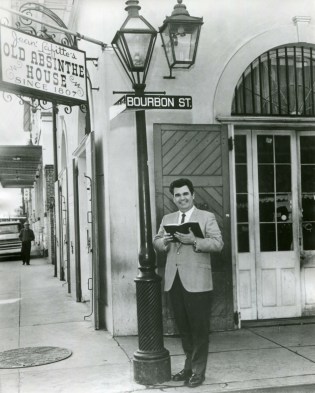
Bob-Harrington---BourbonStreet

Famed New Orleans evangelist Bob Harrington, known by many as “the Chaplain of Bourbon Street.”

Forgiveness is a significant theme in God’s Word.

The Bible tells us: “As far as the east is from the west, so far has He removed our transgressions from us” (Psalm 103:12). “I, even I, am He who blots out your transgressions for My own sake; and I will remember not your sins” (Isaiah 43:25). “He [Jesus] was delivered up because of our offenses, and raised because of our justification” (Romans 4:25). “If we confess our sins, He is faithful and just to forgive us our sins and to cleanse us from all unrighteousness” (1 John 1:9).

Scripture is clear; God’s forgiveness is for all, but each one of us must receive His forgiveness personally.

Our family has experienced forgiveness in a clear and visible way. My dad, Bob Harrington, was dramatically converted on April 15, 1958, when I was only 6 years old. He attended a revival meeting in his hometown of Sweet Water, Ala., to find some insurance prospects, and instead he found the Lord. During the fifth stanza of “Just As I Am,” Dad was forgiven of his sin and saved by the grace of God.

He preached his first sermon three days later and led his parents to faith in Jesus Christ. My mother, sister and I followed Dad in faith and became active in church. The Lord called my dad to ministry and led him to attend New Orleans Baptist Theological Seminary.

In a chapel service, then-NOBTS President Leo Eddleman presented a challenge to students: “Any pocket of sin is a mission field, and the closest Christian to it is a missionary.” Dad responded to that call and began a ministry in the French Quarter of New Orleans. In 1962, he was proclaimed by the mayor “The Chaplain of Bourbon Street.”

His ministry expanded in the 1960s and 1970s from the second block of Bourbon Street to nationwide crusades and national television. Many people were converted and called to the ministry through his personal soul-winning and powerful preaching. God used Bob Harrington to share His gift of forgiveness with thousands of others.

At the peak of Dad’s ministry, “the devil threw him a pass and he ran for defeat” (drawing from his own words). He left the Lord, left the ministry, left my mother and left our family. What a painful time for each of us.

God immediately spoke to me about forgiveness. I needed to forgive my dad even though he did not ask for forgiveness. Initially I did not want to forgive him, but later I chose to obey God’s clear command. We prayed faithfully for Dad’s restoration for 17 years before he returned to the Lord. What a time of rejoicing for our family! We were a part of his redemption story as Dad sought forgiveness from each of us.

After Dad returned to the Lord, he again had “fun being saved” and became “happy in the Lord.” He was bold in his witness and called to preach to others like him who had left the Lord and needed to get right with Him. He titled his message on prodigals, “Loving the Left Back Right.” What a beautiful picture of forgiveness!

In his later years, Dad had dementia. He was completely at peace in his condition. He spent his days sitting in his big red chair watching television.

As I walked into his little house one afternoon, God gave me a vivid example of total forgiveness. A divorced couple on the Jerry Springer program was screaming at each other. Dad looked up at me and said, “Isn’t it wonderful that no one in our family has ever been divorced? We all love each other.” Wow! Who would have ever thought that such truth could come from a Jerry Springer moment? Dad himself had been divorced twice, but God had forgiven him and taken his sin out of his conscious thoughts. What a perfect picture of forgiveness! When God forgives, our sin is completely removed.

My sister and I rejoice in the forgiveness of God which allowed our family to be reunited and our dad to have joy until his last breath. To our knowledge, Dad had no memory of the time he was away from the Lord. He talked often about our family years ago and remembered many amazing days of ministry. When once asked by a reporter what led him back to the Lord, Dad sincerely replied, “I have never left the Lord. I have always loved Him.” God literally removed his sin and blotted it from his memory, so he remembered it no more. I will always be grateful for being a part of a real-life story of forgiveness!

This article first appeared at BPnews.net.

We had to terminate a deacon in a church I once pastored. No one wanted to do it, because he had served for forty years, and because his wife was one of the kindest, godliest women any of us knew. They were pillars in our church. But it had to be done.

The man would approach young women at church, hug them close, and ask if they wanted to go for a ride. “Would you like to go to the coast?” was code for who-knows-what, because no one took him up on the offer, so far as we knew. But the implication was uncomfortable and the hands-y hugging very inappropriate.

Even then, twenty years ago, we knew what we had to do. After meeting with his accusers, then him and his wife, we removed him from office. What would Jesus do about sexual harassment? Put a stop to it.

It’s surprising how little comment there has been recently from church leaders on the subject of harassment and the Christian’s responsibility. Perhaps because it’s patently obvious that sex belongs within marriage, and no one should harass anyone about anything. But given the proliferation of accusations, from Hollywood to the halls of Congress, perhaps we should review the subject—for ourselves and for our children.

What are we teaching young men about their behavior, and young women about their value? Jesus has a few lessons:

Jesus was respectful of women. Some of his last words from the cross concerned the salvation of lost men and the future care of his mother. Some of his most tender sayings were to women, “Little girl, arise,” “Daughter, your faith has made you well; go in peace.” And in the presence of Lazarus’s grieving sisters, Jesus wept.

Jesus was honest with women. The woman at the well in Samaria is a good example of this.  Pointing out the woman’s sexual past would be uncomfortable for most men, but in the context of ministry—especially as it related to her salvation—it was necessary. But we note that Jesus conducted a challenging conversation in a public place. And only as it related to sin, repentance, and forgiveness.

Jesus stood up for women. Jesus was willing to confront the accusers of the woman caught in adultery. As they took up stones to kill her, Jesus issued the warning that caused them to drop the rocks and walk away. The law said stone her, mercy said forgive her. And the truth was that no one in that circle was sinless—except Jesus. In this instance, the boys club was closed. The boys went home mulling their own complicity, and the woman was spared.

Jesus did not exclude women because of controversy. Here is the difficult part for men in leadership today: how to include women fully in the workplace without being overly familiar. Jesus’ entourage at times included his mother, Mary Magdalene, and several other women. Whether their traveling together was unusual for the time, I don’t know. But I do know that if not for the women, Jesus would have died with almost no one in attendance and there would have been no plans to prepare his body for burial. It was women who anointed his hair, washed his feet, ran to the tomb, and cried out his name upon recognizing him, resurrected, in the garden.

The easy answer for men fearful of accusations would be to isolate themselves from women in the workplace. And there is wisdom in the usual precautions: have glass installed in the office door, don’t spend time alone unnecessarily, don’t dine privately with women. Billy Graham’s “Modesto Manifesto” is a good guideline for men today; but it’s not an excuse to exclude women from ministry or leadership.

At the highest levels, with Vice President Mike Pence being a recent example, leaders who exercise caution are as likely to be criticized as those who exercise none. But, with the right motivations, standing up for women means being as concerned for their reputations as we are for our own.

My mother quit a job once after only a month. That was very unlike her. She was excited about the new post at the beginning, but quickly soured on it. “It wasn’t a nice place to work” was the only explanation she would offer to me as a pre-teen. Years later she gave an account that sounds much like the news stories we hear today. No one in management would listen: resignation was her only choice. What followed was months of unemployment and the beginning of a long rough patch for us as a family.

Actions have consequences far beyond the few people most closely involved. How differently it might all have turned out if someone in that scenario had stood up for the woman, and put a stop to the harassment.

Eric Reed is editor of the Illinois Baptist.

Global missions focus is December 3-10

LMCO Moscow.jpg

GROWING NEED – Moscow now has more Muslims than any other European city. Here, thousands gather for Friday prayers at the city’s Grand Mosque.

Every December since 1888, the Lottie Moon Christmas Offering has empowered Southern Baptists’ international missions work. This year’s Lottie Moon Offering and Week of Prayer feature people doing difficult work around the world—whether they’re reaching out to Muslims in Russia, starting a new church in Japan, or giving hope to refugees.

Reaching the unreached
When most people think of Russia, they may conjure up images of Romanov royalty, a parade of dictators like Stalin and Lenin or Brezhnev, or maybe cultural icons such as Mikhail Baryshnikov or Dostoyevsky. They don’t think of Muslims.

But Islam is part of the fabric of old Russia—it made it there 66 years before Christianity did. As a result, Muslim groups are indigenous to the North Caucasus region, an area between the Black and Caspian Seas situated on northern slopes of the mountain range that generally separates Europe from Asia. These people groups include 45 to 50 subsets of people and even more languages, making them very difficult to reach.

However many of them are moving into Moscow, Russia’s capital, which now has more Muslims than any other European city. Its newly reopened Grand Mosque can hold 10,000 worshippers.

“God says, ‘If you can’t go to them, I’ll bring them to you,’” said Elizabeth*, a Christian worker among Muslims in Moscow. “There’s no better time to be in the former Soviet Union. God is moving Muslims right under our noses.”

Seeing the impossible
International Mission Board missionaries Jared and Tara Jones knew that God could do a lot with something little. But they never imagined just how many doors he would open through their adopted infant son, Ezra.

In the East Asian country, 40,000 children live in orphanages, but parents rarely give up their rights so that a child can be adopted. But the Joneses knew God had placed a baby on their hearts, and they prayed. “We serve a God who makes doors where doors don’t exist,” Jared said. “And this little guy gives us multiple opportunities to talk about the Lord.”

Their son’s pediatrician was the key to another door—a church plant they had been praying about for years. One day, the doctor told Tara out of the blue that she wanted to start a church at her office and asked if Jared could lead it. Tara described it as a divine appointment. The first Sunday 70 people came. They’ve seen hearts changed and people keep coming.

Remembering the forgotten
Don Alan* says he remembers a refugee telling him once that he didn’t feel alive, but he wasn’t dead either—he was somewhere in between.

“Hopelessness is a universal feeling among refugees,” Don said. “They feel forgotten.” That’s why International Mission Board missionaries like Don, who serves in North Africa and the Middle East, and Seth Payton*, who works with refugees in Europe, spend their lives taking hope into those hopeless places.

“Refugees come to Europe looking for a better life, and many times they find nothing,” Seth said. Often, they’ve paid traffickers a high price for a long, miserable trip across the desert and then a dangerous boat ride across the Mediterranean Sea. If they make it alive, then they often can’t get jobs. They spend their days scrounging for food and their nights packed into an apartment with 15 other people.

“We pray that through this time God will open their hearts and draw them into his kingdom through the hope that he offers,” Seth said. “Hundreds of refugees from closed countries are becoming believers in Europe. So there are great things happening in the midst of a heartbreaking situation.”

Go to IMB.org/lottie-moon-christmas-offering for videos, stories, photos, and prayer requests for each day of the Week of Prayer for International Missions.

*Names changed.

– From IMB.org


Why Chicago?

ib2newseditor —  December 7, 2017

chicago-cloud-sculpture

We may not verbalize the “why” question with the persistence of a young child, but we still look for a reason or substantial meaning when called to some action.

Through more than a dozen years in church planting, I’ve heard the “why” question. When a family gave five acres for a new church property to a local association in eastern North Carolina, many in nearby churches asked why, even as their buildings were nowhere near filling their seating capacity.

When I planted a church in Buckeye, Ariz., the North Carolina churches I invited to partner with us often wondered why they should care about planting a church in a community 2,000 or more miles away.

For nearly four years now, I have had the privilege of living in Chicago. During that time, I have mentored, coached and challenged many church planters here. I’ve also invited churches in more than a dozen states to get engaged in supporting church plants here in Chicago with prayer, action and finances.

“Why Chicago?” some ask, jesting, “Why not Hawaii? That would be a great mission trip!”

Yet there are three key answers:

The first reason is biblical. In Luke’s account of the Great Commission in Acts 1:8, Jesus tells His disciples and us, “But you will receive power when the Holy Spirit has come on you, and you will be my witnesses in Jerusalem, in all Judea and Samaria, and to the end of the earth” (CSB).

No matter where you live, major metropolitan areas like Chicago are located between you and “the end of the earth.” And frankly, because of political views and sensationalized news, Chicago in particular is to many in southern Illinois and elsewhere what Samaria was to the Jews: a place and people we’ve been trained or conditioned to dislike or even hate. Yet, even if it is Samaria to Christians, it’s a place and people to which Jesus has sent us to bear witness of Him and His Good News.

The second reason is practical. Cities like Chicago have, from their earliest settlement, become a home for immigrant people groups — many that are identified as “unreached and unengaged” by the International Mission Board.

Because of technology and ease of global travel from America’s major cities, many immigrants maintain a reach to and influence in their homelands. So, effectively evangelizing and discipling people in a city like Chicago gives us a reach into many parts of the world, including most of the peoples in the 10/40 window, a region between the 10th and 40th parallels across Africa and Asia where most of the people who have never heard the Gospel live.

Reaching Chicago and other metropolitan areas with the Gospel could bring a significant advance toward the global evangelization that Jesus promised in Matthew 24:14.

The final answer to “Why Chicago?” is missiological. Chicago is sometimes called the “most segregated city in America.” And while that is changing in some of the neighborhoods of the city, people groups are usually heavily concentrated in certain areas. Poles are heavily concentrated in the northwest neighborhoods and nearby suburbs. Chinatown, as you might guess, is home to mostly Chinese people, many of them still speaking Mandarin or Cantonese. Pakistanis are clustered along Devon Avenue in the northern part of the city. Professional millennials make up two-thirds of the population in the West Loop. Wicker Park is the epicenter of the hipsters.

High concentrations of people groups in a specific place give us a missiological advantage in reaching them. Even if it is a cross-culturally gifted southern boy and his family living among south Asian immigrants, winning one or two to Jesus could result in dozens who live nearby coming to faith in Christ. Given their close proximity to each other, bringing them together to a form a new church can happen very naturally.

While it may not be unique, Chicago is rare in giving us three good reasons to seize the opportunities for the Gospel that lie within our reach.

Dennis Conner directs IBSA church planting efforts in northeast Illinois. Beginning Jan. 1, Conner will transition to planting a church in Chicago’s South Loop neighborhood. This article first appeared in the Illinois Baptist and has been republished by Baptist Press.

Editor’s note: The 500th anniversary of the Protestant Reformation collided with the reality that there are still martyrs today. Ron F. Hale, a former IBSA director of evangelism, examines the Anabaptist movement that catalyzed a second Reformation of sorts, and gives Baptists another piece of their spiritual heritage.

Balthasar_Hubmaier

Dr. Balthasar Hübmaier of Friedberg

On the heels of the Reformation came the Radical Reformers, who questioned everything that didn’t have scriptural authority. Infant baptism and the observance of Mass caused the greatest angst for Anabaptists. And like shooting stars against the backdrop of the Dark Ages, many forces came forth to snuff out these bright lights.

Sixteenth-century Anabaptists were put to death by state-church authorities as they launched the most revolutionary act of the Reformation. Thousands died—burned at the stake, drowned in the rivers of Europe, run through with swords, or starved in putrid prisons.

The wheels of this revolution began turning as young intellectuals gathered around the Swiss reformer Ulrich Zwingli in serious study of the Greek New Testament. Some of the young theologians became convinced that Zwingli and others lacked sufficient reforms in purifying the church and recovering New Testament practices.

In all this Reformation talk, don’t forget the Anabaptists.

On the evening of Jan. 21, 1525, several men who became known as the Swiss Brethren met without Zwingli in the home of Felix Manz in Zürich. After earnest prayer, George Blaurock (a Catholic priest) begged Conrad Grebel to baptize him with true Christian baptism upon his confession of faith in Jesus.

After Blaurock received his own baptism, he baptized the others as they came humbly, promising God and each other to live separated from the world and to preach the gospel. The next morning, these young men hit the streets preaching and baptizing new believers as they boldly lived out the Great Commission of Jesus.

Thousands executed
The Zurich council vigorously suppressed this movement and established an ordinance that the teaching or preaching of Anabaptism was against the law. The radicals were derisively labeled “re-baptizers.”

Withholding your baby from the baptism font or re-baptizing citizens upon their profession of faith became illegal. Sam Storms, a pastor and former professor at Wheaton College, indicates that more than 5,000 Anabaptists were executed in Switzerland by 1535.

Felix Manz was the first person to be executed from the tiny group that met in his home on that historic night. With the support of Zwingli, Manz was taken from the Wallenberg prison tower on a cold winter day. He was taken to the fish market by the Limmat River to be read his death sentence. He was forced into a boat and escorted to a little hut in the middle of the river by a pastor and his executioner. Felix Manz was shackled and pulled from the top of the fishing hut, disappearing into his watery grave.

George Blaurock, the first to be baptized that fateful night, was later burned at the stake on Sept. 6, 1529, in Klassen (now Austria), after winning and baptizing hundreds to Christ.

The movement continues
The Anabaptist movement would grow to be important beyond the issues of Mass and infant baptism. It became a new paradigm of doing church. The old parish concept of every baby being baptized as a new member of the church was being replaced by a “free church” model where only those mature enough to confess Christ as Lord and follow him in believer’s baptism would be regenerate members of the local church. These members would observe the Lord’s Supper as a memorial meal without sacramental and medieval trappings.

Michael Sattler became important to the movement as the writer of the Seven Articles, the first Anabaptist declaration of faith. The articles, now referred to as the Schleitheim Confession of Faith, became widely circulated and accepted. However, Sattler became a marked man.

On May 20, 1527, he was tortured prior to being burned at the stake. A part of his tongue was cut out, his flesh was burned with red-hot tongs. His faithful wife, Margaretha, was drowned eight days later.

Sola Scriptura…
If biblical authority was the major issue between Magisterial Reformers (those associated with Martin Luther and John Calvin) and the Roman Catholics, believers’ baptism became that between the Anabaptists and the Magisterial Reformers. Anabaptist historian William Estep said, “Believers’ baptism was for the Anabaptists the logical implementation of the Reformation principle of sola Scriptura.”

Dr. Balthasar Hübmaier of Friedberg became the ablest defender of the Anabaptist position on believers-only baptism in the 16th century. Estep called him the Simon Peter of early Anabaptists.

Hübmaier saw that the regenerate nature of the church presupposes a certain degree of maturity, personal faith, and volition. Since infants cannot confess sins and believe, then infant baptism had to be dismissed as unscriptural. Since neither John [the Baptist], Jesus, nor the apostles taught or practiced infant baptism, Hübmaier never tired of denouncing this practice. He saw no saving power in church water. Nor could he find any New Testament evidence of a godfather or spiritual sponsor being able to believe for the infant undergoing baptism.

Hübmaier and his wife were martyred in Vienna in 1528. Baptists owe a debt of gratitude to them and other Anabaptists who stood firmly—even unto death—on Scripture, rather than church tradition, as the final authority on matters of faith and practice.

Ron F. Hale has served as a Southern Baptist pastor, denominational leader, and religion writer. He currently ministers on the pastoral staff of a local SBC congregation in his hometown of Jackson, Tenn.

Thanks for everything on blackboard

There are a few verses that most Christ followers at least sort of know by heart. Verses like John 3:16. Or Hebrews 11:1. Or this one:

“Be joyful always; pray continually; give thanks in all circumstances, for this is God’s will for you in Christ Jesus” (1 Thessalonians 5:16-18).

It’s a strange passage coming from someone like the apostle Paul. He’s been bitten by snakes, shipwrecked, beaten within an inch of his life on numerous occasions, abandoned by his friends on some occasions, maligned by people he cared about on others. And yet, Paul stresses the obedience of joy and thankfulness almost as much as he stresses grace and faith.

And make no mistake—it is an issue of obedience. Often we think of joy and gratitude in the realm of feelings. Either we feel joyful or thankful, or we don’t. When we feel it, we do it. But obedience doesn’t work that way.

Obedience is doing regardless of whether you’re feeling. Thankfully, as we grow in Christ, we find the Lord not only bringing about in us the correct actions but also the correct feelings that come alongside those actions. But until we are made right and whole again, it is left to us to give ourselves to the sanctifying work of the Holy Spirit by continuing to do, even (and perhaps most especially) when we do not feel.

So, your gratitude—just like mine—is not a question of whether you feel thankful, but whether you are willing to obey this command from the Lord.

But there is another issue here to examine during this season set aside for giving thanks—whether there is a difference between giving thanks IN all circumstances and giving thanks FOR all circumstances.

Gratitude isn’t a matter of how we feel in the moment, but a measure of our obedience.

If there is, it means that no matter what situation you find yourself in, there is always something to be thankful for. You may not be thankful for the suffering, the pain, the hardship or the persecution, but there are other things to lift your heart. When you consider everything that the Lord is, all that he continues to do in the world, and the next world waiting for the believer, there are plenty of reasons to say “thanks,” no matter what happens to be going on.

If there’s not a difference, it means you believe that every circumstance, regardless of how devastating or marvelous, has come from God. And since you know that God is for you, not against you, then you can be thankful for the circumstance, even if you are doing so in faith. You are thankful because you believe that ultimately good will come of it.

I think people love Jesus and believe both of these things. And at the end of the day, both sets of believers are thankful.

In my own life, I have seen how, over time, you become more thankful “for.” Over time, and with perspective, you begin to see the invisible hand of God moving in times that, in the moment, you could not see. You begin to reflect on God’s providential care and love and wisdom even when he may have seemed so significantly absent. You see how he has shaped you and guided you into a deeper experience of Jesus. And so, over time, you become thankful “for.”

To bring it full circle, notice that the command here is to give thanks in all circumstances. That’s what you can do right now, even if you don’t feel like it. You can practice the discipline of gratitude, finding the grace of God, in general and in particular, at work in your life.

But as you do that, think back a bit. Think back to those moments when you thought you would never have another reason to feel thankful again. Think back, and then look and see the redemptive hand of God at work because of those times. And maybe this is the year that you are not only obediently thankful in, but also being thankful for.

Michael Kelley is director of groups ministry for LifeWay Christian Resources. He is on Twitter at @_michaelkelley and online at michaelkelley.com, where this article first appeared.

– From Baptist Press

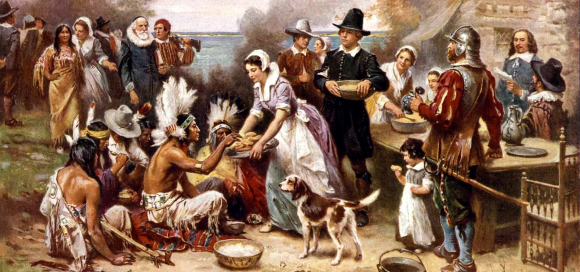
The real first Thanksgiving

ib2newseditor —  November 22, 2017
The_First_Thanksgiving_Jean_Louis_Gerome_Ferris

The First Thanksgiving Jean Louis Gerome Ferris (Public domain)

Images from the Pilgrims’ first Thanksgiving Day feast are easy to call to mind—black hats, wide white collars, Native American guests, and an idyllic feast bringing together two very different cultures. But historian Robert Tracy McKenzie—along with others in his field—say that many of those images are, to put it simply, not true.

The Pilgrims often wore bright colors, for example. And while the 1621 feast did include Native Americans, the dynamic between the two groups was likely tense.

McKenzie, chair of the history department at Wheaton College, explores the Pilgrims’ journey from England to Holland to America in his 2013 book “The First Thanksgiving: What the Real Story Tells Us About Loving God and Learning from History.”

The Pilgrims, he writes, wouldn’t have been given to celebrating very many holy days. This set them apart from the Catholic and Anglican Churches. Aside from a weekly Sabbath, the Pilgrims had two distinct reasons to call for a holy day: a day of humiliation and fasting, and a day of thanksgiving.

Both happened in 1623, as new settlers arrived while the existing colonists were already struggling to survive. Food was scarce, and now there were more mouths to feed. And on top of all that, McKenzie writes, they faced a two-month drought that summer.

The Pilgrims called a day of humiliation “to seek the Lord by humble and fervent prayer.” They prayed for eight or nine hours, McKenzie writes, during which the sky became overcast. Then, it rained for the next 14 days.

And then the Pilgrims saw reason for another holy day—a day of thanksgiving. McKenzie writes this particular day was very different from what we traditionally think of as the first Thanksgiving, which historians generally consider to have been a kind of harvest festival. The real first Thanksgiving, he says, was “called to acknowledge a very specific, extraordinary blessing from the Lord.”

The current vestiges of Thanksgiving Day celebrations are very different than what the Pilgrims embraced, McKenzie says. “In their view, an annual Thanksgiving taught human conceit and divine predictability and could easily degenerate into a meaningless ritual that reduced God’s provision for human news to his creation of the crop cycle.

“By observing Thanksgiving irregularly, on the other hand…the Pilgrims reminded one another to look with expectancy for God’s ongoing, direct intervention in every aspect of their lives.”

– The First Thanksgiving (IVP Academic, 2013)