Archives For November 30, 1999

COMMENTARY | Lisa Sergent

Recently, I’ve had several opportunities to talk in IBSA meetings about “modern families” in our communities. I often ask the group I’m speaking to if they know anyone who is gay. Some say no, but others, especially younger people, begin to tick off a list.

And a fair number choose to say nothing. They appear uncomfortable. But then, aren’t we all?

When we hear about a florist being sued for declining to provide services for a same-sex wedding, or former megachurch pastor Rob Bell telling Oprah the church is just “moments away” from accepting gay marriage, our heads spin. We’ve come a long way from the early 80s when we were trying to figure out if singer Boy George was indeed a boy.

As I share how the Illinois Baptist newspaper has covered the rapidly changing marriage culture in Illinois, I tell how I’ve met same-sex couples at the Capitol eager to be married. I mention a former high school classmate who came out on his Facebook page. In my own extended family, a second cousin recently married his longtime companion/partner.

After the presentation, there are always a few people who come up and share with me in hushed tones about a family member or friend who has announced he or she is gay. They whisper how they are struggling with this knowledge. They want to minister to these loved ones but don’t know how. And they’re afraid to bring it up at church. They’re worried about how they will be looked at by fellow church members. On some level, there is a fear of guilt by association.

As the culture changes around us, we have to seek guidance from God’s Word, and be Christ-like in our actions. People are trapped in sin and are hurting, even if they don’t recognize it themselves. As a result, people in our churches are hurting for these friends and relatives.

But they keep silent.

We need not only to minister to homosexuals, but also to the friends and family members who love them. Figuring out how to minister to people who hurt, whatever the source, can’t be avoided.

While the church is trying to balance Christ-like outreach to people who are gay with biblical truth about their lifestyle, we can’t forget the Christian aunts, cousins, grandmothers and parents who are wrestling with the same tension. We need to create an environment in church where the relatives are free to talk about their struggle and receive biblical, loving counsel, so that they can in turn minister to their loved ones.

We’re way past the time for keeping quiet.

Lisa Sergent is director of communications for the Illinois Baptist State Association, and contributing editor of the Illinois Baptist newspaper.

COMMENTARY | Heath Tibbetts

“So what do you think about demons?” This was the random text message my 21-year-old brother sent me a few months back. I replied, “They sound scary, and they’re totally real.”

He called and told me of his friend, John, who believed he was being harassed by a demon. John doesn’t go to church, but he decided to call a few of the local pastors in his town, asking them what he should do. In each instance, the pastor didn’t believe his story, and offered nothing further.

Heath_Tibbetts_Feb26John lives out of state from my brother and me, so I offered to call. Soon, he was explaining his story to me. Let’s put it this way…YIKES! The hairs on my neck stood at attention as John explained this entity’s ability to take a visible shape while bringing him feelings of dread and even depression. He was now worried that this “entity” (I told him demon was the correct term) would attempt to possess him, and he was highly fearful.

I’ve heard of pastors who have blown off these types of stories. A previous pastor I served with said he had received a call from someone who thought they had a demon in their house. When I asked him what he was going to do, he replied, “Not go over there!” This didn’t sit well with me. Jesus spent many days defeating demons who were bringing hopelessness and harm to people all over Israel (Matthew 8:16, Luke 11:20, bunches of others). The Bible spoke of demons as a real threat, and I was shocked that our church didn’t act accordingly.

After telling John I believed him, I asked about his relationship to God. He admitted to having none, though he had been growing more curious about spiritual things. And as John continued to talk, I realized these attacks had intensified during this newfound curiosity. Long story short, I shared with John the Good News of Jesus and he willingly repented of his sins over the phone and placed his trust in Jesus. Then, we had a crash course in Holy Spirit theology. I told him that according to 1 Corinthians 6:19, no one can ever possess him now that he has become a temple of the Holy Spirit. John hung up the phone sounding much more confident about the future.

In fact, in the three months since John accepted Christ, he’s experienced a great change. Because the local pastors didn’t offer hope, he was unwilling to attend their churches. I’ve been discipling him by phone, texts, and e-mails. He reports no visits from this demon since his salvation, and he is reading his Bible and spending time in prayer. John is also finding new plans opening up for his life. He is moving to a new city in February to continue his education, and the first question he asked me was, “How do I find a good church when I get there?”

What is the takeaway for us? First of all, there were pastors who had an unbeliever call them for hope and they offered NONE. We have the hope of salvation and purpose in Jesus. When an unbeliever approaches us, no matter their dilemma, we must be prepared to help them see that Jesus is calling them in the midst of their crisis.

Secondly, if the Bible warns us of something, we had better take it seriously! Satan and his demons are real and they are working tirelessly to deceive, depress, and destroy souls. We must remain aware that spiritual warfare is going on all around us. Sometimes we can see it more clearly than others, but we are not fighting against people, but against “the spiritual forces of evil,” according to Ephesians 6:12. God has called us to be
warriors for the gospel who will help the hurting and broken find hope in Jesus Christ. As Peter said, let us always be prepared to share the hope that lies within us.

Heath Tibbetts pastors First Baptist Church in Machesney Park.

Government leaders need support, encouragement, advice and gospel centered truth, says Carrie Campbell (second from right).

Government leaders need support, encouragement,
advice and gospel centered truth,
says Carrie Campbell (second from right).

COMMENTARY | Carrie Campbell

Every year, my family goes to the Springfield City Basketball Tournament to watch our four city high schools duke it out for the top spot. A few weeks ago, we were sitting at the tournament on a Saturday night when I got a text message from my roommate: Bruce Rauner, Illinois’ newly elected governor, was there.

I quickly scanned the crowd looking for men in suits and a cluster of people. After searching for about 10 minutes, my mom spotted him among the crowd looking just like the rest of us, wearing blue jeans. I immediately decided I wanted to meet him. My sisters and a friend of ours from church headed down to where he was sitting near the court. Gov. Rauner was taking photos with a few other people, and when it was our turn, he smiled at us brightly and told us to come in close and put our heads together.

I introduced myself and told him that I was a middle school teacher. He laughed and said, “God bless you.” We went back to our seats, but later that evening, I went back to talk to him and his team a bit more. I told them that I teach at a diverse school, with students from more than 10 countries. I invited him to meet our students, most of whom have probably never met anyone that influential, especially a government official.

As Christians, I think it’s easy to get intimidated or star-struck by people that lead lives that seem more important than ours. Yes, the governor of Illinois does make many important decisions for our state. But he’s also like the rest of us, a human being put on this earth to glorify God. My introduction to Gov. Rauner reminded me that not only is it extremely important that we lift up our government officials in prayer, but also that we build relationships with them when we have the opportunity. They need our support, encouragement, advice, and gospel centered truth just as much as the next person does.

Romans 13:1 calls Christians to action in just this way: “Let every person be subject to the governing authorities. For there is no authority except from God, and those that exist have been instituted by God.” So I put forth a challenge to you: The next time you come in contact with a government leader, encourage that person with a friendly introduction, handshake, and—as God gives opportunities—with gospel centered truth.

Carrie Campbell is a middle school teacher in Beardstown and a member of Delta Church in Springfield.

By Eric Reed

Editor’s note: Baptist news editors met in coastal Alabama this week. Look for stories in the Illinois Baptist and online over the next few weeks.

Orange Beach, Ala. | It’s a wonder the local paper didn’t call this “The Battle of Mobile Gay.” This is, after all, the place where in 1864 Admiral Farragut famously condemned the torpedoes and ran his ship “full speed ahead” past Confederate forts and mines (called “torpedoes”) tethered in the Bay.

The 2015 version had attorneys dueling on the courthouse steps and clerks inside shuttering the marriage license window because the probate judge refused to accept applications from same-sex couples.

“I’m plumb ashamed of this town,” one applicant said outside the courthouse on Monday when he and his partner were unable to get married. On Thursday, that same man declared, “In Alabama! I never would’ve believed it!” as he waved his new license in the air with one arm and hugged his new spouse with the other.

Between Monday and Thursday, the Battle:

A federal judge in Mobile, Callie Granade (pronounced like the ammunition), had ruled Alabama’s ban on same-sex marriage unconstitutional on January 23. Marriage licenses were to be issued starting Monday. But on Sunday night, Chief Justice of the Alabama Supreme Court Roy Moore told the state’s probate court judges, who issue marriage licenses here, that the federal ruling did not apply to them.

On Monday, it was reported 60 counties started processing applications from same-sex couples; seven did not, including the state’s second most populous county, Mobile. Probate judge Don Davis ordered the license window, festooned with purple and gold Mardi Gras masks, shuttered. No licenses were issued to any couples, same-sex or otherwise.

By Wednesday, it was reported only 23 counties were issuing same-sex licenses.

Attorneys representing gay couples and Judge Davis went to court.

And Roy Moore went on TV.

The last time Moore opposed a higher court ruling, he was removed from the bench. That was over the monument to the Ten Commandments at the State Supreme Court. This time, Moore went to the court of public opinion.

For many observers, he appeared to win in Alabama, where his stance is based on a state’s right to amend its own constitution as 81% voters did in 2006, limiting marriage to the traditional, biblical definition. But on TV, against CNN’s Chris Cuomo, Moore lost, according to national pundits who gave the win to the news anchor/attorney.

It didn’t matter. Late Thursday, Granade ruled again. Probate courts must issue marriage licenses to all couples, despite the state constitution. And today, Friday, it is reported all counties’ license offices are open for business.

Frankly, in Alabama, many would never have believed it. I wouldn’t, because I grew up here.

As Baptist editors gathered for their annual conclave to hear reports from SBC entity heads and discuss journalism, I was also looking forward to a short visit to my old home. I didn’t expect to see history made.

I learned to report from that federal courthouse where TV reporters waited this week for the rulings, reporting breathlessly at 5, 6, and 10 on the latest developments—or lack of them. I covered the same county governments at the place where a half-dozen gay couples were wed in the hour after the marriage license office reopened. And I thought I understood this coastal town where half the people are Baptist and the other half are Catholic, and their alliance has kept the politics and the morals mostly conservative for 300 years.

Until now.

Leaders of the Baptist state convention in Alabama quickly commented: “The vast and overwhelming majority of Alabama Baptist leaders and other church members continue to affirm the biblical view of marriage and the historic declarations that Alabama Baptists have made concerning the marriage relationship,” executive director Rick Lance said.

But the comment did not appear on local newscasts in Mobile.

I did hear a comment from an SBC leader at this meeting that demands my consideration. Given the rapid liberalization of public opinion on same-sex marriage and other moral issues, is it possible that pastors and leaders of SBC entities will find themselves heading organizations that are more conservative than the people in the pews—especially younger people? (That’s just the opposite of what happened in mainline denominations in the second half of the 20th century, when leaders grew far more liberal than church members.) Our church members will be shifted by the tide of public opinion, he said, if we pastors and teachers don’t provide a firmer biblical foundation.

And the next wave is coming soon. From here, it’s full speed ahead to the U.S. Supreme Court, where a ruling possibly in June is likely to determine the legality of same-sex marriage in all 50 states. Expect Southern Baptists to speak to that, but will anyone listen?

The Baptists came to Alabama this week, but that wasn’t news. The world changed while we were here. That’s the news.

Eric Reed is editor of the Illinois Baptist newspaper and associate executive director for the Church Communications team of the Illinois Baptist State Association.


How a biblical proverb can help us manage modern money

COMMENTARY | Doug Morrow

Doug_Morrow_blog_calloutI’ve been working on a project since mid-November. Once a week (okay, once every two weeks), I write an extended devotional or comment based on a chapter of Proverbs and have been addressing it to my children. Proverbs represents some of the most amazing “counsel” ever written, and much is written as from a parent to a child. I’ve been trying to amplify the Proverbs into my own paternal voice for the benefit of Reed, Lauren and Claire.

It was in this process that I discovered a nugget that describes what I believe in so passionately, and the mission of the Baptist Foundation of Illinois:

“Honor the Lord with your wealth and with the first fruits of all your produce,” reads Proverbs 3:9, “then your barns will be filled with plenty, and your vats will be bursting with wine.”

King Solomon’s words can be difficult to translate to our time and culture. “First fruits” has a different meaning in an America so replete with cheap food that we’re far more likely to queue up at the McDonald’s drive-thru than pray for rain for the wheat crop. Few of us have barns, and ever since municipal water projects, there are even fewer with “vats bursting with wine.” So, what could the Spirit say to us through these words to those living in the wealthiest nation in our planet’s history? “Honor the Lord with our wealth?”

In truth, most of the assets we steward for the Lord aren’t in our income (technically our “first fruits”), or emergency cash. Over time, most people collect “wealth” in things like real estate (67% of Illinoisans own their home), IRA or other retirement assets (often acquired ‘pre-tax’), life insurance, or other “stuff” we collect over our lifetimes.

I think the way we honor the Lord with this wealth, along with our first fruits, is amazingly simple and can be found in the text itself. The pattern we apply to our wealth should be consistent with the pattern we establish with our “first fruits!”

Do we take care of our needs such as food, shelter and clothing with our first fruits?

Do we use those fruits to care for our children and dependents?

What about supporting the work of God’s church?

Absolutely, on all three counts. And because we do those things with our first fruits, we should do so with our wealth.

How does all of this come together in a way that accomplishes this God-honoring stewardship plan? Well, since most of our “wealth” is not accessed until our death, it’s important to put together a Christian Estate Plan now. Such a plan accomplishes the “pattern” that God has called us to live out in our lives—taking care of our own needs, caring for children and dependents, and investing in the work of God’s church.

These are the elements I commonly refer to as the “big four” parts of a Christian Estate Plan:

• A will and possibly a living trust
• A financial (durable) power of attorney (when not using a living trust)
• A health care power of attorney
• Careful attention to titling, beneficiary designations, or transfer on death devices on retirement assets, life insurance, financial accounts or other assets, since any asset designated in this way bypasses the will and the probate process

The Baptist Foundation has actually made the process simpler than you might imagine—and much less expensive than you might fear. A great place to start is with the Life Stewardship Navigator, a free download from http://www.BaptistFoundationIL.org. BFI provides complimentary and confidential help in putting together a plan that enables you to provide for your family and support Christian causes in exactly the manner you wish to support.

Over the next few months, I’ll keep working on the Proverbs chapters (my wife wants me to arrive at chapter 31 in time for Mother’s Day). In the meantime, it’s important that we begin this year with the counsel that all we are, hope to be, or ever will steward belongs to our God. May we carefully honor Him in everything.

Doug Morrow is executive director of the Baptist Foundation of Illinois.

COMMENTARY | Bob Elmore

Bob_Elmore_blog_calloutWaking up to the sound of a high-pitched alarm is never a good start to a day. But this morning in April 2012 started just that way. It had been a stormy night, so I initially thought it was the weather alert radio and I mentally prepared to get my family down to the basement—not an easy task, since we have two sons with profound autism who strongly resist any changes to their routines.

I groggily opened my eyes and remembered I had been sleeping on the couch in the living room with my wife and son, Mark, who has epilepsy in addition to autism. He had a seizure that night, so we had been keeping watch over him as he slept on the floor. I looked around at our dark house and saw an odd orange glow coming from Mark’s room. The shrill alarm I heard was our smoke alarm. Mark’s room was on fire!

I woke up my wife and we got our protesting sons out of the house and into the car, which we moved away from the house. We were in pajamas and bare feet while we waited for the heater in the car to warm up. We watched dark smoke billow out of our windows as our small local fire department arrived.

Somehow, my wife and I were filled with a peace that belied our circumstances. We gripped hands and prayed, thanking God for our family’s safety and especially that our son had not been in his room when the fire began—the first time we were ever grateful for a seizure.

We opened our eyes after the “Amen.” All we had in the world was given to us by God, like Psalm 24 tells us. “The earth is the Lord’s, and everything in it, the world, and all who live in it.” We instinctively knew that He would give us what we needed, just like He always had before…and He did.

Our dear neighbors and loving church family in Winchester, Ill.—about an hour west of Springfield—brought us blankets, clothes, coffee and emotional support. Over the next days, weeks and months, we would watch God fold His arms around us by bringing people to us. We had spent years together trusting God to take care of our atypical family each day, and He had always proved Himself faithful and now continued to do so.

Within three months, we had relocated to Springfield, where I now serve as IBSA’s short-term missions coordinator. We have a new house and new furnishings. Most importantly, we have another reason to entrust all that we have to God. Matthew 6:21 reminds us that “where your treasure is, there your heart will be also.”

Our treasure always lies with our God. That way, our hearts will forever be in a safe and peaceful place.

Bob Elmore is IBSA’s short-term missions coordinator. He and his family are members of Western Oaks Baptist Church.

Editor’s note: This piece is reprinted from Baptist Press (BPNews.net). Sanctity of Human Life Sunday is January 18. For resources, go to ERLC.com/life.

COMMENTARY | The claim of some pro-choice groups that Scripture does not address abortion would have surprised both Jews and Christians living in the first century. That’s because they were virtually unanimous that the Bible implicitly—though clearly—prohibited the killing of unborn children.

David_Roach_calloutAbortion advocates today tend either to deny this fact or remain gladly ignorant of it. For example, Planned Parenthood, America’s largest abortion provider, issued a “pastoral letter to patients” last spring stating, “Many people wrongly assume that all religious leaders disapprove of abortion. The truth is that abortion is not even mentioned in the Scriptures—Jewish or Christian—and there are clergy and people of faith from all denominations who support women making this complex decision.”

Of course, the Bible does not contain the direct commandment, “Thou shalt not have an abortion.” But based on passages like Psalm 139:14-16, Jeremiah 1:4-5, Amos 1:13 and others, ancient Jews and Christians believed it was clear that God cared for the unborn and regarded abortion as a sin.

Some may be surprised to learn that abortion existed more than 2,000 years ago, with surgical and chemical abortions performed in pagan cultures hundreds of years before Christ’s birth. The Greeks were among the first Ancient Near Eastern people to permit abortion, with Plato arguing in “The Republic” that pregnant women over 40 should be required to have abortions. In contrast to pagan cultures, Judaism emphasized the value of unborn and pre-born life dating back at least to the time of Moses, when God’s people protected infant males from being slaughtered at birth as Pharaoh ordered (Exodus 1:15-21).

In fact, some scholars believe Pharaoh’s command to kill Hebrew boys “on the birthstool” (Exodus 1:16) was actually a command to commit partial birth abortion, with “birth stool” functioning as a Hebrew euphemism for “birth canal.”

Either way, the Jewish culture of life was evident, and the Jews of Jesus’ time expressed their anti-abortion convictions. The Jewish work Sentences of Pseudo-Phocylides, written between 50 B.C. and A.D. 50, taught that “a woman should not destroy the unborn in her belly.” First Enoch, which was written in the first or second century B.C., said it was evil to “smash the embryo in the womb.”

Josephus, a Jewish historian born in A.D. 37, summarized, “The Law orders all offspring to be brought up, and forbids women either to cause abortion or to make away with the fetus.”

Early Christians agreed. The Didache, a first-century document that some church fathers argued should have been included in the New Testament, taught, “Thou shalt not murder a child by abortion nor kill them when born.” Another Christian writing considered for inclusion in the New Testament, the Epistle of Barnabas, said, “You shall not abort a child nor, again, commit infanticide.” Both of these documents were read aloud in some churches.

When Spanish bishops convened a council in approximately 305 in the city of Elvira, they voted unanimously to decree eternal excommunication for women who had abortions—a decision that reflected their just condemnation of the practice though it failed to reflect the biblical promise of forgiveness to post-abortive women who confess their sin and trust Christ as their Lord and Savior.

“If a woman conceives in adultery and then has an abortion, she may not commune again…because she has sinned twice,” the council decreed.

Among other early church leaders whose writings condemned abortion explicitly were Tertullian (c. 150-c. 229), Clement of Alexandria (c. 153-c. 215), Basil of Caesarea (c. 329-379), Jerome (c. 347-419) and John Chrysostom (c. 349-407).

Perhaps one reason the New Testament writers did not address abortion was that they did not need to. For the first 500 years of Christianity, there was a strong and practically unanimous consensus among believers that terminating a pregnancy violated Scripture’s doctrine of the sanctity of human life.

A thousand years later, John Calvin demonstrated that the Christian tradition of opposing abortion was still alive and well. Commenting on Exodus 21:22-23, Calvin wrote, “The fetus, though enclosed in the womb of its mother, is already a human being, and it is almost a monstrous crime to rob it of the life which it has not yet begun to enjoy. If it seems more horrible to kill a man in his own house than in a field, because a man’s house is his place of most secure refuge, it ought surely to be deemed more atrocious to destroy a fetus in the womb before it has come to light.”

In the strictest sense, abortion advocates are correct: The Bible does not speak explicitly to abortion. But that should not leave believers in a state of moral confusion any more than the Bible’s failure to explicitly address money laundering or internet pornography. For more than 2,000 years, the Lord’s followers have extrapolated from biblical principles that some behaviors are obviously sinful. The united witness of Jews and Christians regarding abortion is a case in point.

Basil, Jerome, Chrysostom, Calvin and a host of other believers from every nation, tribe, people and tongue would scoff at the claim that Scripture is silent and that God’s people historically have been divided regarding abortion.

David Roach is chief national correspondent for Baptist Press.

Newsweek_0112COMMENTARY | Meredith Flynn

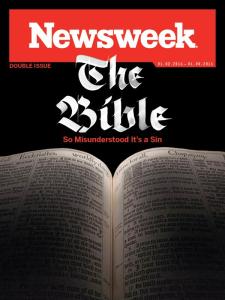
Christians who read Kurt Eichenwald’s Dec. 23 cover story might have been reminded of a well-known line from a comic strip:

“We have met the enemy, and he is us.”

The words, written by Pogo cartoonist Walt Kelly, weren’t about Bible-believers coming face to face with an article claiming to debunk some really famous stories. But read through the Newsweek article, paying particularly close to the pictures, and it might be difficult not to squirm in your seat or look over your shoulder.

We have met the enemy—or, at least, we know who Newsweek thinks it is. It’s us.

As Southern Seminary President Al Mohler and others have pointed out, the first two paragraphs of Eichenwald’s article read like an attack: “They wave their Bibles at passersby, screaming their condemnations of homosexuals. They fall on their knees, worshipping at the base of granite monuments to the Ten Commandments while demanding prayer in school.”

And those are just the first two sentences. What follows is mostly about the Bible, but tinged with the same hostility toward Christians, which also has been noted by numerous leaders and scholars. Mohler called it “one of the most irresponsible articles ever to appear in a journalistic guise.” Michael Kruger, president of Reformed Theological Seminary in Charlotte, said Eichenwald deserved a “slap on the journalistic wrist.”

But even for those who can’t counter every one of the anti-Bible arguments in the article or don’t care to debate its journalistic merits, if you can get past Eichenwald’s angry words, his piece can bring some valuable introspection. Because as soon as you realize you’re his enemy, you scroll past a photo of a protest by members of the infamous Westboro Baptist Church. Or controversial TV preacher Pat Robertson. Eichenwald lumps all Christians together, like it or not.

What else would you expect from a non-Christian, one might ask? It’s a good question, but the better question is, What is this non-Christian asking of us? Near the end of the article, Eichenwald puts forth two pleas:

Christians, know the Bible, he writes. (His stinging criticism suggests many of us “seem to read John Grisham novels with greater care” than God’s Word.) That’s good advice, even from a source that proved less than empathetic in his previous 8,500 words.

“And embrace what modern Bible experts know to be the true sections of the New Testament,” Eichenwald writes. “Jesus said, Don’t judge. He condemned those who pointed out the faults of others while ignoring their own. And he proclaimed, ‘Thou shalt love thy neighbor as thyself. There is none other commandment greater than these.’”

To that we would say Amen, and we’re glad Eichenwald acknowledges some biblical teaching is worthy of embrace. But there are plenty of modern scholars who believe the whole Bible is true. He should talk to some of them next time.

2015: The year of prayer

Meredith Flynn —  January 1, 2015

Editor’s note: This is the first in a series of posts on prayer. In 2014, Illinois Baptists focused on prayer and spiritual awakening at their November Annual Meeting. The national Southern Baptist Convention also will mark a Call to Prayer this year, detailed by Ronnie Floyd during his few few months as SBC President.)

Eric Reed | Our IBSA Annual Meeting focused on prayer, as part of a statewide call to revival and spiritual awakening. Using Isaiah 6:1-8 as our inspiration, moving through this cycle of prayer:

Layout 1


1. We lament the sins of our state. As Isaiah said, after witnessing the holiness of the Lord in the temple, “Woe is me…I am undone.”

2. We repent of apathy among believers and ask God to send revival to our churches. The angel affirmed to Isaiah, “Your sins are forgiven.”

3. We intercede for the needs of the 13 million people of Illinois and especially the 8 million or more who are lost, asking God for spiritual awakening in our state and across the United States. The Lord asked Isaiah, “Who will go?”

4. We commit to pray for their salvation and to minister in the name of Jesus. And He waits to hear, “Here I am. Send me.”

The four video collages from the IBSA Concert of Prayer (held during November’s Annual Meeting) are available for use in your church. Download them here.

Part 2

Part 3

Eric Reed is IBSA’s associate executive director for the Church Communications team, and editor of the Illinois Baptist newspaper.

Fear and worry in St. Louis

Lisa Misner —  December 18, 2014

COMMENTARY | Growing up in a small rural Missouri community just 90 miles north of St. Louis gave me the opportunity to experience some of the best the city and its surrounding communities had to offer. My family made frequent trips to the St. Louis Zoo, the Museums of Art and Natural History, Six Flags, Cardinals baseball games, the Fox Theatre, and, of course, the numerous malls and shops.

I looked forward to any and all trips into the city. St. Louis seemed so fast and exciting compared to my sleepy little farming community. I still love St. Louis and look forward to any visits I can make there. It’s because of my heart for the city and the connections I have there that the recent events in Ferguson have particularly saddened me.

I’m Facebook friends with former classmates who now live in the metro area. I’ve been following one of my classmate’s posts in particular since the evening of August 29, when a white police officer shot and killed a young black man. She and her family live in a town adjacent to Ferguson and have experienced first-hand the events that have captured the nation’s attention.

She has chronicled the fear and frustration felt by many in the community. She has also shared about being a parent of four young children and how the unrest has affected them. Some nights they could hear the sounds of the protestors from their home.

My classmate has struggled to explain to them what happened, why people are angry, why school has been cancelled, and many other related things. Along with her husband, their top priority has been keeping their children safe and also making them feel safe.

I’ve read with joy when she’s written about her faith in the Lord and knowing He would keep them safe. I’ve read with sadness when she has expressed fears for her family. When the announcement was made that the grand jury had come to a verdict, she wrote that a friend in another town had offered to let them stay in her home if they felt unsafe in their own. She jokingly posted that she hoped they didn’t have to have a “slumber party” that night.

When the school reopened following the grand jury announcement, she wrote about walking her children in and reassuring them of their safety. She also shared about barely making it out the school’s front door before collapsing into tears from stress and worry.

What my friend and her family are experiencing doesn’t have anything to do with whether you agree with the grand jury’s decision not to indict Darren Wilson for the death of Michael Brown. It’s about the sin that is in this world and our failure as a society to seek God.

May we turn to Him to ask for healing and understanding between all races in our nation, and for Him to be glorified through our words and actions.