Archives For November 30, 1999

SBC_VotingWith another call to prayer for the redemption of America, another missionary commissioning, and another bunch of resolutions on national politics and the precipitous slide in our national moral values, this might appear to be another fairly predictable meeting when the Southern Baptist Convention convenes in St. Louis June 14-15.

It isn’t.

The more significant news from the convention is not likely to come from its political statements or from protests by cultural liberals outside the hall. What can be said about the run for the White House, same-sex marriage, or sexual identity that hasn’t already been said? It will be in the election of an SBC president to succeed outgoing Arkansas pastor Ronnie Floyd that messengers will signal a turn.

Floyd has issued a “national call to prayer for spiritual leadership” in the Tuesday evening session. Floyd is using the mid-America location to address issues at the spiritual heart of America, in particular the need for evangelism and spiritual awakening, and renewed efforts at racial reconciliation. (See “What are the three greatest challenges facing the SBC?”)

By the time of the prayer gathering, messengers will already have selected a new president—and perhaps a new direction. At this crossroads, signs point to missions funding, evangelism and theology, and the age of denominational leaders.

The most obvious turn could be generational. Only recently has the “greatest generation” of Southern Baptists handed off leadership to their children, the Baby Boomers born after World War II. The possible election of 43-year-old J.D. Greear over Steve Gaines, 58, or David Crosby, 63, would confirm the handoff to Generation X, or the Baby Busters. These younger leaders, born after 1964, have already assumed leadership of the Convention’s two missions boards.

Leaders have reported that the demographics of convention attenders have shifted younger over the past decade. The meeting isn’t as gray as it used to be, and that’s good news observers say. These younger Southern Baptists are making their presence known through Baptist 21, SEND conferences, and other venues aimed at Busters and their quickly advancing successors, the Millennials. Electing one of their own could hasten the transition.

“One of the things God has put on my heart is that my generation needs to take personal responsibility for the agencies and the mission boards of the SBC and not just think of them as the SBC’s, but think of them as ours,” said Greear in his nomination announcement.

A second turning point for the Convention is the future of the Cooperative Program. Implicit in the election of a president is endorsement of his view of CP funding for missions and Southern Baptist work, whether it is whole-hearted and longstanding, recently renewed as part of the Great Commission Resurgence, or newly embraced as one of many ways of funding missions. The three candidates for president all speak highly of the Cooperative Program, but their churches have notable differences in their historic support of CP and their current giving levels.

Crosby’s response to a question from the Illinois Baptist is enlightening: “As SBC president, I will not talk or act as if a return to the society method of supporting our cooperative work is progress.” (See “What are the three greatest challenges facing the SBC?”) At its foundation, this is what a church’s record of CP support demonstrates: Is missions giving through Cooperative Program the main way Southern Baptist churches fund missions, or rather one of many ways?

And third, simmering under the surface in this election is the role of election in salvation and the future commitment to evangelism in the SBC.

“Listen very carefully: We have criticized evangelism right out of the Southern Baptist Convention,” Floyd told the SBC Executive Committee in February. “Years ago, something happened where pastors and churches that reached and baptized people effectively came under the microscope of other Baptists who oftentimes did not have a heart for evangelism themselves. A culture of skepticism about evangelism began to creep into our Convention. Evangelism began to die.”

This culture shift was framed by some as evangelism versus discipleship. Evangelism was criticized as “easy believe-ism” while discipleship was elevated. Discussion of the “sinner’s prayer” at the 2012 Pastors’ Conference was followed by Executive Committee CEO Frank Page’s appointment of an ad hoc panel to address the rise of Reform Theology and whether Calvinists and “Traditionalists” as they were called at that time could peacefully coexist in the SBC tent.

Gaines was an outspoken supporter of the “sinner’s prayer” style of personal commitment at the time, while International Mission Board President David Platt, then pastor of Birmingham megachurch The Church at Brook Hills was critical of evangelism that emphasized acts of conversion, such as “walking the aisle” at church, over discipleship of new believers that emphasizes personal recognition of God’s call and sovereignty in their salvation.

This election brings up that question again. Gaines and Crosby have traditional views on evangelism and conversion, while Greear’s theology is Reform. The church Greear pastors is evangelistic, baptizing 928 in 2014, but it is also active in the Acts 29 Network of church planting, which expects its members to hold Reform views. And of the three candidates, Greear has the greatest support among the rising group of younger, Reformed pastors in the SBC.

These three issues—and the candidates holding different views on them—stand before Southern Baptists at the crossroads.

– Eric Reed is editor of the Illinois Baptist

Safe zoneRecently I had an opportunity to attend a conference at one of the schools in the Illinois State University system. The conference was very informative and what I learned should benefit IBSA churches. What I learned walking through the campus may have been an even greater education.

I always enjoy being on college campuses and find the atmosphere invigorating. It’s a world that’s insulated from the stressors of work, dedicated to learning, the exchange of ideas, and full of youthful energy. But as a Christian it seems less and less welcoming.

Posters on the walls of hallways advertised events featuring authors of books on “queer” studies and “Lavender Graduation” ceremonies which the Human Rights Campaign describes as “an annual ceremony conducted on numerous campuses to honor lesbian, gay, bisexual, transgender, and ally students and to acknowledge their achievements and contributions to the University.” The ceremony was scheduled to take place in a
few weeks in one of the rooms where my conference was meeting.

Different offices bore rainbow colored stickers emblazoned with the words, “Safe Zone.” Generally, they denote places where students can “safely” approach those inside about LGBTQ issues. I wondered how welcome I would be to walk inside and discuss Christ.

Like many of us, I consider myself well-read and informed, believing I know what’s going on in our country and culture. However, the reality of the situation hit me like a slap across the face. This is what many students from our churches encounter on their public university campuses everyday. Their beliefs are not celebrated and most likely not welcomed.

We must encourage and disciple the young people in our churches. We must do the same for them on our college campuses, and our churches must reach out to those on the campuses who do not know Christ. The culture is leading the next generation away from Christ, and we must speak truth into that culture—the truth that is Christ.

Christian college students can’t do it alone. Remember yourself as a student and the pressures you faced. Those pressures have only multiplied. Our churches must stand alongside them.

During a break between sessions, I found my way to the restrooms—one marked “men” and another marked “women.” I couldn’t help but wonder who I might encounter inside.

– LMS

TentI often find myself at denominational functions looking around the room and wondering, “What is it that really brings us together here?” Is our unity based simply on an expressed common desire to reach the lost? Or do we gladly join together in mission because we have deeply shared doctrinal convictions?

I’ve found some guidelines in a couple of the smallest books in the Bible, 2 and 3 John. One way to read these short letters (which combine for a total of just 28 verses) is to put them side-by-side as two crucial lessons in cooperation.

First, here is some background to both books: a church planting movement is taking root in the Roman world furthered by traveling missionaries who depend upon support from other Christians, primarily in the form of food and lodging.

In 2 John the tone and feel is one of caution: “Many deceivers have gone out into the world.” “Watch yourselves.” The emphasis is on getting the gospel right. Specifically, some of these traveling missionaries “do not confess the coming of Jesus Christ in the flesh,” what has been referred to as the “Gnostic heresy.” John speaks soberly of remaining in Christ’s teaching and not going beyond it. He then directs genuine believers: “If anyone comes to you and does not bring this teaching, do not receive him into your home… for the one who says, ‘Welcome’ to him shares in his evil works.” In other words, don’t cooperate with everyone!

The tenor is different in 3 John. Here John is commending a “dear friend” for his generosity to certain missionaries. The emphasis in this mini-epistle is on getting the gospel out. “You will do well to send them on their journey in a manner worthy of God.” These missionaries “set out for the sake of the Name” and trusted God to provide through his people. “Therefore, we ought to support such men,” says John. He even calls out a guy named Diotrephes for his independent spirit. “He not only refuses to welcome the brothers himself, but he even stops those who want to do so.” Don’t be like Diotrephes. Don’t cooperate with no one!

2 John teaches us not to make our tent too big. 3 John encourages us not to draw our circle too small. We need both messages.

Notice the disproportionate amount of times the words truth and love occur in these two short letters. We absolutely cannot disconnect them. There are people who have great drive, but do not have good doctrine. We have to be discerning about who we partner with. On the other hand, there are Christians who are cranky and overly separatist. We must be large-hearted and kingdom-minded.

Because of 2 John I know that the Apostle John would applaud the “Conservative Resurgence” in the SBC. Is it not amazing that we have six top-notch seminaries that are committed to robust and orthodox theological training?

At the same time, based on 3 John, I am pretty certain that the Apostle would thoroughly endorse the concept of the Cooperative Program and be thrilled with our North American and International Mission Boards. It is wonderful that we have state and local associations. And is it not telling that we have Directors of Mission and not District Superintendents? We are the people who come up with campaigns like “Million More in ’54.” And I love that I live in what was once a Strategic Focus City, now a SEND City.

However, we have not always gotten this balance right. At times I have seen people approved for work in the SBC based on their passion without an examination of their doctrine. And at other times I have seen people who were well qualified turned away because of a technicality.

In all of our missional zeal, may we never fudge on doctrinal clarity. And in making sure we are all on the same page about what the gospel is, may we make sure we are doing whatever it takes to get the gospel out. If we are truly faithful to Scripture, we will heed the lessons of both 2 and 3 John. But there just might be something to the fact that 2 John comes before 3 John.

Nathan Carter is pastor of Immanuel Baptist in the University District of Chicago.

‘Tricky’ endorsements

Lisa Misner —  March 22, 2016

The young woman who summarized all of Baptist history in a five-minute rap video in 2013 has returned with a campaign video for J. D. Greear. Ashley Unzicker tells in beat-box rhyme how Southern Baptist Convention presidential candidate Greear would lead the massive SBC, saying “it’s tricky.” The rap is a parody of Run-D.M.C.’s “It’s Tricky” released in 1986.

Several leading SBC figures appear in the video, each repeating the line, “it’s tricky.”

They include the heads of three SBC entities: International Mission Board president David Platt, Ethics and Religious Liberty Commission president Russell Moore, Southeastern Seminary president Danny Akin and former SBC president Bryant Wright. Their sound bites appear to have been recorded by the entity heads on cell phones.

A disclaimer on the video says the opinions expressed are those of the rap-artist, and not necessarily the opinions of the Southern Baptist Convention, International Mission Board, North American Mission Board, Greear or his church. A card at the end requests the viewer “keep all angry comments, blog posts, and e-mails to yourself.” The rapper may mean that to be funny, but it appears she means it.

And no, we won’t.

We don’t expect the heads of SBC entities to endorse candidates for SBC office. The next SBC president will appoint the people who name trustees and board members for denominational entities. Indirectly, they affect the budgets. Appearing in a particular candidate’s video—even a funny one produced by a well-meaning church member—could be interpreted as an endorsement. Is that ethical?

What’s next? Should Frank Page, Paige Patterson, Chuck Kelley, and O.S. Hawkins form a quartet to sing on Steve Gaines’s behalf? For many reasons, let us hope not.

Expressing support for your friends is admirable; but when they could, even indirectly, affect the flow of money in your direction, well, it’s tricky.

–  The Illinois Baptist Editors

We who handle holy things

Lisa Misner —  March 21, 2016

Jesus Christ crown of thorns and nail

Jesus wept. Standing in the cemetery with Martha and Mary, he didn’t pat the grieving sisters on the shoulder. He didn’t say, “I’ve got this.” Certainly he could have. Jesus knew that in a few moments he would order the great stone rolled away from the tomb and call a dead man from its greedy maw. He knew that this sign would portend his own resurrection and back up his statement: “I am the resurrection and the life.”

But when the sisters each said, “Lord if you had been here our brother wouldn’t have died,” it must have been like a knife under his ribs. He had delayed rushing to their brother’s deathbed on purpose so that the Father would be glorified. But in that moment, before the tomb, he grieved for the sisters and for his friend Lazarus. Jesus did not stand apart from their grief. He entered into it.

On a recent Wednesday, I faced this phenomenon myself: stand apart from the sorrow, or enter into it. First I visited with the family of a man who had learned two weeks earlier that he had only months to live. But the end came more quickly than that. On Saturday he was changing the brakes on his wife’s car; on Sunday he was in a coma. He believed in God, his wife said, but unlike her, he never accepted Jesus as his savior. She had carried this sad truth throughout their marriage. She had lived her faith before the man and witnessed to him many times. Many people had, and now it was too late.

An hour later I met with another man who had learned two weeks earlier that he had only months to live. He had questions about faith. He wanted answers about why Jesus had to die for everyone. But more important, he wanted to be certain of his own salvation. He wept over sin—his own—and we prayed for his salvation and assurance.

On the way home I thought about the contrasts between these two meetings. And I wondered when was the last time I saw someone weep over his own sin. It’s been a while. I’ve been there many times when people cried over the sins of others, and the impact of sin on the nation, but crying with the realization that their own sin is an offense to God? That their sin sent Jesus to the cross? It’s been a while. And stopped at a red light, I thought, How long since I cried over my own sins and my part in the sacrifice of Jesus?

We who handle holy things are like celebrity chefs who brag about their “asbestos fingers.” They’re so accustomed to grabbing hot pots without pot holders that their hands have become desensitized to the heat.

We stand so close the burning bush that it warms our toes but singes our eyebrows, and we hardly notice the difference. We climb the mountain like Moses to meet with God, and we approach the burning peak with such aplomb that the smoke and lightning don’t scare us. We reach out to prop up the house of God with unholy hands, hardly thinking that others who did so were struck dead.

And across a thousand Sundays in the course of our ministries, we offer up symbolic body and blood with little thought to the lambs whose throats were slit, whose lifeblood drained into bowls to sprinkle the altar, and whose bodies were burned in sacrifice for sins. “Without the shedding of blood there is no forgiveness for sin” is easier said over Welch’s than Red Cross. Strange as it sounds, in the rush to the Good News, it’s possible to skim past the realities of death. It’s possible to celebrate the Cross without mourning the blood dripping from God’s Ultimate Sacrifice. If we are not careful, all this handling of holy things becomes routine.

Even when we are careful.

Before we rush to the joys of Resurrection Sunday, let’s stop first at the reality of Crucifixion Friday. With sorrowful John and the weeping Marys at the foot of the Cross, let’s consider our own complicity, and enter in.

Eric Reed is editor of the Illinois Baptist newspaper.

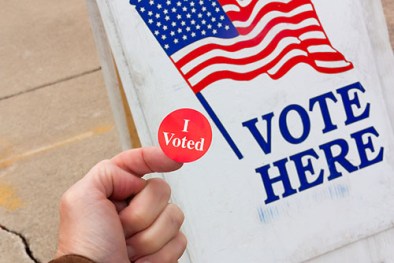
I Voted!With the nation’s first few presidential primaries and caucuses out of the way, pundits are scratching their heads and wondering why evangelical voters aren’t behaving as predicted. Among the three candidates most popular with evangelical voters, Donald Trump, a Presbyterian with a less than pious past, continues to best his two closest rivals – Ted Cruz, a Southern Baptist, and Marco Rubio, a Catholic who attends a Baptist church.

Now, many are starting to ask: “Who are these evangelical voters?” “Who are they really supporting, and why?” Some analysts say not all the people pollsters are calling “evangelicals” really qualify for that label. That may be the reason it appears the evangelical voting bloc is split. It may also be the reason Trump is claiming the support of evangelicals despite the outcry among some devout leaders that his lifestyle and apparent values clash with their own evangelical beliefs.

A survey by LifeWay Research and the National Association of Evangelicals (NAE) determined last fall that evangelicals (as most Southern Baptists would describe them) hold four common beliefs: the Bible is their highest authority, it is very important to share Christ with non-Christians, Christ’s death on the cross is the only sacrifice that can remove sin, and only those who accept Christ as their savior will receive eternal salvation

The survey surprisingly found just 41% of self-identified evangelicals hold all four beliefs, and 21% of those who rejected the evangelical label actually agree with all four. Other polls and studies have found many define evangelical in much broader terms, or as LifeWay’s Trevin Wax stated on The Gospel Coalition’s website, “’Evangelical’ sometimes means ‘cultural Christianity.’”

Later in that same article, Wax also blamed a lack of discipleship as a factor in evangelical voting writing, “A 30-minute sermon once a week or a brief morning prayer are not nearly as formative as the hours and hours a congregant may spend watching cable news, or listening to talk radio, or frequenting conspiratorial websites, or sharing articles that fan the flames of fear and anger.”

The National Review also weighed in after Trump’s win in South Carolina, the fifth most religious state according to Pew Survey. Writer JD Vance cited lack of church attendance by self-identified evangelicals as a factor in the second and third place finishes of Marco Rubio and Ted Cruz. “While approximately 80 percent of the country identifies as Christian, only about one in five regularly attend church services,” Vance wrote.

Based on this, he believes Cruz, who has most actively sought the evangelical vote, may be depending “on a group of religious voters who increasingly spurn church services and, consequently, traditional social conservatives like him.”

There is still much to be said. Next week is Super Tuesday, when Bible Belt states will have their say. While Illinois voters won’t go to the polls until March 15.

Perhaps Rubio, may have had the best insight when speaking after learning of this second place finish in South Carolina. “If it is God’s will that we should win this election, then history will say that on this night in South Carolina we took the first step forward in the beginning of a New American Century.” Truly, the outcome of the 2016 presidential election does hinge on God’s will.

Where evangelicals stand now

Lisa Misner —  February 11, 2016

candidates

After Iowa and N.H., will faith-based voters coalesce?

No one really expected New Hampshire’s first-in-the-nation primary to serve as a predictor of evangelical voting patterns, since only 9% of the state’s voters call themselves “evangelical.” But after strong support from the Christian right in Iowa, Texas Senator Ted Cruz’ dropped to third place in the Republican presidential race raising questions whether Cruz regain his footing among Christians.

I Voted ButtonAccording to a Washington Post article from the morning after the New Hampshire primary, Cruz, and perhaps other evangelical-friendly candidates, need not worry. While Gallup polling found New Hampshire to be the least religious state in the country, upcoming Super Tuesday states in the heavily evangelical South are predicted to tip the balance.

Before Illinois votes on March 15, the question of the “evangelical bloc” may have been decided. On Super Tuesday March 1, six of the 11 states holding primaries have large numbers of evangelical voters. Before that is the February 20 South Carolina primary, and more primaries take place March 5, 8, and 15 in heavily Christian or evangelical states including Kansas, Louisiana, Kentucky, Mississippi, Missouri and North Carolina.

As these primaries approach, are evangelical voters pitching their lot with frontrunner Donald Trump, sticking with other frontrunners Ted Cruz and Marco Rubio, or have they found a new candidate in Ohio governor John Kasich, who finished second in New Hampshire? Kasich has written about his faith in a book called Every Other Monday, describing his 20-year participation in a men’s Bible study group.

Florida senator Marco Rubio, who evangelicals helped to a third-place finish in the Iowa caucuses, stumbled in the New Hampshire primary and finished fifth behind former Florida governor Jeb Bush.

Faith isn’t the only apparent gap in this election cycle. Analysts point to an education gap in supporters of Trump and the other Republican candidates. Among people with only high school degrees, Trump leads Cruz 46 % to 13%; while among people with higher degrees, the gap closes to only 13 points.

In a poll of Protestant pastors conducted in January, LifeWay Christian Research found considerable disparity in the support for Trump. Only 5% of self-identified Republican pastors support the real estate mogul.

“One of the most surprising findings of our survey was the poor showing of Donald Trump (among pastors)”, said Ed Stetzer, executive director of LifeWay Research. “When it comes to Mr. Trump, there seems to be a huge gap between the pulpit and the pew.”

As of the time of that survey, four-in-ten Republicans and three-in-ten Democrats were still undecided about which candidate they would support. LifeWay found that older pastors (those over 64) are more likely to be undecided (54%) than those 18 to 44 (44%). Older pastors were more likely to favor Trump (8% percent), while Cruz performed well with pastors 45 to 54 (21%).

Among U.S. pastors of all denominations, LifeWay found 54% identified as Republican while 46% were Democrats.

Democrats are not making much appeal on the basis of overt faith-based values. Religion News Services describes frontrunner Hillary Clinton as a “social-justice-focused Methodist,” and Senator Bernie Sanders as culturally Jewish and “unabashedly irreligious.” Clinton’s thumping by Sanders in New Hampshire is likely to be balanced by support from a more diverse electorate elsewhere, including Black Protestants in the South.

“Simply put, it’s a bizarre election season,” Stetzer said.

– IB Staff with additional reporting from Baptist Press and RNS

Split ticket

Evangelicals are divided going into the presidential primaries, and few candidates are courting them.

If there is a nexus of evangelical politics so far in the 2016 presidential election, it may be the platform at the Liberty University arena in Lynchburg, Virginia. The conservative Baptist school founded by Moral Majority leader Jerry Falwell has hosted Democrat Bernie Sanders, Republicans Ben Carson and Ted Cruz (who announced his candidacy there), and most recently Donald Trump.

“Evangelicals love me!” Trump declared. “I’m big with evangelicals.”

With those words Trump reminded Christian and conservative voters of what didn’t seem possible a year ago: Polling shows the New York businessman and former reality TV star is the candidate more evangelicals favor than any other. Perhaps it’s because few candidates are overtly courting “the evangelical vote.” And while Trump and Cruz are leaders among likely evangelical voters, the bloc is split.

Evangelicals’ influence was still a factor in the presidential election four years ago, when pundits wondered whether they’d get behind a Mormon, Mitt Romney, and whether he would miss their support if they didn’t.

With faith seeming to be less at issue in this campaign cycle, some surmise the waning evangelical influence wondered about in 2012 is a reality in 2016. “You cannot, if you’re a Republican [candidate] ignore the evangelical bloc, because it’s such a large percentage of the Republican voting electorate,” Andrew Walker, director of policy studies for the Ethics and Religious Liberty Commission, told the Illinois Baptist.

But, “I think that our issues as a share of the electorate have tragically become less influential,” he added. For example, when President George W. Bush won the Republican nomination and then ree

The Trump factor

FOX News released a poll Jan. 9 that showed Cruz (33%) leading Trump (26%) among voters who call themselves “very” conservative. But among evangelical Christians, the poll showed Trump at 28% over Cruz’s 26%.

Another poll released Jan. 12 by The New York Times and CBS showed evangelicals supporting Trump by 42% over Ted Cruz at 25%.

The New York Times reported Jan. 18 it had interviewed “dozens of evangelical voters in 16 states” about their support for Trump. According to the Times, the voters called him “a decent man who simply wanted to get things done.”

They also believed “that his heart was in the right place, that his intentions for the country were pure, that he alone was capable of delivering to a troubled country salvation in the here and now.”

But Trump’s stump stop in Lynchburg raised more questions than it answered. Trump told the audience Christianity is under attack and as president he would defend it. “You look at the different places, and Christianity, it’s under siege. We’re going to protect Christianity. If you look at what’s going on throughout the world—you look at Syria, where if you’re Christian, they’re chopping off heads.” That drew cheers. But when Trump quoted Liberty’s theme verse, “Where the Spirit of the Lord is, there is liberty” from 2 Corinthians 3:17, he said “Two Corinthians” rather than “Second Corinthians” and drew chuckles from the student-audience and guffaws on social media.

Washington Post religion writer Sarah Pulliam Bailey later pointed out “Two Corinthians” is a common British pronunciation and Trump’s mother is of Scottish origin. Trump describes himself as Presbyterian, but not as born again.

CNN’s Jake Tapper asked Trump if he regrets past remarks he made about his faith—that he has never asked God for forgiveness—and whether he believes those remarks hurt his chances with Christian voters.

Trump replied he has no regrets.

“I have a very great relationship with God, and I have a very great relationship with evangelicals, and I think that’s why I’m doing so well with Iowa,” Trump said.

“This would be hilarious if it weren’t so counter to the mission of the gospel of Jesus Christ,” ERLC President Russell Moore tweeted during Trump’s presentation. Moore later talked to CNN’s Erin Burnett about his sharp response to the candidate’s speech.

“I think the problem was this is someone who as recently as yesterday has said that he has nothing to seek forgiveness for,” Moore said, noting Trump’s marital history, involvement in the gambling industry, and use of racially charged language.

Last September, Moore wrote an op-ed piece for The New York Times that asked, “Have evangelicals who support Trump lost their values?” Perhaps the question now, a few months later, is exactly which evangelicals are supporting him?

“I would say that Ted Cruz is leading in the ‘Jerry Falwell’ wing, Marco Rubio is leading the ‘Billy Graham’ wing and Trump is leading the ‘Jimmy Swagger’ wing,” Moore told Roll Call for an article which asked, “Can Marco Rubio appeal to evangelicals?”

The article went on to explain the comments:
‘…meaning that Cruz has largely followed the classic Moral Majority model that was the face of the conservative movement—he has received endorsements from figures such as Focus on the Family founder James Dobson—while Trump ‘tends to work most closely with the prosperity wing of Pentecostalism’ which tends to believe that God would financially reward believers.”

“I personally question the so-called fanfare that Trump has among evangelicals. I sense, instead, that Donald Trump’s main appeal is to a segment of the population that is burnt out and feels disenfranchised by an American culture and economy that has seemingly passed them by,” said Moore’s colleague Andrew Walker.

Walker called Trump’s appearance, and his apparent support by Jerry Falwell Jr., who has succeeded his late father, “embarassing.”

“It sets the maturing of Christian politics back and it alienates greatly younger evangelicals who are searching for a political identity as Christians, but know that what we saw at Liberty is not acceptable for them.”

Who will get their vote?

“You see definitely different strategies with candidates right now, and how they are lining up and trying to get the evangelical constituency,” Walker said.

For example, he noted, Cruz, a Southern Baptist, is reaching out to traditionalists who would have a “take back America for God” mentality, whereas Rubio, a Roman Catholic, “speaks the evangelical language as well as anyone, but he’s not doing it in a Christian America template.” His “common good Christianity” sees it less as recovering Christian America, and more as bringing Christian values into the public square, in order to shape the public square for righteousness’ sake, Walker said.

That mentality may fare better with younger evangelicals who are cynical about moral majority politics, he said. While no less political than their elders, “they’re trying to do Christian politics less through the vein of ‘let’s take back America for God,’ and more as ‘let’s bring our Christian values into the public square for the sake of the common good.’”

Democrats, meanwhile, are making no overt approaches to evangelicals in Iowa, where there is a substantial bloc, or in New Hampshire, where there is almost none. Other than his Liberty University appearance, where Sanders, who is Jewish, was received politely if not warmly, Democrats have kept quiet on religion.

Hillary Clinton, a United Methodist, commented when she was First Lady that she had Bible verse cards in her purse. Her most recent comment on faith was visual rather than verbal: On Face the Nation last week, Clinton wore a necklace with a cross that also appeared to have symbols of other religions. The strategy for Democrats, and many Republicans as well, is to keep it ecumenical, or better yet, keep it quiet on religion.

A Christian’s responsibility

“One of the things that is really important for Christians to realize is that we are both citizens of God’s Kingdom and our country,” Mark Quintanilla, history professor at Hannibal-LaGrange University in Hannibal, Missouri, told the Illinois Baptist. “In our political views we need to be searching for what God would have us to do.”

In Southern Baptist life, some leaders have spoken clearly about particular candidates. Others are saying simply, pray about it and do your duty.

The outgoing president of the South Carolina Baptist Convention, Tommy Kelly, has endorsed Cruz. The ERLC has critiqued Trump among others, while some of their staff have tweeted favorably about Rubio. Saddleback Community Church pastor Rick Warren has served on Rubio’s advisory committee, but has declined to endorse him.

President of the Billy Graham Evangelistic Association Franklin Graham is traveling to the capitals of all 50 states this year. His “Decision America Tour” urges Christians to vote and to elect candidates who “stand for biblical principles and biblical truth,” Graham told NBC.

Frank Page, president of the SBC Executive Committee, outlined the importance of Christian citizenship and participation in the election process in a recent Baptist Press article, citing Romans 13:3-7. “We know that God’s purpose through government is to aid the good and punish the evil…Assuming that the government fulfills its purpose, one reason for obeying our laws would be the fear of punishment. However, for Christians there is a more worthy motive, namely to be good citizens as part of being a positive Christian witness in society.”

Page said he is “aware that we are in the midst of one of the most interesting election cycles in our history. There is deep division in our country as to what needs to happen in the days ahead.” He urged Christians to be involved in the election process. “To relegate that responsibility to nonbelievers is irresponsible at best.”

Quintanilla cautioned Christians, “When we nominate or elect a candidate we must scrutinize which of them lives up to our Christian ideals. As nice as it is to vote our pocketbooks, I’m not sure that this should be our direction.” Analyzing comments from evangelicals in social media, he said, “It is concerning, the views people have and the lack of concern about our higher calling.

“We need to scrutinize the candidates and their views,” Quintanilla said. “As ambassadors of Christ, we are to be mindful that we are a reflection of God’s Kingdom.

– Illinois Baptist team report by Meredith Flynn, Lisa Sergent, and Eric Reed.

This is the time of year when millions of Americans tune in to hear our president give his State of the Union address. He will give his assessment of our national security, our priorities and our vision for the future.

This is a tricky word — “our.”

These days it seems as if America can hardly find “our vision” for anything, much less the future. Our nation is deeply polarized around our political parties and is totally unrelenting in fighting against one another. Despite growing national security threats, violence erupting, escalating racial tensions, the devaluing of human life and economic insecurity, we find ourselves unable to agree on almost anything.

What’s especially alarming to me, serving as the president of the Southern Baptist Convention, is that we fail to realize how the spiritual health of our nation affects the state of our union. As our spiritual lives go, so goes the nation.

It wasn’t meant to be this way in America. One of the reasons our founders so cemented Judeo-Christian principles in our nation is because they were skeptical of men’s ability to govern themselves. America would be a nation first subject to God — and subject to His higher law — so that our respect for our creator would provide a baseline for our “more perfect union.”

We would at least be united around important things when we couldn’t find unity among many things. Where are the leaders in America today who can bring people together, rather than separate us?

Our founders knew that the moment we no longer saw ourselves subject to God — and to His higher law — that we would begin to fight over everything in an attempt to gather God’s authority for ourselves.

When our political leaders and the people of America lack fear of God, we become subject to that awful temptation we find in Judges 17:6 — “to do what is right in their own eyes.”

Since the beginning of time, we have been tempted to be like God. And when a nation’s leaders and her people lose their fear of God and replace it with their own authority, we begin to live in a kind of chaotic unity — not with one another — but in an unholy union with the very sin that brought sin to earth in the Garden of Eden. Aside from all of the others, we fail to follow the very first commandment given to us through Moses, “Thou shalt have no other gods before me.”

In America, we have replaced God with government and granted politicians the ability to circumvent God’s higher law at will. It is our fault as citizens because we are a country that elects our leaders.

While we profess to remain “one nation under God” — and while we have inscribed such belief on our currency and in marble all over the nation’s capital — we seem to be more interested in “God bless America” than in actually being “one nation under God.”

The first phrase infers what we want from God while the second phrase infers what God requires. We want His blessing, but His blessing comes with our being subject to His authority.

Rarely is God ever mentioned in the State of the Union address except with that customary salutation, “God bless America.” It’s all about what we can get from God and less about what we need from Him.

So, what is the actual spiritual state of our union?

It is very simple.

We need to repent, come back to God and put our trust in God alone. America needs a Great Spiritual Awakening.

Now is the time to elect leaders who fear God and we need to learn to fear God again ourselves.

We need not say phrases like “God Bless America” because they are our tradition. We need to speak them with a holy reverence for God’s authority, for without God there never would have been an America at all, and without God at its center, America would not exist as it has.

I’m trusting that 2016 is a year where we apply a simple verse from 2 Chronicles 7:14: “If my people, which are called by my name, shall humble themselves, and pray, and seek my face, and turn from their wicked ways; then will I hear from heaven, and will forgive their sin, and will heal their land.”

Ronnie Floyd is serving his second one-year term as president of the Southern Baptist Convention. He is senior pastor of Cross Church in northwest Arkansas. This column first appeared on his blog, ronniefloyd.com.


The year of orange

Lisa Misner —  January 14, 2016

Larycia Hawkins, a Wheaton College professor, announced she would wear a Muslim headscarf throughout Advent as a way of showing solidarity with Muslims. In a Facebook post, the professor explained she’d wear a hijab to work, class, and church.

In particular, Hawkins, a Christian, said she wishes to express support for Muslim women. “I don’t love my Muslim neighbor because s/he is American. I love my Muslim neighbor because s/he deserves love by virtue of her/his human dignity,” Hawkins wrote. “I stand in human solidarity with my Muslim neighbor because we are formed of the same primordial clay.”

For some observers, her demonstration missed the mark. In 2015 we saw many Christians trying to identify with people in need: Some identified with Muslims in general as the American political rhetoric turned against them. Some identified with Syrian refugees, including Muslims and Christians, fleeing persecution. And for some American evangelicals, the fashion statement of the year was not a headscarf, but a jumpsuit.

As the Illinois Baptist editors discussed the images that characterized 2015, there was a strong case to be made for that grainy video freeze-frame we saw in February: 21 Coptic Christians in orange jumpsuits, kneeling on a Libyan beach with knives held to their throats by ISIS-rebel captors. Gratefully, the image from just seconds later was not widely distributed by news services: 21 Christians beheaded.

This may have been the most horrific image any of us have ever seen.

It proved what we have heard all our lives. Christians will face persecution for our faith and some may be martyred. But not in our lifetimes has martyrdom seemed so possible, or even probable. No longer is it that Christians may be martyred. Christians will be martyred. The mass shooting in San Bernardino by a radicalized Islamic couple proves it can happen even here in the United States.

If we’re looking for someone to identify with, let’s consider again those men in orange jumpsuits. Their lives—and deaths—force us to confront the strength of our own faith. Jesus told us to lay down our lives and take up the cross.

In contemporary terms, are we ready to wear orange?

Editor’s note: Hawkins is on paid leave after her comments on social media about Muslims and Christians worshipping the same God.  Wheaton administrators have recommended her termination from the college.

– DER