Archives For November 30, 1999

BETHLEHEM, ISRAEL - MARCH 6, 2015: The modern fresco of Palm Sun

The modern fresco of Palm Sunday in Syrian orthodox church by artist K. Veniadis (1987).

The crowd is often wrong. Popular opinion frequently misses the truth. And unfortunately, it seems that unrighteousness is usually trending.

From the earliest days of human history that has been so. The crowd was wrong in the days of Noah, as it was in the gathering at Babel. Godliness was often forsaken in the days of the prophets, and the dominant culture was usually wrong in the days of the early church.

But the crowds that gathered as Jesus entered Jerusalem on that first Palm Sunday got it gloriously right.

The crowds that gathered in the city just days later would call for the murder of Jesus. Many political and religious leaders would exult in the His crucifixion. But on that first Palm Sunday the gathered people welcomed the Messiah and Savior of the world.

Let’s note three ways the crowd got it right on that first Palm Sunday as we consider our response to Jesus on this Palm Sunday.

The crowd was right to give honor

The people got word that Jesus was entering the city and they immediately stepped forward to honor Him. He entered on a borrowed donkey which both fulfilled Old Testament prophecy and spoke to humility. People rushed to cushion each step by placing palm branches and even their own cloaks on the ground before Him.

We rightly honor Jesus by our care for the things of God. When we care more about the glory of the Lord than our own comfort, we honor Him. When we sacrifice our time and energy and possessions, we honor Him. When we look for ways to bless His work, we honor Him.

I pray you will honor the Lord with your life this Palm Sunday and Easter season. Honor Him by loving the things that matter. Honor Him with your sacrifice for the things that count. Honor Him with a bent knee and a giving heart. On Palm Sunday we remember all that Jesus is and all that He has done. And we honor that memory and that mission as we gather with the crowd.

The crowd was right to worship

The people began a spontaneous worship service as Jesus passed by on the first Palm Sunday. They sang out snatches of the Psalms. Their cries of “Hosanna” — a word of praise from the Hebrew word for “salvation” — rang out above the noise. They sensed the working of God to save mankind from sin and could not contain songs of loudest praise.

I hope you will worship the Lord joyfully this Palm Sunday and Easter season. He is worthy of all your praise. By His death, we can find life. By His work, we can find meaning and purpose in the work of our lives. By His resurrection, we have power over death and the grave. We have ample reason to praise our Messiah, Savior and Lord.

When you gather for worship on Sunday, remember who Jesus is and what He has done. And praise Him from the depth of your heart. Jesus told the skeptical Pharisees who hated this praise that the rocks would cry out if the people didn’t. We have a reason to sing and a reason to shout and Palm Sunday reminds us of this privilege. Let no stone be needed to take your place in worship. Praise His name fully and powerfully.

The crowd was right to proclaim

Matthew’s Gospel tells us the city was shaken by the crowd’s praise. People asked who it was that passed by. The crowd proclaimed, “This is the prophet Jesus from Nazareth in Galilee!” (Matthew 21:11).

We gather in worship on Palm Sunday and the Easter season to proclaim the message of Jesus. We proclaim the Gospel message that Jesus is God’s only begotten Son, that He died to pay the penalty for our sins, that He was buried but that He rose from the dead on the third day. We proclaim Christ as our Savior and as our King. We proclaim that He is the only hope for the world. We proclaim that He will return one day to claim His own and that those who repent of their sins and place their faith in Him will live for eternity with Him in heaven. This is our proclamation in song and sermon and life.

The crowd got it right on that first Palm Sunday. Let’s gather this week with other believers and all those who will hear and, together, honor and worship and proclaim the name of Jesus. There will be no need for stones to take our place.

— Doug Munton is pastor of First Baptist Church O’Fallon and first vice president of the Southern Baptist Convention. This column first appeared in Baptist Press.

Code of Ethics

A bill pending in the Illinois senate that would require pastors to take state-regulated classes in child protection raises important questions: Shouldn’t pastors do all they can to protect children? That’s how one colleague phrased it. Yes, obviously, but at what risk to religious communities’ First Amendment rights?

And, as important is this question: Why aren’t clergy engaging in stronger self-policing using a mechanism most already have in place, the ministerial code of ethics?

Senate Bill 912 introduced by Melinda Bush of Lake County is surely purely motivated, but this means of child protection draws immediate objection based on First Amendment grounds: if the state requires pastors to receive certification in this well-intended and altruistic concern, then what’s next? There aren’t many steps from this bill to government licensure of clergy and churches. That’s why the Illinois Family Institute is urging Christians to notify state lawmakers of their objection based on religious liberty. “Won’t somebody please think of the children!” isn’t a sufficient argument to allow government regulation of pastoral work.

And, there’s a better way.

A good ministerial code of ethics guides pastors in their ministry to children and families in jeopardy.

As a seminary student, I was required to write for myself a ministerial code of ethics. I studied a dozen examples and came up with my own list of biblical and ethical ways for dealing with people, issues, and sticky situations.

A year or two later, I was the grader for that class, and I read scores of codes of ethics submitted by students. Most of these aspiring pastors took the assignment seriously, considering how they should handle counseling and confidentiality, reporting of abuse or neglect, the pastor’s relationship to the law and enforcement agencies. Some addressed euthanasia, and a few spoke to sexual identity and relationship issues just entering public discourse at the time.

Some of these students laid a good foundation for engaging and regulating their future work, so when hard questions arose, they already had in place biblical ways of processing the issues not based on emotion and reaction.

A good ministerial code of ethics guides pastors in their ministry to children and families in jeopardy. It requires that pastors stay up-to-date on the issues and the law. Through such personally adopted codes, pastors police themselves. They may join in voluntary association with other clergy in their enforcement.

Our Baptist polity—respecting the autonomy of the local church—doesn’t allow the denomination to enforce rules on pastors. Neither does the U. S. Constitution. That’s why we must take responsibility to govern ourselves.

For the sake of the children.

Eric Reed is editor of the Illinois Baptist newspaper.

Nathan Carter

Nathan Carter

At our church we have a questionnaire that anyone who desires to be an elder has to fill out. One of the questions is, “What are the five solas of the Reformation and would you be willing to be burned alive at the stake for holding these?” We strongly believe these rallying cries of the Reformation are still just as needed today as they were 500 years ago.

Before returning to Germany and facing his eventual martyrdom at the hands of the Nazis, theologian and pastor Dietrich Bonhoeffer lived for a time in the United States. His assessment of the religious scene here was “Protestantism without Reformation.” This critique still largely holds true. We may not be Roman Catholic, but might some of the same problems that precipitated the Reformation in 16th century Europe be present in 21st century evangelicalism? I am afraid so.

The five solas provide a helpful grid for assessing the American church’s current spiritual climate and guide us in how to pray and work for revival.

Sola Scriptura (Scripture alone)
I think there are many churches who say on paper that they believe the Bible to be the inspired, inerrant, authoritative, sufficient Word of God. But in practice, you cannot tell. Scripture does not saturate their worship services. The sermon is cut short and full of stories and tips instead of exposition and proclamation of the whole counsel of God. The Word is not trusted to grow the church, but rather we look to and lean on techniques and tricks. Science is respected over Scripture, psychology prized over theology, experience trusted over exegesis. And many church-goers today are as biblically illiterate as they were in the Middle Ages.

Sola Fide (faith alone)
If we gave Southern Baptist church-goers a test with this true or false question—“People get into heaven by doing good”—I imagine a majority would know enough to say FALSE. But that doesn’t mean they could pass an essay question on what justification by faith entails.

We may have simply lowered the bar or tried to lighten the law, but we still are preaching a form of works-righteousness when we major on what people need to do…to end sex-trafficking, get out of debt, have healthy families…instead of what Christ has done to free us from sin, forgive us our debts, and adopt us into his family. The truth is that you actually have to be perfect to get into heaven, and thus our only hope is having Jesus’ perfect record given to us as a gift, received by faith.

Sola Gratia (grace alone)
We like grace—when it is seen as an assist for our slam dunk. The polls are heart-rending that show the number of Christians who think that the quote “God helps those who help themselves” comes from the Bible. Do we really believe our salvation is wholly of grace? If so, we could never allow our Christianity to be a badge of pride that makes us feel superior to or live in fear of the big, bad world.

Solus Christus (Christ alone)
We may say that we believe Jesus is the only way to God, but do our actions back that up? We live in a highly pluralistic society. Do we really believe that the nice Hindu family living down the street is destined for hell apart from faith in Christ? Do we believe it enough to lovingly and sacrificially share with them the gospel of what Christ has uniquely done?

Our lack of evangelism betrays our lack of belief in the exclusivity of Christ. Furthermore, so much of our faith talk is vague spirituality that does not really need the virgin birth, perfect life, substitutionary death, victorious resurrection, and imminent return of the historical God-man Jesus Christ. We spout meaningless Oprah-esque mumbo-jumbo and it is no wonder that our kids start to think Christianity is not that distinct from the other religions and philosophies of their friends.

Soli Deo Gloria (the glory of God alone)
Ministry can so easily become about our name or brand. We like to take the credit for our successes. Plus, there is a pervasive man-centeredness in our culture which has seeped into our churches. We are not in awe of God, but obsessed with our felt needs. Therefore, we fundamentally view God as there to serve us instead of the other way around. We have not been struck by the utter weightiness of the triune God, but are pathetically shallow and flit easily from this fad to that fad.

In our consumeristic context where everyone is bombarded with endless options all the time, the solas can at first seem like a straightjacket. But they truly represent our only hope. We are in desperate need of a fresh vision of God’s glory, in the face of Jesus Christ, as a result of his grace, perceived by faith, in the pages of the Bible.

Nathan Carter is pastor of Immanuel Baptist Church in Chicago.

Luther: action hero

ib2newseditor —  March 9, 2017
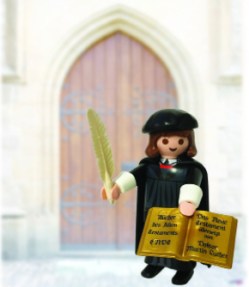
Martin Luther playmobll

This 3” tall toy from Playmobil is a big seller in Germany this year.

His story has all the markings of a summer blockbuster: thunder, lightning, daring escapes, an imprisonment (of sorts) in a German castle. But Martin Luther, born in 1483, was supposed to have been a lawyer and lived a much quieter, less adventurous life.

As a young teen, Luther was sent to school to study the law. His life changed dramatically in 1505 as he was traveling through a thunderstorm and a bolt of lightning struck too close for comfort. In desperation, Luther promised to become a monk.

He was ordained as a priest in 1507, but after 10 years of monastic life and increasing disillusionment with church practices, he sent a letter to leaders protesting the sale of indulgences, or pardons for sin. He included in the letter 95 Theses on faith, grace, sin, redemption, and religious authority. Those concepts, which sparked the Protestant Reformation, will celebrate their 500th anniversary this October 31, the date of Luther’s letter to church leaders.

Of the Scripture passages believed to have inspired Luther’s transformation, it is Romans 1:17 that theologian R.C. Sproul said “turned the lights on for Luther” because it details a righteousness given by God to those who would receive it by faith, rather than to those who could earn it.

In 1523, his life took another unexpected turn when a group of nuns asked for his help to escape their convent. He did so, sneaking them out in fish barrels. One of the sisters, Katherine Von Bora, eventually became Luther’s wife and the mother of his six children. (Von Bora must have been an unlikely partner for Luther; he once said that upon hearing of his choice, his close friends said, “For heaven’s sake, not this one.”)

Luther’s battles with established religion continued throughout his life, leading to his excommunication from the Catholic church after he refused to recant the Reformation’s ideals. Labeled a heretic and an outlaw, he was put in protective custody at Wartburg Castle. There, he translated the New Testament into German.

In the end, Luther left a legacy even larger than the life he led.

– Meredith Flynn, with info from Christianity Today, Ligonier Ministries, and Britannica.com

Steve GainesIt seems a fair question, especially following the loquacious and public presidency of Ronnie Floyd. Steve Gaines, by comparison, is almost invisible. This is not a criticism of Gaines, that he would have a different style as Southern Baptist Convention president. That is to be expected. Each president makes his own way and leads from his own strengths. But Gaines’s style, working in a less public way that his immediate predecessors, leaves us wondering: What is Steve Gaines doing?


And we find ourselves hoping that he’s focusing on issues that we just haven’t heard about yet.

Floyd wrote. Floyd spoke. A lot. Almost every week Floyd published on his blog and in Baptist Press his thoughts on righting the denomination and meeting the culture conflict head on. He quickly assumed a statesman position for his two years in office, urging support for missions and the Cooperative Program. We in the local Baptist news media came to rely on his thoughtful, well-reasoned analysis of current events.

Gaines, on the other hand, has spoken for publication rarely. He offered a few comments in the election season and after the January inauguration, mostly encouraging Southern Baptists to pray for the Trump Administration. And in February he addressed Baptist newspaper editors and state convention executive directors in Los Angeles. Gaines spoke on Trump’s election, appointments, and early actions as president. And he urged prayer for revival in America. Gaines has themed the 2017 SBC Annual Meeting “Pray: For Such a Time as This,” following Floyd and his predecessor, Fred Luter, in bringing Southern Baptists to our knees for spiritual awakening.

But it’s his comment on the complaints about the Ethics and Religious Liberty Commission and its president Russell Moore that, we hope, gives a glimpse at Gaines’s work behind the curtain.

“I hope the kind of talk we have been hearing is not the direction in which we are going. I hope Russell will remain in his position and that we have reconciliation with a lot of people,” Gaines said in Los Angeles. His comment came almost simultaneously with the announcement by Dallas-area pastor Jack Graham that his megachurch, Prestonwood Baptist, would be holding in escrow its $1-million offering through the Cooperative Program. Graham expressed concerns about the direction of the SBC and the ERLC, in particular, after an election cycle marked by anti-Trump tweets, Moore’s ongoing concern for refugees, and the “friend of the court” support of a freedom of religion case, in which both the ERLC and the International Mission Board (IMB) opposed onerous government regulations placed on a New Jersey mosque.

Southern Baptists do not need another era of suspicion, doubt, and sometime demagoguery. Our mission cause is too important to withhold funding over ancillary anxieties. The reconciliation that Gaines spoke about requires behind-the-scenes diplomacy and skillful mediation. That’s what we might hope Gaines is doing, even if we never hear about it publicly.

-Eric Reed is editor of the Illinois Baptist

The old adage says there are three things you should never talk about in polite company—money, religion, and politics. We already break two of those three rules every Sunday in church. Are we ready to break the third—politics?

The Free Speech Fairness Act was introduced the U.S. Senate and House of Representatives Feb. 1. The bill doesn’t repeal the Johnson Amendment, which limits church involvement in politics, but offers what Alliance Defending Freedom calls a “relief valve”—“as you carry out the mission of your church, you would have the right to speak freely on all matters of life, including candidates and elections.” Most importantly it maintains the prohibition against churches and other 501(c)(3) organizations from donating money to candidates and political campaigns.

The Johnson Amendment became part of the U.S. tax code in 1954 when then Senator Lyndon Johnson successfully restricted tax-exempt organizations, including churches, from endorsing or opposing political candidates under penalty of losing their tax-exempt status.

President Donald Trump discussed eliminating the amendment numerous times throughout his campaign and most recently at the National Prayer Breakfast Feb. 2. “[Thomas] Jefferson asked, can the liberties of a nation be secure when we have removed a conviction that these liberties are the gift of God,” Trump said. “Among those freedoms is the right to worship according to our own beliefs. That is why I will get rid of and totally destroy the Johnson Amendment and allow our representatives of faith to speak freely and without fear of retribution. I will do that, remember.”

The question is, are churches ready for this? The pastor of the small church I grew up in was not shy about sharing his political views. He shared from the pulpit who he was voting for in the presidential election, and told congregants they could vote for whomever they wanted, just go vote. I remember as a middle-schooler being shocked, not so much by his action, but by the person he was voting for on election day. His candidate lost, there was no outcry in the church, and the IRS never came knocking on our church doors.

Not all pastors and congregants want to discuss politics within the church walls, but, if passed, the Free Speech Fairness Act would give those who want to the freedom to do so.

– LMS

should-congress-fix-the-johnson-amendment-2-27-17

Leverage others’ strengths

ib2newseditor —  February 23, 2017
carmen-halsey

Carmen Halsey

Because she was only 13 months younger than her brother in their small high school, there were many classes Carmen Halsey attended with him.

“I took the book home to study and he never did, yet he’s the one that always pulled the A,” said Halsey during a breakout session at the Illinois Leadership Summit. “ That mentality is setting people up to fail. Sometimes we are just not a natural, and all the practice just depletes our energy level and leaves us feeling incompetent.”

Halsey, who serves as IBSA’s director of women’s ministry and missions, as well as Illinois WMU executive director, spoke on how to leverage the strengths of leaders.

First, Halsey said, leaders should have a general knowledge of how God created the brain and understand how their emotions impact them.

“All people experience things emotionally before their reason kicks in, but not all people do this at the same level,” she said. “Understanding the differences of how this works within a team will increase performance and decrease time wasted and drama.”

Halsey said the next step is identifying a person’s natural talents and strengths. “Take inventory. Ask them to take a strengths survey, to describe their dream job, and the sweet spot of their current ministry,” she said. “Watch them. People will naturally nurture their strengths without much thought behind it.”

Once strengths are identified, the leader must be intentional to invest in further developing those strengths.

“We must find ways to cultivate the natural talents in people to make them even stronger,” Halsey said. “We do this in practical ways with our encouragement, and by providing training opportunities. As we come alongside our team, we are confirming their strengths.”

Finally, Halsey said, a church or organization should always position people according to their strengths. “Sometimes out of need we ask someone to sit in a seat that might not be their best position,” she said. “If that’s the case, communicate that it’s temporary. And move them to a better fit as soon as you can. That’s how a person can get from good to great.”

– Kayla Rinker

face-the-nation-moore

WELCOME TO MARS HILL – ERLC President Russell Moore joined a panel discussion on Face the Nation.

Russell Moore has the hardest job in the Southern Baptist Convention. He is required to speak on behalf of a people who take great pride in speaking for themselves, even (or especially) with the Almighty. It’s in our theology (priesthood of all believers). It’s in our polity (autonomy of the local congregation). It’s in our DNA (we’re preachers).

So when someone dares to speak for all of us, and says something we might disagree with, we bristle.

Some are bristling over Moore’s anti-Trump stance during the election. And, as the Wall Street Journal and NPR reported a month ago, some churches are considering withdrawing support for the Southern Baptist agency Moore heads, the Ethics and Religious Liberty Commission. Moore apologized for any ill will he caused, but has that settled the conflict?

Moore is two years into his presidency, succeeding Richard Land who served 25 years in the role. Land was brusque, but his views matched the vast majority of Southern Baptists’ on issues of religious liberty and sanctity of life, and we mostly agreed with him when he spoke for us.

But times have changed. As evidenced by Moore, a new generation is rising to SBC leadership, and they focus on different issues than their predecessors did. Moore has spoken to the church’s handling of refugees and the theology of adoption and gender issues—and politics.

Several questions arise from the murmurings about the ERLC:

Is the ERLC really out of touch with mainstream Southern Baptist opinion? Or are we finding, especially in this election cycle, that the world is more complex and even once-monolithic Southern Baptists have varying opinions on some issues—especially political issues?

Is this a squall that will subside as Moore finds a more modulated approach to his “spokesman-ship”? Or is there really a storm brewing?

Will older leaders assume the statesman role, and let younger leaders lead? Or, is there truly a divide among Southern Baptists among generational, geographical, educational, economic, or political divides that will not be bridged.

Time will tell, we suppose. But in the meantime—

We need the ERLC, and it shouldn’t be muzzled. The ERLC should still represent Southern Baptists in the public discourse on religious liberty, the church, and sanctity of life. True, some ERLC staff posted political opinions on their personal blogs and Twitter feeds during the election cycle. Their views might have been too easily mistaken for Southern Baptists’ as a whole. Only Moore should address the SBC’s core issues in the blogosphere or Twitterverse.

Stop the habitual tweeting. The tweet may be the lingua franca, but the 140-character debate hasn’t served the ERLC well lately. At times in 2016, we wondered if the ERLC really needed to express opinions on so many topics. Those who speak for Southern Baptists should not be reactionary, but instead offer considered opinions and measured words.

Finally, we should acknowledge generational differences and allow the hand-off to proceed. This is no longer the Land era. Younger Baptists may have a different perspective on some things, but, so long as their views are biblical, we must let them speak to their times—and ours.

-Eric Reed

Read more about this story, “Baptists debate politics, religious liberty, missions funding”

Follow the follower

ib2newseditor —  February 16, 2017

follow-jesus

Christian leadership training experts like to cite Jesus as an example of the best leader ever, Michael Kramer told Illinois Leadership Summit breakout attenders. While he agrees, the pastor also believes Jesus is an example of the best follower the world will ever see.

The education pastor from Immanuel Baptist in Benton based his claim on this: “Christ called us to be followers. Even Jesus followed the will of the Father. Jesus was the greatest follower and his disciples followed him… As followers we are to be deeply dependent on Jesus.”

As leaders, Kramer stressed, we are to follow the tenet of John 3:30—He must increase, I must decrease. “Our intake of Jesus must be greater than our outtake,” he said. “We need to be spending much time in the Word. Not time in sermon preparation, don’t count that.”

Kramer suggested several ways to increase private prayer time and Bible reading. “Read through the Bible in a year or read a Psalm a night. Download a Bible app and listen. Buy the Jesus Storybook Bible, it’s the most creative Bible I’ve come in contact with. It goes straight to the heart. Memorize a Bible verse a week.”

“Pray the Lord’s Prayer every morning before your feet hit the floor,” Kramer said. “Go away for a few hours or an even longer period of time once a month just for prayer.” Kramer will spend a few hours in the woods walking and talking with God. He also recommended praying through a prayer list with your spouse, children, or grandchildren

By increasing time spent with God, you begin to decrease your focus on self. “What’s it look like to decrease?” he asked. “When God wants to go after your heart he’s going to do it in an unexpected way. Christ is going to go after the places that he wants to claim in our hearts.”

Cultivate spiritual health

ib2newseditor —  February 9, 2017

tibbettsTimes of ministry burnout are coming, Heath Tibbetts told leaders gathered in Springfield for the Illinois Leadership Summit. So are areas of weakness. But there is a way to prepare for those inevitable difficulties, said the pastor of First Baptist Church in Machesney Park.

“Spiritual build-up prepares us for burnout and blind spots that we know are on the horizon,” Tibbetts said during his breakout session on the spiritual health of a leader.

One warning sign that spiritual build-up may be lacking, Tibbetts said, is reacting poorly to challenges. There was a time, he said, when his church didn’t plan for occasional obstacles, like losing a Sunday school teacher or facing a bill they couldn’t afford to pay. Leaders can fail to prepare in the same way, if they allow their current plans and level of knowledge to be enough.

“Visionless ministry punches the clock.”

So, how can a leader make sure his or her spiritual health is strong? Tibbetts suggested several ideas, including coaching from other leaders. He recently starting a mentoring relationship with a pastor in another part of the country, which started when Tibbetts read a magazine article about how the other church was utilizing facility space and e-mailed the pastor a question.

There’s also a need for trusted friends who can ask questions like, “How’s your relationship with your wife?” Tibbetts added.

Building oneself up spiritually also comes from time with God himself, he reminded his audience. “Personal devotion is one of the easiest things to let slip in your life.” As a pastor, if sermon preparation is the only study he does, Tibbetts said, and if he isn’t spending devotion time in other parts of Scripture, not only will the sermon be lacking, but he’ll also be missing a valuable build-up opportunity.

When ministry burnout does come, Tibbetts said, there are ways to confront it. Unplug, and “say no a lot.” Leaders need to remember their vision for ministry, even apart from what they are currently doing. “Visionless ministry punches the clock,” Tibbetts said, asking leaders to identify, What defines you separately from your ministry?

And keep building up. Tibbetts said a man in his church recently waited two months to call him for a counseling appointment, because he knew his pastor would ask about his spiritual life, and he wanted to make sure he was reading his Bible. If you’re confronting burnout, Tibbetts said, schedule more times of prayer.

– MDF