Archives For November 30, 1999

Russell Moore, president of the Ethics and Religious Liberty Commission, has used the phrase “convictional kindness” to describe how Christians ought to engage a vastly different culture than the one their parents and grandparents knew.

Russell Moore, president of the Ethics and Religious Liberty Commission, has used
the phrase “convictional kindness” to describe how Christians ought to engage a vastly different culture
than the one their parents and grandparents knew.


NEWS | Meredith Flynn

Southern Baptists’ generals in the culture war demonstrated their new strategy at an April meeting for church leaders. But the tactic, softer in decibels but not doctrine, was met by criticism from opponents using modern weaponry – social media.

“The way that we are going to be able to speak to the people in our culture…is not by more culture war posturing, but by a Christ-shaped counter-revolution,” said Russell Moore, president of the Southern Baptist Ethics and Religious Liberty Commission.

The conference on sexuality and the Gospel was the ERLC’s first major event since Moore assumed leadership from Richard Land, who served as the denomination’s main voice on issues such as abortion and first amendment rights.

The event came with a sort of confession: the culture war as we knew it is over.

“We’re all in agreement that the cultural war is over when it comes to homosexuality, certainly when it comes to gay marriage,” Florida pastor Jimmy Scroggins said at the ERLC’s summit. In his urban context of West Palm Beach, Scroggins said, “The question is what are we going to do in the church.”

Some might call this “post-culture war America.” Others might conclude that we’ve entered a new phase, culture cold war, with new weapons such as Twitter and a new battlefield, ironically, inside the church.

Embrace the strangeness
This new culture has been on the horizon for a while: Marriage rates across all demographic groups have fallen continuously since 1970, Andrew Walker of the ERLC noted during his summit breakout session. Cohabitation rates are up too: USA Today reported last year that for almost half of all women between ages 15 and 44, their “first union” was cohabitation instead of marriage.

Also on the rise: Approval for redefining marriage. A recent ABC News/Washington Post poll reported 59% of Americans approve of same-sex marriage.

Addressing sweeping social and cultural changes was one emphasis of the April 21-23 meeting in Nashville, but speakers also talked about how church leaders ought to interact with increasingly specific questions arising at their churches. Like what to do when a transgender person expresses repentance and belief in Christ. Or how to counsel college students when premarital sex is not only accepted, it’s expected on the first date.

A few days before the ERLC summit, Moore appeared on ABC’s “This Week” to discuss religion and politics with a panel of evangelical and conservative leaders. He talked about the falling away of nominal, in-name-only faith, and the increasing “strangeness” of Christianity. Moore told moderator Martha Raddatz, “It’s a different time, and that means…we speak in a different way.”

“We speak to people who don’t necessarily agree with us. There was a time in which we could assume that most Americans agreed with us on life, and on abortion, and on religious liberty and other issues. And we simply had to say, ‘We’re for the same things you’re for, join us.’

“It’s a different day. We have to speak to the rest of the culture and say, ‘Here’s why this is in your interest to value life, to value family, to value religious liberty.’”

During the Nashville meeting, social media provided plenty of evidence of the divide. The meeting was one of Twitter’s top trending topics on its first day. Feedback from attenders was positive, but others watching the summit online spoke out, often harshly, against what speakers said.

That Christian views are seen as strange isn’t surprising, Moore said on the ABC broadcast.

“Many people now when they hear about what evangelical Christians believe, their response is to say, ‘That sounds freakish to me, that sounds odd and that sounds strange. Well, of course it does. We believe that a previously dead man is now the ruler of the universe and offers forgiveness of sins to anyone who will repent and believe.”

Reclaim the strangeness of Christianity, he urged at the Nashville meeting, basing it on the death and resurrection of Jesus.

So, what should we say?
Throughout the summit, speakers stressed the supremacy of the Gospel and clarity of what the Bible teaches about sexuality. Christians shouldn’t apologize for it, said Andrew Walker. Preaching an almost-Gospel is no match for the sexual revolution, Moore said.

Or, as Southern Seminary’s Denny Burk put it, “We have to be grave about these things.”

Scripture calls Christians to speak the truth, but to speak it in love. “We have to reject ‘redneck theology’ in all of its forms,” Jimmy Scroggins said during a panel discussion on the Gospel and homosexuality. “Let’s stop telling ‘Adam and Steve’ jokes.” (God created Adam and Eve, not Adam and Steve…)

As the audience chuckled, Scroggins continued, “Let’s be compassionate because these are people that are in our community, these are people who are in our churches, these are people who have grown up in our youth groups, and these are people that we’re trying to win to Christ, and we want to care for them as a people created in God’s image.”

Speaking with “convictional kindness” has been a major part of Moore’s message in his first year as ERLC president. “I hope to speak with civility and with kindness and in dialogue with people with whom I disagree,” he told Christianity Today last year.

It’s a timely endeavor, especially when social norms run ever more contrary to the Gospel. J.D. Greear pastors The Summit Church in Raleigh-Durham, N.C. At a church that reaches a large number of college students, sexual ethics are a topic of constant conversation.

“Sex gets at the core of who we are. Its dysfunction and its damage is deep, but the Gospel goes deeper still,” Greear said. “Because where sin abounds, grace much more abounds, and the great brokenness of sex presents an even greater opportunity for the Gospel.”

The May 26 issue of the Illinois Baptist will examine in more detail how speakers at the summit addressed contemporary threats to biblical sexuality and marriage. The ERLC also will look more closely at “The Gospel, Homosexuality, and the Future of Marriage” at a conference scheduled for Oct. 27-29 in Nashville.

Jared Moore

Jared Moore

Update (May 20): Bennie Smith, a deacon from New Salem Baptist Church in Hustonville, Ky., will nominate Jared Moore for president at the SBC Annual Meeting in Baltimore.

NEWS | Kentucky pastor Jared Moore announced this week he will allow himself to be nominated for president of the Southern Baptist Convention at the denomination’s June meeting in Baltimore. Moore, pastor of New Salem Baptist Church in Hustonville, Ky., currently is the SBC’s second vice president.

In a post on his blog and SBC Voices, Moore listed four reasons he’s willing to serve: He wants to serve Southern Baptists, represent rural Southern Baptists, promote unity in the SBC, and promote the Cooperative Program.

“I was saved in a rural Southern Baptist church, and I’ve primarily served rural Southern Baptists ever since,” Moore wrote. “Where I live now, the nearest gas station is 7 miles away. My church is a small church made up of about 60 people. They’re a loving, caring, godly group of people…I want to represent Southern Baptists like the ones I serve on a daily basis who may not have the opportunity to attend the convention or serve at the convention level.”

I want to represent Southern Baptists like the ones I serve on a daily basis who may not have the opportunity to attend the convention or serve at the convention level. – See more at: http://sbcvoices.com/why-i-am-allowing-myself-to-be-nominated-for-sbc-president/#sthash.M2hwtrUG.dpuf

Moore joins Ronnie Floyd, pastor of Cross Church in northwest Arkansas, in the election to succeed current SBC President Fred Luter. Fellow Kentucky pastor Paul Sanchez will nominate Moore, and Albert Mohler, president of The Southern Baptist Theological Seminary, will nominate Floyd.

I was saved in a rural Southern Baptist Church, and I’ve primarily served rural Southern Baptists ever since. Where I live now, the nearest gas station is 7 miles away. My church is a small church made up of about 60 people. They’re a loving, caring, godly group of people. – See more at: http://sbcvoices.com/why-i-am-allowing-myself-to-be-nominated-for-sbc-president/#sthash.M2hwtrUG.dpuf

I was saved in a rural Southern Baptist Church, and I’ve primarily served rural Southern Baptists ever since. Where I live now, the nearest gas station is 7 miles away. My church is a small church made up of about 60 people. They’re a loving, caring, godly group of people. – See more at: http://sbcvoices.com/why-i-am-allowing-myself-to-be-nominated-for-sbc-president/#sthash.M2hwtrUG.dpuf

The_BriefingTHE BRIEFING | Half of all Illinois residents said they’d move out of state if they could, putting the Land of Lincoln at the top of a Gallup survey of all 50 states. But it’s a dubious honor: On average, only 33% of residents in all states would like to move, compared to 50% in Illinois.

19% of Illinois residents said they are extremely, very or somewhat likely to move in the next year, compared to about 14% across all 50 states.

Gallup linked their most recent poll to similar studies that measure how negative residents are about their state’s taxes, and how much they distrust their government. Illinois topped the latter list too – only 28% of residents said they had a great deal or fair amount of trust in their state government. As for taxes, 71% of Illinoisans said they were too high, placing the state fourth on a list topped by New York, New Jersey and Connecticut.

One piece of good news amid the bad: A study from the University of Colorado-Boulder named Chicago the country’s funniest city, largely because of its improv scene. Judging from the Gallup numbers, it may be a good time to learn to laugh at ourselves, too. Read more at Gallup.com.

Supreme Court rules in favor of town meeting prayers
The U.S. Supreme Court on Monday ruled that prayers before town meetings in Greece, N.Y., can continue. The Second Circuit Court of Appeals in New York City had ruled the prayers “had the effect of affiliating the town with Christianity,” but the Supreme Court’s 5-4 decision overturned that ruling. “This is a victory for all of those who believe in the freedom of speech, including religious speech, as a prized part of our God-given religious liberty,” said Russell Moore, president of the Southern Baptist Ethics and Religious Liberty Commission. Read the full story at BPNews.net.

Oklahoma school district bars pre-game prayers
The Freedom From Religion Foundation successfully lobbied an Oklahoma school district to stop pre-game prayers led by baseball coach Larry Turner and his staff. In a letter written by his attorney, Owasso School District Superintendent Clark Ogilvie said his district “will not allow any District employees to participate with any District students in any prayer or other religious activities in connection with any school-sponsored events.” Read more at ChristianPost.com.

Page appoints SBC Mental Health Advisory Council
Frank Page, president of the Southern Baptist Executive Committee, has named a 23-member advisory council to assist churches as they respond to mental health needs in their congregations. The group, chaired by Kentucky pastor Tony Rose, will address concerns brought by messengers at the 2013 SBC Annual Meeting in Houston. There, Baptists approved a motion by Arkansas pastor Ronnie Floyd to ask Southern Baptist entities “to assist our churches in the challenge of ministry to those suffering from mental health issues…” Messengers also approved a resolution on “Mental Health Concerns and the Heart of God.” Read more at BPNews.net.

Disaster Relief volunteers respond to southern storms
Southern Baptist Disaster Relief teams moved quickly into the Southeast U.S. following a spate of tornadoes and severe storms two weeks, and are still at work in several states.

“These storms were so strong that the slabs were swept clean by the wind,” said Disaster Relief director Joe Garner in Arkansas, where teams were serving the Mayflower and Vilonia areas. “There is very little chainsaw work to do. It is mainly clearing debris.”

Since April 26, destructive storms have affected 13 states, Baptist Press reports. For more Disaster Relief updates, go to BPNews.net.

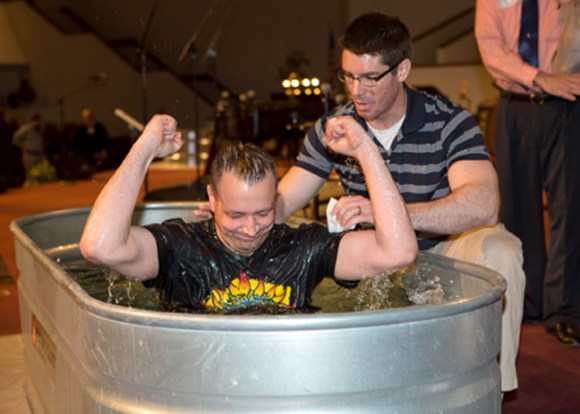
After being baptized in a horse trough, David Vittetoe celebrates as John Howard, minister to students, assists. The troughs gave the church three locations to baptize the 103 people who came forward.

After being baptized in a horse trough, David Vittetoe celebrates as John Howard, FBC O’Fallon minister to students, assists. The troughs gave the church three locations to baptize the 103 people who came forward.


HEARTLAND | Lisa Sergent

Over a single weekend, more people were baptized at First Baptist, O’Fallon, than in all of 2013. The church’s crusade March 29-30 resulted in 103 baptisms, 17 salvation decisions, and 15 rededications.

Tom Dawson, FBC’s minister of adult education who helped organize the crusade, described it as “a wonderful event.” He called Texas evangelist Ronnie Hill “electric. He brought God’s Word straight to peoples’ hearts.”

Dawson said the church did “quite a bit of preparation” in the month before the crusade. Prayer, training, and logistics were key. Groups spent time praying for Hill and for those who would come and make decisions. Church members were trained to be “encouragers,” or counselors, to talk with people as they came forward.

Carol Cluff, adult ministries specialist, said the encouragers were trained a few days in advance of the crusade. “We wanted to make sure every person who stepped forward had someone to come with them, to talk with them about what prompted them to come forward, and to make sure they fully understood the commitment they were making.”

She noted many of those who were baptized had come to understand they had been “baptized out of order. Several people realized they had been baptized as a baby or even as a child without knowing Christ and wanted to be baptized now as believers in Jesus. Others had accepted Christ at youth events some time ago, but not taken that step.”

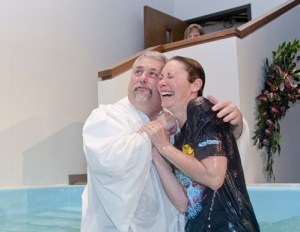
Sarah Schultz rejoices with Skip Leininger, associate pastor of FBC O’Fallon, after being baptized at the church’s March 29-30 crusade.

Sarah Schultz rejoices with Skip Leininger, associate pastor of FBC O’Fallon, after being baptized at the church’s March 29-30 crusade.

Hill urged the church to be ready to baptize people in each session and not make them wait until a later date. In anticipation of a large number of baptisms, the church made sure to have plenty of T-shirts, shorts and towels on hand. Plus, they placed two horse troughs filled with water on either side of the platform giving them three locations, including the baptistery, to baptize people in a single service.

“We were ready to baptize people on the spot,” Dawson said.

First Baptist has made follow-up a priority, stressing the importance of continued discipleship. In a series of follow-up actions, encouragers are keeping in touch with those they counseled and are connecting them with small groups within the church. As part of the effort, Senior Pastor Doug Munton is leading a special sermon series covering the Good News and the importance of baptism along with why Christians should share their faith and be fishers of men.

Munton is pleased with the crusade’s outcome. “We had a great crusade,” he shared. “The Gospel was preached clearly and the response was great. Many people trusted Christ as Savior and that never gets old to me. And, it was such a privilege to see more than 100 people follow the Lord in believer’s baptism.”

Leininger prepares to baptize Sonja Conrad.

Leininger prepares to baptize Sonja Conrad.

Dawson said church members are excited. The momentum continued into Easter as the church had its largest Easter Sunday worship attendance – 2,569 people.

“The crusade was wonderful,” said Cluff. “It lit us on fire.”

Mark_Coppenger_blog_calloutCOMMENTARY | Mark Coppenger

You know the scene: A troubled family member arrives at home only to find various loved ones seated in the living room. They ask him or her to sit down and hear what they have to say. One by one, they read prepared statements of love and admonition. The subject, eyes brimming with tears or flashing with indignation, endures as much as possible before caving in, pushing back or storming out.

The poor soul has bottles hidden around the house and in the flowerbed, and she can find another pint as soon as her prime stashes are blown.

Or there’s the trash addict who can’t throw anything away, even dead animals. (I was called in on a cleanup with some church members in my seminary days; we found a dead, dried out cat under matted stained clothes under stacks of newspapers in one of the closets.)

An intervention is very uncomfortable but worth it, whether the addiction is drugs or drink, clutter or cussedness. They’re ruining themselves, as those around them are grieving if not outright harmed. And they don’t much appreciate your suggestion that something is out of whack.

I know that people can come to Christ in a lot of tender ways. An immigrant wife is touched by her Christian neighbor’s shopping and language tips. A lost welder is disarmed by the warmth of a church softball team he’s been asked to join. A “singing Christmas tree” rendition of Joy to the World brings tears to the eyes of a cranky, unchurched parent who shows up to watch his high school senior perform.

But the Lord has also used Jonathan Edwards’ Sinners in the Hands of an Angry God and the chaste slap of a godly college girl knocking some sense into a unbelieving suitor, whose advances were unseemly, a jolt which caused him to reassess his secular worldview. Or how about Mordecai Ham’s scathing anti-alcohol parades, which salvifically grieved some drunks standing outside bars on the roadside?

God may well use a sequence of happy and scary events and items to lead an individual to Himself. (I think I once heard the late evangelism professor Roy Fish say the average was seven Gospel touches before conversion.)

So Bob may have been providentially prepped for salvation by, in order, a Vacation Bible School lesson he heard at age 8; a highway sign reading, “Prepare to Meet God”; a Jack Chick tract named Holy Joe; the stellar performance of a homeschooled spelling bee champ who thanked Jesus for helping her; five minutes of a Joel Osteen sermon; and a friend who repeated something he heard in an Alistair Begg broadcast.

Truth is, we risk looking silly when we declare, well beyond our competency and theological warrant, that all evangelistic approaches other than our own are tacky, pompous, dated, specious, trendy, dopey, sleepy, grumpy, sneezy and bashful.

That being said, there is an irreducible kernel of awkwardness and agony in conversion — repentance. I compare it to throwing up. I hate it. I fight it. (On a bucking airplane I close my eyes, turn the air full blast on my face, breathe deeply and sit very still.) I suppress it with every fiber of my being. But when it comes, oh, the relief — the blessed cooling of a sweaty brow, the relaxation of suppressed muscles.

Yes, it’s that gross, as is repentance, as we hurl up and out the poison and rot of self and sin and damnable, willful stupidity — the sort of thing you find in James 4:8-10: “Cleanse your hands, sinners, and purify your hearts, double-minded people! Be miserable and mourn and weep. Your laughter must change to mourning and your joy to sorrow. Humble yourselves before the Lord, and He will exalt you.”

Sometimes we hear and say that a witnessing Christian is “just one beggar telling another one where to find bread.” I’d suggest it’s more like a formerly-suicidal fellow who was talked off the ledge trying to talk a currently-suicidal fellow off the ledge. Or it is like a repentant Taliban terrorist in Gitmo going on TV to dissuade current Taliban terrorists to cut it out.

Of course, most don’t think that a law-abiding, philanthropic citizen — working the NYT crossword in Starbucks on Sunday morning, sitting across from his wife Khloe enjoying a half double decaffeinated half-caf with a twist of lemon, beside their jogger stroller bearing little Nash — is a suicidal terrorist. But he is just as we were. He’s bound for a well-deserved sinner’s hell, indifferent to the godly stewardship of his life, harming innocents along the way by his passive, aggressive and passive-aggressive defiance of the Kingdom and its gospel of grace, Khloe and Nash being his prime victims as his “spiritual leadership in the home” couples them to his downgrading train.

And so we intervene. If, that is, we love the person, are convinced of his plight and are willing to risk the alienation of affection. It doesn’t take licenses or programs or eloquence, though those can help. It simply demands compassion, courage, a firm grasp of the hard truth and, yes, a life which reflects a better way.

Mark Coppenger is director of the Nashville extension center and professor of Christian apologetics at Southern Baptist Theological Seminary in Louisville, Ky. This column first appeared at BPNews.net.

Mothers Day Offering 2014COMMENTARY | Nate Adams

I remember my dad writing once about an Easter Sunday that came long after we kids were grown and gone. None of us were going to be home for the holiday weekend that year, so my mom suggested that she and my dad volunteer to work in the nursery that Sunday.

In case my dad had doubts, my mom was ready with her reasons. “There are likely to be several young families visiting our church that day. Those who work in the nursery all the time deserve a break. We’re available, and able. Oh, and by the way, others took care of our kids on Easter for years. Even this Easter, others will be taking care of our grandchildren.”

And so those two grandparents who hadn’t needed a nursery nor worked in one for quite a while sat and rocked babies that Easter Sunday. As they did so, they prayed for the families of those babies, and for their own family. I remember my dad saying it was one of the most memorable Easter Sundays he ever experienced.

There is something especially sacred it seems, about giving to others out of gratitude for the way that you have received yourself. In fact, as Mother’s Day now approaches, I think of the countless ways I have benefited from a godly, sacrificing mother. And I think of how blessed our own children have been by my wife’s investment in their lives.

One way to “pay it forward” to others in gratitude for the mothers who have blessed our lives is to give generously to the Mother’s Day Offering for the Baptist Children’s Home and Family Services (BCHFS). Last year, BCHFS provided Christ-centered services to 1,417 individuals – 23% more than the previous year. Through residential care at the Baptist Children’s Home in Carmi, maternity services at Angels’ Cove, multiple Pathways Counseling offices, the Safe Families for Children program, and ministry to orphans in Uganda, BCHFS lives out this year’s Offering theme, “Families are Worth Fighting For!”

Sharing Christ is the central motivation for the services BCHFS provides. Of course they provide ministry and healing that help families through troubled times. But in doing so, the BCHFS staff also unashamedly shares the Gospel of Jesus with those they serve, and seeks to model His love daily to them. Last year alone, 16 children from the Residential Care program and from Safe Families made professions of faith in Christ.

The BCHFS does not receive state or federal contract for care funding, and does not receive funding through the Cooperative Program. Their ministry is completely reliant on the generosity of Illinois Baptist churches and individuals who invest in the lives of those they serve. That’s why the Mother’s Day Offering is so important.

From the BCHFS web site (www.bchfs.com) your church can download information and materials to help you promote this year’s Mother’s Day Offering. And if your church doesn’t receive an offering that particular Sunday, you can still use the web site to donate directly to BCHFS’s important ministries.

If you appreciate your own family, and especially your mom this Mother’s Day, I can’t think of a better way to demonstrate your gratitude to God and “pay it forward” than to support this important ministry to hundreds of hurting families. And remember, if your own family is facing challenges right now, the Baptist Children’s Home and Family Services is there for you too.

Our family will be supporting the ministries of BCHFS this year, and I pray yours will too. Whether it’s thanking our children’s workers with a turn in the nursery, or thanking our mothers by giving to help hurting families, it’s a good, good thing to “pay it forward.” As Jesus said in Matthew 10:8 “Freely you have received; freely give.”

Nate Adams is executive director of the Illinois Baptist State Association.

THE BRIEFING | Meredith Flynn

Barna reports the same percentage of Americans are Bible-engaged as are Bible-skeptical. The annual State of Bible study, produced with the American Bible Society, found 19% of people say they read the Bible at least four times a week and believe it is the actual or inspired Word of God. And 19% say the Bible is “just another book of teaching written by men that contains stories and advice.” The number of skeptics has almost doubled over the past three years, according to a summary at Barna.com.

Baptists may meet with gay author
Southern Baptist leaders who authored a response to Matthew Vines’ book “God and the Gay Christian,” said they’re willing to meet with the author in person. Vines’ book was released April 22, the same day Southern Seminary President Albert Mohler and a group of professors released an e-book to respond to Vines’ belief that Scripture allows monogamous same-sex relationships.

“I will be very glad to meet you in person and not merely in print. I am thankful for a respectful exchange of beliefs,” Mohler tweeted in response to a message from Vines thanking him for engaging in a Religion News Service Q&A about the book. Read more at BPNews.net.

‘Family Talk’ wins in court
A ministry run by Focus on the Family founder James Dobson was issued a temporary injunction against the federal government, meaning the organization does not have to provide abortion-inducing drugs in its employee health care plans. Dobson’s “Family Talk” radio program, newsletter and website has 28 full-time employees, according to an Associated Press report. The U.S. Supreme Court currently is considering a similar case involving Hobby Lobby. Get the full story at ChristianPost.com.

Midwest leaders meet to pray
Around 100 Baptist leaders and church planters from the Midwest gathered in Wisconsin for an April prayer summit hosted by the North American Mission Board. “It was a wonderful time of focused prayer for our personal life, in a small group, and corporately in a large group setting,” said IBSA President Odis Weaver. “We prayed for personal holiness, for the Midwest Send cities, and for revival and spiritual awakening.”

Coach denies proselytizing charges
Clemson University football coach Dabo Swinney, an outspoken Christian, defended his program’s policies after the Freedom From Religion Foundation sent a letter of complaint detailing “several serious constitutional concerns.” FFRF’s concerns include Swinney’s appointment of a chaplain for the team, scheduled devotionals, and the team’s attendance at a 2011 Fellowship of Christian Athletes breakfast.

“Players of any faith or no faith at all are welcome in our program. All we require in the recruitment of any player is that he must be a great player at his position, meet the academic requirements, and have good character,” Swinney responded in a statement. CBS News reported the coach said in a teleconference he would continue to run the program like he always has. Read more at

Erich_Bridges_blog_calloutHEARTLAND | Erich Bridges

She wants desperately to return to the hurting people she loves.

Laura Miles* is a missionary on hold. At least, she sometimes feels that way.

Miles spent two terms overseas with her husband, in places where the people she served are experiencing hard times and the threat of worse. It tears her up inside to watch from a distance their suffering. But for now she’s back home, where she and her husband minister to young adults in a local church.

“We really felt like it was a lifetime calling,” Miles said of the first stint abroad. “We went over and just loved the people, loved the ministry. We have a definite heart for Muslims. We felt like we really connected, but about halfway through the Lord was telling us we needed to go back and [prepare] for long-term career ministry.”

They thought God would lead them back to the same place, “but it wasn’t long after leaving that we felt that door kind of shut,” Miles said. “We prayed and prayed. We were very impatient with the Lord. We wanted to know where and what was next. We realized we weren’t trusting in Him, so we committed to resting in serving where we were until He revealed the next location.”

When the time was right, they went to a different country and ministered there for three years. “We left everything, sold everything, and we thought it was going to be long-term,” she recalled.

Once again, however, they sensed the Lord drawing them home — this time to reach out to American millennials searching for God’s purpose for their lives. Young women who look to Miles for guidance and inspiration confirm that she’s doing a pretty good job.

Still, a hurting, darkness-enveloped world calls to her.

“Honestly, my heart is on the field somewhere,” she admitted. “So I’m trying to seek out, ‘Lord, who do You want me to be right now while I’m here? Whenever You want to send me back somewhere, I’m ready.’ But until then, it’s about trying to be faithful where you’re at, with whom you’re given.”

The missionary call of God is as clear as glass. He called Abraham to leave his home for a place yet to be revealed (Genesis 12). Abraham obeyed, setting in motion a divine plan that would bless all nations. Jesus called His followers to make disciples among all peoples (Matthew 28:19-20), a command to His church that still stands. The New Testament refers 195 times to a “calling.”

But God’s specific calling to individuals is more mysterious. It arrives in His time, not ours. It might be dramatic or quiet. It might come gradually or in a single, powerful moment. It is personal, tailored to one’s gifts and experiences. It might involve traditional avenues of mission service, or using your professional skills to share the Gospel in the secular marketplace.

“God’s call involves a personal response to the witness of the Holy Spirit within us,” according to “Exploring your Personal Call,” an IMB document shared with potential missionary candidates. “In this sense, the call of God is inward, personal and even secret. People accurately say, ‘God has laid this on my heart.’ There is a sense of ‘oughtness’ or divine compulsion toward a task or occupation. This kind of conviction led Isaiah to utter [in Isaiah 6:8] the memorable words, ‘Here am I. Send me!'”

“This inward call can come in a variety of ways: through reading Scripture, through concentrated prayer, through special events or a special person, or through life’s experiences,” the IMB document reads. “However this personal call comes, it must be followed by a commitment to do that which God intends.”

Obedience, then, is the key. God calls us first to Him, not to a place or a people. Location comes later, and it may change. Abraham didn’t know where he was going; he only knew the One who was calling.

“No one, in other words, has a call to a particular place,” writes author and speaker Joan Chittister. “The call of God is to the will of God.”

Day by day, Laura Miles is learning that truth. What about you?

*Name changed. Erich Bridges is an International Mission Board global correspondent. He blogs at Worldview Conversation.

Movie_postersCOMMENTARY | Mark Mohler

“Son of God,” “Noah” and “God’s Not Dead” each created a stir at the box office (and on blogs) already this year. And “Heaven is For Real” had a great opening weekend, coming in behind only “Captain America.” It’s been a busy season for Christian-themed movies, and everybody’s talking about them.

Your friends all saw “Noah.” Your small group planned an outing to view “God’s Not Dead,” and invited non-Christians to watch the movie with them. All this sounded like a great idea until you read a blog calling these movies heretical, warning Christians against worldly influences, and shaming you for supporting these blasphemous productions. Now what seemed like missional opportunities for fellowship, outreach, and redemptive conversations make you wonder if you are denying your faith and disappointing your Savior.

To complicate matters, respected Bible teachers are weighing in on the subject with no unifying voice to be heard. Your scales of decision teeter toward whichever opinion you heard most recently. As a Christ-follower you have the ability to make your own decision concerning the appropriateness of any faith-based movie. The following are suggestions to help you exercise your faith and reason when it comes to whether or not you should view these movies at home or the theater. But first, remember two things:

Some Christians are against everything. As you read reviews remember that overly cynical Christians speak out against anything and everything. They believe that godliness comes through pointing out the least hint of error, and they somehow serve the kingdom by warning others. If they spot a “non-biblical” moment in a movie, the entire movie should be cast into the abyss, along with the actors, directors, producers, and college student who brought donuts to the set. Beware – the cynic’s definition of non-biblical and yours may differ. For the cynic, non-biblical most often refers to a scene or line that cannot be found in the Bible. For most everyone else, non-biblical refers to a scene or line that stands in opposition to biblical material.

Some Christians embrace anything. The polar opposite of the cynic is the Christian who embraces anything and is enamored with what they call “new perspectives.” By new perspectives, they mean a new approach to telling the story of Jesus; by a new approach to telling the story of Jesus, they mean adjusting the story in order to suit personal tastes, agendas or presuppositions.

So, how do you decide? You are not a cynic, nor do you embrace anything stamped with the word “Christian.” You do wish to view biblically-based movies, making certain you do not open yourself to negative influences. The following are four questions to ask before, during, and after the movie.

1. Does this movie support or negate the need for a Savior? The Bible has a theme –God’s holiness confronts man’s sinfulness in love, redeeming him through the sacrifice of the Son. Scripture is clear that man is hopeless without God’s grace-filled intervention into life and eternity. Any faith-based movie must espouse the biblical motif of exclusive redemption. We tread into dangerous waters when a movie hints that man, apart from God, can better his life or eternity.

2.   Does this movie contradict Scripture, implicitly or explicitly? The Bible is our final voice of truth and authority. If a so-called faith-based movie contradicts Scripture at any point, we must acknowledge its folly.

Some faith-based movies include scenes or dialogue that the Bible does not. For example, in “The Passion of the Christ,” the character of Jesus “invents” the table and chairs (and his mother says she doesn’t think it will catch on). We know Jesus most likely did not invent the table and chairs, but does this make the movie blasphemous? In my opinion, no. It does not contradict Scripture, nor does it teach a false belief affecting the salvation of others. In some ways, this is no different than a pastor postulating the words Jesus wrote in the sand just before declaring, “He who is without sin cast the first stone,” because there is no proof to support any opinion.

On the other hand many films do openly contradict the Bible. Case in point: NBC’s 1999 miniseries “Noah’s Ark.” The show is replete with contra-biblical material. Take for example the episode in which Lot (Abraham’s nephew) attacks the ark. Any student of the Bible knows that Lot appears generations after the flood and God promises to destroy everything except those on the ark. We must acknowledge this movie, and others like it, explicitly contradict Scripture.

3.   Is the goal of this movie to teach Biblical doctrine or rebuff Christian thinking?Is there a Christian who has not seen “Courageous”? Probably so. Should they see it? Probably so. I am not a paid actor, nor paid spokesperson, but “Courageous” is a very good example of a biblically-based, faith-based movie. From beginning to end, the movie affirms Scripture. Actors are portrayed as fallen and each success is connected to God’s grace and the Spirit’s activity. The movie teaches the biblical doctrine of integrity, while offering grace to those who fall short. There are moments of uncommon (or unrealistic) divine activity, but that is not outside the realm of biblical possibility.

But not all movies featuring Christian philosophies are meant to support those philosophies. Let’s go old school. Remember reading, then watching, “Inherit the Wind” somewhere around your sophomore year of high school? If you were a church kid, the movie about the Scopes Monkey Trial made you question your Christian faith. Had your pastor and Sunday School teachers ushered you into the world of idiotic, close-minded bigotry “Inherit the Wind” assigned your faith? The movie featured the Christian doctrine of creationism, but the intent was not to paint an objective presentation of the facts. Instead, the film was written with the sole intent of defacing the Christian belief of creationism, and should be viewed with the understanding that you are not interacting with facts, but a movie as one-sided as the belief it presumes to confront.

4.   Is the Spirit affirming this movie or rebuking it? The Bible tells us that the Holy Spirit affirms that which is right and warns against that which is wrong. Jesus told His disciples that the Spirit would lead them into all truth. Believers enjoy the privilege of direct communication with the Father through the Spirit.

As you watch a faith-based movie (or one that claims to be), ask the Father to shed light into what you are watching. Pray that the Lord will affirm the truth, reject the falsehood, all while leading you to a Spirit-led conclusion about what you saw.

I’ve come to this conclusion about this season’s faith-based movies: I have determined to capitalize on Hollywood’s venture. If they choose to produce and release these films, the church should be part of the conversation that follows. Let’s forego the protests and boycotts in order that we might interact with those who have been exposed to the Bible at the movies, but need to hear the true gospel.

Mark Mohler is pastor of Second Baptist Church in Marion, Ill.

ERLC_Summit_logoNEWS | Meredith Flynn

Nashville, Tenn. | The Ethics and Religious Liberty Commission’s summit on the Gospel and sexuality drew to a close this morning. Much was said on a variety of topics related to sexual ethics, and we’ll cover the conference extensively in the May 5 and May 26 issues of the Illinois Baptist. For now, here are three threads that ran through the conversation in Nashville this week.

Same-sex marriage isn’t the only threat to biblical marriage, and may not be the biggest. In a breakout session this week, Andrew Walker of the ERLC outlined 11 contemporary threats. Same-sex marriage was #6 on his list that also includes economic pressures, divorce, singles aspiring to find their soul mates, and the rise of “professional marriages,” in which spouses have individual bank accounts and separate social lives.

Closing speaker Kevin Smith summarized it this way: “I don’t know what homosexuals shall do or can do to the institution of marriage in the future, but I know marriage is jacked up right now in America in the popular culture and among believers because of heterosexuals.”

The call to reclaim biblical marriage is more urgent. Summit speaker David Prince probably raised some eyebrows when he said that as a pastor visiting new parents, he prays over their babies, and specifically for their future spouses. One grandfather in a hospital room expressed his disbelief that Prince was praying that way already, the Kentucky pastor said. But several leaders this week echoed the principle: At a time when marriage is being redefined, and fewer people are getting married in the first place, it’s up to evangelicals to reclaim and profess the biblical meaning of marriage.

Embrace the strangeness. One of Moore’s main messages during his first year as ERLC president has been that Christians will be increasingly strange – he has even used the word “freakish” – as nominal Christianity falls away and culture continues to move away from previously held values. Twitter proved that point this week, as posts with the hashtag #erlcsummit poured in during nearly every session. The majority of the feedback was negative from those watching online or following along on Twitter, but that’s not surprising, Andrew Walker said.

“We are talking about the Christian sexual ethic being more unique and distinguishable in society, and we’re trying to warn Christians, ‘Hey, the ground has kind of fallen out from beneath you. The culture has changed on this issue. And one way to really gage that is to see what social media is saying.'”

The correct response to our increasing strangeness, Moore said, is an awareness of what’s happening in the world and a commitment to speak lovingly into the culture. “We have to understand that as we speak prophetically within the church and outside of the church when it relates to issues of sexuality or any other issue, we have to do that in a way that opposes the devil, without acting like the devil.”