Archives For November 30, 1999

By Mike Keppler

Open Bible

Growing Christians often make commitments to read the Word of God more faithfully each day. Some of that reading is done by reading the “whole of the Word” through a systematic read-the-Bible-through plan. Another way to read the Bible is in “small bites,” using a devotional booklet or app like Our Daily Bread.

Both reading plans are good and balanced. They give us daily exposure to the inspiration and instruction from God’s holy Word.

May I suggest another, less common way to read the Bible? When was the last time you read God’s Word aloud? We know the Bible itself instructs us to “devote yourself to the public reading of Scripture” (1 Tim. 4:13). Worshippers know the value of the public reading of the Bible in responsive readings and liturgies. But the value of using our voices in Bible-reading goes well beyond merely enhancing our participation in corporate worship.

By reading Scripture aloud, I have experienced a deeper blessing personally and corporately for some years now. Privately, I have made a practice of reading my weekly message and Sunday school lessons out loud. At first, I was embarrassed to have anyone hearing me read to myself. I would review the selected text for the week in hushed tones and whispers so as not to invite questions from family members at home or staff members at church.

An ancient practice is changing our Bible study groups for the better.

I soon got over being self-conscious, because I have found a specific benefit to reading the Bible with my voice: I “hear” truths that I miss when I only read a passage silently.

At first, I was surprised by these insights and mistakenly thought that maybe I was just being too careless in hurriedly reviewing the text. However, as I continued this exercise, I saw something deeper in the practice. It was as if God was speaking to me at another level…audibly.

Now, in truth, I have never had God speak to me through his mighty, audible voice, like he must have spoken when the world was created or when he would speak to the prophets of old. But, as I read the Bible to myself, audibly, I hear him “speaking” in new ways. Words that I would have just passed over before come to life with meaning I would not have “heard” in my silent reading. This was both refreshing and insightful as I began to practice reading aloud God’s Word during my private study.

With growing curiosity, I read online about the practice of reading the Bible out loud. There has been considerable research conducted on communal reading. Dr. Brian J. Wright, an author, popular speaker, and blogger who serves as an adjunct professor at New Orleans Baptist Theological Seminary, has written extensively on how the practice of communal reading dates back to the first century. Dr. Wright says that Justin Martyr, an early church leader, instructed believers during that period to engage in the communal reading of the apostle’s memoirs and prophetic writings on the Lord’s Day.

History tells us the Torah was passed down audibly from generation to generation, preserving Jewish traditions and teachings. Even Scripture itself speaks to the power of hearing the Word of God aloud:

“So faith comes from hearing, and hearing through the word of Christ” (Rom. 10:17).

I started practicing communal reading during my Wednesday night Bible studies at our church a couple of years back. Our regular attenders seemed to readily take to the exercise and enjoyed it. In recent months, I have been leading our auditorium Sunday school class in the same practice. Not everyone chooses to participate, but those that do have sat up straighter and spoken out louder with more authority and respect as they have joined in the reading.

I am now convinced more than ever that this simple engagement through communal reading of the Word is blessing both study groups. It involves us and inspires us to hear the Bible passage read with our own voices.

I encourage you to make a renewed commitment to read the Bible aloud and try to involve your friends in this practice as well. This refreshing approach to the Word will bless your personal worship and study and enrich your disciple-making ministries. I am convinced that as you read the Word aloud you will discover hidden truths and insights you haven’t “heard” before.

Mike Keppler pastored Springfield Southern Baptist Church for 26 years before
retiring in 2018. You can read his blog at mjkministries.com.

By the IBSA Media Team

5 changes that change leaders

From 2015 to 2018, God led Scott Nichols, senior pastor at Crossroads Community Church in Carol Stream, through a season of change. First, his wife, Vicki, was diagnosed with cancer. The year was filled with surgery and chemotherapy appointments, as well as a rollercoaster of emotions and experiences that had them looking forward to 2016.

But the next year brought more change, this time in ministry. Eventually, more than a quarter of the congregation left the church (some were sent out to do other ministries; some were not).

Though none of the changes during this season were easy, God was still at work both in the pastor’s personal walk and ministry. At the Illinois Leadership Summit, Nichols shared what the Lord taught him in a breakout session titled “Transformed: 5 ways God grows church leaders.”

Nichols shared five truths about change: It reminds the leader of their insufficiency, keeps the leader fresh, reinforces the value of teamwork, transforms the leader personally, and provides an opportunity to learn through challenges and setbacks.

“God taught me that Crossroads would not have been positioned for our upcoming season of ministry growth if we had not endured those two years of change and transition,” Nichols said. “Discomfort can also be called opportunity.”

Mind the knowledge gap

While in London on a mission trip, Carmen Halsey noticed signs cautioning riders on the city’s underground rail system to “mind the gap.” The warning to step carefully from the platform to the subway has implications for leaders too, said IBSA’s director of women’s ministry and church missions.

In leadership, the gap is the space between knowing what you know, and what you don’t.
“You’re not acting smart by saying there’s not a gap there,” said Halsey during her ILS breakout, “Fact: You can lead in the present if you mind the gap.”

“We’re living in a constantly changing world. There’s always going to be a gap for a leader.”

Halsey suggested four ways leaders can manage the gap:

1. Seek God and be confident in your calling.
2. Don’t be afraid to say “I don’t know” and “I’m going to find us an answer.”
3. Admit mistakes and take responsibility for them.
4. Learn what level of honesty is required.

“Be a leader with integrity,” Halsey said, “but not everything gets shared on every stage. Know your audience; think beyond the moment; tell them what they need to know. Understand what you need to say when you need to say it.”

Dysfunction: Call it what it is

Whether he verbally assaults the pastor at a church business meeting or she arranges secret meetings with members around her kitchen table, dysfunctional church leaders lurk inside every unhealthy church.

“We went to their house to let them know their reputation was on the line and we needed to get together as a group and walk through where the misunderstanding occurred,” said Bob Bickford, a St. Louis pastor and church replanting specialist for the North American Mission Board.

“They refused to do that. And as we were walking away the wife said to me, ‘We were a lot better off before you got here.’ It was at that point I knew God was working to heal the church from the incredible dysfunction that had been going on.”

In his ILS breakout session, “Dealing with dysfunctional leaders in your church,” Bickford said the early church confronted problems directly and sought solutions. They didn’t shy away from calling dysfunction what it was.

“The challenge for our churches, particularly the 900 or so who are closing each year, is that we don’t have many pastors or deacon chairs or associational missionaries who are willing to do what I’ve described,” Bickford said. “Tolerating misbehavior keeps us from the mission. It’s worth risking your salary to protect God’s church.”

Planning vision from the inside out

Frank Lloyd Wright designed one of his most famous buildings—Fallingwater—to blend seamlessly with its environment. The Pennsylvania home, built from materials found onsite, is suspended over a waterfall that existed long before the architect ever tackled the project.

Churches would do well to follow the Fallingwater method, said Cliff Woodman (right) in his session, “Beyond Sunday: Creating a better vision for your church.” The pastor of Emmanuel Baptist Church in Carlinville said that many churches use a “copy and paste” method, borrowing from other churches what’s working well in their context.

Instead, he advised, consider what’s going on in your church’s community and culture, and implement a vision that fits that context. And keep your eye on the ultimate prize: transformation.

“Your church congregation should be more than just attenders. They should be different than when they first started coming to church,” Woodman said.

“Just as a school grows their students, the church should also grow its attenders. You shouldn’t be satisfied with a 10-year Christian who is still, spiritually, two years old. Ask yourself: What steps need to be taken to grow the disciples?”

2019 Illinois Leadership Summit videos are available at Vimeo.com/album/5783060.

MindbendersBy Kayla Rinker

With its historical architecture and pristine interior design, Mark Clifton’s church was so lovely that for years its tagline was “Wornall Road Baptist Church: The church beautiful.”

“And it is very beautiful. It could be on the cover of a Hallmark card; I don’t deny that,” said Clifton, senior director of replanting at the North American Mission Board (NAMB). “But somewhere along the way the mission became maintaining it, instead of its true purpose. It was beautiful, but it was empty.”

Clifton was the keynote speaker for the 2019 Illinois Baptist Leadership Summit, held Jan. 22-23 in Springfield. Nearly 250 Illinois Baptist leaders and presenters gathered to “Reimagine” their ministries and gain a fresh perspective and vision for their churches going forward. Clifton (below) spoke from his 30-plus years of experience in both church planting and in pastoring a dying church that had dwindled to less than 20 mostly elderly members.

Like many Southern Baptist churches, Wornall Road needed revitalizing. But the concept can be hard to define, said IBSA’s Mark Emerson, because the term is used to describe a variety of different strategies.

Emerson said IBSA defines revitalization as when a church that is stagnant or dying seeks to enter a process to learn new strategies to replace current ones, in hopes that the new methods spur new growth.

If that kind of revitalization doesn’t happen in time, the next step could be replanting, when current leaders step aside so new leaders can restart the church in an existing building. Or, the church could decide to turn their assets over to an organization like the Baptist Foundation of Illinois, to be used for other Kingdom work.

Mark Clifton

Mark Clifton

“One Sunday I left there frustrated and ready to walk away,” Clifton said of his time at his Kansas City church. “I came to the end of myself and then I heard a clear message: ‘What about a dying church brings glory to God?’ What about a dying church says, ‘Our God is great and his gospel is powerful?’ When a church dies, it’s not just the church that’s at stake. His name is at stake.”

While that statement might seem to put pressure on pastors and leaders of aging congregations everywhere, Clifton said the good news—the gospel, actually—says otherwise. Christ died for his church. His church. Clifton referenced Revelation 1: “I turned to see whose voice it was that spoke to me. When I turned I saw seven lampstands, and among the lampstands was One like the Son of Man…” (Rev. 1:12-13a).

“The lampstands are the churches,” Clifton said. “Jesus is among every church. He’s not looking down on them; he’s among them. You do not have to pick it up and carry it on your shoulders.

“Don’t focus on what you don’t have, which in my case was 580 empty seats and nothing but an MP3 player for worship. Instead, focus on what you do have. The risen Lord is with your church. Church revitalization doesn’t begin with you or me or NAMB, it begins with the risen Lord.”

Drawing board

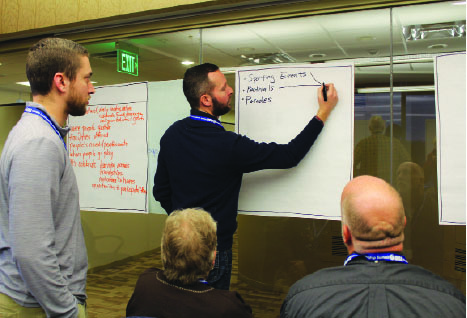
THE DRAWING BOARD – Jonathan Davis, pastor of Delta Church in Springfield, serves as scribe during brainstorming at one of 36 breakout sessions offered at the Illinois Leadership Summit.

What does it take?
Clifton began to focus his ministry on the spiritual growth of his existing congregation instead of their numerical growth. And God breathed new life into the church, he said. Members began to shift from making decisions based on personal preferences, toward making decisions based on serving the neighborhood. They became a beautiful church.

“No, it’s not as comfortable singing worship songs that you don’t know,” Clifton said. “But hey, if you hear a 27-year-old singing a song about Jesus you aren’t familiar with, and they are singing it with their whole heart and you can’t worship God in that—you’ve got a real problem.”

While revitalizing the church is not about doing whatever is necessary to fill seats every Sunday, Clifton said it is about making disciples. It’s about making disciples of people who have attended faithfully for decades, and it’s about making disciples of new people who are still deciding if church is relevant in their lives.

Collective Learning

COLLECTIVE LEARNING – Large-group sessions, called “collectives,” focused on revitalization and community engagement.

In a breakout session at the summit, he shared nine steps to a revitalized church, starting with a commitment to glorify God in everything and find joy in the gospel alone. Then, he said, pray without ceasing. There is spiritual warfare happening in a church being reborn or revitalized, Clifton said.

“Joy is found in the risen Lord and, just as John sees Jesus in all his resurrected power and glory (Rev. 1), we are going to be glorified,” he said. “At Wornall’s worst—even as I was preaching and feeling like a failure—if that trumpet had sounded, we would have had a glorified church; a perfect bride ready to meet her groom.

“Don’t let Satan rob you of that joy. Those are his saints. God is under no obligation nor will he likely resource your plans for his church, but he will spare nothing from heaven to resource his plans for his church. He can raise a dead church.”

The remaining steps are practical ideas for pastors of revitalizing churches:

• Love and shepherd remaining members; don’t be more concerned and in love with the church you wish you had than with the church you have now.
• Serve the church’s unique community, never valuing your needs over the needs of the unreached.
• Use resources generously. How can the church building be repurposed and redeemed to serve the community?
• Simplify the strategy. Don’t value the process more than the outcome.
• Intentionally develop young men. Churches that die never passed meaningful leadership to the next generation. The goal is to get young men to connect and make them disciples, and then teach them to make disciples.
• Celebrate the legacy often. A church that transforms from dying to thriving is like a living sermon in its community. Celebrate that.

Clifton’s Wornall Road Baptist Church is a church revitalization success story. The church grew from 18 people when Clifton arrived, to about 120 when he left. It’s a thriving, multi-generational, neighborhood church. But it took revitalization to get there.

Currently, Clifton said, more than 900 Southern Baptist churches close each year and 65-75% of SBC churches are considered plateaued.

“Churches often begin the process too late,” Emerson said. “We recommend that church leaders study their growth trends and seek help when they discover that they are no longer growing and reaching people. IBSA can help churches assess their need and readiness for revitalization.”

For more information, contact IBSA’s Church Resources Team at (217) 391-3136.

Kayla Rinker is a freelance writer and pastor’s wife in Missouri.

By Eric Reed

“It’s just the Wild West out there right now,” a colleague declared of the Twitterverse, as Baptists registered their opinions on new reports of sexual abuse and the failure of Southern Baptists to stop perpetrators’ movement among churches. Then the Internet mostly applauded the recommendations by SBC President J.D. Greear’s study committee to address sexual abuse in our churches. Then when the Executive Committee reported that the actions of only three of ten churches cited by the Houston Chronicle merited further investigation, the blogosphere blew up again. “A free for all!” my colleague said.

That’s to be expected. Emotions are running high, and there has been a lot of use of crisis language. But beyond that, on any ordinary day, Baptists are a people who expect their voices to be heard.

Please hear me say this: Action must be taken to prevent sexual abuse in the future, to deal with those credibly accused, to assure they do not have places of leadership in SBC churches, and to minister to those who have been harmed by abuse or the threat of abuse.

That said, let me also say, we also have to handle faithfully our historic Baptist doctrines.

We may find in the discussion leading to the SBC annual meeting in June that nothing in Southern Baptist life is a done deal until it is accepted and implemented at the grassroots level.

A seminary professor of mine told this story of a convention in a large southern state: The receptionist was instructed to answer the phone, “Baptist Headquarters.”

“Hmmph,” she soon heard, followed by a long pause. “This is Pastor Smith calling from First Baptist Church. This is Baptist headquarters.”

The next time the pastor called, the phone was answered, “Hello. Baptist Building.”

The professor’s point sticks: The local church is Baptist headquarters. That’s what it means to be a Baptist. We are not a hierarchical denomination, and we don’t operate from the top down. We are the un-denomination. Early leaders even refused for the SBC to be called a denomination, thus they chose the term “convention” to describe this voluntary association of local churches. And, thus, the word “autonomy” becomes important.

In the recent reporting, a few writers described autonomy as a shield some leaders hid behind to avoid dealing with the critical issue of prevention. Maybe autonomy was an easy response to difficult situations in the past, as leaders were accustomed to churches making their own decisions on most matters of policy. And, to be sure, autonomy of the local church must not be an excuse for keeping our eyes closed to evil in our midst. But the foundational Baptist doctrine of autonomy cannot be dismissed.

In the Houston Chronicle’s reporting, around 380 people in Southern Baptist churches were credibly accused and about 220 were convicted of sexual abuse or received plea deals. Of those, 35 found new places of service in other Southern Baptist churches. For our denomination to effectively stop offenders from becoming repeat offenders in new settings, local churches will have to do the hard work of policing and training and fingerprinting and screening volunteer workers and ministry candidates. That is first a local action that must be done first in local churches. Without full participation of local churches, we won’t have a solution to the problem, even if we do create national policies and databases.

One reporter described Pope Francis’s call to his own church, in light of their abuse crisis, not to “simple condemnation but to concrete and effective measures.” As we offer and endorse solutions, we should remember that Baptists accomplish more by cooperation than declaration. In Southern Baptist life, it’s not the language of crisis that compels us or draws us, but the invitation to responsible cooperation.

Eric Reed is editor of the Illinois Baptist.

Our neverending task

Lisa Misner —  March 4, 2019

By Nate Adams

In addition to a great faculty of Illinois pastors and church leaders, last month’s 2019 Illinois Leadership Summit welcomed Mark Clifton as its primary speaker. Mark has been a pastor, a church planter and replanter, and a director of missions for decades. He now serves churches through the North American Mission Board in the area of church replanting.

The theme of our conference was “Reimagine.” I was hoping that leaders in general, not just church replanters and revitalizers, would benefit from Mark’s teaching. I was not disappointed.

As Mark began describing churches that should consider replanting, he clarified that he was talking about churches that, presuming they remain on their current trajectories, would probably need to close their doors in the next three to five years. And yet as he described the characteristics and needs of those declining or dying churches, I saw many, many pastors and leaders in the room nodding in empathy and agreement. Their churches may not have been five years from closing, but it was clear they recognized some of the same danger signs in their own settings. In a sense, all pastors must be revitalizers or replanters.

Churches that die, Mark asserted, tend to value their own preferences over the needs of the unreached. They cease, perhaps gradually, to be part of the fabric of the community. In fact, what was once a community church often becomes a commuter church.

On today’s ministry landscape, all pastors must be ‘vitalizers.’

As the church declines, some members tend to resent the community for not responding the way they once did. They may work harder and harder on church programs or activities, but these tend to be for insiders, and have little impact on the unchurched, or little relevance to the community.

Dying churches, Mark observed, also seem to have an inability to pass meaningful leadership on to the next generation, and they can often confuse caring for the church building with caring for the church and community. Dying churches value the process of decision-making more than the outcomes of those decisions. And a few strong personalities tend to drive those decisions, while others remain silent or simply drift away.

Of course, it’s much easier to recognize those kinds of traits in churches other than your own. That’s why an outside perspective or consultant is often helpful. And as this experienced leader from outside Illinois described the churches with which he had worked over the years, it was as if he was holding up a mirror in which we could also see ourselves.

One thing I really appreciate about Mark’s background and experience is that he had invested 10 years in a Midwest, urban church that had declined to 18 people when he arrived and grew back to about 120 by the time he left. He spoke personally and lovingly, not of “small” churches, but of “normative” size churches, reminding us that 63% of SBC churches in America have less than 100 in worship, and 83% have less than 200. If we are going to penetrate the lostness of our nation, he reminded us, it will not just be through large churches, but through thousands of normative-size churches, both revitalized and newly planted.

My greatest personal takeaway from the conference was simply this. Especially in the normative-size churches of Illinois, the primary focus of a pastor or church leader must be to bring vitality to a church by leading it proactively out into its community. Replanting is only necessary when revitalization doesn’t happen in time. And revitalization is only necessary if we allow the church’s intended vitality to fade.

Nate Adams is executive director of the Illinois Baptist State Association. Respond at IllinoisBaptist@IBSA.org.

Sending hope

Lisa Misner —  February 28, 2019

Annual offering aids missionaries reaching the nations here at home

By North American Mission Board

AAEO

Church planter Philip Nache stands outside Hope of Nations Gospel Church in Minneapolis, the congregation he started and hopes will serve as a launching pad for more churches in his city and around the world.

Philip Nache could have given in to despair. Boko Haram, the jihadist militant group located in Nigeria, had threatened his life, martyred a convert to Christianity, and continued to intimidate Christians. But despite the danger, Nache expected to return and work among the people he’d served for nearly 20 years. He had come to the United States to attend Southern Baptist Theological Seminary, a moment of divine timing that coincided with Boko Haram’s first threats on his life.

As he contemplated whether and how to return to Nigeria, another divine appointment redirected his steps.

“At that time, God opened the door for me to come to Minneapolis,” Nache said. “When I was told about the need here in the Twin Cities, I was still thinking of Africa, but after praying, I felt convicted to go to Minnesota.”

So, he decided to plan a visit. When he arrived, he was surprised by what he saw.

“It’s like I was in Africa—the northern part of Africa. Because I [saw a] basket full of people—Africans,” Nache recalled. Seeing fellow Africans opened his mind and heart, and Nache’s disposition toward Minneapolis changed. He sensed God’s leading and prepared to go.

Nache saw how the nations had come to North America. This year he is a 2019 Week of Prayer missionary for the Annie Armstrong Easter Offering for North American Missions.

When he moved his family to the Twin Cities, Nache discovered a hunger for new churches among the various African populations. They lacked the means to make it happen until Nache arrived with the support of Southern Baptists.

“One pastor came to me,” Nache recalled, “and said, ‘Oh, there are a lot of South Sudanese and Ethiopians and so many Africans that are there. I’ve tried even to start a church with them, but I couldn’t because of resources.’”

That believer asked Nache if he was willing to reach out to those populations even though many of them were Muslim. Nache’s response was simple. “Why not? This is [why] God has brought me.”

He joined a group of believers, started reaching out to neighbors, and began house-to-house fellowships. And that’s how God opened the door and established his church, Hope of Nations Gospel Church.

Hope of Nations has grown to two services, one for South Sudanese and another for northern Nigerians. Nache and many of his church members have a vision to reach not only their immediate neighbors but the whole world.

While in Nigeria, Nache pastored and planted churches, and now God continues to use his ministry in Minneapolis to reach the nations of Africa. In the Twin Cities, Nache said, “we are able to identify potential pastors who desire to go and reach out to their people and plant churches in their own countries.”

One such example is Khemis Artema, a refugee from South Sudan. Artema traveled through refugee camps, where he endured physical suffering and lack of medication, before arriving in the United States. Nache said that Artema remained faithful to the Lord through those trials, and now he disciples him so that he can return to South Sudan and plant a church.

Hope of Nations sent Artema on a short-term trip to South Sudan, which was the trip that solidified God’s calling for him to return. Nache continues to disciple and train future missionaries like Artema.

“Our desire is to keep multiplying and reaching out to more people groups, especially people from Africa,” said Nache. He sees donations to the Annie Armstrong Easter Offering as a key part of that vision going forward.

“I must say that without the help of the Annie Armstrong support that we are getting from the North American Mission Board,” said Nache, “honestly speaking, I don’t think this work will be possible…So, I seriously appreciate and thank God for this offering. Thank God for the churches all over North America that are helping to support this work.”

Gifts made to the Annie Armstrong Easter Offering go directly to support and resource North American missionaries in the field. To learn more, visit anniearmstrong.com.

The purposes of ordination

Lisa Misner —  February 27, 2019

By Nate Adams

This past month our family gathered at Calvary Baptist Church in Elgin for my middle son Noah’s ordination into pastoral ministry. It was my privilege to deliver the “charge to the candidate,” something I felt I had been doing to Noah all his life, first as a boy, then as a teenager and young man, but now specifically as a Baptist minister of the gospel.

Calvary is my mom’s home church, and the location of my father’s funeral service almost 13 years ago. I wore one of Dad’s ties into the pulpit that evening, and gave another to Noah, reminding him that he represents a third generation of ministry in our family. I’ve known some of the church members there at Calvary for more than 40 years, and I watched gratefully as some of them, and then some of their children, came down front to lay hands on Noah and to pray for him. Needless to say, it was a very special evening.

The week after Noah’s ordination, I received an e-mail survey from an associational missions strategist in Kentucky who is doing research on pastoral ordination in Southern Baptist churches. The introduction to the survey stated that it was being precipitated by a “significant discussion concerning SBC ordination practices,” stemming from a recent report in the Houston Chronicle regarding sexual abuse in Southern Baptist churches, some by ordained pastors.

It calls for celebration, yes, but also ongoing accountability.

The survey asked each participant to reflect on his own ordination experience, and whether it included certain elements. While I had to reflect back more than 25 years, I quickly recognized in the survey’s questions many elements that my ordination process included, but some that it did not.

For example, my ordination council consisted of ordained men from multiple churches, and they asked me questions about the Bible, and about The Baptist Faith and Message, and about my views on specific doctrines. They asked questions about my experience in ministry, though most of them had observed that first-hand for years, and about my wife’s commitment to ministry.

I do not, however, recall any questions or conversation about sexual purity, past or present. I do not recall questions or conversation examining potentially personal or selfish motivations or expectations for ministry. The survey helped me think about the benefits of including those elements in an ordination process.

Perhaps most thought-provoking to me was the survey’s question asking whether members of my ordination council had ever followed up with me to see how I was doing in ministry. My dad was on my ordination council, so I did have that follow-through and accountability. Others were friends and acquaintances for years to come. But there was no formal follow-up, and I had to admit it sounded nice to get an occasional call from someone on my ordination council, checking in on me and helping rekindle and sustain my call to ministry.

Sadly, since that wonderful, affirming, inspirational time of my ordination, I have come in contact with pastors who have fallen into sexual sin, financial impropriety, deceit or greed that was destructive to their church, child abuse, and even one who underwent operations to change his sexual identity.

So as we ordained my son this past week, I was reminded that ordination is not only a time of great celebration for the church, and affirmation of God’s calling on someone’s life. It is also a time of careful examination, scrutiny, and ongoing accountability, not just for the benefit of the ordaining church, but for the long-term good and protection of all the churches in that man’s future.

Nate Adams is executive director of the Illinois Baptist State Association. Respond at IllinoisBaptist@IBSA.org.

Intercessors spend a day lifting up the needs of the city

By Andrew Woodrow

Hillcrest-departing

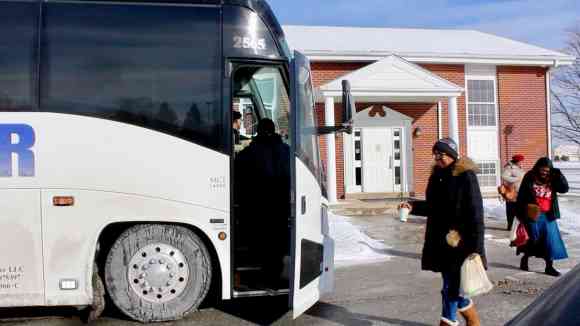
“A bus tour is a good way to see the neighborhoods we’ll be praying for,” said Cheryl Dorsey, prayer coordinator for the Chicago Metro Baptist Association. “As we travel between churches, we will review the social and spiritual profile of the neighborhoods, praying en route for those communities.”

This was the fifth year Dorsey and fellow intercessor Phil Miglioratti have drawn together a band of people to pray for Chicagoland, but this was the first time the prayer meeting was mobile.

The group of 20 who braved sub-zero temperatures on January 26 visited four church locations scattered across the metro area. Throughout the trip, pastors shared concerns for their churches and communities while Dorsey and Miglioratti lead prayer using a Chicago neighborhood prayer guide by John Fuder.

Stop #1
Hillcrest Baptist Church
Country Club Hills

“We are praying for you and with you as you go out and pray for your brothers and sisters across the Chicagoland area,” Pastor Adron Robinson told the prayer team as they met at Hillcrest to start the day-long journey. “Pray for us as a church,” he said, to fulfill the Great  Commission. “And pray for Country Clubs Hills. There are about 16,000 people in our suburb and many who do not know the Lord,” he added.

As they boarded the bus, Dorsey encouraged the team to sit next to a prayer partner and to be “sensitive to allow whatever site you see along the way to prompt a prayer”—whether it’s a school building, house, store, or a family in a passing car.

Stop #2
Advent Church
South Loop

Gathered in the eleventh floor community room of a South Loop condo building, the prayer team learned about the up-and-coming community Dennis Conner serves as well as the barriers he faces planting a church in a high-rise. Conner called it a “very different mission field,” where “money and gatekeepers render door-to-door evangelism ineffective.”

The goal of Advent Church is to reach the working professionals in the city. “Pray for fruits for our labor,” he said, “because this is a place that until someone has credibility, gives you their credibility, you don’t have it.”

Stop #3
Chicagoland Community Church
North Side

Nestled in a tight squeeze of low-rise townhouses and multi-unit complexes is Chicagoland Community Church. Here, Pastor Jon Pennington of the Lakeview Community church asked prayer for the church’s success in sharing the gospel.

“We’re passionate to teach people in this neighborhood how to be Jesus-followers,” he said, “But what we really want to see happen in these next two years is 200 first-time visitors at our worship services who are curious about the gospel or our mission—and that at least 20 of them will become new members of the church.”

Stop #4
Iglesia Bautista Erie
West Side

Heading into West Town, snow began falling as the bus reached its last stop, where Marvin Del Rios serves as pastor. “Pray for our community,” he said. “The last several years our community has been going through a process of gentrification. Young professionals are moving back into the city while the working poor to middle class are moving out, changing our outreach strategy.

“The spiritual soil is tough at the moment,” Del Rios said. He hopes as these young professionals have families, “that might be the door to use for us to share the gospel – through their children.”

“Chicago is still a very divided city rooted in a history of prejudice,” Miglioratti said. “And the church of Chicago needs prayer because the church is also divided. So, as we pray for a greater unity in the church, that prayer will produce greater outreach which will lead to many more people becoming part of the family of God.”

Eight hours later, Dorsey described the excitement through prayer she encountered  “as though the Holy Spirit was tailoring our prayer to suit the needs in (each) location,” she said. “It opened our eyes that we pray without prejudice and bias. And being equal partakers of the inheritance of Christ Jesus is not going to happen if people don’t pray into the Kingdom. And that is what we are doing.”

By Eric Reed

Illinois Exodus

Hard times hit the publishing industry in the early 2000’s. The president of Christianity Today International, for whom I worked at the time, called the confluence of 9/11, falling ad sales, and the rise of the internet “whitewater.” Apparently he enjoyed rafting, but he knew the river crashing against the rocks as placid waters turned swift was a dangerous situation, even for adventurous souls. He talked often about “whitewater” for several years. He told us to hold on tight.

We did.

It wasn’t easy. In the end, the organization was leaner, but publishers who survived met the crisis with creativity and invention. And the gospel mission was advanced.

I thought of that while reading an article on “the Illinois Exodus.” In it, a Chicagoland pastor used the same term to describe these tremulous times in our state. “I suspect we’re headed into some whitewater,” said Mike Woodruff. “The waves are going to knock us around a bit. But our foundations are strong.”

Woodruff was quoted by Sarah Eekhoff Zylstra at The Gospel Coalition. She asked about the future of Illinois in light of declining population and growing debt. More specifically, she questioned the impact of the resulting exodus on churches.

Some 45,000 people left Illinois in 2018, a trend mirrored in equally high-tax states California and New Jersey. In Illinois, the mounting debt is due in large part to retirement promises—and the financial obligation to cover them—which now equals about $50,800 per household.

Sound off

“What worries me is that I think most Illinois churches are unprepared for what will happen—i.e., in an effort to meet pension obligations, legislators will raise taxes and reduce social programming, which will likely shift the safety net to churches…”
– Mike Woodruff, Chicagoland pastor

“…For several generations, pastors have not seen these issues as something they need to know anything about, so now they’re unable to do much because they don’t know anything….We need to play catch-up and fast.”
– Greg Forster, Trinity International University, Deerfield

How will that affect our ministries? The first answer is obvious: population decline. Especially in troubled neighborhoods and dwindling rural communities, the loss of people hurts. As young people leave to find jobs and older people leave when they retire, the church loses reliable attenders, servants, and givers, and to some extent its future.

But beyond population loss, what happens when the politicians try to adjust the budget to cover the bills? The pastors Zylstra interviewed pointed to a different problem: efforts to cover the gaps could result in loss of services in failing communities, and increases the probability that local churches will be called upon to make up the difference for people in need.

Such a likelihood causes me to ask, Are we prepared? Evangelicals today say we are interested in social issues and in being the hands of Jesus for our community. That commitment will be tested in time and money. “There will be opportunity for pastors to lead well and offer hope,” Woodruff said. “Don’t build barriers and retreat inside and just take care of your own.”

Who imagined a call to local and state missions would be driven by the state’s financial and demographic crunch, but if that’s what it takes to spur the church to a new era of action, so be it.

Baptism 1

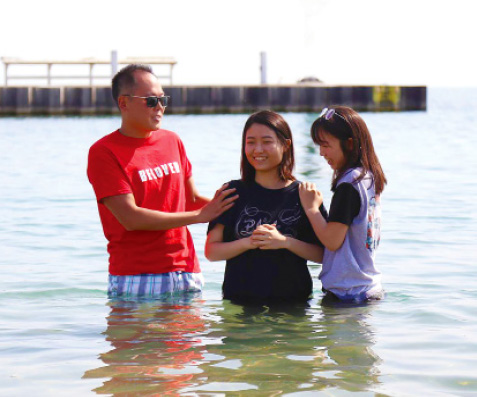
Church of the Beloved in Chicago
celebrated baptisms in Lake Michigan last August.

‘One GRAND’ emphasis returns this spring, plus a new one-on-one evangelism strategy

By Meredith Flynn

When Pastor Kenyatta Smith’s church moved into their new building, an important piece was missing. The former Catholic church had no baptistry.

Another Chance Church, which Smith planted in 2012, got around it by bringing in an inflatable pool when someone was ready to be baptized. Last year, that was often. The church baptized 52 people.

The Chicago church’s increase in baptisms (up from 22 in 2017) mirrors statewide growth. In 2018, IBSA churches reported 3,676 baptisms, an increase of almost 7% over the previous year. The One GRAND Sunday emphasis last April resulted in 671 baptisms in churches intentionally focused on training people to share their faith, and inviting people to respond to the gospel.

At Smith’s church, the key to more baptisms was staying the course, the pastor said. “It wasn’t a planned thing; it was more [that] we just kept working and sharing the gospel, and it just kind of happened.”

Baptisms generate excitement and are a “big boost for evangelism,” Smith said. Another Chance does a lot of evangelism training to ensure that sharing the gospel is in the church’s DNA.

Across the Southern Baptist Convention, churches are being called to make a similar commitment to evangelism, with an emphasis on keeping things simple. In January, SBC President J.D. Greear introduced “Who’s Your One?” a convention-wide effort to pray for people who don’t know Christ, and intentionally look for ways to share the gospel with them.

The challenge comes at a time when membership and baptism numbers in SBC churches continue to decline. LifeWay Research acknowledges the decline in baptisms nationwide is due in part to non-reporting churches. But even when the numbers are adjusted, churches are baptizing fewer people per member than they did in 1950, for example.

When Greear shared “Who’s Your One?” with Baptist association leaders Jan. 31, he referenced obstacles churches face in a post-Christian culture. “These are some challenging days for the Southern Baptist Convention,” said Greear, pastor of The Summit Church in Raleigh-Durham. “They’re challenging days for the church in general in the United States, but is God perhaps setting us up for one of the greatest evangelism explosions that we’ve ever seen?”

As Southern Baptists across the country and in Illinois look for effective ways to communicate spiritual truth with their neighbors, “gospel conversations” are key. A conversational approach to the gospel—sharing Jesus in the context of relationship—is the basis of many recent evangelism initiatives and training guides. And once Christians catch on, said IBSA’s Pat Pajak, and see how receptive others are to hear, the believer is encouraged to look for more opportunities to speak truth.

“But it all starts with just one conversati0n with one person,” said Pajak, associate executive director for evangelism. “We’re asking, ‘Who’s your one?’”

Baptism 2

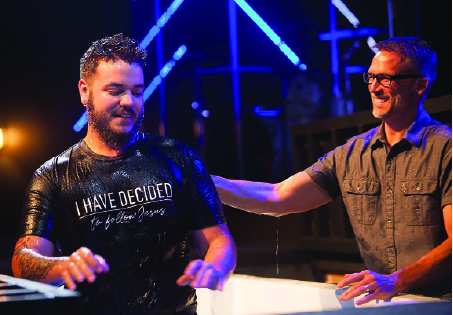
Pastor Michael Nave (right) baptizes Nathan Morgan at Cornerstone Church in Marion. The church celebrates baptism every third Sunday, and invites “spontaneous baptisms” when the worship service is focused primarily on salvation.

More than numbers
At Cornerstone Community Church in Marion, evangelism training is built into the church membership process. The final step in a four-pronged process is “Go.” In other words, said Pastor Michael Nave, how do you as a Christian bring other people with you?
Talking about the gospel “ought to be as natural as talking about the weather,” Nave said. Christians shouldn’t have to switch into evangelism mode; rather, the gospel should permeate the conversations and relationships we already have.

Even when evangelism is a natural outgrowth of a Christian’s spiritual development, church leaders still credit intentionality as a major factor in overall effectiveness. In 2018, Cornerstone celebrated 57 baptisms, up from 22 the previous year. The church saw the increase after implementing some intentional strategies around baptism, Nave said.

“First, we set a baptism weekend, the third weekend of each month,” he said. “We will gladly baptize someone on other weekends, but this gives us an opportunity to keep it in front of our people.” Explaining the importance of baptism is also a part of Cornerstone’s membership process. And, the church stays open to how God might work.

“From time to time, when the sermon is specifically about salvation and baptism, we offer ‘spontaneous baptism,’” Nave said. They don’t practice it frequently, he said, and are sure to give a full explanation of what baptism means. “We have simply found that some people need the opportunity to do it now!”

He recounted Peter’s Pentecost sermon in Acts 2, which stirred people to immediately respond by asking, “What shall we do?” Peter’s answer: repent and be baptized. The two acts went hand-in-hand, Nave said. “That water didn’t save them, but their public profession of faith came very quickly and naturally.”

Last year’s One GRAND Sunday initiative highlighted the links between hearing the gospel, responding, and following up that decision with baptism. As people shared their stories—on video or from the baptistry or afterward over e-mail—many talked about the journey they had taken to get to the point of baptism that day.

For some, the road was long. Others took a shorter route, like the father in Amboy who came to church for his daughter’s baptism, heard the gospel, responded, and was baptized that very day.

Counting baptisms is one way to measure health and growth, but Pajak said after last year’s One GRAND Sunday that the day was about more than numbers. As IBSA churches prepare for another One GRAND emphasis this spring, his position on last year’s statewide success is an important guiding principle.

“The great thing is that it sparked a fresh passion for evangelism across the state.”

– With additional reporting from Baptist Press